Electrolysis Han Ming Xuan 1P1 (9)
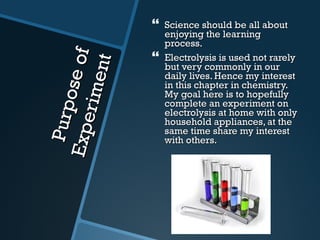
Purpose of Experiment Science should be all about enjoying the learning process. Electrolysis is used not rarely but very commonly in our daily lives. Hence my interest in this chapter in chemistry. My goal here is to hopefully complete an experiment on electrolysis at home with only household appliances, at the same time share my interest with others.
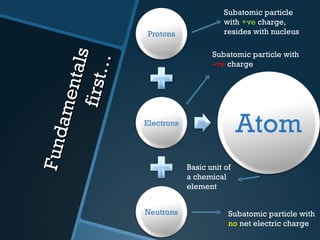
Fundamentals first… Subatomic particle with  +ve  charge, resides with nucleus Subatomic particle with  –ve  charge Subatomic particle with  no  net electric charge Basic unit of a chemical element
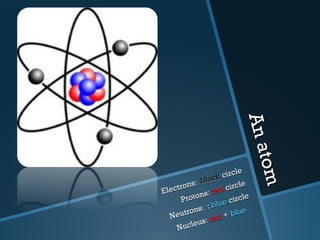
An atom Electrons:  black  circle Protons:  red   circle Neutrons:  :  blue  circle Nucleus:  red   +  blue
What is Electrolysis?
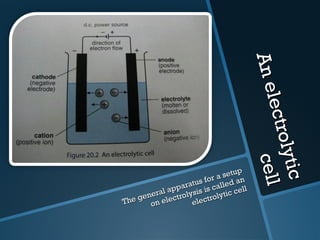
An electrolytic cell The general apparatus for a setup on electrolysis is called an electrolytic cell
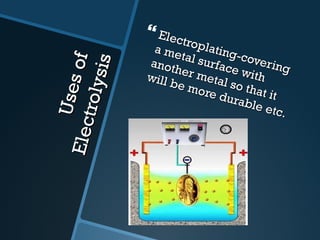
Uses of  Electrolysis Electroplating-covering a metal surface with another metal so that it will be more durable etc.
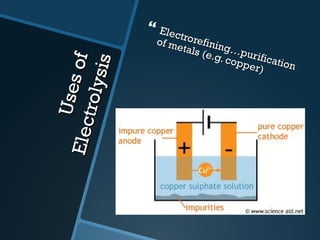
Uses of  Electrolysis Electrorefining…purification of metals (e.g. copper)
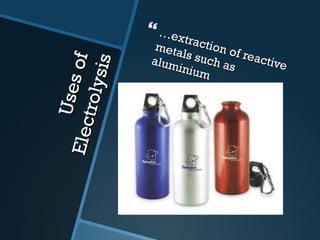
Uses of  Electrolysis … extraction of reactive metals such as aluminium
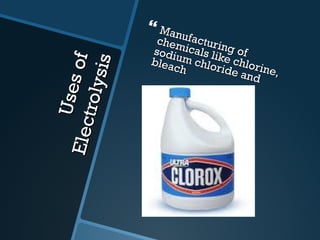
Uses of  Electrolysis Manufacturing of chemicals like chlorine, sodium chloride and bleach
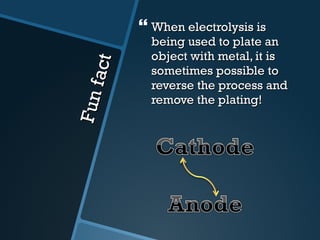
Fun fact When electrolysis is being used to plate an object with metal, it is sometimes possible to reverse the process and remove the plating!
Basics of Electrolysis References: Chemistry Insights ‘O’ Level 2 nd  Edition
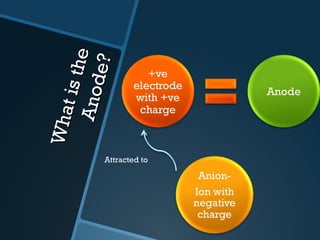
What is the Anode? Attracted to
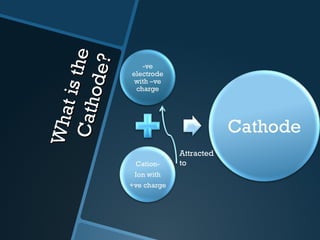
What is the Cathode? Attracted  to
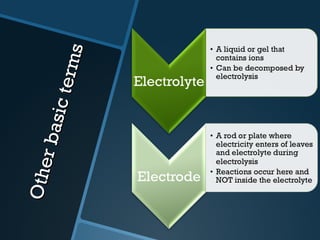
Other basic terms
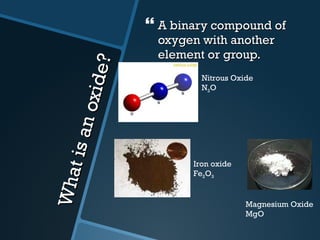
What is an oxide? A binary compound of oxygen with another element or group. Nitrous Oxide  N 2 O Iron oxide Fe 2 O 3 Magnesium Oxide  MgO
History Of Electrolysis
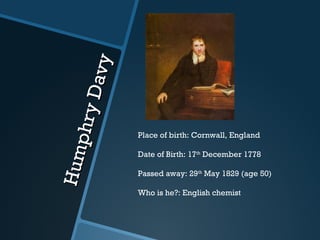
Humphry Davy Place of birth: Cornwall, England Date of Birth: 17 th  December 1778 Passed away: 29 th  May 1829 (age 50) Who is he?: English chemist
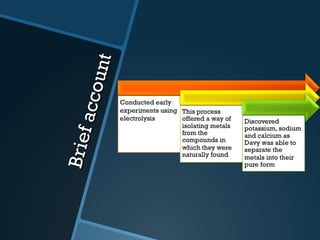
Brief account
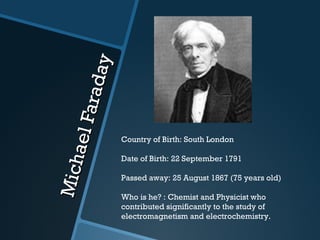
Michael Faraday Country of Birth: South London Date of Birth: 22 September 1791 Passed away: 25 August 1867 (75 years old) Who is he? : Chemist and Physicist who contributed significantly to the study of electromagnetism and electrochemistry.
Short Bibliography
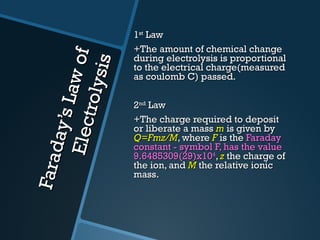
Faraday’s Law of Electrolysis 1 st  Law +The amount of chemical change during electrolysis is proportional to the electrical charge(measured as coulomb C) passed.  2 nd  Law +The charge required to deposit or liberate a mass  m   is given by  Q=Fmz/M , where  F  is the  Faraday constant - symbol F, has the value 9.6485309(29)x10 4 ,  z   the charge of the ion, and  M  the relative ionic mass.
Redox reactions
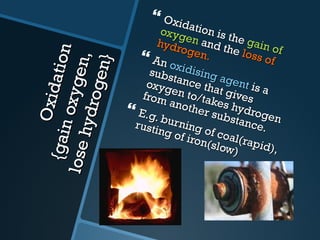
Oxidation {gain oxygen,  lose hydrogen} Oxidation is the  gain of oxygen  and the  loss of hydrogen. An  oxidising agent  is a substance that gives oxygen to/takes hydrogen from another substance. E.g. burning of coal(rapid), rusting of iron(slow)
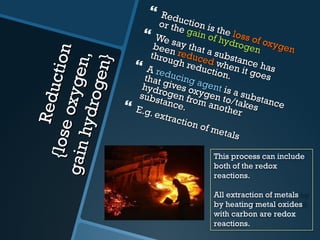
Reduction {lose oxygen,  gain hydrogen} Reduction is the  loss of oxygen  or the  gain of hydrogen We say that a substance has been  reduced  when it goes through reduction. A  reducing agent  is a substance that gives oxygen to/takes hydrogen from another substance. E.g. extraction of metals This process can include both of the redox reactions. All extraction of metals by heating metal oxides with carbon are redox reactions.
Experiment No.1
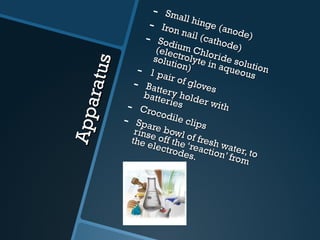
Apparatus Small hinge (anode) Iron nail (cathode) Sodium Chloride solution (electrolyte in aqueous solution) 1 pair of gloves Battery holder with batteries Crocodile clips Spare bowl of fresh water, to rinse off the ‘reaction’ from the electrodes.
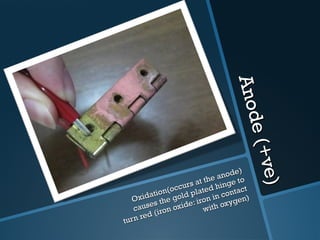
Anode (+ve) Oxidation(occurs at the anode) causes the gold plated hinge to turn red (iron oxide: iron in contact with oxygen)
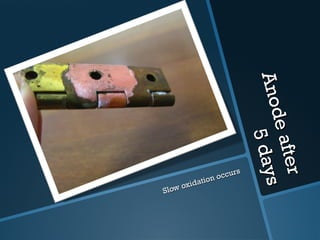
Anode after  5 days Slow oxidation occurs
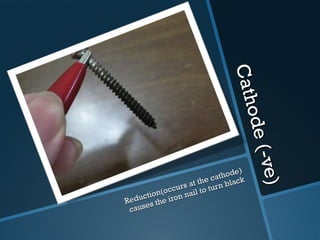
Cathode (-ve) Reduction(occurs at the cathode) causes the iron nail to turn black
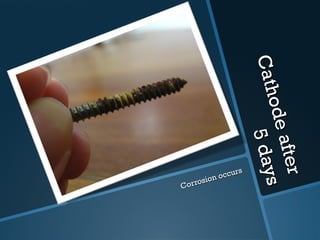
Cathode after  5 days Corrosion occurs
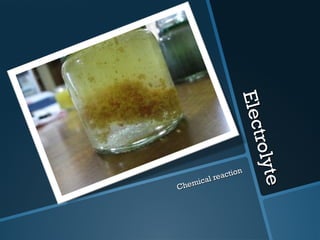
Electrolyte Chemical reaction
Explanation
Electrolysis of Sodium Chloride
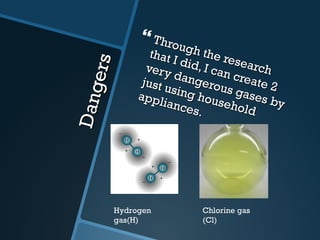
Dangers Through the research that I did, I can create 2 very dangerous gases by just using household appliances. Hydrogen gas(H) Chlorine gas (Cl)
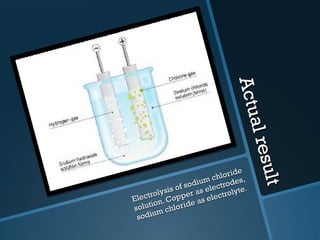
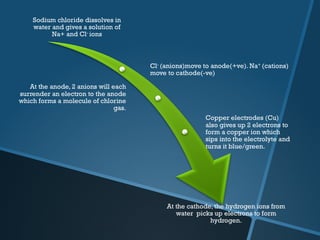
Actual result Electrolysis of sodium chloride solution. Copper as electrodes, sodium chloride as electrolyte.
 
Chlorine
Cl=Chlorine gas Stays close to the ground and spreads rapidly(heavier than air) Has a pungent and irritating odour Used in WW1 as a choking agent Strong oxidiser, react with explosive chemicals(turpentine and ammonia) and produce explosive compounds. When it comes into contact with moist tissues (eyes, lungs, throat), it changes into  hydrochloric  and  hypochlorous   acid (bleach) .
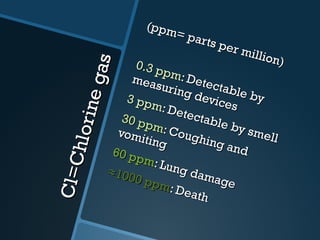
Cl=Chlorine gas (ppm= parts per million) 0.3 ppm : Detectable by measuring devices 3 ppm : Detectable by smell 30 ppm : Coughing and vomiting 60 ppm : Lung damage ≈ 1000 ppm : Death
Symptoms of exposure Coughing Chest tightness Burning sensation in the nose, throat, and eyes Watery eyes Blurred vision  Nausea and vomiting Burning pain, redness, and blisters on the skin if exposed to gas, skin injury similar to frostbite if exposed to liquid chlorine Difficulty breathing or shortness of breath (may appear immediately if high concentrations of chlorine gas are inhaled, or may be delayed if low concentrations of chlorine gas are inhaled) Fluid in the lungs (pulmonary edema) within 2 to 4 hours
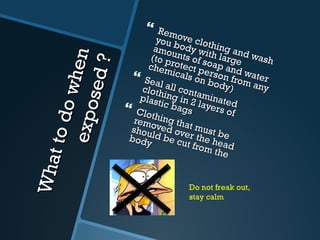
What to do when exposed ? Remove clothing and wash you body with large amounts of soap and water (to protect person from any chemicals on body) Seal all contaminated clothing in 2 layers of plastic bags Clothing that must be removed over the head should be cut from the body Do not freak out, stay calm
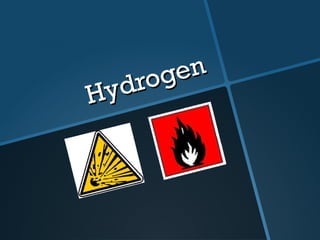
Hydrogen
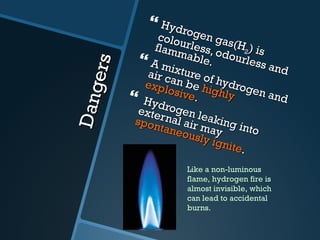
Dangers Hydrogen gas(H 2 ) is  colourless, odourless and flammable. A mixture of hydrogen and air can be  highly explosive . Hydrogen leaking into external air may  spontaneously ignite . Like a non-luminous flame, hydrogen fire is almost invisible, which can lead to accidental burns.
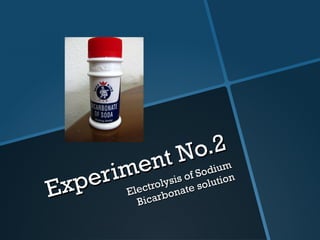
Experiment No.2 Electrolysis of Sodium Bicarbonate solution
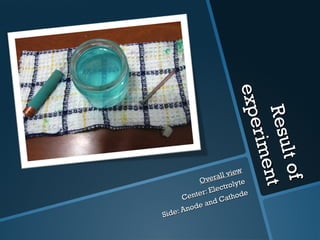
Result of experiment Overall view Center: Electrolyte Side: Anode and Cathode
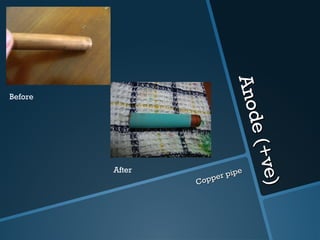
Anode (+ve) Copper pipe Before After
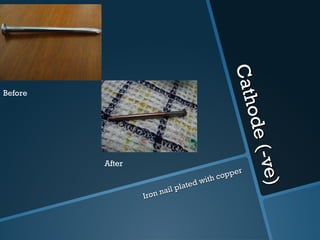
Cathode (-ve) Iron nail plated with copper Before After
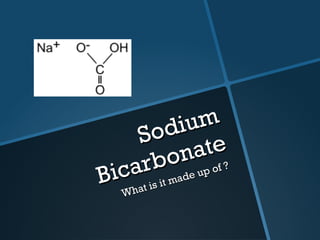
Sodium Bicarbonate What is it made up of ?
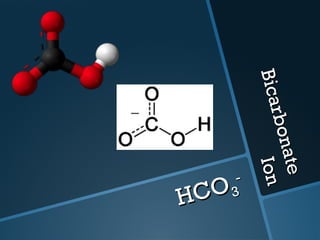
Bicarbonate  Ion HCO 3 -
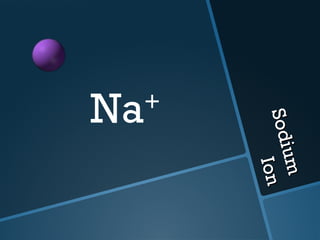
Sodium  Ion Na +
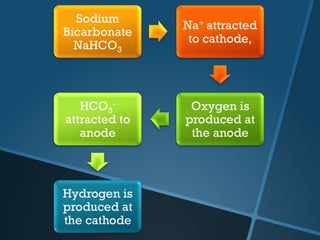
What happened?
 
 
Other References http://www.crscientific.com/electrolysis.html http://www.thenakedscientists.com/forum/index.php?topic=1298 http://www.youtube.com/watch?v=WPo2RHWZpRk

Electrolysis term 2 lss ace

  • 1.
  • 2.
    Purpose of ExperimentScience should be all about enjoying the learning process. Electrolysis is used not rarely but very commonly in our daily lives. Hence my interest in this chapter in chemistry. My goal here is to hopefully complete an experiment on electrolysis at home with only household appliances, at the same time share my interest with others.
  • 3.
    Fundamentals first… Subatomicparticle with +ve charge, resides with nucleus Subatomic particle with –ve charge Subatomic particle with no net electric charge Basic unit of a chemical element
  • 4.
    An atom Electrons: black circle Protons: red circle Neutrons: : blue circle Nucleus: red + blue
  • 5.
  • 6.
    An electrolytic cellThe general apparatus for a setup on electrolysis is called an electrolytic cell
  • 7.
    Uses of Electrolysis Electroplating-covering a metal surface with another metal so that it will be more durable etc.
  • 8.
    Uses of Electrolysis Electrorefining…purification of metals (e.g. copper)
  • 9.
    Uses of Electrolysis … extraction of reactive metals such as aluminium
  • 10.
    Uses of Electrolysis Manufacturing of chemicals like chlorine, sodium chloride and bleach
  • 11.
    Fun fact Whenelectrolysis is being used to plate an object with metal, it is sometimes possible to reverse the process and remove the plating!
  • 12.
    Basics of ElectrolysisReferences: Chemistry Insights ‘O’ Level 2 nd Edition
  • 13.
    What is theAnode? Attracted to
  • 14.
    What is theCathode? Attracted to
  • 15.
  • 16.
    What is anoxide? A binary compound of oxygen with another element or group. Nitrous Oxide N 2 O Iron oxide Fe 2 O 3 Magnesium Oxide MgO
  • 17.
  • 18.
    Humphry Davy Placeof birth: Cornwall, England Date of Birth: 17 th December 1778 Passed away: 29 th May 1829 (age 50) Who is he?: English chemist
  • 19.
  • 20.
    Michael Faraday Countryof Birth: South London Date of Birth: 22 September 1791 Passed away: 25 August 1867 (75 years old) Who is he? : Chemist and Physicist who contributed significantly to the study of electromagnetism and electrochemistry.
  • 21.
  • 22.
    Faraday’s Law ofElectrolysis 1 st Law +The amount of chemical change during electrolysis is proportional to the electrical charge(measured as coulomb C) passed. 2 nd Law +The charge required to deposit or liberate a mass m is given by Q=Fmz/M , where F is the Faraday constant - symbol F, has the value 9.6485309(29)x10 4 , z the charge of the ion, and M the relative ionic mass.
  • 23.
  • 24.
    Oxidation {gain oxygen, lose hydrogen} Oxidation is the gain of oxygen and the loss of hydrogen. An oxidising agent is a substance that gives oxygen to/takes hydrogen from another substance. E.g. burning of coal(rapid), rusting of iron(slow)
  • 25.
    Reduction {lose oxygen, gain hydrogen} Reduction is the loss of oxygen or the gain of hydrogen We say that a substance has been reduced when it goes through reduction. A reducing agent is a substance that gives oxygen to/takes hydrogen from another substance. E.g. extraction of metals This process can include both of the redox reactions. All extraction of metals by heating metal oxides with carbon are redox reactions.
  • 26.
  • 27.
    Apparatus Small hinge(anode) Iron nail (cathode) Sodium Chloride solution (electrolyte in aqueous solution) 1 pair of gloves Battery holder with batteries Crocodile clips Spare bowl of fresh water, to rinse off the ‘reaction’ from the electrodes.
  • 28.
    Anode (+ve) Oxidation(occursat the anode) causes the gold plated hinge to turn red (iron oxide: iron in contact with oxygen)
  • 29.
    Anode after 5 days Slow oxidation occurs
  • 30.
    Cathode (-ve) Reduction(occursat the cathode) causes the iron nail to turn black
  • 31.
    Cathode after 5 days Corrosion occurs
  • 32.
  • 33.
  • 34.
  • 35.
    Dangers Through theresearch that I did, I can create 2 very dangerous gases by just using household appliances. Hydrogen gas(H) Chlorine gas (Cl)
  • 36.
    Actual result Electrolysisof sodium chloride solution. Copper as electrodes, sodium chloride as electrolyte.
  • 37.
  • 38.
  • 39.
    Cl=Chlorine gas Staysclose to the ground and spreads rapidly(heavier than air) Has a pungent and irritating odour Used in WW1 as a choking agent Strong oxidiser, react with explosive chemicals(turpentine and ammonia) and produce explosive compounds. When it comes into contact with moist tissues (eyes, lungs, throat), it changes into hydrochloric and hypochlorous acid (bleach) .
  • 40.
    Cl=Chlorine gas (ppm=parts per million) 0.3 ppm : Detectable by measuring devices 3 ppm : Detectable by smell 30 ppm : Coughing and vomiting 60 ppm : Lung damage ≈ 1000 ppm : Death
  • 41.
    Symptoms of exposureCoughing Chest tightness Burning sensation in the nose, throat, and eyes Watery eyes Blurred vision Nausea and vomiting Burning pain, redness, and blisters on the skin if exposed to gas, skin injury similar to frostbite if exposed to liquid chlorine Difficulty breathing or shortness of breath (may appear immediately if high concentrations of chlorine gas are inhaled, or may be delayed if low concentrations of chlorine gas are inhaled) Fluid in the lungs (pulmonary edema) within 2 to 4 hours
  • 42.
    What to dowhen exposed ? Remove clothing and wash you body with large amounts of soap and water (to protect person from any chemicals on body) Seal all contaminated clothing in 2 layers of plastic bags Clothing that must be removed over the head should be cut from the body Do not freak out, stay calm
  • 43.
  • 44.
    Dangers Hydrogen gas(H2 ) is colourless, odourless and flammable. A mixture of hydrogen and air can be highly explosive . Hydrogen leaking into external air may spontaneously ignite . Like a non-luminous flame, hydrogen fire is almost invisible, which can lead to accidental burns.
  • 45.
    Experiment No.2 Electrolysisof Sodium Bicarbonate solution
  • 46.
    Result of experimentOverall view Center: Electrolyte Side: Anode and Cathode
  • 47.
    Anode (+ve) Copperpipe Before After
  • 48.
    Cathode (-ve) Ironnail plated with copper Before After
  • 49.
    Sodium Bicarbonate Whatis it made up of ?
  • 50.
  • 51.
  • 52.
  • 53.
  • 54.
  • 55.
    Other References http://www.crscientific.com/electrolysis.htmlhttp://www.thenakedscientists.com/forum/index.php?topic=1298 http://www.youtube.com/watch?v=WPo2RHWZpRk

Editor's Notes

  • #12 Sources: 1000 Questions and Answers ISBN: 978-1-84322-661-1
  • #22 References: Oxford Dictionary of Science 5 th Edition; http://www.bbc.co.uk/history/historic_figures/faraday_michael.shtml
  • #23 References: Oxford Dictionary of Science 5 th Edition
  • #40 Sources: http://www.bt.cdc.gov/agent/chlorine/basics/facts.asp
  • #41 Sources: http://en.wikipedia.org/wiki/Chlorine
  • #42 Sources: http://www.bt.cdc.gov/agent/chlorine/basics/facts.asp
  • #51 Sources: http://en.wikipedia.org/wiki/Bicarbonate
  • #52 Sources: http://en.wikipedia.org/wiki/Sodium_bicarbonate#Production