Presented by:
Dr. Sonia Rani
Department of Chemistry
Dayanand Girls P. G. College,
Kanpur, U. P India
Introduction
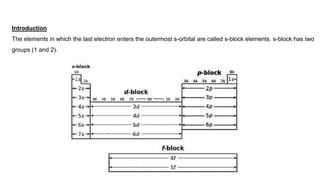
The elements in which the last electron enters the outermost s-orbital are called s-block elements. s-block has two
groups (1 and 2).
• Group 1 elements are called alkali metals. They form hydroxides by reacting with water that is strongly
alkaline in nature and hence are regarded as alkali metals.
• Whereas Group 2 elements are called alkaline earth metals. The oxides and hydroxides of these metals
are alkaline in nature and exist in earth crust and hence are regarded as alkaline earth metals.
Diagonal Relationship
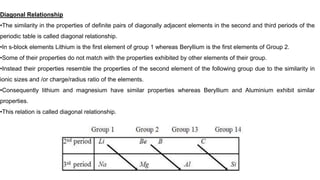
•The similarity in the properties of definite pairs of diagonally adjacent elements in the second and third periods of the
periodic table is called diagonal relationship.
•In s-block elements Lithium is the first element of group 1 whereas Beryllium is the first elements of Group 2.
•Some of their properties do not match with the properties exhibited by other elements of their group.
•Instead their properties resemble the properties of the second element of the following group due to the similarity in
ionic sizes and /or charge/radius ratio of the elements.
•Consequently lithium and magnesium have similar properties whereas Beryllium and Aluminium exhibit similar
properties.
•This relation is called diagonal relationship.
Similarity of lithium with magnesium
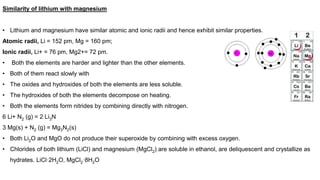
• Lithium and magnesium have similar atomic and ionic radii and hence exhibit similar properties.
Atomic radii, Li = 152 pm, Mg = 160 pm;
Ionic radii, Li+ = 76 pm, Mg2+= 72 pm.
• Both the elements are harder and lighter than the other elements.
• Both of them react slowly with
• The oxides and hydroxides of both the elements are less soluble.
• The hydroxides of both the elements decompose on heating.
• Both the elements form nitrides by combining directly with nitrogen.
6 Li+ N2 (g) = 2 Li3N
3 Mg(s) + N2 (g) = Mg3N2(s)
• Both Li2O and MgO do not produce their superoxide by combining with excess oxygen.
• Chlorides of both lithium (LiCl) and magnesium (MgCl2) are soluble in ethanol, are deliquescent and crystallize as
hydrates. LiCl·2H2O, MgCl2·8H2O
Similarity of beryllium and aluminium
•The charge/radius ratio of Be2+ ion is nearly the same as that of the Al3+ ion and hence exhibit similar properties.
•Both remains unaffected by acids due to the presence of an oxide film on the metallic surface.
•Hydroxide of both the elements dissolves in excess of alkali to produce beryllate ion[Be (OH)4]2– and aluminate ion
[Al(OH)4]–
•Chlorides of both the elements are soluble in organic solvents and act as strong Lewis acids
•The ions of both the elements have strong tendency to form complexes like BeF4
2–, AlF6
3–.
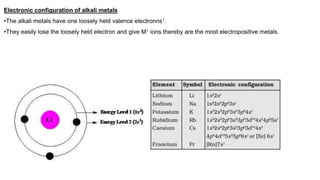
Electronic configuration of alkali metals
•The alkali metals have one loosely held valence electronns1.
•They easily lose the loosely held electron and give M+ ions thereby are the most electropositive metals.
Atomic and Ionic Radii of alkali metals
•In Group 1 the atom of the atomic and ionic radii increases down the group.
•Increase in atomic number increases the size of the atom of the elements.
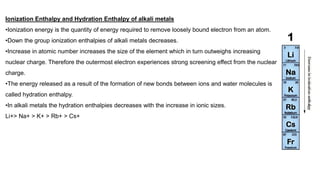
Ionization Enthalpy and Hydration Enthalpy of alkali metals
•Ionization energy is the quantity of energy required to remove loosely bound electron from an atom.
•Down the group ionization enthalpies of alkali metals decreases.
•Increase in atomic number increases the size of the element which in turn outweighs increasing
nuclear charge. Therefore the outermost electron experiences strong screening effect from the nuclear
charge.
•The energy released as a result of the formation of new bonds between ions and water molecules is
called hydration enthalpy.
•In alkali metals the hydration enthalpies decreases with the increase in ionic sizes.
Li+> Na+ > K+ > Rb+ > Cs+
Physical Properties of alkali metals
•Alkali metals appears silvery white, soft and.
•They have low density due to their large size which goes on increasingdown the group.
•The melting and boiling point of the alkali metals are low.
•This shows that they have weak metallic bonding.
•There is a weak bonding due to thepresence of only a single valence electron.
•These metals impart colour when exposed to oxidizing flame due to the excitation of the outermost electron to a higher
energy
• level and then return to their ground state by emitting radiation.
Chemical Properties of alkali metals
(i) Reactivity towards air
Alkali metals get tarnished in the presence of dry air due to the formation of their respective oxides.
The metallic oxide so formed further reacts with moisture to form hydroxides.
The alkali metals burn vigorously in oxygen and form their respective oxides.
4Li + O2 --> 2Li2O (Oxide)
(ii) Reactivity towards water:
The alkali metals react with water and forms hydroxide and dihydrogen.
Lithium due to its small size and very high hydration energy does not react with water vigorously even though it has mos
negative E0 value.
But on the other hand sodium do reacts with water vigorously even though it has least negative E0 value.
(iii) Reactivity towards dihydrogen
The alkali metals react with dihydrogen at about 673K (lithium at 1073K) and form hydrides.
2M + H2 --> 2M+H-
(iv) Reactivity towards halogens
The alkali metals react vigorously with halogens and form ionic halides, M+X–
(v) Reducing nature
The alkali metals are strong reducing agents.
Lithium is the most powerful and sodium is the least powerful.
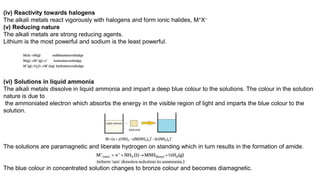
(vi) Solutions in liquid ammonia
The alkali metals dissolve in liquid ammonia and impart a deep blue colour to the solutions. The colour in the solution
nature is due to
the ammoniated electron which absorbs the energy in the visible region of light and imparts the blue colour to the
solution.
The solutions are paramagnetic and liberate hydrogen on standing which in turn results in the formation of amide.
The blue colour in concentrated solution changes to bronze colour and becomes diamagnetic.
Anomalous properties of lithium
Anomalous behaviour of an element refers to the deviation of the properties and behaviour of an element from its usual or normal
behaviour.
It is due to the following reasons:
(i) Exceptionally small size of its atom and ion (ii) High polarizing power
The anomalous behaviour of lithium is as follows:
•Lithium is harder than other metals of the respective group. It has higher Melting and boiling point than other metals
• It is least reactive. It is strongestreducing agent.
•Unlike other metals LiCl is deliquescent and exist as LiCl.2H2
•Li+ ion polarizes water molecules readily than other alkali metals of the respective group and hence the lithium salts attracts the
water molecules and it exists as water of crystallization (2H2O). As the polarizing power decreases with the increasing size of the ions
the other alkali metal ions usually form anhydrous salts.
•Lithium does not form ethynide on reacting with Ethyne.
•Heating lithium nitrate results in the production of lithium oxide, Li2
4LiNO3 --> 2Li2O + 4NO2 + O2
Lithium nitrate Lithium oxide
•Heating nitrates of other alkali metal results in the decomposition of the nitrate leading to the production of their corresponding nitrite.
2NaNO3 --> 2NaNO2 + O2
Sodium nitrate Sodium nitrite
Washing Soda
•The chemical name of washing soda is Sodium Carbonate (Na2CO310H2O).
•It is a whitecrystalline solid existing as dehydrate (Na2CO310H2O).
•On application of heat decahydrate loses water of crystallizationand form monohydrate which becomes completely anhydrous at a
temperature above 373K and forms white powder called soda ash.
Na2CO3.10H2O --> Na2CO3.H2O + 9H2O
(Sodium carbonate decahydrate)
Na2CO3.H2O ---> Na2CO3 + H2O
(Sodium carbonate monohydrate)
•It is used for softening of water, laundering, cleaning, manufacture of glass,soap, borax, paper, paints and textile
•It is also extensively used as laboratory reagent.
s block element.pptx

s block element.pptx

  • 1.
    Presented by: Dr. SoniaRani Department of Chemistry Dayanand Girls P. G. College, Kanpur, U. P India
  • 2.
    Introduction The elements inwhich the last electron enters the outermost s-orbital are called s-block elements. s-block has two groups (1 and 2).
  • 3.
    • Group 1elements are called alkali metals. They form hydroxides by reacting with water that is strongly alkaline in nature and hence are regarded as alkali metals. • Whereas Group 2 elements are called alkaline earth metals. The oxides and hydroxides of these metals are alkaline in nature and exist in earth crust and hence are regarded as alkaline earth metals.
  • 4.
    Diagonal Relationship •The similarityin the properties of definite pairs of diagonally adjacent elements in the second and third periods of the periodic table is called diagonal relationship. •In s-block elements Lithium is the first element of group 1 whereas Beryllium is the first elements of Group 2. •Some of their properties do not match with the properties exhibited by other elements of their group. •Instead their properties resemble the properties of the second element of the following group due to the similarity in ionic sizes and /or charge/radius ratio of the elements. •Consequently lithium and magnesium have similar properties whereas Beryllium and Aluminium exhibit similar properties. •This relation is called diagonal relationship.
  • 5.
    Similarity of lithiumwith magnesium • Lithium and magnesium have similar atomic and ionic radii and hence exhibit similar properties. Atomic radii, Li = 152 pm, Mg = 160 pm; Ionic radii, Li+ = 76 pm, Mg2+= 72 pm. • Both the elements are harder and lighter than the other elements. • Both of them react slowly with • The oxides and hydroxides of both the elements are less soluble. • The hydroxides of both the elements decompose on heating. • Both the elements form nitrides by combining directly with nitrogen. 6 Li+ N2 (g) = 2 Li3N 3 Mg(s) + N2 (g) = Mg3N2(s) • Both Li2O and MgO do not produce their superoxide by combining with excess oxygen. • Chlorides of both lithium (LiCl) and magnesium (MgCl2) are soluble in ethanol, are deliquescent and crystallize as hydrates. LiCl·2H2O, MgCl2·8H2O
  • 6.
    Similarity of berylliumand aluminium •The charge/radius ratio of Be2+ ion is nearly the same as that of the Al3+ ion and hence exhibit similar properties. •Both remains unaffected by acids due to the presence of an oxide film on the metallic surface. •Hydroxide of both the elements dissolves in excess of alkali to produce beryllate ion[Be (OH)4]2– and aluminate ion [Al(OH)4]– •Chlorides of both the elements are soluble in organic solvents and act as strong Lewis acids •The ions of both the elements have strong tendency to form complexes like BeF4 2–, AlF6 3–.
  • 7.
    Electronic configuration ofalkali metals •The alkali metals have one loosely held valence electronns1. •They easily lose the loosely held electron and give M+ ions thereby are the most electropositive metals.
  • 8.
    Atomic and IonicRadii of alkali metals •In Group 1 the atom of the atomic and ionic radii increases down the group. •Increase in atomic number increases the size of the atom of the elements.
  • 9.
    Ionization Enthalpy andHydration Enthalpy of alkali metals •Ionization energy is the quantity of energy required to remove loosely bound electron from an atom. •Down the group ionization enthalpies of alkali metals decreases. •Increase in atomic number increases the size of the element which in turn outweighs increasing nuclear charge. Therefore the outermost electron experiences strong screening effect from the nuclear charge. •The energy released as a result of the formation of new bonds between ions and water molecules is called hydration enthalpy. •In alkali metals the hydration enthalpies decreases with the increase in ionic sizes. Li+> Na+ > K+ > Rb+ > Cs+
  • 10.
    Physical Properties ofalkali metals •Alkali metals appears silvery white, soft and. •They have low density due to their large size which goes on increasingdown the group. •The melting and boiling point of the alkali metals are low. •This shows that they have weak metallic bonding. •There is a weak bonding due to thepresence of only a single valence electron. •These metals impart colour when exposed to oxidizing flame due to the excitation of the outermost electron to a higher energy • level and then return to their ground state by emitting radiation.
  • 11.
    Chemical Properties ofalkali metals (i) Reactivity towards air Alkali metals get tarnished in the presence of dry air due to the formation of their respective oxides. The metallic oxide so formed further reacts with moisture to form hydroxides. The alkali metals burn vigorously in oxygen and form their respective oxides. 4Li + O2 --> 2Li2O (Oxide) (ii) Reactivity towards water: The alkali metals react with water and forms hydroxide and dihydrogen. Lithium due to its small size and very high hydration energy does not react with water vigorously even though it has mos negative E0 value. But on the other hand sodium do reacts with water vigorously even though it has least negative E0 value. (iii) Reactivity towards dihydrogen The alkali metals react with dihydrogen at about 673K (lithium at 1073K) and form hydrides. 2M + H2 --> 2M+H-
  • 12.
    (iv) Reactivity towardshalogens The alkali metals react vigorously with halogens and form ionic halides, M+X– (v) Reducing nature The alkali metals are strong reducing agents. Lithium is the most powerful and sodium is the least powerful. (vi) Solutions in liquid ammonia The alkali metals dissolve in liquid ammonia and impart a deep blue colour to the solutions. The colour in the solution nature is due to the ammoniated electron which absorbs the energy in the visible region of light and imparts the blue colour to the solution. The solutions are paramagnetic and liberate hydrogen on standing which in turn results in the formation of amide. The blue colour in concentrated solution changes to bronze colour and becomes diamagnetic.
  • 13.
    Anomalous properties oflithium Anomalous behaviour of an element refers to the deviation of the properties and behaviour of an element from its usual or normal behaviour. It is due to the following reasons: (i) Exceptionally small size of its atom and ion (ii) High polarizing power The anomalous behaviour of lithium is as follows: •Lithium is harder than other metals of the respective group. It has higher Melting and boiling point than other metals • It is least reactive. It is strongestreducing agent. •Unlike other metals LiCl is deliquescent and exist as LiCl.2H2 •Li+ ion polarizes water molecules readily than other alkali metals of the respective group and hence the lithium salts attracts the water molecules and it exists as water of crystallization (2H2O). As the polarizing power decreases with the increasing size of the ions the other alkali metal ions usually form anhydrous salts. •Lithium does not form ethynide on reacting with Ethyne. •Heating lithium nitrate results in the production of lithium oxide, Li2 4LiNO3 --> 2Li2O + 4NO2 + O2 Lithium nitrate Lithium oxide •Heating nitrates of other alkali metal results in the decomposition of the nitrate leading to the production of their corresponding nitrite. 2NaNO3 --> 2NaNO2 + O2 Sodium nitrate Sodium nitrite
  • 14.
    Washing Soda •The chemicalname of washing soda is Sodium Carbonate (Na2CO310H2O). •It is a whitecrystalline solid existing as dehydrate (Na2CO310H2O). •On application of heat decahydrate loses water of crystallizationand form monohydrate which becomes completely anhydrous at a temperature above 373K and forms white powder called soda ash. Na2CO3.10H2O --> Na2CO3.H2O + 9H2O (Sodium carbonate decahydrate) Na2CO3.H2O ---> Na2CO3 + H2O (Sodium carbonate monohydrate) •It is used for softening of water, laundering, cleaning, manufacture of glass,soap, borax, paper, paints and textile •It is also extensively used as laboratory reagent.