Dr. Babasaheb Ambedkar Technological University, Lonere
RSM’S
N.N.SATTHA COLLEGE OF
P PHARMACY, AHMEDNAGAR
Subject of Seminar
Presented By
Ms. Monali Vaidya
(F.Y.M PHARM, PHARMACOGNOSY)
Under the guidance of
ASST. PROF.D.B.HARDAS
(M.PHARM, PHARMACEUTICAL CHEMISTRY)
CONTENTS
* principle
* potentiometer-Instrumentation
* reference Electrode
* indicator electrode
* method to detect end point
* advantages
* Disadvantages
* Applications of potentiometry
* Reference
What is potentiometry
Potentiometry is a technique that measures the potential
of electrochemical cells when no current is flowing
What is potentiometry
Potentiometry is a technique that measures the potential of
electrochemical cells when no current is flowing
i
PRINCIPLE
• The principle involved in the Potentiometry is when the pair of electrodes is placed in the sample
solution it shows the potential difference by the addition of the titrant or by the change in the
concentration of the ions.
• Potentiometric methods of analysis are based upon measurements of the potential of electrochemical
cells under conditions of zero current, where the Nernst equation governs the operation of potentiometer
The total electric potential or the potential difference can be calculated as follows:
Ecell = Eind – Eref + Ej
were,
Ecell = potential of the whole cell
Eind = potential of the indicator
Eref = potential or electromotive force of the reference
electrode
Nernst equation: Ecell = E0cell - (RT/nF) lnQ
INSTRUMENTATION
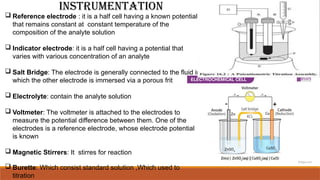
 Reference electrode : it is a half cell having a known potential
that remains constant at constant temperature of the
composition of the analyte solution
 Indicator electrode: it is a half cell having a potential that
varies with various concentration of an analyte
 Salt Bridge: The electrode is generally connected to the fluid in
which the other electrode is immersed via a porous frit
 Electrolyte: contain the analyte solution
 Voltmeter: The voltmeter is attached to the electrodes to
measure the potential difference between them. One of the
electrodes is a reference electrode, whose electrode potential
is known
 Magnetic Stirrers: It stirres for reaction
 Burette: Which consist standard solution ,Which used to
titration
What is an Electrochemical Cell?
• An electrochemical cell is a device that capable of converting chemical energy into
electrical energy, or vice versa.
• Such cells capable of generating an electric current from the chemical reactions occurring in them
called Galvanic cells.
• when an electric current is passed through them are called electrolytic cells. Electrochemical cells
generally consist of a cathode and an anode. The key features of the cathode and the anode are
tabulated below.
Cathode Anode
Denoted by a positive sign since
electrons are consumed here
Denoted by a negative sign since
electrons are liberated here
A reduction reaction occurs in the
cathode of an electrochemical cell
An oxidation reaction occurs here
Electrons move into the cathode Electrons move out of the anode
WORKING OF ELECTROCHEMICAL CELL
• potentiometer consists of two electrodes, whose reduction potentials differ, inserted in
a test solution. The voltmeter is attached to the electrodes to measure the potential
difference between them. One of the electrodes is a reference electrode, whose
electrode potential is known.
• The other electrode is the test electrode. The test electrode is usually either a metal
immersed in a solution of its own ions, whose concentration ,a carbon rod electrode
sitting a solution which contains the ions of interest in two different oxidation states.
• Oxidation take place at anode. For example on zinc electrode Zn → Zn2+ + 2e- 1.
• Reduction take place at cathode. For example on copper electrode Cu2+ + 2e−→ Cu
When redox reaction take place than potential is develop which is measured by
galvanometer.
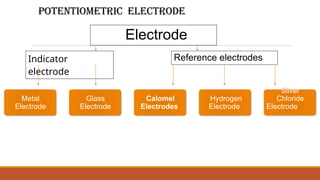
Potentiometric Electrode
Metal
Electrode
Glass
Electrode
Calomel
Electrodes
Hydrogen
Electrode
Silver
Chloride
Electrode
Reference electrodes
Electrode
Indicator
electrode
The reference electrode
• The reference electrode is the electrode which contains of its own potential.
• Reference electrodes need to have a repeatable and steady voltage. Preferably,
reversible-type electrodes are employed as reference electrodes.
• A tiny cathodic current in a reversible electrode causes the reduction reaction,
whereas a small anodic current causes the oxidation reaction
1) Calomel Electrodes
2) Silver Chloride Electrodes
3) Hydrogen electrode
Hydrogen electrode
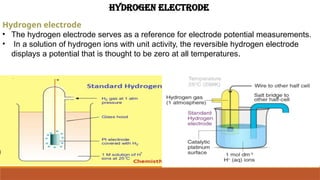
Hydrogen electrode
• The hydrogen electrode serves as a reference for electrode potential measurements.
• In a solution of hydrogen ions with unit activity, the reversible hydrogen electrode
displays a potential that is thought to be zero at all temperatures.
Calomel Electrodes
A reference electrode based on the reaction between elemental mercury and mercury
(I) chloride is known as a saturated calomel electrode (SCE).
A saturated solution of potassium chloride in water serves as the aqueous phase in
contact with the mercury and mercury (I) chloride. The electrode is generally
connected to the fluid in which the other electrode is immersed via a porous frit ie. salt
bridge
Advantages
•Reliable potential
•Compared to a silver el. with fewer samples.
•Easy of use
Disadvantages
•Temperature sensitivity
•Toxicity concerns
Silver Chloride Electrodes
• The silver chloride reference electrode is made of a silver wire (Ag) coated with a
coating of solid silver chloride (AgCl), which is then submerged in a solution that is
saturated with KCI and AgCl.
• The reaction in the half cell is AgCl (s) + e – Ag (s) + CI (satd).
• Reference electrode is the silver chloride electrode, which is based on the
reduction
Advantages
• Widely used in electrochemical measurement
•.More temperature-resistant than SCE
• It`s replaced the saturated calomel electrode for
environmental reasons
Disadvantages
•It reacts to samples
Metallic indicator electrode
• Metallic indicator electrodes are used in electrochemical measurements to determine the
concentrations of targeted analytes in a solution
• These electrodes develop electric potential in response to redox reactions on the metal surface.
• It responds to a redox reaction at the metal surface and does not participate in many chemical reactions
(Inert).
• Example of metal electrode
Platinum(pt), Gold(Au), Silver (Ag), Copper (Cu),Zinc (Zn),Cadium (Cd), Mercury (Hg)
Indicator electrodes
• It is a half cell having a potential that varies with various concentration of an analyte.
• The ideal indicator electrode should react quickly to changes in ion concentration as
well as when other ions present in the sample matrix are present.
• There are mainly two types of indicator electrodes.
1) Glass Electrode
2) Metal Electrode
Glass electrode
• Glass electrodes are commonly used in potentiometric analysis to measure the potential
difference between two solutions. These electrodes consist of a thin-walled glass tube
filled with an electrolyte solution and a reference electrode immersed in the electrolyte.
• The indicator electrode is usually made of a special glass that contains a particular ion or
group of ions that are sensitive to changes in the concentration of a specific analyte in the
solution being measured.
• As the concentration of the analyte changes, the potential difference between the
indicator electrode and the reference electrode changes, producing a voltage signal that
can be measured and used to calculate the concentration of the analyte.
1) Graphical method
• The electrode potential is plotted
against the volume of titrant added,
producing a titration curve.
• The end point corresponds to the
point of the steepest slope on the
curve, indicating a sudden change in
potential that marks the completion
of the reaction between the analyte
and titrant.
2) First derivative method
• The first derivative of the titration
curve (dE/dV) is calculated and
plotted against the volume of titrant
added.
• The end point is determined as the
point where the first derivative is at its
maximum (the peak of the curve),
representing the most significant
change in potential per unit volume of
titrant added.
3) Second derivative method
• The second derivative of the
titration curve (d²E/dV²) is
calculated and plotted.
• The end point is determined
where the second derivative
crosses zero, a transition from
positive to negative .This method
is particularly useful when the
inflection point is weak or not
well-defined.
Method to Determine End Point
•https://www.bdn.go.th/tp/ebook/qQEcAat1pR9gC3q0GT5gMJq0qT5co3uw.
•https://www.vedantu.com/chemistry/potentiometric-titration.
•https://unacademy.com/content/nta-ugc/study-material/pharmaceutical-
analysis/theory-and-principles-of-potentiometry/.
•https://www.ncbi.nlm.nih.gov/pmc/articles/PMC2515866/,
•http://rxpharmaworld.blogspot.com/2016/12/potentiometry.html
•https://faculty.ksu.edu.sa/sites/default/files/Chapter
%2021%20%281%29.pdf
•www.google.com
References
Potentiometry principle,reference and indicator electrode

Potentiometry principle,reference and indicator electrode

  • 1.
    Dr. Babasaheb AmbedkarTechnological University, Lonere RSM’S N.N.SATTHA COLLEGE OF P PHARMACY, AHMEDNAGAR Subject of Seminar Presented By Ms. Monali Vaidya (F.Y.M PHARM, PHARMACOGNOSY) Under the guidance of ASST. PROF.D.B.HARDAS (M.PHARM, PHARMACEUTICAL CHEMISTRY)
  • 2.
    CONTENTS * principle * potentiometer-Instrumentation *reference Electrode * indicator electrode * method to detect end point * advantages * Disadvantages * Applications of potentiometry * Reference
  • 3.
    What is potentiometry Potentiometryis a technique that measures the potential of electrochemical cells when no current is flowing What is potentiometry Potentiometry is a technique that measures the potential of electrochemical cells when no current is flowing
  • 4.
    i PRINCIPLE • The principleinvolved in the Potentiometry is when the pair of electrodes is placed in the sample solution it shows the potential difference by the addition of the titrant or by the change in the concentration of the ions. • Potentiometric methods of analysis are based upon measurements of the potential of electrochemical cells under conditions of zero current, where the Nernst equation governs the operation of potentiometer The total electric potential or the potential difference can be calculated as follows: Ecell = Eind – Eref + Ej were, Ecell = potential of the whole cell Eind = potential of the indicator Eref = potential or electromotive force of the reference electrode Nernst equation: Ecell = E0cell - (RT/nF) lnQ
  • 5.
    INSTRUMENTATION  Reference electrode: it is a half cell having a known potential that remains constant at constant temperature of the composition of the analyte solution  Indicator electrode: it is a half cell having a potential that varies with various concentration of an analyte  Salt Bridge: The electrode is generally connected to the fluid in which the other electrode is immersed via a porous frit  Electrolyte: contain the analyte solution  Voltmeter: The voltmeter is attached to the electrodes to measure the potential difference between them. One of the electrodes is a reference electrode, whose electrode potential is known  Magnetic Stirrers: It stirres for reaction  Burette: Which consist standard solution ,Which used to titration
  • 6.
    What is anElectrochemical Cell? • An electrochemical cell is a device that capable of converting chemical energy into electrical energy, or vice versa. • Such cells capable of generating an electric current from the chemical reactions occurring in them called Galvanic cells. • when an electric current is passed through them are called electrolytic cells. Electrochemical cells generally consist of a cathode and an anode. The key features of the cathode and the anode are tabulated below. Cathode Anode Denoted by a positive sign since electrons are consumed here Denoted by a negative sign since electrons are liberated here A reduction reaction occurs in the cathode of an electrochemical cell An oxidation reaction occurs here Electrons move into the cathode Electrons move out of the anode
  • 7.
    WORKING OF ELECTROCHEMICALCELL • potentiometer consists of two electrodes, whose reduction potentials differ, inserted in a test solution. The voltmeter is attached to the electrodes to measure the potential difference between them. One of the electrodes is a reference electrode, whose electrode potential is known. • The other electrode is the test electrode. The test electrode is usually either a metal immersed in a solution of its own ions, whose concentration ,a carbon rod electrode sitting a solution which contains the ions of interest in two different oxidation states. • Oxidation take place at anode. For example on zinc electrode Zn → Zn2+ + 2e- 1. • Reduction take place at cathode. For example on copper electrode Cu2+ + 2e−→ Cu When redox reaction take place than potential is develop which is measured by galvanometer.
  • 8.
  • 9.
    The reference electrode •The reference electrode is the electrode which contains of its own potential. • Reference electrodes need to have a repeatable and steady voltage. Preferably, reversible-type electrodes are employed as reference electrodes. • A tiny cathodic current in a reversible electrode causes the reduction reaction, whereas a small anodic current causes the oxidation reaction 1) Calomel Electrodes 2) Silver Chloride Electrodes 3) Hydrogen electrode
  • 10.
    Hydrogen electrode Hydrogen electrode •The hydrogen electrode serves as a reference for electrode potential measurements. • In a solution of hydrogen ions with unit activity, the reversible hydrogen electrode displays a potential that is thought to be zero at all temperatures.
  • 11.
    Calomel Electrodes A referenceelectrode based on the reaction between elemental mercury and mercury (I) chloride is known as a saturated calomel electrode (SCE). A saturated solution of potassium chloride in water serves as the aqueous phase in contact with the mercury and mercury (I) chloride. The electrode is generally connected to the fluid in which the other electrode is immersed via a porous frit ie. salt bridge Advantages •Reliable potential •Compared to a silver el. with fewer samples. •Easy of use Disadvantages •Temperature sensitivity •Toxicity concerns
  • 12.
    Silver Chloride Electrodes •The silver chloride reference electrode is made of a silver wire (Ag) coated with a coating of solid silver chloride (AgCl), which is then submerged in a solution that is saturated with KCI and AgCl. • The reaction in the half cell is AgCl (s) + e – Ag (s) + CI (satd). • Reference electrode is the silver chloride electrode, which is based on the reduction Advantages • Widely used in electrochemical measurement •.More temperature-resistant than SCE • It`s replaced the saturated calomel electrode for environmental reasons Disadvantages •It reacts to samples
  • 13.
    Metallic indicator electrode •Metallic indicator electrodes are used in electrochemical measurements to determine the concentrations of targeted analytes in a solution • These electrodes develop electric potential in response to redox reactions on the metal surface. • It responds to a redox reaction at the metal surface and does not participate in many chemical reactions (Inert). • Example of metal electrode Platinum(pt), Gold(Au), Silver (Ag), Copper (Cu),Zinc (Zn),Cadium (Cd), Mercury (Hg) Indicator electrodes • It is a half cell having a potential that varies with various concentration of an analyte. • The ideal indicator electrode should react quickly to changes in ion concentration as well as when other ions present in the sample matrix are present. • There are mainly two types of indicator electrodes. 1) Glass Electrode 2) Metal Electrode
  • 14.
    Glass electrode • Glasselectrodes are commonly used in potentiometric analysis to measure the potential difference between two solutions. These electrodes consist of a thin-walled glass tube filled with an electrolyte solution and a reference electrode immersed in the electrolyte. • The indicator electrode is usually made of a special glass that contains a particular ion or group of ions that are sensitive to changes in the concentration of a specific analyte in the solution being measured. • As the concentration of the analyte changes, the potential difference between the indicator electrode and the reference electrode changes, producing a voltage signal that can be measured and used to calculate the concentration of the analyte.
  • 15.
    1) Graphical method •The electrode potential is plotted against the volume of titrant added, producing a titration curve. • The end point corresponds to the point of the steepest slope on the curve, indicating a sudden change in potential that marks the completion of the reaction between the analyte and titrant. 2) First derivative method • The first derivative of the titration curve (dE/dV) is calculated and plotted against the volume of titrant added. • The end point is determined as the point where the first derivative is at its maximum (the peak of the curve), representing the most significant change in potential per unit volume of titrant added. 3) Second derivative method • The second derivative of the titration curve (d²E/dV²) is calculated and plotted. • The end point is determined where the second derivative crosses zero, a transition from positive to negative .This method is particularly useful when the inflection point is weak or not well-defined. Method to Determine End Point

  • 19.