Persuasive Writing
An Introduction, by Mr. Thompson
5th Grade ELA
•
•
•
•
•
•

Lesson 1: What is Persuasive Writing?
Lesson 2: Know Your Audience
Lesson 3: Do Your Research
Lesson 4: Make it About You
Lesson 5: Make it About Them
Lesson 6: Close With a Punch

Table of Contents
LESSON 1
What is Persuasive Writing?
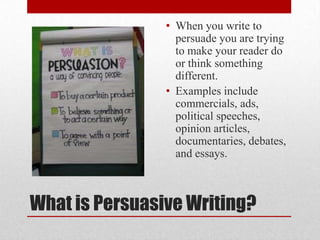
• When you write to
persuade you are trying
to make your reader do
or think something
different.
• Examples include
commercials, ads,
political speeches,
opinion articles,
documentaries, debates,
and essays.

What is Persuasive Writing?
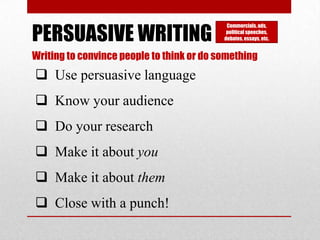
PERSUASIVE WRITING

Commercials, ads,
political speeches,
debates, essays, etc.

Writing to convince people to think or do something

 Use persuasive language
 Know your audience
 Do your research
 Make it about you
 Make it about them

 Close with a punch!
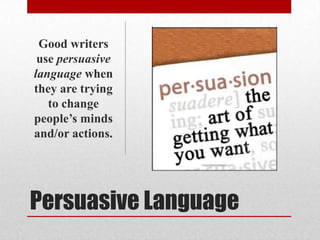
Good writers
use persuasive
language when
they are trying
to change
people’s minds
and/or actions.

Persuasive Language
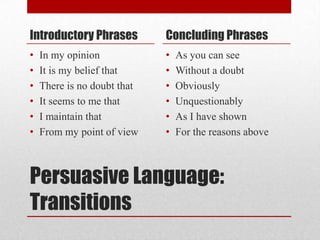
Introductory Phrases

Concluding Phrases

•
•
•
•
•
•

•
•
•
•
•
•

In my opinion
It is my belief that
There is no doubt that
It seems to me that
I maintain that
From my point of view

As you can see
Without a doubt
Obviously
Unquestionably
As I have shown
For the reasons above

Persuasive Language:
Transitions
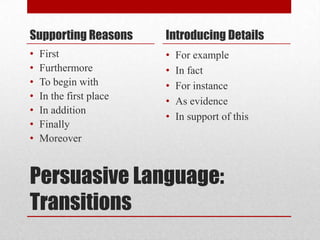
Supporting Reasons

Introducing Details

•
•
•
•
•
•
•

•
•
•
•
•

First
Furthermore
To begin with
In the first place
In addition
Finally
Moreover

For example
In fact
For instance
As evidence
In support of this

Persuasive Language:
Transitions
LESSON 2
Know Your Audience
Your audience is
who you are
writing to.
This will effect
what arguments
you use, the tone
of your writing,
and even the
words you choose.

What is Audience?
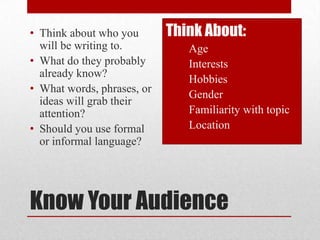
• Think about who you
will be writing to.
• What do they probably
already know?
• What words, phrases, or
ideas will grab their
attention?
• Should you use formal
or informal language?

Think About:
•
•
•
•
•
•

Age
Interests
Hobbies
Gender
Familiarity with topic
Location

Know Your Audience
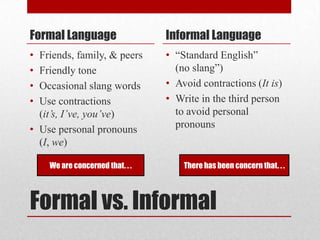
Formal Language

Informal Language

•
•
•
•

• “Standard English”
(no slang”)
• Avoid contractions (It is)
• Write in the third person
to avoid personal
pronouns

Friends, family, & peers
Friendly tone
Occasional slang words
Use contractions
(it’s, I’ve, you’ve)
• Use personal pronouns
(I, we)
We are concerned that. . .

There has been concern that. . .

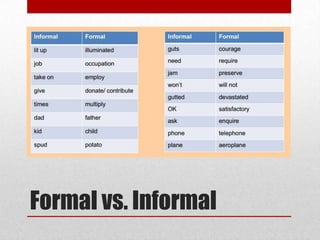
Formal vs. Informal
Formal vs. Informal
LESSON 3
Do Your Research
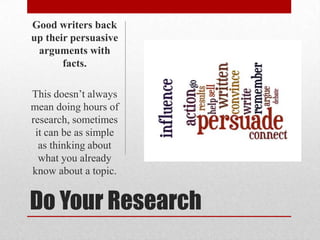
Good writers back
up their persuasive
arguments with
facts.
This doesn’t always
mean doing hours of
research, sometimes
it can be as simple
as thinking about
what you already
know about a topic.

Do Your Research
• If possible, research
your topic using the
internet or text
resources.
• Remember to be
thinking about
whether or not
sources are reliable.

Research
• Think about what you
already know about
your topic.
• What facts can you
use to help support
your argument?
NOTE: This is why it’s always a good
idea to find topics you’re already
interested in!

Background Knowledge
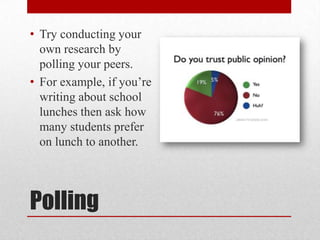
• Try conducting your
own research by
polling your peers.
• For example, if you’re
writing about school
lunches then ask how
many students prefer
on lunch to another.

Polling
LESSON 4
Make it About You
Making a
personal
connection with
the topic can
help get your
point across.

Make it About You
• How does this issue affect you personally?
• Using a personal anecdote about “One time when. . .” can
make your persuasive writing more effective.
• Remember to also think about your audience and your
purpose though. It doesn’t make much sense to tell a
personal anecdote about being lost in a commercial for
quaking duck toys, but it would make sense in an
advertisement for a life-saving flashlight that alerts
rescuers of your location.

Make it About You
Think of some other examples of ways to “Make it About
You” using these topics:
•
•
•
•
•

Litter on our streets
Extended recess
School uniforms
Endangered species
A proposal to cut all field trips

Make it About You
LESSON 5
Make it About Them
Demonstrate
how the topic
will affect your
audience.

Make it About Them
• To make someone
change their mind or
do something
different you have to
make them care.
• Give examples of
what will happen if
they do/don’t act in
the way you want.

“If you don’t act now to
help prevent the
dumping of toxic waste,
all our homes will be at
risk!”

Make it About Them
Think of some other examples of ways to “Make it About
Them” using these topics:
•
•
•
•
•

Litter on our streets
Extended recess
School uniforms
Endangered species
A proposal to cut all field trips

Make it About Them
LESSON 6
Close with a Punch!
Pick the two most
interesting details
for your argument
and put one at the
beginning and one
at the end.
A fact that makes
an emotional
punch can make
the best ending.

Close with a Punch!
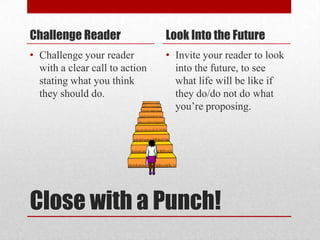
Challenge Reader

Look Into the Future

• Challenge your reader
with a clear call to action
stating what you think
they should do.

• Invite your reader to look
into the future, to see
what life will be like if
they do/do not do what
you’re proposing.

Close with a Punch!
• "We don't turn back. We leave no one behind. [Cheers.]
We pull each other up. [Cheers, applause.] We draw
strength from our victories. [Cheers, applause.] And we
learn from our mistakes. But we keep our eyes fixed on
that distant horizon knowing that providence is with us
and that we are surely blessed to be citizens of the
greatest nation on earth."

Look into the Future
• “Our budget has been cut by 25% and private donations
are the key to our organization’s survival. I’m sending
around the volunteer forms, please sign up to help with
one or two of our important fundraisers this year. In
addition, you’ll see the donation forms which you can
hand to Paul on your way out.”

Challenge Your Reader
• The evidence is overwhelming: the cost of driving a vehicle,
both monetarily and environmentally, is outweighing the
benefits. We can no longer in good faith support something
that is so destructive of the environment. At five dollars per
gallon in some areas, we need to ask ourselves if our
dependence on cars is merely a result of our own laziness. The
bicycle is truly the most efficient means of commuting if we
would just take the energy to do so. Saving money while
saving the planet is surely enough reason to sway a person
without even mentioning the health benefits. Some will never
be convinced, but every little bit helps.

Close with a Punch!
Persuasive Writing
An Introduction, by Mr. Thompson
5th Grade ELA

Intro to Persuasive Writing

  • 1.
    Persuasive Writing An Introduction,by Mr. Thompson 5th Grade ELA
  • 2.
    • • • • • • Lesson 1: Whatis Persuasive Writing? Lesson 2: Know Your Audience Lesson 3: Do Your Research Lesson 4: Make it About You Lesson 5: Make it About Them Lesson 6: Close With a Punch Table of Contents
  • 3.
    LESSON 1 What isPersuasive Writing?
  • 4.
    • When youwrite to persuade you are trying to make your reader do or think something different. • Examples include commercials, ads, political speeches, opinion articles, documentaries, debates, and essays. What is Persuasive Writing?
  • 5.
    PERSUASIVE WRITING Commercials, ads, politicalspeeches, debates, essays, etc. Writing to convince people to think or do something  Use persuasive language  Know your audience  Do your research  Make it about you  Make it about them  Close with a punch!
  • 6.
    Good writers use persuasive languagewhen they are trying to change people’s minds and/or actions. Persuasive Language
  • 8.
    Introductory Phrases Concluding Phrases • • • • • • • • • • • • Inmy opinion It is my belief that There is no doubt that It seems to me that I maintain that From my point of view As you can see Without a doubt Obviously Unquestionably As I have shown For the reasons above Persuasive Language: Transitions
  • 9.
    Supporting Reasons Introducing Details • • • • • • • • • • • • First Furthermore Tobegin with In the first place In addition Finally Moreover For example In fact For instance As evidence In support of this Persuasive Language: Transitions
  • 10.
  • 11.
    Your audience is whoyou are writing to. This will effect what arguments you use, the tone of your writing, and even the words you choose. What is Audience?
  • 12.
    • Think aboutwho you will be writing to. • What do they probably already know? • What words, phrases, or ideas will grab their attention? • Should you use formal or informal language? Think About: • • • • • • Age Interests Hobbies Gender Familiarity with topic Location Know Your Audience
  • 13.
    Formal Language Informal Language • • • • •“Standard English” (no slang”) • Avoid contractions (It is) • Write in the third person to avoid personal pronouns Friends, family, & peers Friendly tone Occasional slang words Use contractions (it’s, I’ve, you’ve) • Use personal pronouns (I, we) We are concerned that. . . There has been concern that. . . Formal vs. Informal
  • 14.
  • 15.
  • 16.
    Good writers back uptheir persuasive arguments with facts. This doesn’t always mean doing hours of research, sometimes it can be as simple as thinking about what you already know about a topic. Do Your Research
  • 17.
    • If possible,research your topic using the internet or text resources. • Remember to be thinking about whether or not sources are reliable. Research
  • 18.
    • Think aboutwhat you already know about your topic. • What facts can you use to help support your argument? NOTE: This is why it’s always a good idea to find topics you’re already interested in! Background Knowledge
  • 19.
    • Try conductingyour own research by polling your peers. • For example, if you’re writing about school lunches then ask how many students prefer on lunch to another. Polling
  • 20.
  • 21.
    Making a personal connection with thetopic can help get your point across. Make it About You
  • 22.
    • How doesthis issue affect you personally? • Using a personal anecdote about “One time when. . .” can make your persuasive writing more effective. • Remember to also think about your audience and your purpose though. It doesn’t make much sense to tell a personal anecdote about being lost in a commercial for quaking duck toys, but it would make sense in an advertisement for a life-saving flashlight that alerts rescuers of your location. Make it About You
  • 23.
    Think of someother examples of ways to “Make it About You” using these topics: • • • • • Litter on our streets Extended recess School uniforms Endangered species A proposal to cut all field trips Make it About You
  • 24.
    LESSON 5 Make itAbout Them
  • 25.
    Demonstrate how the topic willaffect your audience. Make it About Them
  • 26.
    • To makesomeone change their mind or do something different you have to make them care. • Give examples of what will happen if they do/don’t act in the way you want. “If you don’t act now to help prevent the dumping of toxic waste, all our homes will be at risk!” Make it About Them
  • 27.
    Think of someother examples of ways to “Make it About Them” using these topics: • • • • • Litter on our streets Extended recess School uniforms Endangered species A proposal to cut all field trips Make it About Them
  • 28.
  • 29.
    Pick the twomost interesting details for your argument and put one at the beginning and one at the end. A fact that makes an emotional punch can make the best ending. Close with a Punch!
  • 30.
    Challenge Reader Look Intothe Future • Challenge your reader with a clear call to action stating what you think they should do. • Invite your reader to look into the future, to see what life will be like if they do/do not do what you’re proposing. Close with a Punch!
  • 31.
    • "We don'tturn back. We leave no one behind. [Cheers.] We pull each other up. [Cheers, applause.] We draw strength from our victories. [Cheers, applause.] And we learn from our mistakes. But we keep our eyes fixed on that distant horizon knowing that providence is with us and that we are surely blessed to be citizens of the greatest nation on earth." Look into the Future
  • 32.
    • “Our budgethas been cut by 25% and private donations are the key to our organization’s survival. I’m sending around the volunteer forms, please sign up to help with one or two of our important fundraisers this year. In addition, you’ll see the donation forms which you can hand to Paul on your way out.” Challenge Your Reader
  • 33.
    • The evidenceis overwhelming: the cost of driving a vehicle, both monetarily and environmentally, is outweighing the benefits. We can no longer in good faith support something that is so destructive of the environment. At five dollars per gallon in some areas, we need to ask ourselves if our dependence on cars is merely a result of our own laziness. The bicycle is truly the most efficient means of commuting if we would just take the energy to do so. Saving money while saving the planet is surely enough reason to sway a person without even mentioning the health benefits. Some will never be convinced, but every little bit helps. Close with a Punch!
  • 34.
    Persuasive Writing An Introduction,by Mr. Thompson 5th Grade ELA