CHAPTER 3
Wiring Methods
and Materials
CHAPTER 3: Wiring Medthods and Materials
The Philippine Electrical Code (PEC) 2017, Chapter 3 focuses on Wiring Methods and
Materials. It lays down the standards and guidelines for the safe and effective
installation of wiring systems in residential, commercial, and industrial settings.
This presentation provides a summary of Chapter 3 of the Philippine Electrical Code
(PEC) 2017. While we have made every effort to accurately consolidate and
summarize the content of this chapter, the information presented here is intended for
general reference purposes only.
Wiring Methods
CONDUIT
1. To provide mechanical protection against physical damge
2. To provide system ground path
3. Protect the surrounding from fire hazard
4. Support the conductors
PURPOSE OF USING CONDUIT
CONDUIT
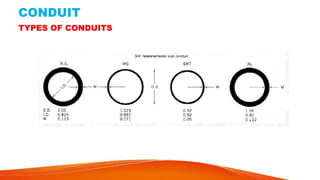
1. Rigid Metal Conduit (RMC)
2. Intermediate Metal Conduit (IMC)
3. Electrical Metallic Tubing (EMT)
4. Aluminum Conduits
5. Flexible Metal Conduits
6. Non-Metal Conduits (PVC, Rigid PVC)
TYPES OF CONDUITS
CONDUIT
TYPES OF CONDUITS
CONDUIT
TYPES OF CONDUITS
CONDUIT
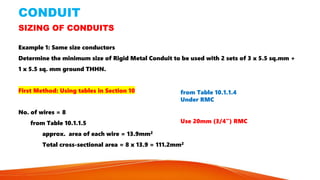
Example 1: Same size conductors
Determine the minimum size of Rigid Metal Conduit to be used with 2 sets of 3 x 5.5 sq.mm +
1 x 5.5 sq. mm ground THHN.
First Method: Using tables in Section 10
No. of wires = 8
from Table 10.1.1.5
approx. area of each wire = 13.9mm2
Total cross-sectional area = 8 x 13.9 = 111.2mm2
SIZING OF CONDUITS
from Table 10.1.1.4
Under RMC
Use 20mm (3/4”) RMC
CONDUIT
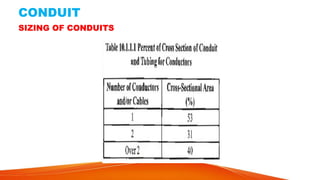
SIZING OF CONDUITS
CONDUIT
SIZING OF CONDUITS
CONDUIT
SIZING OF CONDUITS
CABLE TRAYS
A cable tray is a system used to support insulated electrical
cables in a building or structure. It offers a framework that
allows for the safe distribution and organization of cables,
particularly in large or complex installations such as
commercial or industrial settings
CABLE TRAYS
Ladder-Type Cable Tray - Resembles a ladder, with two side rails and cross members. It is used
for general wiring installations and offers ventilation, making it ideal for heat dissipation.
Solid-Bottom Cable Tray - Has a flat, solid base and offers maximum protection for cables
against dust and debris. However, it provides less ventilation.
Trough Cable Tray - Similar to the ladder type but with closer-spaced cross members,
providing better support for small cables.
Wire Mesh Cable Tray - Constructed with wire mesh, allowing flexibility for supporting smaller
and shorter cable runs. It is also lightweight and easy to install.
Channel-Type Cable Tray - A U-shaped system designed for small quantities of control or
power cables, offering better protection in limited space.
Types of Cable Trays
CABLE TRAYS
Types of Cable Trays
CABLE TRAYS
1. Single Conductors Cables
2.Multiconductors Power and Lighting Cables
3.Multicables Control and/or Signal Cables
4.Telecommunication Cables
Types of Cable installed in Cable Trays
CABLE TRAYS
Size of Cable Tray
CABLE TRAYS
Size of Cable Tray
Comparison: Cable Trays vs. Raceways
Open and concealed wiring
Open wiring and concealed wiring are two common methods of
electrical installation, each with its distinct advantages,
disadvantages, and specific applications. Both methods are
governed by safety standards in the Philippine Electrical Code
(PEC) 2017, ensuring that electrical systems are installed
correctly, safely, and efficiently.
Open wiring
Open wiring refers to electrical wiring systems where cables, conduits, or other electrical conductors are installed visibly
on the surface of walls, ceilings, or structures, rather than being hidden behind walls or inside enclosed spaces.
Characteristics of Open Wiring:
• Visibility - The wiring is exposed or installed on the surface of walls, ceilings, or structural elements.
• Accessibility - Easier to access for maintenance, repairs, or upgrades without the need for cutting into
walls or removing panels.
• Cable Support - Wires may be supported by cleats, brackets, or insulators to prevent them from sagging
or coming into contact with surfaces that could damage them.
• Materials Used - Open wiring often uses conduits (rigid or flexible), armored cables, or raceways to
protect the wires from mechanical damage.
• Applications - It is commonly found in industrial buildings, workshops, utility rooms, and sometimes in
temporary installations where aesthetic considerations are secondary to function.
Open wiring
Common Uses:
•Industrial environments
•Warehouses or factories
•Workshops or utility rooms
•Temporary installations
Concealed Wiring
Concealed wiring refers to electrical wiring that is hidden from view, typically behind walls, ceilings, or floors. This
method is often used in residential and commercial buildings where aesthetic appearance is important, and wiring should
not be visible.
Characteristics of Concealed Wiring:
• Hidden from View - The wires are routed inside walls, ceilings, or floors, and are not visible from the
outside.
• Conduits - Cables are often housed in conduits (metallic or non-metallic), raceways, or plastic tubing for
additional protection from mechanical damage.
• Electrical Boxes - Electrical boxes are used to house switches, outlets, and junctions. These boxes are
also concealed, with only the cover plate or face of the outlet/switch exposed.
• Safety - Concealed wiring offers greater protection against mechanical damage, weather exposure, and
accidental contact.
• Aesthetics - Since the wiring is hidden, it creates a clean, streamlined appearance, making it ideal for
homes, offices, and commercial spaces.
Concealed Wiring
Common Uses:
• Residential homes (apartments, houses, condominiums)
• Commercial offices and buildings
• Hotels and hospitality industries
• Educational institutions and hospitals
Comparison of Open and Concealed
Wiring
Comparison of Open and Concealed
Wiring
Surface and Underground installations
Surface installations and underground installations are two major
methods of installing electrical systems. Both methods have
distinct applications, benefits, and challenges, and are used
depending on the environment, the type of project, and safety
considerations. The Philippine Electrical Code (PEC) 2017 governs
the installation requirements for both methods to ensure safety
and compliance.
Surface Installations
Surface installations refer to the installation of electrical conduits, cables, or raceways on the surface of walls, ceilings, or
other structures. These systems are mounted externally and are visible after installation.
Characteristics of Surface Installations:
• Visibility - The electrical components are exposed or mounted on the surface, rather than hidden inside
walls or underground.
• Accessibility - These systems are easily accessible for repairs, maintenance, or upgrades since they are
not concealed.
• Mounting Methods - Electrical wiring and conduits are typically mounted using clips, brackets, or
fasteners attached to walls or ceilings.
• Protection - Surface installations may require extra protection in high-traffic areas or
Underground Installations
Underground installations involve burying electrical conduits, cables, or ducts below the surface, usually in trenches. This
method is used to protect electrical systems from environmental factors and provide a clean, unobtrusive setup.
Characteristics of Underground Installations:
• Concealment - The wiring and conduits are completely hidden underground, creating a clean
and aesthetically pleasing installation.
• Protection - Underground cables and conduits are better protected from physical damage,
weather conditions, and vandalism.
• Installation Requirements - Underground installations require proper trenching, backfilling,
and protective materials to ensure safety and durability.
Underground Installations
The PEC 2017 provides specific guidelines for how deep different types of cables and
conduits must be buried to ensure safety. The depth depends on the voltage, conduit
material, and the type of location (e.g., under sidewalks, driveways, or open fields).
Example: For low-voltage systems (0 to 1000 volts), conduits may need to be buried
at a depth of at least 450 mm in non-vehicular traffic areas, or 600 mm under streets
and driveways.
Comparison of Surface and
Underground Installations
Conductors for General
Wiring
WIRE INSULATION
1. Thermoplastic Insulation - is made from materials that soften when heated and
harden when cooled, making them easy to shape during manufacturing.
Types of Thermoplastic Insulation:
Polyvinyl Chloride (PVC) - one of the most widely used insulation materials. It is durable, flexible, flame-retardant,
and resistant to moisture and chemicals.
Temperature Range - Typically up to 75°C for general use.
Used in non-metallic sheathed cables like Type NM (non-metallic) or THHN (Thermoplastic High Heat-resistant
Nylon-coated).
Nylon (Polyamide) - Used as a coating over other insulation materials like PVC, nylon adds an extra layer of abrasion
resistance and mechanical protection.
Temperature Range: Similar to PVC but can withstand higher mechanical stresses.
Often used in wires that are subject to wear and tear or rough handling, such as THHN or THWN (Thermoplastic Heat
and Water-resistant Nylon-coated) conductors in building installations.
Types of wire insulation and their applications
WIRE INSULATION
2. Thermoset Insulation - materials, unlike thermoplastics, do not soften when heated. Once
cured or hardened, they maintain their shape and properties even in high-temperature
environments.
Types of Thermoset Insulation:
Cross-Linked Polyethylene (XLPE) - Commonly used in high-voltage cables, building wiring, and industrial
applications where heat resistance is required. Also used in underground cables and power distribution networks.
Temperature Range - Rated up to 90°C for continuous operation, but can tolerate up to 250°C in emergency
conditions.
Silicone Rubber - Can withstand temperatures up to 200°C and remains flexible at temperatures as low as -60°C. Ideal
for high-temperature environments, such as furnace wiring, heating appliances, and aerospace or automotive
applications. It’s also used in extreme environments where flexibility is required, like engine wiring harnesses.
Temperature Range - Can withstand temperatures up to 200°C and remains flexible at temperatures as low as -60°C.
Types of wire insulation and their applications
WIRE INSULATION
3. Fluoropolymer insulation - materials, like PTFE (Polytetrafluoroethylene) and FEP
(Fluorinated Ethylene Propylene), offer excellent thermal and chemical resistance.
Types of Fluoropolymer Insulation:
PTFE (Polytetrafluoroethylene) - Ccommonly known as Teflon, is highly resistant to heat, chemicals, and moisture. It
also has non-stick properties and a low coefficient of friction.
Temperature Range - Can withstand temperatures from -60°
C to 250°
C.
Used in wiring for high-performance systems like aircraft, medical equipment, and chemical processing plants.
SFEP (Fluorinated Ethylene Propylene) - provides excellent electrical insulation and is resistant to heat and chemicals.
It is also known for its low friction and non-stick properties.
Temperature Range - Can operate in temperatures up to 200°
C.
Used in harsh industrial environments, telecommunications, data cables, and high-frequency applications.
Types of wire insulation and their applications
WIRE INSULATION
4. Rubber insulation is flexible and durable, making it suitable for a variety of applications.
Different formulations of rubber provide unique properties for insulation, including resistance
to heat, moisture, and chemicals.
Types of Rubber Insulation:
Natural Rubber - Natural rubber provides flexibility and is commonly used in flexible cables.
Often used in temporary wiring, flexible cords, and equipment leads.
Neoprene - provides good resistance to chemicals, oils, and water, making it suitable for industrial and outdoor
use.It
is also known for its low friction and non-stick properties.
Used in environments where cables are exposed to oils, greases, and harsh chemicals, such as industrial machinery
and outdoor lighting cables.
Types of wire insulation and their applications
WIRE INSULATION
5. Paper Insulation (Oil-Impregnated)- often oil-impregnated, is used in older electrical systems
or in specific applications like high-voltage power distribution. The oil serves as an insulator,
and the paper provides structure.
Types of wire insulation and their applications
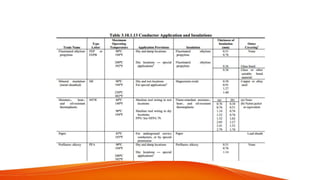
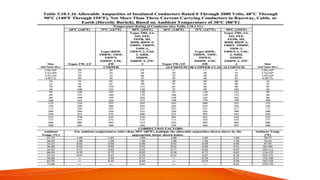
Conductor sizing and temperature ratings
Conductor sizing and temperature ratings are critical factors in ensuring the safe and
efficient operation of electrical systems. Correctly sizing a conductor and
understanding its temperature rating are essential to prevent overheating, insulation
degradation, and potential fire hazards. The Philippine Electrical Code (PEC) 2017 and
other international standards provide guidelines to ensure the proper selection of
conductor sizes and temperature ratings.
Types of wire insulation and their applications
Conductor sizing and temperature ratings
Types of wire insulation and their applications
Conductor sizing and temperature ratings
Types of wire insulation and their applications
Conductor sizing and temperature ratings
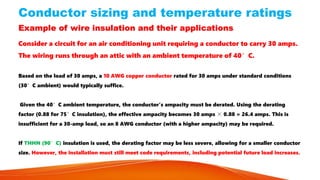
Consider a circuit for an air conditioning unit requiring a conductor to carry 30 amps.
The wiring runs through an attic with an ambient temperature of 40°C.
Based on the load of 30 amps, a 10 AWG copper conductor rated for 30 amps under standard conditions
(30°C ambient) would typically suffice.
Given the 40°C ambient temperature, the conductor’s ampacity must be derated. Using the derating
factor (0.88 for 75°C insulation), the effective ampacity becomes 30 amps × 0.88 = 26.4 amps. This is
insufficient for a 30-amp load, so an 8 AWG conductor (with a higher ampacity) may be required.
If THHN (90°C) insulation is used, the derating factor may be less severe, allowing for a smaller conductor
size. However, the installation must still meet code requirements, including potential future load increases.
Example of wire insulation and their applications
CHAPTER 3
Wiring Methods
and Materials
ARTICLE 3.0 - GENERAL
REQUIREMENTS FOR
WIRING METHODS AND
MATERIALS
3.0.1 General
Requirements
3.0.1.1 Scope.
A. All Wiring Installations. This article outlines the
methods for installing electrical wiring, ensuring it
meets safety standards across various applications.
B. Integral Parts of Equipment. The provisions of
this article are not intended to apply to the conductors
that form an integral part of equipment, such as
motors, controllers, motor control centers, or factory
assembled control equipment or listed utilization
equipment.
C. Metric Designators and Trade Sizes. Metric
designators and trade sizes for conduit, tubing, and
associated fittings and accessories shall be as
designated in Table 3.0.1.1(C).
3.0.1 General Requirements
3.0.1.2 Limitations.
A. Voltage. Wiring methods specified in Chapter 3 shall be used for 1000 Volts.
nominal, or less where not specifically limited in some section of Chapter 3.
They shall be permitted for over 1000 Volts, nominal, where specifically
permitted elsewhere in this Code.
B. Temperature Limitation. Conductors must comply with temperature
restrictions based on the type of wiring and insulation. This ensures the
longevity and safety of the installation under different environmental conditions​
3.0.1 General Requirements
3.0.1.3 Conductors.
A. Single Conductors - Single conductors specified in Table 3.10.3.1 (A)
B. Conductors of the same Circuit - This section emphasizes that all conductors belonging to the same circuit must
be installed together to maintain electrical system safety and performance.
General Requirement - All conductors (such as phase conductors, neutral conductors, grounding conductors,
and equipment grounding conductors) of the same circuit must be grouped together. They must be run in the same
raceway, cable, or trench.
Grounding and Bonding Conductors - Conductors used for grounding and bonding associated with the same
circuit must also be routed together.
Parallel Conductors - When conductors are installed in parallel (e.g., multiple conductors per phase), all
conductors for each phase and neutral must be run together.
3.0.1 General Requirements
3.0.1.3 Conductors.
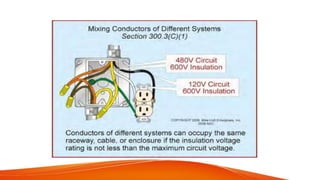
C. Conductors of different Systems - Conductors from different systems (e.g., low voltage, high voltage,
communication systems) must be kept separate to avoid electrical interference and ensure system integrity.
• Conductors from different systems may be installed in the same raceway, cable, or enclosure only if specifically
allowed by the code.
• When conductors of different systems are installed together, they must have compatible insulation rated for the
highest voltage present in the enclosure.
• Conductors must have insulation appropriate for the maximum voltage they may encounter.
• If different systems (such as low-voltage and high-voltage systems) share a raceway, the insulation on the
conductors must be rated for the highest voltage present to avoid breakdown and potential hazards.
3.0.1 General Requirements
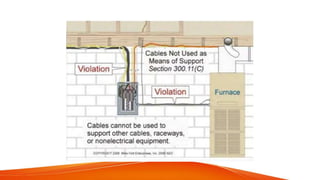
3.0.1.4 Protection Against Physical Damage.
The intent of this section is to ensure the longevity and safety of electrical installations by preventing
damage to the wiring, which could lead to short circuits, electrical failures, or fires.
(A) Cables and Raceways Through Wood Members.
• Bored holes must be placed at a safe distance from the edges of structural members to prevent accidental
damage to the conductors (such as nails or screws penetrating the wiring during construction or future
renovations). The PEC typically requires holes to be 1¼ inches (32 mm) or more from the nearest edge of the
wood member to protect the conductor from physical damage.
• Notches in Wood - Conductors routed through notches must be protected from physical damage. This can be
achieved by using protective coverings or bushings at the points where conductors enter and exit the notch. The
PEC specifies that notches should be located in the top or bottom of the member but should not extend through
the entire depth, as this could weaken the beam.
3.0.1 General Requirements
3.0.1.4 Protection Against Physical Damage.
(B) Nonmetallic-Sheathed Cables and Electrical Nonmetallic Tubing Through Metal Framing
Members.
• When running nonmetallic cables or tubing through metal framing members, they must be protected
from physical damage.
• This is typically achieved by using bushings or grommets at the entry and exit points of the metal
framing to prevent abrasion and damage to the cable or tubing insulation.
• The cables or tubing should be installed in such a way that they do not become pinched or overly
strained, which could compromise their integrity.
3.0.1 General Requirements
3.0.1.4 Protection Against Physical Damage.
(C.) Cables Through Spaces Behind Panels Designed to Allow Access.
Cables may be installed in spaces behind access panels, provided that these spaces are designed for
easy access to electrical equipment or wiring.
(D.) Cables and Raceways Parallel to Framing Members and Furring Strips
In both exposed and concealed locations, where a cable- or raceway-type wiring method is installed parallel to
framing members, such as joists, rafters, or studs, or is installed parallel to furring strips, the cable or raceway shall be
installed and supported so that the nearest outside surface of the cable or raceway is not less than 32 mm from the
nearest edge of the framing member or furring strips where nails or screws are likely to penetrate. Where this distance
cannot be maintained, the cable or raceway shall be protected from penetration by nails or screws by a steel plate,
sleeve, or equivalent at least 1.6 mm thick.
3.0.1 General Requirements
3.0.1.4 Protection Against Physical Damage.
(E.) Cables, Raceways, or Boxes Installed in or Under Roof Decking.
A cable, raceway, or box, installed in exposed or concealed locations under metal-corrugated sheet roof decking,
shall be installed and supported so there is not less than 3 8 mm measured from the lowest surface of the roof decking
to the top of the cable, raceway, or box. A cable, raceway, or box shall not be installed in concealed locations in metal-
corrugated, sheet decking-type roof.
(F.) Cables and Raceways Installed in Shallow Grooves.
Cable- or raceway-type wiring methods installed in a groove, to be covered by wallboard, siding, paneling,
carpeting, or similar finish, shall be protected by 1.6 mm thick steel plate, sleeve, or equivalent or by not less than 32-
mm free space for the full length of the groove in which the cable or raceway is installed.
3.0.1 General Requirements
3.0.1.4 Protection Against Physical Damage.
(G.) Insulated Fittings.
Where raceways contain 22 mm2 or larger insulated circuit conductors, and these conductors enter a cabinet, a
box, an enclosure, or a raceway, the conductors shall be protected by an identified fitting providing a smoothly rounded
insulating surface, unless the conductors are separated from the fitting or raceway by identified insulating material that
is securely fastened in place.
(H.) Structural Joints.
A listed expansion/deflection fitting or other approved means shall be used where a raceway crosses a structural
joint intended for expansion, contraction or deflection, used in buildings, bridges, parking garages, or other structures.
3.0.1 General Requirements
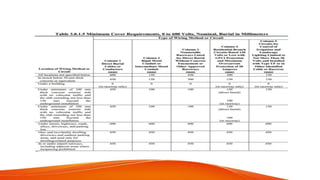
3.0.1.5 Underground Installations..
The requirements for installing electrical conductors and systems underground. This section ensures that
underground electrical installations are safe, durable, and compliant with code standards.
Permitted Cables and Conductors
• Only specific types of conductors and cables rated for underground use are permitted, such as direct burial cables
or those installed in conduits.
• These cables must be designed to withstand moisture and soil conditions.
Depth of Burial
• Conductors installed underground must be buried at a minimum depth to protect them from physical damage and to
comply with local codes.
• The typical minimum burial depth is usually around 600 mm (24 inches) for direct burial cables, but this can vary
based on the type of cable and local regulations.
3.0.1 General Requirements
3.0.1.5 Underground Installations..
Conduit Requirements
• If conduits are used, they must be securely installed and capable of preventing moisture ingress.
• Conduits must also be of appropriate material (e.g., PVC, metal) depending on environmental conditions.
Protection from Physical Damage
• Conductors must be protected from physical damage, which may involve using protective enclosures or additional
layers of material depending on the environment.
• Any above-ground portions of the installation must also be protected against impact or damage.
Junction Boxes
• If junction boxes are used in underground installations, they must be weatherproof and suitable for underground
applications.
• These boxes should be installed at accessible locations for maintenance and inspection.
3.0.1 General Requirements
3.0.1.6 Protection Against Corrosion and Deterioration.
Raceways, cable trays, cablebus, auxiliary gutters, cable armor, boxes, cable sheathing, cabinets, elbows, couplings,
fittings, supports, and support hardware shall be of materials suitable for the environment in which they are to be
installed.
A. Ferrous Metal Equipment - Ferrous metal raceways, cable trays, cablebus, auxiliary gutters, cable armor,
boxes, cable sheathing, cabinets, metal elbows, couplings, nipples, fittings, supports, and support hardware shall be
suitably protected against corrosion inside and outside (except threads at joints) by a coating of approved corrosion-
resistant material.
B. Aluminum Metal Equipment - Aluminum raceways, cable trays, cablebus, auxiliary gutters, cable armor, boxes,
cable sheathing, cabinets, elbows, couplings, nipples, fittings, supports, and support hardware embedded or
encased in concrete or in direct contact with the earth shall be provided with supplementary corrosion protection.
3.0.1 General Requirements
3.0.1.6 Protection Against Corrosion and Deterioration.
C. Nonmetallic Equipment - Nonmetallic raceways, cable trays, cablebus, auxiliary gutters, boxes, cables with a
nonmetallic outer jacket and internal metal armoror jacket, cable sheathing, cabinets, elbows, couplings,
nipples, fittings, supports, and support hardware shall be made of material approved for the condition and
shall comply with (C)(1) and (C)(2) as applicable to the specific installation.
D. Indoor Wet Locations - In portions of dairy processing facilities, laundries, canneries, and other indoor Wet
locations, and in locations where walls are frequently washed or where there are, surfaces of absorbent
materials, such as damp paper or wood,the entire wiring system, where installed exposed,including all boxes,
fittings, raceways, and cable used therewith. shall be mounted so that there is at least a6-mm airspace
between it and the wall or supporting surface.
3.0.1 General Requirements
3.0.1.7 Raceways Exposed to Different Temperatures.
A. Sealing - Where portions of a raceway or sleeve are known to be subjected to different temperatures,
and where condensation is known to be a problem, as in cold storage areas of buildings or where
passing from the interior to the exterior of a building, the raceway or sleeve shall be filled with an
approved material to prevent the circulation of warm air to a colder section of the raceway or
sleeve. An explosionproof seal shall not be required for this purpose.
B. Expansion, Expansion-Deflection, and Deflection Fittings - Raceways shall be provided with
expansion, expansion-deflection, deflection fittings where necessary to compensate for thermal
expansion, deflection and contraction.
3.0.1 General Requirements
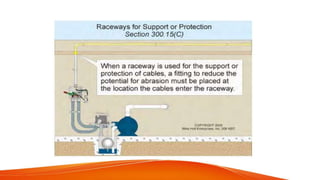
3.0.1.8 Installation of Conductors with Other Systems.
Racev.-ays or cable trays containing electrical conductors shall not contain any pipe, tube, or
equal for steam. water, air, gas, drainage, or any service other than electrical.
3.0.1.9 Raceways in Wet Locations Abovegrade.
Where raceways are installed in wet locations abovegrade, the interior of these raceways shall be
considered to be a wet location. Insulated conductors and cables installed in raceways in wet locations
abovegrade shall comply with 3.10.2.l(C).
3.0.1.10 Electrical Continuity of Metal Raceways and Enclosures.
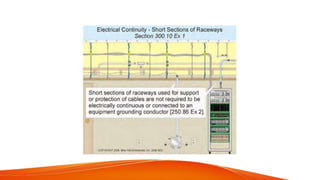
Metal raceways, cable armor, and other metal enclosures for conductors shall be metallically
joined together into a continuous electrical conductor and shall be connected to all boxes, fittings, and
cabinets so as to provide effective electrical continuity. Unless specifically permitted elsewhere in this
Code, raceways and cable assemblies shall be mechanically secured to boxes, fittings, cabinets, and
other enclosures
3.0.1 General Requirements
3.0.1.11 Securing and Supporting.
Deals with the requirements for securing and supporting electrical installations. This section ensures that electrical
conduits, cables, and other components are properly fastened and supported to maintain safety and reliability.
For example, it specifies that electrical metallic tubing (EMT) must be securely fastened in place and supported at
specific intervals to prevent sagging or movement1. This helps to prevent damage to the wiring and reduces the risk of
electrical hazards.
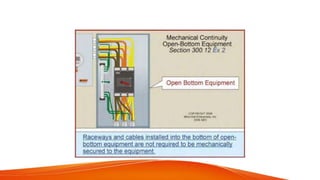
3.0.1.12 Mechanical Continuity - Raceways and Cables.
Raceways, cable armors, and cable sheaths shall be continuous between cabinets, boxes, fittings, or other
enclosures or outlets.
3.0.1.13 Mechanical and Electrical Continuity-Conductors.
• General. Conductors in raceways shall be continuous between outlets, boxes, devices, and so forth. There shall be
no splice or tap within a raceway unless permitted by 3.0.1.15; 3.68.2.47(A); 3.76.2.47; 3.78.2.47; 3.84.2.47;
3.86.2.47; 3.88.2.47; or 3.90.1.7.
• Device Removal. In multiwire branch circuits, the continuity of a grounded conductor shall not depend on device
connections such as lampholders, receptacles, and so forth, where the removal of such devices would interrupt the
continuity.
3.0.1 General Requirements
3.0.1.14 Length of Free Conductors at Outlets,Junctions, and Switch Points.
At least 150 mm of free conductor, measured from the point in the box where it emerges from its raceway or cable
sheath, shall be left at each outlet, junction, and switch point for splices or the connection of luminaires or devices.
Where the opening to an outlet, junction, or switch point is less than 200 mm in any dimension, each conductor shall be
long enough to extend at least 75 mm outside the opening.
3.0.1.15 Boxes, Conduit Bodies, or Fittings - Where Required.
A box shall be installed at each outlet and switch point for concealed knob-and-tube wiring.
Fittings and connectors shall be used only with the specific wiring methods for which they are designed and listed.
3.0.1.16 Raceway or Cable to Open or Concealed Wiring.
A. Box, Conduit Body, or Fitting.
B. Bushing. A bushing shall be permitted in lieu of a box or terminal where the conductors emerge from a raceway
and enter or terminate at equipment, such as open switchboards, unenclosed control equipment, or similar
equipment. The bushing shall be of the insulating type for other than lead-sheathed conductors
3.0.1 General Requirements
3.0.1.17 Number and Size of Conductors in Raceway.
The number and size of conductors in any raceway shall not be more than will pem1it dissipation of the heat
and ready installation or withdrawal of the conductors without damage to the conductors or to their insulation.
3.0.1.18 Raceway Installations.
(A) Complete Runs. Raceways, other than busways or exposed raceways having hinged or remoYable covers,
shall be installed complete between outle-. junction, or splicing points prior to the installation of conductors.
(B) Welding. Metal raceways shall not be supported, terminated, or connected by welding to the raceway unless
specifically designed to be or otherwise specifically permitted to be in this Code.
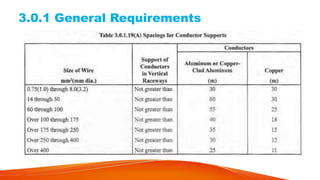
3.0.1.19 Supporting Conductors in Vertical Raceways.
(A) Spacing Intervals - Maximum. Conductors in vertical raceways shall be supported if the vertical rise exceeds
the values in Table 3.0.l.19(A).
(B) Fire-Rated Cables and Conductors. Support methods and spacing intervals for fire-rated cables and
conductors shall comply with any restrictions provided in the listing of the electrical circuit protective system used and in
no case shall exceed the values in Table 3.0.1.19(A).
3.0.1 General Requirements
3.0.1.20 Induced Currents in Ferrous Metal Enclosures or Ferrous Metal Raceways.
(A) Conductors Grouped Together. Where conductors carrying alternating current are installed in ferrous metal
enclosures or ferrous metal raceways, they shall be arranged so as to avoid heating the surrounding ferrous metal by
induction. To accomplish this, all phase conductors and, where used, the grounded conductor and all equipment
grounding conductors shall be grouped together.
(B) Individual Conductors. Where a single conductor carrying alternating current passes through metal with
magnetic properties, the inductive effect shall be minimized by (1) cutting slots in the metal between the individual holes
through which the individual conductors pass or (2) passing all the conductors in the circuit through an insulating wall
sufficiently large for all of the conductors of the circuit.
3.0.1.21 Spread of Fire or Products of Combustion.
Electrical installations in hollow spaces, vertical shafts, and ventilation or air-handling ducts shall be made so that
the possible spread of fire or products of combustion will not be substantially increased. Openings around electrical
penetrations into or through fire-resistant-rated walls, partitions, floors, or ceilings shall be :firestopped using approved
methods to maintain the fire resistance rating.
3.0.1 General Requirements
3.0.1.22 Wiring in Ducts Not Used for Air Handling, Fabricated Ducts for
Environmental Air, and Other Spaces for Environmental Air (Plenums).
The provisions of this section shall apply to the installation and uses of electrical wiring and equipment
in ducts used for dust, loose stock, or vapor removal; ducts specifically fabricated for environmental air;
and other spaces used for environmental air (plenums ).
3.0.1.23 Panels Designed to Allow Access.
Cables, raceways, and equipment installed behind panels designed to allow access, including
suspended ceiling panels, shall be arranged and secured so as to allow the removal of panels and access
to the equipment.
3.0.2 Requirements for over 1000 Volts, Nominal
3.0.2.1 Covers Required.
Suitable covers shall be installed on all boxes, fittings, and similar enclosures to prevent accidental contact with
energized parts or physical damage to parts or insulation.
3.0.2.4 Conductor Bending Radius.
The conductor shall not be bent to a radius less than 8 times the overall diameter for nonshielded conductors or 12
times the overall diameter for shielded or leadcovered conductors during or after installation. For multiconductor or
multiplexed single-conductor cables having individually shielded conductors, the 164 minimum bending radius is 12
times the diameter of the individually shielded conductors or 7 times the overall diameter, whichever is greater.
3.0.2.5 Protection Against Induction Heating.
Metallic raceways and associated conductors shall be arranged so as to amid heating of the raceway in accordance
with the applicable provisions of 3.0.1.20.
3.0.2.7 Aboveground Wiring Methods.
Aboveground conductors shall be installed in rigid metal conduit, in intennediate metal conduit, in electrical metallic
tubing, in RTRC and PVC conduit, in cable trays, in auxiliary gutters. as busways, as cablebus.
3.0.2 Requirements for over 1000 Volts, Nominal
3.0.2.8 Raceways in Wet Locations Above Grade.
Where raceways are installed in wet locations above grade, the interior of these raceways shall be considered to
be a wet location. Insulated conductors and cables installed in raceways in wet locations above grade shallcomply with
3.10.2.1(C).
3.0.2.9 Braid-Covered Insulated Conductors-Exposed Installation.
Exposed runs of braid-covered insulated conductors shall have a flame-retardant braid. If the conductors used do
not have this protection, a flame-retardant saturant shall be applied to the braid covering after installation.
3.0.2.10 Insulation Shielding.
Metallic and semiconducting insulation shielding components of shielded cables shall be removed for a distance
dependent on the circuit voltage and insulation. Stress reduction means shall be provided at all terminations of factory-
applied shielding.
3.0.2.12 Moisture or Mechanical Protection for Metal-Sheathed Cables.
Where cable conductors emerge from a metal sheath and where protection against moisture or physical damage is
necessary, the insulation of the conductors shall be protected by a cable sheath terminating device.
3.0.2 Requirements for over 1000 Volts, Nominal
3.0.2.15 Warning Signs.
Warning signs shall be conspicuously posted at points of access to conductors in all conduit systems
and cable systems. The warning sign(s) shall be legible and permanent and shall carry the following
wording:
DANGER-HIGH VOLTAGE-KEEP OUT
ARTICLE 3.10- CONDUCTORS
FOR GENERAL
WIRING
ARTICLE 3.10 – CONDUCTORS FOR GENERAL WIRING
STRANDED CONDUCTORS
THE CONDUCTORS INSTALLED IN RACEWAYS, SIZE 8.0 mm2 AND LARGER SHALL BE STRANDED.
CONDUCTORS IN PARALLEL
CONDUCTORS THAT ARE 50 MM2 AND LARGER (ALUMINUM, COPPER_x0002_CLAD ALUMINUM,
COPPER) ARE PERMITTED TO BE IN PARALLEL. PARALLEL CONDUCTORS IN EACH PHASE,
POLARITY, NEUTRAL/GROUNDED CIRCUIT CONDUCTORS SHALL COMPLY WITH THE
FF:
1. BE THE SAME LENGTH
2. HAVE THE SAME CONDUCTOR MATERIAL
3. BE THE SAME CROSS SECTIONAL AREA OF THE CONDUCTING MATERIAL
4. HAVE THE SAME INSULATION TYPE
5. BE TERMINATED IN THE SAME MANNER
ARTICLE 3.10 – CONDUCTORS FOR GENERAL WIRING
SHIELDED
SOLID DIELECTRIC INSULATED CONDUCTORS OPERATED ABOVE 2000 VOLTS IN PERMANENT
INSTALLATIONS SHALL HAVE AN OZONE RESISTANT INSULATION AND SHALL BE SHIELDED
LOCATIONS
A) DRY LOCATIONS - INSULATED CONDUCTORS AND CABLES OF ANY TYPE CAN BE USED IN
DRY LOCATIONS.
B) DRY AND DAMP LOCATIONS - INSULATED CONDUCTORS AND CABLES USED IN DRY AND
DAMP LOCATIONS SHALL BE OF TYPES FEP, FEPB, MTW, PFA, RHH, RHW, RHW-2, SA, THHN,
THW, THW-2, THHW, THHW-2, THWN, THWN-2, TW, XHH, XHHW, XHHW-2, Z, OR ZW
C) WET LOCATIONS - CONDUCTORS USED IN WET LOCATIONS SHALL BE:
1. MOISTURE-IMPERVIOUS METAL SHEATHED
2. TYPES MTW, RHW, RHW-2, TW, THW, THW-2, THHW, THHW-2, THWN, THWN-2, XHHW, XHHW-2,
ZW
ARTICLE 3.10 – CONDUCTORS FOR GENERAL WIRING
D) LOCATIONS EXPOSED TO DIRECT SUNLIGHT - INSULATED CONDUCTORS OR CABLES
EXPOSED TO DIRECT RAYS OF THE SUN SHALL BE OF TYPES THAT ARE SUNLIGHT RESISTANT.
MARKING
A) REQUIRED INFORMATION - ALL CONDUCTORS AND CABLES SHALL BE MARKED
WITH THE FOLLOWING:
1. THE MAXIMUM RATED VOLTAGE.
2. PROPER TYPE OF LETTER OR LETTERS.
3. THE MANUFACTURER’S NAME, TRADEMARK, OR DISTINCTIVE MARKING OF
MANUFACTURER.
4. SIZE IN MILLIMETER SQUARE OR MILLIMETER DIAMETER.
5. CABLE ASSEMBLIES WHERE THE NEUTRAL CONDUCTOR IS SMALLER THAN THE
UNGROUNDED CONDUCTORS
ARTICLE 3.10 – CONDUCTORS FOR GENERAL WIRING
B) METHOD OF MARKING
1. SURFACE MARKING - THE SIZE IN MM OR MM DIAMETER SHALL BE REPEATED AT
INTERVALS NOT EXCEEDING 600 MM. ALL OTHER MARKINGS SHALL BE REPEATED AT
INTERVALS NOT EXCEEDING 1000 MM.
• SINGLE-CONDUCTOR AND
• MULTICONDUCTOR RUBBER AND THERMOPLASTIC INSULATED WIRE
• NONMETALLIC-SHEATHED CABLE
• SERVICE-ENTRANCE CABLE
• UNDERGROUND FEEDER AND TRAY
ARTICLE 3.10 – CONDUCTORS FOR GENERAL WIRING
2. MARKER TAPE - METAL-COVERED MULTICONDUCTOR CABLES SHALL EMPLOY A
MARKER TAPE.
3. TAG MARKING - PRINTED TAG SHALL BE ATTACHED TO THE COIL, REEL OR CARTON
FOR THE FOLLOWING:
• MINERAL-INSULATED, METAL_x0002_SHEATHED CABLE
• SWITCHBOARD WIRES
• METAL-COVERED, SINGLE_x0002_CONDUCTOR CABLES
• TYPE AC CABLE
ARTICLE 3.10 – CONDUCTORS FOR GENERAL WIRING
C) SUFFIXES TO DESIGNATE NUMBER OF CONDUCTORS - A TYPE LETTER TO
INDICATE THE NUMBER OF CONDUCTORS.
D - TWO INSULATED CONDUCTORS LAY PARALLEL WITH NONMETALLIC COVERING.
M - ASSEMBLY OF TWO OR MORE INSULATED CONDUCTORS, TWISTED SPIRALLY
WITH NONMETALLIC COVERING.
ALUMINUM CONDUCTOR MATERIAL
- ALL ALUMINUM ALLOY CONDUCTORS SHALL BE MADE OF AA-8000 SERIES ELECTRICAL GRADE ALUMINUM.
ALUMINUM CONDUCTOR MATERIAL
- ALL ALUMINUM ALLOY CONDUCTORS SHALL BE MADE OF AA-8000 SERIES ELECTRICAL GRADE ALUMINUM.
1. SOLID CONDUCTORS - 8.0 MM2 (3.2 MM DIA.), 5.5 MM2 (2.6 MM DIA.), AND 3.5 MM2 (2.0 MM DIA.)
2. STRANDED CONDUCTORS - 8.0 MM2 THROUGH 500 MM2 (TYPE RHH, RHW, XHHW, THW, THHW,
THWN, THHN, SERVICE-ENTRANCE TYPE SE STYLE U AND SE STYLE R)
Article 3.50: Liquidtight Flexible Metal Conduit (Type LFMC)
Definition and Use:
Liquidtight Flexible Metal Conduit (LFMC) is a flexible conduit with a metal core covered by a liquidtight jacket. It is
designed for installations requiring flexibility and protection from moisture, oil, or chemicals.
Construction:
LFMC consists of an interlocked or corrugated metal core, usually made of steel or aluminum, and a liquidtight
nonmetallic outer jacket that protects it from the environment.
Uses Permitted:
LFMC can be used in environments where protection from water, oils, or corrosive substances is needed, such as
industrial settings or outdoor applications.
It is commonly used for flexible connections to motors, lighting fixtures, transformers, and HVAC units.
LFMC is permitted in concealed and exposed locations as long as it is properly supported and installed in
accordance with the PEC.
Uses Not Permitted:
LFMC is not suitable for use where subject to severe physical damage.
It cannot be used as a grounding conductor by itself; a separate grounding conductor must be run alongside the
LFMC if required by the installation.
Article 3.52: Rigid PVC Conduit (Type PVC)
Definition and Use:
Rigid PVC conduit (Type PVC) is a nonmetallic conduit made from polyvinyl chloride. It is corrosion-
resistant, lightweight, and offers protection for electrical wiring against environmental factors like moisture,
chemicals, and physical damage.
Uses Permitted:
• PVC conduit can be used in exposed and concealed locations where protection from environmental
elements is needed.
• It is allowed in underground installations (either direct burial or encased in concrete) and in locations
subject to moisture, chemical exposure, or corrosive environments (e.g., near chemicals, saltwater, or
in industrial settings).
• Suitable for use in indoor and outdoor installations, including residential, commercial, and industrial
settings.
• It can be used for aboveground installations, but special care must be taken to protect it from physical
damage in exposed areas.
Article 3.52: Rigid PVC Conduit (Type PVC)
Uses Not Permitted:
• PVC conduit cannot be used where it will be subjected to severe physical damage.
• It cannot be used in environments with high temperature exposure, as the material may degrade or
lose its structural integrity.
• PVC is not to be used as a grounding conductor. When a grounding conductor is required, a separate
ground wire must be included in the conduit system.
Protection from Physical Damage:
When installed in locations where the conduit could be exposed to physical damage, PVC conduit
must be adequately protected by additional shielding or located in less vulnerable areas.
Grounding Requirements:
Since PVC is a non-conductive material, it cannot serve as a grounding path. If grounding is required,
a separate grounding conductor must be run inside the conduit to comply with electrical grounding
requirements.
Article 3.53: High-Density Polyethylene Conduit (Type
HDPE Conduit)
Definition and Characteristics:
High-Density Polyethylene (HDPE) Conduit is a flexible, nonmetallic conduit made from durable HDPE
material. It is highly resistant to corrosion, chemicals, moisture, and extreme temperatures, making it ideal
for underground and outdoor installations.
Uses Permitted:
• HDPE conduit can be used in underground installations, including direct burial and installations within
concrete encasement.
• It is permitted for use in locations exposed to moisture, chemicals, and harsh environmental conditions
(e.g., industrial plants, coastal areas).
• HDPE conduit can also be used for long-distance horizontal directional drilling (HDD) applications due
to its flexibility and strength.
• It is often utilized for protecting fiber optic cables and electrical cables, especially in situations requiring
long conduit runs without joints or fittings.
Article 3.53: High-Density Polyethylene Conduit (Type
HDPE Conduit)
Uses Not Permitted:
• HDPE conduit cannot be used in environments where it is exposed to severe physical damage or direct
flame, as it is a thermoplastic material.
• It is not suitable for applications where high-temperature exposure could lead to deformation or failure
of the conduit.
• It is not to be used in aboveground installations without adequate protection from sunlight (UV
exposure) unless it is specifically rated for UV resistance.
Support and Securing:
• HDPE conduit must be properly supported to prevent movement and maintain alignment, especially
during backfilling in underground installations.
• For direct burial applications, HDPE conduits are typically laid in a trench and covered with suitable
backfill material to prevent shifting or damage.
Article 3.54: Nonmetallic Underground Conduit with
Conductors (Type NUCC)
Definition and Characteristics:
Nonmetallic Underground Conduit with Conductors (NUCC) is a nonmetallic conduit system that is
pre-manufactured with electrical conductors inside. It is designed for underground installations to protect
wiring from physical damage, moisture, corrosion, and environmental conditions.
Uses Permitted:
• NUCC is specifically designed for underground installations in direct burial applications, encased in
concrete, or in locations subject to moisture or corrosive conditions.
• It is permitted for use in service conductors, feeder circuits, and branch circuits for both residential and
commercial buildings.
• This type of conduit is ideal for areas requiring quick and efficient underground wiring installation since
the conductors are already pre-installed.
Article 3.54: Nonmetallic Underground Conduit with
Conductors (Type NUCC)
Uses Not Permitted:
• NUCC cannot be used in aboveground installations unless specifically rated for such use.
• It is not permitted in areas where it may be exposed to severe physical damage or where it could be
exposed to direct sunlight without appropriate UV-resistant properties.
• NUCC should not be used in environments with extreme heat, as nonmetallic conduits may degrade or
deform under high temperatures.
Installation Guidelines:
• The conduit must be installed at the required depth as specified in the PEC, which typically depends on
the voltage of the conductors and the location of installation (e.g., residential, commercial, or industrial).
• Direct burial installations must ensure that the conduit is placed on a bed of suitable material, such as
sand or crushed stone, to protect it from sharp objects and to provide stability.
• In concrete-encased applications, care must be taken to ensure the conduit is properly secured and
spaced to maintain alignment during the pouring of concrete.
Article 3.55: Reinforced Thermosetting Resin Conduit
(Type RTRC)
Definition and Characteristics:
Reinforced Thermosetting Resin Conduit (RTRC) is a rigid, nonmetallic conduit composed of
thermosetting resin, reinforced with materials like fiberglass to increase its mechanical strength and
durability.
Uses Permitted:
• RTRC conduit is permitted in aboveground and underground installations where it is exposed to
chemicals, moisture, and corrosive substances.
• It is used in industrial applications, hazardous locations, and outdoor environments requiring protection
against harsh conditions.
• Direct burial, concrete encasement, and exposed locations are allowed, as long as RTRC is properly
supported and installed according to PEC requirements.
Article 3.55: Reinforced Thermosetting Resin Conduit
(Type RTRC)
Uses Not Permitted:
• RTRC cannot be used in locations where it may be subjected to severe physical damage unless
additional protection is provided.
• It is not suitable for use as a grounding conductor. Separate grounding conductors must be installed as
part of the electrical system when required.
• RTRC is not recommended for installations in areas where exposure to direct sunlight could cause
material degradation unless specifically rated for UV resistance
Protection Against Physical Damage:
In locations where RTRC is exposed to potential physical damage, such as in industrial settings or
areas with heavy equipment, additional protection (e.g., shields or concrete encasement) may be required
to maintain the integrity of the conduit.
Article 3.55: Reinforced Thermosetting Resin Conduit
(Type RTRC)
Grounding and Bonding:
RTRC is a non-conductive material, so it cannot serve as a grounding path. A separate grounding
conductor must be installed inside the conduit system to meet grounding requirements.
All grounding and bonding provisions must comply with the PEC and ensure that all metallic parts of the
system are properly grounded.
Installation Considerations:
• Cutting and handling of RTRC must be done with care to prevent cracking or damaging the conduit.
Special tools or procedures may be necessary for cutting and fitting the conduit.
• The installation process should ensure that the conduit is properly aligned, supported, and protected
throughout the installation to maintain its long-term performance.
Article 3.58: Electrical Metallic Tubing (Type EMT)
Definition and Characteristics:
• Electrical Metallic Tubing (EMT) is a rigid, thin-walled conduit made of either steel or aluminum, used to
protect and route electrical wiring in a variety of building types.
• EMT is typically non-threaded and relies on compression or set-screw fittings to connect sections or
terminate the conduit.
Uses Permitted:
• EMT is permitted for use in exposed and concealed locations, providing protection for electrical
conductors in dry, wet, and damp conditions when installed according to code.
• It is commonly used for the electrical wiring of branch circuits, feeders, and service conductors in
residential, commercial, and industrial buildings.
• EMT is suitable for use in areas that are not subject to severe physical damage, such as indoors or in
commercial applications where mechanical protection is needed but the conduit won’t be exposed to
harsh impacts.
Article 3.58: Electrical Metallic Tubing (Type EMT)
Uses Not Permitted:
• EMT cannot be used in locations where it is exposed to severe physical damage, such as in heavy industrial
environments, unless additional protection is provided.
• EMT is not suitable for direct burial or in concrete encasements unless specifically listed for such purposes or
protected against corrosion.
• It should not be used in installations where threaded conduit is required, as EMT is typically connected using
compression or set-screw fittings rather than threading.
Protection Against Corrosion:
In corrosive environments, such as areas exposed to moisture, chemicals, or salt air, EMT must be installed with
appropriate corrosion-resistant finishes or coatings, such as zinc or galvanization.
Grounding and Bonding:
EMT provides a continuous grounding path when properly installed. It can be used as an equipment grounding
conductor, provided all fittings and connections are secure and electrically continuous.
Article 3.58: Electrical Metallic Tubing (Type EMT)
Uses Not Permitted:
• EMT cannot be used in locations where it is exposed to severe physical damage, such as in heavy industrial
environments, unless additional protection is provided.
• EMT is not suitable for direct burial or in concrete encasements unless specifically listed for such purposes or
protected against corrosion.
• It should not be used in installations where threaded conduit is required, as EMT is typically connected using
compression or set-screw fittings rather than threading.
Protection Against Corrosion:
In corrosive environments, such as areas exposed to moisture, chemicals, or salt air, EMT must be installed with
appropriate corrosion-resistant finishes or coatings, such as zinc or galvanization.
Grounding and Bonding:
EMT provides a continuous grounding path when properly installed. It can be used as an equipment grounding
conductor, provided all fittings and connections are secure and electrically continuous.
Armored Cable - A fabricated assembly of insulated conductors in a flexible metallic
enclosure.
Thermal Insulation - 90°C (194°F); For Application usage 60°C (140°F) Bending
Radius - The radius of the curve not less than 5 times the diameter.
Securing - 300 mm within every outlet box, junction box,
cabinet.
Supporting - Horizontal run supported within 1400m intervals.
Uses Permitted Uses Not Permitted
In both exposed and concealed works Where subject to physical damage
In cable trays In damp or wet locations
In dry locations Where exposed to corrosive fumes or vapors
Embedded in plaster finish on brick or other
masonry; except in damp or wet locations
Embedded in plaster finish on brick or other
masonry in damp or wet locations
To be run or fished in the air voids of masonry
block or tile walls; not exposed to excessive
moisture/dampness
In air voids of masonry block or tile walls where
walls are exposed or subject to excessive
moisture/dampness
ARTICLE 3.20 – ARMORED CABLE:TYPE AC
Armored Cable: Type AC
Flat Cable Assemblies - An assembly of parallel conductors formed integrally with an insulating
material web specifically for field installation in surface metal raceway.
• Construction - It consist of 2, 3, 4, or 5 conductors.
• Conductors - 5.5 mm2 (2.6 mm dia.) special stranded copper wires.
• Securing and Supporting - Supported by special design features within surface metal raceways.
• Temperature Rating - The ratings shall be marked on the surface at intervals not exceeding
600 mm.
• Grounded Conductor - White or gray marking.
Uses Permitted Uses Not Permitted
Branch circuits for lighting, small appliances, or
small power loads (not exceed 30 amperes)
Subject to corrosive vapors unless suitable
for application
Installed for exposed work In hoistways or on elevators or escalators
Not subject to physical damage. In any hazardous (location)
Surface metal raceways identified for the use Outdoors in wet or damp locations
ARTICLE 3.22 – FLAT CABLE ASSEMBLIES:TYPE FC
Flat Cable Assemblies: Type FC
Flat Conductor Cable - 3 or more flat copper conductors placed edge-to-edge and separated and
enclosed within an insulating assembly.
• Bottom Shield - The protective layer installed between the floor and Type FCC for protection
• Top Shield - A grounded metal shield covering under-carpet components.
• Cable Connector - Connector designed to join Type FCC without using a junction box.
• FCC System - Complete wiring system for branch circuits design for installation under carpet
squares.
• Insulating End - Insulator designed to electrically insulate the end of Type FCC.
• Metal Shield Connections - Means of connection designed to electrically and mechanically
connect a metal shield to another metal.
• Transition Assembly - Incorporated with electrical connection and a suitable box or
covering for safety.
• Voltage - Shall not exceed 300V and voltage between phase and ground conductors not exceed
150V.
• Current - General-purpose and appliance branch circuits shall have 20A rating. And,
individual branch circuits shall have 30 ampere rating.
Uses Not Permitted
Outdoors or in wet locations
Subject to corrosive vapors
In any hazardous (classified) location
In residential, school, and hospital buildings
Installation (shall be permitted on the following conditions):
• Floors - Hard, sound, smooth, continuous floor
surfaces made of concrete,
ceramic/composition flooring.
• Walls - Wall surfaces in surface metal raceways.
• Heated Floors - Shall be identified if in excess of
30°C
• System Height - Exceeding 2.30 mm shall be tapered
or feathered at the edges to floor level.
Flat Conductor Cable: Type FCC
Integrated Gas Spacer - A factory assembly of one or more conductors, each individually insulated and
enclosed in a loose fit, nonmetallic flexible conduit as an integrated gas spacer cable
rated 0 through 600V.
• Bends - A run Type IGS shall not contain more than equivalent of four quarter bends. (360 bends)
• Fittings - The terminations and splices shall be suitable for maintaining gas pressure within the
conduit. Valve and cap shall be provided to check the gas pressure or to inject gas into the conduit
• Conductors - Solid aluminum rods, lay parallel, consisting of 1 to 19 (13 mm diam. rods). The minimum
size conductor size shall be 125 mm2, and the maximum size shall be 2375 mm2. (4750
kcmil)
• Insulation - Shall be dry kraft paper tapes and a pressurized sulfur hexafluoride (SF6). The nominal gas
pressure shall be 138 kPA gauge.
• Conduit - The conduit shall be a medium density polyethylene identified as suitable for use with natural
gas rated pipe in race size 50 mm, 80 mm, or 100 mm.
Uses Permitted Uses Not Permitted
Service-entrance conductors Interior wiring or be exposed in contact with
buildings
Feeder or branch-circuit conductors
Uses Permitted Uses Not Permitted
In wet or dry locations Where exposed to direct sunlight
In raceways In cable trays
In cable trays (specified)
Direct burial (not in accordance with
code)
Direct burial (specified)
In messenger supported wiring
Metal Clad Cable - A factory assembly of one or more insulated circuit conductors with or without optical fiber
members enclosed in an armor of interlocking metal tape or a smooth or corrugated metallic
sheath.
Uses Permitted - Type MC cable shall be permitted as follows:
1. For services, feeders, and branch circuits
2. For power, lighting, control, and signal circuits
3. Indoors or outdoors
4. Exposed or concealed
5. To be direct buried where identified for such use
6. In cable tray where identified for such use
7. In any raceway
8. As aerial cable on a messenger
9. In hazardous (classified) locations as permitted
10. In dry locations and embedded in plaster finish on brick except in damp or wet locations
11. In wet locations where any of the following conditions are met:
• Metallic covering is impervious to moisture
• A lead sheath or moisture-impervious jacket is provided under the metal covering
• The insulated conductors under the metallic covering are listed for use in wet locations
12. Where single-conductor cables are used, all phase conductors and, where used, the neutral conductor
shall be grouped together.
ARTICLE 3.30 – METAL-CLAD CABLE:TYPE MC
Uses Not Permitted - shall not be exposed to corrosive conditions
1. Where subject to physical damage
2. Direct burial in the earth
3. In concrete
Bending Radius - The radius of the curve of the inner edge of bends shall not be less than the required:
• Smooth Sheath
• Cable not more than 19 mm dia. - 10 times the external diameter
• Cable more than 19 mm but less than 40 mm dia. - 12 times the external diameter
• Cable more than 40 mm dia. - 15 times the external diameter
• Interlocked-Type Armor or Corrugated Sheath - 7 times the external diameter
• Shielded Conductors - 12 times the overall diameter of one of the individual conductors or 7 times the
overall diameter of the multi-conductor cable, whichever is greater.
Securing - Unless otherwise provided, cables shall be secured at intervals not exceeding 1800 mm. 4 or fewer conductors
sized no larger than 5.5 mm2 (2.6 mm dia.) shall be secured within 300 mm.
Conductors - copper, aluminum, or copper-clad aluminum, solid or stranded. The minimum conductor size shall be 18
AWG (0.75 mm2; 1.0 mm dia.) copper and 3.5 mm2 (2.0 mm dia.) aluminum or copper-clad aluminum.
Metal Clad Cable: Type MCC
Mineral Insulated, Metal-Sheathed Cable - A factory assembly of one or more conductors insulated with a
highly compressed refractory mineral insulation and enclosed in a liquid tight and gastight continuous copper or
alloy steel sheath.
Conductors - Solid copper, nickel, or nickel-coated copper
Uses Permitted - Type MI cable shall be permitted as follows:
1. For services, feeders, and branch circuits
2. For power, lighting, control, and signal circuits
3. In dry, wet, or continuously moist locations
4. Indoors or outdoors
5. Where exposed or concealed
6. Where embedded in plaster, concrete, fill, or other masonry, whether above or below grade
7. In any hazardous (classified) location
8. Where exposed to oil and gasoline
9. Where exposed to corrosive conditions not deteriorating to its sheath
10. In underground runs where suitably protected against physical damage and corrosive
conditions
11. In or attached to cable tray
Uses Not Permitted - Type MI cable shall not be used under the following conditions
1. Underground runs unless protected from physical damage, where necessary
2. Exposed to conditions that are destructive and corrosive to the metallic sheath
ARTICLE 3.32 – MINERAL-INSULATED, METAL-SHEATED
CABLE:TYPE MI
Bending Radius - The radius of the curve of the inner edge of bends shall not be less than the required
• Cable more than 19 mm dia. - 5 times the external diameter
• Cable greater than 19 mm but not more than 25 mm dia. - 10 times the external diameter
Securing - Cables shall be secured at intervals not exceeding 1800 mm
Mineral Insulated, Metal Sheated Cable: Type MI
Nonmetallic-Sheathed Cable - A factory assembly of two or more insulated conductors enclosed within an
overall nonmetallic jacket.
• Type NM - Insulated conductors enclosed within an overall nonmetallic jacket.
• Type NMC - Insulated conductors enclosed within an overall, corrosion resistant, nonmetallic jacket.
• Type NMS - Insulated power or control conductors with signaling, data, and communications
conductors within an overall nonmetallic jacket.
Uses Permitted - Type NM, Type NMC, and Type NMS cables shall be permitted to be used in the ff:
1. One-and two-family dwellings
2. Multifamily dwellings permitted to be of Types III, IV, and V construction.
3. Other structures permitted to be of Types III, IV, and V construction. Cables shall be concealed
within walls, floors, or ceilings that provide a thermal barrier of material that has at least a
15-minute finish rating.
4. Cable trays in structures permitted to be Types III, IV, or V identified for the use.
ARTICLE 3.34 – NONMETALLIC-SHEATED CABLE:TYPE NM,
NMC, AND NMS
Uses Not Permitted - Type NM and NMS shall not be used under the ff:
1. Where exposed to corrosive fumes or vapors
2. Where embedded in masonry, concrete, adobe, fill, or plaster
3. In a shallow chase in masonry, concrete, or adobe and covered with plaster, adobe
4. Where exposed or subject to excessive moisture or dampness
Protection from Physical Damage - conductors shall be protected by intermediate metallic conduit
(IMC), rigid metallic conduit (RMC), electrical metallic tubing
(EMT), or Schedule 80 PVC.
Bending Radius - The radius of the curve of the inner edge shall not be less than 5 times the diameter
of the cable.
Securing and Supporting - The conductors shall be secured by staples, cable ties, straps, hangers, or similar
fittings at intervals not exceeding 1400 mm and within 300 mm of every outlet
box, junction box, cabinet, etc.
Conductor Insulation - The conductor temperature insulation must be rated at 90°C
Sheath - The outer sheath of nonmetallic-sheathed cable shall comply with the ff:
a) Type NM - Flame retardant and moisture resistant.
b) Type NMC - Flame retardant, moisture resistant, fungus resistant, and corrosion resistant.
c) Type NMS - Flame retardant and moisture resistant. The sheath shall be applied so as to separate
the power conductors from the communications and signaling conductors.
Non-Metallic Sheated Cable: Type NM, NMC, and NMS
Power and Control Tray Cable - A factory assembly of two or more insulated conductors, with or
without associated bare or covered grounding conductors, under a
nonmetallic jacket.
Uses Permitted - Type TC cable shall be permitted to be used as follows:
1. For power, lighting, control, and signal circuits
2. In cable trays
3. In raceways
4. In outdoor locations supported by a messenger wire
5. For Class 1 circuits
6. For non-power-limited fire alarm circuits
7. In industrial establishments where there is regular maintenance and supervision.
8. Where installed in wet locations and shall be resistant to moisture and corrosive
agents.
Uses Not Permitted - Type TC tray cable shall not be installed as follows:
1. Exposed to physical damage
2. Installed outside a raceway or cable tray system, except as permitted.
3. Exposed to direct rays of the sun, unless identified as sunlight resistant.
4. Direct buried, unless identified for such use.
Bending Radius - Type TC cable without metal shielding, bending radius shall be as follows:
• 25 mm or less in dia. cable - 4 times the overall diameter
• Larger than 25 mm (1 in.) but not more than 50 mm dia. - 5 times the overall diameter
• Larger than 50 mm in dia. - 6 times the overall diameter
Power and Control Tray Cable: Type TC
Service-Entrance Cable - A single conductor or multi-conductor assembly provided with or without an overall
covering, primarily used for services, and of the following types:
a) Type SE - Cable with flame-retardant, moisture-resistant covering.
b) Type USE - Cable identified for underground use, having a moisture-resistant covering, but not
required to have a flame-retardant covering.
Bending Radius - The radius of the curve of the inner edge shall not be less than 5 times the
diameter of the cable.
Service-Entrance Cable:
Type SE and USE
Underground Feeder and Branch-Circuit - A factory assembly of one or more insulated conductors
with an integral or an overall covering of nonmetallic
material suitable for direct burial in the earth.
Uses Permitted - Type UF cable shall be permitted as follows:
1. For use underground, including direct burial in the earth
2. As single-conductor cable
3. Wiring in wet, dry, or corrosive locations recognized by the code
4. Installed as nonmetallic-sheathed cable
5. For solar photovoltaic systems
6. As single-conductor cables as the non-heating leads for heating cables
7. Supported by cable trays
Uses Not Permitted - Type UF cable shall not be used as follows:
1. As service-entrance cable
2. In commercial garages
3. In theaters and similar locations
4. In motion picture studios
5. In storage battery rooms
6. In hoistways or on elevators or escalators
7. In hazardous (classified) locations
8. Embedded in poured cement, concrete, or aggregate,
except where embedded in plaster as non-heating leads
where permitted
9. Exposed to direct rays of the sun, unless identified as
sunlight resistant
10. Where subject to physical damage
11. As overhead cable, except where installed as messenger-
supported wiring
Bending Radius - The radius of the curve of the inner edge shall not be less than 5 times
the diameter of the cable.
Conductors - The conductors shall be of sizes 2.0 mm2 (1.6 mm dia.) copper or 3.5 mm2
(2.0 mm dia.) aluminum or copper-clad aluminum through 100 mm2
Sheath - The overall covering shall be flame retardant; moisture, fungus, and corrosion
resistant; and suitable for direct burial in the earth.
Underground Feeder and Branch Circuit Cable: Type UF
Intermediate Metal Conduit - A steel threadable raceway of circular cross section designed for the
physical protection and routing of conductors and cables and for use as
an equipment grounding conductor when installed with its integral or
associated coupling and appropriate fittings.
Uses Permitted:
1.All Atmospheric Conditions and Occupancies - IMC shall be permitted
under all atmospheric conditions and occupancies.
2.Corrosion Environments - IMC, elbows, couplings, and fittings shall be permitted
to be installed in concrete, in direct contact with earth.
3.Cinder Fill - IMC shall be protected on all sides by a layer of non-cinder concrete
not less than 50 mm thick; where conduit is not less than 450 mm under the fill.
4.Wet Locations - All supports, bolts, straps, screws, and so forth, shall be of
corrosionresistant materials or protected against corrosion by corrosion-resistant
materials.
Size:
Minimum - IMC smaller than raceway size 15 mm shall not be used.
Maximum - IMC larger than raceway size 100 mm shall not be used.
Bends - Number in One Run - There shall not be more than 4 quarter bends (360 degree total)
Securing and Supporting
Securely Fastened - 900 mm within of each outlet box, junction box, device box,
cabinet, conduit body, or other conduit termination
Supports - IMC shall be supported in accordance with one of the following:
• Conduits supported at intervals not exceeding 3000 mm
• Exposed vertical risers from industrial machinery or fixed equipment supported at
intervals not exceeding 6000 mm.
• Horizontal runs of IMC supported by openings through framing members at intervals not
exceeding 3000 mm and securely fastened within 900 mm
Marking - Conduits shall be durably marked at least every 1500 mm with the letters IMC.
Standard Length - 3000 mm, including an attached coupling and each end shall be threaded.
.
Intermediate Metal Conduit: Type IMC
Rigid Metal Conduit - A threadable raceway of circular cross section designed for the physical
protection and routing of conductors and cables and for use as an equipment
grounding conductor when installed with its integral or associated coupling and
appropriate fittings. RMC is generally made of steel (ferrous) with protective coatings
or aluminum (nonferrous). Special use types are silicon bronze and stainless steel.
Uses Permitted
1. All Atmospheric Conditions and Occupancies - RMC is permitted under all
atmospheric conditions and occupancies. Ferrous raceways and fittings protected from
corrosion solely by enamel shall be permitted only indoors not subject to severe corrosive
influences.
2. Corrosion Environments - RMC, elbows, couplings, and fittings shall be permitted to be
installed in concrete, in direct contact with earth.
3. Cinder Fill - RMC shall be protected on all sides by a layer of non-cinder concrete not less
than 50 mm thick; where conduit is not less than 450 mm under the fill.
4. Wet Locations - All supports, bolts, straps, screws, and so forth, shall be of corrosionresistant
materials or protected against corrosion by corrosion-resistant materials.
ARTICLE 3.44 –RIGID METAL CONDUIT :TYPE RMC
Securing and Supporting
Securely Fastened - 900 mm within of each outlet box, junction box, device box, cabinet,
conduit body, or other conduit termination.
Supports - RMC shall be supported in accordance with one of the following:
• Conduits supported at intervals not exceeding 3000 mm.
• Exposed vertical risers from industrial machinery or fixed equipment supported at
intervals not exceeding 6000 mm.
• Horizontal runs of RMC supported by openings through framing members at
intervals not exceeding 3000 mm and securely fastened within 900 mm.
Marking - RMC shall be durably marked at least every 3000 mm. Nonferrous conduit of corrosion-resistant material
shall have suitable markings.
Standard Length - 3000 mm, including an attached coupling and each end shall be threaded.
Longer or shorter lengths with or without coupling and threaded or unthreaded shall be permitted.
Size:
Minimum - RMC smaller than raceway size 15 mm shall not be used.
Maximum - RMC larger than raceway size 150 mm shall not be used.
Bends - Number in One Run - There shall not be more than 4 quarter bends. (360 degree total)
Reaming and Threading - All cut ends shall be reamed to remove rough edges. Where conduit
is threaded in the field, a standard cutting die with a taper of 1 in 16
shall be used.
Intermediate Metal Conduit: Type IMC
Flexible Metal Conduit - A raceway of circular cross section made of helically wound, formed,
interlocked metal strip.
Uses Permitted - FMC permitted to be used in exposed or concealed locations.
Uses Not Permitted - FMC shall not be used in the following:
1. Wet locations unless the conductors are approved for the specific condition
2. In hoistways other than as permitted
3. In storage battery rooms
4. In any hazardous (classified) location other than permitted
5. Exposed to materials with a deteriorating effect on the conductors (such as oil or gasoline)
6. Underground or embedded in poured concrete or aggregate
7. Where subject to physical damage
Size:
Minimum - FMC less than raceway size 15 mm shall not be used.
Maximum - FMC larger than raceway size 100 mm shall not be used.
Trimmings - All cut ends shall be trimmed or finished to remove rough edges.
Securing and Supporting
Securely Fastened and Supported - 300 mm within of each outlet, junction, and device box cabinet,
conduit body, and supported at intervals within 1400 mm.
Couplings and Connectors - Angle connectors shall not be used for concealed raceway.
ARTICLE 3.48 – FLEXIBLE METAL CONDUIT: TYPE FMC
Flexible Metal Conduit: Type FMC

CHAPTER 3 PEC (ILLUMINATION).pdf PHILIPPINE ELECTRICAL CODE

  • 1.
  • 2.
    CHAPTER 3: WiringMedthods and Materials The Philippine Electrical Code (PEC) 2017, Chapter 3 focuses on Wiring Methods and Materials. It lays down the standards and guidelines for the safe and effective installation of wiring systems in residential, commercial, and industrial settings. This presentation provides a summary of Chapter 3 of the Philippine Electrical Code (PEC) 2017. While we have made every effort to accurately consolidate and summarize the content of this chapter, the information presented here is intended for general reference purposes only.
  • 3.
  • 4.
    CONDUIT 1. To providemechanical protection against physical damge 2. To provide system ground path 3. Protect the surrounding from fire hazard 4. Support the conductors PURPOSE OF USING CONDUIT
  • 5.
    CONDUIT 1. Rigid MetalConduit (RMC) 2. Intermediate Metal Conduit (IMC) 3. Electrical Metallic Tubing (EMT) 4. Aluminum Conduits 5. Flexible Metal Conduits 6. Non-Metal Conduits (PVC, Rigid PVC) TYPES OF CONDUITS
  • 6.
  • 7.
  • 8.
    CONDUIT Example 1: Samesize conductors Determine the minimum size of Rigid Metal Conduit to be used with 2 sets of 3 x 5.5 sq.mm + 1 x 5.5 sq. mm ground THHN. First Method: Using tables in Section 10 No. of wires = 8 from Table 10.1.1.5 approx. area of each wire = 13.9mm2 Total cross-sectional area = 8 x 13.9 = 111.2mm2 SIZING OF CONDUITS from Table 10.1.1.4 Under RMC Use 20mm (3/4”) RMC
  • 9.
  • 10.
  • 11.
  • 12.
    CABLE TRAYS A cabletray is a system used to support insulated electrical cables in a building or structure. It offers a framework that allows for the safe distribution and organization of cables, particularly in large or complex installations such as commercial or industrial settings
  • 13.
    CABLE TRAYS Ladder-Type CableTray - Resembles a ladder, with two side rails and cross members. It is used for general wiring installations and offers ventilation, making it ideal for heat dissipation. Solid-Bottom Cable Tray - Has a flat, solid base and offers maximum protection for cables against dust and debris. However, it provides less ventilation. Trough Cable Tray - Similar to the ladder type but with closer-spaced cross members, providing better support for small cables. Wire Mesh Cable Tray - Constructed with wire mesh, allowing flexibility for supporting smaller and shorter cable runs. It is also lightweight and easy to install. Channel-Type Cable Tray - A U-shaped system designed for small quantities of control or power cables, offering better protection in limited space. Types of Cable Trays
  • 14.
  • 15.
    CABLE TRAYS 1. SingleConductors Cables 2.Multiconductors Power and Lighting Cables 3.Multicables Control and/or Signal Cables 4.Telecommunication Cables Types of Cable installed in Cable Trays
  • 16.
  • 17.
  • 18.
  • 19.
    Open and concealedwiring Open wiring and concealed wiring are two common methods of electrical installation, each with its distinct advantages, disadvantages, and specific applications. Both methods are governed by safety standards in the Philippine Electrical Code (PEC) 2017, ensuring that electrical systems are installed correctly, safely, and efficiently.
  • 20.
    Open wiring Open wiringrefers to electrical wiring systems where cables, conduits, or other electrical conductors are installed visibly on the surface of walls, ceilings, or structures, rather than being hidden behind walls or inside enclosed spaces. Characteristics of Open Wiring: • Visibility - The wiring is exposed or installed on the surface of walls, ceilings, or structural elements. • Accessibility - Easier to access for maintenance, repairs, or upgrades without the need for cutting into walls or removing panels. • Cable Support - Wires may be supported by cleats, brackets, or insulators to prevent them from sagging or coming into contact with surfaces that could damage them. • Materials Used - Open wiring often uses conduits (rigid or flexible), armored cables, or raceways to protect the wires from mechanical damage. • Applications - It is commonly found in industrial buildings, workshops, utility rooms, and sometimes in temporary installations where aesthetic considerations are secondary to function.
  • 21.
    Open wiring Common Uses: •Industrialenvironments •Warehouses or factories •Workshops or utility rooms •Temporary installations
  • 22.
    Concealed Wiring Concealed wiringrefers to electrical wiring that is hidden from view, typically behind walls, ceilings, or floors. This method is often used in residential and commercial buildings where aesthetic appearance is important, and wiring should not be visible. Characteristics of Concealed Wiring: • Hidden from View - The wires are routed inside walls, ceilings, or floors, and are not visible from the outside. • Conduits - Cables are often housed in conduits (metallic or non-metallic), raceways, or plastic tubing for additional protection from mechanical damage. • Electrical Boxes - Electrical boxes are used to house switches, outlets, and junctions. These boxes are also concealed, with only the cover plate or face of the outlet/switch exposed. • Safety - Concealed wiring offers greater protection against mechanical damage, weather exposure, and accidental contact. • Aesthetics - Since the wiring is hidden, it creates a clean, streamlined appearance, making it ideal for homes, offices, and commercial spaces.
  • 23.
    Concealed Wiring Common Uses: •Residential homes (apartments, houses, condominiums) • Commercial offices and buildings • Hotels and hospitality industries • Educational institutions and hospitals
  • 24.
    Comparison of Openand Concealed Wiring
  • 25.
    Comparison of Openand Concealed Wiring
  • 26.
    Surface and Undergroundinstallations Surface installations and underground installations are two major methods of installing electrical systems. Both methods have distinct applications, benefits, and challenges, and are used depending on the environment, the type of project, and safety considerations. The Philippine Electrical Code (PEC) 2017 governs the installation requirements for both methods to ensure safety and compliance.
  • 27.
    Surface Installations Surface installationsrefer to the installation of electrical conduits, cables, or raceways on the surface of walls, ceilings, or other structures. These systems are mounted externally and are visible after installation. Characteristics of Surface Installations: • Visibility - The electrical components are exposed or mounted on the surface, rather than hidden inside walls or underground. • Accessibility - These systems are easily accessible for repairs, maintenance, or upgrades since they are not concealed. • Mounting Methods - Electrical wiring and conduits are typically mounted using clips, brackets, or fasteners attached to walls or ceilings. • Protection - Surface installations may require extra protection in high-traffic areas or
  • 28.
    Underground Installations Underground installationsinvolve burying electrical conduits, cables, or ducts below the surface, usually in trenches. This method is used to protect electrical systems from environmental factors and provide a clean, unobtrusive setup. Characteristics of Underground Installations: • Concealment - The wiring and conduits are completely hidden underground, creating a clean and aesthetically pleasing installation. • Protection - Underground cables and conduits are better protected from physical damage, weather conditions, and vandalism. • Installation Requirements - Underground installations require proper trenching, backfilling, and protective materials to ensure safety and durability.
  • 29.
    Underground Installations The PEC2017 provides specific guidelines for how deep different types of cables and conduits must be buried to ensure safety. The depth depends on the voltage, conduit material, and the type of location (e.g., under sidewalks, driveways, or open fields). Example: For low-voltage systems (0 to 1000 volts), conduits may need to be buried at a depth of at least 450 mm in non-vehicular traffic areas, or 600 mm under streets and driveways.
  • 30.
    Comparison of Surfaceand Underground Installations
  • 31.
  • 32.
    WIRE INSULATION 1. ThermoplasticInsulation - is made from materials that soften when heated and harden when cooled, making them easy to shape during manufacturing. Types of Thermoplastic Insulation: Polyvinyl Chloride (PVC) - one of the most widely used insulation materials. It is durable, flexible, flame-retardant, and resistant to moisture and chemicals. Temperature Range - Typically up to 75°C for general use. Used in non-metallic sheathed cables like Type NM (non-metallic) or THHN (Thermoplastic High Heat-resistant Nylon-coated). Nylon (Polyamide) - Used as a coating over other insulation materials like PVC, nylon adds an extra layer of abrasion resistance and mechanical protection. Temperature Range: Similar to PVC but can withstand higher mechanical stresses. Often used in wires that are subject to wear and tear or rough handling, such as THHN or THWN (Thermoplastic Heat and Water-resistant Nylon-coated) conductors in building installations. Types of wire insulation and their applications
  • 33.
    WIRE INSULATION 2. ThermosetInsulation - materials, unlike thermoplastics, do not soften when heated. Once cured or hardened, they maintain their shape and properties even in high-temperature environments. Types of Thermoset Insulation: Cross-Linked Polyethylene (XLPE) - Commonly used in high-voltage cables, building wiring, and industrial applications where heat resistance is required. Also used in underground cables and power distribution networks. Temperature Range - Rated up to 90°C for continuous operation, but can tolerate up to 250°C in emergency conditions. Silicone Rubber - Can withstand temperatures up to 200°C and remains flexible at temperatures as low as -60°C. Ideal for high-temperature environments, such as furnace wiring, heating appliances, and aerospace or automotive applications. It’s also used in extreme environments where flexibility is required, like engine wiring harnesses. Temperature Range - Can withstand temperatures up to 200°C and remains flexible at temperatures as low as -60°C. Types of wire insulation and their applications
  • 34.
    WIRE INSULATION 3. Fluoropolymerinsulation - materials, like PTFE (Polytetrafluoroethylene) and FEP (Fluorinated Ethylene Propylene), offer excellent thermal and chemical resistance. Types of Fluoropolymer Insulation: PTFE (Polytetrafluoroethylene) - Ccommonly known as Teflon, is highly resistant to heat, chemicals, and moisture. It also has non-stick properties and a low coefficient of friction. Temperature Range - Can withstand temperatures from -60° C to 250° C. Used in wiring for high-performance systems like aircraft, medical equipment, and chemical processing plants. SFEP (Fluorinated Ethylene Propylene) - provides excellent electrical insulation and is resistant to heat and chemicals. It is also known for its low friction and non-stick properties. Temperature Range - Can operate in temperatures up to 200° C. Used in harsh industrial environments, telecommunications, data cables, and high-frequency applications. Types of wire insulation and their applications
  • 35.
    WIRE INSULATION 4. Rubberinsulation is flexible and durable, making it suitable for a variety of applications. Different formulations of rubber provide unique properties for insulation, including resistance to heat, moisture, and chemicals. Types of Rubber Insulation: Natural Rubber - Natural rubber provides flexibility and is commonly used in flexible cables. Often used in temporary wiring, flexible cords, and equipment leads. Neoprene - provides good resistance to chemicals, oils, and water, making it suitable for industrial and outdoor use.It is also known for its low friction and non-stick properties. Used in environments where cables are exposed to oils, greases, and harsh chemicals, such as industrial machinery and outdoor lighting cables. Types of wire insulation and their applications
  • 36.
    WIRE INSULATION 5. PaperInsulation (Oil-Impregnated)- often oil-impregnated, is used in older electrical systems or in specific applications like high-voltage power distribution. The oil serves as an insulator, and the paper provides structure. Types of wire insulation and their applications
  • 37.
    Conductor sizing andtemperature ratings Conductor sizing and temperature ratings are critical factors in ensuring the safe and efficient operation of electrical systems. Correctly sizing a conductor and understanding its temperature rating are essential to prevent overheating, insulation degradation, and potential fire hazards. The Philippine Electrical Code (PEC) 2017 and other international standards provide guidelines to ensure the proper selection of conductor sizes and temperature ratings. Types of wire insulation and their applications
  • 38.
    Conductor sizing andtemperature ratings Types of wire insulation and their applications
  • 39.
    Conductor sizing andtemperature ratings Types of wire insulation and their applications
  • 40.
    Conductor sizing andtemperature ratings Consider a circuit for an air conditioning unit requiring a conductor to carry 30 amps. The wiring runs through an attic with an ambient temperature of 40°C. Based on the load of 30 amps, a 10 AWG copper conductor rated for 30 amps under standard conditions (30°C ambient) would typically suffice. Given the 40°C ambient temperature, the conductor’s ampacity must be derated. Using the derating factor (0.88 for 75°C insulation), the effective ampacity becomes 30 amps × 0.88 = 26.4 amps. This is insufficient for a 30-amp load, so an 8 AWG conductor (with a higher ampacity) may be required. If THHN (90°C) insulation is used, the derating factor may be less severe, allowing for a smaller conductor size. However, the installation must still meet code requirements, including potential future load increases. Example of wire insulation and their applications
  • 41.
  • 42.
    ARTICLE 3.0 -GENERAL REQUIREMENTS FOR WIRING METHODS AND MATERIALS
  • 43.
    3.0.1 General Requirements 3.0.1.1 Scope. A.All Wiring Installations. This article outlines the methods for installing electrical wiring, ensuring it meets safety standards across various applications. B. Integral Parts of Equipment. The provisions of this article are not intended to apply to the conductors that form an integral part of equipment, such as motors, controllers, motor control centers, or factory assembled control equipment or listed utilization equipment. C. Metric Designators and Trade Sizes. Metric designators and trade sizes for conduit, tubing, and associated fittings and accessories shall be as designated in Table 3.0.1.1(C).
  • 44.
    3.0.1 General Requirements 3.0.1.2Limitations. A. Voltage. Wiring methods specified in Chapter 3 shall be used for 1000 Volts. nominal, or less where not specifically limited in some section of Chapter 3. They shall be permitted for over 1000 Volts, nominal, where specifically permitted elsewhere in this Code. B. Temperature Limitation. Conductors must comply with temperature restrictions based on the type of wiring and insulation. This ensures the longevity and safety of the installation under different environmental conditions​
  • 45.
    3.0.1 General Requirements 3.0.1.3Conductors. A. Single Conductors - Single conductors specified in Table 3.10.3.1 (A) B. Conductors of the same Circuit - This section emphasizes that all conductors belonging to the same circuit must be installed together to maintain electrical system safety and performance. General Requirement - All conductors (such as phase conductors, neutral conductors, grounding conductors, and equipment grounding conductors) of the same circuit must be grouped together. They must be run in the same raceway, cable, or trench. Grounding and Bonding Conductors - Conductors used for grounding and bonding associated with the same circuit must also be routed together. Parallel Conductors - When conductors are installed in parallel (e.g., multiple conductors per phase), all conductors for each phase and neutral must be run together.
  • 46.
    3.0.1 General Requirements 3.0.1.3Conductors. C. Conductors of different Systems - Conductors from different systems (e.g., low voltage, high voltage, communication systems) must be kept separate to avoid electrical interference and ensure system integrity. • Conductors from different systems may be installed in the same raceway, cable, or enclosure only if specifically allowed by the code. • When conductors of different systems are installed together, they must have compatible insulation rated for the highest voltage present in the enclosure. • Conductors must have insulation appropriate for the maximum voltage they may encounter. • If different systems (such as low-voltage and high-voltage systems) share a raceway, the insulation on the conductors must be rated for the highest voltage present to avoid breakdown and potential hazards.
  • 47.
    3.0.1 General Requirements 3.0.1.4Protection Against Physical Damage. The intent of this section is to ensure the longevity and safety of electrical installations by preventing damage to the wiring, which could lead to short circuits, electrical failures, or fires. (A) Cables and Raceways Through Wood Members. • Bored holes must be placed at a safe distance from the edges of structural members to prevent accidental damage to the conductors (such as nails or screws penetrating the wiring during construction or future renovations). The PEC typically requires holes to be 1¼ inches (32 mm) or more from the nearest edge of the wood member to protect the conductor from physical damage. • Notches in Wood - Conductors routed through notches must be protected from physical damage. This can be achieved by using protective coverings or bushings at the points where conductors enter and exit the notch. The PEC specifies that notches should be located in the top or bottom of the member but should not extend through the entire depth, as this could weaken the beam.
  • 48.
    3.0.1 General Requirements 3.0.1.4Protection Against Physical Damage. (B) Nonmetallic-Sheathed Cables and Electrical Nonmetallic Tubing Through Metal Framing Members. • When running nonmetallic cables or tubing through metal framing members, they must be protected from physical damage. • This is typically achieved by using bushings or grommets at the entry and exit points of the metal framing to prevent abrasion and damage to the cable or tubing insulation. • The cables or tubing should be installed in such a way that they do not become pinched or overly strained, which could compromise their integrity.
  • 49.
    3.0.1 General Requirements 3.0.1.4Protection Against Physical Damage. (C.) Cables Through Spaces Behind Panels Designed to Allow Access. Cables may be installed in spaces behind access panels, provided that these spaces are designed for easy access to electrical equipment or wiring. (D.) Cables and Raceways Parallel to Framing Members and Furring Strips In both exposed and concealed locations, where a cable- or raceway-type wiring method is installed parallel to framing members, such as joists, rafters, or studs, or is installed parallel to furring strips, the cable or raceway shall be installed and supported so that the nearest outside surface of the cable or raceway is not less than 32 mm from the nearest edge of the framing member or furring strips where nails or screws are likely to penetrate. Where this distance cannot be maintained, the cable or raceway shall be protected from penetration by nails or screws by a steel plate, sleeve, or equivalent at least 1.6 mm thick.
  • 50.
    3.0.1 General Requirements 3.0.1.4Protection Against Physical Damage. (E.) Cables, Raceways, or Boxes Installed in or Under Roof Decking. A cable, raceway, or box, installed in exposed or concealed locations under metal-corrugated sheet roof decking, shall be installed and supported so there is not less than 3 8 mm measured from the lowest surface of the roof decking to the top of the cable, raceway, or box. A cable, raceway, or box shall not be installed in concealed locations in metal- corrugated, sheet decking-type roof. (F.) Cables and Raceways Installed in Shallow Grooves. Cable- or raceway-type wiring methods installed in a groove, to be covered by wallboard, siding, paneling, carpeting, or similar finish, shall be protected by 1.6 mm thick steel plate, sleeve, or equivalent or by not less than 32- mm free space for the full length of the groove in which the cable or raceway is installed.
  • 51.
    3.0.1 General Requirements 3.0.1.4Protection Against Physical Damage. (G.) Insulated Fittings. Where raceways contain 22 mm2 or larger insulated circuit conductors, and these conductors enter a cabinet, a box, an enclosure, or a raceway, the conductors shall be protected by an identified fitting providing a smoothly rounded insulating surface, unless the conductors are separated from the fitting or raceway by identified insulating material that is securely fastened in place. (H.) Structural Joints. A listed expansion/deflection fitting or other approved means shall be used where a raceway crosses a structural joint intended for expansion, contraction or deflection, used in buildings, bridges, parking garages, or other structures.
  • 52.
    3.0.1 General Requirements 3.0.1.5Underground Installations.. The requirements for installing electrical conductors and systems underground. This section ensures that underground electrical installations are safe, durable, and compliant with code standards. Permitted Cables and Conductors • Only specific types of conductors and cables rated for underground use are permitted, such as direct burial cables or those installed in conduits. • These cables must be designed to withstand moisture and soil conditions. Depth of Burial • Conductors installed underground must be buried at a minimum depth to protect them from physical damage and to comply with local codes. • The typical minimum burial depth is usually around 600 mm (24 inches) for direct burial cables, but this can vary based on the type of cable and local regulations.
  • 53.
    3.0.1 General Requirements 3.0.1.5Underground Installations.. Conduit Requirements • If conduits are used, they must be securely installed and capable of preventing moisture ingress. • Conduits must also be of appropriate material (e.g., PVC, metal) depending on environmental conditions. Protection from Physical Damage • Conductors must be protected from physical damage, which may involve using protective enclosures or additional layers of material depending on the environment. • Any above-ground portions of the installation must also be protected against impact or damage. Junction Boxes • If junction boxes are used in underground installations, they must be weatherproof and suitable for underground applications. • These boxes should be installed at accessible locations for maintenance and inspection.
  • 54.
    3.0.1 General Requirements 3.0.1.6Protection Against Corrosion and Deterioration. Raceways, cable trays, cablebus, auxiliary gutters, cable armor, boxes, cable sheathing, cabinets, elbows, couplings, fittings, supports, and support hardware shall be of materials suitable for the environment in which they are to be installed. A. Ferrous Metal Equipment - Ferrous metal raceways, cable trays, cablebus, auxiliary gutters, cable armor, boxes, cable sheathing, cabinets, metal elbows, couplings, nipples, fittings, supports, and support hardware shall be suitably protected against corrosion inside and outside (except threads at joints) by a coating of approved corrosion- resistant material. B. Aluminum Metal Equipment - Aluminum raceways, cable trays, cablebus, auxiliary gutters, cable armor, boxes, cable sheathing, cabinets, elbows, couplings, nipples, fittings, supports, and support hardware embedded or encased in concrete or in direct contact with the earth shall be provided with supplementary corrosion protection.
  • 55.
    3.0.1 General Requirements 3.0.1.6Protection Against Corrosion and Deterioration. C. Nonmetallic Equipment - Nonmetallic raceways, cable trays, cablebus, auxiliary gutters, boxes, cables with a nonmetallic outer jacket and internal metal armoror jacket, cable sheathing, cabinets, elbows, couplings, nipples, fittings, supports, and support hardware shall be made of material approved for the condition and shall comply with (C)(1) and (C)(2) as applicable to the specific installation. D. Indoor Wet Locations - In portions of dairy processing facilities, laundries, canneries, and other indoor Wet locations, and in locations where walls are frequently washed or where there are, surfaces of absorbent materials, such as damp paper or wood,the entire wiring system, where installed exposed,including all boxes, fittings, raceways, and cable used therewith. shall be mounted so that there is at least a6-mm airspace between it and the wall or supporting surface.
  • 56.
    3.0.1 General Requirements 3.0.1.7Raceways Exposed to Different Temperatures. A. Sealing - Where portions of a raceway or sleeve are known to be subjected to different temperatures, and where condensation is known to be a problem, as in cold storage areas of buildings or where passing from the interior to the exterior of a building, the raceway or sleeve shall be filled with an approved material to prevent the circulation of warm air to a colder section of the raceway or sleeve. An explosionproof seal shall not be required for this purpose. B. Expansion, Expansion-Deflection, and Deflection Fittings - Raceways shall be provided with expansion, expansion-deflection, deflection fittings where necessary to compensate for thermal expansion, deflection and contraction.
  • 57.
    3.0.1 General Requirements 3.0.1.8Installation of Conductors with Other Systems. Racev.-ays or cable trays containing electrical conductors shall not contain any pipe, tube, or equal for steam. water, air, gas, drainage, or any service other than electrical. 3.0.1.9 Raceways in Wet Locations Abovegrade. Where raceways are installed in wet locations abovegrade, the interior of these raceways shall be considered to be a wet location. Insulated conductors and cables installed in raceways in wet locations abovegrade shall comply with 3.10.2.l(C). 3.0.1.10 Electrical Continuity of Metal Raceways and Enclosures. Metal raceways, cable armor, and other metal enclosures for conductors shall be metallically joined together into a continuous electrical conductor and shall be connected to all boxes, fittings, and cabinets so as to provide effective electrical continuity. Unless specifically permitted elsewhere in this Code, raceways and cable assemblies shall be mechanically secured to boxes, fittings, cabinets, and other enclosures
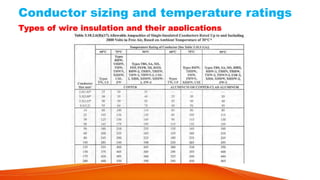
  • 58.
    3.0.1 General Requirements 3.0.1.11Securing and Supporting. Deals with the requirements for securing and supporting electrical installations. This section ensures that electrical conduits, cables, and other components are properly fastened and supported to maintain safety and reliability. For example, it specifies that electrical metallic tubing (EMT) must be securely fastened in place and supported at specific intervals to prevent sagging or movement1. This helps to prevent damage to the wiring and reduces the risk of electrical hazards. 3.0.1.12 Mechanical Continuity - Raceways and Cables. Raceways, cable armors, and cable sheaths shall be continuous between cabinets, boxes, fittings, or other enclosures or outlets. 3.0.1.13 Mechanical and Electrical Continuity-Conductors. • General. Conductors in raceways shall be continuous between outlets, boxes, devices, and so forth. There shall be no splice or tap within a raceway unless permitted by 3.0.1.15; 3.68.2.47(A); 3.76.2.47; 3.78.2.47; 3.84.2.47; 3.86.2.47; 3.88.2.47; or 3.90.1.7. • Device Removal. In multiwire branch circuits, the continuity of a grounded conductor shall not depend on device connections such as lampholders, receptacles, and so forth, where the removal of such devices would interrupt the continuity.
  • 59.
    3.0.1 General Requirements 3.0.1.14Length of Free Conductors at Outlets,Junctions, and Switch Points. At least 150 mm of free conductor, measured from the point in the box where it emerges from its raceway or cable sheath, shall be left at each outlet, junction, and switch point for splices or the connection of luminaires or devices. Where the opening to an outlet, junction, or switch point is less than 200 mm in any dimension, each conductor shall be long enough to extend at least 75 mm outside the opening. 3.0.1.15 Boxes, Conduit Bodies, or Fittings - Where Required. A box shall be installed at each outlet and switch point for concealed knob-and-tube wiring. Fittings and connectors shall be used only with the specific wiring methods for which they are designed and listed. 3.0.1.16 Raceway or Cable to Open or Concealed Wiring. A. Box, Conduit Body, or Fitting. B. Bushing. A bushing shall be permitted in lieu of a box or terminal where the conductors emerge from a raceway and enter or terminate at equipment, such as open switchboards, unenclosed control equipment, or similar equipment. The bushing shall be of the insulating type for other than lead-sheathed conductors
  • 60.
    3.0.1 General Requirements 3.0.1.17Number and Size of Conductors in Raceway. The number and size of conductors in any raceway shall not be more than will pem1it dissipation of the heat and ready installation or withdrawal of the conductors without damage to the conductors or to their insulation. 3.0.1.18 Raceway Installations. (A) Complete Runs. Raceways, other than busways or exposed raceways having hinged or remoYable covers, shall be installed complete between outle-. junction, or splicing points prior to the installation of conductors. (B) Welding. Metal raceways shall not be supported, terminated, or connected by welding to the raceway unless specifically designed to be or otherwise specifically permitted to be in this Code. 3.0.1.19 Supporting Conductors in Vertical Raceways. (A) Spacing Intervals - Maximum. Conductors in vertical raceways shall be supported if the vertical rise exceeds the values in Table 3.0.l.19(A). (B) Fire-Rated Cables and Conductors. Support methods and spacing intervals for fire-rated cables and conductors shall comply with any restrictions provided in the listing of the electrical circuit protective system used and in no case shall exceed the values in Table 3.0.1.19(A).
  • 61.
  • 62.
    3.0.1 General Requirements 3.0.1.20Induced Currents in Ferrous Metal Enclosures or Ferrous Metal Raceways. (A) Conductors Grouped Together. Where conductors carrying alternating current are installed in ferrous metal enclosures or ferrous metal raceways, they shall be arranged so as to avoid heating the surrounding ferrous metal by induction. To accomplish this, all phase conductors and, where used, the grounded conductor and all equipment grounding conductors shall be grouped together. (B) Individual Conductors. Where a single conductor carrying alternating current passes through metal with magnetic properties, the inductive effect shall be minimized by (1) cutting slots in the metal between the individual holes through which the individual conductors pass or (2) passing all the conductors in the circuit through an insulating wall sufficiently large for all of the conductors of the circuit. 3.0.1.21 Spread of Fire or Products of Combustion. Electrical installations in hollow spaces, vertical shafts, and ventilation or air-handling ducts shall be made so that the possible spread of fire or products of combustion will not be substantially increased. Openings around electrical penetrations into or through fire-resistant-rated walls, partitions, floors, or ceilings shall be :firestopped using approved methods to maintain the fire resistance rating.
  • 63.
    3.0.1 General Requirements 3.0.1.22Wiring in Ducts Not Used for Air Handling, Fabricated Ducts for Environmental Air, and Other Spaces for Environmental Air (Plenums). The provisions of this section shall apply to the installation and uses of electrical wiring and equipment in ducts used for dust, loose stock, or vapor removal; ducts specifically fabricated for environmental air; and other spaces used for environmental air (plenums ). 3.0.1.23 Panels Designed to Allow Access. Cables, raceways, and equipment installed behind panels designed to allow access, including suspended ceiling panels, shall be arranged and secured so as to allow the removal of panels and access to the equipment.
  • 64.
    3.0.2 Requirements forover 1000 Volts, Nominal 3.0.2.1 Covers Required. Suitable covers shall be installed on all boxes, fittings, and similar enclosures to prevent accidental contact with energized parts or physical damage to parts or insulation. 3.0.2.4 Conductor Bending Radius. The conductor shall not be bent to a radius less than 8 times the overall diameter for nonshielded conductors or 12 times the overall diameter for shielded or leadcovered conductors during or after installation. For multiconductor or multiplexed single-conductor cables having individually shielded conductors, the 164 minimum bending radius is 12 times the diameter of the individually shielded conductors or 7 times the overall diameter, whichever is greater. 3.0.2.5 Protection Against Induction Heating. Metallic raceways and associated conductors shall be arranged so as to amid heating of the raceway in accordance with the applicable provisions of 3.0.1.20. 3.0.2.7 Aboveground Wiring Methods. Aboveground conductors shall be installed in rigid metal conduit, in intennediate metal conduit, in electrical metallic tubing, in RTRC and PVC conduit, in cable trays, in auxiliary gutters. as busways, as cablebus.
  • 65.
    3.0.2 Requirements forover 1000 Volts, Nominal 3.0.2.8 Raceways in Wet Locations Above Grade. Where raceways are installed in wet locations above grade, the interior of these raceways shall be considered to be a wet location. Insulated conductors and cables installed in raceways in wet locations above grade shallcomply with 3.10.2.1(C). 3.0.2.9 Braid-Covered Insulated Conductors-Exposed Installation. Exposed runs of braid-covered insulated conductors shall have a flame-retardant braid. If the conductors used do not have this protection, a flame-retardant saturant shall be applied to the braid covering after installation. 3.0.2.10 Insulation Shielding. Metallic and semiconducting insulation shielding components of shielded cables shall be removed for a distance dependent on the circuit voltage and insulation. Stress reduction means shall be provided at all terminations of factory- applied shielding. 3.0.2.12 Moisture or Mechanical Protection for Metal-Sheathed Cables. Where cable conductors emerge from a metal sheath and where protection against moisture or physical damage is necessary, the insulation of the conductors shall be protected by a cable sheath terminating device.
  • 66.
    3.0.2 Requirements forover 1000 Volts, Nominal 3.0.2.15 Warning Signs. Warning signs shall be conspicuously posted at points of access to conductors in all conduit systems and cable systems. The warning sign(s) shall be legible and permanent and shall carry the following wording: DANGER-HIGH VOLTAGE-KEEP OUT
  • 67.
  • 68.
    ARTICLE 3.10 –CONDUCTORS FOR GENERAL WIRING STRANDED CONDUCTORS THE CONDUCTORS INSTALLED IN RACEWAYS, SIZE 8.0 mm2 AND LARGER SHALL BE STRANDED. CONDUCTORS IN PARALLEL CONDUCTORS THAT ARE 50 MM2 AND LARGER (ALUMINUM, COPPER_x0002_CLAD ALUMINUM, COPPER) ARE PERMITTED TO BE IN PARALLEL. PARALLEL CONDUCTORS IN EACH PHASE, POLARITY, NEUTRAL/GROUNDED CIRCUIT CONDUCTORS SHALL COMPLY WITH THE FF: 1. BE THE SAME LENGTH 2. HAVE THE SAME CONDUCTOR MATERIAL 3. BE THE SAME CROSS SECTIONAL AREA OF THE CONDUCTING MATERIAL 4. HAVE THE SAME INSULATION TYPE 5. BE TERMINATED IN THE SAME MANNER
  • 69.
    ARTICLE 3.10 –CONDUCTORS FOR GENERAL WIRING SHIELDED SOLID DIELECTRIC INSULATED CONDUCTORS OPERATED ABOVE 2000 VOLTS IN PERMANENT INSTALLATIONS SHALL HAVE AN OZONE RESISTANT INSULATION AND SHALL BE SHIELDED LOCATIONS A) DRY LOCATIONS - INSULATED CONDUCTORS AND CABLES OF ANY TYPE CAN BE USED IN DRY LOCATIONS. B) DRY AND DAMP LOCATIONS - INSULATED CONDUCTORS AND CABLES USED IN DRY AND DAMP LOCATIONS SHALL BE OF TYPES FEP, FEPB, MTW, PFA, RHH, RHW, RHW-2, SA, THHN, THW, THW-2, THHW, THHW-2, THWN, THWN-2, TW, XHH, XHHW, XHHW-2, Z, OR ZW C) WET LOCATIONS - CONDUCTORS USED IN WET LOCATIONS SHALL BE: 1. MOISTURE-IMPERVIOUS METAL SHEATHED 2. TYPES MTW, RHW, RHW-2, TW, THW, THW-2, THHW, THHW-2, THWN, THWN-2, XHHW, XHHW-2, ZW
  • 70.
    ARTICLE 3.10 –CONDUCTORS FOR GENERAL WIRING D) LOCATIONS EXPOSED TO DIRECT SUNLIGHT - INSULATED CONDUCTORS OR CABLES EXPOSED TO DIRECT RAYS OF THE SUN SHALL BE OF TYPES THAT ARE SUNLIGHT RESISTANT. MARKING A) REQUIRED INFORMATION - ALL CONDUCTORS AND CABLES SHALL BE MARKED WITH THE FOLLOWING: 1. THE MAXIMUM RATED VOLTAGE. 2. PROPER TYPE OF LETTER OR LETTERS. 3. THE MANUFACTURER’S NAME, TRADEMARK, OR DISTINCTIVE MARKING OF MANUFACTURER. 4. SIZE IN MILLIMETER SQUARE OR MILLIMETER DIAMETER. 5. CABLE ASSEMBLIES WHERE THE NEUTRAL CONDUCTOR IS SMALLER THAN THE UNGROUNDED CONDUCTORS
  • 71.
    ARTICLE 3.10 –CONDUCTORS FOR GENERAL WIRING B) METHOD OF MARKING 1. SURFACE MARKING - THE SIZE IN MM OR MM DIAMETER SHALL BE REPEATED AT INTERVALS NOT EXCEEDING 600 MM. ALL OTHER MARKINGS SHALL BE REPEATED AT INTERVALS NOT EXCEEDING 1000 MM. • SINGLE-CONDUCTOR AND • MULTICONDUCTOR RUBBER AND THERMOPLASTIC INSULATED WIRE • NONMETALLIC-SHEATHED CABLE • SERVICE-ENTRANCE CABLE • UNDERGROUND FEEDER AND TRAY
  • 72.
    ARTICLE 3.10 –CONDUCTORS FOR GENERAL WIRING 2. MARKER TAPE - METAL-COVERED MULTICONDUCTOR CABLES SHALL EMPLOY A MARKER TAPE. 3. TAG MARKING - PRINTED TAG SHALL BE ATTACHED TO THE COIL, REEL OR CARTON FOR THE FOLLOWING: • MINERAL-INSULATED, METAL_x0002_SHEATHED CABLE • SWITCHBOARD WIRES • METAL-COVERED, SINGLE_x0002_CONDUCTOR CABLES • TYPE AC CABLE
  • 73.
    ARTICLE 3.10 –CONDUCTORS FOR GENERAL WIRING C) SUFFIXES TO DESIGNATE NUMBER OF CONDUCTORS - A TYPE LETTER TO INDICATE THE NUMBER OF CONDUCTORS. D - TWO INSULATED CONDUCTORS LAY PARALLEL WITH NONMETALLIC COVERING. M - ASSEMBLY OF TWO OR MORE INSULATED CONDUCTORS, TWISTED SPIRALLY WITH NONMETALLIC COVERING. ALUMINUM CONDUCTOR MATERIAL - ALL ALUMINUM ALLOY CONDUCTORS SHALL BE MADE OF AA-8000 SERIES ELECTRICAL GRADE ALUMINUM. ALUMINUM CONDUCTOR MATERIAL - ALL ALUMINUM ALLOY CONDUCTORS SHALL BE MADE OF AA-8000 SERIES ELECTRICAL GRADE ALUMINUM. 1. SOLID CONDUCTORS - 8.0 MM2 (3.2 MM DIA.), 5.5 MM2 (2.6 MM DIA.), AND 3.5 MM2 (2.0 MM DIA.) 2. STRANDED CONDUCTORS - 8.0 MM2 THROUGH 500 MM2 (TYPE RHH, RHW, XHHW, THW, THHW, THWN, THHN, SERVICE-ENTRANCE TYPE SE STYLE U AND SE STYLE R)
  • 91.
    Article 3.50: LiquidtightFlexible Metal Conduit (Type LFMC) Definition and Use: Liquidtight Flexible Metal Conduit (LFMC) is a flexible conduit with a metal core covered by a liquidtight jacket. It is designed for installations requiring flexibility and protection from moisture, oil, or chemicals. Construction: LFMC consists of an interlocked or corrugated metal core, usually made of steel or aluminum, and a liquidtight nonmetallic outer jacket that protects it from the environment. Uses Permitted: LFMC can be used in environments where protection from water, oils, or corrosive substances is needed, such as industrial settings or outdoor applications. It is commonly used for flexible connections to motors, lighting fixtures, transformers, and HVAC units. LFMC is permitted in concealed and exposed locations as long as it is properly supported and installed in accordance with the PEC. Uses Not Permitted: LFMC is not suitable for use where subject to severe physical damage. It cannot be used as a grounding conductor by itself; a separate grounding conductor must be run alongside the LFMC if required by the installation.
  • 92.
    Article 3.52: RigidPVC Conduit (Type PVC) Definition and Use: Rigid PVC conduit (Type PVC) is a nonmetallic conduit made from polyvinyl chloride. It is corrosion- resistant, lightweight, and offers protection for electrical wiring against environmental factors like moisture, chemicals, and physical damage. Uses Permitted: • PVC conduit can be used in exposed and concealed locations where protection from environmental elements is needed. • It is allowed in underground installations (either direct burial or encased in concrete) and in locations subject to moisture, chemical exposure, or corrosive environments (e.g., near chemicals, saltwater, or in industrial settings). • Suitable for use in indoor and outdoor installations, including residential, commercial, and industrial settings. • It can be used for aboveground installations, but special care must be taken to protect it from physical damage in exposed areas.
  • 93.
    Article 3.52: RigidPVC Conduit (Type PVC) Uses Not Permitted: • PVC conduit cannot be used where it will be subjected to severe physical damage. • It cannot be used in environments with high temperature exposure, as the material may degrade or lose its structural integrity. • PVC is not to be used as a grounding conductor. When a grounding conductor is required, a separate ground wire must be included in the conduit system. Protection from Physical Damage: When installed in locations where the conduit could be exposed to physical damage, PVC conduit must be adequately protected by additional shielding or located in less vulnerable areas. Grounding Requirements: Since PVC is a non-conductive material, it cannot serve as a grounding path. If grounding is required, a separate grounding conductor must be run inside the conduit to comply with electrical grounding requirements.
  • 94.
    Article 3.53: High-DensityPolyethylene Conduit (Type HDPE Conduit) Definition and Characteristics: High-Density Polyethylene (HDPE) Conduit is a flexible, nonmetallic conduit made from durable HDPE material. It is highly resistant to corrosion, chemicals, moisture, and extreme temperatures, making it ideal for underground and outdoor installations. Uses Permitted: • HDPE conduit can be used in underground installations, including direct burial and installations within concrete encasement. • It is permitted for use in locations exposed to moisture, chemicals, and harsh environmental conditions (e.g., industrial plants, coastal areas). • HDPE conduit can also be used for long-distance horizontal directional drilling (HDD) applications due to its flexibility and strength. • It is often utilized for protecting fiber optic cables and electrical cables, especially in situations requiring long conduit runs without joints or fittings.
  • 95.
    Article 3.53: High-DensityPolyethylene Conduit (Type HDPE Conduit) Uses Not Permitted: • HDPE conduit cannot be used in environments where it is exposed to severe physical damage or direct flame, as it is a thermoplastic material. • It is not suitable for applications where high-temperature exposure could lead to deformation or failure of the conduit. • It is not to be used in aboveground installations without adequate protection from sunlight (UV exposure) unless it is specifically rated for UV resistance. Support and Securing: • HDPE conduit must be properly supported to prevent movement and maintain alignment, especially during backfilling in underground installations. • For direct burial applications, HDPE conduits are typically laid in a trench and covered with suitable backfill material to prevent shifting or damage.
  • 96.
    Article 3.54: NonmetallicUnderground Conduit with Conductors (Type NUCC) Definition and Characteristics: Nonmetallic Underground Conduit with Conductors (NUCC) is a nonmetallic conduit system that is pre-manufactured with electrical conductors inside. It is designed for underground installations to protect wiring from physical damage, moisture, corrosion, and environmental conditions. Uses Permitted: • NUCC is specifically designed for underground installations in direct burial applications, encased in concrete, or in locations subject to moisture or corrosive conditions. • It is permitted for use in service conductors, feeder circuits, and branch circuits for both residential and commercial buildings. • This type of conduit is ideal for areas requiring quick and efficient underground wiring installation since the conductors are already pre-installed.
  • 97.
    Article 3.54: NonmetallicUnderground Conduit with Conductors (Type NUCC) Uses Not Permitted: • NUCC cannot be used in aboveground installations unless specifically rated for such use. • It is not permitted in areas where it may be exposed to severe physical damage or where it could be exposed to direct sunlight without appropriate UV-resistant properties. • NUCC should not be used in environments with extreme heat, as nonmetallic conduits may degrade or deform under high temperatures. Installation Guidelines: • The conduit must be installed at the required depth as specified in the PEC, which typically depends on the voltage of the conductors and the location of installation (e.g., residential, commercial, or industrial). • Direct burial installations must ensure that the conduit is placed on a bed of suitable material, such as sand or crushed stone, to protect it from sharp objects and to provide stability. • In concrete-encased applications, care must be taken to ensure the conduit is properly secured and spaced to maintain alignment during the pouring of concrete.
  • 98.
    Article 3.55: ReinforcedThermosetting Resin Conduit (Type RTRC) Definition and Characteristics: Reinforced Thermosetting Resin Conduit (RTRC) is a rigid, nonmetallic conduit composed of thermosetting resin, reinforced with materials like fiberglass to increase its mechanical strength and durability. Uses Permitted: • RTRC conduit is permitted in aboveground and underground installations where it is exposed to chemicals, moisture, and corrosive substances. • It is used in industrial applications, hazardous locations, and outdoor environments requiring protection against harsh conditions. • Direct burial, concrete encasement, and exposed locations are allowed, as long as RTRC is properly supported and installed according to PEC requirements.
  • 99.
    Article 3.55: ReinforcedThermosetting Resin Conduit (Type RTRC) Uses Not Permitted: • RTRC cannot be used in locations where it may be subjected to severe physical damage unless additional protection is provided. • It is not suitable for use as a grounding conductor. Separate grounding conductors must be installed as part of the electrical system when required. • RTRC is not recommended for installations in areas where exposure to direct sunlight could cause material degradation unless specifically rated for UV resistance Protection Against Physical Damage: In locations where RTRC is exposed to potential physical damage, such as in industrial settings or areas with heavy equipment, additional protection (e.g., shields or concrete encasement) may be required to maintain the integrity of the conduit.
  • 100.
    Article 3.55: ReinforcedThermosetting Resin Conduit (Type RTRC) Grounding and Bonding: RTRC is a non-conductive material, so it cannot serve as a grounding path. A separate grounding conductor must be installed inside the conduit system to meet grounding requirements. All grounding and bonding provisions must comply with the PEC and ensure that all metallic parts of the system are properly grounded. Installation Considerations: • Cutting and handling of RTRC must be done with care to prevent cracking or damaging the conduit. Special tools or procedures may be necessary for cutting and fitting the conduit. • The installation process should ensure that the conduit is properly aligned, supported, and protected throughout the installation to maintain its long-term performance.
  • 101.
    Article 3.58: ElectricalMetallic Tubing (Type EMT) Definition and Characteristics: • Electrical Metallic Tubing (EMT) is a rigid, thin-walled conduit made of either steel or aluminum, used to protect and route electrical wiring in a variety of building types. • EMT is typically non-threaded and relies on compression or set-screw fittings to connect sections or terminate the conduit. Uses Permitted: • EMT is permitted for use in exposed and concealed locations, providing protection for electrical conductors in dry, wet, and damp conditions when installed according to code. • It is commonly used for the electrical wiring of branch circuits, feeders, and service conductors in residential, commercial, and industrial buildings. • EMT is suitable for use in areas that are not subject to severe physical damage, such as indoors or in commercial applications where mechanical protection is needed but the conduit won’t be exposed to harsh impacts.
  • 102.
    Article 3.58: ElectricalMetallic Tubing (Type EMT) Uses Not Permitted: • EMT cannot be used in locations where it is exposed to severe physical damage, such as in heavy industrial environments, unless additional protection is provided. • EMT is not suitable for direct burial or in concrete encasements unless specifically listed for such purposes or protected against corrosion. • It should not be used in installations where threaded conduit is required, as EMT is typically connected using compression or set-screw fittings rather than threading. Protection Against Corrosion: In corrosive environments, such as areas exposed to moisture, chemicals, or salt air, EMT must be installed with appropriate corrosion-resistant finishes or coatings, such as zinc or galvanization. Grounding and Bonding: EMT provides a continuous grounding path when properly installed. It can be used as an equipment grounding conductor, provided all fittings and connections are secure and electrically continuous.
  • 103.
    Article 3.58: ElectricalMetallic Tubing (Type EMT) Uses Not Permitted: • EMT cannot be used in locations where it is exposed to severe physical damage, such as in heavy industrial environments, unless additional protection is provided. • EMT is not suitable for direct burial or in concrete encasements unless specifically listed for such purposes or protected against corrosion. • It should not be used in installations where threaded conduit is required, as EMT is typically connected using compression or set-screw fittings rather than threading. Protection Against Corrosion: In corrosive environments, such as areas exposed to moisture, chemicals, or salt air, EMT must be installed with appropriate corrosion-resistant finishes or coatings, such as zinc or galvanization. Grounding and Bonding: EMT provides a continuous grounding path when properly installed. It can be used as an equipment grounding conductor, provided all fittings and connections are secure and electrically continuous.
  • 105.
    Armored Cable -A fabricated assembly of insulated conductors in a flexible metallic enclosure. Thermal Insulation - 90°C (194°F); For Application usage 60°C (140°F) Bending Radius - The radius of the curve not less than 5 times the diameter. Securing - 300 mm within every outlet box, junction box, cabinet. Supporting - Horizontal run supported within 1400m intervals. Uses Permitted Uses Not Permitted In both exposed and concealed works Where subject to physical damage In cable trays In damp or wet locations In dry locations Where exposed to corrosive fumes or vapors Embedded in plaster finish on brick or other masonry; except in damp or wet locations Embedded in plaster finish on brick or other masonry in damp or wet locations To be run or fished in the air voids of masonry block or tile walls; not exposed to excessive moisture/dampness In air voids of masonry block or tile walls where walls are exposed or subject to excessive moisture/dampness ARTICLE 3.20 – ARMORED CABLE:TYPE AC
  • 106.
  • 107.
    Flat Cable Assemblies- An assembly of parallel conductors formed integrally with an insulating material web specifically for field installation in surface metal raceway. • Construction - It consist of 2, 3, 4, or 5 conductors. • Conductors - 5.5 mm2 (2.6 mm dia.) special stranded copper wires. • Securing and Supporting - Supported by special design features within surface metal raceways. • Temperature Rating - The ratings shall be marked on the surface at intervals not exceeding 600 mm. • Grounded Conductor - White or gray marking. Uses Permitted Uses Not Permitted Branch circuits for lighting, small appliances, or small power loads (not exceed 30 amperes) Subject to corrosive vapors unless suitable for application Installed for exposed work In hoistways or on elevators or escalators Not subject to physical damage. In any hazardous (location) Surface metal raceways identified for the use Outdoors in wet or damp locations ARTICLE 3.22 – FLAT CABLE ASSEMBLIES:TYPE FC
  • 108.
  • 109.
    Flat Conductor Cable- 3 or more flat copper conductors placed edge-to-edge and separated and enclosed within an insulating assembly. • Bottom Shield - The protective layer installed between the floor and Type FCC for protection • Top Shield - A grounded metal shield covering under-carpet components. • Cable Connector - Connector designed to join Type FCC without using a junction box. • FCC System - Complete wiring system for branch circuits design for installation under carpet squares. • Insulating End - Insulator designed to electrically insulate the end of Type FCC. • Metal Shield Connections - Means of connection designed to electrically and mechanically connect a metal shield to another metal. • Transition Assembly - Incorporated with electrical connection and a suitable box or covering for safety. • Voltage - Shall not exceed 300V and voltage between phase and ground conductors not exceed 150V. • Current - General-purpose and appliance branch circuits shall have 20A rating. And, individual branch circuits shall have 30 ampere rating.
  • 110.
    Uses Not Permitted Outdoorsor in wet locations Subject to corrosive vapors In any hazardous (classified) location In residential, school, and hospital buildings Installation (shall be permitted on the following conditions): • Floors - Hard, sound, smooth, continuous floor surfaces made of concrete, ceramic/composition flooring. • Walls - Wall surfaces in surface metal raceways. • Heated Floors - Shall be identified if in excess of 30°C • System Height - Exceeding 2.30 mm shall be tapered or feathered at the edges to floor level.
  • 111.
  • 112.
    Integrated Gas Spacer- A factory assembly of one or more conductors, each individually insulated and enclosed in a loose fit, nonmetallic flexible conduit as an integrated gas spacer cable rated 0 through 600V. • Bends - A run Type IGS shall not contain more than equivalent of four quarter bends. (360 bends) • Fittings - The terminations and splices shall be suitable for maintaining gas pressure within the conduit. Valve and cap shall be provided to check the gas pressure or to inject gas into the conduit • Conductors - Solid aluminum rods, lay parallel, consisting of 1 to 19 (13 mm diam. rods). The minimum size conductor size shall be 125 mm2, and the maximum size shall be 2375 mm2. (4750 kcmil) • Insulation - Shall be dry kraft paper tapes and a pressurized sulfur hexafluoride (SF6). The nominal gas pressure shall be 138 kPA gauge. • Conduit - The conduit shall be a medium density polyethylene identified as suitable for use with natural gas rated pipe in race size 50 mm, 80 mm, or 100 mm. Uses Permitted Uses Not Permitted Service-entrance conductors Interior wiring or be exposed in contact with buildings Feeder or branch-circuit conductors
  • 115.
    Uses Permitted UsesNot Permitted In wet or dry locations Where exposed to direct sunlight In raceways In cable trays In cable trays (specified) Direct burial (not in accordance with code) Direct burial (specified) In messenger supported wiring
  • 116.
    Metal Clad Cable- A factory assembly of one or more insulated circuit conductors with or without optical fiber members enclosed in an armor of interlocking metal tape or a smooth or corrugated metallic sheath. Uses Permitted - Type MC cable shall be permitted as follows: 1. For services, feeders, and branch circuits 2. For power, lighting, control, and signal circuits 3. Indoors or outdoors 4. Exposed or concealed 5. To be direct buried where identified for such use 6. In cable tray where identified for such use 7. In any raceway 8. As aerial cable on a messenger 9. In hazardous (classified) locations as permitted 10. In dry locations and embedded in plaster finish on brick except in damp or wet locations 11. In wet locations where any of the following conditions are met: • Metallic covering is impervious to moisture • A lead sheath or moisture-impervious jacket is provided under the metal covering • The insulated conductors under the metallic covering are listed for use in wet locations 12. Where single-conductor cables are used, all phase conductors and, where used, the neutral conductor shall be grouped together. ARTICLE 3.30 – METAL-CLAD CABLE:TYPE MC
  • 117.
    Uses Not Permitted- shall not be exposed to corrosive conditions 1. Where subject to physical damage 2. Direct burial in the earth 3. In concrete Bending Radius - The radius of the curve of the inner edge of bends shall not be less than the required: • Smooth Sheath • Cable not more than 19 mm dia. - 10 times the external diameter • Cable more than 19 mm but less than 40 mm dia. - 12 times the external diameter • Cable more than 40 mm dia. - 15 times the external diameter • Interlocked-Type Armor or Corrugated Sheath - 7 times the external diameter • Shielded Conductors - 12 times the overall diameter of one of the individual conductors or 7 times the overall diameter of the multi-conductor cable, whichever is greater. Securing - Unless otherwise provided, cables shall be secured at intervals not exceeding 1800 mm. 4 or fewer conductors sized no larger than 5.5 mm2 (2.6 mm dia.) shall be secured within 300 mm. Conductors - copper, aluminum, or copper-clad aluminum, solid or stranded. The minimum conductor size shall be 18 AWG (0.75 mm2; 1.0 mm dia.) copper and 3.5 mm2 (2.0 mm dia.) aluminum or copper-clad aluminum.
  • 118.
  • 119.
    Mineral Insulated, Metal-SheathedCable - A factory assembly of one or more conductors insulated with a highly compressed refractory mineral insulation and enclosed in a liquid tight and gastight continuous copper or alloy steel sheath. Conductors - Solid copper, nickel, or nickel-coated copper Uses Permitted - Type MI cable shall be permitted as follows: 1. For services, feeders, and branch circuits 2. For power, lighting, control, and signal circuits 3. In dry, wet, or continuously moist locations 4. Indoors or outdoors 5. Where exposed or concealed 6. Where embedded in plaster, concrete, fill, or other masonry, whether above or below grade 7. In any hazardous (classified) location 8. Where exposed to oil and gasoline 9. Where exposed to corrosive conditions not deteriorating to its sheath 10. In underground runs where suitably protected against physical damage and corrosive conditions 11. In or attached to cable tray Uses Not Permitted - Type MI cable shall not be used under the following conditions 1. Underground runs unless protected from physical damage, where necessary 2. Exposed to conditions that are destructive and corrosive to the metallic sheath ARTICLE 3.32 – MINERAL-INSULATED, METAL-SHEATED CABLE:TYPE MI
  • 120.
    Bending Radius -The radius of the curve of the inner edge of bends shall not be less than the required • Cable more than 19 mm dia. - 5 times the external diameter • Cable greater than 19 mm but not more than 25 mm dia. - 10 times the external diameter Securing - Cables shall be secured at intervals not exceeding 1800 mm Mineral Insulated, Metal Sheated Cable: Type MI
  • 121.
    Nonmetallic-Sheathed Cable -A factory assembly of two or more insulated conductors enclosed within an overall nonmetallic jacket. • Type NM - Insulated conductors enclosed within an overall nonmetallic jacket. • Type NMC - Insulated conductors enclosed within an overall, corrosion resistant, nonmetallic jacket. • Type NMS - Insulated power or control conductors with signaling, data, and communications conductors within an overall nonmetallic jacket. Uses Permitted - Type NM, Type NMC, and Type NMS cables shall be permitted to be used in the ff: 1. One-and two-family dwellings 2. Multifamily dwellings permitted to be of Types III, IV, and V construction. 3. Other structures permitted to be of Types III, IV, and V construction. Cables shall be concealed within walls, floors, or ceilings that provide a thermal barrier of material that has at least a 15-minute finish rating. 4. Cable trays in structures permitted to be Types III, IV, or V identified for the use. ARTICLE 3.34 – NONMETALLIC-SHEATED CABLE:TYPE NM, NMC, AND NMS
  • 122.
    Uses Not Permitted- Type NM and NMS shall not be used under the ff: 1. Where exposed to corrosive fumes or vapors 2. Where embedded in masonry, concrete, adobe, fill, or plaster 3. In a shallow chase in masonry, concrete, or adobe and covered with plaster, adobe 4. Where exposed or subject to excessive moisture or dampness Protection from Physical Damage - conductors shall be protected by intermediate metallic conduit (IMC), rigid metallic conduit (RMC), electrical metallic tubing (EMT), or Schedule 80 PVC. Bending Radius - The radius of the curve of the inner edge shall not be less than 5 times the diameter of the cable. Securing and Supporting - The conductors shall be secured by staples, cable ties, straps, hangers, or similar fittings at intervals not exceeding 1400 mm and within 300 mm of every outlet box, junction box, cabinet, etc. Conductor Insulation - The conductor temperature insulation must be rated at 90°C Sheath - The outer sheath of nonmetallic-sheathed cable shall comply with the ff: a) Type NM - Flame retardant and moisture resistant. b) Type NMC - Flame retardant, moisture resistant, fungus resistant, and corrosion resistant. c) Type NMS - Flame retardant and moisture resistant. The sheath shall be applied so as to separate the power conductors from the communications and signaling conductors.
  • 123.
    Non-Metallic Sheated Cable:Type NM, NMC, and NMS
  • 124.
    Power and ControlTray Cable - A factory assembly of two or more insulated conductors, with or without associated bare or covered grounding conductors, under a nonmetallic jacket. Uses Permitted - Type TC cable shall be permitted to be used as follows: 1. For power, lighting, control, and signal circuits 2. In cable trays 3. In raceways 4. In outdoor locations supported by a messenger wire 5. For Class 1 circuits 6. For non-power-limited fire alarm circuits 7. In industrial establishments where there is regular maintenance and supervision. 8. Where installed in wet locations and shall be resistant to moisture and corrosive agents. Uses Not Permitted - Type TC tray cable shall not be installed as follows: 1. Exposed to physical damage 2. Installed outside a raceway or cable tray system, except as permitted. 3. Exposed to direct rays of the sun, unless identified as sunlight resistant. 4. Direct buried, unless identified for such use.
  • 125.
    Bending Radius -Type TC cable without metal shielding, bending radius shall be as follows: • 25 mm or less in dia. cable - 4 times the overall diameter • Larger than 25 mm (1 in.) but not more than 50 mm dia. - 5 times the overall diameter • Larger than 50 mm in dia. - 6 times the overall diameter Power and Control Tray Cable: Type TC
  • 126.
    Service-Entrance Cable -A single conductor or multi-conductor assembly provided with or without an overall covering, primarily used for services, and of the following types: a) Type SE - Cable with flame-retardant, moisture-resistant covering. b) Type USE - Cable identified for underground use, having a moisture-resistant covering, but not required to have a flame-retardant covering. Bending Radius - The radius of the curve of the inner edge shall not be less than 5 times the diameter of the cable. Service-Entrance Cable: Type SE and USE
  • 127.
    Underground Feeder andBranch-Circuit - A factory assembly of one or more insulated conductors with an integral or an overall covering of nonmetallic material suitable for direct burial in the earth. Uses Permitted - Type UF cable shall be permitted as follows: 1. For use underground, including direct burial in the earth 2. As single-conductor cable 3. Wiring in wet, dry, or corrosive locations recognized by the code 4. Installed as nonmetallic-sheathed cable 5. For solar photovoltaic systems 6. As single-conductor cables as the non-heating leads for heating cables 7. Supported by cable trays
  • 128.
    Uses Not Permitted- Type UF cable shall not be used as follows: 1. As service-entrance cable 2. In commercial garages 3. In theaters and similar locations 4. In motion picture studios 5. In storage battery rooms 6. In hoistways or on elevators or escalators 7. In hazardous (classified) locations 8. Embedded in poured cement, concrete, or aggregate, except where embedded in plaster as non-heating leads where permitted 9. Exposed to direct rays of the sun, unless identified as sunlight resistant 10. Where subject to physical damage 11. As overhead cable, except where installed as messenger- supported wiring
  • 129.
    Bending Radius -The radius of the curve of the inner edge shall not be less than 5 times the diameter of the cable. Conductors - The conductors shall be of sizes 2.0 mm2 (1.6 mm dia.) copper or 3.5 mm2 (2.0 mm dia.) aluminum or copper-clad aluminum through 100 mm2 Sheath - The overall covering shall be flame retardant; moisture, fungus, and corrosion resistant; and suitable for direct burial in the earth. Underground Feeder and Branch Circuit Cable: Type UF
  • 130.
    Intermediate Metal Conduit- A steel threadable raceway of circular cross section designed for the physical protection and routing of conductors and cables and for use as an equipment grounding conductor when installed with its integral or associated coupling and appropriate fittings. Uses Permitted: 1.All Atmospheric Conditions and Occupancies - IMC shall be permitted under all atmospheric conditions and occupancies. 2.Corrosion Environments - IMC, elbows, couplings, and fittings shall be permitted to be installed in concrete, in direct contact with earth. 3.Cinder Fill - IMC shall be protected on all sides by a layer of non-cinder concrete not less than 50 mm thick; where conduit is not less than 450 mm under the fill. 4.Wet Locations - All supports, bolts, straps, screws, and so forth, shall be of corrosionresistant materials or protected against corrosion by corrosion-resistant materials. Size: Minimum - IMC smaller than raceway size 15 mm shall not be used. Maximum - IMC larger than raceway size 100 mm shall not be used. Bends - Number in One Run - There shall not be more than 4 quarter bends (360 degree total)
  • 131.
    Securing and Supporting SecurelyFastened - 900 mm within of each outlet box, junction box, device box, cabinet, conduit body, or other conduit termination Supports - IMC shall be supported in accordance with one of the following: • Conduits supported at intervals not exceeding 3000 mm • Exposed vertical risers from industrial machinery or fixed equipment supported at intervals not exceeding 6000 mm. • Horizontal runs of IMC supported by openings through framing members at intervals not exceeding 3000 mm and securely fastened within 900 mm Marking - Conduits shall be durably marked at least every 1500 mm with the letters IMC. Standard Length - 3000 mm, including an attached coupling and each end shall be threaded. .
  • 132.
  • 133.
    Rigid Metal Conduit- A threadable raceway of circular cross section designed for the physical protection and routing of conductors and cables and for use as an equipment grounding conductor when installed with its integral or associated coupling and appropriate fittings. RMC is generally made of steel (ferrous) with protective coatings or aluminum (nonferrous). Special use types are silicon bronze and stainless steel. Uses Permitted 1. All Atmospheric Conditions and Occupancies - RMC is permitted under all atmospheric conditions and occupancies. Ferrous raceways and fittings protected from corrosion solely by enamel shall be permitted only indoors not subject to severe corrosive influences. 2. Corrosion Environments - RMC, elbows, couplings, and fittings shall be permitted to be installed in concrete, in direct contact with earth. 3. Cinder Fill - RMC shall be protected on all sides by a layer of non-cinder concrete not less than 50 mm thick; where conduit is not less than 450 mm under the fill. 4. Wet Locations - All supports, bolts, straps, screws, and so forth, shall be of corrosionresistant materials or protected against corrosion by corrosion-resistant materials. ARTICLE 3.44 –RIGID METAL CONDUIT :TYPE RMC
  • 134.
    Securing and Supporting SecurelyFastened - 900 mm within of each outlet box, junction box, device box, cabinet, conduit body, or other conduit termination. Supports - RMC shall be supported in accordance with one of the following: • Conduits supported at intervals not exceeding 3000 mm. • Exposed vertical risers from industrial machinery or fixed equipment supported at intervals not exceeding 6000 mm. • Horizontal runs of RMC supported by openings through framing members at intervals not exceeding 3000 mm and securely fastened within 900 mm. Marking - RMC shall be durably marked at least every 3000 mm. Nonferrous conduit of corrosion-resistant material shall have suitable markings. Standard Length - 3000 mm, including an attached coupling and each end shall be threaded. Longer or shorter lengths with or without coupling and threaded or unthreaded shall be permitted. Size: Minimum - RMC smaller than raceway size 15 mm shall not be used. Maximum - RMC larger than raceway size 150 mm shall not be used. Bends - Number in One Run - There shall not be more than 4 quarter bends. (360 degree total) Reaming and Threading - All cut ends shall be reamed to remove rough edges. Where conduit is threaded in the field, a standard cutting die with a taper of 1 in 16 shall be used.
  • 135.
  • 136.
    Flexible Metal Conduit- A raceway of circular cross section made of helically wound, formed, interlocked metal strip. Uses Permitted - FMC permitted to be used in exposed or concealed locations. Uses Not Permitted - FMC shall not be used in the following: 1. Wet locations unless the conductors are approved for the specific condition 2. In hoistways other than as permitted 3. In storage battery rooms 4. In any hazardous (classified) location other than permitted 5. Exposed to materials with a deteriorating effect on the conductors (such as oil or gasoline) 6. Underground or embedded in poured concrete or aggregate 7. Where subject to physical damage Size: Minimum - FMC less than raceway size 15 mm shall not be used. Maximum - FMC larger than raceway size 100 mm shall not be used. Trimmings - All cut ends shall be trimmed or finished to remove rough edges. Securing and Supporting Securely Fastened and Supported - 300 mm within of each outlet, junction, and device box cabinet, conduit body, and supported at intervals within 1400 mm. Couplings and Connectors - Angle connectors shall not be used for concealed raceway. ARTICLE 3.48 – FLEXIBLE METAL CONDUIT: TYPE FMC
  • 137.