SHRI GOVINDRAM SEKSARIA
INSTITUTE OF SCIENCE AND
TECHNOLOGY
ELECTRICAL WORKSHOP
POWER POINT PRESENTATION ON:
SUBMITTED TO: SUBMITTED BY:
ASHUTOSH SIR AAKASH LILHORE- 0801EE141001
AAYUSHI KHADIKAR- 0801EE141002
AISHWARYA KAUSHAL- 0801EE141006
AYUSHI JAIN- 0801EE141020
TABLE OF CONTENTS
 Electrical wiring
 Types of wiring according to use
 Factors affecting the choice of wiring
 Domestic Wiring- 1.Types of wirings
2.Conditions for domestic installations
 Colour coding
 Industrial Wiring
 Forms of Wires
 Conclusion
ELECTRICAL WIRING
Electrical wiring is generally refers to insulated
conductor used to carry current and associated
device. This presentation describes general
aspects of electrical wiring as used to provide
power in buildings and structures, commonly
referred to as building wiring. Building wiring is
the electrical wiring and associated devices such
as switches, meters and light fittings used in
buildings or other structures. Electrical wiring
uses insulated conductors.
FACTORS AFFECTING THE CHOICE OF WIRING:
1. DURABILITY: Type of wiring selected should conform to
standard specifications, so that it is durable i.e.
without being affected by the weather conditions,
fumes , etc.
2. SAFETY: The wiring must provide safety against leakage ,
shock and fire hazards for the operating
personnel.
3. APPEARANCE: Electrical wiring should give an aesthetic appeal
to the interiors.
4. COST: It should not be prohibitively expensive.
5. ACCESSIBILTY: The switches and plug points provided should be
easily accessible. There must be provision for
further extension of the wiring system, if
necessary.
6. MAINTENANCE COST: The maintenance cost should be a minimum.
7. MECHANICAL SAFETY: The wiring must be protected against any
mechanical damage.
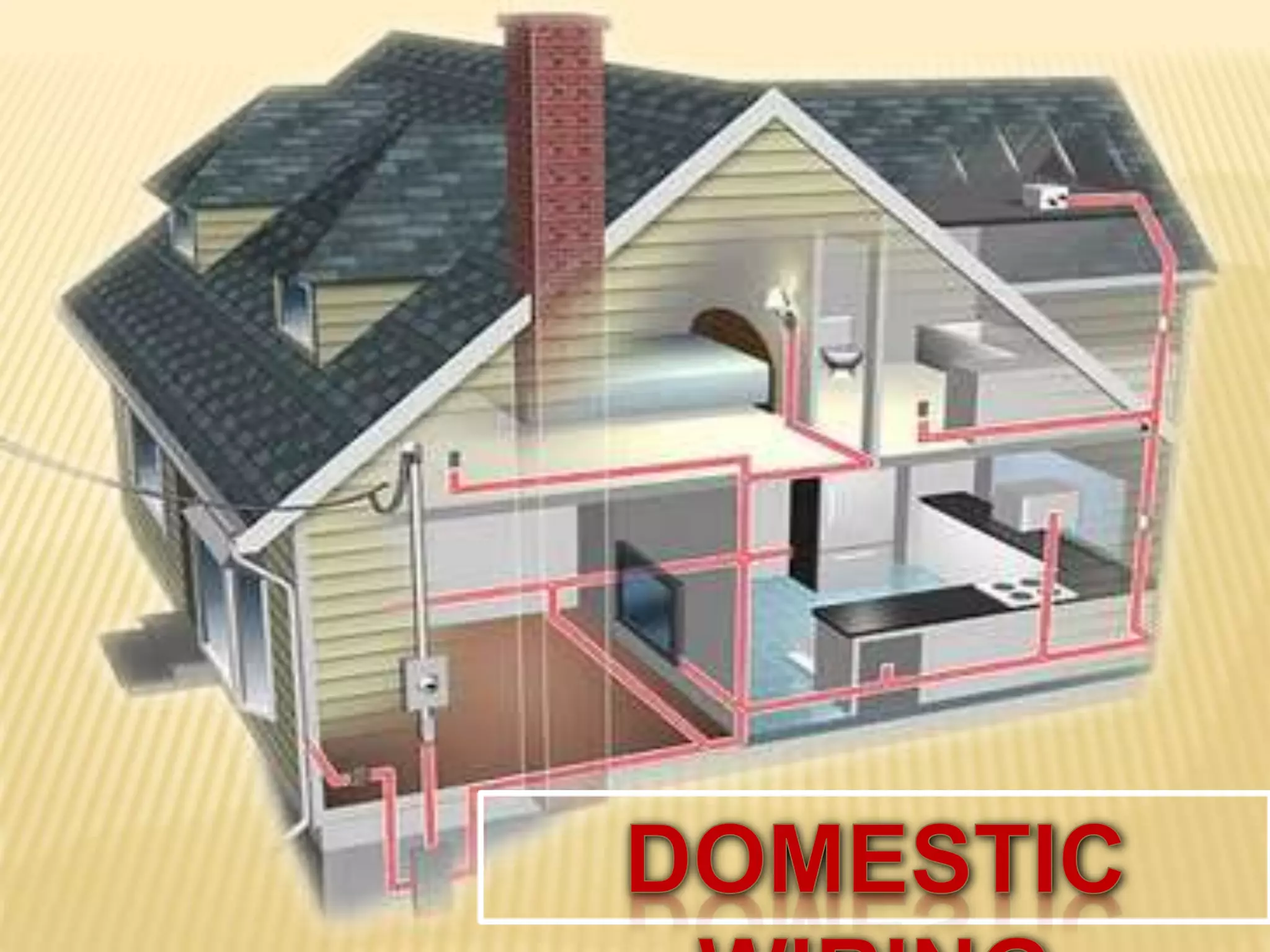
DOMESTIC WIRING
TYPES OF WIRINGS :
1. Cleat wiring
2. CTS wiring or TRS wiring or
batten wiring
3. Metal sheathed wiring or lead
sheathed wiring
4. Casing and capping
5. Conduit wiring
1. Cleat wiring:
In this type of wiring, insulated conductors (usually VIR, Vulcanized Indian Rubber) are
supported on porcelain or wooden cleats. The cleats have two halves one base and the other
cap. The cables are placed in the grooves provided in the base and then the cap is placed. Both
are fixed securely on the walls by 40mm long screws. The cleats are easy to erect and are fixed
4.5 – 15 cms apart. This wiring is suitable for temporary installations where cost is the main
criteria but not the appearance.
Advantages:
• Easy installation
• Materials can be retrieved for reuse
• Flexibility provided for inspection, modifications and expansion.
• Relatively economical
• Skilled manpower not required.
Disadvantages:
•Appearance is not good
•Open system of wiring requiring regular cleaning.
•Higher risk of mechanical injury.
2. CTS ( Cable Tyre Sheathed) / TRS ( Tough Rubber
Sheathed ) / Batten wiring:
In this wiring system, wires sheathed in tough rubber are used which are quite flexible.
They are clipped on wooden battens with brass clips (link or joint) and fixed on to the
walls or ceilings by flat head screws. These cables are moisture and chemical proof.
They are suitable for damp climate but not suitable for outdoor use in sunlight. TRS
wiring is suitable for lighting in low voltage installations.
Advantages:
•Easy installation and is durable
•Lower risk of short circuit.
•Cheaper than casing and capping system of wiring
•Gives a good appearance if properly erected.
Disadvantages:
•Danger of mechanical injury.
•Danger of fire hazard.
•Should not be exposed to direct sunlight.
•Skilled workmen are required.
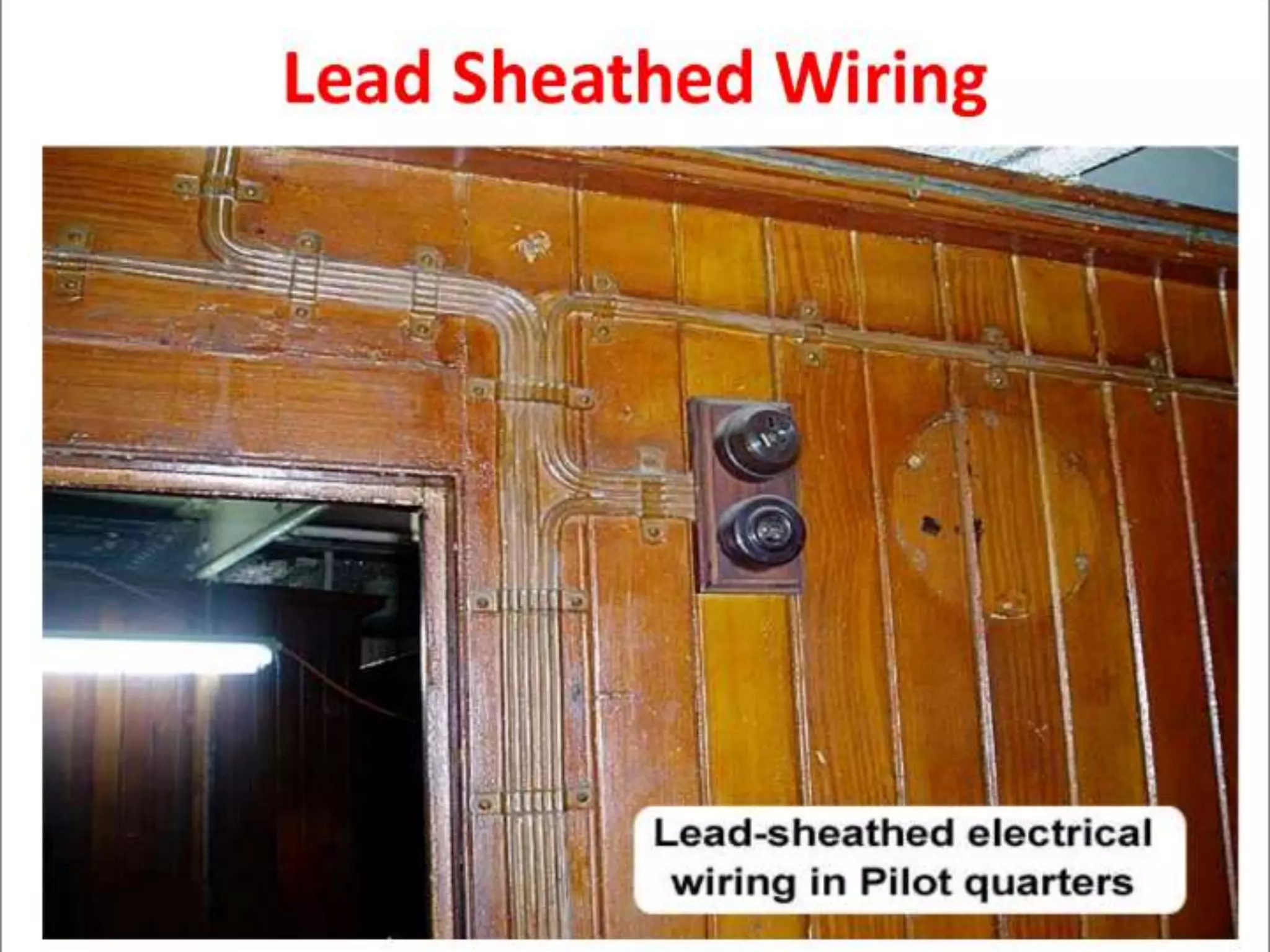
3. Metal Sheathed or Lead Sheathed wiring :
The wiring is similar to that of CTS but the conductors (two or three) are individually
insulated and covered with a common outer lead-aluminium alloy sheath. The sheath
protects the cable against dampness, atmospheric extremities and mechanical
damages. The sheath is earthed at every junction to provide a path to ground for the
leakage current. They are fixed by means of metal clips on wooden battens. The wiring
system is very expensive. It is suitable for low voltage installations.
Precautions to be taken during installation:
The clips used to fix the cables on battens should not react with the sheath.
Lead sheath should be properly earthed to prevent shocks due to leakage currents.
Cables should not be run in damp places and in areas where chemicals (may react with
the lead) are used.
Advantages:
•Easy installation and is aesthetic in appearance
•Highly durable
•Suitable in adverse climatic conditions provided the joints are not
exposed.
Disadvantages:
•Requires skilled labor
•Very expensive
•Unsuitable for chemical industries
4. Casing and Capping:
It consists of insulated conductors laid inside rectangular, teakwood or PVC boxes
having grooves inside it. A rectangular strip of wood called capping having same width
as that of casing is fixed over it. Both the casing and the capping are screwed together
at every 15 cms. Casing is attached to the wall. Two or more wires of same polarity are
drawn through different grooves. The system is suitable for indoor and domestic
installations.
Advantages:
• Cheaper than lead sheathed and conduit wiring.
• Provides good isolation as the conductors are placed apart reducing the risk of short
circuit.
• Easily accessible for inspection and repairs.
• Since the wires are not exposed to atmosphere, insulation is less affected by dust,
dirt and climatic variations.
Disadvantages:
•Highly inflammable.
•Usage of unseasoned wood gets damaged by termites.
•Skilled workmanship required.
5. Conduit wiring:
In this system PVC (polyvinyl chloride) or VIR cables are run through metallic or PVC
pipes providing good protection against mechanical injury and fire due to short circuit.
They are either embedded inside the walls or supported over the walls, and are known
as concealed wiring or surface conduit wiring (open conduit) respectively. The conduits
are buried inside the walls on wooden gutties and the wires are drawn through them
with fish (steel) wires. The system is best suited for public buildings, industries and
workshops.
Advantages:
• No risk of fire and good protection against mechanical injury.
• The lead and return wires can be carried in the same tube.
• Earthing and continuity is assured.
• Waterproof and trouble shooting is easy.
• Shock- proof with proper earthing and bonding
• Durable and maintenance free
• Aesthetic in appearance
Disadvantages:
• Very expensive system of wiring.
• Requires good skilled workmanship.
CONDITION FOR DOMESTIC INSTALLATION
• Height of switch board must be 1.3m to 1.75m from floor
level.
•Height of distribution board must be 1.5m to 1.75m from
floor level.
•The bottom of ceiling fan should have minimum clearance of
2.75m.
•All lamp should be fitted with a minimum clearance of 2.75m
above floor level.
•For load above 4KW,3 phase supply must arrange load
should be equally shared.
•In any building light wiring and power wiring should be kept
separate.
•Power per circuit may take it as 800W or 1000W.
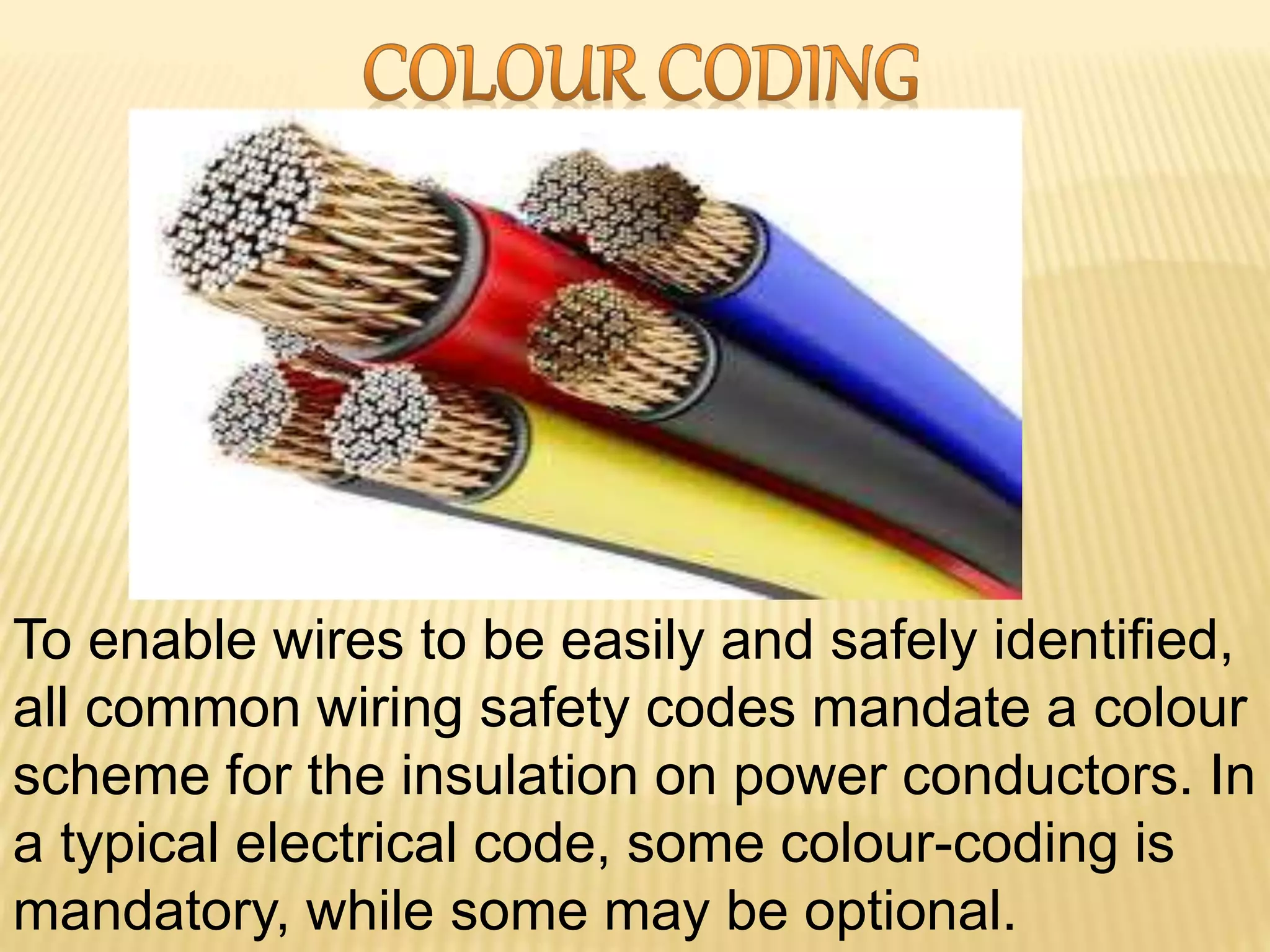
To enable wires to be easily and safely identified,
all common wiring safety codes mandate a colour
scheme for the insulation on power conductors. In
a typical electrical code, some colour-coding is
mandatory, while some may be optional.
INDUSTRIAL WIRING:
Every type of machine has unique requirements when it comes to operator safety.
From an electrical standpoint, industrial machine equipment and tools - from drill
presses to multi-motored automatic machines - can present special fire and shock
hazards.
You must identify conductors at each termination so they match the identification
markings on the diagrams attached to the machine.
Equipment-grounding conductors -- You must use the colour
green, with or without one or more yellow stripes, to identify the equipment-
grounding conductor (where insulated or covered). International and European
standards require the use of a bicolour green-and-yellow for this purpose . You can use
conductors of other colours, provided the insulation or cover is appropriately
identified at all access points.
For grounded control circuits, you may use a green (with or without one or more
yellow stripes) or a bare conductor to connect the transformer terminal to a grounding
terminal on the control panel.
Other colours for the purpose of identification
as follows:
• Black represents ungrounded line, load and control conductors at line
voltage.
• Red represents ungrounded AC control conductors, at less than line voltage.
• Blue represents ungrounded DC control conductors.
• Yellow represents ungrounded control circuit conductors that may remain
energized when the main disconnecting means is in the OFF position. These
conductors must be yellow throughout the entire circuit, including wiring in the
control panel and the external field wiring. International and European
Standards require you to use orange for this purpose.
• White or natural gray represents a grounded circuit conductor.
• White with blue stripe represents a grounded DC current-carrying circuit
conductor. International and European standards require you to use light blue
for the neutral conductor .
• White with yellow stripe represents grounded AC current-carrying control
circuit conductors that remain energized when the disconnecting means is in
the OFF position. For additional circuits powered from different sources that
remain energized when the main disconnecting means is in the OFF position,
you must use striping colors other than green, yellow or blue to uniquely
identify the grounded conductors.
SPLICES –
You are required to run conductors and cables from terminal to terminal without splices.
However, an exception allows you to install a splice in leads attached to electrical
equipment, such as motors and solenoids.
PANEL WIRING –
This section requires you to support conductors in panels to keep them in place. You're
permitted to use wiring channels if they're made of a flame-retardant insulating material.
If you're working with back-connected control panels, you must provide access doors or
swing out panels that swing about a vertical axis. Multiple-device control panels must
have terminal blocks or attachment plugs and receptacles to terminate and connect all
outgoing control conductors.
MACHINE WIRING –
You must totally enclose conductors and their connection external to the control panel
enclosure in suitable raceways or enclosures. Unless used for flexible connections
involving small or infrequent movements, or connections to normally stationary motors,
limit switches and other externally mounted devices, fittings used with raceways or
multiconductor cables must be liquid tight.
Wire connectors and connections –
You are required to use pressure connectors to connect conductors to devices with
lug-type terminals that are not equipped with saddle straps or equivalent means of
retaining conductor strands. Under certain conditions of use, the standard allows you
to use solder connections and wire-wrapped connections.
Raceway fill –
The combined cross-sectional area of all conductors and cables is not permitted to
exceed 50% of the interior cross-sectional area of the raceway. The fill provisions are
based on the actual dimensions of the conductors or cables used.
Junction and pull boxes –
When constructing junction boxes and pull boxes, you must be careful to exclude
materials such as dust, flyings, oil and coolant. After you complete all wiring
operations, you must seal all unused knockouts or openings.
FORMS OF WIRES
•Solid wire
Solid wire, also called solid-core or single-strand wire, consists of one piece of metal
wire. Solid wire is useful for wiring breadboards. Solid wire is cheaper to manufacture
than stranded wire and is used where there is little need for flexibility in the wire. Solid
wire also provides mechanical ruggedness; and, because it has relatively less surface
area which is exposed to attack by corrosives, protection against the environment
friendly.
•Stranded wire
Stranded copper wire-
Stranded wire is composed of a number of small gauge wire bundled or wrapped
together to form a larger conductor. Stranded wire is more flexible than solid wire of
the same total cross-sectional area. Stranded wire tends to be a better conductor than
solid wire because the individual wires collectively comprise a greater surface area.
Stranded wire is used when higher resistance to metal fatigue is required.
•Braided wire
A braided wire is composed of a number of small strands of wire braided together.
Similar to stranded wires, braided wires are better conductors than solid wires.
Braided wires do not break easily when flexed. Braided wires are often suitable as an
electromagnetic shield in noise-reduction cables.
Number of strands
The more individual wire strands in a wire bundle, the more flexible, kink-resistant,
break-resistant, and stronger the wire is. But more strands increase cost.
The lowest number of strands usually seen is 7: one in the middle, 6 surrounding it.
The next level up is 19, which is another layer of 12 strands on top of the 7. After that
the number varies, but 37 and 49 are common, then in the 70 to 100 range (the
number is no longer exact). Even larger numbers than that are typically found only in
very large cables.
For application where the wire moves, 19 is the lowest that should be used (7 should
only be used in applications where the wire is placed and then does not move), and 49
is much better. For applications with constant repeated movement, such as assembly
robots and headphone wires, 70 to 100 is mandatory.
Modern electrical machine tool equipment may vary from
that of a single-motor machine (such as a drill press that
performs simple, repetitive operations) to very large,
multimotored automatic machines, which contain highly
complex electrical control systems. Typically, these machines
are especially designed, factory-wired, tested by the builder
and then erected in the plant.
You must install, support, and protect interconnection
wiring from the supply circuit and between machines.
Residential wiring PPT.pptx

Residential wiring PPT.pptx

  • 1.
    SHRI GOVINDRAM SEKSARIA INSTITUTEOF SCIENCE AND TECHNOLOGY ELECTRICAL WORKSHOP POWER POINT PRESENTATION ON: SUBMITTED TO: SUBMITTED BY: ASHUTOSH SIR AAKASH LILHORE- 0801EE141001 AAYUSHI KHADIKAR- 0801EE141002 AISHWARYA KAUSHAL- 0801EE141006 AYUSHI JAIN- 0801EE141020
  • 3.
    TABLE OF CONTENTS Electrical wiring  Types of wiring according to use  Factors affecting the choice of wiring  Domestic Wiring- 1.Types of wirings 2.Conditions for domestic installations  Colour coding  Industrial Wiring  Forms of Wires  Conclusion
  • 4.
    ELECTRICAL WIRING Electrical wiringis generally refers to insulated conductor used to carry current and associated device. This presentation describes general aspects of electrical wiring as used to provide power in buildings and structures, commonly referred to as building wiring. Building wiring is the electrical wiring and associated devices such as switches, meters and light fittings used in buildings or other structures. Electrical wiring uses insulated conductors.
  • 6.
    FACTORS AFFECTING THECHOICE OF WIRING: 1. DURABILITY: Type of wiring selected should conform to standard specifications, so that it is durable i.e. without being affected by the weather conditions, fumes , etc. 2. SAFETY: The wiring must provide safety against leakage , shock and fire hazards for the operating personnel. 3. APPEARANCE: Electrical wiring should give an aesthetic appeal to the interiors. 4. COST: It should not be prohibitively expensive. 5. ACCESSIBILTY: The switches and plug points provided should be easily accessible. There must be provision for further extension of the wiring system, if necessary. 6. MAINTENANCE COST: The maintenance cost should be a minimum. 7. MECHANICAL SAFETY: The wiring must be protected against any mechanical damage.
  • 8.
    DOMESTIC WIRING TYPES OFWIRINGS : 1. Cleat wiring 2. CTS wiring or TRS wiring or batten wiring 3. Metal sheathed wiring or lead sheathed wiring 4. Casing and capping 5. Conduit wiring
  • 9.
    1. Cleat wiring: Inthis type of wiring, insulated conductors (usually VIR, Vulcanized Indian Rubber) are supported on porcelain or wooden cleats. The cleats have two halves one base and the other cap. The cables are placed in the grooves provided in the base and then the cap is placed. Both are fixed securely on the walls by 40mm long screws. The cleats are easy to erect and are fixed 4.5 – 15 cms apart. This wiring is suitable for temporary installations where cost is the main criteria but not the appearance. Advantages: • Easy installation • Materials can be retrieved for reuse • Flexibility provided for inspection, modifications and expansion. • Relatively economical • Skilled manpower not required. Disadvantages: •Appearance is not good •Open system of wiring requiring regular cleaning. •Higher risk of mechanical injury.
  • 11.
    2. CTS (Cable Tyre Sheathed) / TRS ( Tough Rubber Sheathed ) / Batten wiring: In this wiring system, wires sheathed in tough rubber are used which are quite flexible. They are clipped on wooden battens with brass clips (link or joint) and fixed on to the walls or ceilings by flat head screws. These cables are moisture and chemical proof. They are suitable for damp climate but not suitable for outdoor use in sunlight. TRS wiring is suitable for lighting in low voltage installations. Advantages: •Easy installation and is durable •Lower risk of short circuit. •Cheaper than casing and capping system of wiring •Gives a good appearance if properly erected. Disadvantages: •Danger of mechanical injury. •Danger of fire hazard. •Should not be exposed to direct sunlight. •Skilled workmen are required.
  • 12.
    3. Metal Sheathedor Lead Sheathed wiring : The wiring is similar to that of CTS but the conductors (two or three) are individually insulated and covered with a common outer lead-aluminium alloy sheath. The sheath protects the cable against dampness, atmospheric extremities and mechanical damages. The sheath is earthed at every junction to provide a path to ground for the leakage current. They are fixed by means of metal clips on wooden battens. The wiring system is very expensive. It is suitable for low voltage installations. Precautions to be taken during installation: The clips used to fix the cables on battens should not react with the sheath. Lead sheath should be properly earthed to prevent shocks due to leakage currents. Cables should not be run in damp places and in areas where chemicals (may react with the lead) are used.
  • 13.
    Advantages: •Easy installation andis aesthetic in appearance •Highly durable •Suitable in adverse climatic conditions provided the joints are not exposed. Disadvantages: •Requires skilled labor •Very expensive •Unsuitable for chemical industries
  • 15.
    4. Casing andCapping: It consists of insulated conductors laid inside rectangular, teakwood or PVC boxes having grooves inside it. A rectangular strip of wood called capping having same width as that of casing is fixed over it. Both the casing and the capping are screwed together at every 15 cms. Casing is attached to the wall. Two or more wires of same polarity are drawn through different grooves. The system is suitable for indoor and domestic installations. Advantages: • Cheaper than lead sheathed and conduit wiring. • Provides good isolation as the conductors are placed apart reducing the risk of short circuit. • Easily accessible for inspection and repairs. • Since the wires are not exposed to atmosphere, insulation is less affected by dust, dirt and climatic variations. Disadvantages: •Highly inflammable. •Usage of unseasoned wood gets damaged by termites. •Skilled workmanship required.
  • 17.
    5. Conduit wiring: Inthis system PVC (polyvinyl chloride) or VIR cables are run through metallic or PVC pipes providing good protection against mechanical injury and fire due to short circuit. They are either embedded inside the walls or supported over the walls, and are known as concealed wiring or surface conduit wiring (open conduit) respectively. The conduits are buried inside the walls on wooden gutties and the wires are drawn through them with fish (steel) wires. The system is best suited for public buildings, industries and workshops. Advantages: • No risk of fire and good protection against mechanical injury. • The lead and return wires can be carried in the same tube. • Earthing and continuity is assured. • Waterproof and trouble shooting is easy. • Shock- proof with proper earthing and bonding • Durable and maintenance free • Aesthetic in appearance Disadvantages: • Very expensive system of wiring. • Requires good skilled workmanship.
  • 18.
    CONDITION FOR DOMESTICINSTALLATION • Height of switch board must be 1.3m to 1.75m from floor level. •Height of distribution board must be 1.5m to 1.75m from floor level. •The bottom of ceiling fan should have minimum clearance of 2.75m. •All lamp should be fitted with a minimum clearance of 2.75m above floor level. •For load above 4KW,3 phase supply must arrange load should be equally shared. •In any building light wiring and power wiring should be kept separate. •Power per circuit may take it as 800W or 1000W.
  • 19.
    To enable wiresto be easily and safely identified, all common wiring safety codes mandate a colour scheme for the insulation on power conductors. In a typical electrical code, some colour-coding is mandatory, while some may be optional.
  • 23.
    INDUSTRIAL WIRING: Every typeof machine has unique requirements when it comes to operator safety. From an electrical standpoint, industrial machine equipment and tools - from drill presses to multi-motored automatic machines - can present special fire and shock hazards. You must identify conductors at each termination so they match the identification markings on the diagrams attached to the machine. Equipment-grounding conductors -- You must use the colour green, with or without one or more yellow stripes, to identify the equipment- grounding conductor (where insulated or covered). International and European standards require the use of a bicolour green-and-yellow for this purpose . You can use conductors of other colours, provided the insulation or cover is appropriately identified at all access points. For grounded control circuits, you may use a green (with or without one or more yellow stripes) or a bare conductor to connect the transformer terminal to a grounding terminal on the control panel.
  • 24.
    Other colours forthe purpose of identification as follows: • Black represents ungrounded line, load and control conductors at line voltage. • Red represents ungrounded AC control conductors, at less than line voltage. • Blue represents ungrounded DC control conductors. • Yellow represents ungrounded control circuit conductors that may remain energized when the main disconnecting means is in the OFF position. These conductors must be yellow throughout the entire circuit, including wiring in the control panel and the external field wiring. International and European Standards require you to use orange for this purpose. • White or natural gray represents a grounded circuit conductor. • White with blue stripe represents a grounded DC current-carrying circuit conductor. International and European standards require you to use light blue for the neutral conductor . • White with yellow stripe represents grounded AC current-carrying control circuit conductors that remain energized when the disconnecting means is in the OFF position. For additional circuits powered from different sources that remain energized when the main disconnecting means is in the OFF position, you must use striping colors other than green, yellow or blue to uniquely identify the grounded conductors.
  • 25.
    SPLICES – You arerequired to run conductors and cables from terminal to terminal without splices. However, an exception allows you to install a splice in leads attached to electrical equipment, such as motors and solenoids. PANEL WIRING – This section requires you to support conductors in panels to keep them in place. You're permitted to use wiring channels if they're made of a flame-retardant insulating material. If you're working with back-connected control panels, you must provide access doors or swing out panels that swing about a vertical axis. Multiple-device control panels must have terminal blocks or attachment plugs and receptacles to terminate and connect all outgoing control conductors. MACHINE WIRING – You must totally enclose conductors and their connection external to the control panel enclosure in suitable raceways or enclosures. Unless used for flexible connections involving small or infrequent movements, or connections to normally stationary motors, limit switches and other externally mounted devices, fittings used with raceways or multiconductor cables must be liquid tight.
  • 26.
    Wire connectors andconnections – You are required to use pressure connectors to connect conductors to devices with lug-type terminals that are not equipped with saddle straps or equivalent means of retaining conductor strands. Under certain conditions of use, the standard allows you to use solder connections and wire-wrapped connections. Raceway fill – The combined cross-sectional area of all conductors and cables is not permitted to exceed 50% of the interior cross-sectional area of the raceway. The fill provisions are based on the actual dimensions of the conductors or cables used. Junction and pull boxes – When constructing junction boxes and pull boxes, you must be careful to exclude materials such as dust, flyings, oil and coolant. After you complete all wiring operations, you must seal all unused knockouts or openings.
  • 28.
    FORMS OF WIRES •Solidwire Solid wire, also called solid-core or single-strand wire, consists of one piece of metal wire. Solid wire is useful for wiring breadboards. Solid wire is cheaper to manufacture than stranded wire and is used where there is little need for flexibility in the wire. Solid wire also provides mechanical ruggedness; and, because it has relatively less surface area which is exposed to attack by corrosives, protection against the environment friendly. •Stranded wire Stranded copper wire- Stranded wire is composed of a number of small gauge wire bundled or wrapped together to form a larger conductor. Stranded wire is more flexible than solid wire of the same total cross-sectional area. Stranded wire tends to be a better conductor than solid wire because the individual wires collectively comprise a greater surface area. Stranded wire is used when higher resistance to metal fatigue is required.
  • 30.
    •Braided wire A braidedwire is composed of a number of small strands of wire braided together. Similar to stranded wires, braided wires are better conductors than solid wires. Braided wires do not break easily when flexed. Braided wires are often suitable as an electromagnetic shield in noise-reduction cables. Number of strands The more individual wire strands in a wire bundle, the more flexible, kink-resistant, break-resistant, and stronger the wire is. But more strands increase cost. The lowest number of strands usually seen is 7: one in the middle, 6 surrounding it. The next level up is 19, which is another layer of 12 strands on top of the 7. After that the number varies, but 37 and 49 are common, then in the 70 to 100 range (the number is no longer exact). Even larger numbers than that are typically found only in very large cables. For application where the wire moves, 19 is the lowest that should be used (7 should only be used in applications where the wire is placed and then does not move), and 49 is much better. For applications with constant repeated movement, such as assembly robots and headphone wires, 70 to 100 is mandatory.
  • 31.
    Modern electrical machinetool equipment may vary from that of a single-motor machine (such as a drill press that performs simple, repetitive operations) to very large, multimotored automatic machines, which contain highly complex electrical control systems. Typically, these machines are especially designed, factory-wired, tested by the builder and then erected in the plant. You must install, support, and protect interconnection wiring from the supply circuit and between machines.