Types of Wiring
Electrical Wiring
• Electrical Wiring is a process of connecting cables and wires to the
related devices such as fuse, switches, sockets, lights, fans etc. to the
main distribution board in a specific structure to the utility pole for
continues power supply.
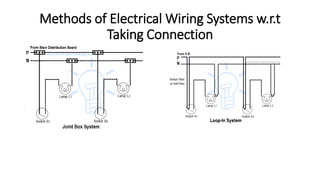
Methods of Electrical Wiring Systems w.r.t
Taking Connection
• Advantages of Loop-In Method of Wiring
• It doesn’t require joint boxes and so money is saved
• In loop – in systems, no joint is concealed beneath floors or in roof spaces.
• Fault location is made easy as the points are made only at outlets so that they
are accessible.
• Disadvantages of Loop-In Method of Wiring
• Length of wire or cables required is more and voltage drop and copper losses
are therefore more
• Looping – in switches and lamp holders is usually difficult
Different Types of Electrical Wiring Systems
The types of internal wiring usually used are
• Cleat wiring
• Wooden casing and capping wiring
• CTS or TRS or PVC sheath wiring
• Lead sheathed or metal sheathed wiring
• Conduit wiring
• Surface or open Conduit type
• Recessed or concealed or underground type Conduit
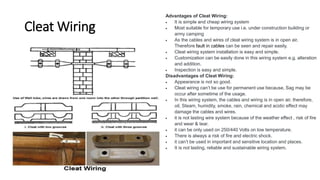
Cleat Wiring
Advantages of Cleat Wiring:
 It is simple and cheap wiring system
 Most suitable for temporary use i.e. under construction building or
army camping
 As the cables and wires of cleat wiring system is in open air,
Therefore fault in cables can be seen and repair easily.
 Cleat wiring system installation is easy and simple.
 Customization can be easily done in this wiring system e.g. alteration
and addition.
 Inspection is easy and simple.
Disadvantages of Cleat Wiring:
 Appearance is not so good.
 Cleat wiring can’t be use for permanent use because, Sag may be
occur after sometime of the usage.
 In this wiring system, the cables and wiring is in open air, therefore,
oil, Steam, humidity, smoke, rain, chemical and acidic effect may
damage the cables and wires.
 it is not lasting wire system because of the weather effect , risk of fire
and wear & tear.
 it can be only used on 250/440 Volts on low temperature.
 There is always a risk of fire and electric shock.
 it can’t be used in important and sensitive location and places.
 It is not lasting, reliable and sustainable wiring system.
Casing and Capping wiring
Advantages of Casing Capping Wiring:
 It is cheap wiring system as compared to sheathed and
conduit wiring systems.
 It is strong and long-lasting wiring system.
 Customization can be easily done in this wiring system.
 If Phase and Neutral wire is installed in separate slots, then
repairing is easy.
 Stay for long time in the field due to strong insulation of
capping and casing..
 It stays safe from oil, Steam, smoke and rain.
 No risk of electric shock due to covered wires and cables in
casing & capping.
Disadvantages Casing Capping Wiring:
 There is a high risk of fire in casing & capping wiring system.
 Not suitable in the acidic, alkalies and humidity conditions
 Costly repairing and need more material.
 Material can’t be found easily in the contemporary
 White ants may damage the casing & capping of wood.
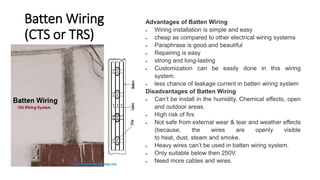
Batten Wiring
(CTS or TRS)
Advantages of Batten Wiring
 Wiring installation is simple and easy
 cheap as compared to other electrical wiring systems
 Paraphrase is good and beautiful
 Repairing is easy
 strong and long-lasting
 Customization can be easily done in this wiring
system.
 less chance of leakage current in batten wiring system
Disadvantages of Batten Wiring
 Can’t be install in the humidity, Chemical effects, open
and outdoor areas.
 High risk of firs
 Not safe from external wear & tear and weather effects
(because, the wires are openly visible
to heat, dust, steam and smoke.
 Heavy wires can’t be used in batten wiring system.
 Only suitable below then 250V.
 Need more cables and wires.
Lead Sheathed Wiring
• The type of wiring employs conductors that are insulated with VIR
and covered with an outer sheath of lead aluminum alloy containing
about 95% of lead. The metal sheath given protection to cables from
mechanical damage, moisture and atmospheric corrosion.
• The whole lead covering is made electrically continuous and is
connected to earth at the point of entry to protect against electrolytic
action due to leaking current and to provide safety in case the sheath
becomes alive. The cables are run on wooden batten and fixed by
means of link clips just as in TRS wiring.
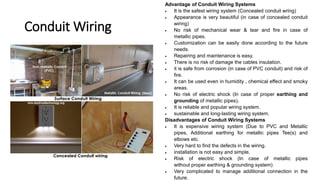
Conduit Wiring
Advantage of Conduit Wiring Systems
 It is the safest wiring system (Concealed conduit wring)
 Appearance is very beautiful (in case of concealed conduit
wiring)
 No risk of mechanical wear & tear and fire in case of
metallic pipes.
 Customization can be easily done according to the future
needs.
 Repairing and maintenance is easy.
 There is no risk of damage the cables insulation.
 it is safe from corrosion (in case of PVC conduit) and risk of
fire.
 It can be used even in humidity , chemical effect and smoky
areas.
 No risk of electric shock (In case of proper earthing and
grounding of metallic pipes).
 It is reliable and popular wiring system.
 sustainable and long-lasting wiring system.
Disadvantages of Conduit Wiring Systems
 It is expensive wiring system (Due to PVC and Metallic
pipes, Additional earthing for metallic pipes Tee(s) and
elbows etc.
 Very hard to find the defects in the wiring.
 installation is not easy and simple.
 Risk of electric shock (In case of metallic pipes
without proper earthing & grounding system)
 Very complicated to manage additional connection in the
future.
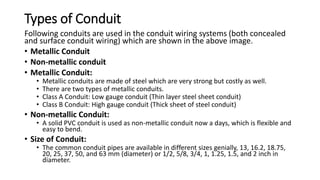
Types of Conduit
Following conduits are used in the conduit wiring systems (both concealed
and surface conduit wiring) which are shown in the above image.
• Metallic Conduit
• Non-metallic conduit
• Metallic Conduit:
• Metallic conduits are made of steel which are very strong but costly as well.
• There are two types of metallic conduits.
• Class A Conduit: Low gauge conduit (Thin layer steel sheet conduit)
• Class B Conduit: High gauge conduit (Thick sheet of steel conduit)
• Non-metallic Conduit:
• A solid PVC conduit is used as non-metallic conduit now a days, which is flexible and
easy to bend.
• Size of Conduit:
• The common conduit pipes are available in different sizes genially, 13, 16.2, 18.75,
20, 25, 37, 50, and 63 mm (diameter) or 1/2, 5/8, 3/4, 1, 1.25, 1.5, and 2 inch in
diameter.
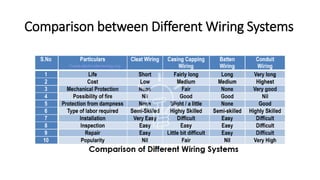
Comparison between Different Wiring Systems

Types of Wiring.pptx

  • 1.
  • 2.
    Electrical Wiring • ElectricalWiring is a process of connecting cables and wires to the related devices such as fuse, switches, sockets, lights, fans etc. to the main distribution board in a specific structure to the utility pole for continues power supply.
  • 3.
    Methods of ElectricalWiring Systems w.r.t Taking Connection
  • 4.
    • Advantages ofLoop-In Method of Wiring • It doesn’t require joint boxes and so money is saved • In loop – in systems, no joint is concealed beneath floors or in roof spaces. • Fault location is made easy as the points are made only at outlets so that they are accessible. • Disadvantages of Loop-In Method of Wiring • Length of wire or cables required is more and voltage drop and copper losses are therefore more • Looping – in switches and lamp holders is usually difficult
  • 5.
    Different Types ofElectrical Wiring Systems The types of internal wiring usually used are • Cleat wiring • Wooden casing and capping wiring • CTS or TRS or PVC sheath wiring • Lead sheathed or metal sheathed wiring • Conduit wiring • Surface or open Conduit type • Recessed or concealed or underground type Conduit
  • 6.
    Cleat Wiring Advantages ofCleat Wiring:  It is simple and cheap wiring system  Most suitable for temporary use i.e. under construction building or army camping  As the cables and wires of cleat wiring system is in open air, Therefore fault in cables can be seen and repair easily.  Cleat wiring system installation is easy and simple.  Customization can be easily done in this wiring system e.g. alteration and addition.  Inspection is easy and simple. Disadvantages of Cleat Wiring:  Appearance is not so good.  Cleat wiring can’t be use for permanent use because, Sag may be occur after sometime of the usage.  In this wiring system, the cables and wiring is in open air, therefore, oil, Steam, humidity, smoke, rain, chemical and acidic effect may damage the cables and wires.  it is not lasting wire system because of the weather effect , risk of fire and wear & tear.  it can be only used on 250/440 Volts on low temperature.  There is always a risk of fire and electric shock.  it can’t be used in important and sensitive location and places.  It is not lasting, reliable and sustainable wiring system.
  • 7.
    Casing and Cappingwiring Advantages of Casing Capping Wiring:  It is cheap wiring system as compared to sheathed and conduit wiring systems.  It is strong and long-lasting wiring system.  Customization can be easily done in this wiring system.  If Phase and Neutral wire is installed in separate slots, then repairing is easy.  Stay for long time in the field due to strong insulation of capping and casing..  It stays safe from oil, Steam, smoke and rain.  No risk of electric shock due to covered wires and cables in casing & capping. Disadvantages Casing Capping Wiring:  There is a high risk of fire in casing & capping wiring system.  Not suitable in the acidic, alkalies and humidity conditions  Costly repairing and need more material.  Material can’t be found easily in the contemporary  White ants may damage the casing & capping of wood.
  • 8.
    Batten Wiring (CTS orTRS) Advantages of Batten Wiring  Wiring installation is simple and easy  cheap as compared to other electrical wiring systems  Paraphrase is good and beautiful  Repairing is easy  strong and long-lasting  Customization can be easily done in this wiring system.  less chance of leakage current in batten wiring system Disadvantages of Batten Wiring  Can’t be install in the humidity, Chemical effects, open and outdoor areas.  High risk of firs  Not safe from external wear & tear and weather effects (because, the wires are openly visible to heat, dust, steam and smoke.  Heavy wires can’t be used in batten wiring system.  Only suitable below then 250V.  Need more cables and wires.
  • 9.
    Lead Sheathed Wiring •The type of wiring employs conductors that are insulated with VIR and covered with an outer sheath of lead aluminum alloy containing about 95% of lead. The metal sheath given protection to cables from mechanical damage, moisture and atmospheric corrosion. • The whole lead covering is made electrically continuous and is connected to earth at the point of entry to protect against electrolytic action due to leaking current and to provide safety in case the sheath becomes alive. The cables are run on wooden batten and fixed by means of link clips just as in TRS wiring.
  • 10.
    Conduit Wiring Advantage ofConduit Wiring Systems  It is the safest wiring system (Concealed conduit wring)  Appearance is very beautiful (in case of concealed conduit wiring)  No risk of mechanical wear & tear and fire in case of metallic pipes.  Customization can be easily done according to the future needs.  Repairing and maintenance is easy.  There is no risk of damage the cables insulation.  it is safe from corrosion (in case of PVC conduit) and risk of fire.  It can be used even in humidity , chemical effect and smoky areas.  No risk of electric shock (In case of proper earthing and grounding of metallic pipes).  It is reliable and popular wiring system.  sustainable and long-lasting wiring system. Disadvantages of Conduit Wiring Systems  It is expensive wiring system (Due to PVC and Metallic pipes, Additional earthing for metallic pipes Tee(s) and elbows etc.  Very hard to find the defects in the wiring.  installation is not easy and simple.  Risk of electric shock (In case of metallic pipes without proper earthing & grounding system)  Very complicated to manage additional connection in the future.
  • 11.
    Types of Conduit Followingconduits are used in the conduit wiring systems (both concealed and surface conduit wiring) which are shown in the above image. • Metallic Conduit • Non-metallic conduit • Metallic Conduit: • Metallic conduits are made of steel which are very strong but costly as well. • There are two types of metallic conduits. • Class A Conduit: Low gauge conduit (Thin layer steel sheet conduit) • Class B Conduit: High gauge conduit (Thick sheet of steel conduit) • Non-metallic Conduit: • A solid PVC conduit is used as non-metallic conduit now a days, which is flexible and easy to bend. • Size of Conduit: • The common conduit pipes are available in different sizes genially, 13, 16.2, 18.75, 20, 25, 37, 50, and 63 mm (diameter) or 1/2, 5/8, 3/4, 1, 1.25, 1.5, and 2 inch in diameter.
  • 12.