T Y PE S O F W I R I N G S Y S T E M
PRESENTED BY SHAKIR AHMED
SUBJECT BASIC ELECTRICAL ENGINEERING
SUBMITTED TO MISS KIRAN RAHEEL
SEMESTER SECOND
ID CU-139-2018
W I R I N G S Y S T E M
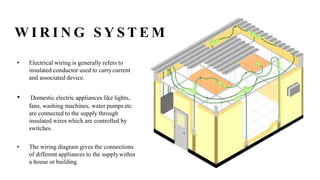
• Electrical wiring is generally refers to
insulated conductor used to carrycurrent
and associated device.
• Domestic electric appliances like lights,
fans, washing machines, water pumps etc
are connected to the supply through
insulated wires which are controlled by
switches.
• The wiring diagram gives the connections
of different appliances to the supplywithin
a house or building.
TYPES OF WIRING SYSTEM
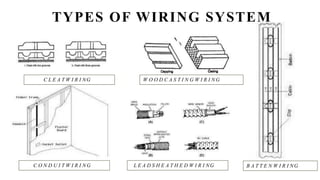
C O N D U I T W I R I N G B A T T E N W I R I NGL E A D S H E A T H E D W I R I NG
W O O D C A S T I N G W I R I N GC L E A T W I R I NG
CLEAT WIRING
• This system of wiring comprise of ordinary VIR or
PVC insulated wires (occasionally, sheathed and
weather proof cable) braided and compounded held on
walls or ceilings by means of porcelain cleats, Plasticor
wood.
• Cleat wiring system is a temporary wiring system
therefore it is not suitable for domesticpremises.
CLEAT WIRI NG : ADVANTAGES &DISADVANTAGES
ADVANTAGES
• It is simple and cheap wiring system
• Most suitable for temporary use i.e. under
construction building or army camping
• As the cables and wires of cleat wiring system is
in open air, Therefore fault in cables can be seen
and repair easily.
• Cleat wiring system installation is easy and
simple.
• Customization can be easily done in this wiring
system e.g. alteration and addition.
• Inspection is easy and simple.
DISADVANTAGES
• Appearance is not so good.
• Cleat wiring can’t be use for permanent use because,
Sag may be occur after sometime of the usage.
• In this wiring system, the cables and wiring is in open
air, therefore, oil, Steam, humidity, smoke, rain,
chemical and acidic effect may damage the cables and
wires.
• it is not lasting wire system because of the weather
effect , risk of fire and wear & tear.
• it can be only used on 250/440 Volts on low
temperature.
• There is always a risk of fire and electric shock.
• it can’t be used in important and sensitive location and
places.
• It is not lasting, reliable and sustainable wiring system.
WOOD CASING WIRING
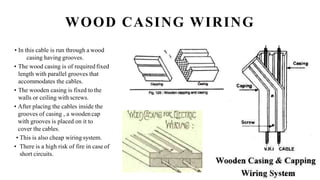
• In this cable is run through a wood
casing having grooves.
• The wood casing is of requiredfixed
length with parallel grooves that
accommodates the cables.
• The wooden casing is fixed to the
walls or ceiling with screws.
• After placing the cables inside the
grooves of casing , a woodencap
with grooves is placed on it to
cover the cables.
• This is also cheap wiring system.
• There is a high risk of fire in case of
short circuits.
W OOD C A S IN G WIR IN G:
AD VA NTA G ES &D ISAD VA NTA GES
ADVANTAGES
•It is cheap wiring system as compared to
sheathed and conduit wiring systems.
•It is strong and long-lasting wiring system.
•Customization can be easily done in this wiring
system.
•If Phase and Neutral wire is installed in separate
slots, then repairing is easy.
•Stay for long time in the field due to strong
insulation of capping and casing..
•It stays safe from oil, Steam, smoke and rain.
•No risk of electric shock due to covered wires
and cables in casing & capping
DISADVANTAGES
•There is a high risk of fire in casing & capping wiring
system.
•Not suitable in the acidic, alkalis and humidity
conditions
•Costly repairing and need more material.
•Material can’t be found easily in the contemporary
•White ants may damage the casing & capping of
wood.
BATTEN WIRING (CTS OR TRS)
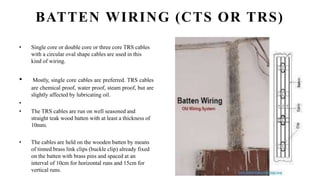
• Single core or double core or three core TRS cables
with a circular oval shape cables are used in this
kind of wiring.
• Mostly, single core cables are preferred. TRS cables
are chemical proof, water proof, steam proof, but are
slightly affected by lubricating oil.
•
• The TRS cables are run on well seasoned and
straight teak wood batten with at least a thickness of
10mm.
• The cables are held on the wooden batten by means
of tinned brass link clips (buckle clip) already fixed
on the batten with brass pins and spaced at an
interval of 10cm for horizontal runs and 15cm for
vertical runs.
ADVANTAGES
•Wiring installation is simple and easy
•cheap as compared to other electrical wiring
systems
•Paraphrase is good and beautiful
•Repairing is easy
•strong and long-lasting
•Customization can be easily done in this
wiring system.
•Less chance of leakage current in batten
wiring system.
DISADVANTAGES
•Can’t be install in the humidity, Chemical
effects, open and outdoor areas.
•High risk of firs
•Not safe from external wear & tear and weather
effects (because, the wires are openly visible
to heat, dust, steam and smoke.
•Heavy wires can’t be used in batten wiring
system.
•Only suitable below then 250V.
•Need more cables and wires.
BAT TEN WIR IN G ( CTS OR TRS) :
AD VA NTA G ES &DISAD VA NTA GE S
LEAD SHEATHED WIRING
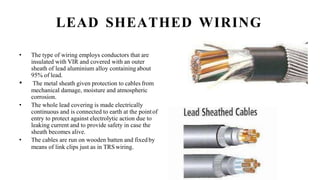
• The type of wiring employs conductors that are
insulated with VIR and covered with an outer
sheath of lead aluminium alloy containingabout
95% of lead.
• The metal sheath given protection to cables from
mechanical damage, moisture and atmospheric
corrosion.
• The whole lead covering is made electrically
continuous and is connected to earth at the pointof
entry to protect against electrolytic action due to
leaking current and to provide safety in case the
sheath becomes alive.
• The cables are run on wooden batten and fixedby
means of link clips just as in TRS wiring.
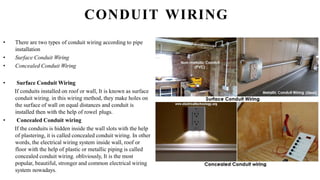
• There are two types of conduit wiring according to pipe
installation
• Surface Conduit Wiring
• Concealed Conduit Wiring
• Surface Conduit Wiring
If conduits installed on roof or wall, It is known as surface
conduit wiring. in this wiring method, they make holes on
the surface of wall on equal distances and conduit is
installed then with the help of rowel plugs.
• Concealed Conduit wiring
If the conduits is hidden inside the wall slots with the help
of plastering, it is called concealed conduit wiring. In other
words, the electrical wiring system inside wall, roof or
floor with the help of plastic or metallic piping is called
concealed conduit wiring. obliviously, It is the most
popular, beautiful, stronger and common electrical wiring
system nowadays.
CONDUIT WIRING
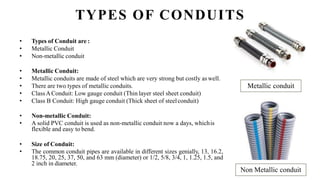
TYPES OF CONDUITS
• Types of Conduit are :
• Metallic Conduit
• Non-metallic conduit
• Metallic Conduit:
• Metallic conduits are made of steel which are very strong but costly as well.
• There are two types of metallic conduits.
• ClassAConduit: Low gauge conduit (Thin layer steel sheet conduit)
• Class B Conduit: High gauge conduit (Thick sheet of steelconduit)
• Non-metallic Conduit:
• A solid PVC conduit is used as non-metallic conduit now a days, whichis
flexible and easy to bend.
• Size of Conduit:
• The common conduit pipes are available in different sizes genially, 13, 16.2,
18.75, 20, 25, 37, 50, and 63 mm (diameter) or 1/2, 5/8, 3/4, 1, 1.25, 1.5, and
2 inch in diameter.
Non Metallic conduit
Metallic conduit
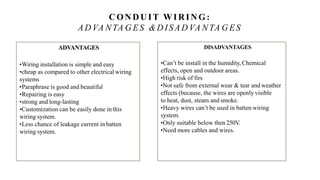
CON D UIT WIRING:
AD VA NTA G ES &D ISAD VA NTA GES
ADVANTAGES
•Wiring installation is simple and easy
•cheap as compared to other electrical wiring
systems
•Paraphrase is good and beautiful
•Repairing is easy
•strong and long-lasting
•Customization can be easily done in this
wiring system.
•Less chance of leakage current in batten
wiring system.
DISADVANTAGES
•Can’t be install in the humidity, Chemical
effects, open and outdoor areas.
•High risk of firs
•Not safe from external wear & tear and weather
effects (because, the wires are openly visible
to heat, dust, steam and smoke.
•Heavy wires can’t be used in batten wiring
system.
•Only suitable below then 250V.
•Need more cables and wires.
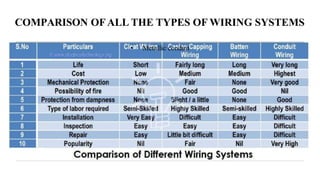
COMPARISON OFALL THE TYPES OF WIRING SYSTEMS
• Metallic conduit

Wiring and its types

  • 1.
    T Y PES O F W I R I N G S Y S T E M PRESENTED BY SHAKIR AHMED SUBJECT BASIC ELECTRICAL ENGINEERING SUBMITTED TO MISS KIRAN RAHEEL SEMESTER SECOND ID CU-139-2018
  • 2.
    W I RI N G S Y S T E M • Electrical wiring is generally refers to insulated conductor used to carrycurrent and associated device. • Domestic electric appliances like lights, fans, washing machines, water pumps etc are connected to the supply through insulated wires which are controlled by switches. • The wiring diagram gives the connections of different appliances to the supplywithin a house or building.
  • 3.
    TYPES OF WIRINGSYSTEM C O N D U I T W I R I N G B A T T E N W I R I NGL E A D S H E A T H E D W I R I NG W O O D C A S T I N G W I R I N GC L E A T W I R I NG
  • 4.
    CLEAT WIRING • Thissystem of wiring comprise of ordinary VIR or PVC insulated wires (occasionally, sheathed and weather proof cable) braided and compounded held on walls or ceilings by means of porcelain cleats, Plasticor wood. • Cleat wiring system is a temporary wiring system therefore it is not suitable for domesticpremises.
  • 5.
    CLEAT WIRI NG: ADVANTAGES &DISADVANTAGES ADVANTAGES • It is simple and cheap wiring system • Most suitable for temporary use i.e. under construction building or army camping • As the cables and wires of cleat wiring system is in open air, Therefore fault in cables can be seen and repair easily. • Cleat wiring system installation is easy and simple. • Customization can be easily done in this wiring system e.g. alteration and addition. • Inspection is easy and simple. DISADVANTAGES • Appearance is not so good. • Cleat wiring can’t be use for permanent use because, Sag may be occur after sometime of the usage. • In this wiring system, the cables and wiring is in open air, therefore, oil, Steam, humidity, smoke, rain, chemical and acidic effect may damage the cables and wires. • it is not lasting wire system because of the weather effect , risk of fire and wear & tear. • it can be only used on 250/440 Volts on low temperature. • There is always a risk of fire and electric shock. • it can’t be used in important and sensitive location and places. • It is not lasting, reliable and sustainable wiring system.
  • 6.
    WOOD CASING WIRING •In this cable is run through a wood casing having grooves. • The wood casing is of requiredfixed length with parallel grooves that accommodates the cables. • The wooden casing is fixed to the walls or ceiling with screws. • After placing the cables inside the grooves of casing , a woodencap with grooves is placed on it to cover the cables. • This is also cheap wiring system. • There is a high risk of fire in case of short circuits.
  • 7.
    W OOD CA S IN G WIR IN G: AD VA NTA G ES &D ISAD VA NTA GES ADVANTAGES •It is cheap wiring system as compared to sheathed and conduit wiring systems. •It is strong and long-lasting wiring system. •Customization can be easily done in this wiring system. •If Phase and Neutral wire is installed in separate slots, then repairing is easy. •Stay for long time in the field due to strong insulation of capping and casing.. •It stays safe from oil, Steam, smoke and rain. •No risk of electric shock due to covered wires and cables in casing & capping DISADVANTAGES •There is a high risk of fire in casing & capping wiring system. •Not suitable in the acidic, alkalis and humidity conditions •Costly repairing and need more material. •Material can’t be found easily in the contemporary •White ants may damage the casing & capping of wood.
  • 8.
    BATTEN WIRING (CTSOR TRS) • Single core or double core or three core TRS cables with a circular oval shape cables are used in this kind of wiring. • Mostly, single core cables are preferred. TRS cables are chemical proof, water proof, steam proof, but are slightly affected by lubricating oil. • • The TRS cables are run on well seasoned and straight teak wood batten with at least a thickness of 10mm. • The cables are held on the wooden batten by means of tinned brass link clips (buckle clip) already fixed on the batten with brass pins and spaced at an interval of 10cm for horizontal runs and 15cm for vertical runs.
  • 9.
    ADVANTAGES •Wiring installation issimple and easy •cheap as compared to other electrical wiring systems •Paraphrase is good and beautiful •Repairing is easy •strong and long-lasting •Customization can be easily done in this wiring system. •Less chance of leakage current in batten wiring system. DISADVANTAGES •Can’t be install in the humidity, Chemical effects, open and outdoor areas. •High risk of firs •Not safe from external wear & tear and weather effects (because, the wires are openly visible to heat, dust, steam and smoke. •Heavy wires can’t be used in batten wiring system. •Only suitable below then 250V. •Need more cables and wires. BAT TEN WIR IN G ( CTS OR TRS) : AD VA NTA G ES &DISAD VA NTA GE S
  • 10.
    LEAD SHEATHED WIRING •The type of wiring employs conductors that are insulated with VIR and covered with an outer sheath of lead aluminium alloy containingabout 95% of lead. • The metal sheath given protection to cables from mechanical damage, moisture and atmospheric corrosion. • The whole lead covering is made electrically continuous and is connected to earth at the pointof entry to protect against electrolytic action due to leaking current and to provide safety in case the sheath becomes alive. • The cables are run on wooden batten and fixedby means of link clips just as in TRS wiring.
  • 11.
    • There aretwo types of conduit wiring according to pipe installation • Surface Conduit Wiring • Concealed Conduit Wiring • Surface Conduit Wiring If conduits installed on roof or wall, It is known as surface conduit wiring. in this wiring method, they make holes on the surface of wall on equal distances and conduit is installed then with the help of rowel plugs. • Concealed Conduit wiring If the conduits is hidden inside the wall slots with the help of plastering, it is called concealed conduit wiring. In other words, the electrical wiring system inside wall, roof or floor with the help of plastic or metallic piping is called concealed conduit wiring. obliviously, It is the most popular, beautiful, stronger and common electrical wiring system nowadays. CONDUIT WIRING
  • 12.
    TYPES OF CONDUITS •Types of Conduit are : • Metallic Conduit • Non-metallic conduit • Metallic Conduit: • Metallic conduits are made of steel which are very strong but costly as well. • There are two types of metallic conduits. • ClassAConduit: Low gauge conduit (Thin layer steel sheet conduit) • Class B Conduit: High gauge conduit (Thick sheet of steelconduit) • Non-metallic Conduit: • A solid PVC conduit is used as non-metallic conduit now a days, whichis flexible and easy to bend. • Size of Conduit: • The common conduit pipes are available in different sizes genially, 13, 16.2, 18.75, 20, 25, 37, 50, and 63 mm (diameter) or 1/2, 5/8, 3/4, 1, 1.25, 1.5, and 2 inch in diameter. Non Metallic conduit Metallic conduit
  • 13.
    CON D UITWIRING: AD VA NTA G ES &D ISAD VA NTA GES ADVANTAGES •Wiring installation is simple and easy •cheap as compared to other electrical wiring systems •Paraphrase is good and beautiful •Repairing is easy •strong and long-lasting •Customization can be easily done in this wiring system. •Less chance of leakage current in batten wiring system. DISADVANTAGES •Can’t be install in the humidity, Chemical effects, open and outdoor areas. •High risk of firs •Not safe from external wear & tear and weather effects (because, the wires are openly visible to heat, dust, steam and smoke. •Heavy wires can’t be used in batten wiring system. •Only suitable below then 250V. •Need more cables and wires.
  • 14.
    COMPARISON OFALL THETYPES OF WIRING SYSTEMS • Metallic conduit