ELECTRICAL
SERVICES
ELECTRICAL SERVICES DEFINATION
Electrical services is an mode which provides us the electricity
that is required by us to run electrical appliances, in industries to
provide electricity to run the machineries , in commercial places to run
the mechanical services.
Use of electricity:
Residential Building: Lights , Fans, Heaters, Television, Refrigerators
etc.
Industrial Buildings: Machineries, Welding, Electroplating etc.
Commercial Buildings: Lifts, Escalators, Alarm Systems, Advertising
Displays etc.
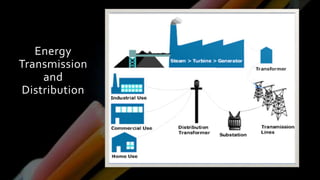
Energy
Transmission
and
Distribution
TERMS RELATED TO ELECTRICAL CIRCUIT
• Electric current:The electric current means the flow of electrons from
one end of a conductor to another end. Its symbol is ‘I’. And its unit is
ampere.
Current (I) = Q/t = Ampere
• Ampere:When charge of 1 coulomb passes through a point in 1
seconds, it is said that a current of 1 Ampere is flowing.
Ampere= Coulomb/Second
• Potential Difference:Work/energy Required to be done to move unit
charge from one point to another in the circuit is called voltage or
potential difference
Voltage or Potential Difference=W/Q =Work/Charge
• Conductors: Material which allow the current to flow easily through
them are called Conductors.
• Insulator: Material which greatly oppose the current flow i.e do not
allow the current to pass through it are called Insulators.
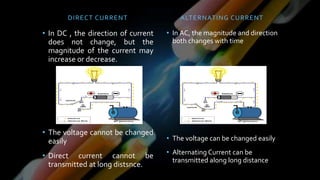
DIRECT CURRENT
• In DC , the direction of current
does not change, but the
magnitude of the current may
increase or decrease.
• The voltage cannot be changed
easily
• Direct current cannot be
transmitted at long distsnce.
ALTERNATING CURRENT
• In AC, the magnitude and direction
both changes with time
• The voltage can be changed easily
• Alternating Current can be
transmitted along long distance
Domestic electric Supply
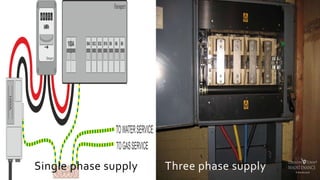
• The power is supplied to the houses in two different phases
depending upon the need of electricity. First is single phase supply
having 240 volts current at 50hz and other is three phase supply
having a voltage 420/240 volts at 50hz.
• Single phase supply consists of two wires Live wire (red) and Neutral
Wire (black)
• Three phase supply consists of 4 wires three live wires and one
neutral wire.
Single phase supply Three phase supply
Terms related to wiring
• Fuse: Fuse is a thin piece of wire with low melting point connected at
its end in a fuse plug. The function of fuse wire is to protect the
electrical appliances from heavy current.
• Miniature Circuit Breaker: MCB is a device that is used to break the
circuit at the time of excess of current and protects the device from
the appliances from the damage.
• ELCB: Earth Leakage Circuit Breaker is an device is which breaks the
circuit when there is leakage of the current in the system.
• RCCB: Residual Current Circuit Breaker is a circuit breaker that breaks
the circuit when there is imbalance of current between the live and
the neutral wire this imbalance can be due to the current leakage.
Earthing
• Earthing is the process of connecting the appliances to the ground so
that any unforeseen current such as leakages is transmitted to the
earth.The purpose of the earthing is to protect the people from the
electric shock.
• Types of earthing:
• Wire earthing
• Rod earthing
• Pipe earthing
• Plate earthing
• Wire earthing: in wire earthing is usually adopted in the rocky terrain.
In this method copper wire of enough length is buried in a trench
• Rod Earthing: in this type of earthing a G.I. rod of 20mm diameter is
buried to a depth of 200 to 300 cm to this rod the earthing wire is
clamped.
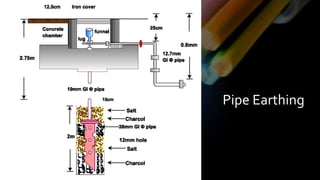
• Pipe Earthing: In this method pipe of 38mm diameter and 2m long is
used as an earth electrode. A hole of about 30cm diameter and 3.5m
deep is dug into the ground using auger.The pipe is placed in the hole
the pipe covered with 80mm of charcoal and a layer of common salt
of 30mm to decrease the resistance offered by the earth mass.
Pipe Earthing
Plate earthing
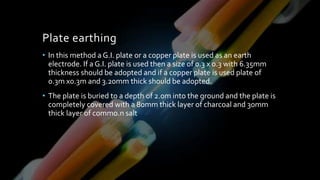
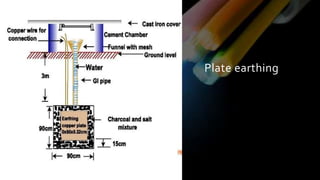
• In this method a G.I. plate or a copper plate is used as an earth
electrode. If a G.I. plate is used then a size of 0.3 x 0.3 with 6.35mm
thickness should be adopted and if a copper plate is used plate of
0.3m x0.3m and 3.20mm thick should be adopted.
• The plate is buried to a depth of 2.0m into the ground and the plate is
completely covered with a 80mm thick layer of charcoal and 30mm
thick layer of commo.n salt
Plate earthing
Types of wiring
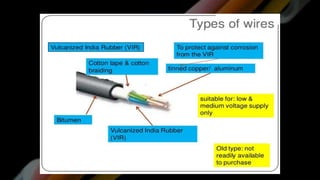
• vulcanized Indian rubber wire (V.I.R)
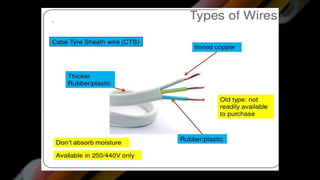
• tough rubber sheathed wire or CabTyre Sheathed(T.R.S)
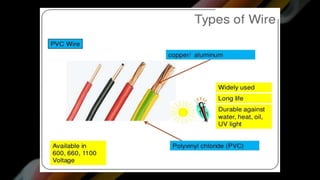
• poly vinyl chloride wire (P.V.C.)
• Lead CoveredWire
• weather proof wires
• flexible wire
• MICC wire
P.V.C. (Poly Vinyl Chloride) wires.
• This is the most commonly used wire for wiring purpose.
• Conductor is insulated by poly vinyl chloride (insulating
material).
• P.V.S. has following properties:
• 1. Moisture proof.
• 2.Tough.
• 3.Durable.
• 4.Chemically inert.
• But it softens at high temperatures therefore not suitable for
connection to heating appliances.
Lead CoveredWires.
• In this type of wire insulated rubber is provided on the
conductor.A tube made of lead is kept over it. Due to lead it
has no effect of moisture. It can easily affected by the
mechanical stresses.
Weather proof wires.

• These types of wires are used outdoor i.e. providing a service
connection from overhead line to building etc.
• In this type of wire the conductor is not tinned and the
conductor is covered with three braids (layer) of fibrous yarn
and saturated with water proof compound.
Flexible wires.
• These wires consists of number of strands instead of a single
conductor. (Strand is a very thin conductor).
• The conductor is insulated with P.V.C. material.
• These wires are very useful for household portable appliances
where flexibility of wire is more important.
Mineral insulated Copper CoveredWire
• In this type of wire coating of magnesium oxide is provided as
insulation on the copper conductor.
• Over this a copper sheath is provided.
• This type of wire is used for wiring in mines, factories, refineries,
furnace boilers, rolling mills etc. it is less affected by temperature.
Systems of wiring
1.CleatWiring.
2.Wood casing- cappingWiring.
3.BattenWiring.
4.ConduitWiring.
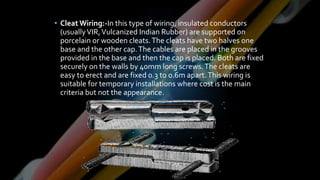
• Cleat Wiring:-In this type of wiring, insulated conductors
(usuallyVIR,Vulcanized Indian Rubber) are supported on
porcelain or wooden cleats.The cleats have two halves one
base and the other cap.The cables are placed in the grooves
provided in the base and then the cap is placed. Both are fixed
securely on the walls by 40mm long screws.The cleats are
easy to erect and are fixed 0.3 to 0.6m apart.This wiring is
suitable for temporary installations where cost is the main
criteria but not the appearance.
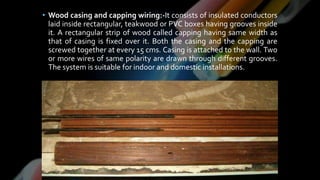
• Wood casing and capping wiring:-It consists of insulated conductors
laid inside rectangular, teakwood or PVC boxes having grooves inside
it. A rectangular strip of wood called capping having same width as
that of casing is fixed over it. Both the casing and the capping are
screwed together at every 15 cms. Casing is attached to the wall. Two
or more wires of same polarity are drawn through different grooves.
The system is suitable for indoor and domestic installations.
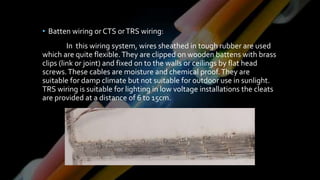
• Batten wiring or CTS orTRS wiring:
In this wiring system, wires sheathed in tough rubber are used
which are quite flexible.They are clipped on wooden battens with brass
clips (link or joint) and fixed on to the walls or ceilings by flat head
screws.These cables are moisture and chemical proof.They are
suitable for damp climate but not suitable for outdoor use in sunlight.
TRS wiring is suitable for lighting in low voltage installations the cleats
are provided at a distance of 6 to 15cm.
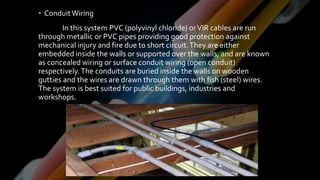
• ConduitWiring
In this system PVC (polyvinyl chloride) orVIR cables are run
through metallic or PVC pipes providing good protection against
mechanical injury and fire due to short circuit.They are either
embedded inside the walls or supported over the walls, and are known
as concealed wiring or surface conduit wiring (open conduit)
respectively.The conduits are buried inside the walls on wooden
gutties and the wires are drawn through them with fish (steel) wires.
The system is best suited for public buildings, industries and
workshops.
References
• http://www.electricaltechnology.org/2015/09/types-of-wiring-systems-
electrical-wiring-methods.html
• http://elearning.vtu.ac.in/e-con/EEE/html/0025.htm
• http://www.authorstream.com/Presentation/dhruvitkardani-2234526-
types-wires-cable/
• http://elearning.vtu.ac.in/e-con/EEE/html/0032.htm
• http://www.slideshare.net/vigyanashram/wiring-part-3-wires-cables
• http://www.electricaltechnology.org/2015/05/earthing-and-electrical-
grounding-types-of-earthing.html
• https://www.researchgate.net/post/What_difference_between_MCB_MCC
B_RCCB_ELCB
PREPARED BY
DHAWANI LAVISH J. 136510306026
LALWANI PIYUSH P. 136510306039
MODI PARTH P. 136510306042
THANKYOU

Electrical services

  • 1.
  • 2.
    ELECTRICAL SERVICES DEFINATION Electricalservices is an mode which provides us the electricity that is required by us to run electrical appliances, in industries to provide electricity to run the machineries , in commercial places to run the mechanical services. Use of electricity: Residential Building: Lights , Fans, Heaters, Television, Refrigerators etc. Industrial Buildings: Machineries, Welding, Electroplating etc. Commercial Buildings: Lifts, Escalators, Alarm Systems, Advertising Displays etc.
  • 3.
  • 4.
    TERMS RELATED TOELECTRICAL CIRCUIT • Electric current:The electric current means the flow of electrons from one end of a conductor to another end. Its symbol is ‘I’. And its unit is ampere. Current (I) = Q/t = Ampere • Ampere:When charge of 1 coulomb passes through a point in 1 seconds, it is said that a current of 1 Ampere is flowing. Ampere= Coulomb/Second
  • 5.
    • Potential Difference:Work/energyRequired to be done to move unit charge from one point to another in the circuit is called voltage or potential difference Voltage or Potential Difference=W/Q =Work/Charge • Conductors: Material which allow the current to flow easily through them are called Conductors. • Insulator: Material which greatly oppose the current flow i.e do not allow the current to pass through it are called Insulators.
  • 6.
    DIRECT CURRENT • InDC , the direction of current does not change, but the magnitude of the current may increase or decrease. • The voltage cannot be changed easily • Direct current cannot be transmitted at long distsnce. ALTERNATING CURRENT • In AC, the magnitude and direction both changes with time • The voltage can be changed easily • Alternating Current can be transmitted along long distance
  • 7.
    Domestic electric Supply •The power is supplied to the houses in two different phases depending upon the need of electricity. First is single phase supply having 240 volts current at 50hz and other is three phase supply having a voltage 420/240 volts at 50hz. • Single phase supply consists of two wires Live wire (red) and Neutral Wire (black) • Three phase supply consists of 4 wires three live wires and one neutral wire.
  • 8.
    Single phase supplyThree phase supply
  • 9.
    Terms related towiring • Fuse: Fuse is a thin piece of wire with low melting point connected at its end in a fuse plug. The function of fuse wire is to protect the electrical appliances from heavy current. • Miniature Circuit Breaker: MCB is a device that is used to break the circuit at the time of excess of current and protects the device from the appliances from the damage. • ELCB: Earth Leakage Circuit Breaker is an device is which breaks the circuit when there is leakage of the current in the system. • RCCB: Residual Current Circuit Breaker is a circuit breaker that breaks the circuit when there is imbalance of current between the live and the neutral wire this imbalance can be due to the current leakage.
  • 10.
    Earthing • Earthing isthe process of connecting the appliances to the ground so that any unforeseen current such as leakages is transmitted to the earth.The purpose of the earthing is to protect the people from the electric shock. • Types of earthing: • Wire earthing • Rod earthing • Pipe earthing • Plate earthing
  • 11.
    • Wire earthing:in wire earthing is usually adopted in the rocky terrain. In this method copper wire of enough length is buried in a trench • Rod Earthing: in this type of earthing a G.I. rod of 20mm diameter is buried to a depth of 200 to 300 cm to this rod the earthing wire is clamped. • Pipe Earthing: In this method pipe of 38mm diameter and 2m long is used as an earth electrode. A hole of about 30cm diameter and 3.5m deep is dug into the ground using auger.The pipe is placed in the hole the pipe covered with 80mm of charcoal and a layer of common salt of 30mm to decrease the resistance offered by the earth mass.
  • 12.
  • 13.
    Plate earthing • Inthis method a G.I. plate or a copper plate is used as an earth electrode. If a G.I. plate is used then a size of 0.3 x 0.3 with 6.35mm thickness should be adopted and if a copper plate is used plate of 0.3m x0.3m and 3.20mm thick should be adopted. • The plate is buried to a depth of 2.0m into the ground and the plate is completely covered with a 80mm thick layer of charcoal and 30mm thick layer of commo.n salt
  • 14.
  • 15.
    Types of wiring •vulcanized Indian rubber wire (V.I.R) • tough rubber sheathed wire or CabTyre Sheathed(T.R.S) • poly vinyl chloride wire (P.V.C.) • Lead CoveredWire • weather proof wires • flexible wire • MICC wire
  • 19.
    P.V.C. (Poly VinylChloride) wires. • This is the most commonly used wire for wiring purpose. • Conductor is insulated by poly vinyl chloride (insulating material). • P.V.S. has following properties: • 1. Moisture proof. • 2.Tough. • 3.Durable. • 4.Chemically inert. • But it softens at high temperatures therefore not suitable for connection to heating appliances.
  • 20.
    Lead CoveredWires. • Inthis type of wire insulated rubber is provided on the conductor.A tube made of lead is kept over it. Due to lead it has no effect of moisture. It can easily affected by the mechanical stresses. Weather proof wires. • These types of wires are used outdoor i.e. providing a service connection from overhead line to building etc. • In this type of wire the conductor is not tinned and the conductor is covered with three braids (layer) of fibrous yarn and saturated with water proof compound.
  • 21.
    Flexible wires. • Thesewires consists of number of strands instead of a single conductor. (Strand is a very thin conductor). • The conductor is insulated with P.V.C. material. • These wires are very useful for household portable appliances where flexibility of wire is more important.
  • 22.
    Mineral insulated CopperCoveredWire • In this type of wire coating of magnesium oxide is provided as insulation on the copper conductor. • Over this a copper sheath is provided. • This type of wire is used for wiring in mines, factories, refineries, furnace boilers, rolling mills etc. it is less affected by temperature.
  • 23.
    Systems of wiring 1.CleatWiring. 2.Woodcasing- cappingWiring. 3.BattenWiring. 4.ConduitWiring.
  • 24.
    • Cleat Wiring:-Inthis type of wiring, insulated conductors (usuallyVIR,Vulcanized Indian Rubber) are supported on porcelain or wooden cleats.The cleats have two halves one base and the other cap.The cables are placed in the grooves provided in the base and then the cap is placed. Both are fixed securely on the walls by 40mm long screws.The cleats are easy to erect and are fixed 0.3 to 0.6m apart.This wiring is suitable for temporary installations where cost is the main criteria but not the appearance.
  • 25.
    • Wood casingand capping wiring:-It consists of insulated conductors laid inside rectangular, teakwood or PVC boxes having grooves inside it. A rectangular strip of wood called capping having same width as that of casing is fixed over it. Both the casing and the capping are screwed together at every 15 cms. Casing is attached to the wall. Two or more wires of same polarity are drawn through different grooves. The system is suitable for indoor and domestic installations.
  • 26.
    • Batten wiringor CTS orTRS wiring: In this wiring system, wires sheathed in tough rubber are used which are quite flexible.They are clipped on wooden battens with brass clips (link or joint) and fixed on to the walls or ceilings by flat head screws.These cables are moisture and chemical proof.They are suitable for damp climate but not suitable for outdoor use in sunlight. TRS wiring is suitable for lighting in low voltage installations the cleats are provided at a distance of 6 to 15cm.
  • 27.
    • ConduitWiring In thissystem PVC (polyvinyl chloride) orVIR cables are run through metallic or PVC pipes providing good protection against mechanical injury and fire due to short circuit.They are either embedded inside the walls or supported over the walls, and are known as concealed wiring or surface conduit wiring (open conduit) respectively.The conduits are buried inside the walls on wooden gutties and the wires are drawn through them with fish (steel) wires. The system is best suited for public buildings, industries and workshops.
  • 28.
    References • http://www.electricaltechnology.org/2015/09/types-of-wiring-systems- electrical-wiring-methods.html • http://elearning.vtu.ac.in/e-con/EEE/html/0025.htm •http://www.authorstream.com/Presentation/dhruvitkardani-2234526- types-wires-cable/ • http://elearning.vtu.ac.in/e-con/EEE/html/0032.htm • http://www.slideshare.net/vigyanashram/wiring-part-3-wires-cables • http://www.electricaltechnology.org/2015/05/earthing-and-electrical- grounding-types-of-earthing.html • https://www.researchgate.net/post/What_difference_between_MCB_MCC B_RCCB_ELCB
  • 29.
    PREPARED BY DHAWANI LAVISHJ. 136510306026 LALWANI PIYUSH P. 136510306039 MODI PARTH P. 136510306042
  • 30.