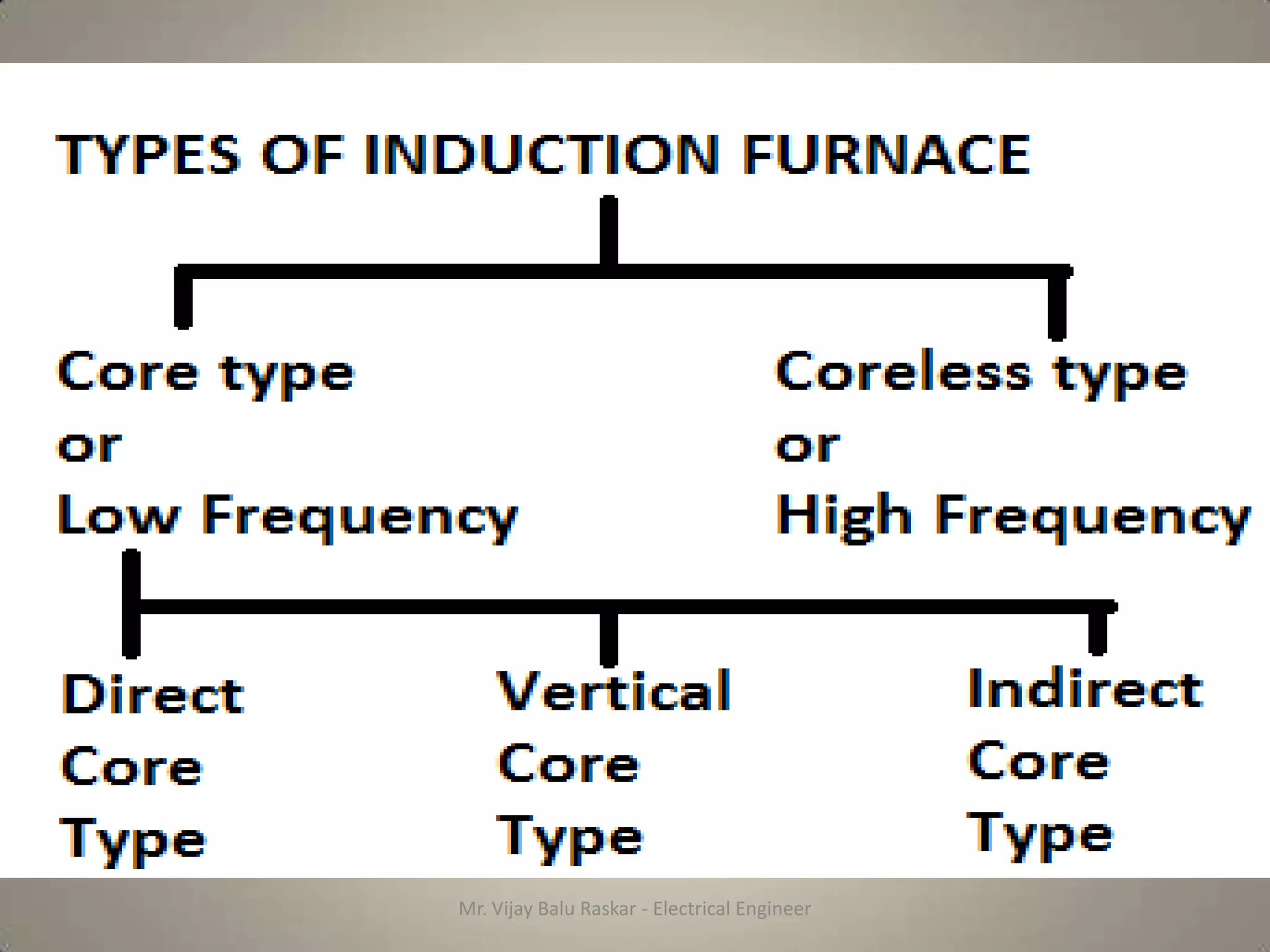
Mr. Vijay Balu Raskar - Electrical Engineer
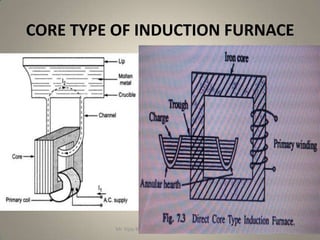
CORE TYPE OF INDUCTION FURNACE


          Mr. Vijay Balu Raskar - Electrical Engineer
DIRECT CORE TYPE INDUCTION FURNACE:-

Consists of a vertical furnace with a V shaped portion at the bottom.
Consists of a Transformer ±charge is magnetically coupled to the
primary winding and forms single-turn short circuited secondary.
Secondary channel should not be emptied.
Magnetic coupling between primary & secondary is weak resulting in
large leakage reactance poor p.f
Leakage reactance is nullified using low frequency supply

Drawbacks.
1)Leakage reactance is high & p.f is low.
2)Low frequency requirement.
3) Suffers from Pinching Effect.
Pinching Effect = current, density above 500 A/cm2, flowing around the
melt interacts with the alternating field and produces force to squeeze
the melt of a section and results in complete interruption of current.
Use-preferable for non-intermittent service, are obsolete these days
                           Mr. Vijay Balu Raskar - Electrical Engineer
VERTICAL CORE TYPE INDUCTION FURNACE
Also known as AJAX-WYATT FURNACE.
Vertical crucible is used for the charge.
Bottom is usually V-shaped or U-shaped.
Molten metal is kept circulated round the V.
Pinch effect is counteracted by the weight of the charge.
Capable of continuous operation.
Normal frequency can be used.
Use-melting & refining of non-ferrous metals .

Advantage-
Highly efficient.
Low operating cost.
Temperature control is simple.
Comparatively higher p.f Balu Raskar - Electrical Engineer
                      Mr. Vijay
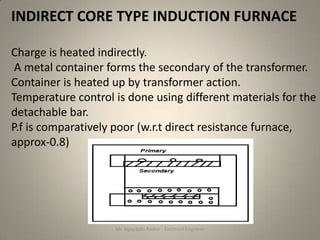
INDIRECT CORE TYPE INDUCTION FURNACE

Charge is heated indirectly.
 A metal container forms the secondary of the transformer.
Container is heated up by transformer action.
Temperature control is done using different materials for the
detachable bar.
P.f is comparatively poor (w.r.t direct resistance furnace,
approx-0.8)


                    Mr. Vijay Balu Raskar - Electrical Engineer
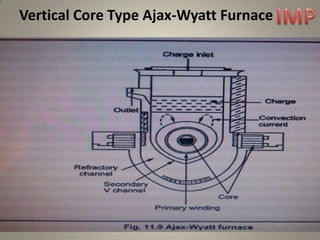
Vertical Core Type Ajax-Wyatt Furnace


              Mr. Vijay Balu Raskar - Electrical Engineer
The limitation of core type induction furnace can be eliminated
by use of vertical type furnace called Ajax-wyatt Furnace.
Construction :-
The furnace is narrow V-shaped.
V – shaped tendency of the molten metal is to get itself accumulated at the bottom
and this helps at least a small amount of charge to be present for the secondary
circuit to be completed.
The probability of the discontinuity of the circuit is thus found to be less.
Pinch effects occurs in it.


                             Mr. Vijay Balu Raskar - Electrical Engineer
OPERATION:-
The primary inductor coil is connected to the A.C.
Supply.
This causes an intense electromagnetic field to
fluctuate in the iron core.
The metal acts a short circuited secondary and carries
the induced currents.
Heat is mainly generated in the V shaped portion as it
has highest resistance due to small narrow section.
This heat is rapidly distributed to the metal with the
help of convection current and by electromagnetic
forces.
The heat ultimately results into melting of a charge.
                   Mr. Vijay Balu Raskar - Electrical Engineer
Vertical crucible is used for the charge.
Bottom is usually V-shaped or U-shaped.
Molten metal is kept circulated round the V.
Pinch effect is counteracted by the weight of
the charge.
Capable of continuous operation.
Normal frequency can be used.
Use-melting & refining of non-ferrous metals .

Advantage-
Highly efficient.
Low operating cost.
Temperature control is simple.
Comparatively higher p.f
                Mr. Vijay Balu Raskar - Electrical Engineer
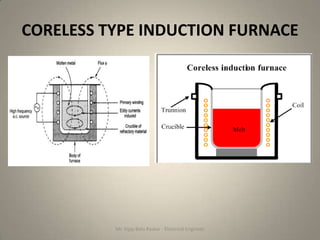
CORELESS TYPE INDUCTION FURNACE


          Mr. Vijay Balu Raskar - Electrical Engineer
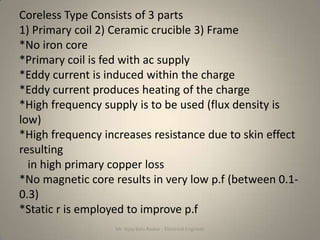
Coreless Type Consists of 3 parts
1) Primary coil 2) Ceramic crucible 3) Frame
*No iron core
*Primary coil is fed with ac supply
*Eddy current is induced within the charge
*Eddy current produces heating of the charge
*High frequency supply is to be used (flux density is
low)
*High frequency increases resistance due to skin effect
resulting
  in high primary copper loss
*No magnetic core results in very low p.f (between 0.1-
0.3)
*Static r is employed to improve p.f
                  Mr. Vijay Balu Raskar - Electrical Engineer
Use-
1) Steel production
2) Melting non-ferrous metals
3) Electronic industry
 Advantages
Simple method to control
Semi skilled labor can handle
Fast operation
Required less space
Easy to maintain
Controllable by electrical clock or else
No oxidation
Can be used intermittently
Low cost / economical
Precise control of power
Low melting time Mr. Vijay Balu Raskar - Electrical Engineer
Requirement of Good Electrode
            Material
Material Must have following properties:-
1)It should be good conductor of electricity.
2)It should have high resistance to thermal
  shocks.
3)It should have sufficient mechanical
  strength.
4)It should have low thermal conductivity.
5)It should be insoluble in the charge ,
  chemically Inert and non-corrosive.
               Mr. Vijay Balu Raskar - Electrical Engineer
Low & Medium Temperature (up to1150°C)
 Alloy of nickel & chromium
Ni= 80%, Cr= 20%
Alloy of nickel, chromium & iron Ni= 65%,
Cr=15%,Fe=20%


High Temperature (>1150 °C)
Silicon carbide
Molybdenum
Tungsten
Graphite
               Mr. Vijay Balu Raskar - Electrical Engineer
ELECTRIC RESISTANCE FURNACE
These are insulated closed chambers with
       a provision for ventilation

Heating elements may consists of circulars
       wire or rectangular ribbons

Heating elements placed either on top or
           sides of the oven

Charge is placed inside a heating chamber
              Mr. Vijay Balu Raskar - Electrical Engineer
TEMPERATURE CONTROL OF HEATING
FURNACE
Temperature of Furnace depends upon–
Voltage (V) ±can be controlled by tapped
transformer.
Resistance (R)-can be controlled by switching in
various combinations of groups of resistance of
the furnace.
Time (t)-can be controlled by an on-off switch,
which determines the time for which the
furnace is connected to supply or remain
isolated from the supply.
                Mr. Vijay Balu Raskar - Electrical Engineer
LOSSES
Besides raising the temperature of the
Charge, heat energy is lost in following
operations:
- In raising the temperature of furnace
- In raising the temperature of the
  container/carrier
- Heat conducted through wall
- Escapement of heat due to opening of
   door
               Mr. Vijay Balu Raskar - Electrical Engineer
Mr. Vijay Balu Raskar - Electrical Engineer

Electrical Heating 03-03

  • 1.
    Mr. Vijay BaluRaskar - Electrical Engineer
  • 2.
    CORE TYPE OFINDUCTION FURNACE Mr. Vijay Balu Raskar - Electrical Engineer
  • 3.
    DIRECT CORE TYPEINDUCTION FURNACE:- Consists of a vertical furnace with a V shaped portion at the bottom. Consists of a Transformer ±charge is magnetically coupled to the primary winding and forms single-turn short circuited secondary. Secondary channel should not be emptied. Magnetic coupling between primary & secondary is weak resulting in large leakage reactance poor p.f Leakage reactance is nullified using low frequency supply Drawbacks. 1)Leakage reactance is high & p.f is low. 2)Low frequency requirement. 3) Suffers from Pinching Effect. Pinching Effect = current, density above 500 A/cm2, flowing around the melt interacts with the alternating field and produces force to squeeze the melt of a section and results in complete interruption of current. Use-preferable for non-intermittent service, are obsolete these days Mr. Vijay Balu Raskar - Electrical Engineer
  • 4.
    VERTICAL CORE TYPEINDUCTION FURNACE Also known as AJAX-WYATT FURNACE. Vertical crucible is used for the charge. Bottom is usually V-shaped or U-shaped. Molten metal is kept circulated round the V. Pinch effect is counteracted by the weight of the charge. Capable of continuous operation. Normal frequency can be used. Use-melting & refining of non-ferrous metals . Advantage- Highly efficient. Low operating cost. Temperature control is simple. Comparatively higher p.f Balu Raskar - Electrical Engineer Mr. Vijay
  • 5.
    INDIRECT CORE TYPEINDUCTION FURNACE Charge is heated indirectly. A metal container forms the secondary of the transformer. Container is heated up by transformer action. Temperature control is done using different materials for the detachable bar. P.f is comparatively poor (w.r.t direct resistance furnace, approx-0.8) Mr. Vijay Balu Raskar - Electrical Engineer
  • 6.
    Vertical Core TypeAjax-Wyatt Furnace Mr. Vijay Balu Raskar - Electrical Engineer
  • 7.
    The limitation ofcore type induction furnace can be eliminated by use of vertical type furnace called Ajax-wyatt Furnace. Construction :- The furnace is narrow V-shaped. V – shaped tendency of the molten metal is to get itself accumulated at the bottom and this helps at least a small amount of charge to be present for the secondary circuit to be completed. The probability of the discontinuity of the circuit is thus found to be less. Pinch effects occurs in it. Mr. Vijay Balu Raskar - Electrical Engineer
  • 8.
    OPERATION:- The primary inductorcoil is connected to the A.C. Supply. This causes an intense electromagnetic field to fluctuate in the iron core. The metal acts a short circuited secondary and carries the induced currents. Heat is mainly generated in the V shaped portion as it has highest resistance due to small narrow section. This heat is rapidly distributed to the metal with the help of convection current and by electromagnetic forces. The heat ultimately results into melting of a charge. Mr. Vijay Balu Raskar - Electrical Engineer
  • 9.
    Vertical crucible isused for the charge. Bottom is usually V-shaped or U-shaped. Molten metal is kept circulated round the V. Pinch effect is counteracted by the weight of the charge. Capable of continuous operation. Normal frequency can be used. Use-melting & refining of non-ferrous metals . Advantage- Highly efficient. Low operating cost. Temperature control is simple. Comparatively higher p.f Mr. Vijay Balu Raskar - Electrical Engineer
  • 10.
    CORELESS TYPE INDUCTIONFURNACE Mr. Vijay Balu Raskar - Electrical Engineer
  • 11.
    Coreless Type Consistsof 3 parts 1) Primary coil 2) Ceramic crucible 3) Frame *No iron core *Primary coil is fed with ac supply *Eddy current is induced within the charge *Eddy current produces heating of the charge *High frequency supply is to be used (flux density is low) *High frequency increases resistance due to skin effect resulting in high primary copper loss *No magnetic core results in very low p.f (between 0.1- 0.3) *Static r is employed to improve p.f Mr. Vijay Balu Raskar - Electrical Engineer
  • 12.
    Use- 1) Steel production 2)Melting non-ferrous metals 3) Electronic industry Advantages Simple method to control Semi skilled labor can handle Fast operation Required less space Easy to maintain Controllable by electrical clock or else No oxidation Can be used intermittently Low cost / economical Precise control of power Low melting time Mr. Vijay Balu Raskar - Electrical Engineer
  • 13.
    Requirement of GoodElectrode Material Material Must have following properties:- 1)It should be good conductor of electricity. 2)It should have high resistance to thermal shocks. 3)It should have sufficient mechanical strength. 4)It should have low thermal conductivity. 5)It should be insoluble in the charge , chemically Inert and non-corrosive. Mr. Vijay Balu Raskar - Electrical Engineer
  • 14.
    Low & MediumTemperature (up to1150°C) Alloy of nickel & chromium Ni= 80%, Cr= 20% Alloy of nickel, chromium & iron Ni= 65%, Cr=15%,Fe=20% High Temperature (>1150 °C) Silicon carbide Molybdenum Tungsten Graphite Mr. Vijay Balu Raskar - Electrical Engineer
  • 15.
    ELECTRIC RESISTANCE FURNACE Theseare insulated closed chambers with a provision for ventilation Heating elements may consists of circulars wire or rectangular ribbons Heating elements placed either on top or sides of the oven Charge is placed inside a heating chamber Mr. Vijay Balu Raskar - Electrical Engineer
  • 16.
    TEMPERATURE CONTROL OFHEATING FURNACE Temperature of Furnace depends upon– Voltage (V) ±can be controlled by tapped transformer. Resistance (R)-can be controlled by switching in various combinations of groups of resistance of the furnace. Time (t)-can be controlled by an on-off switch, which determines the time for which the furnace is connected to supply or remain isolated from the supply. Mr. Vijay Balu Raskar - Electrical Engineer
  • 17.
    LOSSES Besides raising thetemperature of the Charge, heat energy is lost in following operations: - In raising the temperature of furnace - In raising the temperature of the container/carrier - Heat conducted through wall - Escapement of heat due to opening of door Mr. Vijay Balu Raskar - Electrical Engineer
  • 18.
    Mr. Vijay BaluRaskar - Electrical Engineer