9EE605A.17to18 1
Induction Heating
• Induction heating is also known as high frequency heating
• Induction heating process makes use of currents. induced by
electromagnetic action in the material to be heated
• It uses transformer principle
• Conversion of electromagnetic energy into heat energy takes
place in the material, it self
9EE605A.17to18 2
Induction Heating
• Heat transfer by high frequency heating is as much as
10,000 W/cm2
• The high frequency heating can be applied mainly to two
classes of materials firstly, conducting materials &
secondary insulating materials
• Heating of first type of materials is called induction
heating and heating of Second type of materials is
dielectric heating
9EE605A.17to18 3
Induction Heating
Induction furnaces are further classified as
i) Core type induction furnace
ii) Coreless induction furnace
9EE605A.17to18 4
Core Type Induction Heating
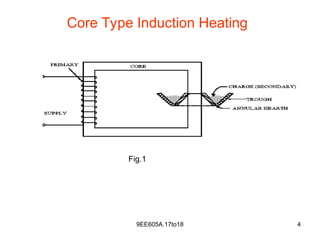
Fig.1
9EE605A.17to18 5
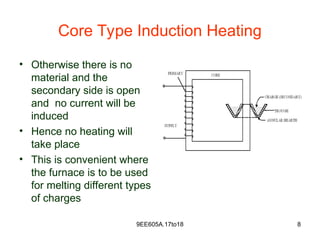
Core Type Induction Heating
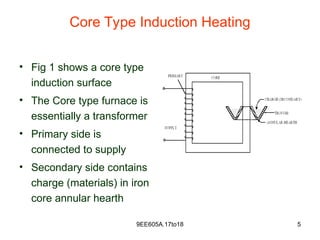
• Fig 1 shows a core type
induction surface
• The Core type furnace is
essentially a transformer
• Primary side is
connected to supply
• Secondary side contains
charge (materials) in iron
core annular hearth
9EE605A.17to18 6
Core Type Induction Heating
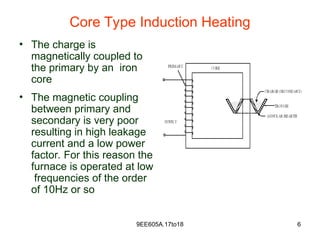
• The charge is
magnetically coupled to
the primary by an iron
core
• The magnetic coupling
between primary and
secondary is very poor
resulting in high leakage
current and a low power
factor. For this reason the
furnace is operated at low
frequencies of the order
of 10Hz or so
9EE605A.17to18 7
Core Type Induction Heating
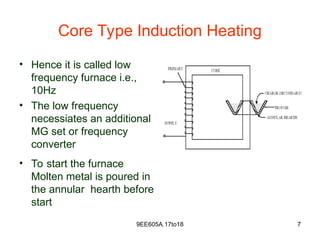
• Hence it is called low
frequency furnace i.e.,
10Hz
• The low frequency
necessiates an additional
MG set or frequency
converter
• To start the furnace
Molten metal is poured in
the annular hearth before
start
9EE605A.17to18 8
Core Type Induction Heating
• Otherwise there is no
material and the
secondary side is open
and no current will be
induced
• Hence no heating will
take place
• This is convenient where
the furnace is to be used
for melting different types
of charges
9EE605A.17to18 9
Core Type Induction Heating
• If the current density
exceeds about 5A/mm2
the pinch effect due to
electro magnetic forces,
may cause a complete
interruption of the
secondary circuit
9EE605A.17to18 10
Core Type Induction Heating
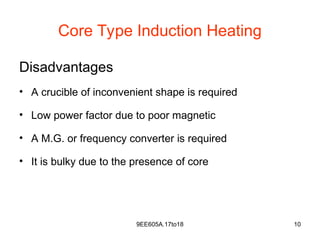
Disadvantages
• A crucible of inconvenient shape is required
• Low power factor due to poor magnetic
• A M.G. or frequency converter is required
• It is bulky due to the presence of core
9EE605A.17to18 11
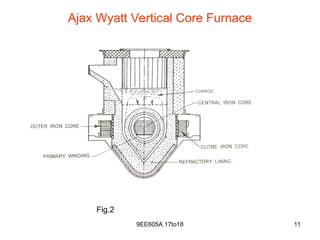
Ajax Wyatt Vertical Core Furnace
Fig.2
9EE605A.17to18 12
Ajax Wyatt Vertical Core Furnace
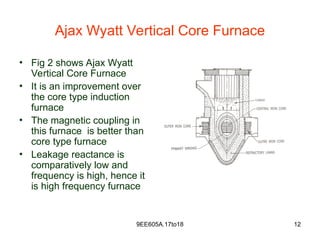
• Fig 2 shows Ajax Wyatt
Vertical Core Furnace
• It is an improvement over
the core type induction
furnace
• The magnetic coupling in
this furnace is better than
core type furnace
• Leakage reactance is
comparatively low and
frequency is high, hence it
is high frequency furnace
9EE605A.17to18 13
Ajax Wyatt Vertical Core Furnace
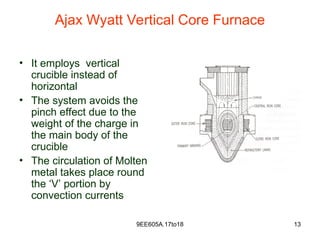
• It employs vertical
crucible instead of
horizontal
• The system avoids the
pinch effect due to the
weight of the charge in
the main body of the
crucible
• The circulation of Molten
metal takes place round
the ‘V’ portion by
convection currents
9EE605A.17to18 14
Ajax Wyatt Vertical Core Furnace
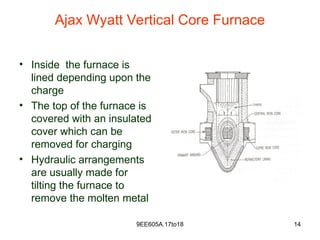
• Inside the furnace is
lined depending upon the
charge
• The top of the furnace is
covered with an insulated
cover which can be
removed for charging
• Hydraulic arrangements
are usually made for
tilting the furnace to
remove the molten metal
9EE605A.17to18 15
Indirect Core Type Induction Furnace
Fig.3
9EE605A.17to18 16
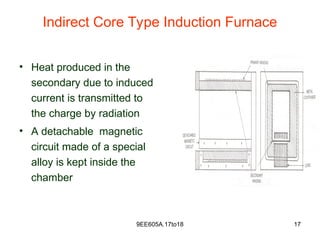
Indirect Core Type Induction Furnace
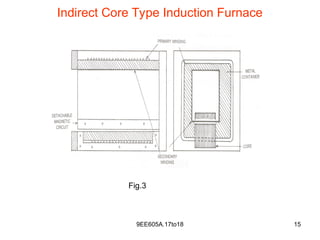
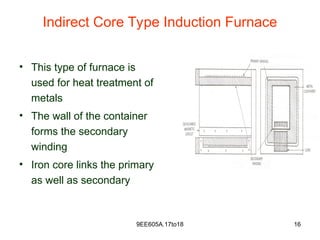
• This type of furnace is
used for heat treatment of
metals
• The wall of the container
forms the secondary
winding
• Iron core links the primary
as well as secondary
9EE605A.17to18 17
Indirect Core Type Induction Furnace
• Heat produced in the
secondary due to induced
current is transmitted to
the charge by radiation
• A detachable magnetic
circuit made of a special
alloy is kept inside the
chamber
9EE605A.17to18 18
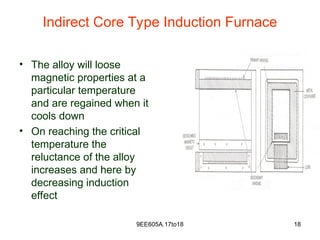
Indirect Core Type Induction Furnace
• The alloy will loose
magnetic properties at a
particular temperature
and are regained when it
cools down
• On reaching the critical
temperature the
reluctance of the alloy
increases and here by
decreasing induction
effect
9EE605A.17to18 19
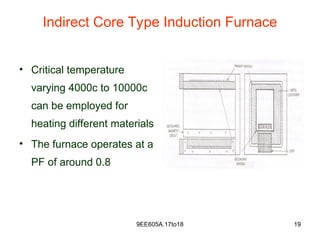
Indirect Core Type Induction Furnace
• Critical temperature
varying 4000c to 10000c
can be employed for
heating different materials
• The furnace operates at a
PF of around 0.8
9EE605A.17to18 20
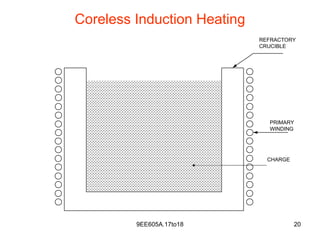
Coreless Induction Heating
PRIMARY
WINDING
REFRACTORY
CRUCIBLE
CHARGE
9EE605A.17to18 21
Coreless Induction Heating
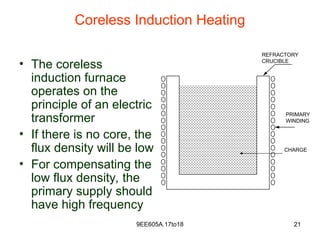
• The coreless
induction furnace
operates on the
principle of an electric
transformer
• If there is no core, the
flux density will be low
• For compensating the
low flux density, the
primary supply should
have high frequency
PRIMARY
WINDING
REFRACTORY
CRUCIBLE
CHARGE
9EE605A.17to18 22
Coreless Induction Heating
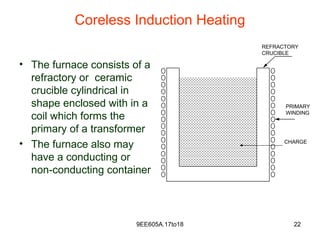
• The furnace consists of a
refractory or ceramic
crucible cylindrical in
shape enclosed with in a
coil which forms the
primary of a transformer
• The furnace also may
have a conducting or
non-conducting container
PRIMARY
WINDING
REFRACTORY
CRUCIBLE
CHARGE
9EE605A.17to18 23
Coreless Induction Heating
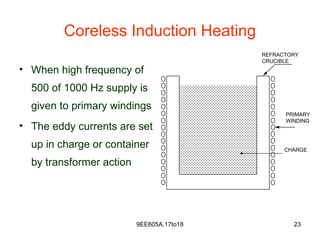
• When high frequency of
500 of 1000 Hz supply is
given to primary windings
• The eddy currents are set
up in charge or container
by transformer action
PRIMARY
WINDING
REFRACTORY
CRUCIBLE
CHARGE
9EE605A.17to18 24
Coreless Induction Heating
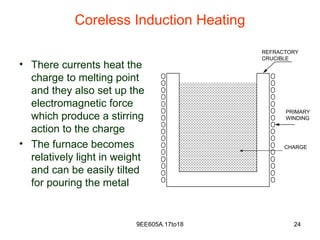
• There currents heat the
charge to melting point
and they also set up the
electromagnetic force
which produce a stirring
action to the charge
• The furnace becomes
relatively light in weight
and can be easily tilted
for pouring the metal
PRIMARY
WINDING
REFRACTORY
CRUCIBLE
CHARGE
9EE605A.17to18 25
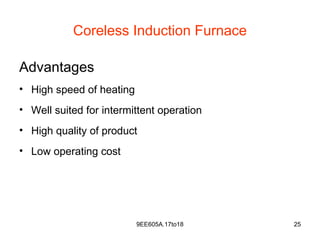
Coreless Induction Furnace
Advantages
• High speed of heating
• Well suited for intermittent operation
• High quality of product
• Low operating cost
9EE605A.17to18 26
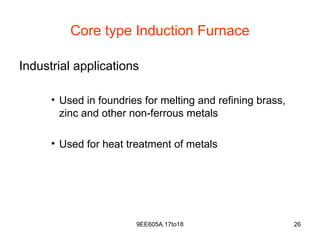
Core type Induction Furnace
Industrial applications
• Used in foundries for melting and refining brass,
zinc and other non-ferrous metals
• Used for heat treatment of metals
9EE605A.17to18 27
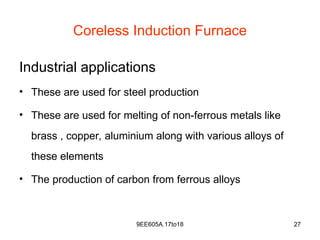
Coreless Induction Furnace
Industrial applications
• These are used for steel production
• These are used for melting of non-ferrous metals like
brass , copper, aluminium along with various alloys of
these elements
• The production of carbon from ferrous alloys
9EE605A.17to18 28
Comparison Between High Frequency And
Power Frequency Furnaces
Special starting procedure is
required.
No special starting procedure is
required
6
Large scrap melts with less
oxidation loss.
Large scrap melts with more
oxidation loss.
5
More
Less turbulence and stirring
effect
4
Less
Maintenance cost is more
3
Less energy required.
More energy required i.e, 20%
to 30% for same rating.
2
Not required.
Frequency converter is
necessary
1
Power frequency
High Frequency
S.
No.
9EE605A.17to18 29
Overall efficient is more.
Overall efficiency is low.
12
Negligible.
Care should be taken against
stray field
11
Well suited for long
production schedules of one
alloy.
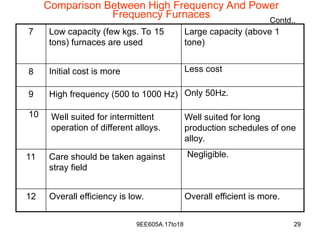
Well suited for intermittent
operation of different alloys.
10
Only 50Hz.
High frequency (500 to 1000 Hz)
9
Less cost
Initial cost is more
8
Large capacity (above 1
tone)
Low capacity (few kgs. To 15
tons) furnaces are used
7
Contd..
Comparison Between High Frequency And Power
Frequency Furnaces
9EE605A.17to18 30
Summary
In this class we have discussed about
• Principle and operation of induction heating
• Core type induction heating
• Core less induction heating
9EE605A.17to18 31
Quiz
1.Coreless induction furnace operate on the principle of
a. Transformer
b. Induction motor
c. Generator
d. Motor
9EE605A.17to18 32
Frequently Asked Questions
1) What is induction heating ?
2) Describe briefly with a neat sketch the core type induction
furnace
3) Explain the vertical core type of furnace (Ajax Wyatt
furnace) with a neat diagram
4) Explain the construction and operation of coreless induction
furnace
5) Explain the indirect core type induction furnace with sketch
9EE605A.17to18 33
THANK YOU

Induction Heating-Core type induction furnace

  • 1.
    9EE605A.17to18 1 Induction Heating •Induction heating is also known as high frequency heating • Induction heating process makes use of currents. induced by electromagnetic action in the material to be heated • It uses transformer principle • Conversion of electromagnetic energy into heat energy takes place in the material, it self
  • 2.
    9EE605A.17to18 2 Induction Heating •Heat transfer by high frequency heating is as much as 10,000 W/cm2 • The high frequency heating can be applied mainly to two classes of materials firstly, conducting materials & secondary insulating materials • Heating of first type of materials is called induction heating and heating of Second type of materials is dielectric heating
  • 3.
    9EE605A.17to18 3 Induction Heating Inductionfurnaces are further classified as i) Core type induction furnace ii) Coreless induction furnace
  • 4.
    9EE605A.17to18 4 Core TypeInduction Heating Fig.1
  • 5.
    9EE605A.17to18 5 Core TypeInduction Heating • Fig 1 shows a core type induction surface • The Core type furnace is essentially a transformer • Primary side is connected to supply • Secondary side contains charge (materials) in iron core annular hearth
  • 6.
    9EE605A.17to18 6 Core TypeInduction Heating • The charge is magnetically coupled to the primary by an iron core • The magnetic coupling between primary and secondary is very poor resulting in high leakage current and a low power factor. For this reason the furnace is operated at low frequencies of the order of 10Hz or so
  • 7.
    9EE605A.17to18 7 Core TypeInduction Heating • Hence it is called low frequency furnace i.e., 10Hz • The low frequency necessiates an additional MG set or frequency converter • To start the furnace Molten metal is poured in the annular hearth before start
  • 8.
    9EE605A.17to18 8 Core TypeInduction Heating • Otherwise there is no material and the secondary side is open and no current will be induced • Hence no heating will take place • This is convenient where the furnace is to be used for melting different types of charges
  • 9.
    9EE605A.17to18 9 Core TypeInduction Heating • If the current density exceeds about 5A/mm2 the pinch effect due to electro magnetic forces, may cause a complete interruption of the secondary circuit
  • 10.
    9EE605A.17to18 10 Core TypeInduction Heating Disadvantages • A crucible of inconvenient shape is required • Low power factor due to poor magnetic • A M.G. or frequency converter is required • It is bulky due to the presence of core
  • 11.
    9EE605A.17to18 11 Ajax WyattVertical Core Furnace Fig.2
  • 12.
    9EE605A.17to18 12 Ajax WyattVertical Core Furnace • Fig 2 shows Ajax Wyatt Vertical Core Furnace • It is an improvement over the core type induction furnace • The magnetic coupling in this furnace is better than core type furnace • Leakage reactance is comparatively low and frequency is high, hence it is high frequency furnace
  • 13.
    9EE605A.17to18 13 Ajax WyattVertical Core Furnace • It employs vertical crucible instead of horizontal • The system avoids the pinch effect due to the weight of the charge in the main body of the crucible • The circulation of Molten metal takes place round the ‘V’ portion by convection currents
  • 14.
    9EE605A.17to18 14 Ajax WyattVertical Core Furnace • Inside the furnace is lined depending upon the charge • The top of the furnace is covered with an insulated cover which can be removed for charging • Hydraulic arrangements are usually made for tilting the furnace to remove the molten metal
  • 15.
    9EE605A.17to18 15 Indirect CoreType Induction Furnace Fig.3
  • 16.
    9EE605A.17to18 16 Indirect CoreType Induction Furnace • This type of furnace is used for heat treatment of metals • The wall of the container forms the secondary winding • Iron core links the primary as well as secondary
  • 17.
    9EE605A.17to18 17 Indirect CoreType Induction Furnace • Heat produced in the secondary due to induced current is transmitted to the charge by radiation • A detachable magnetic circuit made of a special alloy is kept inside the chamber
  • 18.
    9EE605A.17to18 18 Indirect CoreType Induction Furnace • The alloy will loose magnetic properties at a particular temperature and are regained when it cools down • On reaching the critical temperature the reluctance of the alloy increases and here by decreasing induction effect
  • 19.
    9EE605A.17to18 19 Indirect CoreType Induction Furnace • Critical temperature varying 4000c to 10000c can be employed for heating different materials • The furnace operates at a PF of around 0.8
  • 20.
    9EE605A.17to18 20 Coreless InductionHeating PRIMARY WINDING REFRACTORY CRUCIBLE CHARGE
  • 21.
    9EE605A.17to18 21 Coreless InductionHeating • The coreless induction furnace operates on the principle of an electric transformer • If there is no core, the flux density will be low • For compensating the low flux density, the primary supply should have high frequency PRIMARY WINDING REFRACTORY CRUCIBLE CHARGE
  • 22.
    9EE605A.17to18 22 Coreless InductionHeating • The furnace consists of a refractory or ceramic crucible cylindrical in shape enclosed with in a coil which forms the primary of a transformer • The furnace also may have a conducting or non-conducting container PRIMARY WINDING REFRACTORY CRUCIBLE CHARGE
  • 23.
    9EE605A.17to18 23 Coreless InductionHeating • When high frequency of 500 of 1000 Hz supply is given to primary windings • The eddy currents are set up in charge or container by transformer action PRIMARY WINDING REFRACTORY CRUCIBLE CHARGE
  • 24.
    9EE605A.17to18 24 Coreless InductionHeating • There currents heat the charge to melting point and they also set up the electromagnetic force which produce a stirring action to the charge • The furnace becomes relatively light in weight and can be easily tilted for pouring the metal PRIMARY WINDING REFRACTORY CRUCIBLE CHARGE
  • 25.
    9EE605A.17to18 25 Coreless InductionFurnace Advantages • High speed of heating • Well suited for intermittent operation • High quality of product • Low operating cost
  • 26.
    9EE605A.17to18 26 Core typeInduction Furnace Industrial applications • Used in foundries for melting and refining brass, zinc and other non-ferrous metals • Used for heat treatment of metals
  • 27.
    9EE605A.17to18 27 Coreless InductionFurnace Industrial applications • These are used for steel production • These are used for melting of non-ferrous metals like brass , copper, aluminium along with various alloys of these elements • The production of carbon from ferrous alloys
  • 28.
    9EE605A.17to18 28 Comparison BetweenHigh Frequency And Power Frequency Furnaces Special starting procedure is required. No special starting procedure is required 6 Large scrap melts with less oxidation loss. Large scrap melts with more oxidation loss. 5 More Less turbulence and stirring effect 4 Less Maintenance cost is more 3 Less energy required. More energy required i.e, 20% to 30% for same rating. 2 Not required. Frequency converter is necessary 1 Power frequency High Frequency S. No.
  • 29.
    9EE605A.17to18 29 Overall efficientis more. Overall efficiency is low. 12 Negligible. Care should be taken against stray field 11 Well suited for long production schedules of one alloy. Well suited for intermittent operation of different alloys. 10 Only 50Hz. High frequency (500 to 1000 Hz) 9 Less cost Initial cost is more 8 Large capacity (above 1 tone) Low capacity (few kgs. To 15 tons) furnaces are used 7 Contd.. Comparison Between High Frequency And Power Frequency Furnaces
  • 30.
    9EE605A.17to18 30 Summary In thisclass we have discussed about • Principle and operation of induction heating • Core type induction heating • Core less induction heating
  • 31.
    9EE605A.17to18 31 Quiz 1.Coreless inductionfurnace operate on the principle of a. Transformer b. Induction motor c. Generator d. Motor
  • 32.
    9EE605A.17to18 32 Frequently AskedQuestions 1) What is induction heating ? 2) Describe briefly with a neat sketch the core type induction furnace 3) Explain the vertical core type of furnace (Ajax Wyatt furnace) with a neat diagram 4) Explain the construction and operation of coreless induction furnace 5) Explain the indirect core type induction furnace with sketch
  • 33.