Transformers
1. Parallel operation
2. Auto transformer
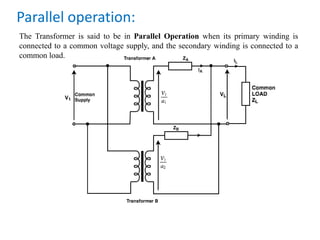
Parallel operation:
The Transformer is said to be in Parallel Operation when its primary winding is
connected to a common voltage supply, and the secondary winding is connected to a
common load.
Necessity of parallel operation:
1. Continuity of supply
2. Operating them in maximum capacity
3. Easy maintenance
4. Connecting and disconnecting according to load requirements
5. Decreasing iron losses
6. Increasing the life of the units
7. Increasing the capacity of sub-station by adding extra units
8. No stand by units are required
Conditions for parallel operation:
1. Same polarity
2. Same voltage ratio and turns ratio
3. Same frequency
4. Same percentage impedance and X/R ratio
5. Same phase sequence (incase of three phase transformers)
Case I: Equal voltage ratio
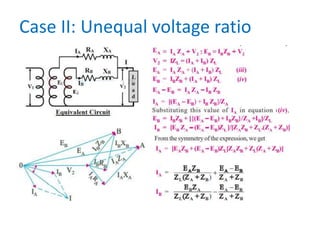
Case II: Unequal voltage ratio
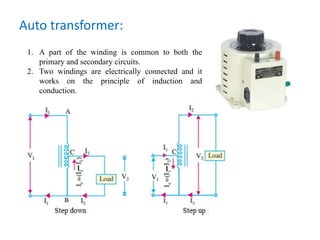
Auto transformer:
1. A part of the winding is common to both the
primary and secondary circuits.
2. Two windings are electrically connected and it
works on the principle of induction and
conduction.
Saving of copper in auto transformer as
compared to ordinary two winding
transformer:
Transfer of power in an auto transformer:
Power transferred inductively= Input X (1-K)
Power transferred conductively= Input X K
Advantages:
1. Cheaper
2. More efficient, because losses are less as compared to ordinary two winding
transformer of the same rating.
3. Better voltage regulation
Disadvantages:
1. it does not have the primary to secondary winding isolation of a conventional
double wound transformer.
2. If the secondary side winding becomes open-circuited, load current stops flowing
through the primary winding stopping the transformer action resulting in the full
primary voltage being applied to the secondary terminals.
3. If the secondary circuit suffers a short-circuit condition, the resulting primary
current would be much larger than an equivalent double wound transformer due to
the increased flux linkage damaging the autotransformer.
4. Since the neutral connection is common to both the primary and secondary
windings, earthing of the secondary winding automatically Earth’s the primary as
there is no isolation between the two windings. Double wound transformers are
sometimes used to isolate equipment from earth.
5. Used only in the limited places where a slight variation of the output voltage from
input voltage is required.
Applications:
1. It is used as a starter to give up to 50 to 60% of full voltage to the stator of a
squirrel cage induction motor during starting.
2. It is used to give a small boost to a distribution cable, to correct the voltage drop.
3. It is also used as a voltage regulator
4. Used in power transmission and distribution system and also in the audio system
and railways.

Transformer_Parallel_opt_auto.ppt

  • 1.
  • 2.
    Parallel operation: The Transformeris said to be in Parallel Operation when its primary winding is connected to a common voltage supply, and the secondary winding is connected to a common load.
  • 3.
    Necessity of paralleloperation: 1. Continuity of supply 2. Operating them in maximum capacity 3. Easy maintenance 4. Connecting and disconnecting according to load requirements 5. Decreasing iron losses 6. Increasing the life of the units 7. Increasing the capacity of sub-station by adding extra units 8. No stand by units are required
  • 4.
    Conditions for paralleloperation: 1. Same polarity 2. Same voltage ratio and turns ratio 3. Same frequency 4. Same percentage impedance and X/R ratio 5. Same phase sequence (incase of three phase transformers)
  • 5.
    Case I: Equalvoltage ratio
  • 6.
    Case II: Unequalvoltage ratio
  • 7.
    Auto transformer: 1. Apart of the winding is common to both the primary and secondary circuits. 2. Two windings are electrically connected and it works on the principle of induction and conduction.
  • 8.
    Saving of copperin auto transformer as compared to ordinary two winding transformer:
  • 9.
    Transfer of powerin an auto transformer: Power transferred inductively= Input X (1-K) Power transferred conductively= Input X K
  • 10.
    Advantages: 1. Cheaper 2. Moreefficient, because losses are less as compared to ordinary two winding transformer of the same rating. 3. Better voltage regulation Disadvantages: 1. it does not have the primary to secondary winding isolation of a conventional double wound transformer. 2. If the secondary side winding becomes open-circuited, load current stops flowing through the primary winding stopping the transformer action resulting in the full primary voltage being applied to the secondary terminals. 3. If the secondary circuit suffers a short-circuit condition, the resulting primary current would be much larger than an equivalent double wound transformer due to the increased flux linkage damaging the autotransformer. 4. Since the neutral connection is common to both the primary and secondary windings, earthing of the secondary winding automatically Earth’s the primary as there is no isolation between the two windings. Double wound transformers are sometimes used to isolate equipment from earth. 5. Used only in the limited places where a slight variation of the output voltage from input voltage is required.
  • 11.
    Applications: 1. It isused as a starter to give up to 50 to 60% of full voltage to the stator of a squirrel cage induction motor during starting. 2. It is used to give a small boost to a distribution cable, to correct the voltage drop. 3. It is also used as a voltage regulator 4. Used in power transmission and distribution system and also in the audio system and railways.