GENSOL ENGINEERING PVT. LTD
www.gensol.in
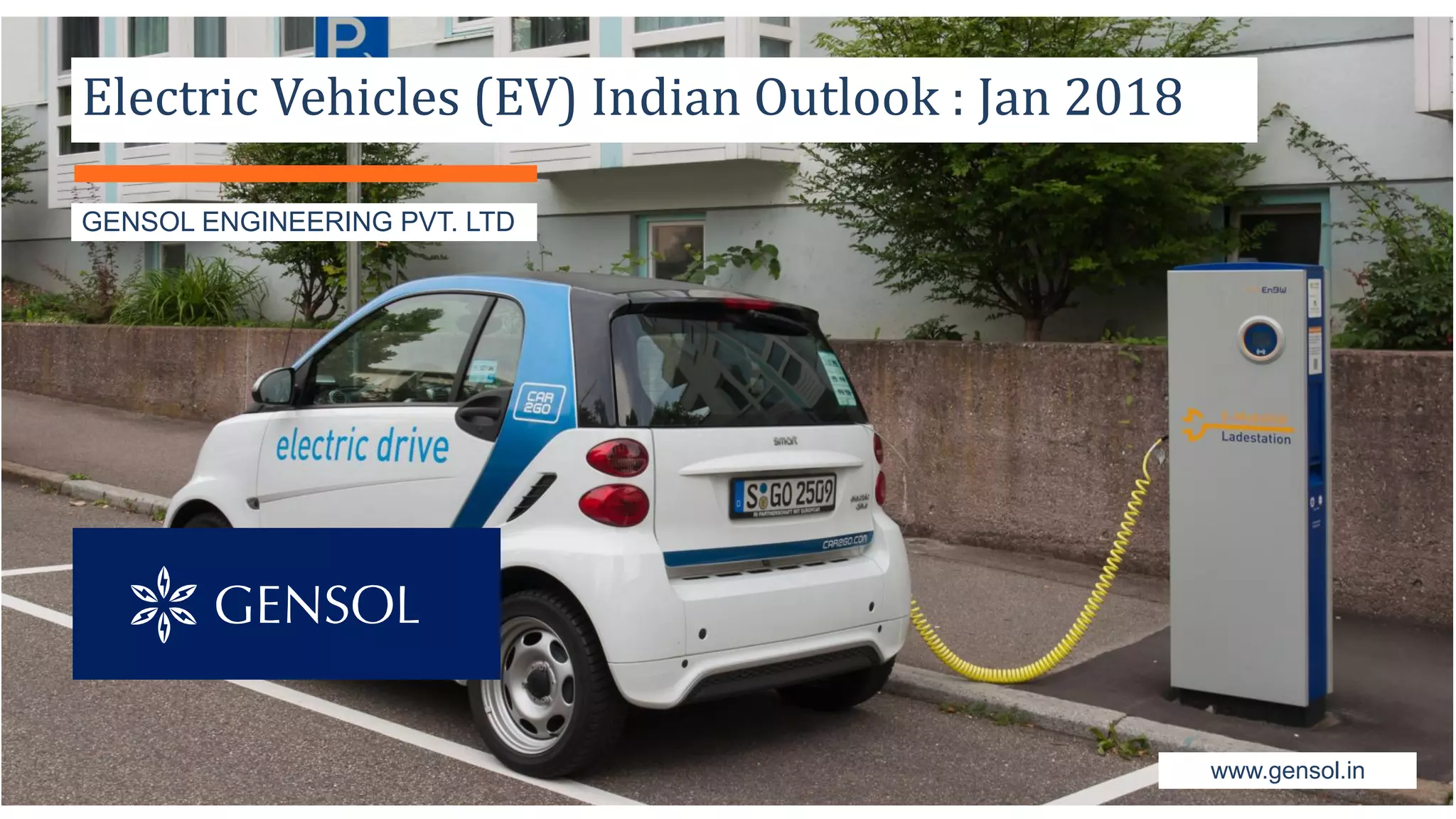
Electric	Vehicles	(EV)	Indian	Outlook	:	Jan	2018
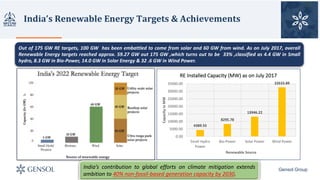
India’s	Renewable	Energy	Targets	&	Achievements
Gensol Group
4389.55
8295.78
13946.22
32633.89
0.00
5000.00
10000.00
15000.00
20000.00
25000.00
30000.00
35000.00
Small	Hydro	
Power
Bio-Power Solar	Power Wind	Power
Capacity	in	MW
Renewable	Source
RE	Installed	Capacity	(MW) as	on	July	2017
Out of 175 GW RE targets, 100 GW has been embattled to come from solar and 60 GW from wind. As on July 2017, overall
Renewable Energy targets reached approx. 59.27 GW out 175 GW ,which turns out to be 33% ,classified as 4.4 GW in Small
hydro, 8.3 GW in Bio-Power, 14.0 GW in Solar Energy & 32 .6 GW in Wind Power.
India’s contribution to global efforts on climate mitigation extends
ambition to 40% non-fossil-based generation capacity by 2030.
RE	Integration	:	Switching	from	Fossil	Fuels
Gensol Group
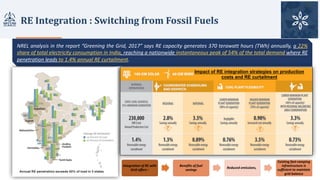
NREL analysis in the report “Greening the Grid, 2017” says RE capacity generates 370 terawatt hours (TWh) annually, a 22%
share of total electricity consumption in India, reaching a nationwide instantaneous peak of 54% of the total demand where RE
penetration leads to 1.4% annual RE curtailment.
Impact of RE integration strategies on production
costs and RE curtailment
Integration	of	RE	with	
Grid	offers	:
Benefits	of	fuel	
savings
Reduced	emissions,	
Existing	fast-ramping	
infrastructure	is	
sufficient	to	maintain	
grid	balance
Findings	for	100	GW	Solar	&	60	GW	Wing	Scenario	:	2022		
Gensol Group
Scenario Description Purpose
No New RE 5 MW Solar & 25 MW Wind -
2014
Establish a baseline to measure impact of adding new RE
to the system
100S-60W 100 MW Solar & 60 MW
Wind-2022
Evaluate changes to planning and operations to meet the
official target of 175 GW RE
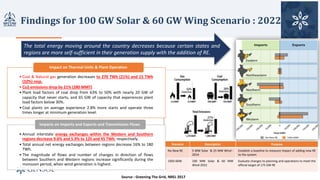
• Coal & Natural gas generation decreases to 270 TWh (21%) and 15 TWh
(32%) resp.
• Co2 emissions drop by 21% (280 MMT)
• Plant load factors of coal drop from 63% to 50% with nearly 20 GW of
capacity that never starts, and 65 GW of capacity that experiences plant
load factors below 30%.
• Coal plants on average experience 2.8% more starts and operate three
times longer at minimum generation level.
Impact	on	Thermal	Units	&	Plant	Operation
• Annual interstate energy exchanges within the Western and Southern
regions decrease 9.6% and 5.9% to 120 and 45 TWh, respectively.
• Total annual net energy exchanges between regions decrease 16% to 180
TWh.
• The magnitude of flows and number of changes in direction of flows
between Southern and Western regions increase significantly during the
monsoon period, when wind generation is highest.
Impacts on Imports and Exports and Transmission Flows
Source	:	Greening	The	Grid,	NREL	2017
The total energy moving around the country decreases because certain states and
regions are more self-sufficient in their generation supply with the addition of RE.
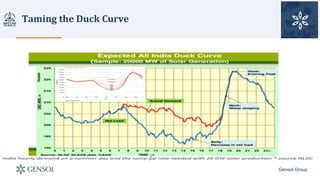
Taming	the	Duck	Curve
Gensol Group
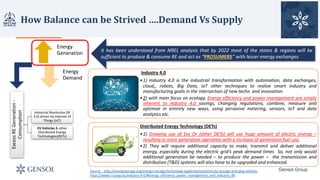
How	Balance	can	be	Strived	….Demand	Vs	Supply
Gensol Group
Industry 4.0
•1) Industry 4.0 is the industrial transformation with automation, data exchanges,
cloud,, robots, Big Data, IoT other techniques to realize smart industry and
manufacturing goals in the intersection of new techn. and innovation.
•2) with main focus on ecology, Energy efficiency and power management are simply
inherent to Industry 4.0 savings, changing regulations, combine, measure and
optimize in entirely new ways, using pervasive metering, sensors, IoT and data
analytics etc.
Distributed Energy Technology (DETs)
•1) Growing use of Evs Or (other DETs) will use huge amount of electric energy –
resulting in more generation operation with a increase of generation fuel use,
•2) They will require additional capacity to make, transmit and deliver additional
energy, especially during the electric grid’s peak demand times So, not only would
additional generation be needed – to produce the power – the transmission and
distribution (T&D) systems will also have to be upgraded and enhanced.
Source		- http://energystorage.org/energy-storage/technology-applications/electricity-storage-and-plug-vehicles
https://www.i-scoop.eu/industry-4-0/#Energy_efficiency_power_management_and_Industry_40
It has been understood from NREL analysis that by 2022 most of the states & regions will be
sufficient to produce & consume RE and act as “PROSUMERS” with lesser energy exchanges.
Energy	
Generation
Energy	
Demand
Excess	RE	Generation	-
Consumption
Industrial	Revolution	(IR	
4.0)	driven	by	Internet	of	
Things	(IoT)
EV	Vehicles	&	other	
Distributed	Energy	
Technologies(DETs)
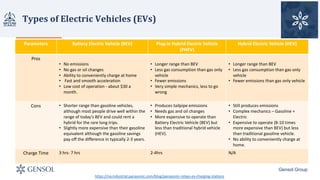
Types	of	Electric	Vehicles	(EVs)
Gensol Group
https://na.industrial.panasonic.com/blog/panasonic-relays-ev-charging-stations
Parameters	 Battery	Electric	Vehicle	(BEV) Plug-in	Hybrid	Electric	Vehicle	
(PHEV)	
Hybrid	Electric	Vehicle	(HEV)
Pros
• No	emissions	
• No	gas	or	oil	changes	
• Ability	to	conveniently	charge	at	home	
• Fast	and	smooth	acceleration	
• Low	cost	of	operation	- about	$30	a	
month.	
• Longer	range	than	BEV	
• Less	gas	consumption	than	gas	only	
vehicle	
• Fewer	emissions	
• Very	simple	mechanics,	less	to	go	
wrong	
• Longer	range	than	BEV	
• Less	gas	consumption	than	gas	only	
vehicle	
• Fewer	emissions	than	gas	only	vehicle	
Cons • Shorter	range	than	gasoline	vehicles,	
although	most	people	drive	well	within	the	
range	of	today’s	BEV	and	could	rent	a	
hybrid	for	the	rare	long	trips.	
• Slightly	more	expensive	than	their	gasoline	
equivalent	although	the	gasoline	savings	
pay	off	the	difference	in	typically	2-3	years.	
• Produces	tailpipe	emissions	
• Needs	gas	and	oil	changes	
• More	expensive	to	operate	than	
Battery	Electric	Vehicle	(BEV)	but	
less	than	traditional	hybrid	vehicle	
(HEV).	
• Still	produces	emissions	
• Complex	mechanics	– Gasoline	+	
Electric	
• Expensive	to	operate	(8-10	times	
more	expensive	than	BEV)	but	less	
than	traditional	gasoline	vehicle.	
• No	ability	to	conveniently	charge	at	
home.	
Charge	Time 3	hrs- 7	hrs 2-4hrs N/A
Global	EV	Market	:	2017	
Gensol Group
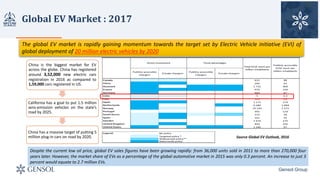
The global EV market is rapidly gaining momentum towards the target set by Electric Vehicle initiative (EVI) of
global deployment of 20 million electric vehicles by 2020
Source	Global	EV	Outlook,	2016
China is the biggest market for EV
across the globe. China has registered
around 3,52,000 new electric cars
registration in 2016 as compared to
1,59,000 cars registered in US.
California has a goal to put 1.5 million
zero-emission vehicles on the state’s
road by 2025.
China has a massive target of putting 5
million plug-in cars on road by 2020.
Despite the current low oil price, global EV sales figures have been growing rapidly: from 36,000 units sold in 2011 to more than 270,000 four
years later. However, the market share of EVs as a percentage of the global automotive market in 2015 was only 0.3 percent. An increase to just 3
percent would equate to 2.7 million EVs.
Indian	EV	Market	Outlook	:	2017	
Gensol Group
Source	:	E-REP	Market	Research	Series,	Oct	2017
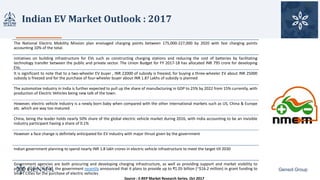
The National Electric Mobility Mission plan envisaged charging points between 175,000-227,000 by 2020 with fast charging points
accounting 10% of the total.
initiatives on building infrastructure for EVs such as constructing charging stations and reducing the cost of batteries by facilitating
technology transfer between the public and private sector. The Union Budget for FY 2017-18 has allocated INR 795 crore for developing
EVs.
It is significant to note that to a two-wheeler EV buyer , INR 22000 of subsidy is freezed, for buying a three-wheeler EV about INR 25000
subsidy is freezed and for the purchase of four-wheeler buyer about INR 1.87 Lakhs of subsidy is planned
The automotive industry in India is further expected to pull up the share of manufacturing in GDP to 25% by 2022 from 15% currently, with
production of Electric Vehicles being new talk of the town.
However, electric vehicle industry is a newly born baby when compared with the other international markets such as US, China & Europe
etc. which are way too matured.
China, being the leader holds nearly 50% share of the global electric vehicle market during 2016, with India accounting to be an invisible
industry participant having a share of 0.1%
However a face change is definitely anticipated for EV industry with major thrust given by the government
Indian government planning to spend nearly INR 1.8 lakh crores in electric vehicle infrastructure to meet the target till 2030
Government agencies are both procuring and developing charging infrastructure, as well as providing support and market visibility to
private players. In fact, the government recently announced that it plans to provide up to ₹1.05 billion (~$16.2 million) in grant funding to
Smart Cities for the purchase of electric vehicles
NITI	Aayog Report	- Approach	to	Mobility	Transformation
Gensol Group
.	
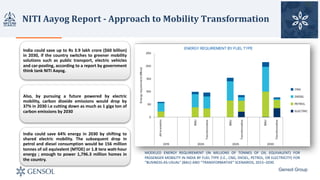
India could save up to Rs 3.9 lakh crore ($60 billion)
in 2030, if the country switches to greener mobility
solutions such as public transport, electric vehicles
and car-pooling, according to a report by government
think tank NITI Aayog.
Also, by pursuing a future powered by electric
mobility, carbon dioxide emissions would drop by
37% in 2030 i.e cutting down as much as 1 giga ton of
carbon emissions by 2030
India could save 64% energy in 2030 by shifting to
shared electric mobility. The subsequent drop in
petrol and diesel consumption would be 156 million
tonnes of oil equivalent (MTOE) or 1.8 tera watt-hour
energy ; enough to power 1,796.3 million homes in
the country.
MODELED ENERGY REQUIREMENT (IN MILLIONS OF TONNES OF OIL EQUIVALENT) FOR
PASSENGER MOBILITY IN INDIA BY FUEL TYPE (I.E., CNG, DIESEL, PETROL, OR ELECTRICITY) FOR
“BUSINESS-AS-USUAL” (BAU) AND “TRANSFORMATIVE” SCENARIOS, 2015–2030
NITI	Aayog Report	- Approach	to	Mobility	Transformation
Gensol Group
.	
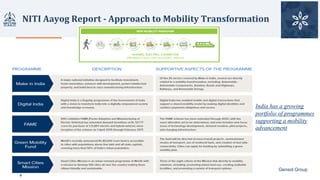
India has a growing
portfolio of programmes
supporting a mobility
advancement
NITI	Aayog Report	- Pursuing	economic	market	segment	
transformation
Gensol Group
.
EV	Charging	Infrastructure	in	India
Gensol Group
Development	of	charging	infrastructure	would	hinge	on	
- Regulations	that	classify	energy	storage	as	an	asset	that	could	also	be	traded.	
- Standards	for	charging	stations,	connectors	and	hardware	protocols.	The	
Automotive	Research	Association	of	India	(ARAI)	has	recently	released	an	industry	
charging	standard	for	AC	systems	and	is	likely	to	release	one	for	DC	systems	soon.	
- Utility’s	preparedness	to	witness	a	surge	in	demand.	
- Incentive	to	charge	vehicles	through	a	time	of	use/	off-peak	charging	tariffs
Source	:	Plugin	India,	2016
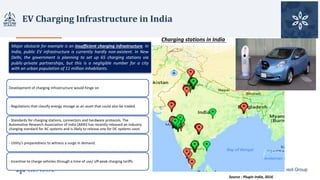
Charging	stations	in	India	
Major obstacle for example is an insufficient charging infrastructure. In
India, public EV infrastructure is currently hardly non-existent. In New
Delhi, the government is planning to set up 65 charging stations via
public-private partnerships, but this is a negligible number for a city
with an urban population of 11 million inhabitants.
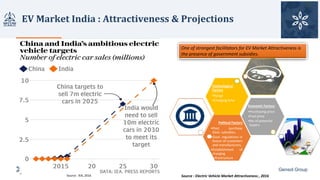
EV	Market	India	:	Attractiveness	&	Projections		
Gensol Group
One	of	strongest	facilitators	for	EV	Market	Attractiveness	is	
the	presence	of	government	subsidies.	
Political	Factors
•Post purchase
Govt. subsidies,
•Govt. regulations in
favour of customers
and manufacturers,
•Establishment of
charging
infrastructure
Economic	Factors
•Purchasing	price
•Fuel	price
•No	of	potential	
buyers
Technological	
Factors
•Range	
•Charging	time
Source	:	Electric	Vehicle	Market	Attractiveness	,	2016Source	:	IEA,	2016
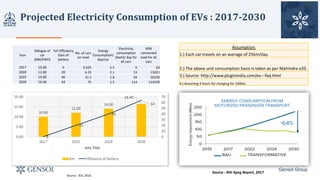
Projected	Electricity	Consumption	of	EVs	:	2017-2030
Gensol Group
Source	:	Niti Ayog Report,	2017
Source	:	IEA,	2016
10.00
12.00
14.00
16.40
0
20
40
64
0
10
20
30
40
50
60
70
0.00
5.00
10.00
15.00
20.00
2017 2022 2024 2030
Axis	Title
Km Efficiency	of	battery
Assumption:	
1.)	Each	car	travels	on	an	average	of	25km/day.	
2.)	The	above	unit	consumption	basis	is	taken	as	per	Mahindra	e20.
3.)	Source:	http://www.pluginindia.com/ev---faq.html
4.)	Assuming	4	hours	for	charging	for	100km.	
Year
Milegae	of	
car	
(KM/KWH)
YoY	Efficiency		
Gain	of	
battery
No.	of	cars	
on	road
Energy	
Consumption/
day/car
Electricity	
consumption	
(Gwh)/	day	for	
all	cars
MW	
connected	
load	for	all	
cars
2017 10.00 0 0.025 2.5 0 63
2020 12.00 20 6.25 2.1 13 13021
2025 14.00 40 31.5 1.8 56 56250
2030 16.40 64 75 1.5 114 114329
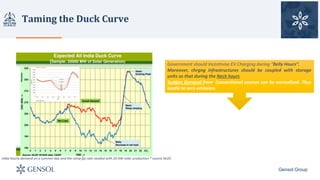
Taming	the	Duck	Curve
Gensol Group
Government should Incentivise EV Charging during “Belly Hours”.
Moreover, chrgng infrastructures should be coupled with storage
units so that during the Neck hours
Sudden Demand from Conventional sources can be normalized. Thus
leadin to zero emission.
EVs	+	BESS	
Gensol Group
Electricity storage + EVs
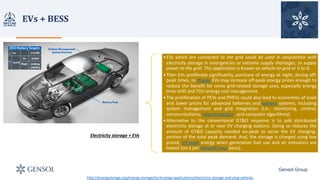
•EVs which are connected to the grid could be used in conjunction with
electricity storage in emergencies or extreme supply shortages, to supply
power to the grid. This application is known as vehicle-to-grid or V to G.
•Then EVs proliferate significantly, purchase of energy at night, during off-
peak times, to charge EVs may increase off-peak energy prices enough to
reduce the benefit for some grid-related storage uses, especially energy
time-shift and TOU energy cost management.
•The proliferation of PEVs and PHEVs could also lead to economies of scale
and lower prices for advanced batteries and battery systems, including
system management and grid integration (i.e., monitoring, control,
communications, interconnection, and computer algorithms).
•Alternative to the conventional GT&D response is to add distributed
electricity storage at or near EV charging stations. Doing so reduces the
amount of GT&D capacity needed on-peak to serve the EV charging-
portion of the total peak demand. And, the storage is charged using low
priced, off-peak energy when generation fuel use and air emissions are
lowest (on a per kilowatt-hour basis).
http://energystorage.org/energy-storage/technology-applications/electricity-storage-and-plug-vehicles
EV	:	Challenges	&	Road	Ahead
Gensol Group
• Appropriate EV Charging infrastructure model for the urban areas, highways
and rural India.
• Type of charging infrastructure model should be deployed in different areas
needs to be finalized : Workplace (8-9 hrs Charging time), Residential (3-4
hrs Charging time) & Highways & Mall ( <2 hrs Charging time)
• Right tariff for the charging of electric vehicles should be – whether we
choose commercial rates/promotional rates for the promotion of EV’s in
India
• the appropriate battery technology for the electric vehicles whether it
should be lead acid or the lithium ion.
• incentives should be provided for the faster adoption of electric vehicles
Challenges	Faced	&	Roadmap
Trending	News	&	Tenders	:	2017
Gensol Group
Nagpur. It became the first city in India to have an electric-vehicle charging station by an oil marketing company, Indian Oil Corporation
100 battery charging stations are proposed to be set up in Delhi-NCR to be set up by BHEL & REIL has planned to set up 200 charging stations in Delhi,
Jaipur and Chandigarh ET Energy World
Indian government planning to spend nearly INR 1.8 lakh crores in electric vehicle infrastructure to meet the target till 2030 Ministry of Power
The government will buy 10,000 electric sedans through state-run Energy Efficiency Services Ltd. in its first step toward making all cars electric by 2030.
Tata Motors Ltd. and Mahindra and Mahindra will supply 500 cars in the first phase.
ABB has submitted a bid to provide 4,500 charging points as part of the government’s tender to procure electric vehicles to push cleaner transport
Toyota, Suzuki to introduce electric vehicles in India in 2020
Bosch, a German firm, has also announced plans to start a manufacturing unit that would manufacture components and parts for EV vehicles in India by
2018
NTPC has emerged as a player in the sector with the construction of two EV charging stations at its offices in Noida and Delhi.
ACME Group launched India’s first Battery Swapping & Charging Station for Electric Vehicles in Nagpur.
Hero Future Energies is preparing to make an entry into the battery storage business and set up charging stations
https://www.bloombergquint.com/business/2017/10/05/abb-india-submits-bid-for-4500-electric-vehicle-charging-stations
economictimes.indiatimes.com/articleshow/61687544.cms?utm_source=contentofinterest&utm_medium=text&utm_campaign=
cppst
https://mercomindia.com/electric-vehicles-opportunity-india/
About	Gensol
Solar Advisory Services Solar EPC Services Solar O&M Services
6,490 MW 42 MW 776 MW
Gensol Group
Gensol provides concept to commissioning solar advisory, execution and operations services for Solar Projects in India and abroad.
103 Projects 65 Execution Engineers71 Design & Supply Chain Engineers
Anmol Singh
Evangelist
+91 7698833311
anmoljaggi@gensol.in
Imran Naqvi
Head of Strategic Advisory
& Business Development
+91 9327016962
imrannaqvi@gensol.in
Gurpreet Singh
Head of Engineering &
Operations
+91 9725544301
gurpreetsingh@gensol.in
Puneet Singh Jaggi
Director
+91 9998025820
puneetjaggi@gensol.in
Pranay Mundra
President
+91 9850673664
pranaymundra@gensol.in
Shivya Singhal
Head of Supply Chain & Group
CFO
+91 9376703846
shivyasinghal@gensol.in
Gensol is one of the leading consultants and system integrators for Solar Power Plants. We boast of a portfolio of over 6000 MW of Solar Photovoltaic Plants. Gensol is also a channel
partner to Ministry of New & Renewable Energy and installs kW scale Solar Rooftop systems on a turnkey basis with more than 42 MW of cumulative installations across the country.
The information contained herein is of a general nature and is not intended to address the circumstances of any particular individual or entity. Although we endeavor to provide
accurate and timely information, there can be no guarantee that such information is accurate as of the date it is received or that it will continue to be accurate in the future. No one
should act on such information without appropriate professional advice after a thorough examination of the particular situation.
Email: solar@gensol.in | Web: www.gensol.in | Phone: +91 79 40068235 | Twitter: gensol_tweets
Gensol Engineering Pvt Ltd | Gensol Consultants Pvt Ltd | Solarig Gensol Utilities Pvt Ltd
Corporate Office
108, Pinnacle Business Park, Opp. Royal Arcade, Prahladnagar, Ahmedabad, Gujarat. India - 380015

Electric Vehicle & Integration with Renewable Energy

  • 1.
    GENSOL ENGINEERING PVT.LTD www.gensol.in Electric Vehicles (EV) Indian Outlook : Jan 2018
  • 2.
    India’s Renewable Energy Targets & Achievements Gensol Group 4389.55 8295.78 13946.22 32633.89 0.00 5000.00 10000.00 15000.00 20000.00 25000.00 30000.00 35000.00 Small Hydro Power Bio-Power Solar PowerWind Power Capacity in MW Renewable Source RE Installed Capacity (MW) as on July 2017 Out of 175 GW RE targets, 100 GW has been embattled to come from solar and 60 GW from wind. As on July 2017, overall Renewable Energy targets reached approx. 59.27 GW out 175 GW ,which turns out to be 33% ,classified as 4.4 GW in Small hydro, 8.3 GW in Bio-Power, 14.0 GW in Solar Energy & 32 .6 GW in Wind Power. India’s contribution to global efforts on climate mitigation extends ambition to 40% non-fossil-based generation capacity by 2030.
  • 3.
    RE Integration : Switching from Fossil Fuels Gensol Group NREL analysisin the report “Greening the Grid, 2017” says RE capacity generates 370 terawatt hours (TWh) annually, a 22% share of total electricity consumption in India, reaching a nationwide instantaneous peak of 54% of the total demand where RE penetration leads to 1.4% annual RE curtailment. Impact of RE integration strategies on production costs and RE curtailment Integration of RE with Grid offers : Benefits of fuel savings Reduced emissions, Existing fast-ramping infrastructure is sufficient to maintain grid balance
  • 4.
    Findings for 100 GW Solar & 60 GW Wing Scenario : 2022 Gensol Group Scenario DescriptionPurpose No New RE 5 MW Solar & 25 MW Wind - 2014 Establish a baseline to measure impact of adding new RE to the system 100S-60W 100 MW Solar & 60 MW Wind-2022 Evaluate changes to planning and operations to meet the official target of 175 GW RE • Coal & Natural gas generation decreases to 270 TWh (21%) and 15 TWh (32%) resp. • Co2 emissions drop by 21% (280 MMT) • Plant load factors of coal drop from 63% to 50% with nearly 20 GW of capacity that never starts, and 65 GW of capacity that experiences plant load factors below 30%. • Coal plants on average experience 2.8% more starts and operate three times longer at minimum generation level. Impact on Thermal Units & Plant Operation • Annual interstate energy exchanges within the Western and Southern regions decrease 9.6% and 5.9% to 120 and 45 TWh, respectively. • Total annual net energy exchanges between regions decrease 16% to 180 TWh. • The magnitude of flows and number of changes in direction of flows between Southern and Western regions increase significantly during the monsoon period, when wind generation is highest. Impacts on Imports and Exports and Transmission Flows Source : Greening The Grid, NREL 2017 The total energy moving around the country decreases because certain states and regions are more self-sufficient in their generation supply with the addition of RE.
  • 5.
  • 6.
    How Balance can be Strived ….Demand Vs Supply Gensol Group Industry 4.0 •1)Industry 4.0 is the industrial transformation with automation, data exchanges, cloud,, robots, Big Data, IoT other techniques to realize smart industry and manufacturing goals in the intersection of new techn. and innovation. •2) with main focus on ecology, Energy efficiency and power management are simply inherent to Industry 4.0 savings, changing regulations, combine, measure and optimize in entirely new ways, using pervasive metering, sensors, IoT and data analytics etc. Distributed Energy Technology (DETs) •1) Growing use of Evs Or (other DETs) will use huge amount of electric energy – resulting in more generation operation with a increase of generation fuel use, •2) They will require additional capacity to make, transmit and deliver additional energy, especially during the electric grid’s peak demand times So, not only would additional generation be needed – to produce the power – the transmission and distribution (T&D) systems will also have to be upgraded and enhanced. Source - http://energystorage.org/energy-storage/technology-applications/electricity-storage-and-plug-vehicles https://www.i-scoop.eu/industry-4-0/#Energy_efficiency_power_management_and_Industry_40 It has been understood from NREL analysis that by 2022 most of the states & regions will be sufficient to produce & consume RE and act as “PROSUMERS” with lesser energy exchanges. Energy Generation Energy Demand Excess RE Generation - Consumption Industrial Revolution (IR 4.0) driven by Internet of Things (IoT) EV Vehicles & other Distributed Energy Technologies(DETs)
  • 7.
    Types of Electric Vehicles (EVs) Gensol Group https://na.industrial.panasonic.com/blog/panasonic-relays-ev-charging-stations Parameters Battery Electric Vehicle (BEV)Plug-in Hybrid Electric Vehicle (PHEV) Hybrid Electric Vehicle (HEV) Pros • No emissions • No gas or oil changes • Ability to conveniently charge at home • Fast and smooth acceleration • Low cost of operation - about $30 a month. • Longer range than BEV • Less gas consumption than gas only vehicle • Fewer emissions • Very simple mechanics, less to go wrong • Longer range than BEV • Less gas consumption than gas only vehicle • Fewer emissions than gas only vehicle Cons • Shorter range than gasoline vehicles, although most people drive well within the range of today’s BEV and could rent a hybrid for the rare long trips. • Slightly more expensive than their gasoline equivalent although the gasoline savings pay off the difference in typically 2-3 years. • Produces tailpipe emissions • Needs gas and oil changes • More expensive to operate than Battery Electric Vehicle (BEV) but less than traditional hybrid vehicle (HEV). • Still produces emissions • Complex mechanics – Gasoline + Electric • Expensive to operate (8-10 times more expensive than BEV) but less than traditional gasoline vehicle. • No ability to conveniently charge at home. Charge Time 3 hrs- 7 hrs 2-4hrs N/A
  • 8.
    Global EV Market : 2017 Gensol Group The globalEV market is rapidly gaining momentum towards the target set by Electric Vehicle initiative (EVI) of global deployment of 20 million electric vehicles by 2020 Source Global EV Outlook, 2016 China is the biggest market for EV across the globe. China has registered around 3,52,000 new electric cars registration in 2016 as compared to 1,59,000 cars registered in US. California has a goal to put 1.5 million zero-emission vehicles on the state’s road by 2025. China has a massive target of putting 5 million plug-in cars on road by 2020. Despite the current low oil price, global EV sales figures have been growing rapidly: from 36,000 units sold in 2011 to more than 270,000 four years later. However, the market share of EVs as a percentage of the global automotive market in 2015 was only 0.3 percent. An increase to just 3 percent would equate to 2.7 million EVs.
  • 9.
    Indian EV Market Outlook : 2017 Gensol Group Source : E-REP Market Research Series, Oct 2017 The NationalElectric Mobility Mission plan envisaged charging points between 175,000-227,000 by 2020 with fast charging points accounting 10% of the total. initiatives on building infrastructure for EVs such as constructing charging stations and reducing the cost of batteries by facilitating technology transfer between the public and private sector. The Union Budget for FY 2017-18 has allocated INR 795 crore for developing EVs. It is significant to note that to a two-wheeler EV buyer , INR 22000 of subsidy is freezed, for buying a three-wheeler EV about INR 25000 subsidy is freezed and for the purchase of four-wheeler buyer about INR 1.87 Lakhs of subsidy is planned The automotive industry in India is further expected to pull up the share of manufacturing in GDP to 25% by 2022 from 15% currently, with production of Electric Vehicles being new talk of the town. However, electric vehicle industry is a newly born baby when compared with the other international markets such as US, China & Europe etc. which are way too matured. China, being the leader holds nearly 50% share of the global electric vehicle market during 2016, with India accounting to be an invisible industry participant having a share of 0.1% However a face change is definitely anticipated for EV industry with major thrust given by the government Indian government planning to spend nearly INR 1.8 lakh crores in electric vehicle infrastructure to meet the target till 2030 Government agencies are both procuring and developing charging infrastructure, as well as providing support and market visibility to private players. In fact, the government recently announced that it plans to provide up to ₹1.05 billion (~$16.2 million) in grant funding to Smart Cities for the purchase of electric vehicles
  • 10.
    NITI Aayog Report - Approach to Mobility Transformation GensolGroup . India could save up to Rs 3.9 lakh crore ($60 billion) in 2030, if the country switches to greener mobility solutions such as public transport, electric vehicles and car-pooling, according to a report by government think tank NITI Aayog. Also, by pursuing a future powered by electric mobility, carbon dioxide emissions would drop by 37% in 2030 i.e cutting down as much as 1 giga ton of carbon emissions by 2030 India could save 64% energy in 2030 by shifting to shared electric mobility. The subsequent drop in petrol and diesel consumption would be 156 million tonnes of oil equivalent (MTOE) or 1.8 tera watt-hour energy ; enough to power 1,796.3 million homes in the country. MODELED ENERGY REQUIREMENT (IN MILLIONS OF TONNES OF OIL EQUIVALENT) FOR PASSENGER MOBILITY IN INDIA BY FUEL TYPE (I.E., CNG, DIESEL, PETROL, OR ELECTRICITY) FOR “BUSINESS-AS-USUAL” (BAU) AND “TRANSFORMATIVE” SCENARIOS, 2015–2030
  • 11.
    NITI Aayog Report - Approach to Mobility Transformation GensolGroup . India has a growing portfolio of programmes supporting a mobility advancement
  • 12.
  • 13.
    EV Charging Infrastructure in India Gensol Group Development of charging infrastructure would hinge on - Regulations that classify energy storage as an asset that could also be traded. -Standards for charging stations, connectors and hardware protocols. The Automotive Research Association of India (ARAI) has recently released an industry charging standard for AC systems and is likely to release one for DC systems soon. - Utility’s preparedness to witness a surge in demand. - Incentive to charge vehicles through a time of use/ off-peak charging tariffs Source : Plugin India, 2016 Charging stations in India Major obstacle for example is an insufficient charging infrastructure. In India, public EV infrastructure is currently hardly non-existent. In New Delhi, the government is planning to set up 65 charging stations via public-private partnerships, but this is a negligible number for a city with an urban population of 11 million inhabitants.
  • 14.
    EV Market India : Attractiveness & Projections Gensol Group One of strongest facilitators for EV Market Attractiveness is the presence of government subsidies. Political Factors •Post purchase Govt.subsidies, •Govt. regulations in favour of customers and manufacturers, •Establishment of charging infrastructure Economic Factors •Purchasing price •Fuel price •No of potential buyers Technological Factors •Range •Charging time Source : Electric Vehicle Market Attractiveness , 2016Source : IEA, 2016
  • 15.
    Projected Electricity Consumption of EVs : 2017-2030 Gensol Group Source : Niti AyogReport, 2017 Source : IEA, 2016 10.00 12.00 14.00 16.40 0 20 40 64 0 10 20 30 40 50 60 70 0.00 5.00 10.00 15.00 20.00 2017 2022 2024 2030 Axis Title Km Efficiency of battery Assumption: 1.) Each car travels on an average of 25km/day. 2.) The above unit consumption basis is taken as per Mahindra e20. 3.) Source: http://www.pluginindia.com/ev---faq.html 4.) Assuming 4 hours for charging for 100km. Year Milegae of car (KM/KWH) YoY Efficiency Gain of battery No. of cars on road Energy Consumption/ day/car Electricity consumption (Gwh)/ day for all cars MW connected load for all cars 2017 10.00 0 0.025 2.5 0 63 2020 12.00 20 6.25 2.1 13 13021 2025 14.00 40 31.5 1.8 56 56250 2030 16.40 64 75 1.5 114 114329
  • 16.
    Taming the Duck Curve Gensol Group Government shouldIncentivise EV Charging during “Belly Hours”. Moreover, chrgng infrastructures should be coupled with storage units so that during the Neck hours Sudden Demand from Conventional sources can be normalized. Thus leadin to zero emission.
  • 17.
    EVs + BESS Gensol Group Electricity storage+ EVs •EVs which are connected to the grid could be used in conjunction with electricity storage in emergencies or extreme supply shortages, to supply power to the grid. This application is known as vehicle-to-grid or V to G. •Then EVs proliferate significantly, purchase of energy at night, during off- peak times, to charge EVs may increase off-peak energy prices enough to reduce the benefit for some grid-related storage uses, especially energy time-shift and TOU energy cost management. •The proliferation of PEVs and PHEVs could also lead to economies of scale and lower prices for advanced batteries and battery systems, including system management and grid integration (i.e., monitoring, control, communications, interconnection, and computer algorithms). •Alternative to the conventional GT&D response is to add distributed electricity storage at or near EV charging stations. Doing so reduces the amount of GT&D capacity needed on-peak to serve the EV charging- portion of the total peak demand. And, the storage is charged using low priced, off-peak energy when generation fuel use and air emissions are lowest (on a per kilowatt-hour basis). http://energystorage.org/energy-storage/technology-applications/electricity-storage-and-plug-vehicles
  • 18.
    EV : Challenges & Road Ahead Gensol Group • AppropriateEV Charging infrastructure model for the urban areas, highways and rural India. • Type of charging infrastructure model should be deployed in different areas needs to be finalized : Workplace (8-9 hrs Charging time), Residential (3-4 hrs Charging time) & Highways & Mall ( <2 hrs Charging time) • Right tariff for the charging of electric vehicles should be – whether we choose commercial rates/promotional rates for the promotion of EV’s in India • the appropriate battery technology for the electric vehicles whether it should be lead acid or the lithium ion. • incentives should be provided for the faster adoption of electric vehicles Challenges Faced & Roadmap
  • 19.
    Trending News & Tenders : 2017 Gensol Group Nagpur. Itbecame the first city in India to have an electric-vehicle charging station by an oil marketing company, Indian Oil Corporation 100 battery charging stations are proposed to be set up in Delhi-NCR to be set up by BHEL & REIL has planned to set up 200 charging stations in Delhi, Jaipur and Chandigarh ET Energy World Indian government planning to spend nearly INR 1.8 lakh crores in electric vehicle infrastructure to meet the target till 2030 Ministry of Power The government will buy 10,000 electric sedans through state-run Energy Efficiency Services Ltd. in its first step toward making all cars electric by 2030. Tata Motors Ltd. and Mahindra and Mahindra will supply 500 cars in the first phase. ABB has submitted a bid to provide 4,500 charging points as part of the government’s tender to procure electric vehicles to push cleaner transport Toyota, Suzuki to introduce electric vehicles in India in 2020 Bosch, a German firm, has also announced plans to start a manufacturing unit that would manufacture components and parts for EV vehicles in India by 2018 NTPC has emerged as a player in the sector with the construction of two EV charging stations at its offices in Noida and Delhi. ACME Group launched India’s first Battery Swapping & Charging Station for Electric Vehicles in Nagpur. Hero Future Energies is preparing to make an entry into the battery storage business and set up charging stations https://www.bloombergquint.com/business/2017/10/05/abb-india-submits-bid-for-4500-electric-vehicle-charging-stations economictimes.indiatimes.com/articleshow/61687544.cms?utm_source=contentofinterest&utm_medium=text&utm_campaign= cppst https://mercomindia.com/electric-vehicles-opportunity-india/
  • 20.
    About Gensol Solar Advisory ServicesSolar EPC Services Solar O&M Services 6,490 MW 42 MW 776 MW Gensol Group Gensol provides concept to commissioning solar advisory, execution and operations services for Solar Projects in India and abroad. 103 Projects 65 Execution Engineers71 Design & Supply Chain Engineers Anmol Singh Evangelist +91 7698833311 anmoljaggi@gensol.in Imran Naqvi Head of Strategic Advisory & Business Development +91 9327016962 imrannaqvi@gensol.in Gurpreet Singh Head of Engineering & Operations +91 9725544301 gurpreetsingh@gensol.in Puneet Singh Jaggi Director +91 9998025820 puneetjaggi@gensol.in Pranay Mundra President +91 9850673664 pranaymundra@gensol.in Shivya Singhal Head of Supply Chain & Group CFO +91 9376703846 shivyasinghal@gensol.in
  • 21.
    Gensol is oneof the leading consultants and system integrators for Solar Power Plants. We boast of a portfolio of over 6000 MW of Solar Photovoltaic Plants. Gensol is also a channel partner to Ministry of New & Renewable Energy and installs kW scale Solar Rooftop systems on a turnkey basis with more than 42 MW of cumulative installations across the country. The information contained herein is of a general nature and is not intended to address the circumstances of any particular individual or entity. Although we endeavor to provide accurate and timely information, there can be no guarantee that such information is accurate as of the date it is received or that it will continue to be accurate in the future. No one should act on such information without appropriate professional advice after a thorough examination of the particular situation. Email: solar@gensol.in | Web: www.gensol.in | Phone: +91 79 40068235 | Twitter: gensol_tweets Gensol Engineering Pvt Ltd | Gensol Consultants Pvt Ltd | Solarig Gensol Utilities Pvt Ltd Corporate Office 108, Pinnacle Business Park, Opp. Royal Arcade, Prahladnagar, Ahmedabad, Gujarat. India - 380015