INDIA’S ENERGY BASKET ANALYSIS:
TAKING INTO ACCOUNT TRANSITION FACTORING COP-21
Dr. DC Patra
Bharat Petroleum
Linear
Historical
Trend
Disruptive
Future
Trend
Sustainable
Paradigm
shift
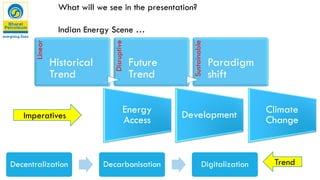
What will we see in the presentation?
Indian Energy Scene …
Energy
Access Development Climate
ChangeImperatives
Decentralization Decarbonisation Digitalization Trend
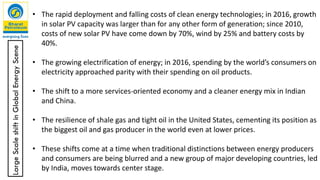
• The rapid deployment and falling costs of clean energy technologies; in 2016, growth
in solar PV capacity was larger than for any other form of generation; since 2010,
costs of new solar PV have come down by 70%, wind by 25% and battery costs by
40%.
• The growing electrification of energy; in 2016, spending by the world’s consumers on
electricity approached parity with their spending on oil products.
• The shift to a more services-oriented economy and a cleaner energy mix in Indian
and China.
• The resilience of shale gas and tight oil in the United States, cementing its position as
the biggest oil and gas producer in the world even at lower prices.
• These shifts come at a time when traditional distinctions between energy producers
and consumers are being blurred and a new group of major developing countries, led
by India, moves towards center stage.
LargeScaleshiftinGlobalEnergyScene
0
100
200
300
400
500
600
700
0
2E+13
4E+13
6E+13
8E+13
1E+14
1.2E+14
Real GDP, Rs
Per Capita Energy Use
Kg of Oil Equivalent
Source: World Bank & WEC
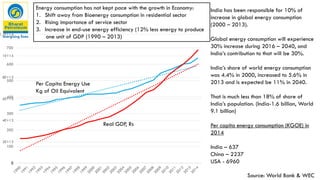
Energy consumption has not kept pace with the growth in Economy:
1. Shift away from Bioenergy consumption in residential sector
2. Rising importance of service sector
3. Increase in end-use energy efficiency (12% less energy to produce
one unit of GDP (1990 – 2013)
India has been responsible for 10% of
increase in global energy consumption
(2000 – 2013).
Global energy consumption will experience
30% increase during 2016 – 2040, and
India’s contribution to that will be 30%.
India’s share of world energy consumption
was 4.4% in 2000, increased to 5.6% in
2013 and is expected be 11% in 2040.
That is much less than 18% of share of
India’s population. (India-1.6 billion, World
9.1 billion)
Per capita energy consumption (KGOE) in
2014
India – 637
China – 2237
USA - 6960
0 1 2 3 4 5 6 7 8 9
1990
1992
1994
1996
1998
2000
2002
2004
2006
2008
2010
2012
2014
0 50 100 150 200
1990
1992
1994
1996
1998
2000
2002
2004
2006
2008
2010
2012
2014
Energy Efficiency
Real GDP per kg of Oil Equivalent
PPS $ constant at 2011
4.99
8.45
Energy Intensity
Kg of Oil Equivalent Used
Per 1000 $ PPP constant at 2011
200.2
118.2
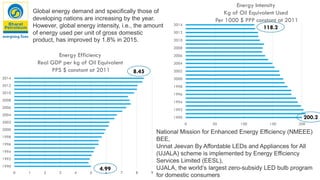
Global energy demand and specifically those of
developing nations are increasing by the year.
However, global energy intensity, i.e., the amount
of energy used per unit of gross domestic
product, has improved by 1.8% in 2015.
National Mission for Enhanced Energy Efficiency (NMEEE)
BEE,
Unnat Jeevan By Affordable LEDs and Appliances for All
(UJALA) scheme is implemented by Energy Efficiency
Services Limited (EESL),
UJALA, the world’s largest zero-subsidy LED bulb program
for domestic consumers
0
10
20
30
40
50
60
70
80
Fossil Fuel % to Total Energy
Imported Energy %
53.7
73.4
8.2
34.3
Source: World Bank
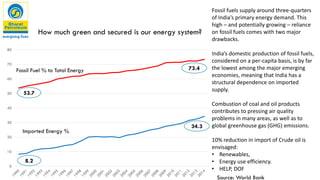
Fossil fuels supply around three-quarters
of India’s primary energy demand. This
high – and potentially growing – reliance
on fossil fuels comes with two major
drawbacks.
India’s domestic production of fossil fuels,
considered on a per-capita basis, is by far
the lowest among the major emerging
economies, meaning that India has a
structural dependence on imported
supply.
Combustion of coal and oil products
contributes to pressing air quality
problems in many areas, as well as to
global greenhouse gas (GHG) emissions.
10% reduction in import of Crude oil is
envisaged:
• Renewables,
• Energy use efficiency.
• HELP, DOF
How much green and secured is our energy system?
0
20
40
60
80
100
120
% Access to Electricity Urban Rural
76.0
98.3
79.2
45.1
70.0
31.9
Source: World Bank
Access to Electricity
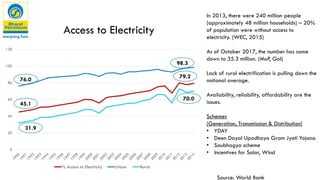
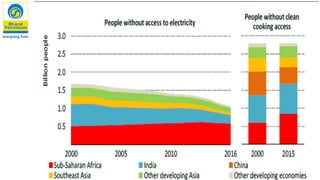
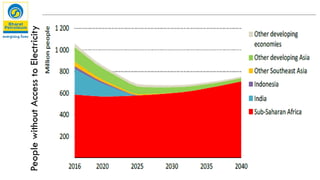
In 2013, there were 240 million people
(approximately 48 million households) – 20%
of population were without access to
electricity. (WEC, 2015)
As of October 2017, the number has come
down to 35.3 million. (MoP, GoI)
Lack of rural electrification is pulling down the
national average.
Availability, reliability, affordability are the
issues.
Schemes
(Generation, Transmission & Distribution)
• YDAY
• Deen Dayal Upadhaya Gram Jyoti Yojana
• Saubhagya scheme
• Incentives for Solar, Wind
PeoplewithoutAccesstoElectricity
0
10
20
30
40
50
60
70
80
90
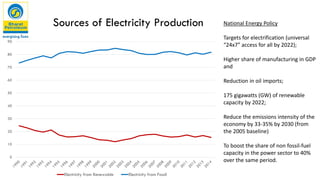
Electricity from Renewable Electricity from Fossil
National Energy Policy
Targets for electrification (universal
“24x7” access for all by 2022);
Higher share of manufacturing in GDP
and
Reduction in oil imports;
175 gigawatts (GW) of renewable
capacity by 2022;
Reduce the emissions intensity of the
economy by 33-35% by 2030 (from
the 2005 baseline)
To boost the share of non fossil-fuel
capacity in the power sector to 40%
over the same period.
Sources of Electricity Production
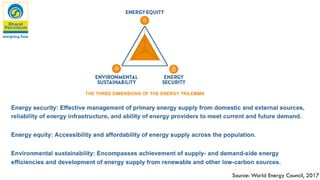
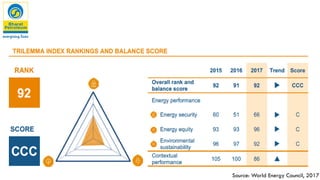
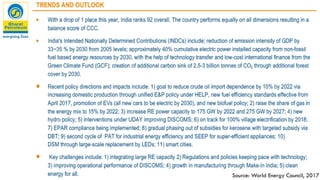
Source: World Energy Council, 2017
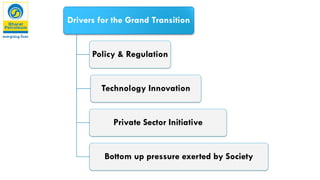
Drivers for the Grand Transition
Policy & Regulation
Technology Innovation
Private Sector Initiative
Bottom up pressure exerted by Society
146
379 402
463 456 409112
206
222
293 331
348
23
43
47
102
135 203
4
10
10
28
59
116
149
196
200
168
142
167
0
5
6
45
87
0
0
200
400
600
800
1000
1200
1400
2000 2015 2016 2025 2030 2040
Coal Oil Gas Nuclear Hydro Bioenergy other Rebewables
45
24
5
1
1
23
1
2015 Share (%)
Coal Oil Gas Nuclear Hydro Bio renewables
28
24
14
8
3
11
13
2040 Share (%)
Total 2.1
Coal 0.1
Oil 1.9
Gas 6.3
Nuclear 10.9
Hydro 5.2
Bio - 0.8
RE 15.9
CAGR % (2016-2040)
441
851 897
1118
1236 1479
Fig - MTOE
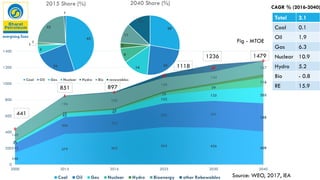
Source: WEO, 2017, IEA
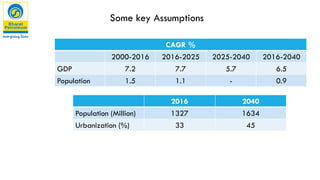
CAGR %
2000-2016 2016-2025 2025-2040 2016-2040
GDP 7.2 7.7 5.7 6.5
Population 1.5 1.1 - 0.9
2016 2040
Population (Million) 1327 1634
Urbanization (%) 33 45
Some key Assumptions
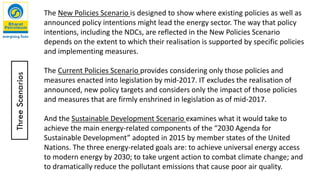
The New Policies Scenario is designed to show where existing policies as well as
announced policy intentions might lead the energy sector. The way that policy
intentions, including the NDCs, are reflected in the New Policies Scenario
depends on the extent to which their realisation is supported by specific policies
and implementing measures.
The Current Policies Scenario provides considering only those policies and
measures enacted into legislation by mid-2017. IT excludes the realisation of
announced, new policy targets and considers only the impact of those policies
and measures that are firmly enshrined in legislation as of mid-2017.
And the Sustainable Development Scenario examines what it would take to
achieve the main energy-related components of the “2030 Agenda for
Sustainable Development” adopted in 2015 by member states of the United
Nations. The three energy-related goals are: to achieve universal energy access
to modern energy by 2030; to take urgent action to combat climate change; and
to dramatically reduce the pollutant emissions that cause poor air quality.
ThreeScenarios
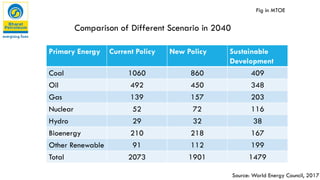
Primary Energy Current Policy New Policy Sustainable
Development
Coal 1060 860 409
Oil 492 450 348
Gas 139 157 203
Nuclear 52 72 116
Hydro 29 32 38
Bioenergy 210 218 167
Other Renewable 91 112 199
Total 2073 1901 1479
Fig in MTOE
Comparison of Different Scenario in 2040
Source: World Energy Council, 2017
India's Engergy Basket Analysis

India's Engergy Basket Analysis

  • 1.
    INDIA’S ENERGY BASKETANALYSIS: TAKING INTO ACCOUNT TRANSITION FACTORING COP-21 Dr. DC Patra Bharat Petroleum
  • 2.
    Linear Historical Trend Disruptive Future Trend Sustainable Paradigm shift What will wesee in the presentation? Indian Energy Scene … Energy Access Development Climate ChangeImperatives Decentralization Decarbonisation Digitalization Trend
  • 3.
    • The rapiddeployment and falling costs of clean energy technologies; in 2016, growth in solar PV capacity was larger than for any other form of generation; since 2010, costs of new solar PV have come down by 70%, wind by 25% and battery costs by 40%. • The growing electrification of energy; in 2016, spending by the world’s consumers on electricity approached parity with their spending on oil products. • The shift to a more services-oriented economy and a cleaner energy mix in Indian and China. • The resilience of shale gas and tight oil in the United States, cementing its position as the biggest oil and gas producer in the world even at lower prices. • These shifts come at a time when traditional distinctions between energy producers and consumers are being blurred and a new group of major developing countries, led by India, moves towards center stage. LargeScaleshiftinGlobalEnergyScene
  • 4.
    0 100 200 300 400 500 600 700 0 2E+13 4E+13 6E+13 8E+13 1E+14 1.2E+14 Real GDP, Rs PerCapita Energy Use Kg of Oil Equivalent Source: World Bank & WEC Energy consumption has not kept pace with the growth in Economy: 1. Shift away from Bioenergy consumption in residential sector 2. Rising importance of service sector 3. Increase in end-use energy efficiency (12% less energy to produce one unit of GDP (1990 – 2013) India has been responsible for 10% of increase in global energy consumption (2000 – 2013). Global energy consumption will experience 30% increase during 2016 – 2040, and India’s contribution to that will be 30%. India’s share of world energy consumption was 4.4% in 2000, increased to 5.6% in 2013 and is expected be 11% in 2040. That is much less than 18% of share of India’s population. (India-1.6 billion, World 9.1 billion) Per capita energy consumption (KGOE) in 2014 India – 637 China – 2237 USA - 6960
  • 6.
    0 1 23 4 5 6 7 8 9 1990 1992 1994 1996 1998 2000 2002 2004 2006 2008 2010 2012 2014 0 50 100 150 200 1990 1992 1994 1996 1998 2000 2002 2004 2006 2008 2010 2012 2014 Energy Efficiency Real GDP per kg of Oil Equivalent PPS $ constant at 2011 4.99 8.45 Energy Intensity Kg of Oil Equivalent Used Per 1000 $ PPP constant at 2011 200.2 118.2 Global energy demand and specifically those of developing nations are increasing by the year. However, global energy intensity, i.e., the amount of energy used per unit of gross domestic product, has improved by 1.8% in 2015. National Mission for Enhanced Energy Efficiency (NMEEE) BEE, Unnat Jeevan By Affordable LEDs and Appliances for All (UJALA) scheme is implemented by Energy Efficiency Services Limited (EESL), UJALA, the world’s largest zero-subsidy LED bulb program for domestic consumers
  • 7.
    0 10 20 30 40 50 60 70 80 Fossil Fuel %to Total Energy Imported Energy % 53.7 73.4 8.2 34.3 Source: World Bank Fossil fuels supply around three-quarters of India’s primary energy demand. This high – and potentially growing – reliance on fossil fuels comes with two major drawbacks. India’s domestic production of fossil fuels, considered on a per-capita basis, is by far the lowest among the major emerging economies, meaning that India has a structural dependence on imported supply. Combustion of coal and oil products contributes to pressing air quality problems in many areas, as well as to global greenhouse gas (GHG) emissions. 10% reduction in import of Crude oil is envisaged: • Renewables, • Energy use efficiency. • HELP, DOF How much green and secured is our energy system?
  • 8.
    0 20 40 60 80 100 120 % Access toElectricity Urban Rural 76.0 98.3 79.2 45.1 70.0 31.9 Source: World Bank Access to Electricity In 2013, there were 240 million people (approximately 48 million households) – 20% of population were without access to electricity. (WEC, 2015) As of October 2017, the number has come down to 35.3 million. (MoP, GoI) Lack of rural electrification is pulling down the national average. Availability, reliability, affordability are the issues. Schemes (Generation, Transmission & Distribution) • YDAY • Deen Dayal Upadhaya Gram Jyoti Yojana • Saubhagya scheme • Incentives for Solar, Wind
  • 10.
  • 11.
    0 10 20 30 40 50 60 70 80 90 Electricity from RenewableElectricity from Fossil National Energy Policy Targets for electrification (universal “24x7” access for all by 2022); Higher share of manufacturing in GDP and Reduction in oil imports; 175 gigawatts (GW) of renewable capacity by 2022; Reduce the emissions intensity of the economy by 33-35% by 2030 (from the 2005 baseline) To boost the share of non fossil-fuel capacity in the power sector to 40% over the same period. Sources of Electricity Production
  • 12.
    Source: World EnergyCouncil, 2017
  • 13.
    Source: World EnergyCouncil, 2017
  • 14.
    Source: World EnergyCouncil, 2017
  • 15.
    Drivers for theGrand Transition Policy & Regulation Technology Innovation Private Sector Initiative Bottom up pressure exerted by Society
  • 16.
    146 379 402 463 456409112 206 222 293 331 348 23 43 47 102 135 203 4 10 10 28 59 116 149 196 200 168 142 167 0 5 6 45 87 0 0 200 400 600 800 1000 1200 1400 2000 2015 2016 2025 2030 2040 Coal Oil Gas Nuclear Hydro Bioenergy other Rebewables 45 24 5 1 1 23 1 2015 Share (%) Coal Oil Gas Nuclear Hydro Bio renewables 28 24 14 8 3 11 13 2040 Share (%) Total 2.1 Coal 0.1 Oil 1.9 Gas 6.3 Nuclear 10.9 Hydro 5.2 Bio - 0.8 RE 15.9 CAGR % (2016-2040) 441 851 897 1118 1236 1479 Fig - MTOE Source: WEO, 2017, IEA
  • 17.
    CAGR % 2000-2016 2016-20252025-2040 2016-2040 GDP 7.2 7.7 5.7 6.5 Population 1.5 1.1 - 0.9 2016 2040 Population (Million) 1327 1634 Urbanization (%) 33 45 Some key Assumptions
  • 18.
    The New PoliciesScenario is designed to show where existing policies as well as announced policy intentions might lead the energy sector. The way that policy intentions, including the NDCs, are reflected in the New Policies Scenario depends on the extent to which their realisation is supported by specific policies and implementing measures. The Current Policies Scenario provides considering only those policies and measures enacted into legislation by mid-2017. IT excludes the realisation of announced, new policy targets and considers only the impact of those policies and measures that are firmly enshrined in legislation as of mid-2017. And the Sustainable Development Scenario examines what it would take to achieve the main energy-related components of the “2030 Agenda for Sustainable Development” adopted in 2015 by member states of the United Nations. The three energy-related goals are: to achieve universal energy access to modern energy by 2030; to take urgent action to combat climate change; and to dramatically reduce the pollutant emissions that cause poor air quality. ThreeScenarios
  • 19.
    Primary Energy CurrentPolicy New Policy Sustainable Development Coal 1060 860 409 Oil 492 450 348 Gas 139 157 203 Nuclear 52 72 116 Hydro 29 32 38 Bioenergy 210 218 167 Other Renewable 91 112 199 Total 2073 1901 1479 Fig in MTOE Comparison of Different Scenario in 2040 Source: World Energy Council, 2017