GENSOL CONSULTANTS PVT. LTD
www.gensol.in
PV Module Reliability & Quality Assurance
Significance of PV Modules Quality
Gensol Group
The lack of Quality Standards in the industry has a negative effect on the quality of modules being installed in
the country today. Different manufactures follows different methodology for quality process.
It is very important to know the quality standardization
process of solar PV modules for Developer, Investor, EPC &
O&M Contractor in solar industry as failure of modules with
lead to huge loss.
Solar PV Module Performance Curve
Gensol Group
The performance of solar PV module in various phases follows the bathtub shaped curve.
Fraunhofers Photovoltaic Durability Initiative Reducing Investment Risks, 2013 Defects Observed in PV Solar modules, Mike Rycroft(EE Publishers), 2016
IEA PVPS 2014
Impact of Solar Module Components on Reliability
Gensol Group
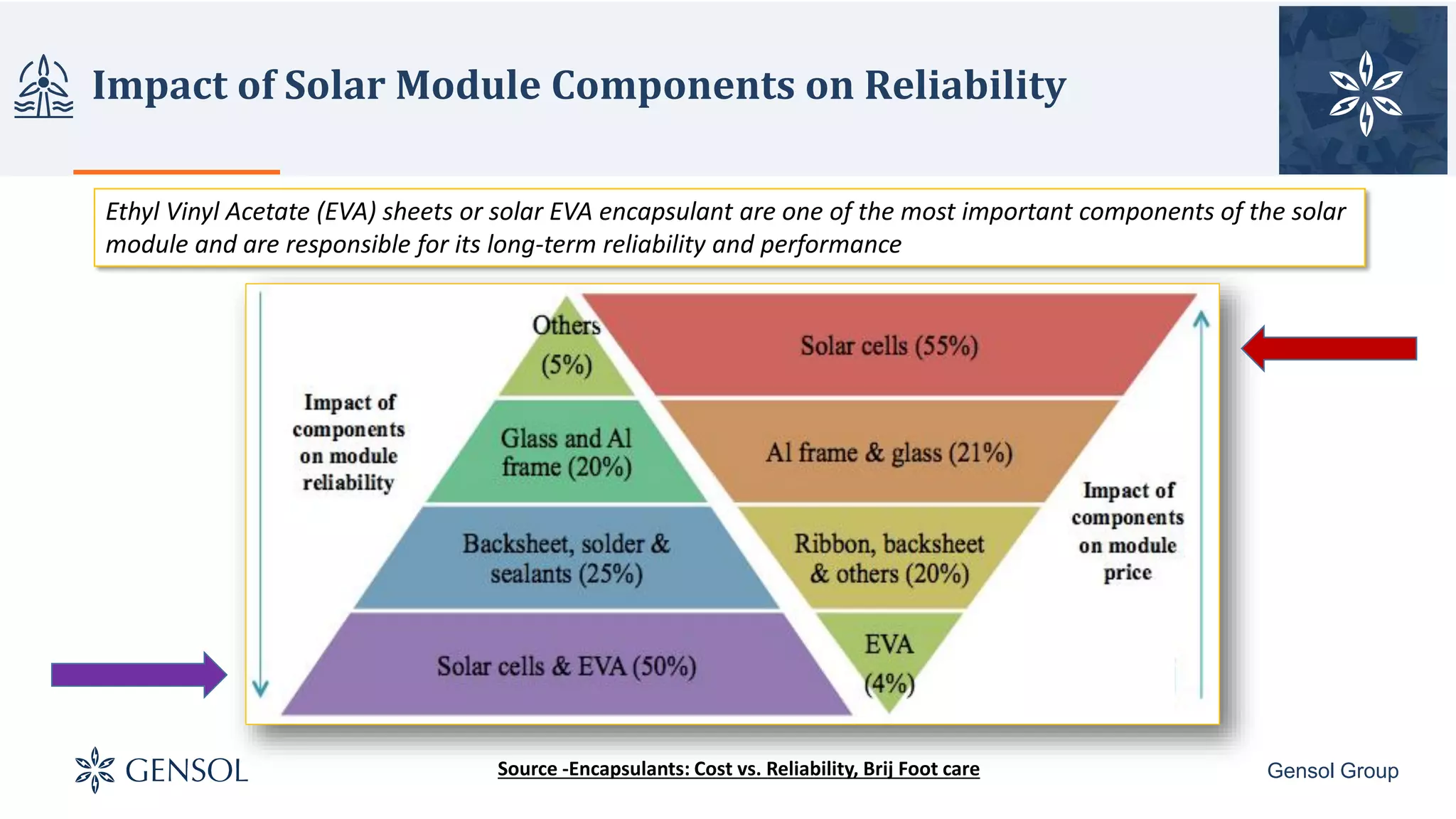
Ethyl Vinyl Acetate (EVA) sheets or solar EVA encapsulant are one of the most important components of the solar
module and are responsible for its long-term reliability and performance
Source -Encapsulants: Cost vs. Reliability, Brij Foot care
Impact of Solar PV Module Failures in Energy Gen. & Cost
Gensol Group
Solar PV Modules
PV Investment Technical Rsik Management, Solar Bankability, 2017
PV Modules Quality Assurance Plan
Gensol Group
Implementing a Quality
Assurance Plan (QAP)
will efficiently diminish
the technology risk
associated with solar
investment. Robust
quality system needs to
be in place for
performing vigorous
material level
evaluation, production
process and post
manufacturing module
level reliability
evaluation.
Reliability
Comes From
Quality
Assurance
Quality
Assurance
Testing
Pre/During
/Post
Process
Visual
Inspection
Proper
Measurem
ent
Service
Terms
Warranty
&
Guarantee
PV Modules Quality Assurance Plan
Gensol Group
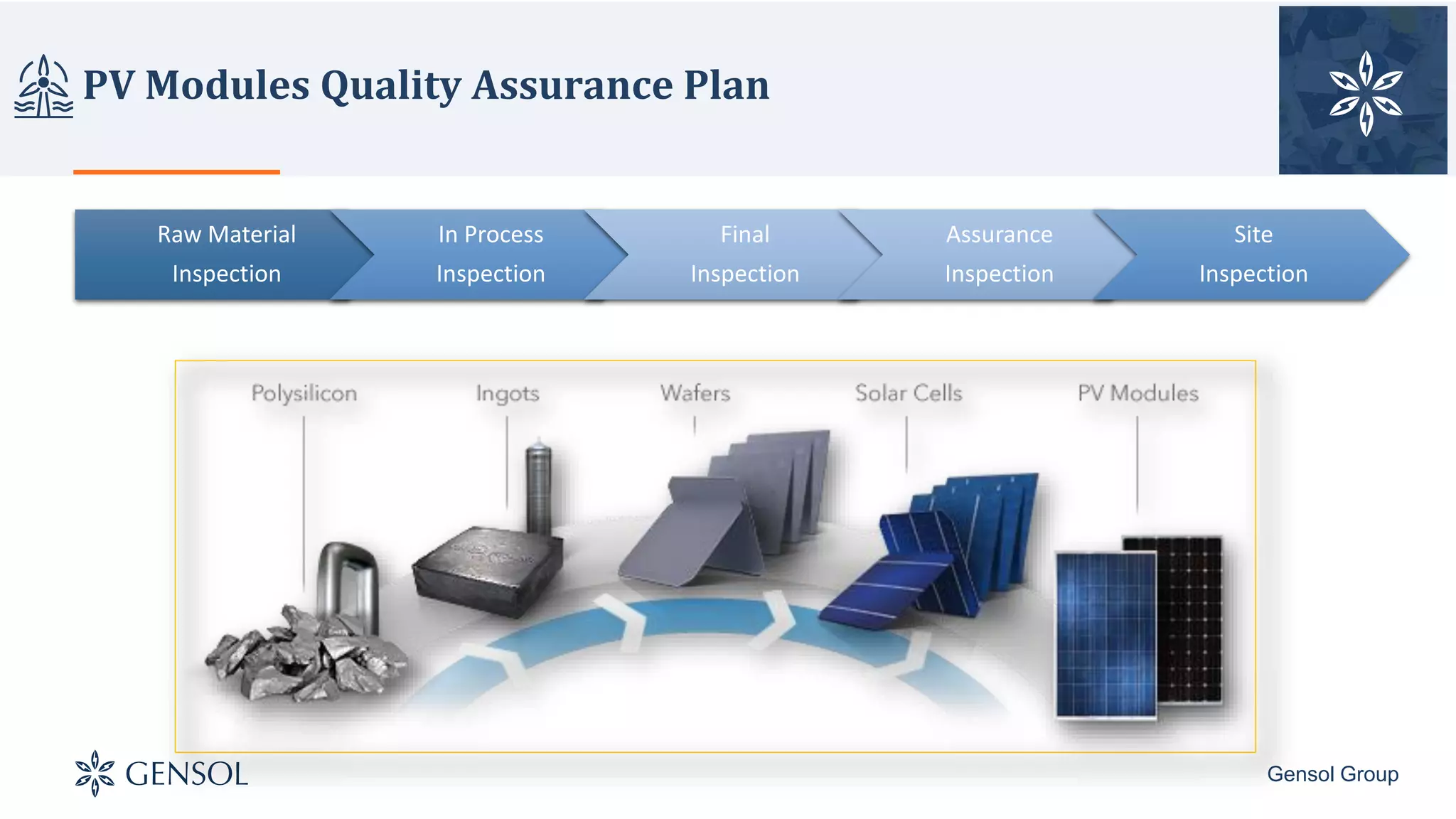
Raw Material
Inspection
In Process
Inspection
Final
Inspection
Assurance
Inspection
Site
Inspection
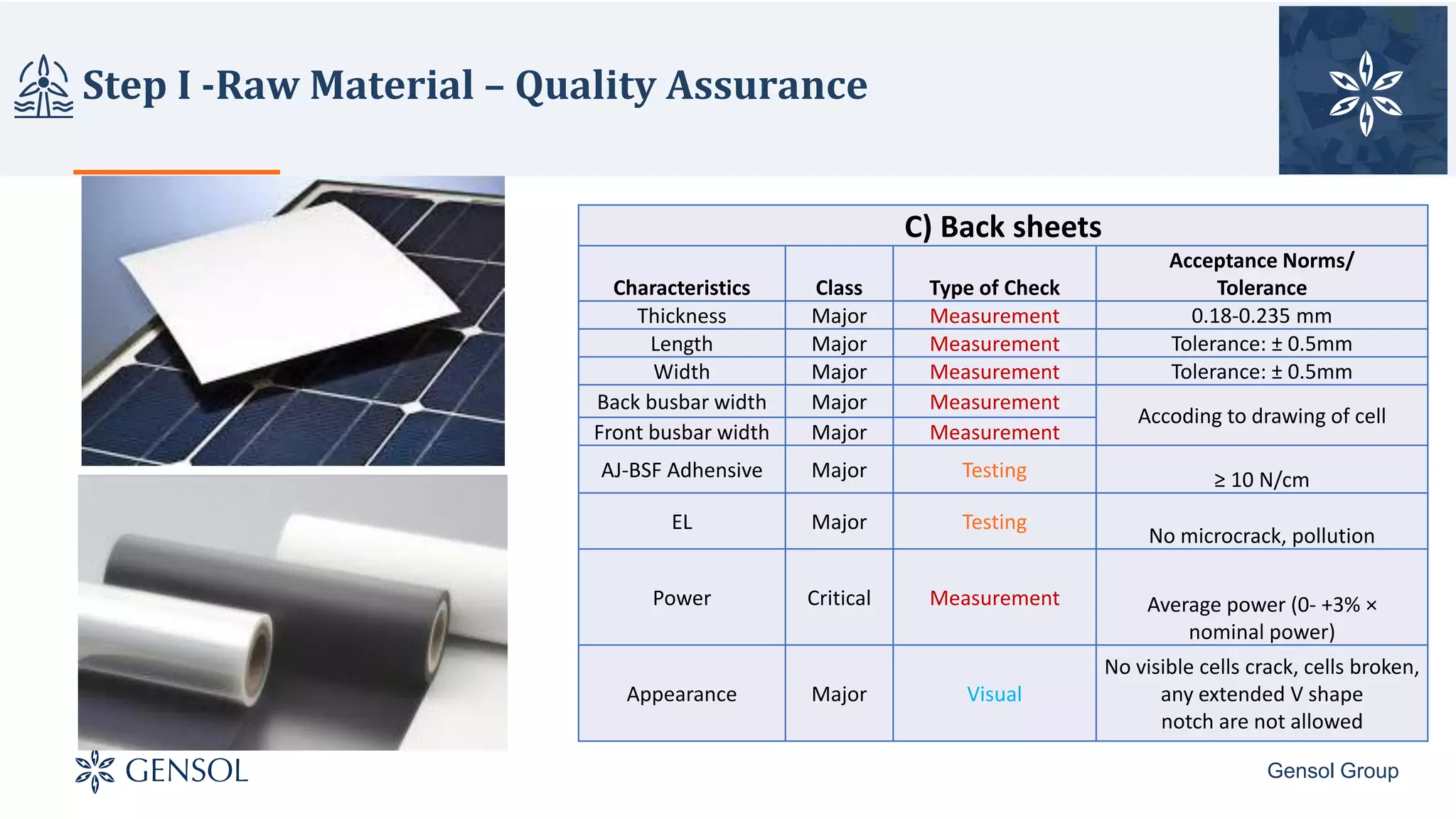
Step I -Raw Material – Quality Assurance
Gensol Group
A) Glass
Characteristics Class Type of Check
Acceptance Norms/
Tolerance
Length Major Measurement Tolerance : ± 1 mm
Width Major Measurement Tolerance : ± 1 mm
Thickness Major Measurement 3.2 mm ± 2 mm
Transmitivity Major
Indirect
Measurement
Normal ≥ 91.5% and
Coating
Impact Resistant Major Testing (Impact Tester) Not broken
Appearance Major Visual
1. Scratch L ≤ 50 mm, W ≤ 0.5mm
allowed one, slight scratch do not
limit
2. Air bubble: width≤ 0.5mm
length ≤ 50mm, n≤ 4/square meter
0.5mm ≤ width ≤ 1mm, length ≤
30mm, n ≤ 1/square meter
3. Glass should be clarity and clean.
Cleaning of the glass surface done
using the rag with alcohol to wipe,
Type of Check Evaluation Technique
Measurement Steel ruler, angle ruler, stopwatch
Electronic scale
Testing
Thermometer, moderator Hygrometer
pull-force meter, Safety testing machine,
Power tester, Illuminance meters
Visual visual inspection
Note –The inspection processes represented here for solar PV quality assurance & its reliability are taken from various module manufacturer’s
QAP and other sources
Step I -Raw Material – Quality Assurance
Gensol Group
B) EVA
Characteristics Class Type of Check
Acceptance Norms/
Tolerance
Thickness Major Measurement ≥ 0.03mm
Dimensions Major Measurement Tolerance: 0-5mm
Gel content Major Testing 75% - 95% or 8 mm
Peel strength
between
Glass with EVA
Critical Testing ≥ 60 N/cm
Peel strength
between EVA with
back sheet
Critical Testing ≥ 40 N/cm
Shrinking Major Testing TD < 2%, MD < 4%
Volume resistivity Major Testing ≥ 6× 10e14 Ω-cm
Appearance Minor Visual
No dust and other foreign material;
no breakage;
no stain
Step I -Raw Material – Quality Assurance
Gensol Group
C) Back sheets
Characteristics Class Type of Check
Acceptance Norms/
Tolerance
Thickness Major Measurement 0.18-0.235 mm
Length Major Measurement Tolerance: ± 0.5mm
Width Major Measurement Tolerance: ± 0.5mm
Back busbar width Major Measurement
Accoding to drawing of cell
Front busbar width Major Measurement
AJ-BSF Adhensive Major Testing ≥ 10 N/cm
EL Major Testing
No microcrack, pollution
Power Critical Measurement Average power (0- +3% ×
nominal power)
Appearance Major Visual
No visible cells crack, cells broken,
any extended V shape
notch are not allowed
Step I -Raw Material – Quality Assurance
Gensol Group
D) Solar Cells
Characteristics Class Type of Check
Acceptance Norms/
Tolerance
Thickness Major Measurement 0.18-0.235 mm
Length Major Measurement Tolerance: ± 0.5mm
Width Major Measurement Tolerance: ± 0.5mm
Back busbar width Major Measurement
Accoding to drawing of cell
Front busbar width Major Measurement
AJ-BSF Adhensive Major Testing ≥ 10 N/cm
EL Major Testing No micro-crack, pollution free
Power Critical Measurement
Average power (0- +3% ×
nominal power)
Appearance Major Visual
No visible cells crack, cells broken,
any extended V shape
notch are not allowed
Step I -Raw Material – Quality Assurance
Gensol Group
E) Ribbon
Characteristics Class Type of Check
Acceptance Norms/
Tolerance
Thickness Major Measurement
Cell connector- Tolerance: ± 0.01mm
String connector- Tolerance: ± 0.01mm
Width Major Measurement
Cell connector- Tolerance: ± 0.05mm
String connector- Tolerance: ± 0.05mm
Soldering strength Critical Testing ≥ 1.5 N/mm
Coating thickness Major
Visual (check the report
provided by supplied)
0.025mm ± 0.005mm (single side)
(check supplier outgoing report)
Appearance Major Visual
Flatness, no stain, no deformation,
no crystal, no coating-missing
Thickness Major Measurement
Cell connector- Tolerance: ± 0.01mm
String connector- Tolerance: ± 0.01mm
Width Major Measurement
Cell connector- Tolerance: ± 0.05mm
String connector- Tolerance: ± 0.05mm
Soldering strength Critical Testing ≥ 1.5 N/mm
Coating thickness Major
Visual (check the report
provided by supplied)
0.025mm ± 0.005mm (single side)
(check supplier outgoing report)
Appearance Major Visual
Flatness, no stain, no deformation,
no crystal, no coating-missing
Step I -Raw Material – Quality Assurance
Gensol Group
F) Anodized Al Frames
Characteristics Class Type of Check
Acceptance Norms/
Tolerance
Width Major Measurement Tolerance: ± 0.5mm
Length Major Measurement Tolerance: ± 0.5mm
Mounting hole pitch Critical Measurement Tolerance: ± 0.5mm
Drain hole distance Major Measurement
60 mm ± 0.5mm
Angle Major Measurement
45˚± 0.25˚
Hardness Major Measurement ≥ 8 hw
Coating thickness Major Measurement ≥ 15um
Appearance Major Visual
same color, no water stain, oil
stain,
contamination, scratch,
coating film no broken
Step I -Raw Material – Quality Assurance
Gensol Group
G) Junction Box
Characteristics Class Type of Check
Acceptance Norms/
Tolerance
Cable length Major Measurement Actual length ± 13mm
Dimensions Major Measurement According drawings
Electrical performance Major Measurement Contact resistance ≤ 10 mohms
Appearance Major Visual
1. Diode polarity, quantity is right,
terminal should be complete
2. No damage
H) Sealant
Characteristics Class Type of Check
Acceptance Norms/
Tolerance
Manufactured date Major Visual Within 12 months after manufacturing
Expiry date Major Visual 12 months
Batch No. Major Visual Within 12 months after manufacturing
Appearance Major Visual No bubble, smooth, thick liquid,
no damage package
Step I -Raw Material – Quality Assurance
Gensol Group
I) Flux
Characteristics Class Type of Check
Acceptance Norms/
Tolerance
Manufactured date Major Visual
Within 6 months after
manufacturing
Expiry date Major Visual 6 months
Batch No. Major Visual
Within 6 months after
manufacturing
Appearance Major Visual Transparent, Colourless
J) Label
Characteristics Class Type of Check
Acceptance Norms/
Tolerance
Label parameters Major Visual
Module type, Pmpp, Voc, Isc, Vmpp, Impp,
Series fuse rating, Tolerance of Pmpp,
Weight, Dimension STC, Measuring
uncertainty of power
Dimensions Major Measurement Tolerance: 5-1 mm
Appearance Major Visual
No flaw, mildew, dirty, delamination,
hole obvious defect by naked eye not
allowed
Step I -Raw Material – Quality Assurance
Gensol Group
G) Palet
Characteristics Class Type of Check
Acceptance Norms/
Tolerance
Dimensions Major Measurement Tolerance: 5-1 mm
Appearance Major Visual
No flaw, mildew, dirty, delamination,
hole obvious defect by naked eye not
allowed
H) Package
Characteristics Class Type of Check
Acceptance Norms/
Tolerance
Dimensions Major Measurement Tolerance: 5-0 mm
Appearance Major Visual
No broken, right painting
Printing Major Visual
Step II - Manufacturing Process –Quality Assurance
Gensol Group
Solar Cells Solar Scribbling Soldering
EVA & back sheet
cutting
Laying
Lamination Framing EL Check IV Test Cleaning
Packaging
Step II - Manufacturing Process –Quality Assurance
Gensol Group
A) Sorting of Cells
Characteristics Class Type of Check
Acceptance Norms/
Tolerance
Appearance Major Visual/Manually
Colour conformity or jumping colour in
one module, No north, No V-type defect,
No crack, No broken
B) EVA & Back Sheet Cutting
Characteristics Class Type of Check
Acceptance Norms/
Tolerance
EVA supplier Major Visual
According to the BOM of production plan
Supplier and Type are right
EVA expiry date Major Visual 6 months
Uneven cutting Major Visual Not allowed
Length of the EVA &
Backsheet
Major Measurement
EVA: +2MM
Backsheet: ± 1mm
Step II - Manufacturing Process –Quality Assurance
Gensol Group
C) Cell Assembling
Characteristics Class Type of Check
Acceptance Norms/
Tolerance
Check materials Major Visual
According to the BOM of production plan supplier and
type are rightCells supplier Major Visual
Flux supplier Major Visual
Expiry date of flux Major Visual 6 months
D) Soldering
Characteristics Class Type of Check
Acceptance Norms/
Tolerance
Ribbon adhesion with
busbar and Tin covering
area
Major Measurement Ribbon Adhesion with busbar ≥ 1.5Nmm
Tin covering area ≥ 85%
Manual line:
Iron temperature
Major Measurement
0.2mm (Ribbon thickness) 320˚ - 350˚
0.23mm (Ribbon thickness) 330˚ - 360˚
0.25mm (Ribbon thickness) 340˚ - 370˚
Automatic soldering
temperature
Major
Visual(check the setting
temperature with the
standard temperature)
Temperature 180˚ - 210˚
Ribbon adhesion with
busbar and Tin covering
area
Major Measurement Ribbon Adhesion with busbar ≥ 1.5Nmm
Tin covering area ≥ 85%
Time Control Major Measurement 3-5 sec
Step II - Manufacturing Process –Quality Assurance
Gensol Group
E) Ribbon
Characteristics Class Type of Check
Acceptance Norms/
Tolerance
Check interconnector (connect
the cells) materials as BOM
Major Visual
According to the BOM of production plan
Supplier and size is right
Check the cross connector
(connect the termination)
Major Visual
According to the BOM of production plan
Supplier and size is right
Appearance Major Visual
Flatness, no stain, no deformation,
no crystal, no coating-missing
F) Lay -Up
Characteristics Class Type of Check
Acceptance Norms/
Tolerance
String misaligned Major Measurement ± 0.3mm
Foreign materials Major Visual Not allowed
EL Test Major Testing According to the EL inspection standard
Step II - Manufacturing Process –Quality Assurance
Gensol Group
G) Lamination
Characteristics Class Type of Check
Acceptance Norms/
Tolerance
Bubbles Major Visual
S ≤ 2mm (on the cell), ≤ 1pcs
S ≤ 3mm (out of the cell), ≤ 2pcs
String merged Major Visual Not allowed
Delamination Major Visual Not allowed
Foreign materials Major Visual As per plant standard
Temperature Major Testing Tolerance ± 3 degrees according to EVA property
Vacuum Major Testing <-99.5kpa
Gel content Major Testing 75% - 95%
Peel strength test Major Testing
Back plate with EVA ≥ 60 N/cm
Glass with EVA ≥ 40 N/cm
H) Framing & Crimping
Characteristics Class Type of Check
Acceptance Norms/
Tolerance
Comer Gap Major Visual ≤ 0.5mm
Vertical Gap Major Visual ≤ 0.5mm
Diagonal Difference Major Visual
Diagonal ≤ 1m, Diagonal difference ≤ 2mm
Diagonal > 1m, Diagonal difference ≤ 3mm
Pressure Major Visual
The presence of the framing machine is
0.6-0.7Mpa
Comer Crimping Major Visual Polish & smooth
Step II - Manufacturing Process –Quality Assurance
Gensol Group
I) JB Fixing & Potting
Characteristics Class Type of Check
Acceptance Norms/
Tolerance
Check junction box, fixing
and potting materials
Major Visual Supplier and type are right
Check for JB soldering
temperature
Major Visual 380˚ - 400˚
J) Cleaning & Labelling
Characteristics Class Type of Check
Acceptance Norms/
Tolerance
Appearance Major Visual
According to the Manufacturers
Inspection Standard for modules
Label fixing Major Visual
Step III- Final Product In Lab Testing
Gensol Group
Source- TUV Rhineland,
Step III- Final Product - In Lab Testing
Gensol Group
A) Thermal Cycling
Characteristics Class Type of Check
Acceptance Norms/
Tolerance
Solder bond or ribbon
failure, usually
associated with thermal
fatigue
Major Testing
This is an extension of IEC 61215 (200
cycles). Thermal cycling is known to identify
this failure; field and modelling studies imply
that longer testing may be beneficial.
-40° C to 85° C.
B) Dynamic Mechanical Load Test
Characteristics Class
Type of
Check
Acceptance Norms/
Tolerance
Cracked cells that
cause hot spots and
power loss
Major Testing
IEC 62782. Studies have shown that the
combination of DML and thermal cycling can
uncover this failure.
mechanical stress -1,000 cycles at
±1,000 Pa) followed by thermal stress (50
cycles of thermal cycling)
Source - PV Module Reliability, DNV GL, 2017
Step III- Final Product In Lab Testing
Gensol Group
D) Damp Heat Test
Characteristics Class Type of Check
Acceptance Norms/
Tolerance
Damp Heat Test Major Testing
In the IEC 61215, modules are held at
a constant temperature of 85° C and a
relative humidity of 85% for 1,000
hours (~42 days)
E) PID Test
Characteristics Class Type of Check
Acceptance Norms/
Tolerance
PID Test Major Testing
Power loss for modules operating at
large (positive or negative) bias
voltage
Test method: IEC 62804
Source - Photovoltaic Module Qualification Plus Testing, 2013
C) Humidity Freeze test
Characteristics Class Type of Check
Acceptance Norms/
Tolerance
Humidity Freeze Test Major Testing
In the standard IEC 61215 test modules are exposed to
temperatures of 85° C and a relative humidity of 85% for a minimum
of 20 hours. The temperature is then rapidly dropped to -40° C for a
minimum of 30 minutes (maximum 4 hours), freezing any moisture
within the module & for 10 cycles.
Step III- Final Product In Lab Testing
Gensol Group
F) Appearance/Visual Inspection
Characteristics Class
Type of
Check
Acceptance Norms/
Tolerance
• Colour of cell,
• Snail trails,
• Bubble,
• Foreign
material,
• Serial number,
• Back sheet,
• Glass,
• Frame
• Junction box
Major Visual
a) No broken, cracked, or tom external surfaces including
superstrates, substrates, frames and junction boxes.
b) No bent or misaligned external surfaces, including
superstrates, substrates, frames and junction boxes to the
extent that the installation and/or operation of the module
would be impaired;
c) No voids in, or visible corrosion of any of the thin film
layers of the active circuity of the module, extending over
more than 10% of any cell;
d) No bubbles or delamination forming a continuous path
between any part of the electrical circuit and the edge of
the module;
e) No loss of mechanical integrity, to the extent that the
installation and/or operation of the module would be
impaired;
f) Module markings(label) is no longer attached or the
information is unreadable.
Step III- Final Product In Lab Testing
Gensol Group
G) Dimensions
Characteristics Class Type of Check
Acceptance Norms/
Tolerance
Length, width, diagonal
difference & label fixing
Major Measurement
Length, width ± 1mm
Diagonal ≤ 1m, Diagonal difference ≤ 2mm
Diagonal > 1m, Diagonal difference ≤ 3mm
H) Insulation Resistance
Characteristics Class Type of Check
Acceptance Norms/
Tolerance
Insulation resistance Major Testing
Module area > 0.1 square meter,
≥ 40Mohm.mm2
Module area < o.1 square meter,
≥ 400 Mohm
I) Hi Pot
Characteristics Class Type of Check
Acceptance Norms/
Tolerance
Hi-pot test Major Testing ≤ 50 µA
Step III- Final Product - In Lab Testing
Gensol Group
J) Grounding Continuity
Characteristics
Class Type of Check
Acceptance Norms/
Tolerance
Grounding continuity test
Major Testing ≤ 100 mΩ
K) Flash Test & IV Data Measurement
Characteristics Class Type of Check
Acceptance Norms/
Tolerance
Electrical data measurement of
vmp, imp, pmax, voc, isc, shunt
resistance, series resistance,
etc.
Major Testing
As the Technical specification;
1) Calibration on Board power than 0.1% of
nominal value
2) Test power on board than 0.3% of nominal
value
L) Electroluminescence Testing
Characteristics Class Type of Check
Acceptance Norms/
Tolerance
Brightness, Black finger, cross
crack, Shadow, Black Area, or
invalid cell, irregular crack
concentration, material
pollution,
wrong cell printing
Major Testing
EL defect of any of the thin film layers of
the active circuitry of the module
extending over more than 10% of any cell.
Total power loss of the module less than
5%. Testing I-V curve is not abnormal
Step III- Final Product - In Lab Testing
Gensol Group
M) Wet Leakage Test
Characteristics Class Type of Check
Acceptance Norms/
Tolerance
Wet leakage test Major Testing ≤ 50 µA
N) Impulse Voltage Test
Characteristics Class Type of Check
Acceptance Norms/
Tolerance
Impulse voltage test Major Testing IEC 61730-2:2004
O) Packaging & Marking
Characteristics Class Type of Check
Acceptance Norms/
Tolerance
Impulse voltage test Major Visual
Road and sea worthy packaging as every sales market
condition
Step IV – Assurance Inspection
Gensol Group
Assurance
Inspection
includes two
principles:
"Fit for purpose"
(the product
should be
suitable for the
intended
purpose);
"right first time"
(mistakes should
be eliminated).
For Assurance Inspection, same sets of tests are being performed as performed during manufacturing process. The final
testing process prior to deployment and is performed by a company tester who ultimately signs off on the product
Safety test
(Safety testing
machine)
Test condition
Withstand voltage test: voltage 3600V, the
upper limit of current 50µA,rising voltage 8S,
test 1S
Property
After a single test, Fail light or the instrument
appear bazzar alarm means unqualified
Step V – On Site Module Inspection
Gensol Group
Visual Inspection.
Electroluminescence Test
(prior and after installation
on structure)
Maximum Power
determination at STC
(module and arrays).
PV String - Voc and Isc
Measurement.
IR Thermography
Inspection of modules
(ground and drone
inspections) and electrical
connection,
Verification of Diodes
Operation.
Voltage Drop
Measurement .
Polarity Verification Tests.
Insulation Resistance
Measurement
Grounding Resistance
Measurements
Audit of Monitoring
System & Weather Stations
Step V – On Site Module Inspection
Gensol Group
Aerial inspections (from drone or airplane) of PV power
plants are being conducted nowadays for defective or
underperforming modules and strings which are able to
detect module-level defects which cause temperature
differences in the module such as diode faults, cell hot-
spots, junction box heating and major differences in module
efficiency.
Source: Heliolytics, “Summary of DC Losses
Observed using Aerial Infra-Red Inspection Across
>1.6 GW”, Rob Andrews and Kristine Sinclair, 2017
Assurance Compliances or Testing Specification
Gensol Group
Compliances Comply with
IEC 61215 (Edition
2005)
Crystalline silicon terrestrial photovoltaic (PV) modules -
Design qualification-Performance Standards
IEC 61646 Thin-film terrestrial photovoltaic (PV) modules - Design
qualification -Performance Standards
IEC 61730 Module safety Qualification – Safety Standards
UL 1703 Fire classification rating
ISO 9001:2008 Module manufacturing unit Quality compliances
ISO 14001 Environmental Management System Certification
OHSAS 18001 Occupational health and Safety
IEC 60891 PV - Procedures for temperature and irradiance corrections to
measured I-V characteristics
IEC 61701 Salt mist corrosion testing
IEC 62716 Ammonium corrosion testing
IEC 60364 Protection Against Electric Shock for low-voltage electrical
installations in PV modules
IEC61646 or
IEC61625-
Wet Leakage Test to test the electrical isolation of the
housing
ASTM E1171 - 15 Test Methods for Photovoltaic Modules in Cyclic
Temperature and Humidity Environments
IEC 60904 Measurement of current-voltage characteristics of bifacial
photovoltaic devices
IEC 60721 PV module’s performance capability under prolonged
exposure to standard climates
IEC60068-2-2 Test to evaluate the ability of the module for use/storage
under high temperature
IEC 61853 Validation of Models using Outdoor Test Methods
IEC TS 62782 test method for performing a cyclic (dynamic) mechanical
load test
IEC TS 62804-1:2015 Test to evaluate the durability of crystalline (PV) modules to
the effects of short-term high-voltage stress including
potential-induced degradation (PID)
About Gensol
Solar Advisory Services Solar EPC Services Solar O&M Services
11,707MW 91 MW 2200 MW
Gensol Group
Gensol provides concept to commissioning solar advisory, execution and operations services for Solar Projects in India and abroad.
150 Advisors
Anmol Singh
Evangelist
+91 7698833311
anmoljaggi@gensol.in
Imran Naqvi
Head of Strategic Advisory
& Business Development
+91 9327016962
imrannaqvi@gensol.in
Gurpreet Singh
Head of Engineering &
Operations
+91 9725544301
gurpreetsingh@gensol.in
Puneet Singh Jaggi
Director
+91 9998025820
puneetjaggi@gensol.in
Pranay Mundra
President
+91 9850673664
pranaymundra@gensol.in
Shivya Singhal
Head of Supply Chain & Group
CFO
+91 9376703846
shivyasinghal@gensol.in
230+ Projects
70 Engineers
170+ Projects
210 Engineers
45 Projects
Gensol is one of the leading consultants and system integrators for Solar Power Plants. We boast of a portfolio of over 6000 MW of Solar Photovoltaic Plants. Gensol is also a channel
partner to Ministry of New & Renewable Energy and installs kW scale Solar Rooftop systems on a turnkey basis with more than 42 MW of cumulative installations across the country.
The information contained herein is of a general nature and is not intended to address the circumstances of any particular individual or entity. Although we endeavor to provide
accurate and timely information, there can be no guarantee that such information is accurate as of the date it is received or that it will continue to be accurate in the future. No one
should act on such information without appropriate professional advice after a thorough examination of the particular situation.
Email: solar@gensol.in | Web: www.gensol.in | Phone: +91 79 40068235 | Twitter: gensol_tweets
Gensol Engineering Pvt Ltd | Gensol Consultants Pvt Ltd | Solarig Gensol Utilities Pvt Ltd
Corporate Office
A2, 12th Floor Palladium, Opp. to Vodafone House , Corporate Road, Prahladnagar, Ahmedabad, Gujarat. India - 380015

Quality Inspection for Solar Modules - Raw Material, Manufacturing & Lab Tests (15.04.18)

  • 1.
    GENSOL CONSULTANTS PVT.LTD www.gensol.in PV Module Reliability & Quality Assurance
  • 2.
    Significance of PVModules Quality Gensol Group The lack of Quality Standards in the industry has a negative effect on the quality of modules being installed in the country today. Different manufactures follows different methodology for quality process. It is very important to know the quality standardization process of solar PV modules for Developer, Investor, EPC & O&M Contractor in solar industry as failure of modules with lead to huge loss.
  • 3.
    Solar PV ModulePerformance Curve Gensol Group The performance of solar PV module in various phases follows the bathtub shaped curve. Fraunhofers Photovoltaic Durability Initiative Reducing Investment Risks, 2013 Defects Observed in PV Solar modules, Mike Rycroft(EE Publishers), 2016 IEA PVPS 2014
  • 4.
    Impact of SolarModule Components on Reliability Gensol Group Ethyl Vinyl Acetate (EVA) sheets or solar EVA encapsulant are one of the most important components of the solar module and are responsible for its long-term reliability and performance Source -Encapsulants: Cost vs. Reliability, Brij Foot care
  • 5.
    Impact of SolarPV Module Failures in Energy Gen. & Cost Gensol Group Solar PV Modules PV Investment Technical Rsik Management, Solar Bankability, 2017
  • 6.
    PV Modules QualityAssurance Plan Gensol Group Implementing a Quality Assurance Plan (QAP) will efficiently diminish the technology risk associated with solar investment. Robust quality system needs to be in place for performing vigorous material level evaluation, production process and post manufacturing module level reliability evaluation. Reliability Comes From Quality Assurance Quality Assurance Testing Pre/During /Post Process Visual Inspection Proper Measurem ent Service Terms Warranty & Guarantee
  • 7.
    PV Modules QualityAssurance Plan Gensol Group Raw Material Inspection In Process Inspection Final Inspection Assurance Inspection Site Inspection
  • 8.
    Step I -RawMaterial – Quality Assurance Gensol Group A) Glass Characteristics Class Type of Check Acceptance Norms/ Tolerance Length Major Measurement Tolerance : ± 1 mm Width Major Measurement Tolerance : ± 1 mm Thickness Major Measurement 3.2 mm ± 2 mm Transmitivity Major Indirect Measurement Normal ≥ 91.5% and Coating Impact Resistant Major Testing (Impact Tester) Not broken Appearance Major Visual 1. Scratch L ≤ 50 mm, W ≤ 0.5mm allowed one, slight scratch do not limit 2. Air bubble: width≤ 0.5mm length ≤ 50mm, n≤ 4/square meter 0.5mm ≤ width ≤ 1mm, length ≤ 30mm, n ≤ 1/square meter 3. Glass should be clarity and clean. Cleaning of the glass surface done using the rag with alcohol to wipe, Type of Check Evaluation Technique Measurement Steel ruler, angle ruler, stopwatch Electronic scale Testing Thermometer, moderator Hygrometer pull-force meter, Safety testing machine, Power tester, Illuminance meters Visual visual inspection Note –The inspection processes represented here for solar PV quality assurance & its reliability are taken from various module manufacturer’s QAP and other sources
  • 9.
    Step I -RawMaterial – Quality Assurance Gensol Group B) EVA Characteristics Class Type of Check Acceptance Norms/ Tolerance Thickness Major Measurement ≥ 0.03mm Dimensions Major Measurement Tolerance: 0-5mm Gel content Major Testing 75% - 95% or 8 mm Peel strength between Glass with EVA Critical Testing ≥ 60 N/cm Peel strength between EVA with back sheet Critical Testing ≥ 40 N/cm Shrinking Major Testing TD < 2%, MD < 4% Volume resistivity Major Testing ≥ 6× 10e14 Ω-cm Appearance Minor Visual No dust and other foreign material; no breakage; no stain
  • 10.
    Step I -RawMaterial – Quality Assurance Gensol Group C) Back sheets Characteristics Class Type of Check Acceptance Norms/ Tolerance Thickness Major Measurement 0.18-0.235 mm Length Major Measurement Tolerance: ± 0.5mm Width Major Measurement Tolerance: ± 0.5mm Back busbar width Major Measurement Accoding to drawing of cell Front busbar width Major Measurement AJ-BSF Adhensive Major Testing ≥ 10 N/cm EL Major Testing No microcrack, pollution Power Critical Measurement Average power (0- +3% × nominal power) Appearance Major Visual No visible cells crack, cells broken, any extended V shape notch are not allowed
  • 11.
    Step I -RawMaterial – Quality Assurance Gensol Group D) Solar Cells Characteristics Class Type of Check Acceptance Norms/ Tolerance Thickness Major Measurement 0.18-0.235 mm Length Major Measurement Tolerance: ± 0.5mm Width Major Measurement Tolerance: ± 0.5mm Back busbar width Major Measurement Accoding to drawing of cell Front busbar width Major Measurement AJ-BSF Adhensive Major Testing ≥ 10 N/cm EL Major Testing No micro-crack, pollution free Power Critical Measurement Average power (0- +3% × nominal power) Appearance Major Visual No visible cells crack, cells broken, any extended V shape notch are not allowed
  • 12.
    Step I -RawMaterial – Quality Assurance Gensol Group E) Ribbon Characteristics Class Type of Check Acceptance Norms/ Tolerance Thickness Major Measurement Cell connector- Tolerance: ± 0.01mm String connector- Tolerance: ± 0.01mm Width Major Measurement Cell connector- Tolerance: ± 0.05mm String connector- Tolerance: ± 0.05mm Soldering strength Critical Testing ≥ 1.5 N/mm Coating thickness Major Visual (check the report provided by supplied) 0.025mm ± 0.005mm (single side) (check supplier outgoing report) Appearance Major Visual Flatness, no stain, no deformation, no crystal, no coating-missing Thickness Major Measurement Cell connector- Tolerance: ± 0.01mm String connector- Tolerance: ± 0.01mm Width Major Measurement Cell connector- Tolerance: ± 0.05mm String connector- Tolerance: ± 0.05mm Soldering strength Critical Testing ≥ 1.5 N/mm Coating thickness Major Visual (check the report provided by supplied) 0.025mm ± 0.005mm (single side) (check supplier outgoing report) Appearance Major Visual Flatness, no stain, no deformation, no crystal, no coating-missing
  • 13.
    Step I -RawMaterial – Quality Assurance Gensol Group F) Anodized Al Frames Characteristics Class Type of Check Acceptance Norms/ Tolerance Width Major Measurement Tolerance: ± 0.5mm Length Major Measurement Tolerance: ± 0.5mm Mounting hole pitch Critical Measurement Tolerance: ± 0.5mm Drain hole distance Major Measurement 60 mm ± 0.5mm Angle Major Measurement 45˚± 0.25˚ Hardness Major Measurement ≥ 8 hw Coating thickness Major Measurement ≥ 15um Appearance Major Visual same color, no water stain, oil stain, contamination, scratch, coating film no broken
  • 14.
    Step I -RawMaterial – Quality Assurance Gensol Group G) Junction Box Characteristics Class Type of Check Acceptance Norms/ Tolerance Cable length Major Measurement Actual length ± 13mm Dimensions Major Measurement According drawings Electrical performance Major Measurement Contact resistance ≤ 10 mohms Appearance Major Visual 1. Diode polarity, quantity is right, terminal should be complete 2. No damage H) Sealant Characteristics Class Type of Check Acceptance Norms/ Tolerance Manufactured date Major Visual Within 12 months after manufacturing Expiry date Major Visual 12 months Batch No. Major Visual Within 12 months after manufacturing Appearance Major Visual No bubble, smooth, thick liquid, no damage package
  • 15.
    Step I -RawMaterial – Quality Assurance Gensol Group I) Flux Characteristics Class Type of Check Acceptance Norms/ Tolerance Manufactured date Major Visual Within 6 months after manufacturing Expiry date Major Visual 6 months Batch No. Major Visual Within 6 months after manufacturing Appearance Major Visual Transparent, Colourless J) Label Characteristics Class Type of Check Acceptance Norms/ Tolerance Label parameters Major Visual Module type, Pmpp, Voc, Isc, Vmpp, Impp, Series fuse rating, Tolerance of Pmpp, Weight, Dimension STC, Measuring uncertainty of power Dimensions Major Measurement Tolerance: 5-1 mm Appearance Major Visual No flaw, mildew, dirty, delamination, hole obvious defect by naked eye not allowed
  • 16.
    Step I -RawMaterial – Quality Assurance Gensol Group G) Palet Characteristics Class Type of Check Acceptance Norms/ Tolerance Dimensions Major Measurement Tolerance: 5-1 mm Appearance Major Visual No flaw, mildew, dirty, delamination, hole obvious defect by naked eye not allowed H) Package Characteristics Class Type of Check Acceptance Norms/ Tolerance Dimensions Major Measurement Tolerance: 5-0 mm Appearance Major Visual No broken, right painting Printing Major Visual
  • 17.
    Step II -Manufacturing Process –Quality Assurance Gensol Group Solar Cells Solar Scribbling Soldering EVA & back sheet cutting Laying Lamination Framing EL Check IV Test Cleaning Packaging
  • 18.
    Step II -Manufacturing Process –Quality Assurance Gensol Group A) Sorting of Cells Characteristics Class Type of Check Acceptance Norms/ Tolerance Appearance Major Visual/Manually Colour conformity or jumping colour in one module, No north, No V-type defect, No crack, No broken B) EVA & Back Sheet Cutting Characteristics Class Type of Check Acceptance Norms/ Tolerance EVA supplier Major Visual According to the BOM of production plan Supplier and Type are right EVA expiry date Major Visual 6 months Uneven cutting Major Visual Not allowed Length of the EVA & Backsheet Major Measurement EVA: +2MM Backsheet: ± 1mm
  • 19.
    Step II -Manufacturing Process –Quality Assurance Gensol Group C) Cell Assembling Characteristics Class Type of Check Acceptance Norms/ Tolerance Check materials Major Visual According to the BOM of production plan supplier and type are rightCells supplier Major Visual Flux supplier Major Visual Expiry date of flux Major Visual 6 months D) Soldering Characteristics Class Type of Check Acceptance Norms/ Tolerance Ribbon adhesion with busbar and Tin covering area Major Measurement Ribbon Adhesion with busbar ≥ 1.5Nmm Tin covering area ≥ 85% Manual line: Iron temperature Major Measurement 0.2mm (Ribbon thickness) 320˚ - 350˚ 0.23mm (Ribbon thickness) 330˚ - 360˚ 0.25mm (Ribbon thickness) 340˚ - 370˚ Automatic soldering temperature Major Visual(check the setting temperature with the standard temperature) Temperature 180˚ - 210˚ Ribbon adhesion with busbar and Tin covering area Major Measurement Ribbon Adhesion with busbar ≥ 1.5Nmm Tin covering area ≥ 85% Time Control Major Measurement 3-5 sec
  • 20.
    Step II -Manufacturing Process –Quality Assurance Gensol Group E) Ribbon Characteristics Class Type of Check Acceptance Norms/ Tolerance Check interconnector (connect the cells) materials as BOM Major Visual According to the BOM of production plan Supplier and size is right Check the cross connector (connect the termination) Major Visual According to the BOM of production plan Supplier and size is right Appearance Major Visual Flatness, no stain, no deformation, no crystal, no coating-missing F) Lay -Up Characteristics Class Type of Check Acceptance Norms/ Tolerance String misaligned Major Measurement ± 0.3mm Foreign materials Major Visual Not allowed EL Test Major Testing According to the EL inspection standard
  • 21.
    Step II -Manufacturing Process –Quality Assurance Gensol Group G) Lamination Characteristics Class Type of Check Acceptance Norms/ Tolerance Bubbles Major Visual S ≤ 2mm (on the cell), ≤ 1pcs S ≤ 3mm (out of the cell), ≤ 2pcs String merged Major Visual Not allowed Delamination Major Visual Not allowed Foreign materials Major Visual As per plant standard Temperature Major Testing Tolerance ± 3 degrees according to EVA property Vacuum Major Testing <-99.5kpa Gel content Major Testing 75% - 95% Peel strength test Major Testing Back plate with EVA ≥ 60 N/cm Glass with EVA ≥ 40 N/cm H) Framing & Crimping Characteristics Class Type of Check Acceptance Norms/ Tolerance Comer Gap Major Visual ≤ 0.5mm Vertical Gap Major Visual ≤ 0.5mm Diagonal Difference Major Visual Diagonal ≤ 1m, Diagonal difference ≤ 2mm Diagonal > 1m, Diagonal difference ≤ 3mm Pressure Major Visual The presence of the framing machine is 0.6-0.7Mpa Comer Crimping Major Visual Polish & smooth
  • 22.
    Step II -Manufacturing Process –Quality Assurance Gensol Group I) JB Fixing & Potting Characteristics Class Type of Check Acceptance Norms/ Tolerance Check junction box, fixing and potting materials Major Visual Supplier and type are right Check for JB soldering temperature Major Visual 380˚ - 400˚ J) Cleaning & Labelling Characteristics Class Type of Check Acceptance Norms/ Tolerance Appearance Major Visual According to the Manufacturers Inspection Standard for modules Label fixing Major Visual
  • 23.
    Step III- FinalProduct In Lab Testing Gensol Group Source- TUV Rhineland,
  • 24.
    Step III- FinalProduct - In Lab Testing Gensol Group A) Thermal Cycling Characteristics Class Type of Check Acceptance Norms/ Tolerance Solder bond or ribbon failure, usually associated with thermal fatigue Major Testing This is an extension of IEC 61215 (200 cycles). Thermal cycling is known to identify this failure; field and modelling studies imply that longer testing may be beneficial. -40° C to 85° C. B) Dynamic Mechanical Load Test Characteristics Class Type of Check Acceptance Norms/ Tolerance Cracked cells that cause hot spots and power loss Major Testing IEC 62782. Studies have shown that the combination of DML and thermal cycling can uncover this failure. mechanical stress -1,000 cycles at ±1,000 Pa) followed by thermal stress (50 cycles of thermal cycling) Source - PV Module Reliability, DNV GL, 2017
  • 25.
    Step III- FinalProduct In Lab Testing Gensol Group D) Damp Heat Test Characteristics Class Type of Check Acceptance Norms/ Tolerance Damp Heat Test Major Testing In the IEC 61215, modules are held at a constant temperature of 85° C and a relative humidity of 85% for 1,000 hours (~42 days) E) PID Test Characteristics Class Type of Check Acceptance Norms/ Tolerance PID Test Major Testing Power loss for modules operating at large (positive or negative) bias voltage Test method: IEC 62804 Source - Photovoltaic Module Qualification Plus Testing, 2013 C) Humidity Freeze test Characteristics Class Type of Check Acceptance Norms/ Tolerance Humidity Freeze Test Major Testing In the standard IEC 61215 test modules are exposed to temperatures of 85° C and a relative humidity of 85% for a minimum of 20 hours. The temperature is then rapidly dropped to -40° C for a minimum of 30 minutes (maximum 4 hours), freezing any moisture within the module & for 10 cycles.
  • 26.
    Step III- FinalProduct In Lab Testing Gensol Group F) Appearance/Visual Inspection Characteristics Class Type of Check Acceptance Norms/ Tolerance • Colour of cell, • Snail trails, • Bubble, • Foreign material, • Serial number, • Back sheet, • Glass, • Frame • Junction box Major Visual a) No broken, cracked, or tom external surfaces including superstrates, substrates, frames and junction boxes. b) No bent or misaligned external surfaces, including superstrates, substrates, frames and junction boxes to the extent that the installation and/or operation of the module would be impaired; c) No voids in, or visible corrosion of any of the thin film layers of the active circuity of the module, extending over more than 10% of any cell; d) No bubbles or delamination forming a continuous path between any part of the electrical circuit and the edge of the module; e) No loss of mechanical integrity, to the extent that the installation and/or operation of the module would be impaired; f) Module markings(label) is no longer attached or the information is unreadable.
  • 27.
    Step III- FinalProduct In Lab Testing Gensol Group G) Dimensions Characteristics Class Type of Check Acceptance Norms/ Tolerance Length, width, diagonal difference & label fixing Major Measurement Length, width ± 1mm Diagonal ≤ 1m, Diagonal difference ≤ 2mm Diagonal > 1m, Diagonal difference ≤ 3mm H) Insulation Resistance Characteristics Class Type of Check Acceptance Norms/ Tolerance Insulation resistance Major Testing Module area > 0.1 square meter, ≥ 40Mohm.mm2 Module area < o.1 square meter, ≥ 400 Mohm I) Hi Pot Characteristics Class Type of Check Acceptance Norms/ Tolerance Hi-pot test Major Testing ≤ 50 µA
  • 28.
    Step III- FinalProduct - In Lab Testing Gensol Group J) Grounding Continuity Characteristics Class Type of Check Acceptance Norms/ Tolerance Grounding continuity test Major Testing ≤ 100 mΩ K) Flash Test & IV Data Measurement Characteristics Class Type of Check Acceptance Norms/ Tolerance Electrical data measurement of vmp, imp, pmax, voc, isc, shunt resistance, series resistance, etc. Major Testing As the Technical specification; 1) Calibration on Board power than 0.1% of nominal value 2) Test power on board than 0.3% of nominal value L) Electroluminescence Testing Characteristics Class Type of Check Acceptance Norms/ Tolerance Brightness, Black finger, cross crack, Shadow, Black Area, or invalid cell, irregular crack concentration, material pollution, wrong cell printing Major Testing EL defect of any of the thin film layers of the active circuitry of the module extending over more than 10% of any cell. Total power loss of the module less than 5%. Testing I-V curve is not abnormal
  • 29.
    Step III- FinalProduct - In Lab Testing Gensol Group M) Wet Leakage Test Characteristics Class Type of Check Acceptance Norms/ Tolerance Wet leakage test Major Testing ≤ 50 µA N) Impulse Voltage Test Characteristics Class Type of Check Acceptance Norms/ Tolerance Impulse voltage test Major Testing IEC 61730-2:2004 O) Packaging & Marking Characteristics Class Type of Check Acceptance Norms/ Tolerance Impulse voltage test Major Visual Road and sea worthy packaging as every sales market condition
  • 30.
    Step IV –Assurance Inspection Gensol Group Assurance Inspection includes two principles: "Fit for purpose" (the product should be suitable for the intended purpose); "right first time" (mistakes should be eliminated). For Assurance Inspection, same sets of tests are being performed as performed during manufacturing process. The final testing process prior to deployment and is performed by a company tester who ultimately signs off on the product Safety test (Safety testing machine) Test condition Withstand voltage test: voltage 3600V, the upper limit of current 50µA,rising voltage 8S, test 1S Property After a single test, Fail light or the instrument appear bazzar alarm means unqualified
  • 31.
    Step V –On Site Module Inspection Gensol Group Visual Inspection. Electroluminescence Test (prior and after installation on structure) Maximum Power determination at STC (module and arrays). PV String - Voc and Isc Measurement. IR Thermography Inspection of modules (ground and drone inspections) and electrical connection, Verification of Diodes Operation. Voltage Drop Measurement . Polarity Verification Tests. Insulation Resistance Measurement Grounding Resistance Measurements Audit of Monitoring System & Weather Stations
  • 32.
    Step V –On Site Module Inspection Gensol Group Aerial inspections (from drone or airplane) of PV power plants are being conducted nowadays for defective or underperforming modules and strings which are able to detect module-level defects which cause temperature differences in the module such as diode faults, cell hot- spots, junction box heating and major differences in module efficiency. Source: Heliolytics, “Summary of DC Losses Observed using Aerial Infra-Red Inspection Across >1.6 GW”, Rob Andrews and Kristine Sinclair, 2017
  • 33.
    Assurance Compliances orTesting Specification Gensol Group Compliances Comply with IEC 61215 (Edition 2005) Crystalline silicon terrestrial photovoltaic (PV) modules - Design qualification-Performance Standards IEC 61646 Thin-film terrestrial photovoltaic (PV) modules - Design qualification -Performance Standards IEC 61730 Module safety Qualification – Safety Standards UL 1703 Fire classification rating ISO 9001:2008 Module manufacturing unit Quality compliances ISO 14001 Environmental Management System Certification OHSAS 18001 Occupational health and Safety IEC 60891 PV - Procedures for temperature and irradiance corrections to measured I-V characteristics IEC 61701 Salt mist corrosion testing IEC 62716 Ammonium corrosion testing IEC 60364 Protection Against Electric Shock for low-voltage electrical installations in PV modules IEC61646 or IEC61625- Wet Leakage Test to test the electrical isolation of the housing ASTM E1171 - 15 Test Methods for Photovoltaic Modules in Cyclic Temperature and Humidity Environments IEC 60904 Measurement of current-voltage characteristics of bifacial photovoltaic devices IEC 60721 PV module’s performance capability under prolonged exposure to standard climates IEC60068-2-2 Test to evaluate the ability of the module for use/storage under high temperature IEC 61853 Validation of Models using Outdoor Test Methods IEC TS 62782 test method for performing a cyclic (dynamic) mechanical load test IEC TS 62804-1:2015 Test to evaluate the durability of crystalline (PV) modules to the effects of short-term high-voltage stress including potential-induced degradation (PID)
  • 34.
    About Gensol Solar AdvisoryServices Solar EPC Services Solar O&M Services 11,707MW 91 MW 2200 MW Gensol Group Gensol provides concept to commissioning solar advisory, execution and operations services for Solar Projects in India and abroad. 150 Advisors Anmol Singh Evangelist +91 7698833311 anmoljaggi@gensol.in Imran Naqvi Head of Strategic Advisory & Business Development +91 9327016962 imrannaqvi@gensol.in Gurpreet Singh Head of Engineering & Operations +91 9725544301 gurpreetsingh@gensol.in Puneet Singh Jaggi Director +91 9998025820 puneetjaggi@gensol.in Pranay Mundra President +91 9850673664 pranaymundra@gensol.in Shivya Singhal Head of Supply Chain & Group CFO +91 9376703846 shivyasinghal@gensol.in 230+ Projects 70 Engineers 170+ Projects 210 Engineers 45 Projects
  • 35.
    Gensol is oneof the leading consultants and system integrators for Solar Power Plants. We boast of a portfolio of over 6000 MW of Solar Photovoltaic Plants. Gensol is also a channel partner to Ministry of New & Renewable Energy and installs kW scale Solar Rooftop systems on a turnkey basis with more than 42 MW of cumulative installations across the country. The information contained herein is of a general nature and is not intended to address the circumstances of any particular individual or entity. Although we endeavor to provide accurate and timely information, there can be no guarantee that such information is accurate as of the date it is received or that it will continue to be accurate in the future. No one should act on such information without appropriate professional advice after a thorough examination of the particular situation. Email: solar@gensol.in | Web: www.gensol.in | Phone: +91 79 40068235 | Twitter: gensol_tweets Gensol Engineering Pvt Ltd | Gensol Consultants Pvt Ltd | Solarig Gensol Utilities Pvt Ltd Corporate Office A2, 12th Floor Palladium, Opp. to Vodafone House , Corporate Road, Prahladnagar, Ahmedabad, Gujarat. India - 380015