Chapter -2
Electrostatic Potential
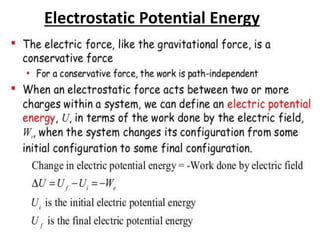
Electrostatic Potential Energy
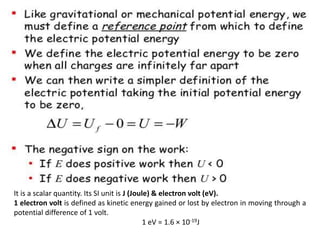
It is a scalar quantity. Its SI unit is J (Joule) & electron volt (eV).
1 electron volt is defined as kinetic energy gained or lost by electron in moving through a
potential difference of 1 volt.
1 eV = 1.6 × 10⁻¹⁹J
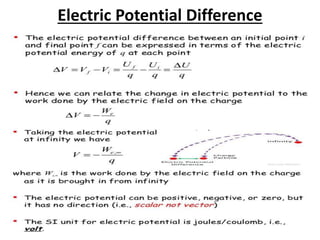
Electric Potential Difference
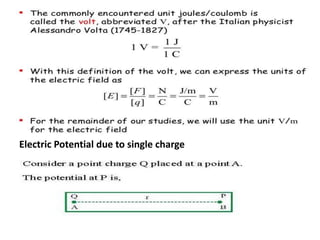
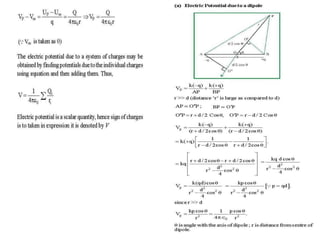
Electric Potential due to single charge
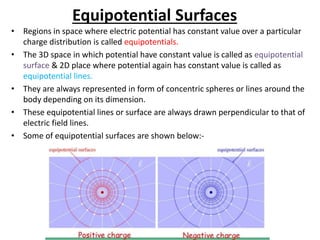
Equipotential Surfaces
• Regions in space where electric potential has constant value over a particular
charge distribution is called equipotentials.
• The 3D space in which potential have constant value is called as equipotential
surface & 2D place where potential again has constant value is called as
equipotential lines.
• They are always represented in form of concentric spheres or lines around the
body depending on its dimension.
• These equipotential lines or surface are always drawn perpendicular to that of
electric field lines.
• Some of equipotential surfaces are shown below:-
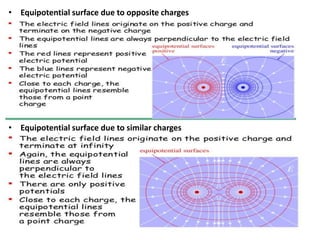
• Equipotential surface due to opposite charges
• Equipotential surface due to similar charges
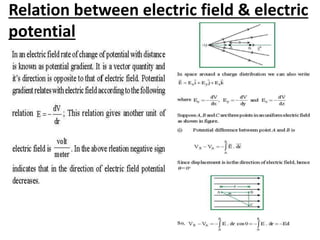
Relation between electric field & electric
potential
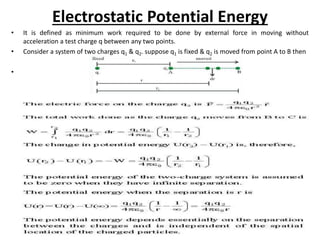
Electrostatic Potential Energy
• It is defined as minimum work required to be done by external force in moving without
acceleration a test charge q between any two points.
• Consider a system of two charges q1 & q2. suppose q1 is fixed & q2 is moved from point A to B then
•
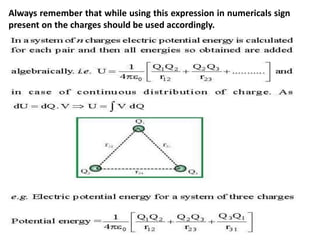
Always remember that while using this expression in numericals sign
present on the charges should be used accordingly.
Chapter  2 physics 12 (a)

Chapter 2 physics 12 (a)

  • 1.
  • 2.
  • 3.
    It is ascalar quantity. Its SI unit is J (Joule) & electron volt (eV). 1 electron volt is defined as kinetic energy gained or lost by electron in moving through a potential difference of 1 volt. 1 eV = 1.6 × 10⁻¹⁹J
  • 5.
  • 6.
    Electric Potential dueto single charge
  • 8.
    Equipotential Surfaces • Regionsin space where electric potential has constant value over a particular charge distribution is called equipotentials. • The 3D space in which potential have constant value is called as equipotential surface & 2D place where potential again has constant value is called as equipotential lines. • They are always represented in form of concentric spheres or lines around the body depending on its dimension. • These equipotential lines or surface are always drawn perpendicular to that of electric field lines. • Some of equipotential surfaces are shown below:-
  • 9.
    • Equipotential surfacedue to opposite charges • Equipotential surface due to similar charges
  • 10.
    Relation between electricfield & electric potential
  • 11.
    Electrostatic Potential Energy •It is defined as minimum work required to be done by external force in moving without acceleration a test charge q between any two points. • Consider a system of two charges q1 & q2. suppose q1 is fixed & q2 is moved from point A to B then •
  • 12.
    Always remember thatwhile using this expression in numericals sign present on the charges should be used accordingly.