Electrostatic Force andCoulomb's Law
• Electrostatic Force : -This is the force exerted
by stationary charged objects on other stationary
charged objects. It can be either attractive or
repulsive, depending on the nature of the
charges (like charges repel, opposite charges
attract).
3.
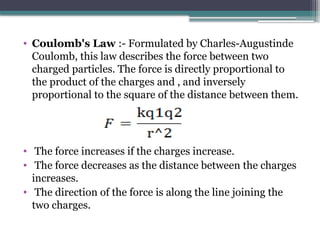
• Coulomb's Law:- Formulated by Charles-Augustinde
Coulomb, this law describes the force between two
charged particles. The force is directly proportional to
the product of the charges and , and inversely
proportional to the square of the distance between them.
• The force increases if the charges increase.
• The force decreases as the distance between the charges
increases.
• The direction of the force is along the line joining the
two charges.
4.
Key Differences BetweenElectric and
Gravitational Forces
• Electric Force: Can be either attractive or
repulsive, and is much stronger than
gravitational force.
• Gravitational Force: Always attractive and
weaker compared to electric force.
5.
Process of charging
1.Rubbing(by friction) :- rub two bodies and
they become oppositely charged
2. Conduction (by sharing) :- when charged
and uncharged bodies become in contact there is
a flow of charge from a charged body .
• The two bodies become the same type of charge
3. Induction :- where the charged practice is held
near an uncharged conductive material that is
grounded on a neutrally charged material
• After the process they become oppositely charged
6.
Distribution of charge
•Charges distribute uniformly on the outer
surface of the sphere
• On an irregular conductor , the charge
distribution is denser at curved sharp or edge
7.
Electric Fields
• ElectricField A region around a charged
object where other charges experience a force.
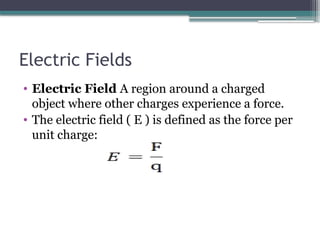
• The electric field ( E ) is defined as the force per
unit charge:
8.
Properties of ElectricField Lines
• Field lines never intersect.
• The density of field lines indicates the strength
of the field.
• Field lines are perpendicular to the surface of a
charged conductor.
9.
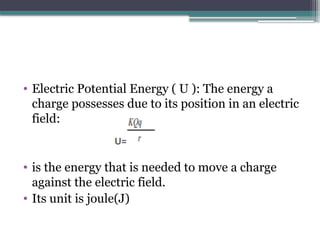
• Electric PotentialEnergy ( U ): The energy a
charge possesses due to its position in an electric
field:
• is the energy that is needed to move a charge
against the electric field.
• Its unit is joule(J)
10.
Electric Potential andPotential Energy
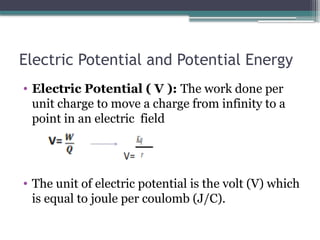
• Electric Potential ( V ): The work done per
unit charge to move a charge from infinity to a
point in an electric field
• The unit of electric potential is the volt (V) which
is equal to joule per coulomb (J/C).
11.
Potential Difference:
• Theexternal work needed to bring a charge from
one location to another location in an electric
field.
• also known as voltage
• If one joule of work done against electric filed to
bring the unit positive charge from infinity to the
point in the electric field then potential difference
at that point will be one volt.
12.
Capacitors and Capacitance
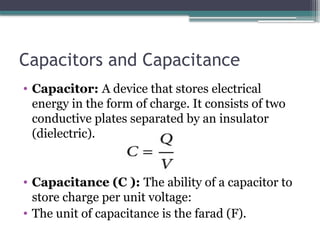
•Capacitor: A device that stores electrical
energy in the form of charge. It consists of two
conductive plates separated by an insulator
(dielectric).
• Capacitance (C ): The ability of a capacitor to
store charge per unit voltage:
• The unit of capacitance is the farad (F).
13.
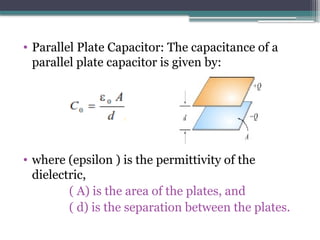
• Parallel PlateCapacitor: The capacitance of a
parallel plate capacitor is given by:
• where (epsilon ) is the permittivity of the
dielectric,
( A) is the area of the plates, and
( d) is the separation between the plates.
14.
Combination of Capacitors
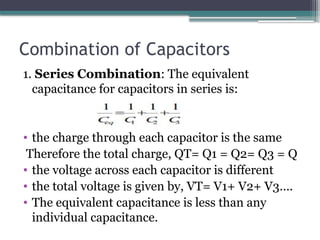
1.Series Combination: The equivalent
capacitance for capacitors in series is:
• the charge through each capacitor is the same
Therefore the total charge, QT= Q1 = Q2= Q3 = Q
• the voltage across each capacitor is different
• the total voltage is given by, VT= V1+ V2+ V3….
• The equivalent capacitance is less than any
individual capacitance.
15.
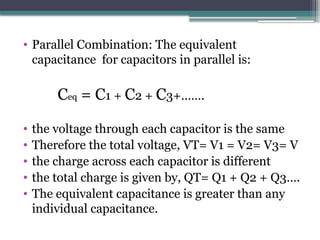
• Parallel Combination:The equivalent
capacitance for capacitors in parallel is:
Ceq = C1 + C2 + C3+…….
• the voltage through each capacitor is the same
• Therefore the total voltage, VT= V1 = V2= V3= V
• the charge across each capacitor is different
• the total charge is given by, QT= Q1 + Q2 + Q3….
• The equivalent capacitance is greater than any
individual capacitance.
16.
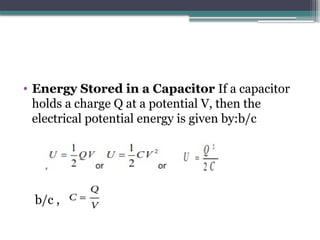
• Energy Storedin a Capacitor If a capacitor
holds a charge Q at a potential V, then the
electrical potential energy is given by:b/c
b/c ,
17.
Applications of Capacitors
•Capacitors are used in various applications,
including energy storage, filtering in electronic
circuits, tuning in radios, and power factor
correction in AC systems.



![3. Electric charge and electric fields [12hrs].pptx](https://cdn.slidesharecdn.com/ss_thumbnails/3-250325125403-64ebc3f7-thumbnail.jpg?width=640&height=640&fit=bounds)


