Beyond the walled garden.
The story of how one learner used social media for professional learning
and development.

Helen Crump
@crumphelen
7th June, 2013
#celt13
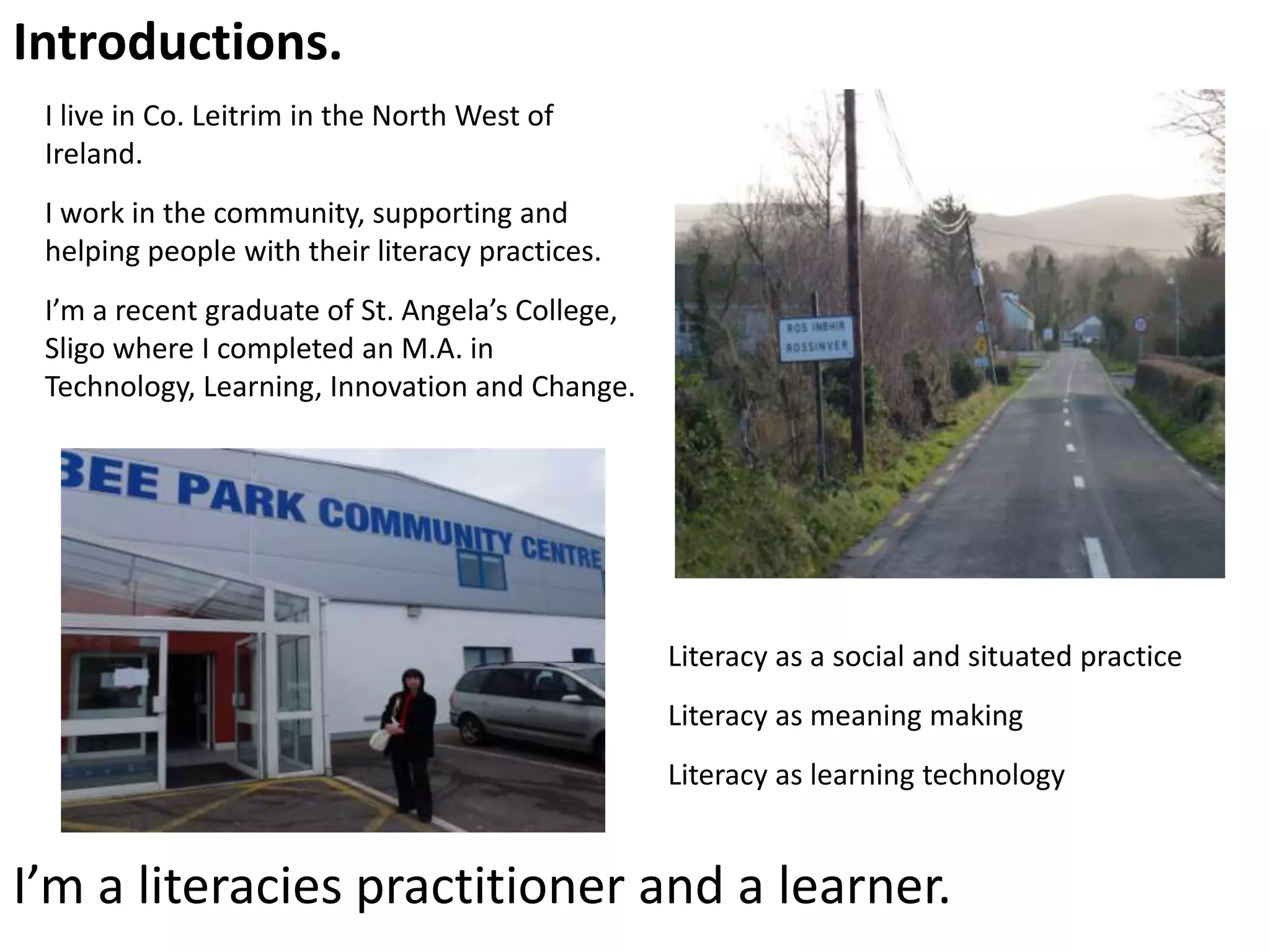
Introductions.
I live in Co. Leitrim in the North West of
Ireland.
I work in the community, supporting and
helping people with their literacy practices.
I’m a recent graduate of St. Angela’s College,
Sligo where I completed an M.A. in
Technology, Learning, Innovation and Change.

Literacy as a social and situated practice
Literacy as meaning making
Literacy as learning technology

I’m a literacies practitioner and a learner.
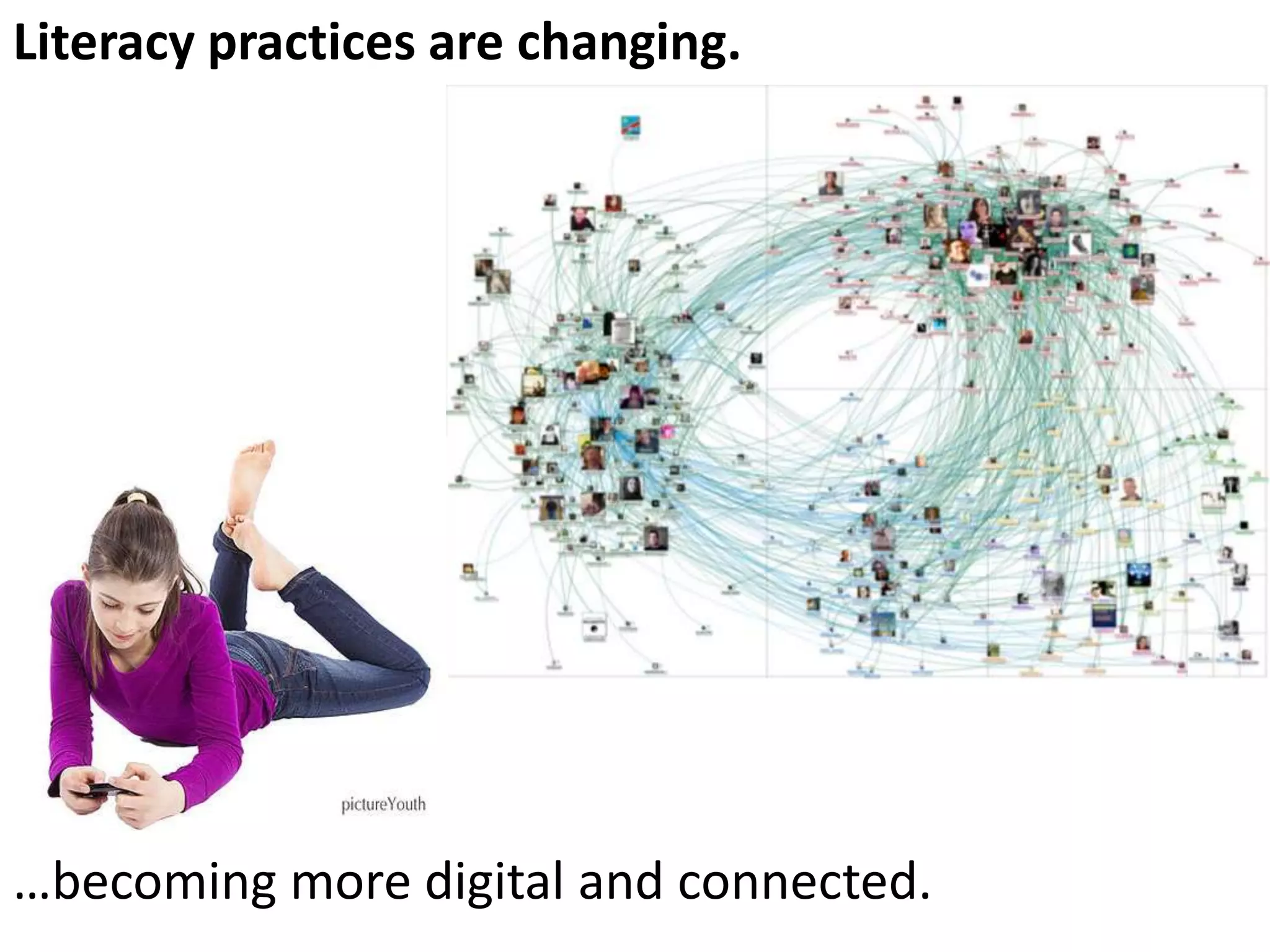
Literacy practices are changing.

…becoming more digital and connected.
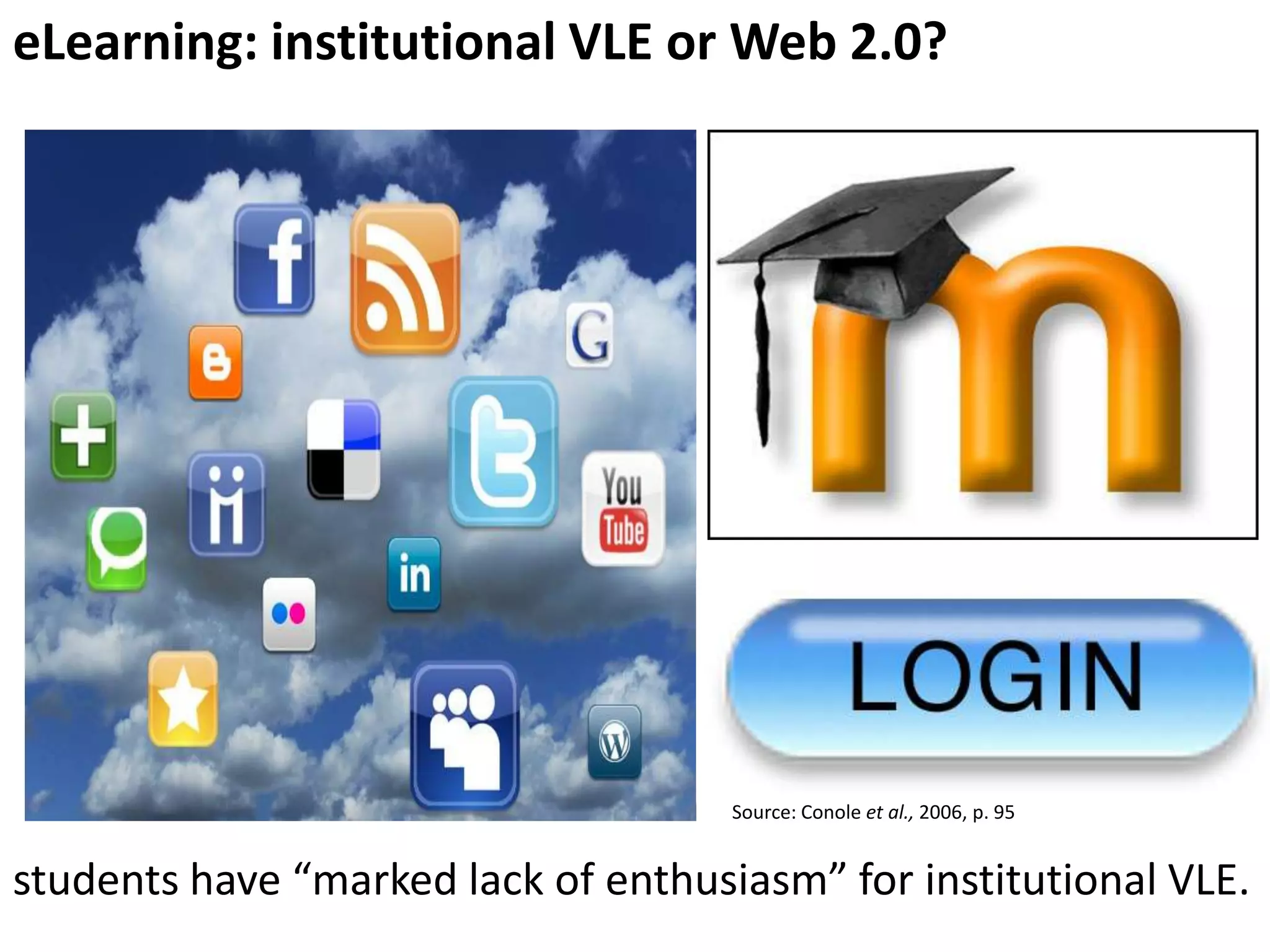
eLearning: institutional VLE or Web 2.0?

Source: Conole et al., 2006, p. 95

students have “marked lack of enthusiasm” for institutional VLE.
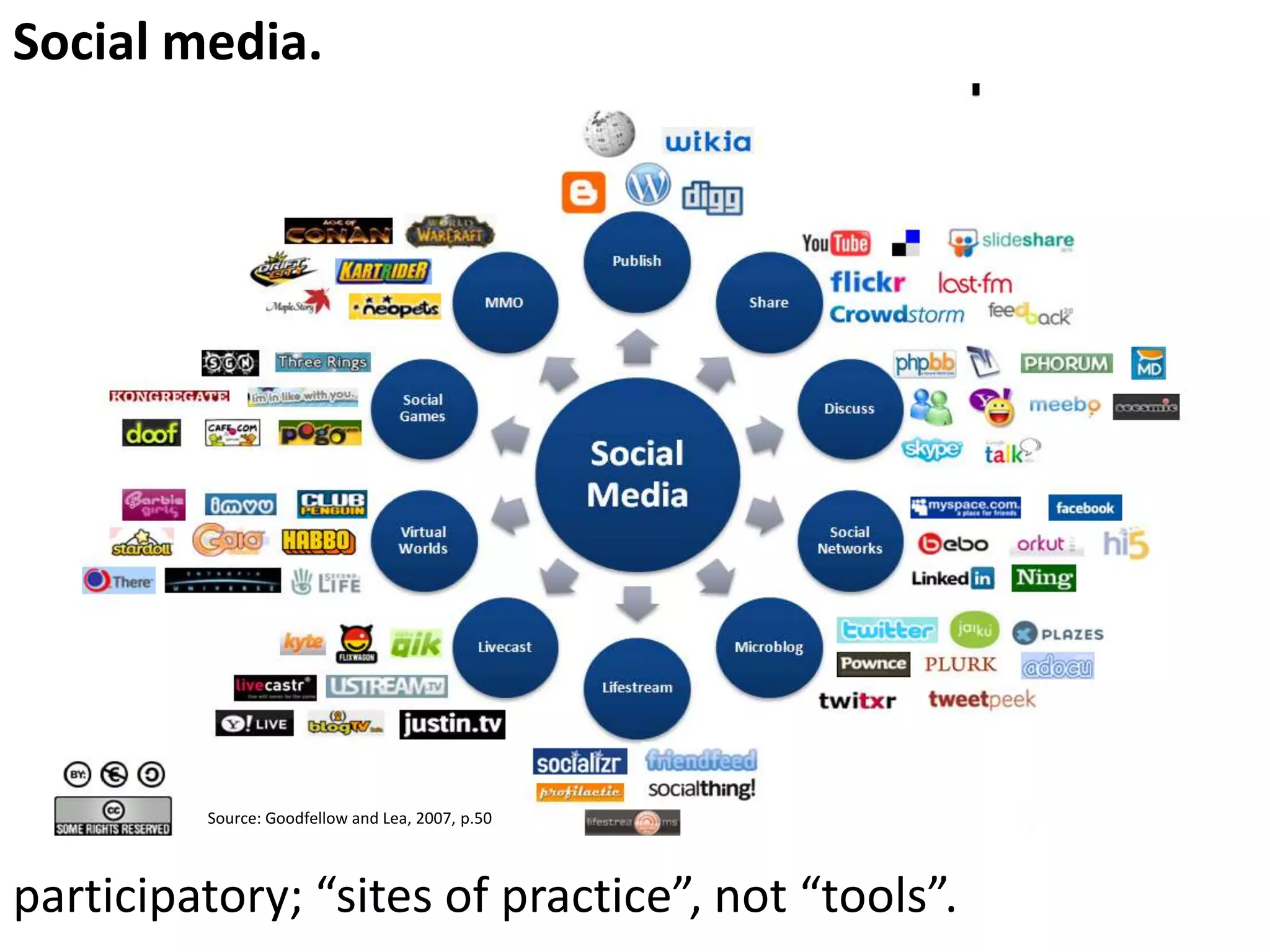
Social media.

Source: Goodfellow and Lea, 2007, p.50

participatory; “sites of practice”, not “tools”.
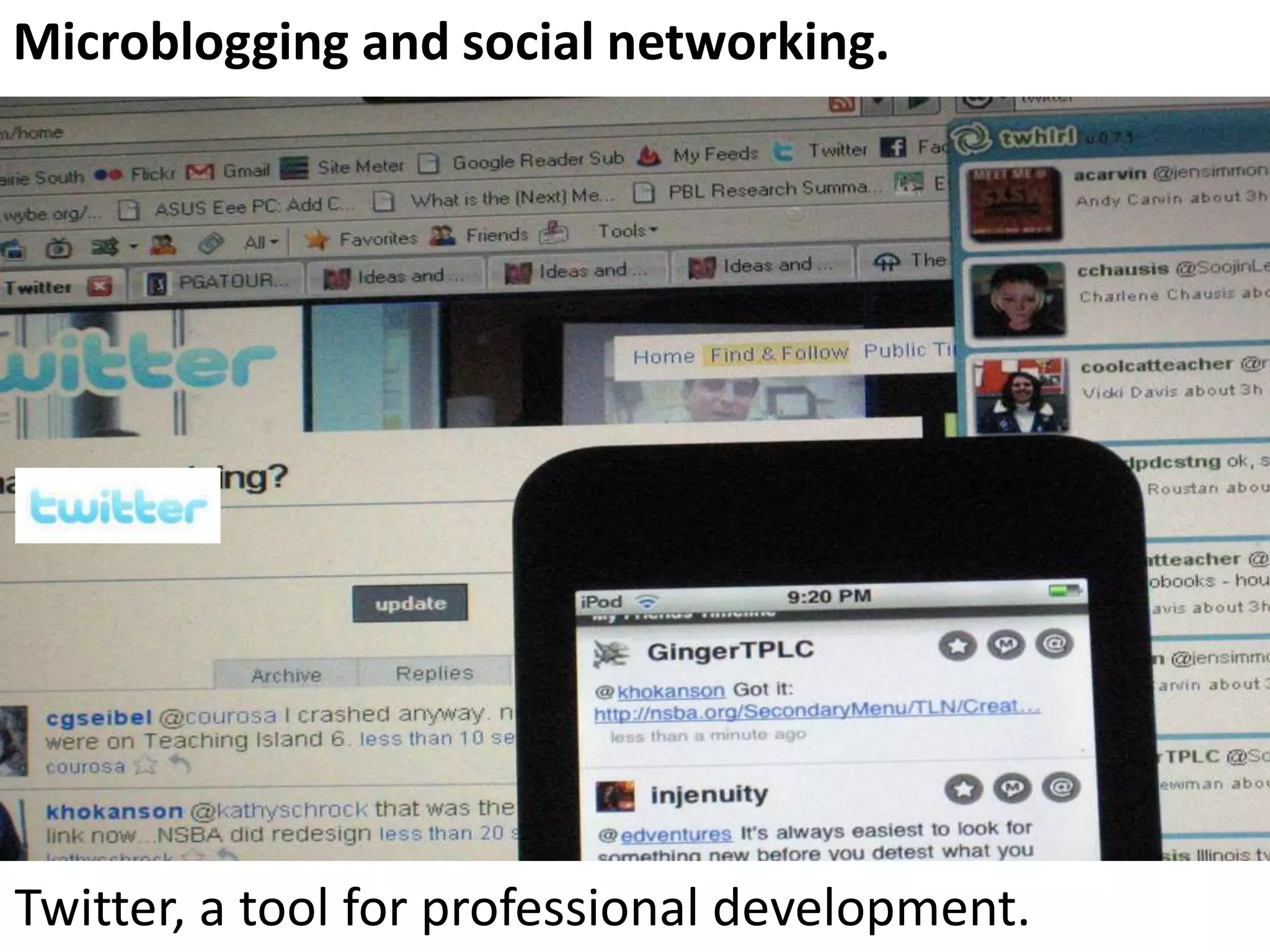
Microblogging and social networking.

Twitter, a tool for professional development.
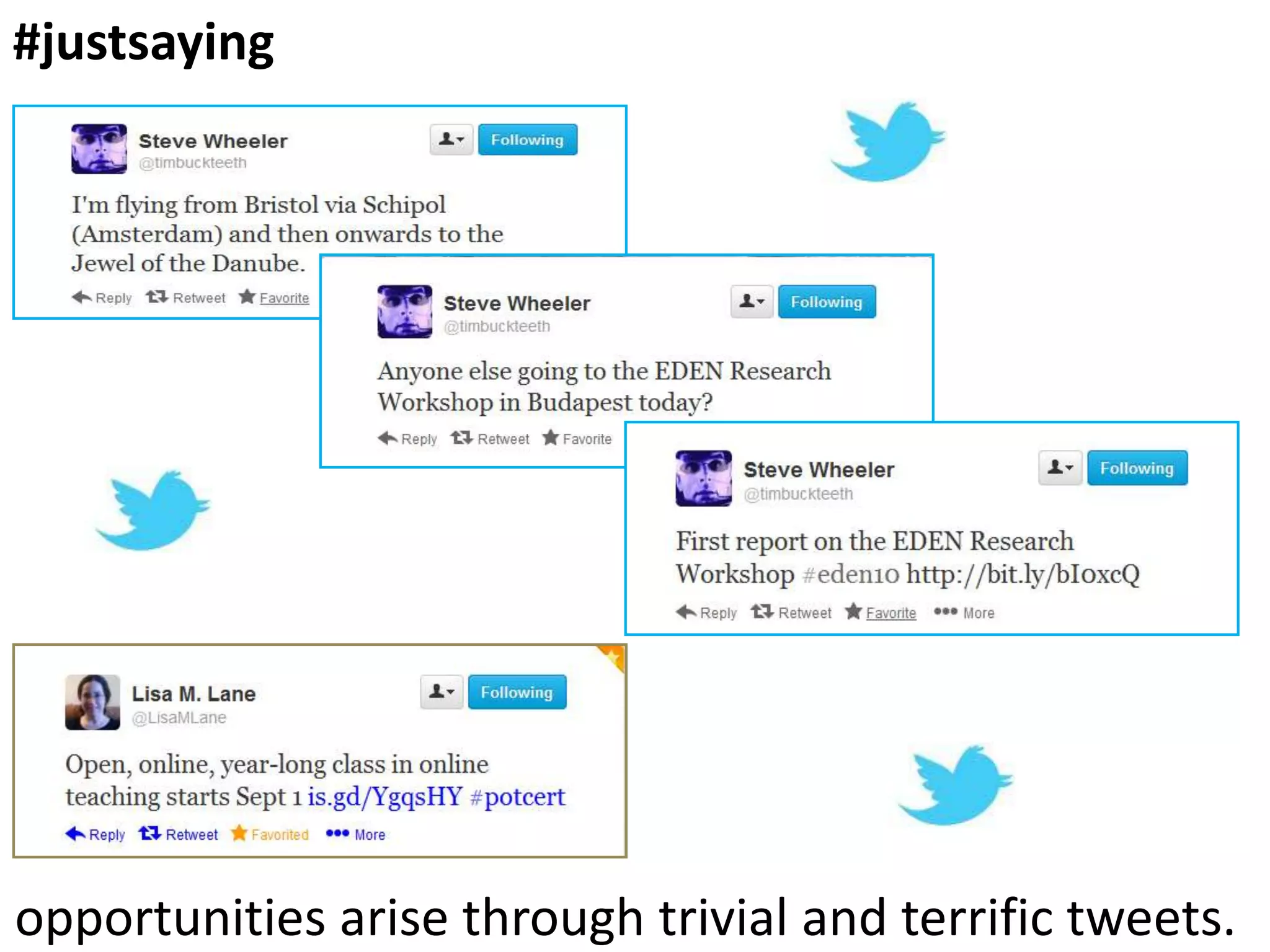
#justsaying

opportunities arise through trivial and terrific tweets.
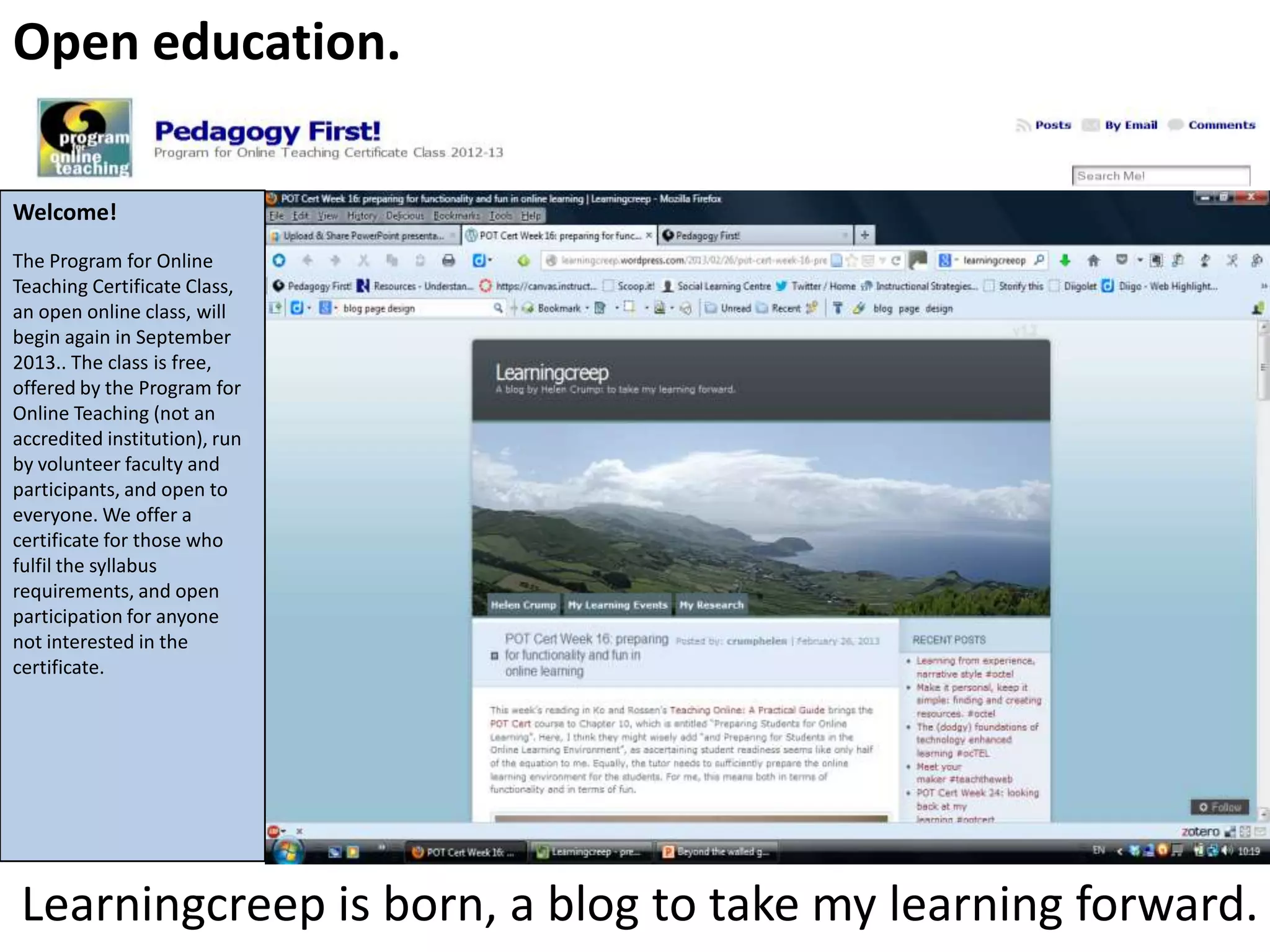
Open education.
Welcome!
The Program for Online
Teaching Certificate Class,
an open online class, will
begin again in September
2013.. The class is free,
offered by the Program for
Online Teaching (not an
accredited institution), run
by volunteer faculty and
participants, and open to
everyone. We offer a
certificate for those who
fulfil the syllabus
requirements, and open
participation for anyone
not interested in the
certificate.

Learningcreep is born, a blog to take my learning forward.
Communities of Practice [CoPs].
The Social Learning Centre is a joint initiative between the Centre for Learning & Performance
Technologies and Jarche Consulting.

A new Community of
Practice intended for
those interested in the
use of social media to
work and learn
smarter. This is a place
where you can join
discussions, ask
questions, share
links, experiences and
events with others about
social learning – whether
it be in education or in
the workplace. Jay Cross
calls it “the living room
for social learning
conversations”!

Jane Hart
Founder of the Centre for Learning &
Performance Technologies (C4LPT).

Harold Jarche
Co-author of The Working Smarter
Fieldbook.

a shared passion, and a desire to learn how to do it better.
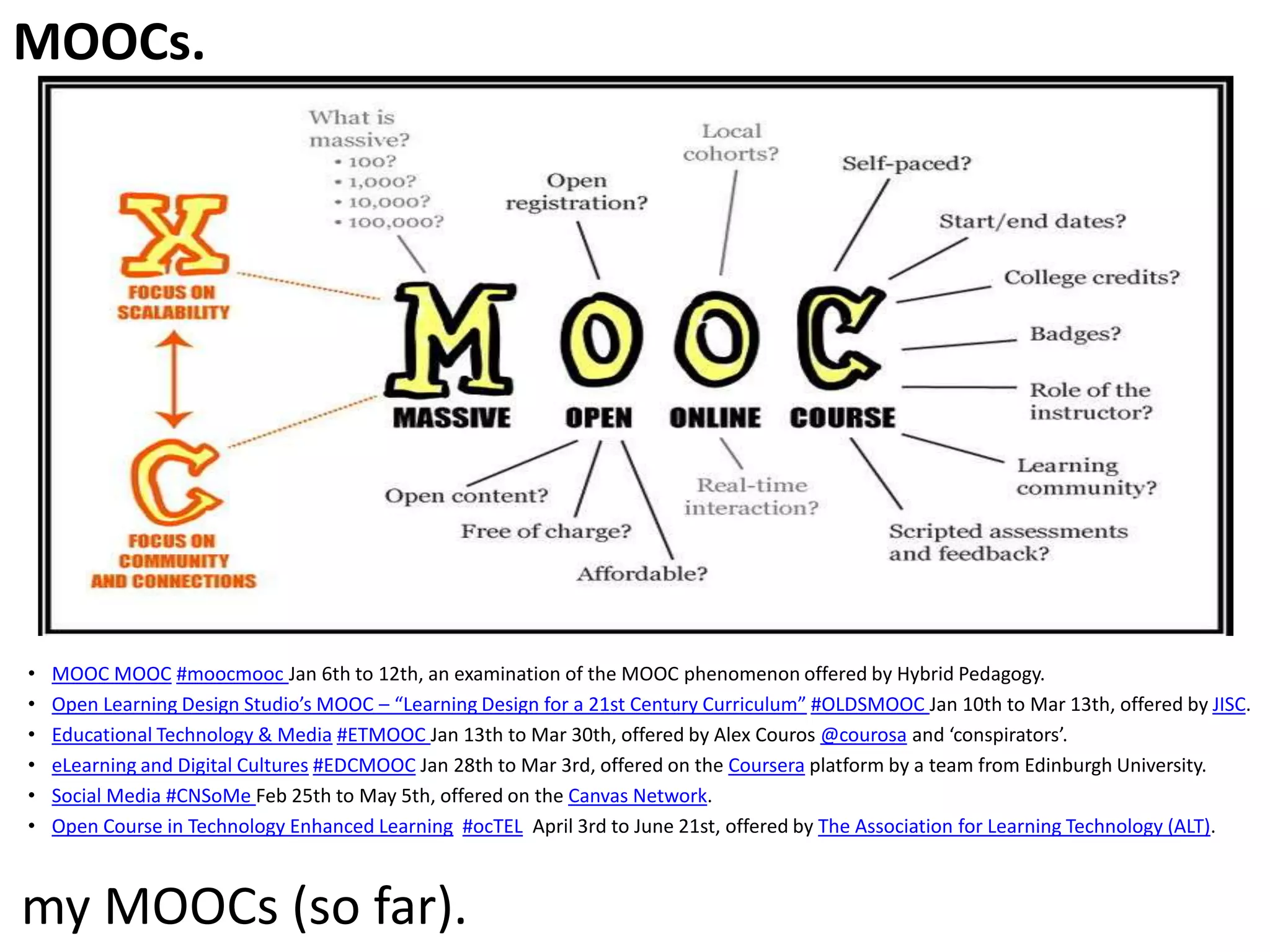
MOOCs.

•
•
•
•
•
•

MOOC MOOC #moocmooc Jan 6th to 12th, an examination of the MOOC phenomenon offered by Hybrid Pedagogy.
Open Learning Design Studio’s MOOC – “Learning Design for a 21st Century Curriculum” #OLDSMOOC Jan 10th to Mar 13th, offered by JISC.
Educational Technology & Media #ETMOOC Jan 13th to Mar 30th, offered by Alex Couros @courosa and ‘conspirators’.
eLearning and Digital Cultures #EDCMOOC Jan 28th to Mar 3rd, offered on the Coursera platform by a team from Edinburgh University.
Social Media #CNSoMe Feb 25th to May 5th, offered on the Canvas Network.
Open Course in Technology Enhanced Learning #ocTEL April 3rd to June 21st, offered by The Association for Learning Technology (ALT).

my MOOCs (so far).
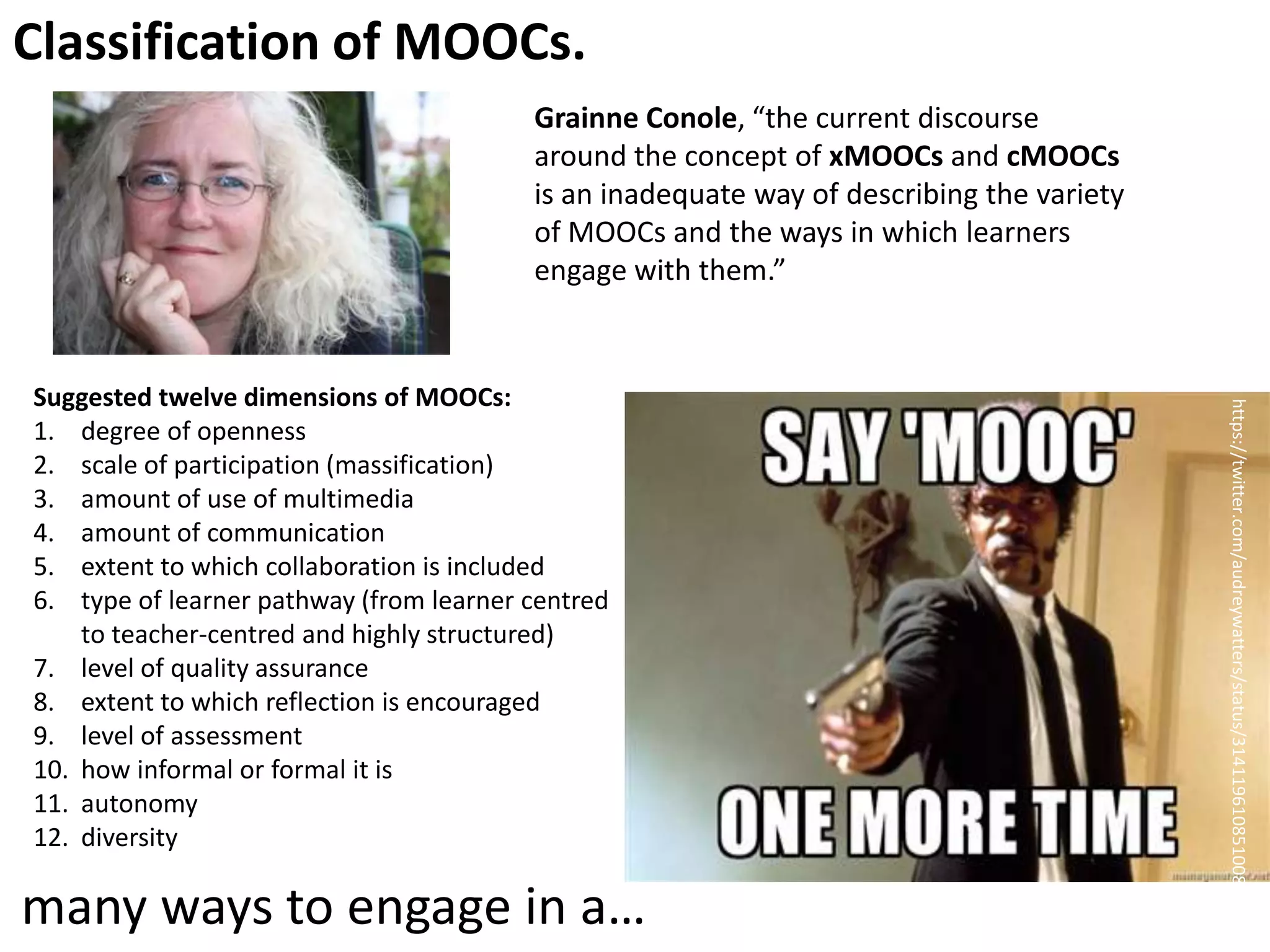
Classification of MOOCs.
Grainne Conole, “the current discourse
around the concept of xMOOCs and cMOOCs
is an inadequate way of describing the variety
of MOOCs and the ways in which learners
engage with them.”

many ways to engage in a…

https://twitter.com/audreywatters/status/314119610851008512

Suggested twelve dimensions of MOOCs:
1. degree of openness
2. scale of participation (massification)
3. amount of use of multimedia
4. amount of communication
5. extent to which collaboration is included
6. type of learner pathway (from learner centred
to teacher-centred and highly structured)
7. level of quality assurance
8. extent to which reflection is encouraged
9. level of assessment
10. how informal or formal it is
11. autonomy
12. diversity
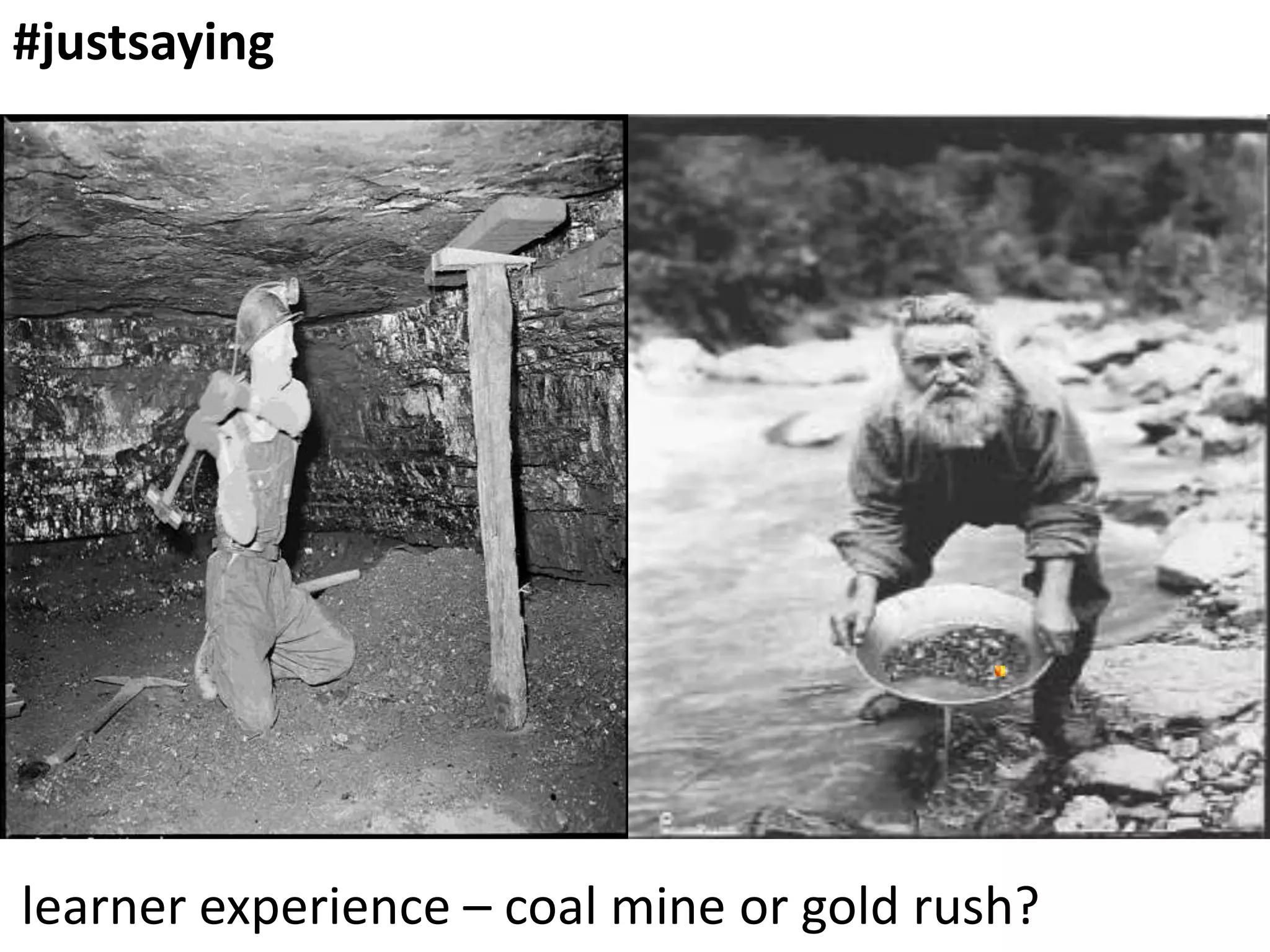
#justsaying

learner experience – coal mine or gold rush?
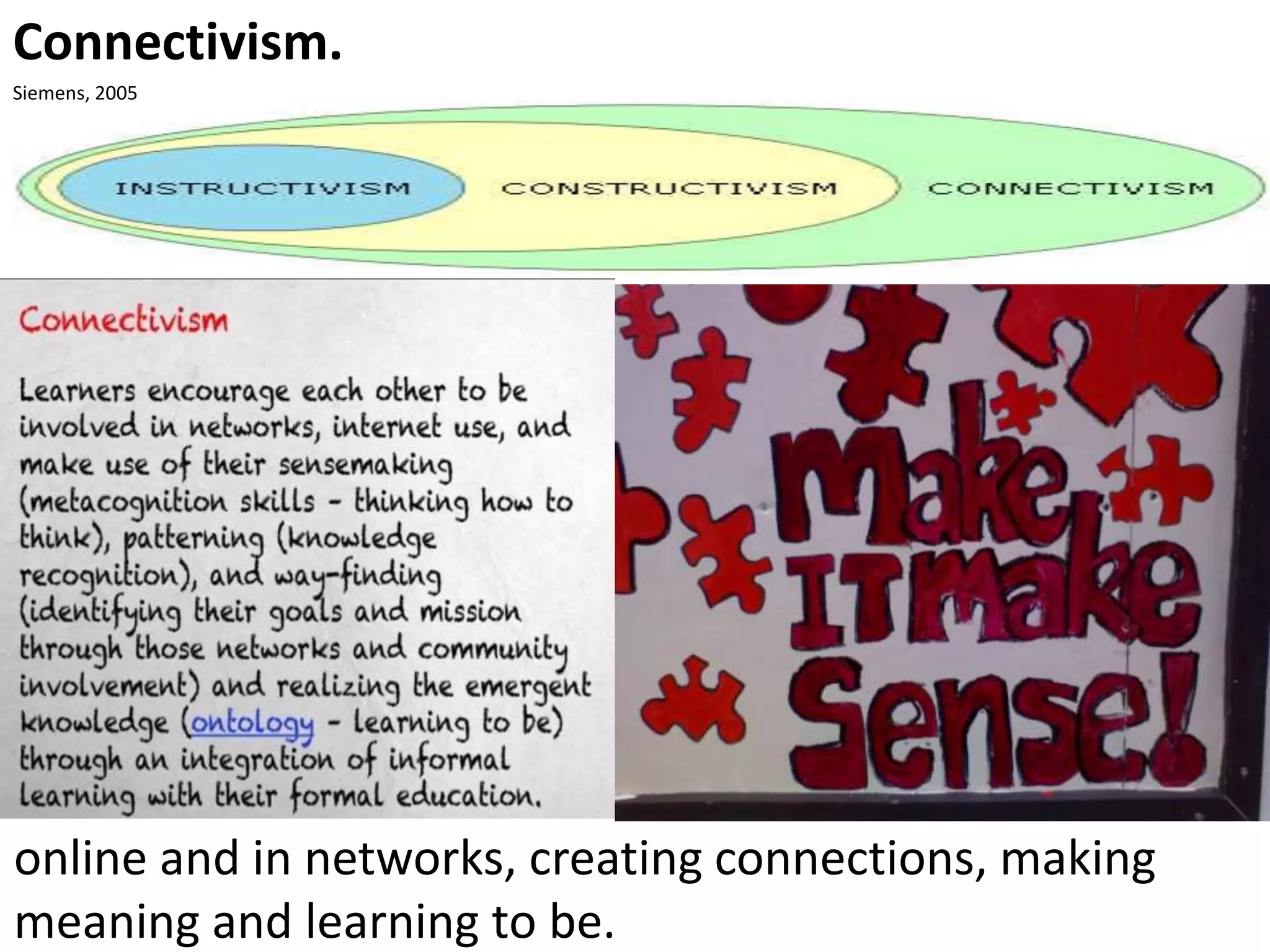
Connectivism.
Siemens, 2005

online and in networks, creating connections, making
meaning and learning to be.
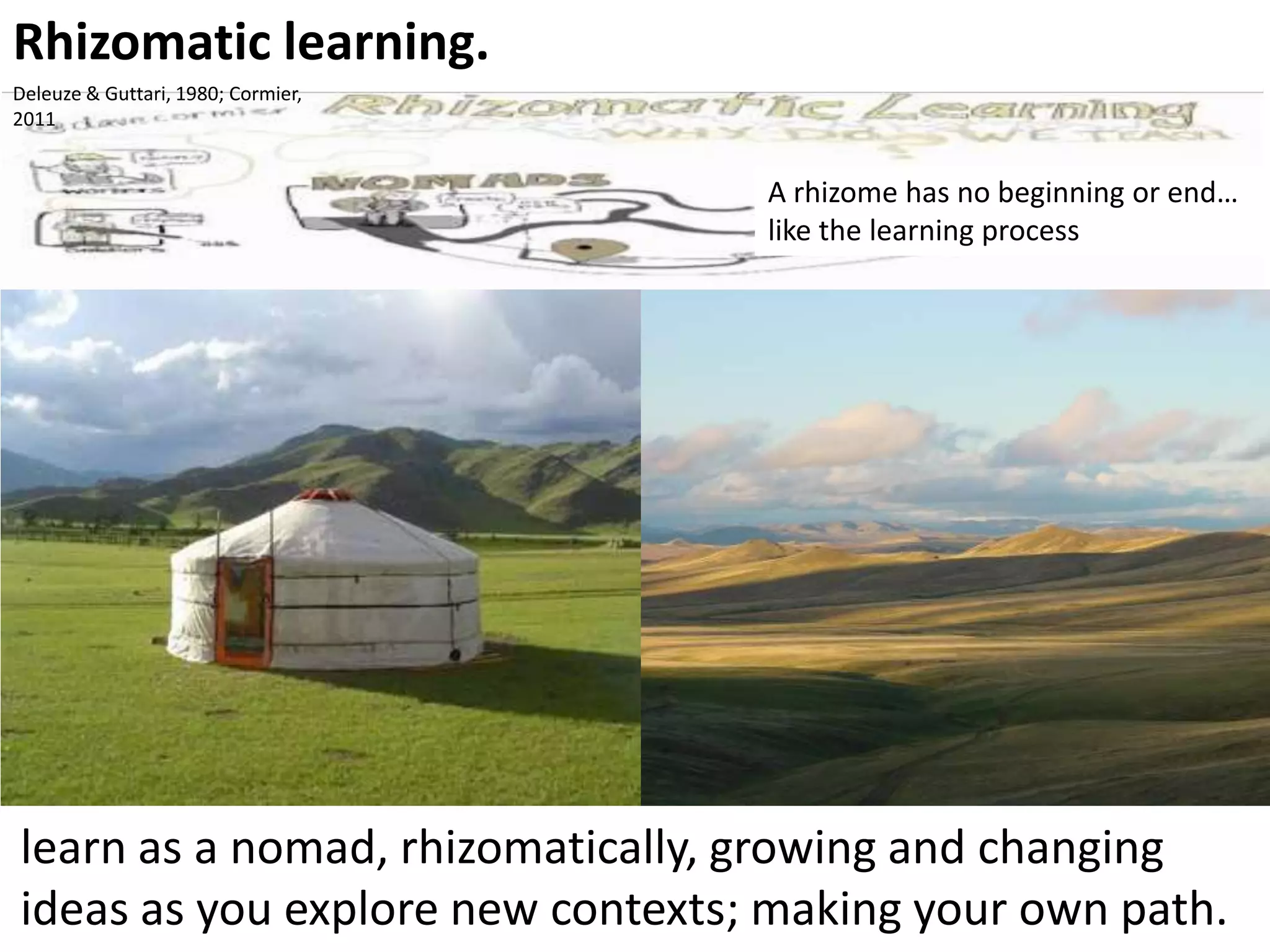
Rhizomatic learning.
Deleuze & Guttari, 1980; Cormier,
2011

A rhizome has no beginning or end…
like the learning process

learn as a nomad, rhizomatically, growing and changing
ideas as you explore new contexts; making your own path.
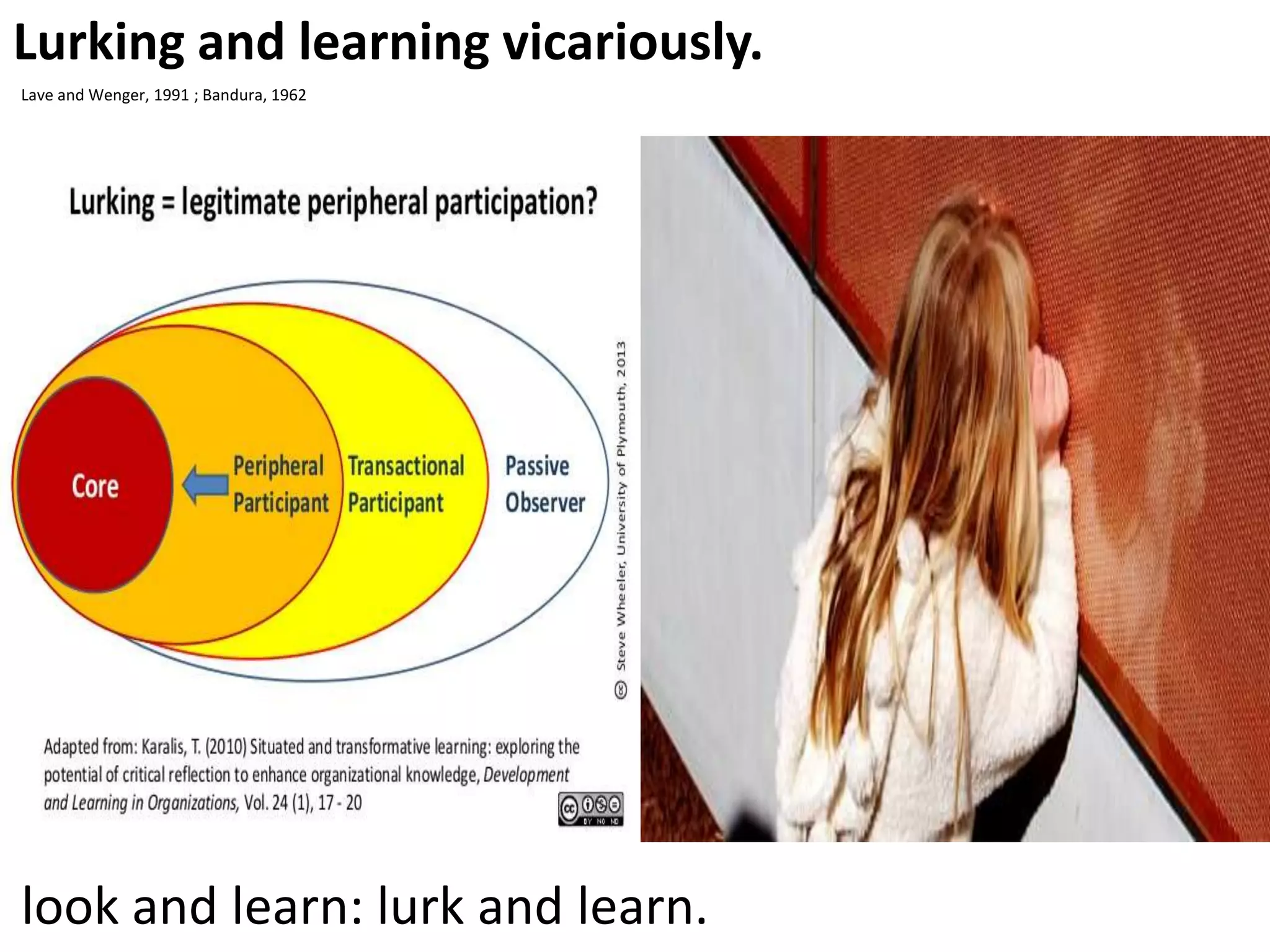
Lurking and learning vicariously.
Lave and Wenger, 1991 ; Bandura, 1962

look and learn: lurk and learn.
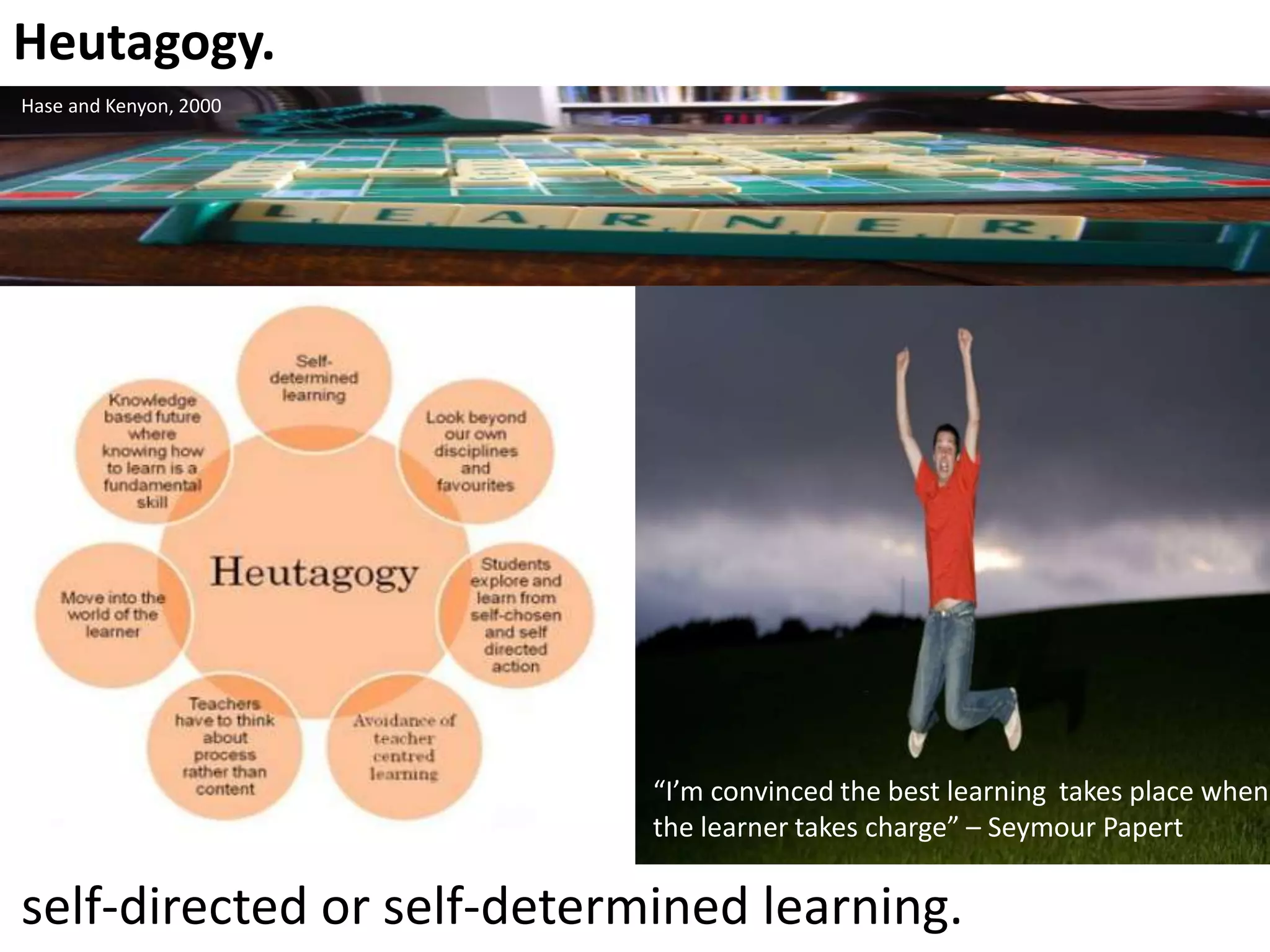
Heutagogy.
Hase and Kenyon, 2000

“I’m convinced the best learning takes place when
the learner takes charge” – Seymour Papert

self-directed or self-determined learning.
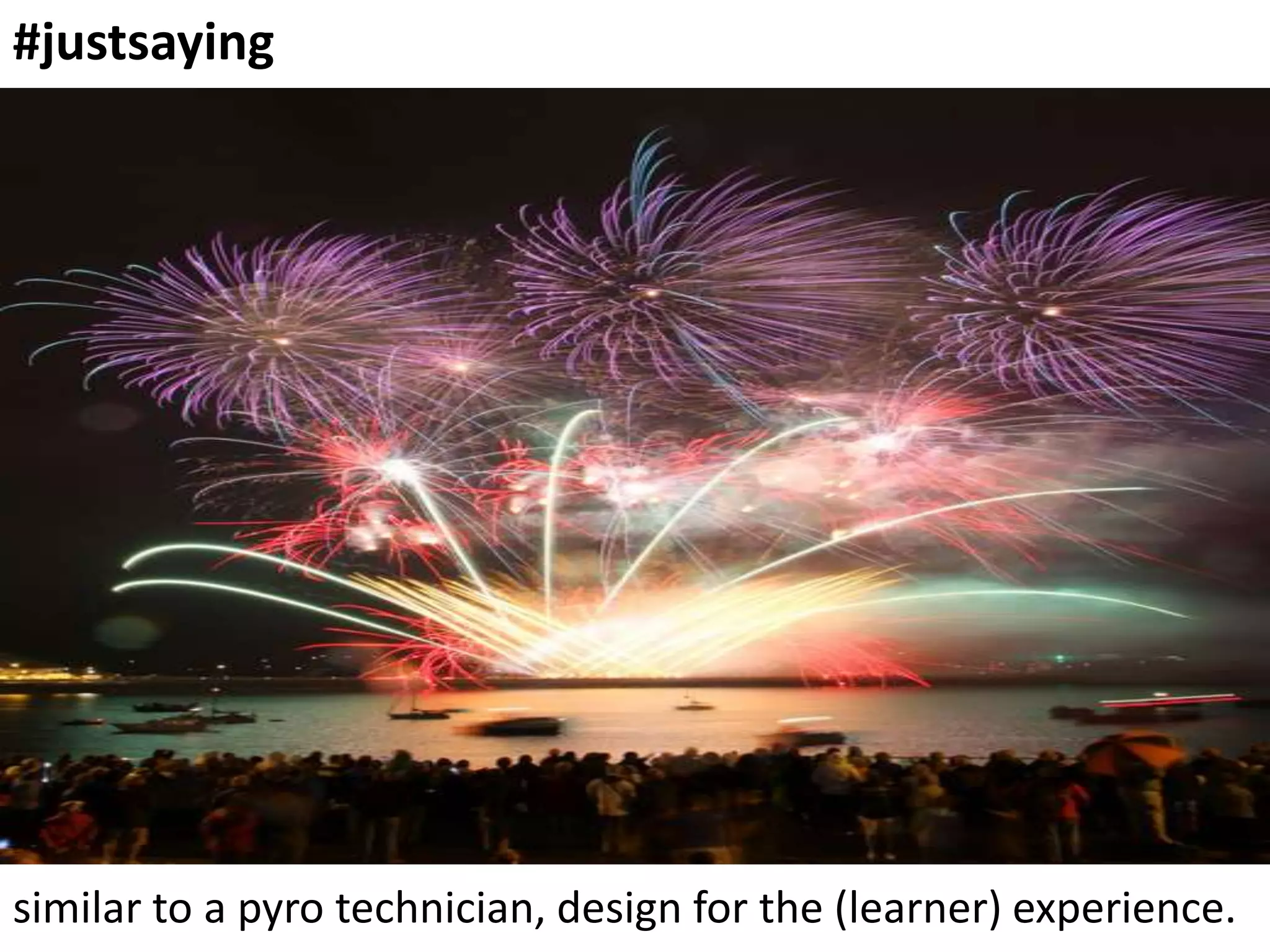
#justsaying

similar to a pyro technician, design for the (learner) experience.
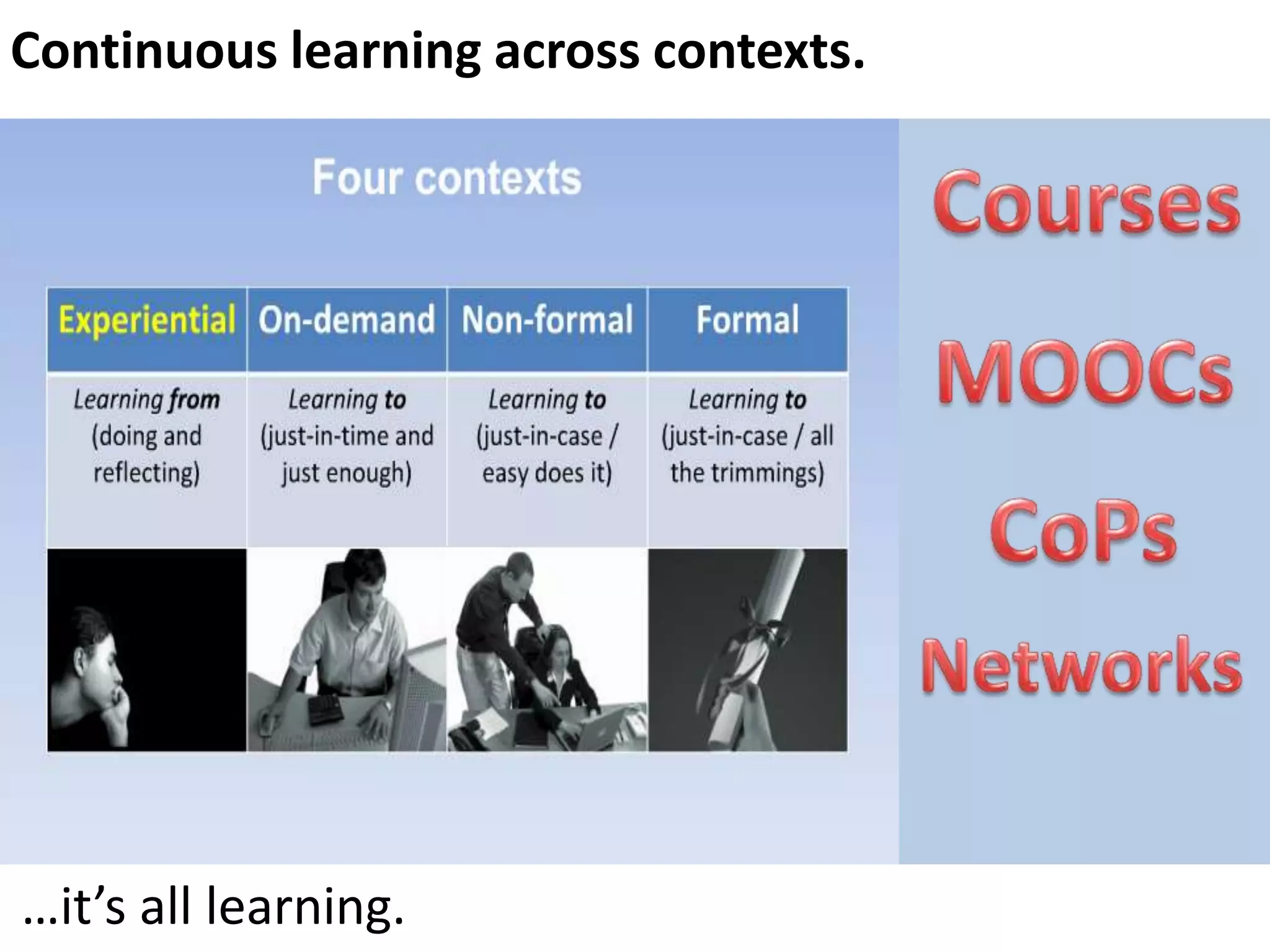
Continuous learning across contexts.

…it’s all learning.
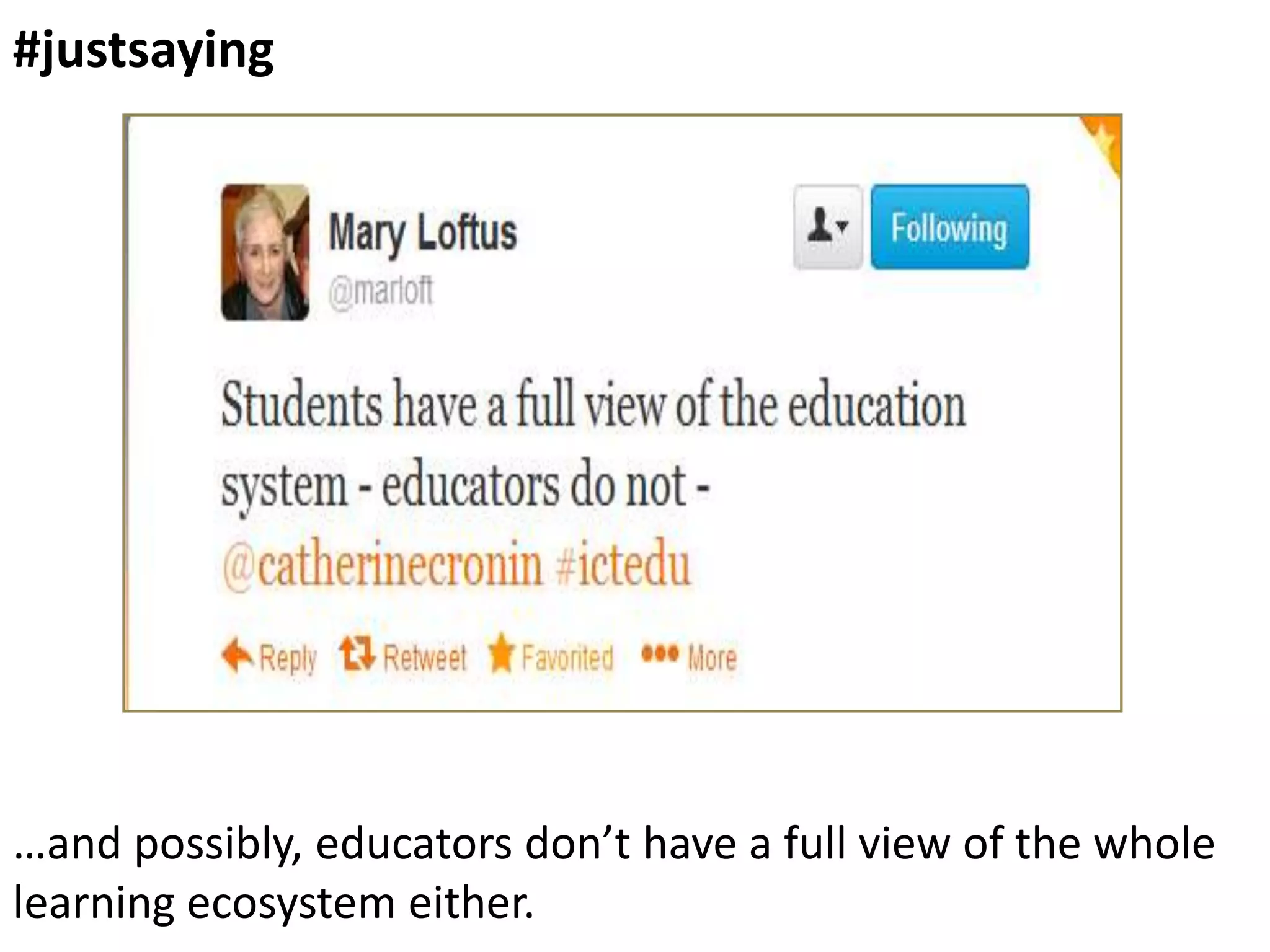
#justsaying

…and possibly, educators don’t have a full view of the whole
learning ecosystem either.
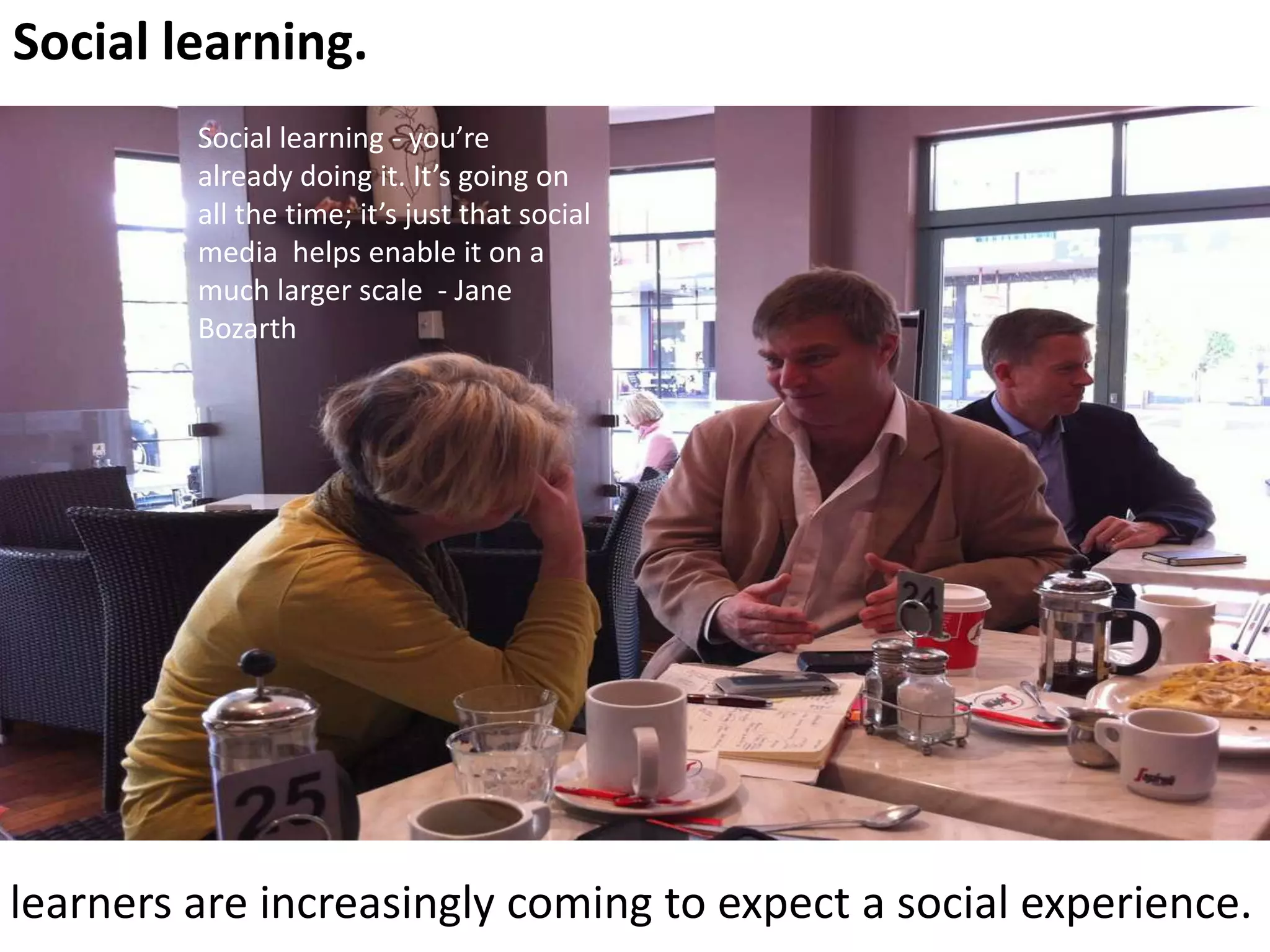
Social learning.
Social learning - you’re
already doing it. It’s going on
all the time; it’s just that social
media helps enable it on a
much larger scale - Jane
Bozarth

learners are increasingly coming to expect a social experience.
Build your personal learning network [PLN].

You can use a PLN to:
•
•
•
•

organise links and sources
ask and answer questions
curate content
reflect on learning

A PLN is a filtering system to help you
to cope with ‘information overload’.
• technical algorithms (search
engines)
• personalised algorithms (RSS feeds)
• social algorithms (network
connections)

filter and collect knowledge through people.
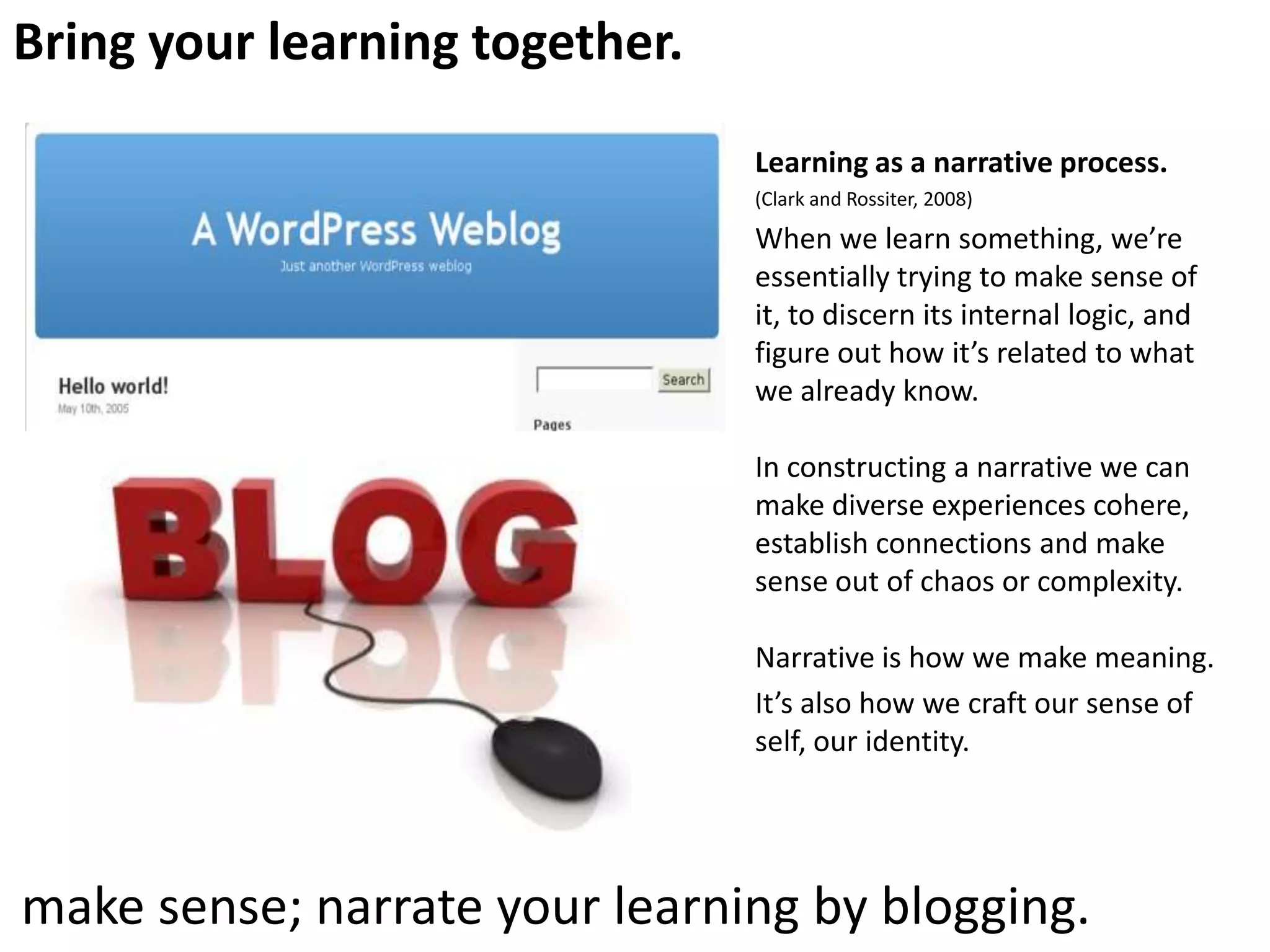
Bring your learning together.
Learning as a narrative process.
(Clark and Rossiter, 2008)

When we learn something, we’re
essentially trying to make sense of
it, to discern its internal logic, and
figure out how it’s related to what
we already know.
In constructing a narrative we can
make diverse experiences cohere,
establish connections and make
sense out of chaos or complexity.
Narrative is how we make meaning.
It’s also how we craft our sense of
self, our identity.

make sense; narrate your learning by blogging.
#justsaying
Blogging makes learning visible; it’s
learning out loud.
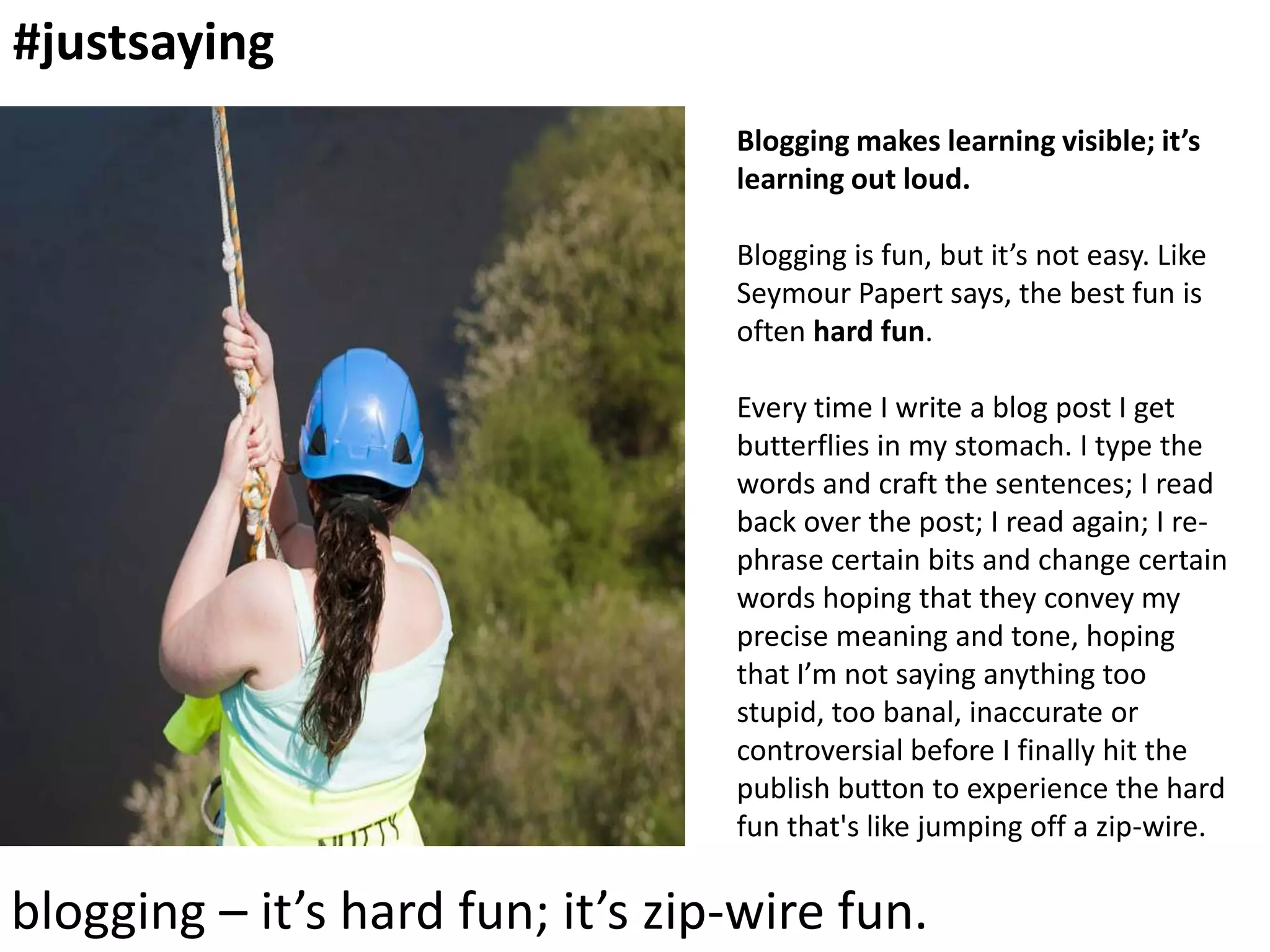
Blogging is fun, but it’s not easy. Like
Seymour Papert says, the best fun is
often hard fun.
Every time I write a blog post I get
butterflies in my stomach. I type the
words and craft the sentences; I read
back over the post; I read again; I rephrase certain bits and change certain
words hoping that they convey my
precise meaning and tone, hoping
that I’m not saying anything too
stupid, too banal, inaccurate or
controversial before I finally hit the
publish button to experience the hard
fun that's like jumping off a zip-wire.

blogging – it’s hard fun; it’s zip-wire fun.
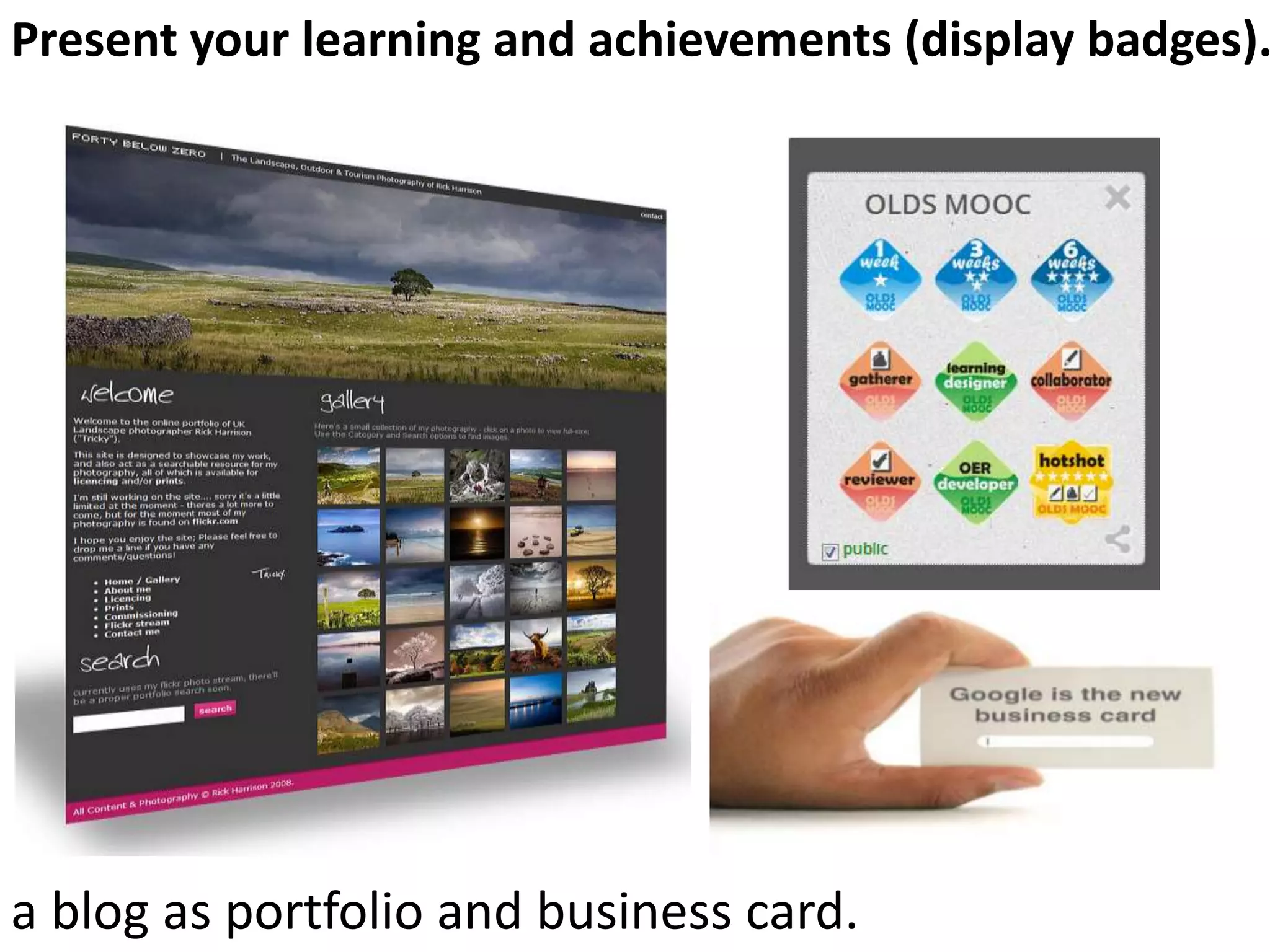
Present your learning and achievements (display badges).

a blog as portfolio and business card.
#justsaying
Open badges
(Belshaw, 2013)

Learning happens everywhere, but it's
often difficult to get recognition for
skills and achievements that happen
online or out of school.
[me] …or for skills that are embedded
in subjects and activities.

Badges are visual representations of
achievements, learning, skills,
interests and competencies. Open
badges can capture learning wherever
and however it happens.

?

Badges can be used for “stealth
assessment”. [me] Why assess by
stealth? It doesn’t half sound sneaky,
never mind “done to”. Why not be
more upfront? Why not call it “honour
assessment” instead?

open badges could be used to honour embedded skills.
#finally

It’s time to make
learning:
• learner-centred, or
self-directed
• connected
• social
• visible
• whole
learning practices are changing.
#andonelastthing

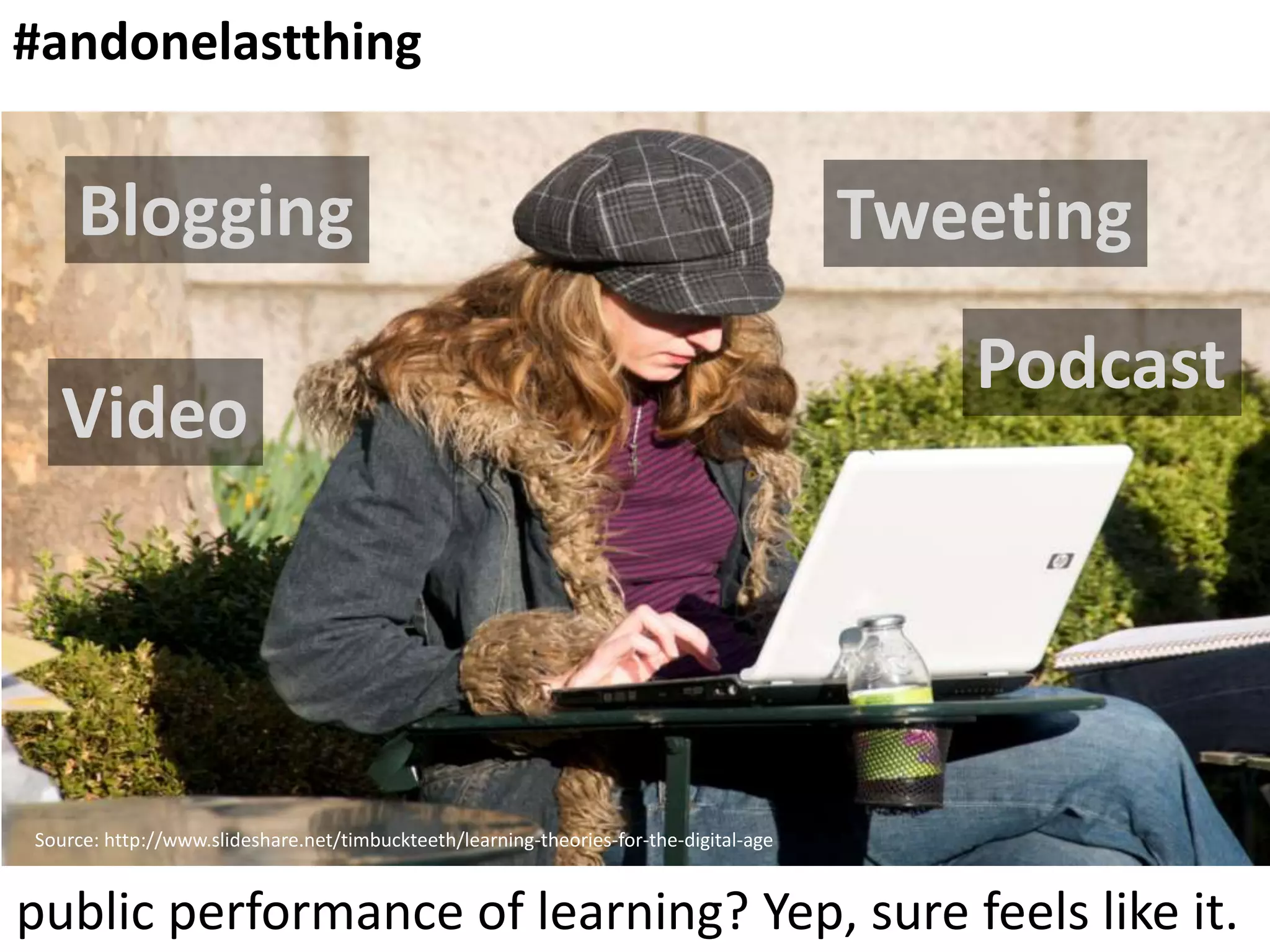
Blogging
Video

Tweeting
Podcast

Source: http://www.slideshare.net/timbuckteeth/learning-theories-for-the-digital-age

public performance of learning? Yep, sure feels like it.

Beyond the walled garden - the story of how one learner used social media for professional learning and development.

  • 1.
    Beyond the walledgarden. The story of how one learner used social media for professional learning and development. Helen Crump @crumphelen 7th June, 2013 #celt13
  • 2.
    Introductions. I live inCo. Leitrim in the North West of Ireland. I work in the community, supporting and helping people with their literacy practices. I’m a recent graduate of St. Angela’s College, Sligo where I completed an M.A. in Technology, Learning, Innovation and Change. Literacy as a social and situated practice Literacy as meaning making Literacy as learning technology I’m a literacies practitioner and a learner.
  • 3.
    Literacy practices arechanging. …becoming more digital and connected.
  • 4.
    eLearning: institutional VLEor Web 2.0? Source: Conole et al., 2006, p. 95 students have “marked lack of enthusiasm” for institutional VLE.
  • 5.
    Social media. Source: Goodfellowand Lea, 2007, p.50 participatory; “sites of practice”, not “tools”.
  • 6.
    Microblogging and socialnetworking. Twitter, a tool for professional development.
  • 7.
    #justsaying opportunities arise throughtrivial and terrific tweets.
  • 8.
    Open education. Welcome! The Programfor Online Teaching Certificate Class, an open online class, will begin again in September 2013.. The class is free, offered by the Program for Online Teaching (not an accredited institution), run by volunteer faculty and participants, and open to everyone. We offer a certificate for those who fulfil the syllabus requirements, and open participation for anyone not interested in the certificate. Learningcreep is born, a blog to take my learning forward.
  • 9.
    Communities of Practice[CoPs]. The Social Learning Centre is a joint initiative between the Centre for Learning & Performance Technologies and Jarche Consulting. A new Community of Practice intended for those interested in the use of social media to work and learn smarter. This is a place where you can join discussions, ask questions, share links, experiences and events with others about social learning – whether it be in education or in the workplace. Jay Cross calls it “the living room for social learning conversations”! Jane Hart Founder of the Centre for Learning & Performance Technologies (C4LPT). Harold Jarche Co-author of The Working Smarter Fieldbook. a shared passion, and a desire to learn how to do it better.
  • 10.
    MOOCs. • • • • • • MOOC MOOC #moocmoocJan 6th to 12th, an examination of the MOOC phenomenon offered by Hybrid Pedagogy. Open Learning Design Studio’s MOOC – “Learning Design for a 21st Century Curriculum” #OLDSMOOC Jan 10th to Mar 13th, offered by JISC. Educational Technology & Media #ETMOOC Jan 13th to Mar 30th, offered by Alex Couros @courosa and ‘conspirators’. eLearning and Digital Cultures #EDCMOOC Jan 28th to Mar 3rd, offered on the Coursera platform by a team from Edinburgh University. Social Media #CNSoMe Feb 25th to May 5th, offered on the Canvas Network. Open Course in Technology Enhanced Learning #ocTEL April 3rd to June 21st, offered by The Association for Learning Technology (ALT). my MOOCs (so far).
  • 11.
    Classification of MOOCs. GrainneConole, “the current discourse around the concept of xMOOCs and cMOOCs is an inadequate way of describing the variety of MOOCs and the ways in which learners engage with them.” many ways to engage in a… https://twitter.com/audreywatters/status/314119610851008512 Suggested twelve dimensions of MOOCs: 1. degree of openness 2. scale of participation (massification) 3. amount of use of multimedia 4. amount of communication 5. extent to which collaboration is included 6. type of learner pathway (from learner centred to teacher-centred and highly structured) 7. level of quality assurance 8. extent to which reflection is encouraged 9. level of assessment 10. how informal or formal it is 11. autonomy 12. diversity
  • 12.
    #justsaying learner experience –coal mine or gold rush?
  • 13.
    Connectivism. Siemens, 2005 online andin networks, creating connections, making meaning and learning to be.
  • 14.
    Rhizomatic learning. Deleuze &Guttari, 1980; Cormier, 2011 A rhizome has no beginning or end… like the learning process learn as a nomad, rhizomatically, growing and changing ideas as you explore new contexts; making your own path.
  • 15.
    Lurking and learningvicariously. Lave and Wenger, 1991 ; Bandura, 1962 look and learn: lurk and learn.
  • 16.
    Heutagogy. Hase and Kenyon,2000 “I’m convinced the best learning takes place when the learner takes charge” – Seymour Papert self-directed or self-determined learning.
  • 17.
    #justsaying similar to apyro technician, design for the (learner) experience.
  • 18.
    Continuous learning acrosscontexts. …it’s all learning.
  • 19.
    #justsaying …and possibly, educatorsdon’t have a full view of the whole learning ecosystem either.
  • 20.
    Social learning. Social learning- you’re already doing it. It’s going on all the time; it’s just that social media helps enable it on a much larger scale - Jane Bozarth learners are increasingly coming to expect a social experience.
  • 21.
    Build your personallearning network [PLN]. You can use a PLN to: • • • • organise links and sources ask and answer questions curate content reflect on learning A PLN is a filtering system to help you to cope with ‘information overload’. • technical algorithms (search engines) • personalised algorithms (RSS feeds) • social algorithms (network connections) filter and collect knowledge through people.
  • 22.
    Bring your learningtogether. Learning as a narrative process. (Clark and Rossiter, 2008) When we learn something, we’re essentially trying to make sense of it, to discern its internal logic, and figure out how it’s related to what we already know. In constructing a narrative we can make diverse experiences cohere, establish connections and make sense out of chaos or complexity. Narrative is how we make meaning. It’s also how we craft our sense of self, our identity. make sense; narrate your learning by blogging.
  • 23.
    #justsaying Blogging makes learningvisible; it’s learning out loud. Blogging is fun, but it’s not easy. Like Seymour Papert says, the best fun is often hard fun. Every time I write a blog post I get butterflies in my stomach. I type the words and craft the sentences; I read back over the post; I read again; I rephrase certain bits and change certain words hoping that they convey my precise meaning and tone, hoping that I’m not saying anything too stupid, too banal, inaccurate or controversial before I finally hit the publish button to experience the hard fun that's like jumping off a zip-wire. blogging – it’s hard fun; it’s zip-wire fun.
  • 24.
    Present your learningand achievements (display badges). a blog as portfolio and business card.
  • 25.
    #justsaying Open badges (Belshaw, 2013) Learninghappens everywhere, but it's often difficult to get recognition for skills and achievements that happen online or out of school. [me] …or for skills that are embedded in subjects and activities. Badges are visual representations of achievements, learning, skills, interests and competencies. Open badges can capture learning wherever and however it happens. ? Badges can be used for “stealth assessment”. [me] Why assess by stealth? It doesn’t half sound sneaky, never mind “done to”. Why not be more upfront? Why not call it “honour assessment” instead? open badges could be used to honour embedded skills.
  • 26.
    #finally It’s time tomake learning: • learner-centred, or self-directed • connected • social • visible • whole learning practices are changing.
  • 27.

Editor's Notes

  • #2 http://images.google.com/imgres?imgurl&imgrefurl=http%3A%2F%2Fpandodaily.com%2F2012%2F11%2F03%2Fhow-ecosystems-became-the-new-walled-gardens%2F&h=0&w=0&sz=1&tbnid=d8yMUjnfsCBzYM&tbnh=183&tbnw=275&prev=%2Fsearch%3Fq%3Dwalled%2Bgarden%26tbm%3Disch%26tbs%3Dsur%3Af%26tbo%3Du&zoom=1&q=walled%20garden&docid=B-qGoJU2yT3cQM&ei=rbCwUZPCB8TBPKb5gcAK&ved=0CAEQsCU
  • #4 http://www.flickr.com/photos/marc_smith/6704337077/sizes/l/http://commons.wikimedia.org/wiki/File:Young_girl_with_smart_phone.jpg
  • #5 http://www.flickr.com/photos/langwitches/4857422165/sizes/l/http://www.flickr.com/photos/kimballs/2754830833/sizes/o/
  • #6 http://www.flickr.com/photos/fredcavazza/2564571564/sizes/o/customarily within education technologies have been regarded as “tools” (Papert 1980) however, with the advent of online social spaces and technology’s ability to blur the boundary of the classroom and alter the context of learning (Parry, 2008; Ebner et al., 2010), Goodfellow (Goodfellow and Lea, 2007) suggests that more accurately technologies should be viewed as “sites of practice” (p. 50), in acknowledgement that application and meaning making is shaped by social relations emanating from the wider social and institutional setting. Further, he cautions that identities within these sites must be taken account of, as they are likely to be contested.
  • #7 http://www.flickr.com/photos/shareski/2319498191/sizes/l/
  • #10 Communities of practice are groups of people who share a concern or a passion for something they do and learn how to do it better as they interact regularly.http://www.ewenger.com/theory/
  • #11 http://en.m.wikipedia.org/wiki/File:MOOC_poster_mathplourde.jpg
  • #12 http://e4innovation.com/?p=727http://oersverige.se/oer-a-question-of-quality/http://www.flickr.com/photos/surreal_badger/8573233746/sizes/o/
  • #13 http://commons.wikimedia.org/wiki/File:Harry_Fain,_coal_loader,_places_and_secures_safety_timber_close_to_the_face_where_he_will_work._Inland_Steel_Co..._-_NARA_-_541483.jpghttp://www.findgoldprospecting.com/gold-rush-prospector-old-pictures-miner-49er-panning-photos/
  • #14 http://www.flickr.com/photos/ergonomic/3477630208/sizes/o/http://www.teachthought.com/learning/the-difference-between-instructivism-constructivism-and-connectivism/ Connectivism: A Learning Theory for the Digital Age, International Journal of Instructional Technology and Distance Learning, Vol. 2 No. 1, Jan 2005
  • #15 http://journeywithjohnsons.blogspot.ie/2011/04/meet-batbaatar-from-mongolia.htmlhttp://www.flickr.com/photos/26341279@N05/2473317114/sizes/l/in/photostream/A rhizome, sometimes called a creeping rootstalk, is a stem of a plant that sends out roots and shoots as it spreads. It is an image used by D&G to describe the way that ideas are multiple, interconnected and self-relicating. A rhizome has no beginning or end… like the learning process.The rhizome is, in a manner of speaking, a kind of network. It’s just a very messy, unpredictable network that isn’t bounded and grows and spreads in strange ways. The nomads make decisions for themselves. They gather what they need for their own path. I think we should be hoping for nomads.Nomads have the ability to learn rhizomatically, to ‘self-reproduce’, to grow and change ideas as they explore new contexts. They are not looking for ‘the accepted way’, they are not looking to receive instructions, but rather to create.
  • #16 http://www.flickr.com/photos/rene_schlegel/5797080397/sizes/l/
  • #17 http://www.flickr.com/photos/jokay/1896354207/sizes/o/http://www.flickr.com/photos/benwerd/185925362/sizes/o/in/photolist-hqV8G-eLGt1-5pmTJ4-845bKP-GUzft-9BwJAB-5MSpvj-65qpGA-7EpLsz-6KoSap-4Kxmdq-9uchHF-9ucopv-9uca9c-9uc8XM-9ucjfa-9ucfBD-9ufhsS-9ufrAA-9uc4v6-9ucnpT-9uc7gt-9ufqF3-9uf6Vh-9ufdso-9ufvAL-9ucdTc-9ucbxF-ceWV2E-bpgsjS-dggPcg-eejhpT-dXm3d8-4tTuyW-8exA9E-RGWxD-e1uaHf-4Y18Cb-874VP1-dtoAEL-3aFqw-7oABPb-4QPfXs-a5Qrt9-9rSA2j-puxeQ-bvLaGa-5daqvx-bBYbX7-bBYbYq-8HenQ2/http://www.flickr.com/photos/paulbence/1241826413/sizes/l/
  • #18 http://www.geograph.org.uk/photo/3092436Teaching as design puts the focus on learning
  • #21 http://www.flickr.com/photos/rog42/4928101028/sizes/l/
  • #22 http://www.flickr.com/photos/catspyjamasnz/7089515065
  • #23 http://commons.wikimedia.org/wiki/File:Wordpress_default1_mainpage.pnghttp://upload.wikimedia.org/wikipedia/commons/4/42/Blog_%281%29.jpg
  • #24 http://www.flickr.com/photos/48379763@N03/7279177068/sizes/l/
  • #25 http://www.flickr.com/photos/sovietuk/3065550166/sizes/l/http://www.flickr.com/photos/will-lion/3974469907/sizes/l/
  • #26 http://www.flickr.com/photos/hastac-dml/8579476967/sizes/l/Source: http://www.slideshare.net/dajbelshaw/open-badgesbbcnorth
  • #27 http://www.flickr.com/photos/90585146@N08/8222922317/sizes/l/