It's hardly easy to be softly hard:
freedom and control in learning
spaces
Terry Anderson
Jon Dron
University of Tallinn
April 2015
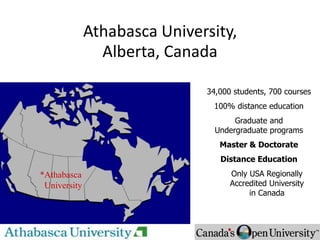
Athabasca University,
Alberta, Canada
* Athabasca University
34,000 students, 700 courses
100% distance education
Graduate and
Undergraduate programs
Master & Doctorate
Distance Education
Only USA Regionally
Accredited University
in Canada
*Athabasca
University
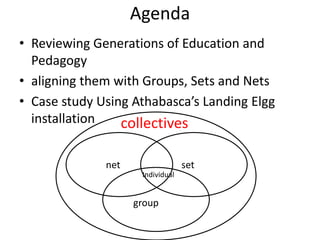
Agenda
• Reviewing Generations of Education and
Pedagogy
• aligning them with Groups, Sets and Nets
• Case study Using Athabasca’s Landing Elgg
installation
setnet
group
collectives
Individual
Proposition #1
The Next Generation Learning Evolves
From and With Past Generations
Proposition #2
• Different Structures/Pedagogies/Technologies,
with different affordances and degrees of
hardness effect our use.
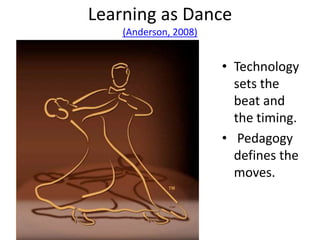
Learning as Dance
(Anderson, 2008)
• Technology
sets the
beat and
the timing.
• Pedagogy
defines the
moves.
Technologies
• The orchestration of phenomena to some use
(Arthur, 2009)
• Assemblies of hard and soft components
• Pedagogies are among the soft components of
all learning technologies
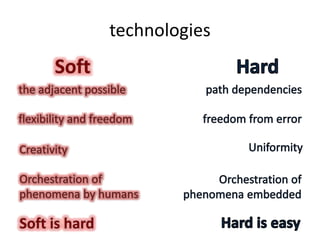
technologies
1. Behavioural/Cognitive Pedagogies
• “tell ‘em what you’re
gonna tell ‘em,
• tell ‘em
• then tell ‘em what you
told ‘em”
Direct Instruction
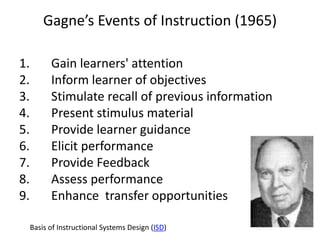
Gagne’s Events of Instruction (1965)
1. Gain learners' attention
2. Inform learner of objectives
3. Stimulate recall of previous information
4. Present stimulus material
5. Provide learner guidance
6. Elicit performance
7. Provide Feedback
8. Assess performance
9. Enhance transfer opportunities
Basis of Instructional Systems Design (ISD)
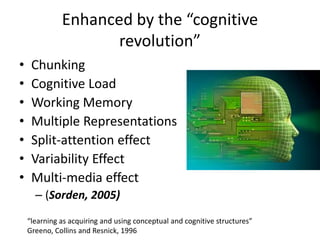
Enhanced by the “cognitive
revolution”
• Chunking
• Cognitive Load
• Working Memory
• Multiple Representations
• Split-attention effect
• Variability Effect
• Multi-media effect
– (Sorden, 2005)
“learning as acquiring and using conceptual and cognitive structures”
Greeno, Collins and Resnick, 1996
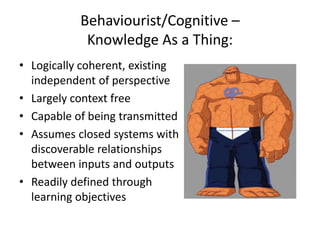
Behaviourist/Cognitive –
Knowledge As a Thing:
• Logically coherent, existing
independent of perspective
• Largely context free
• Capable of being transmitted
• Assumes closed systems with
discoverable relationships
between inputs and outputs
• Readily defined through
learning objectives
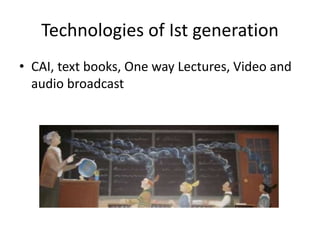
Technologies of Ist generation
• CAI, text books, One way Lectures, Video and
audio broadcast
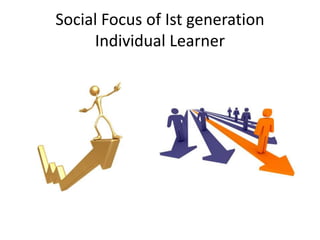
Social Focus of Ist generation
Individual Learner
15
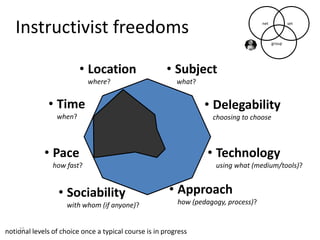
Instructivist freedoms
• Location
where?
• Subject
what?
• Time
when?
• Approach
how (pedagogy, process)?
• Pace
how fast?
• Sociability
with whom (if anyone)?
• Technology
using what (medium/tools)?
• Delegability
choosing to choose
setnet
group
notional levels of choice once a typical course is in progress
Hardness of individual learning
Future of Ist generation
• OERU
• Limitless, very low cost content
• Challenges of accreditation
• The (forever?) just around the corner, ‘learner
adaptation’ technologies
Content:
A bargain even at 80% off??
Most of us like Free!
Interactive MIT courses
MITX Announced
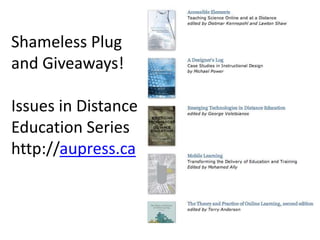
Shameless Plug
and Giveaways!
Issues in Distance
Education Series
http://aupress.ca
2nd Generation DE
Social Constructivist Pedagogy
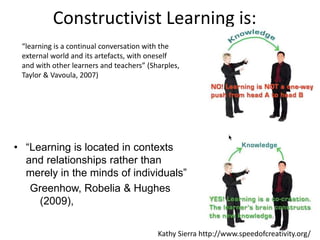
Constructivist Learning is:
• “Learning is located in contexts
and relationships rather than
merely in the minds of individuals”
Greenhow, Robelia & Hughes
(2009),
Kathy Sierra http://www.speedofcreativity.org/
“learning is a continual conversation with the
external world and its artefacts, with oneself
and with other learners and teachers” (Sharples,
Taylor & Vavoula, 2007)
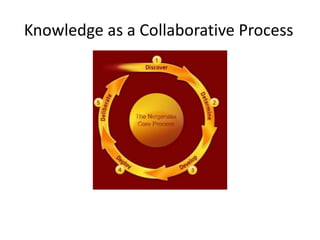
Knowledge as a Collaborative Process
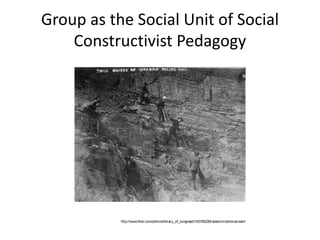
Group as the Social Unit of Social
Constructivist Pedagogy
http://www.flickr.com/photos/library_of_congress/2163782226/sizes/o/in/photostream/
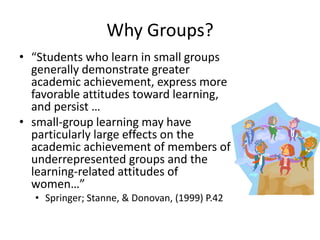
Why Groups?
• “Students who learn in small groups
generally demonstrate greater
academic achievement, express more
favorable attitudes toward learning,
and persist …
• small-group learning may have
particularly large effects on the
academic achievement of members of
underrepresented groups and the
learning-related attitudes of
women…”
• Springer; Stanne, & Donovan, (1999) P.42
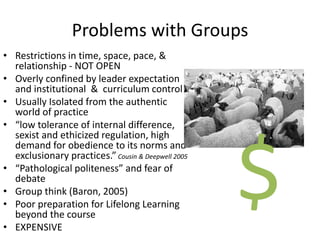
Problems with Groups
• Restrictions in time, space, pace, &
relationship - NOT OPEN
• Overly confined by leader expectation
and institutional & curriculum control
• Usually Isolated from the authentic
world of practice
• “low tolerance of internal difference,
sexist and ethicized regulation, high
demand for obedience to its norms and
exclusionary practices.”Cousin & Deepwell 2005
• “Pathological politeness” and fear of
debate
• Group think (Baron, 2005)
• Poor preparation for Lifelong Learning
beyond the course
• EXPENSIVE
$
26
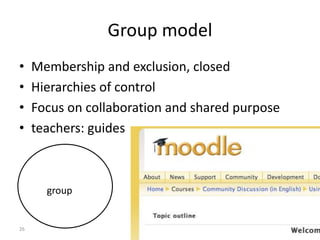
Group model
• Membership and exclusion, closed
• Hierarchies of control
• Focus on collaboration and shared purpose
• teachers: guides
group
27
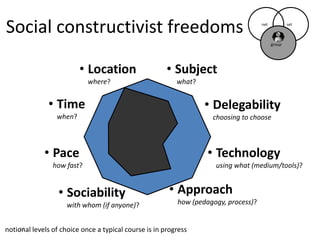
Social constructivist freedoms
• Location
where?
• Subject
what?
• Time
when?
• Approach
how (pedagogy, process)?
• Pace
how fast?
• Sociability
with whom (if anyone)?
• Technology
using what (medium/tools)?
• Delegability
choosing to choose
setnet
group
notional levels of choice once a typical course is in progress
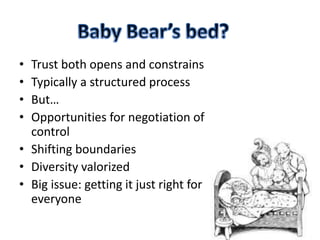
• Trust both opens and constrains
• Typically a structured process
• But…
• Opportunities for negotiation of
control
• Shifting boundaries
• Diversity valorized
• Big issue: getting it just right for
everyone
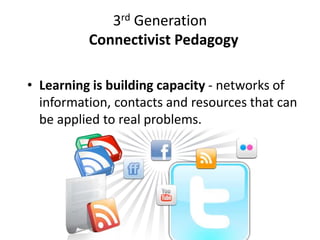
3rd Generation
Connectivist Pedagogy
• Learning is building capacity - networks of
information, contacts and resources that can
be applied to real problems.
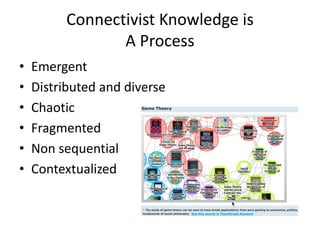
Connectivist Knowledge is
A Process
• Emergent
• Distributed and diverse
• Chaotic
• Fragmented
• Non sequential
• Contextualized
What is Connected Knowledge?
• Knowledge is defined by its creation through
activities
– Accessing information
– Evaluating, filtering
– Conveying ideas
– Reformatting, mashing
– Analyzing,
– Collaborating (Barth 2004)
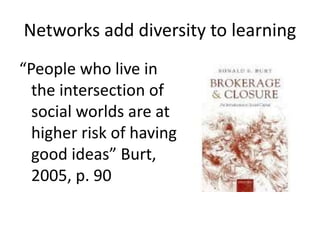
Networks add diversity to learning
“People who live in
the intersection of
social worlds are at
higher risk of having
good ideas” Burt,
2005, p. 90
Networks Celebrate and Stimulate
Cognitive Diversity Cognitive Diversity
Arises when from:
• different types of information and knowledge
perspectives
• different ways of viewing the world or a specific problem
interpretations
• different ways of categorizing a problem or partitioning
perspectives
• heuristics yielding different ways of generating solutions
to problems
• predictive models - different ways of inferring causes and
effects (Fisher, L. (2009)
• “A social network is crucially different from a
social circle, since the function of a social
circle is to curb our appetites and of a network
to extend them. “ Adem Gopnik, 2011
• Read more
http://www.newyorker.com/arts/critics/atlarge/2011/02/14/110214crat_atlarge_g
opnik#ixzz1NHjpnxne
35
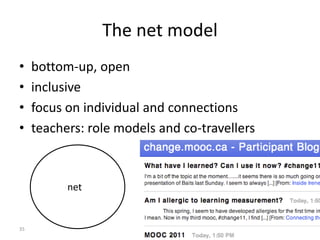
The net model
• bottom-up, open
• inclusive
• focus on individual and connections
• teachers: role models and co-travellers
net
36
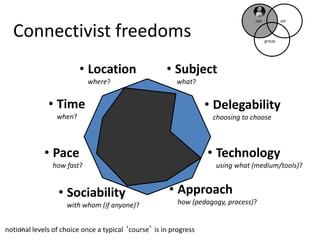
Connectivist freedoms
• Location
where?
• Subject
what?
• Time
when?
• Approach
how (pedagogy, process)?
• Pace
how fast?
• Sociability
with whom (if anyone)?
• Technology
using what (medium/tools)?
• Delegability
choosing to choose
setnet
group
notional levels of choice once a typical ‘course’ is in progress
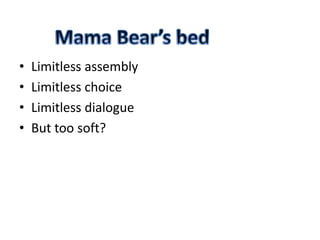
• Limitless assembly
• Limitless choice
• Limitless dialogue
• But too soft?
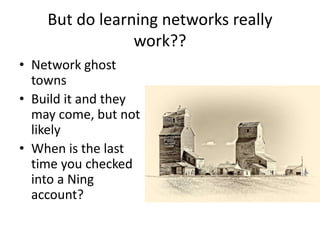
But do learning networks really
work??
• Network ghost
towns
• Build it and they
may come, but not
likely
• When is the last
time you checked
into a Ning
account?
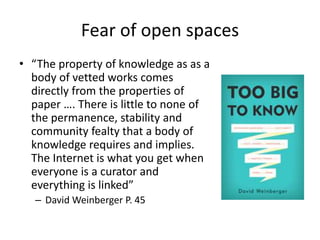
Fear of open spaces
• “The property of knowledge as as a
body of vetted works comes
directly from the properties of
paper …. There is little to none of
the permanence, stability and
community fealty that a body of
knowledge requires and implies.
The Internet is what you get when
everyone is a curator and
everything is linked”
– David Weinberger P. 45
choice != control
it’s not just about
networks
42
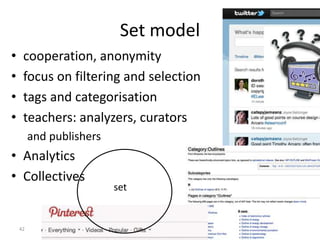
Set model
• cooperation, anonymity
• focus on filtering and selection
• tags and categorisation
• teachers: analyzers, curators
and publishers
• Analytics
• Collectives
set
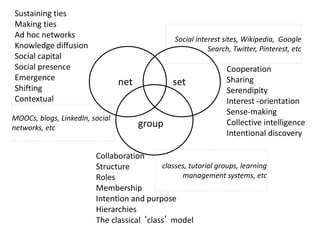
setnet
group
Collaboration
Structure
Roles
Membership
Intention and purpose
Hierarchies
The classical ‘class’ model
Sustaining ties
Making ties
Ad hoc networks
Knowledge diffusion
Social capital
Social presence
Emergence
Shifting
Contextual
Cooperation
Sharing
Serendipity
Interest -orientation
Sense-making
Collective intelligence
Intentional discovery
classes, tutorial groups, learning
management systems, etc
MOOCs, blogs, LinkedIn, social
networks, etc
Social interest sites, Wikipedia, Google
Search, Twitter, Pinterest, etc
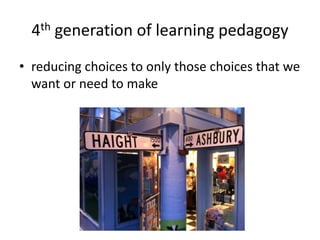
4th generation of learning pedagogy
• reducing choices to only those choices that we
want or need to make
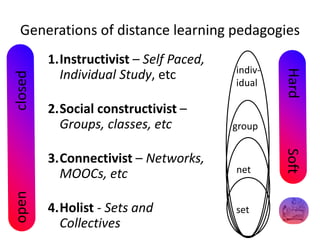
Generations of distance learning pedagogies
1.Instructivist – Self Paced,
Individual Study, etc
2.Social constructivist –
Groups, classes, etc
3.Connectivist – Networks,
MOOCs, etc
4.Holist - Sets and
Collectives
closedopen
net
group
set
indiv-
idual
HardSoft
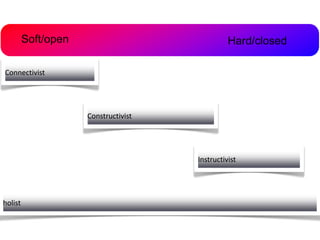
Instructivist
Constructivist
Connectivist
holist
Soft/open Hard/closed
47
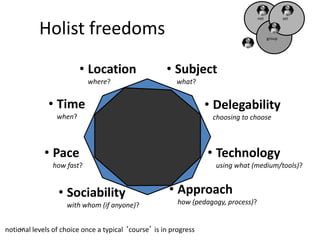
Holist freedoms
• Location
where?
• Subject
what?
• Time
when?
• Approach
how (pedagogy, process)?
• Pace
how fast?
• Sociability
with whom (if anyone)?
• Technology
using what (medium/tools)?
• Delegability
choosing to choose
net
group
set
notional levels of choice once a typical ‘course’ is in progress
48
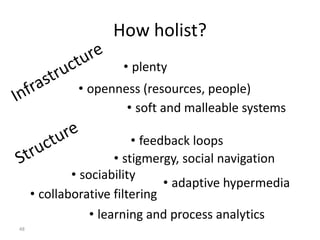
How holist?
• plenty
• stigmergy, social navigation
• collaborative filtering
• adaptive hypermedia
• learning and process analytics
• feedback loops
• sociability
• soft and malleable systems
• openness (resources, people)
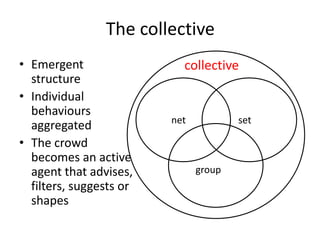
The collective
• Emergent
structure
• Individual
behaviours
aggregated
• The crowd
becomes an active
agent that advises,
filters, suggests or
shapes
setnet
group
collective
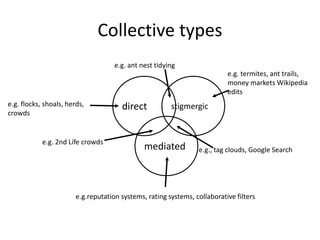
direct
Collective types
stigmergic
mediated
e.g. flocks, shoals, herds,
crowds
e.g. termites, ant trails,
money markets Wikipedia
edits
e.g.reputation systems, rating systems, collaborative filters
e.g., tag clouds, Google Search
e.g. 2nd Life crowds
e.g. ant nest tidying
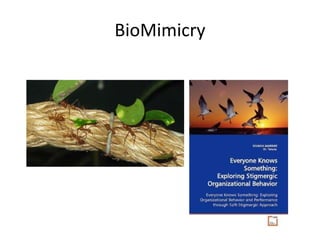
BioMimicry
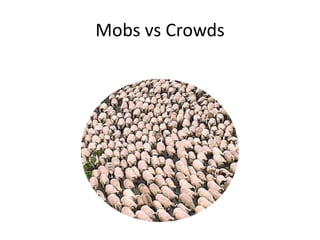
Mobs vs Crowds
Mismatched social forms
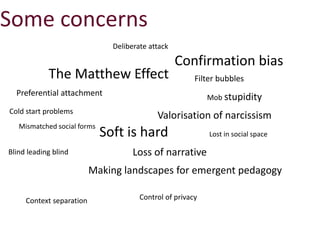
The Matthew Effect
Preferential attachment
Soft is hard Lost in social space
Deliberate attack
Valorisation of narcissism
Filter bubbles
Confirmation bias
Context separation
Loss of narrative
Control of privacy
Blind leading blind
Making landscapes for emergent pedagogy
Some concerns
Cold start problems
Mob stupidity
Exploiting the Behaviours of Others
• From an administrative perspective - Analytics
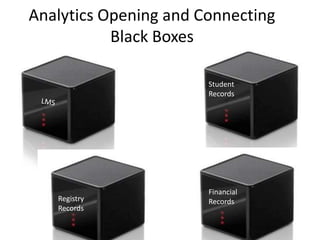
Analytics Opening and Connecting
Black Boxes
Student
Records
Registry
Records
Financial
Records
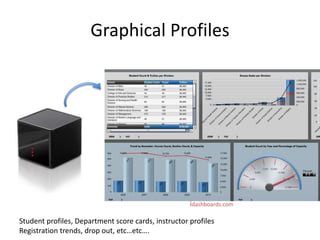
Graphical Profiles
Student profiles, Department score cards, instructor profiles
Registration trends, drop out, etc…etc….
idashboards.com
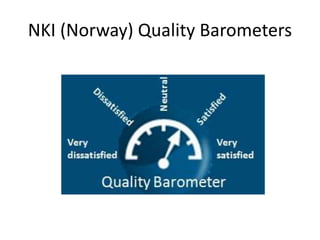
NKI (Norway) Quality Barometers
From a Learner Perspective
• Learner recommendation systems
APPLICATION OF RECOMMENDER SYSTEMS ON
E-LEARNING ENVIRONMENTS
A. Sekhavatian1, M. Mahdavi2
Learning Network Services for Professional
Development
By Rob Koper
Jon Insert some of your slides
From Lak11 and recent thinking on
Sets
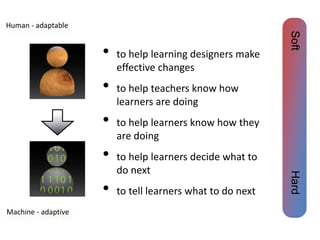
• to help learning designers make
effective changes
• to help teachers know how
learners are doing
• to help learners know how they
are doing
• to help learners decide what to
do next
• to tell learners what to do next
Human - adaptable
Machine - adaptive
SoftHard
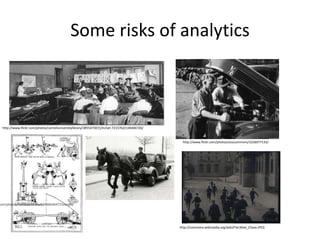
Some risks of analytics
http://commons.wikimedia.org/wiki/File:Mob_Chase.JPEG
http://www.flickr.com/photos/osucommons/3226077133/
http://www.flickr.com/photos/cornelluniversitylibrary/3855473015/in/set-72157622140446726/
com/photos/nationaalarchief/2948560477/sizes/o/
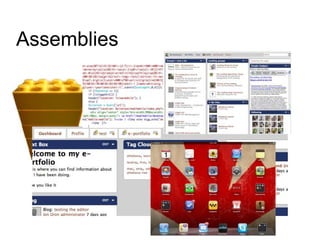
Assemblies
24
A soft space
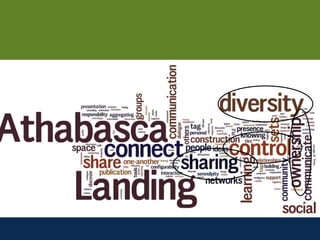
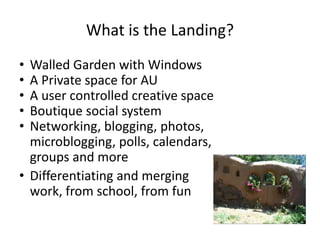
What is the Landing?
• Walled Garden with Windows
• A Private space for AU
• A user controlled creative space
• Boutique social system
• Networking, blogging, photos,
microblogging, polls, calendars,
groups and more
• Differentiating and merging
work, from school, from fun
67
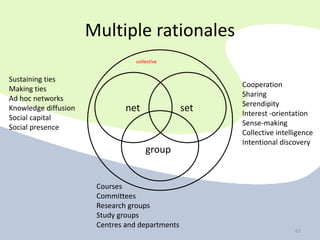
Multiple rationales
67
setnet
group
collective
Courses
Committees
Research groups
Study groups
Centres and departments
Sustaining ties
Making ties
Ad hoc networks
Knowledge diffusion
Social capital
Social presence
Cooperation
Sharing
Serendipity
Interest -orientation
Sense-making
Collective intelligence
Intentional discovery
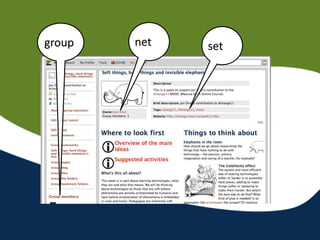
Where to look first
setnetgroup
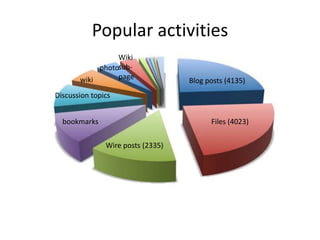
Popular activities
Blog posts (4135)
Files (4023)
Wire posts (2335)
bookmarks
Discussion topics
wiki
photo
Wiki
sub-
page
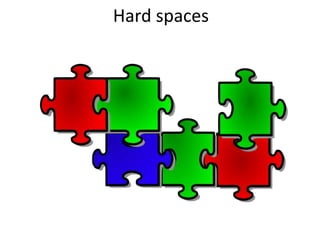
Hard spaces
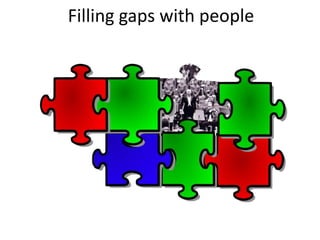
Filling gaps with people
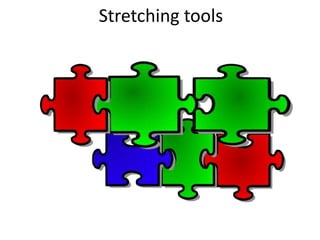
Stretching tools
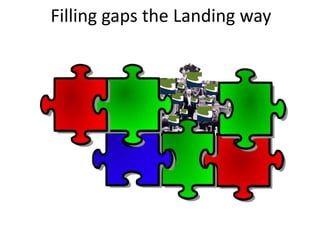
Filling gaps the Landing way
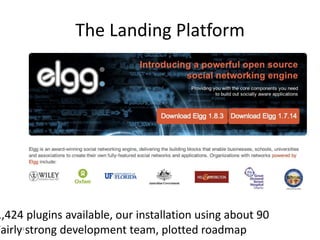
The Landing Platform
74
1,424 plugins available, our installation using about 90
Fairly strong development team, plotted roadmap
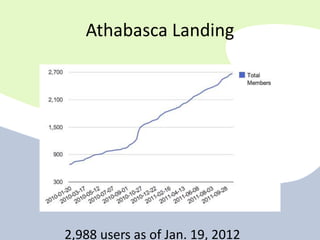
Athabasca Landing
2,988 users as of Jan. 19, 2012
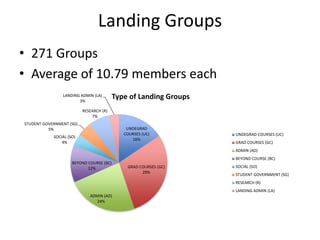
Landing Groups
• 271 Groups
• Average of 10.79 members each
UNDEGRAD
COURSES (UC)
16%
GRAD COURSES (GC)
29%
ADMIN (AD)
24%
BEYOND COURSE (BC)
12%
SOCIAL (SO)
4%
STUDENT GOVERNMENT (SG)
5%
RESEARCH (R)
7%
LANDING ADMIN (LA)
3%
Type of Landing Groups
UNDEGRAD COURSES (UC)
GRAD COURSES (GC)
ADMIN (AD)
BEYOND COURSE (BC)
SOCIAL (SO)
STUDENT GOVERNMENT (SG)
RESEARCH (R)
LANDING ADMIN (LA)
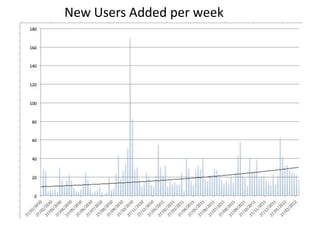
New Users Added per week
Weekly Blog Posts
Files
80
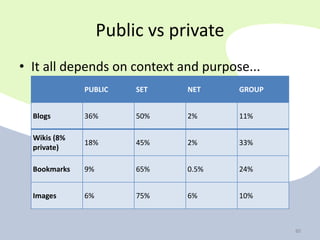
Public vs private
• It all depends on context and purpose...
80
PUBLIC SET NET GROUP
Blogs 36% 50% 2% 11%
Wikis (8%
private)
18% 45% 2% 33%
Bookmarks 9% 65% 0.5% 24%
Images 6% 75% 6% 10%
81
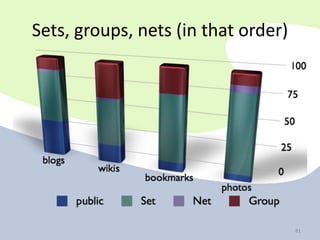
Sets, groups, nets (in that order)
81
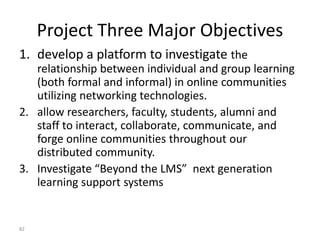
Project Three Major Objectives
1. develop a platform to investigate the
relationship between individual and group learning
(both formal and informal) in online communities
utilizing networking technologies.
2. allow researchers, faculty, students, alumni and
staff to interact, collaborate, communicate, and
forge online communities throughout our
distributed community.
3. Investigate “Beyond the LMS” next generation
learning support systems
82
Teachingcrowds.ca
• https://landing.athabascau.ca
• terrya@athabascau.ca
• jond@athabascau.ca

2015-04-22 research seminar

  • 1.
    It's hardly easyto be softly hard: freedom and control in learning spaces Terry Anderson Jon Dron University of Tallinn April 2015
  • 2.
    Athabasca University, Alberta, Canada *Athabasca University 34,000 students, 700 courses 100% distance education Graduate and Undergraduate programs Master & Doctorate Distance Education Only USA Regionally Accredited University in Canada *Athabasca University
  • 3.
    Agenda • Reviewing Generationsof Education and Pedagogy • aligning them with Groups, Sets and Nets • Case study Using Athabasca’s Landing Elgg installation setnet group collectives Individual
  • 4.
    Proposition #1 The NextGeneration Learning Evolves From and With Past Generations
  • 5.
    Proposition #2 • DifferentStructures/Pedagogies/Technologies, with different affordances and degrees of hardness effect our use.
  • 6.
    Learning as Dance (Anderson,2008) • Technology sets the beat and the timing. • Pedagogy defines the moves.
  • 7.
    Technologies • The orchestrationof phenomena to some use (Arthur, 2009) • Assemblies of hard and soft components • Pedagogies are among the soft components of all learning technologies
  • 8.
  • 9.
    1. Behavioural/Cognitive Pedagogies •“tell ‘em what you’re gonna tell ‘em, • tell ‘em • then tell ‘em what you told ‘em” Direct Instruction
  • 10.
    Gagne’s Events ofInstruction (1965) 1. Gain learners' attention 2. Inform learner of objectives 3. Stimulate recall of previous information 4. Present stimulus material 5. Provide learner guidance 6. Elicit performance 7. Provide Feedback 8. Assess performance 9. Enhance transfer opportunities Basis of Instructional Systems Design (ISD)
  • 11.
    Enhanced by the“cognitive revolution” • Chunking • Cognitive Load • Working Memory • Multiple Representations • Split-attention effect • Variability Effect • Multi-media effect – (Sorden, 2005) “learning as acquiring and using conceptual and cognitive structures” Greeno, Collins and Resnick, 1996
  • 12.
    Behaviourist/Cognitive – Knowledge Asa Thing: • Logically coherent, existing independent of perspective • Largely context free • Capable of being transmitted • Assumes closed systems with discoverable relationships between inputs and outputs • Readily defined through learning objectives
  • 13.
    Technologies of Istgeneration • CAI, text books, One way Lectures, Video and audio broadcast
  • 14.
    Social Focus ofIst generation Individual Learner
  • 15.
    15 Instructivist freedoms • Location where? •Subject what? • Time when? • Approach how (pedagogy, process)? • Pace how fast? • Sociability with whom (if anyone)? • Technology using what (medium/tools)? • Delegability choosing to choose setnet group notional levels of choice once a typical course is in progress
  • 16.
  • 17.
    Future of Istgeneration • OERU • Limitless, very low cost content • Challenges of accreditation • The (forever?) just around the corner, ‘learner adaptation’ technologies
  • 18.
    Content: A bargain evenat 80% off?? Most of us like Free! Interactive MIT courses MITX Announced
  • 19.
    Shameless Plug and Giveaways! Issuesin Distance Education Series http://aupress.ca
  • 20.
    2nd Generation DE SocialConstructivist Pedagogy
  • 21.
    Constructivist Learning is: •“Learning is located in contexts and relationships rather than merely in the minds of individuals” Greenhow, Robelia & Hughes (2009), Kathy Sierra http://www.speedofcreativity.org/ “learning is a continual conversation with the external world and its artefacts, with oneself and with other learners and teachers” (Sharples, Taylor & Vavoula, 2007)
  • 22.
    Knowledge as aCollaborative Process
  • 23.
    Group as theSocial Unit of Social Constructivist Pedagogy http://www.flickr.com/photos/library_of_congress/2163782226/sizes/o/in/photostream/
  • 24.
    Why Groups? • “Studentswho learn in small groups generally demonstrate greater academic achievement, express more favorable attitudes toward learning, and persist … • small-group learning may have particularly large effects on the academic achievement of members of underrepresented groups and the learning-related attitudes of women…” • Springer; Stanne, & Donovan, (1999) P.42
  • 25.
    Problems with Groups •Restrictions in time, space, pace, & relationship - NOT OPEN • Overly confined by leader expectation and institutional & curriculum control • Usually Isolated from the authentic world of practice • “low tolerance of internal difference, sexist and ethicized regulation, high demand for obedience to its norms and exclusionary practices.”Cousin & Deepwell 2005 • “Pathological politeness” and fear of debate • Group think (Baron, 2005) • Poor preparation for Lifelong Learning beyond the course • EXPENSIVE $
  • 26.
    26 Group model • Membershipand exclusion, closed • Hierarchies of control • Focus on collaboration and shared purpose • teachers: guides group
  • 27.
    27 Social constructivist freedoms •Location where? • Subject what? • Time when? • Approach how (pedagogy, process)? • Pace how fast? • Sociability with whom (if anyone)? • Technology using what (medium/tools)? • Delegability choosing to choose setnet group notional levels of choice once a typical course is in progress
  • 28.
    • Trust bothopens and constrains • Typically a structured process • But… • Opportunities for negotiation of control • Shifting boundaries • Diversity valorized • Big issue: getting it just right for everyone
  • 29.
    3rd Generation Connectivist Pedagogy •Learning is building capacity - networks of information, contacts and resources that can be applied to real problems.
  • 30.
    Connectivist Knowledge is AProcess • Emergent • Distributed and diverse • Chaotic • Fragmented • Non sequential • Contextualized
  • 31.
    What is ConnectedKnowledge? • Knowledge is defined by its creation through activities – Accessing information – Evaluating, filtering – Conveying ideas – Reformatting, mashing – Analyzing, – Collaborating (Barth 2004)
  • 32.
    Networks add diversityto learning “People who live in the intersection of social worlds are at higher risk of having good ideas” Burt, 2005, p. 90
  • 33.
    Networks Celebrate andStimulate Cognitive Diversity Cognitive Diversity Arises when from: • different types of information and knowledge perspectives • different ways of viewing the world or a specific problem interpretations • different ways of categorizing a problem or partitioning perspectives • heuristics yielding different ways of generating solutions to problems • predictive models - different ways of inferring causes and effects (Fisher, L. (2009)
  • 34.
    • “A socialnetwork is crucially different from a social circle, since the function of a social circle is to curb our appetites and of a network to extend them. “ Adem Gopnik, 2011 • Read more http://www.newyorker.com/arts/critics/atlarge/2011/02/14/110214crat_atlarge_g opnik#ixzz1NHjpnxne
  • 35.
    35 The net model •bottom-up, open • inclusive • focus on individual and connections • teachers: role models and co-travellers net
  • 36.
    36 Connectivist freedoms • Location where? •Subject what? • Time when? • Approach how (pedagogy, process)? • Pace how fast? • Sociability with whom (if anyone)? • Technology using what (medium/tools)? • Delegability choosing to choose setnet group notional levels of choice once a typical ‘course’ is in progress
  • 37.
    • Limitless assembly •Limitless choice • Limitless dialogue • But too soft?
  • 38.
    But do learningnetworks really work?? • Network ghost towns • Build it and they may come, but not likely • When is the last time you checked into a Ning account?
  • 39.
    Fear of openspaces • “The property of knowledge as as a body of vetted works comes directly from the properties of paper …. There is little to none of the permanence, stability and community fealty that a body of knowledge requires and implies. The Internet is what you get when everyone is a curator and everything is linked” – David Weinberger P. 45
  • 41.
    choice != control it’snot just about networks
  • 42.
    42 Set model • cooperation,anonymity • focus on filtering and selection • tags and categorisation • teachers: analyzers, curators and publishers • Analytics • Collectives set
  • 43.
    setnet group Collaboration Structure Roles Membership Intention and purpose Hierarchies Theclassical ‘class’ model Sustaining ties Making ties Ad hoc networks Knowledge diffusion Social capital Social presence Emergence Shifting Contextual Cooperation Sharing Serendipity Interest -orientation Sense-making Collective intelligence Intentional discovery classes, tutorial groups, learning management systems, etc MOOCs, blogs, LinkedIn, social networks, etc Social interest sites, Wikipedia, Google Search, Twitter, Pinterest, etc
  • 44.
    4th generation oflearning pedagogy • reducing choices to only those choices that we want or need to make
  • 45.
    Generations of distancelearning pedagogies 1.Instructivist – Self Paced, Individual Study, etc 2.Social constructivist – Groups, classes, etc 3.Connectivist – Networks, MOOCs, etc 4.Holist - Sets and Collectives closedopen net group set indiv- idual HardSoft
  • 46.
  • 47.
    47 Holist freedoms • Location where? •Subject what? • Time when? • Approach how (pedagogy, process)? • Pace how fast? • Sociability with whom (if anyone)? • Technology using what (medium/tools)? • Delegability choosing to choose net group set notional levels of choice once a typical ‘course’ is in progress
  • 48.
    48 How holist? • plenty •stigmergy, social navigation • collaborative filtering • adaptive hypermedia • learning and process analytics • feedback loops • sociability • soft and malleable systems • openness (resources, people)
  • 49.
    The collective • Emergent structure •Individual behaviours aggregated • The crowd becomes an active agent that advises, filters, suggests or shapes setnet group collective
  • 50.
    direct Collective types stigmergic mediated e.g. flocks,shoals, herds, crowds e.g. termites, ant trails, money markets Wikipedia edits e.g.reputation systems, rating systems, collaborative filters e.g., tag clouds, Google Search e.g. 2nd Life crowds e.g. ant nest tidying
  • 51.
  • 52.
  • 53.
    Mismatched social forms TheMatthew Effect Preferential attachment Soft is hard Lost in social space Deliberate attack Valorisation of narcissism Filter bubbles Confirmation bias Context separation Loss of narrative Control of privacy Blind leading blind Making landscapes for emergent pedagogy Some concerns Cold start problems Mob stupidity
  • 54.
    Exploiting the Behavioursof Others • From an administrative perspective - Analytics
  • 55.
    Analytics Opening andConnecting Black Boxes Student Records Registry Records Financial Records
  • 56.
    Graphical Profiles Student profiles,Department score cards, instructor profiles Registration trends, drop out, etc…etc…. idashboards.com
  • 57.
  • 58.
    From a LearnerPerspective • Learner recommendation systems APPLICATION OF RECOMMENDER SYSTEMS ON E-LEARNING ENVIRONMENTS A. Sekhavatian1, M. Mahdavi2 Learning Network Services for Professional Development By Rob Koper
  • 59.
    Jon Insert someof your slides From Lak11 and recent thinking on Sets
  • 60.
    • to helplearning designers make effective changes • to help teachers know how learners are doing • to help learners know how they are doing • to help learners decide what to do next • to tell learners what to do next Human - adaptable Machine - adaptive SoftHard
  • 61.
    Some risks ofanalytics http://commons.wikimedia.org/wiki/File:Mob_Chase.JPEG http://www.flickr.com/photos/osucommons/3226077133/ http://www.flickr.com/photos/cornelluniversitylibrary/3855473015/in/set-72157622140446726/ com/photos/nationaalarchief/2948560477/sizes/o/
  • 62.
  • 64.
  • 65.
    What is theLanding? • Walled Garden with Windows • A Private space for AU • A user controlled creative space • Boutique social system • Networking, blogging, photos, microblogging, polls, calendars, groups and more • Differentiating and merging work, from school, from fun
  • 66.
    67 Multiple rationales 67 setnet group collective Courses Committees Research groups Studygroups Centres and departments Sustaining ties Making ties Ad hoc networks Knowledge diffusion Social capital Social presence Cooperation Sharing Serendipity Interest -orientation Sense-making Collective intelligence Intentional discovery
  • 67.
    Where to lookfirst setnetgroup
  • 68.
    Popular activities Blog posts(4135) Files (4023) Wire posts (2335) bookmarks Discussion topics wiki photo Wiki sub- page
  • 69.
  • 70.
  • 71.
  • 72.
    Filling gaps theLanding way
  • 73.
    The Landing Platform 74 1,424plugins available, our installation using about 90 Fairly strong development team, plotted roadmap
  • 74.
    Athabasca Landing 2,988 usersas of Jan. 19, 2012
  • 75.
    Landing Groups • 271Groups • Average of 10.79 members each UNDEGRAD COURSES (UC) 16% GRAD COURSES (GC) 29% ADMIN (AD) 24% BEYOND COURSE (BC) 12% SOCIAL (SO) 4% STUDENT GOVERNMENT (SG) 5% RESEARCH (R) 7% LANDING ADMIN (LA) 3% Type of Landing Groups UNDEGRAD COURSES (UC) GRAD COURSES (GC) ADMIN (AD) BEYOND COURSE (BC) SOCIAL (SO) STUDENT GOVERNMENT (SG) RESEARCH (R) LANDING ADMIN (LA)
  • 76.
  • 77.
  • 78.
  • 79.
    80 Public vs private •It all depends on context and purpose... 80 PUBLIC SET NET GROUP Blogs 36% 50% 2% 11% Wikis (8% private) 18% 45% 2% 33% Bookmarks 9% 65% 0.5% 24% Images 6% 75% 6% 10%
  • 80.
    81 Sets, groups, nets(in that order) 81
  • 81.
    Project Three MajorObjectives 1. develop a platform to investigate the relationship between individual and group learning (both formal and informal) in online communities utilizing networking technologies. 2. allow researchers, faculty, students, alumni and staff to interact, collaborate, communicate, and forge online communities throughout our distributed community. 3. Investigate “Beyond the LMS” next generation learning support systems 82
  • 82.
  • 83.