Sociomedia:  The Transformative Power of Technology Richard Smyth, Ph.D. Library Media Specialist Cathedral High School
Sociomedia vs. Hypermedia The neologism  sociomedia  suggests  “ that computer media exist for ‘social’  purposes.” --Edward Barrett. “Sociomedia:  An Introduction.”
Two Components of Sociomedia Engagement --> “interaction with people” Construction --> “students create a  product from their collaboration” --Edward Barrett. “Sociomedia:  An Introduction.”
Example #1 of Sociomedia Biology (Jamie Hutchinson) Issue:  Global Warming/ The Kyoto Accord Partnered with an English class in Germany (1998) Used email to co-write persuasive letter Sent to respective government representatives Won state award for environmental education
Example #2 of Sociomedia English (Christol Murch) Issue:  Rights of the Child/Universal Human Rights Classes argued for which right should be most important in 21st century and why Created video of play or plea to present during a videoconference with a class in the Netherlands
Example #3 of Sociomedia College English (Richard Smyth) class created a text-based virtual reality (a.k.a. M.O.O.) for local 5 th  grade class created allegorical educational environ-ment modeled on  The Phantom Tollbooth
Example #4 of Sociomedia High School History (Logan Reichert) Class will create WebQuest on Revolutionary War for Boston History class Target audience is Cathedral Grammar School (across the street) Intend to have real class of students experience the webquest
Common Denominators Students collaborate with other students within class and/or outside of class (engagement) Students create a product for a real-world audience to experience  (construction) Students learning how to be active citizens Students dealing with real-world issues (global warming, human rights)
Web 2.0 as Sociomedia New avenues for publication invite “engagement” and “construction” YouTube, Podcasts, Blogs, Wikis Ease of use invites publication Rheingold:  “Participatory Media”
Participatory Media Students are comfortable with these new media: iPods social software (myspace, facebook)  blogs, vlogs and wikis social bookmarking (http://del.icio.us)
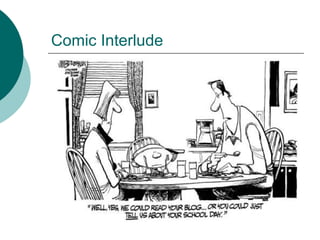
Comic Interlude
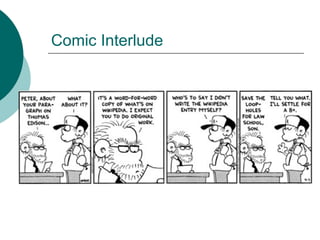
Comic Interlude
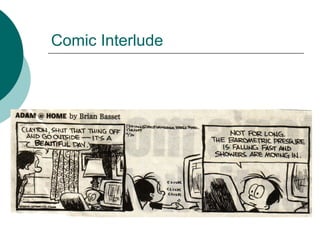
Comic Interlude
Students as “Digital Natives” “ Our students have changed radically. Today’s students are no longer the people our educational system was designed to teach .”  --Mark Prensky.  Digital Natives,  Digital Immigrants.
“Digital Natives” (cont.) “ It is now clear that as a result of this ubiquitous environment and the sheer volume of their interaction with it, today’s students  think and process information fundamentally differently  from their predecessors. These differences go far further and deeper than most educators suspect or realize.” --Mark Prensky.  Digital Natives,  Digital Immigrants.
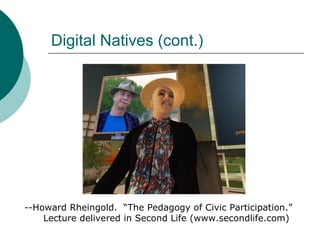
Digital Natives (cont.) --Howard Rheingold.  “The Pedagogy of Civic Participation.” Lecture delivered in Second Life (www.secondlife.com)
Rheingold quote “ Constructivist theories of education that exhort teachers to guide active learning, to hands-on experimentation, are not new ideas.  And neither is the notion that digital media can be used to help encourage this kind of learning.  What  is  new is a population of  digital natives  who have learned how to learn new kinds of software before they started high school, who carry mobile phones, media players, game devices, and laptop computers and know how to use them, and for whom the internet is not a transformative, new technology but a feature of their lives that has always been there like running water and electricity.  This population is both self-guided and in need of guidance.  Although a willingness to learn new media by point & click exploration might come naturally to today’s student cohort, there’s nothing innate about knowing how to apply their skills to the processes of democracy.”
Brain-Based Education “ Some have surmised that teenagers use different parts of their brain and think in different ways than adults when at the computer. We now know that it goes even further—their brains are almost certainly  physiologically different . But these differences, most observers agree, are less a matter of kind than a difference of degree. For example as a result of repeated experiences, particular brain areas are larger and more highly developed, and others are less so.”  --Mark Prensky.  Do They Really  Think  Differently?
New Literacies Need to expand the definition of literacy Electronic environments place additional demands on and require different abilities of users “ Literacy. . . .may be thought of as a moving target” (Leu 11)
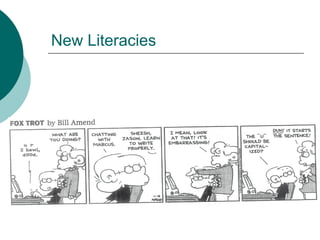
New Literacies
New Literacies Critical Literacy Media Literacy Participatory Media Literacy  “ Electracy” (read my entry at http://en.wikipedia.org)
Critical Literacy The need to evaluate websites Develop skills for determining bias and authority Similar to “Information Literacy”
Media Literacy critical literacy focused on new media (video, images) how to “read” images (commercials, advertisements) how to “write” with images (videography, comics with Comic Life – at www.plasq.com)
Participatory Media Literacy blogs, social software (myspace, facebook), wikis “ . . . shifts the focus of literacy training from individual expression onto community involvement. . . The new literacies are almost all social skills which have to do with collaboration and networking” (Rheingold, quoting Jenkins et al.)
Electracy a neologism describing the skills necessary to exploit the full communicative potential of new media Electracy is to digital media what literacy is to print media draws attention to need for entirely new term that avoids etymological connection to literacy
What does all this mean to us? Teaching to the (Digital Native) Student Recognizing and responding to radical changes in Information & Communications Technologies Using New Media for Construction, Engagement and Civic Participation
Rheingold on Civic Education “…I think we have an opportunity today to make use of the natural enthusiasm of today’s young digital natives for cultural production as well as consumption, to help them learn to use the new production and distribution tools now available to them as a way to develop a public voice about issues they care about…”
Rheingold (cont.) “Learning to use participatory media to learn and speak and organize about issues might well be the most important citizenship skill that digital natives need to learn if they are going to maintain or revive democratic governance.”
Changing Role for Teachers Students know more about new literacies than most adults Teacher can orchestrate learning opportunities between/among students who know new literacies “ In a student-centered, social learning environment, this knowledge can be exchanged, ironically, in a classroom where the teacher may not know either of these skills as well as the students”  (Leu 21).
Changing Role for Teachers “ Schools should require teachers to do action research so that they constantly  feel  what it is like to learn , to be reminded that real learning is always frightening, frustrating, and able to cause self-doubt, regardless of age or talent.  If the job and schedule make us think of ourselves as only teachers instead of also as  model learners , we miss vital opportunities to make education more honest, invigorating, and self-correcting for everyone, adult and child” (320). --Wiggins & McTigue.  Understanding by  Design.
Changing Role for Teachers “ Effective use of games and other new technologies is likely to be limited unless educational institutions are willing to consider significant changes in pedagogy and content, and rethink the role of teachers and other educational professionals” (6). --Federation of American Scientists.  Harnessing the Power of Video Games  for Learning.
Second Life as Educational Space Second Life is an online virtual world, a “participatory social network” Like a 3-D video-game interface for chatting and collaborative world-building “ With [its] popularity…it was only natural that educators would take notice of the phenomenon and begin exploring the possibilities of turning it into an educational tool” (Appel)
Second Life in the News Wired Magazine (October 2006) http://www.wired.com/wired/archive/14.10/sloverview.html USA Today (10/5/2006) “ At colleges, real learning in a virtual world” New York Times (October 19, 2006) “ A Virtual World but Real Money” New York Times (November 3, 2006) “ It’s My (Virtual) World” eSchool News (November 10, 2006) “ Second Life develops education following”
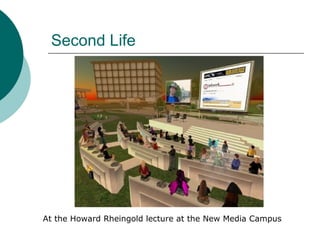
Second Life At the Howard Rheingold lecture at the New Media Campus
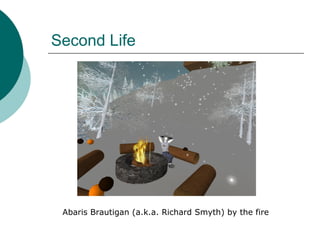
Second Life Abaris Brautigan (a.k.a. Richard Smyth) by the fire
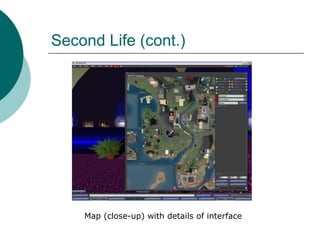
Second Life (cont.) Map (close-up) with details of interface
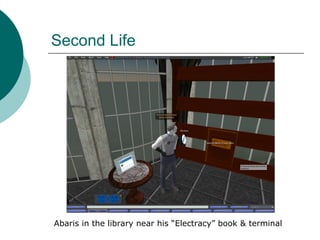
Second Life Abaris in the library near his “Electracy” book & terminal
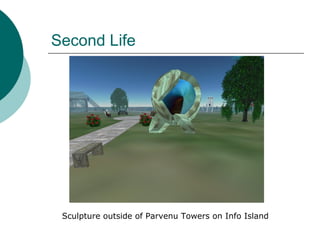
Second Life Sculpture outside of Parvenu Towers on Info Island
“Just Do It” “ So if Digital Immigrant educators  really  want to reach Digital Natives – i.e. all their students – they will have to change. It’s high time for them to stop their grousing, and as the Nike motto of the Digital Native generation says, ‘Just do it!’” --Mark Prensky.  Digital Natives,  Digital Immigrants.
References Appel, Justin.  “Second Life develops education following.” eSchool News online.  Available at http://www.eschoolnews.com/news/Pfshowstory.cfm?ArticleID=6713. Barrett, Edward. “Sociomedia:  An Introduction.” In  Sociomedia:  Multimedia, Hypermedia, and the Social Construction of Knowledge."  Ed. Edward Barrett.  Cambridge, MA:  MIT Press, 1992.  1-10.  Federation of American Scientists.  Harnessing the Power of Video Games for Learning.  Available at  http://fas.org/gamesummit/Resources/Summit%20on%20Educational%20Games.pdf . Leu, Donald J. et al.  “Toward a Theory of New Literacies Emerging from  the Internet and Other Information and Communication Technologies.”  Available at  www. readingonline .org/ newliteracies / leu / .
References Prensky, Marc.  “ Digital Natives, Digital Immigrants.”  On the Horizon  9.5 (October 2001):  1-8.  Available at  www. marcprensky .com/writing/ . Prensky, Marc.  “Do They Really  Think  That Way?”  On the Horizon  9.6 (December 2001):  1-9.  Available at  www. marcprensky .com/writing/ . Rheingold, Howard.  “The Pedagogy of Civic Participation.”  Lecture 21 October 2006.  Second Life New Media Campus 5.  Available  http://media. nmc .org/ sl /audio/ rheingold - oct -21-2006.mp3 . Wiggins, Grant and Jay Mctighe.  Understanding by Design.  2 nd  Edition.  Alexandria, VA:  ASCD, 2005.
Contact Info Richard Smyth, Ph.D. [email_address] edu www.anabiosispress.org/rsmyth [email_address] 617-542-2325 X407

Sociomedia: The Transformative Power of Technology

  • 1.
    Sociomedia: TheTransformative Power of Technology Richard Smyth, Ph.D. Library Media Specialist Cathedral High School
  • 2.
    Sociomedia vs. HypermediaThe neologism sociomedia suggests “ that computer media exist for ‘social’ purposes.” --Edward Barrett. “Sociomedia: An Introduction.”
  • 3.
    Two Components ofSociomedia Engagement --> “interaction with people” Construction --> “students create a product from their collaboration” --Edward Barrett. “Sociomedia: An Introduction.”
  • 4.
    Example #1 ofSociomedia Biology (Jamie Hutchinson) Issue: Global Warming/ The Kyoto Accord Partnered with an English class in Germany (1998) Used email to co-write persuasive letter Sent to respective government representatives Won state award for environmental education
  • 5.
    Example #2 ofSociomedia English (Christol Murch) Issue: Rights of the Child/Universal Human Rights Classes argued for which right should be most important in 21st century and why Created video of play or plea to present during a videoconference with a class in the Netherlands
  • 6.
    Example #3 ofSociomedia College English (Richard Smyth) class created a text-based virtual reality (a.k.a. M.O.O.) for local 5 th grade class created allegorical educational environ-ment modeled on The Phantom Tollbooth
  • 7.
    Example #4 ofSociomedia High School History (Logan Reichert) Class will create WebQuest on Revolutionary War for Boston History class Target audience is Cathedral Grammar School (across the street) Intend to have real class of students experience the webquest
  • 8.
    Common Denominators Studentscollaborate with other students within class and/or outside of class (engagement) Students create a product for a real-world audience to experience (construction) Students learning how to be active citizens Students dealing with real-world issues (global warming, human rights)
  • 9.
    Web 2.0 asSociomedia New avenues for publication invite “engagement” and “construction” YouTube, Podcasts, Blogs, Wikis Ease of use invites publication Rheingold: “Participatory Media”
  • 10.
    Participatory Media Studentsare comfortable with these new media: iPods social software (myspace, facebook) blogs, vlogs and wikis social bookmarking (http://del.icio.us)
  • 11.
  • 12.
  • 13.
  • 14.
    Students as “DigitalNatives” “ Our students have changed radically. Today’s students are no longer the people our educational system was designed to teach .” --Mark Prensky. Digital Natives, Digital Immigrants.
  • 15.
    “Digital Natives” (cont.)“ It is now clear that as a result of this ubiquitous environment and the sheer volume of their interaction with it, today’s students think and process information fundamentally differently from their predecessors. These differences go far further and deeper than most educators suspect or realize.” --Mark Prensky. Digital Natives, Digital Immigrants.
  • 16.
    Digital Natives (cont.)--Howard Rheingold. “The Pedagogy of Civic Participation.” Lecture delivered in Second Life (www.secondlife.com)
  • 17.
    Rheingold quote “Constructivist theories of education that exhort teachers to guide active learning, to hands-on experimentation, are not new ideas. And neither is the notion that digital media can be used to help encourage this kind of learning. What is new is a population of digital natives who have learned how to learn new kinds of software before they started high school, who carry mobile phones, media players, game devices, and laptop computers and know how to use them, and for whom the internet is not a transformative, new technology but a feature of their lives that has always been there like running water and electricity. This population is both self-guided and in need of guidance. Although a willingness to learn new media by point & click exploration might come naturally to today’s student cohort, there’s nothing innate about knowing how to apply their skills to the processes of democracy.”
  • 18.
    Brain-Based Education “Some have surmised that teenagers use different parts of their brain and think in different ways than adults when at the computer. We now know that it goes even further—their brains are almost certainly physiologically different . But these differences, most observers agree, are less a matter of kind than a difference of degree. For example as a result of repeated experiences, particular brain areas are larger and more highly developed, and others are less so.” --Mark Prensky. Do They Really Think Differently?
  • 19.
    New Literacies Needto expand the definition of literacy Electronic environments place additional demands on and require different abilities of users “ Literacy. . . .may be thought of as a moving target” (Leu 11)
  • 20.
  • 21.
    New Literacies CriticalLiteracy Media Literacy Participatory Media Literacy “ Electracy” (read my entry at http://en.wikipedia.org)
  • 22.
    Critical Literacy Theneed to evaluate websites Develop skills for determining bias and authority Similar to “Information Literacy”
  • 23.
    Media Literacy criticalliteracy focused on new media (video, images) how to “read” images (commercials, advertisements) how to “write” with images (videography, comics with Comic Life – at www.plasq.com)
  • 24.
    Participatory Media Literacyblogs, social software (myspace, facebook), wikis “ . . . shifts the focus of literacy training from individual expression onto community involvement. . . The new literacies are almost all social skills which have to do with collaboration and networking” (Rheingold, quoting Jenkins et al.)
  • 25.
    Electracy a neologismdescribing the skills necessary to exploit the full communicative potential of new media Electracy is to digital media what literacy is to print media draws attention to need for entirely new term that avoids etymological connection to literacy
  • 26.
    What does allthis mean to us? Teaching to the (Digital Native) Student Recognizing and responding to radical changes in Information & Communications Technologies Using New Media for Construction, Engagement and Civic Participation
  • 27.
    Rheingold on CivicEducation “…I think we have an opportunity today to make use of the natural enthusiasm of today’s young digital natives for cultural production as well as consumption, to help them learn to use the new production and distribution tools now available to them as a way to develop a public voice about issues they care about…”
  • 28.
    Rheingold (cont.) “Learningto use participatory media to learn and speak and organize about issues might well be the most important citizenship skill that digital natives need to learn if they are going to maintain or revive democratic governance.”
  • 29.
    Changing Role forTeachers Students know more about new literacies than most adults Teacher can orchestrate learning opportunities between/among students who know new literacies “ In a student-centered, social learning environment, this knowledge can be exchanged, ironically, in a classroom where the teacher may not know either of these skills as well as the students” (Leu 21).
  • 30.
    Changing Role forTeachers “ Schools should require teachers to do action research so that they constantly feel what it is like to learn , to be reminded that real learning is always frightening, frustrating, and able to cause self-doubt, regardless of age or talent.  If the job and schedule make us think of ourselves as only teachers instead of also as model learners , we miss vital opportunities to make education more honest, invigorating, and self-correcting for everyone, adult and child” (320). --Wiggins & McTigue. Understanding by Design.
  • 31.
    Changing Role forTeachers “ Effective use of games and other new technologies is likely to be limited unless educational institutions are willing to consider significant changes in pedagogy and content, and rethink the role of teachers and other educational professionals” (6). --Federation of American Scientists. Harnessing the Power of Video Games for Learning.
  • 32.
    Second Life asEducational Space Second Life is an online virtual world, a “participatory social network” Like a 3-D video-game interface for chatting and collaborative world-building “ With [its] popularity…it was only natural that educators would take notice of the phenomenon and begin exploring the possibilities of turning it into an educational tool” (Appel)
  • 33.
    Second Life inthe News Wired Magazine (October 2006) http://www.wired.com/wired/archive/14.10/sloverview.html USA Today (10/5/2006) “ At colleges, real learning in a virtual world” New York Times (October 19, 2006) “ A Virtual World but Real Money” New York Times (November 3, 2006) “ It’s My (Virtual) World” eSchool News (November 10, 2006) “ Second Life develops education following”
  • 34.
    Second Life Atthe Howard Rheingold lecture at the New Media Campus
  • 35.
    Second Life AbarisBrautigan (a.k.a. Richard Smyth) by the fire
  • 36.
    Second Life (cont.)Map (close-up) with details of interface
  • 37.
    Second Life Abarisin the library near his “Electracy” book & terminal
  • 38.
    Second Life Sculptureoutside of Parvenu Towers on Info Island
  • 39.
    “Just Do It”“ So if Digital Immigrant educators really want to reach Digital Natives – i.e. all their students – they will have to change. It’s high time for them to stop their grousing, and as the Nike motto of the Digital Native generation says, ‘Just do it!’” --Mark Prensky. Digital Natives, Digital Immigrants.
  • 40.
    References Appel, Justin. “Second Life develops education following.” eSchool News online. Available at http://www.eschoolnews.com/news/Pfshowstory.cfm?ArticleID=6713. Barrett, Edward. “Sociomedia: An Introduction.” In Sociomedia: Multimedia, Hypermedia, and the Social Construction of Knowledge." Ed. Edward Barrett. Cambridge, MA: MIT Press, 1992. 1-10. Federation of American Scientists. Harnessing the Power of Video Games for Learning. Available at http://fas.org/gamesummit/Resources/Summit%20on%20Educational%20Games.pdf . Leu, Donald J. et al. “Toward a Theory of New Literacies Emerging from the Internet and Other Information and Communication Technologies.” Available at www. readingonline .org/ newliteracies / leu / .
  • 41.
    References Prensky, Marc. “ Digital Natives, Digital Immigrants.” On the Horizon 9.5 (October 2001): 1-8. Available at www. marcprensky .com/writing/ . Prensky, Marc. “Do They Really Think That Way?” On the Horizon 9.6 (December 2001): 1-9. Available at www. marcprensky .com/writing/ . Rheingold, Howard. “The Pedagogy of Civic Participation.” Lecture 21 October 2006. Second Life New Media Campus 5. Available http://media. nmc .org/ sl /audio/ rheingold - oct -21-2006.mp3 . Wiggins, Grant and Jay Mctighe. Understanding by Design. 2 nd Edition. Alexandria, VA: ASCD, 2005.
  • 42.
    Contact Info RichardSmyth, Ph.D. [email_address] edu www.anabiosispress.org/rsmyth [email_address] 617-542-2325 X407