Theory to Practice and Back in TESOL


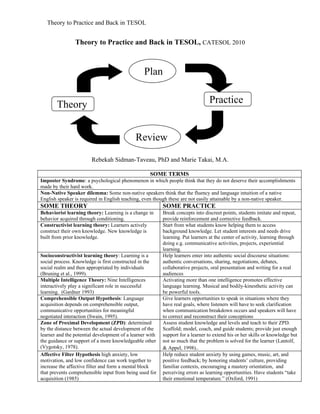
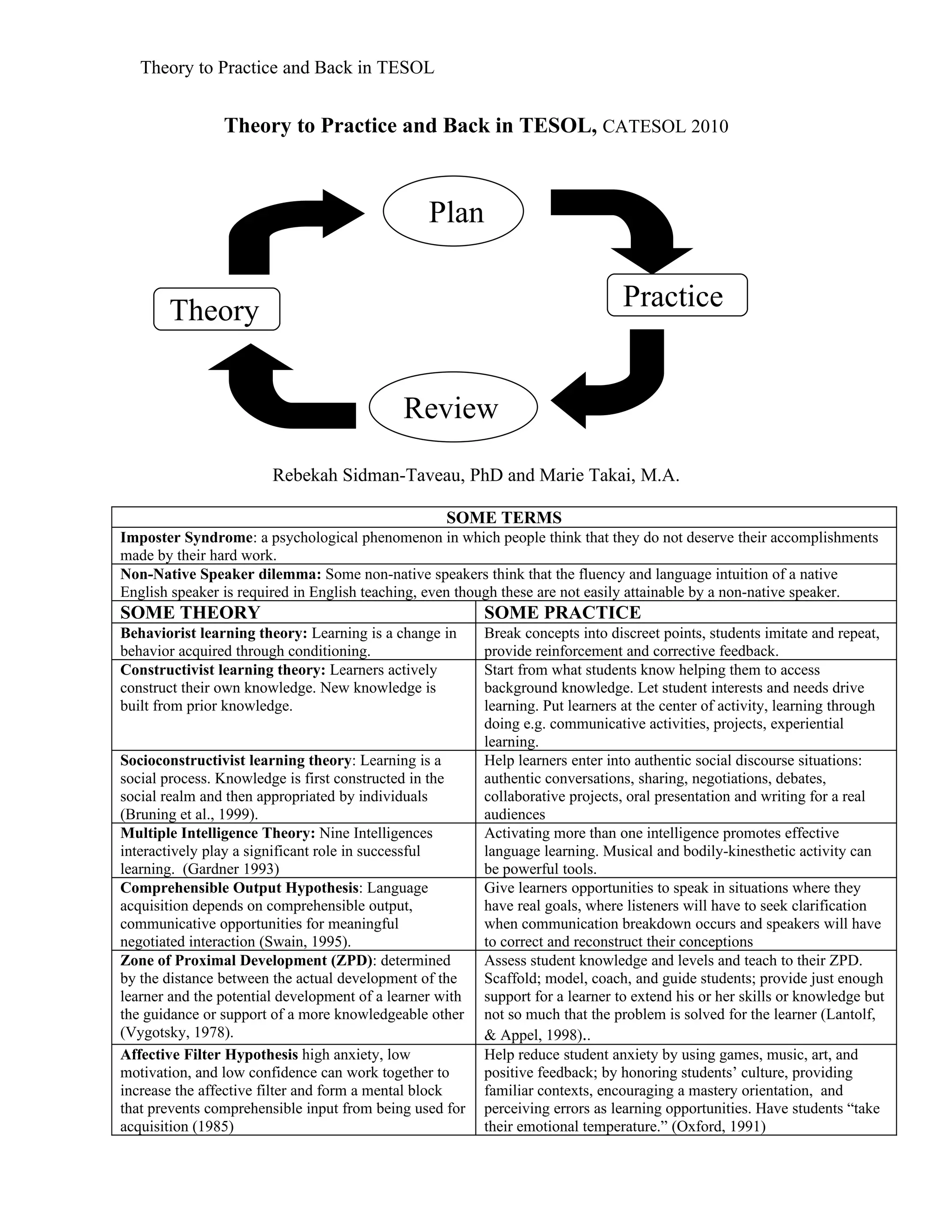
                Theory to Practice and Back in TESOL, CATESOL 2010


                                                 Plan


       Theory                                                                   Practice


                                             Review

                        Rebekah Sidman-Taveau, PhD and Marie Takai, M.A.

                                                   SOME TERMS
Imposter Syndrome: a psychological phenomenon in which people think that they do not deserve their accomplishments
made by their hard work.
Non-Native Speaker dilemma: Some non-native speakers think that the fluency and language intuition of a native
English speaker is required in English teaching, even though these are not easily attainable by a non-native speaker.
SOME THEORY                                               SOME PRACTICE
Behaviorist learning theory: Learning is a change in      Break concepts into discreet points, students imitate and repeat,
behavior acquired through conditioning.                   provide reinforcement and corrective feedback.
Constructivist learning theory: Learners actively         Start from what students know helping them to access
construct their own knowledge. New knowledge is           background knowledge. Let student interests and needs drive
built from prior knowledge.                               learning. Put learners at the center of activity, learning through
                                                          doing e.g. communicative activities, projects, experiential
                                                          learning.
Socioconstructivist learning theory: Learning is a        Help learners enter into authentic social discourse situations:
social process. Knowledge is first constructed in the     authentic conversations, sharing, negotiations, debates,
social realm and then appropriated by individuals         collaborative projects, oral presentation and writing for a real
(Bruning et al., 1999).                                   audiences
Multiple Intelligence Theory: Nine Intelligences          Activating more than one intelligence promotes effective
interactively play a significant role in successful       language learning. Musical and bodily-kinesthetic activity can
learning. (Gardner 1993)                                  be powerful tools.
Comprehensible Output Hypothesis: Language                Give learners opportunities to speak in situations where they
acquisition depends on comprehensible output,             have real goals, where listeners will have to seek clarification
communicative opportunities for meaningful                when communication breakdown occurs and speakers will have
negotiated interaction (Swain, 1995).                     to correct and reconstruct their conceptions
Zone of Proximal Development (ZPD): determined            Assess student knowledge and levels and teach to their ZPD.
by the distance between the actual development of the     Scaffold; model, coach, and guide students; provide just enough
learner and the potential development of a learner with   support for a learner to extend his or her skills or knowledge but
the guidance or support of a more knowledgeable other     not so much that the problem is solved for the learner (Lantolf,
(Vygotsky, 1978).                                         & Appel, 1998)..
Affective Filter Hypothesis high anxiety, low             Help reduce student anxiety by using games, music, art, and
motivation, and low confidence can work together to       positive feedback; by honoring students’ culture, providing
increase the affective filter and form a mental block     familiar contexts, encouraging a mastery orientation, and
that prevents comprehensible input from being used for    perceiving errors as learning opportunities. Have students “take
acquisition (1985)                                        their emotional temperature.” (Oxford, 1991)
Theory to Practice and Back in TESOL


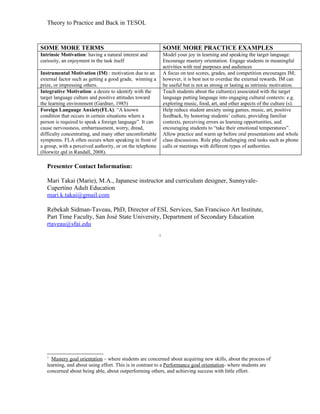
SOME MORE TERMS                                                SOME MORE PRACTICE EXAMPLES
Intrinsic Motivation: having a natural interest and            Model your joy in learning and speaking the target language.
curiosity, an enjoyment in the task itself                     Encourage mastery orientation. Engage students in meaningful
                                                               activities with real purposes and audiences
Instrumental Motivation (IM) : motivation due to an            A focus on test scores, grades, and competition encourages IM;
external factor such as getting a good grade, winning a        however, it is best not to overdue the external rewards. IM can
prize, or impressing others.                                   be useful but is not as strong or lasting as intrinsic motivation.
Integrative Motivation: a desire to identify with the          Teach students about the culture(s) associated with the target
target language culture and positive attitudes toward          language putting language into engaging cultural contexts: e.g.
the learning environment (Gardner, 1985)                       exploring music, food, art, and other aspects of the culture (s).
Foreign Language Anxiety(FLA): “A known                        Help reduce student anxiety using games, music, art, positive
condition that occurs in certain situations where a            feedback, by honoring students’ culture, providing familiar
person is required to speak a foreign language”. It can        contexts, perceiving errors as learning opportunities, and
cause nervousness, embarrassment, worry, dread,                encouraging students to “take their emotional temperatures”.
difficulty concentrating, and many other uncomfortable         Allow practice and warm up before oral presentations and whole
symptoms. FLA often occurs when speaking in front of           class discussions. Role play challenging oral tasks such as phone
a group, with a perceived authority, or on the telephone       calls or meetings with different types of authorities.
(Horwitz qtd in Randall, 2008).

   Presenter Contact Information:

   Mari Takai (Marie), M.A., Japanese instructor and curriculum designer, Sunnyvale-
   Cupertino Adult Education
   mari.k.takai@gmail.com

   Rebekah Sidman-Taveau, PhD, Director of ESL Services, San Francisco Art Institute,
   Part Time Faculty, San José State University, Department of Secondary Education
   rtaveau@sfai.edu
                                                           1


   1
     Mastery goal orientation – where students are concerned about acquiring new skills, about the process of
   learning, and about using effort. This is in contrast to a Performance goal orientation- where students are
   concerned about being able, about outperforming others, and achieving success with little effort.
Theory to Practice and Back in TESOL


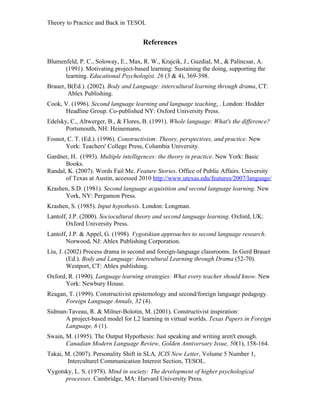
                                     References

Blumenfeld, P. C., Soloway, E., Max, R. W., Krajcik, J., Guzdial, M., & Palincsar, A.
      (1991). Motivating project-based learning: Sustaining the doing, supporting the
      learning. Educational Psychologist, 26 (3 & 4), 369-398.
Brauer, B(Ed.). (2002). Body and Language: intercultural learning through drama, CT:
        Ablex Publishing.
Cook, V. (1996). Second language learning and language teaching. . London: Hodder
      Headline Group. Co-published NY: Oxford University Press.
Edelsky, C., Altwerger, B., & Flores, B. (1991). Whole language: What's the difference?
       Portsmouth, NH: Heinemann.
Fosnot, C. T. (Ed.). (1996). Constructivism: Theory, perspectives, and practice. New
       York: Teachers' College Press, Columbia University.
Gardner, H. (1993). Multiple intelligences: the theory in practice. New York: Basic
       Books.
Randal, K. (2007). Words Fail Me. Feature Stories. Office of Public Affairs. University
       of Texas at Austin, accessed 2010 http://www.utexas.edu/features/2007/language/
Krashen, S.D. (1981). Second language acquisition and second language learning. New
      York, NY: Pergamon Press.
Krashen, S. (1985). Input hypothesis. London: Longman.
Lantolf, J.P. (2000). Sociocultural theory and second language learning. Oxford, UK:
       Oxford University Press.
Lantolf, J.P. & Appel, G. (1998). Vygotskian approaches to second language research.
       Norwood, NJ: Ablex Publishing Corporation.
Liu, J. (2002) Process drama in second and foreign-language classrooms. In Gerd Brauer
         (Ed.). Body and Language: Intercultural Learning through Drama (52-70).
         Westport, CT: Ablex publishing.
Oxford, R. (1990). Language learning strategies: What every teacher should know. New
      York: Newbury House.
Reagan, T. (1999). Constructivist epistemology and second/foreign language pedagogy.
      Foreign Language Annals, 32 (4).
Sidman-Taveau, R. & Milner-Bolotin, M. (2001). Constructivist inspiration:
      A project-based model for L2 learning in virtual worlds. Texas Papers in Foreign
      Language, 6 (1).
Swain, M. (1995). The Output Hypothesis: Just speaking and writing aren't enough.
       Canadian Modern Language Review, Golden Anniversary Issue, 50(1), 158-164.
Takai, M. (2007). Personality Shift in SLA, ICIS New Letter, Volume 5 Number 1,
        Interculturel Communication Interest Section, TESOL.
Vygotsky, L. S. (1978). Mind in society: The development of higher psychological
      processes. Cambridge, MA: Harvard University Press.

CATESOL 2010 Handout

  • 1.
    Theory to Practiceand Back in TESOL Theory to Practice and Back in TESOL, CATESOL 2010 Plan Theory Practice Review Rebekah Sidman-Taveau, PhD and Marie Takai, M.A. SOME TERMS Imposter Syndrome: a psychological phenomenon in which people think that they do not deserve their accomplishments made by their hard work. Non-Native Speaker dilemma: Some non-native speakers think that the fluency and language intuition of a native English speaker is required in English teaching, even though these are not easily attainable by a non-native speaker. SOME THEORY SOME PRACTICE Behaviorist learning theory: Learning is a change in Break concepts into discreet points, students imitate and repeat, behavior acquired through conditioning. provide reinforcement and corrective feedback. Constructivist learning theory: Learners actively Start from what students know helping them to access construct their own knowledge. New knowledge is background knowledge. Let student interests and needs drive built from prior knowledge. learning. Put learners at the center of activity, learning through doing e.g. communicative activities, projects, experiential learning. Socioconstructivist learning theory: Learning is a Help learners enter into authentic social discourse situations: social process. Knowledge is first constructed in the authentic conversations, sharing, negotiations, debates, social realm and then appropriated by individuals collaborative projects, oral presentation and writing for a real (Bruning et al., 1999). audiences Multiple Intelligence Theory: Nine Intelligences Activating more than one intelligence promotes effective interactively play a significant role in successful language learning. Musical and bodily-kinesthetic activity can learning. (Gardner 1993) be powerful tools. Comprehensible Output Hypothesis: Language Give learners opportunities to speak in situations where they acquisition depends on comprehensible output, have real goals, where listeners will have to seek clarification communicative opportunities for meaningful when communication breakdown occurs and speakers will have negotiated interaction (Swain, 1995). to correct and reconstruct their conceptions Zone of Proximal Development (ZPD): determined Assess student knowledge and levels and teach to their ZPD. by the distance between the actual development of the Scaffold; model, coach, and guide students; provide just enough learner and the potential development of a learner with support for a learner to extend his or her skills or knowledge but the guidance or support of a more knowledgeable other not so much that the problem is solved for the learner (Lantolf, (Vygotsky, 1978). & Appel, 1998).. Affective Filter Hypothesis high anxiety, low Help reduce student anxiety by using games, music, art, and motivation, and low confidence can work together to positive feedback; by honoring students’ culture, providing increase the affective filter and form a mental block familiar contexts, encouraging a mastery orientation, and that prevents comprehensible input from being used for perceiving errors as learning opportunities. Have students “take acquisition (1985) their emotional temperature.” (Oxford, 1991)
  • 2.
    Theory to Practiceand Back in TESOL SOME MORE TERMS SOME MORE PRACTICE EXAMPLES Intrinsic Motivation: having a natural interest and Model your joy in learning and speaking the target language. curiosity, an enjoyment in the task itself Encourage mastery orientation. Engage students in meaningful activities with real purposes and audiences Instrumental Motivation (IM) : motivation due to an A focus on test scores, grades, and competition encourages IM; external factor such as getting a good grade, winning a however, it is best not to overdue the external rewards. IM can prize, or impressing others. be useful but is not as strong or lasting as intrinsic motivation. Integrative Motivation: a desire to identify with the Teach students about the culture(s) associated with the target target language culture and positive attitudes toward language putting language into engaging cultural contexts: e.g. the learning environment (Gardner, 1985) exploring music, food, art, and other aspects of the culture (s). Foreign Language Anxiety(FLA): “A known Help reduce student anxiety using games, music, art, positive condition that occurs in certain situations where a feedback, by honoring students’ culture, providing familiar person is required to speak a foreign language”. It can contexts, perceiving errors as learning opportunities, and cause nervousness, embarrassment, worry, dread, encouraging students to “take their emotional temperatures”. difficulty concentrating, and many other uncomfortable Allow practice and warm up before oral presentations and whole symptoms. FLA often occurs when speaking in front of class discussions. Role play challenging oral tasks such as phone a group, with a perceived authority, or on the telephone calls or meetings with different types of authorities. (Horwitz qtd in Randall, 2008). Presenter Contact Information: Mari Takai (Marie), M.A., Japanese instructor and curriculum designer, Sunnyvale- Cupertino Adult Education mari.k.takai@gmail.com Rebekah Sidman-Taveau, PhD, Director of ESL Services, San Francisco Art Institute, Part Time Faculty, San José State University, Department of Secondary Education rtaveau@sfai.edu 1 1 Mastery goal orientation – where students are concerned about acquiring new skills, about the process of learning, and about using effort. This is in contrast to a Performance goal orientation- where students are concerned about being able, about outperforming others, and achieving success with little effort.
  • 3.
    Theory to Practiceand Back in TESOL References Blumenfeld, P. C., Soloway, E., Max, R. W., Krajcik, J., Guzdial, M., & Palincsar, A. (1991). Motivating project-based learning: Sustaining the doing, supporting the learning. Educational Psychologist, 26 (3 & 4), 369-398. Brauer, B(Ed.). (2002). Body and Language: intercultural learning through drama, CT: Ablex Publishing. Cook, V. (1996). Second language learning and language teaching. . London: Hodder Headline Group. Co-published NY: Oxford University Press. Edelsky, C., Altwerger, B., & Flores, B. (1991). Whole language: What's the difference? Portsmouth, NH: Heinemann. Fosnot, C. T. (Ed.). (1996). Constructivism: Theory, perspectives, and practice. New York: Teachers' College Press, Columbia University. Gardner, H. (1993). Multiple intelligences: the theory in practice. New York: Basic Books. Randal, K. (2007). Words Fail Me. Feature Stories. Office of Public Affairs. University of Texas at Austin, accessed 2010 http://www.utexas.edu/features/2007/language/ Krashen, S.D. (1981). Second language acquisition and second language learning. New York, NY: Pergamon Press. Krashen, S. (1985). Input hypothesis. London: Longman. Lantolf, J.P. (2000). Sociocultural theory and second language learning. Oxford, UK: Oxford University Press. Lantolf, J.P. & Appel, G. (1998). Vygotskian approaches to second language research. Norwood, NJ: Ablex Publishing Corporation. Liu, J. (2002) Process drama in second and foreign-language classrooms. In Gerd Brauer (Ed.). Body and Language: Intercultural Learning through Drama (52-70). Westport, CT: Ablex publishing. Oxford, R. (1990). Language learning strategies: What every teacher should know. New York: Newbury House. Reagan, T. (1999). Constructivist epistemology and second/foreign language pedagogy. Foreign Language Annals, 32 (4). Sidman-Taveau, R. & Milner-Bolotin, M. (2001). Constructivist inspiration: A project-based model for L2 learning in virtual worlds. Texas Papers in Foreign Language, 6 (1). Swain, M. (1995). The Output Hypothesis: Just speaking and writing aren't enough. Canadian Modern Language Review, Golden Anniversary Issue, 50(1), 158-164. Takai, M. (2007). Personality Shift in SLA, ICIS New Letter, Volume 5 Number 1, Interculturel Communication Interest Section, TESOL. Vygotsky, L. S. (1978). Mind in society: The development of higher psychological processes. Cambridge, MA: Harvard University Press.