First language Acquisition

        Behaviorists
         Nativists
       Functionalists
First Language Acquisition
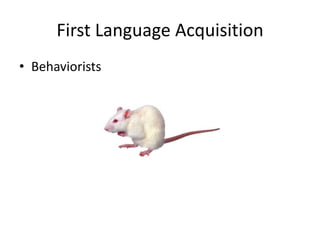
• Behaviorists
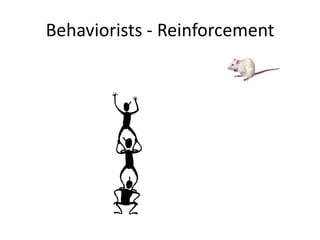
Behaviorists - Reinforcement
Behaviorists - Imitation
Behaviorists - Conditioning
Behaviorists - Habit
Behaviorists – Clean Slate
Behaviorists – Skinner
Nativists - Innate
Nativists - Innate
• Language Acquisition Device (LAD)
Natavists - Innate
• Universal Grammar (UG)
Natavists - Innate
• Construct Rules of language
Natavists - Innate
• Construct Rules of language – predetermined
  steps
Natavists - Innate
• Construct Grammar
Natavists - Innate
• Abstract Thinking – Creative Process

                             Predisposition to language
Natavists - Innate
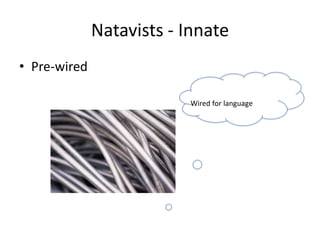
• Pre-wired

                          Wired for language
First Language Acquisition
• Functionalists
Functionalists
• Social Interaction
Functionalists
• 2-way Communication/Discourse
Functionalists
• Serves a purpose
L1 Acquisition and L2 Learning
• Similarities – Construct language from prior
  conceptual knowledge.
L1 Acquisition and L2 Learning
• Similarities – Active learner who tests and
  revises hypotheses.
L1 Acquisition and L2 Learning
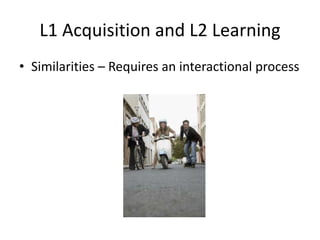
• Similarities – Requires an interactional process
L1 Acquisition and L2 Learning
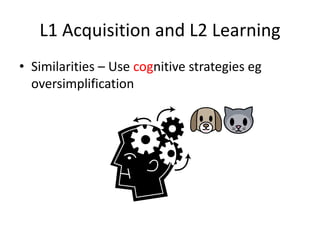
• Similarities – Use cognitive strategies eg
  oversimplification
L1 Acquisition and L2 Learning
• Similarities – is aided by modified input. Both
  will attempt to simplify language p. 42
L1 Acquisition and L2 Learning
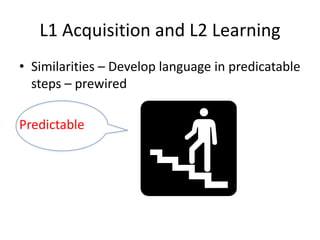
• Similarities – Develop language in predicatable
  steps – prewired

Predictable
L1 Acquisition and L2 Learning
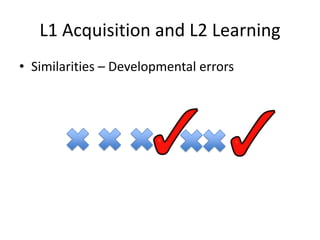
• Similarities – Developmental errors
L1 Acquisition
• L1 – Silent Period a must
L2 Learning
• L2 – Silent Period desireable
L2 Learning
• L2 – Cognitively more developed
L2 Learning
• L2 – Greater Knowledge of the world
L2 Learning
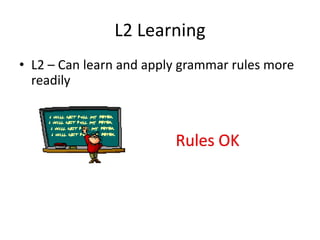
• L2 – Can learn and apply grammar rules more
  readily
L2 Learning
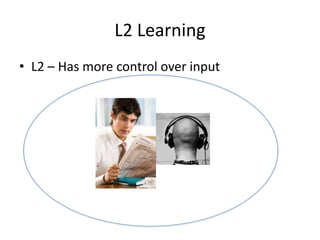
• L2 – Has more control over input
L2 Learning
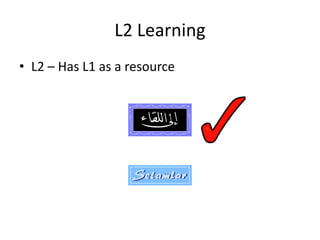
• L2 – Has L1 as a resource
L2 Learning
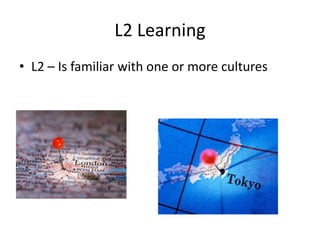
• L2 – Is familiar with one or more cultures
L2 Learning
• L2 – Negative attitude & motivation
L2 Learning
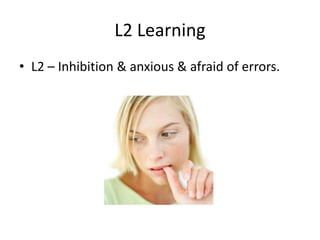
• L2 – Inhibition & anxious & afraid of errors.
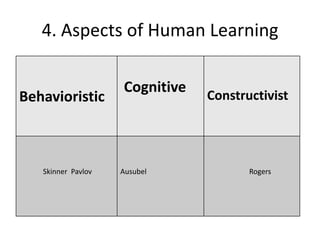
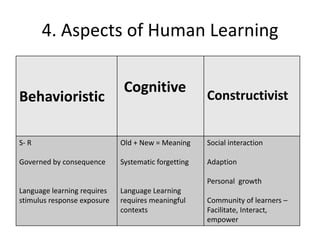
4. Aspects of Human Learning

                    Cognitive   Constructivist
Behavioristic


   Skinner Pavlov   Ausubel            Rogers
4. Aspects of Human Learning

                              Cognitive              Constructivist
Behavioristic

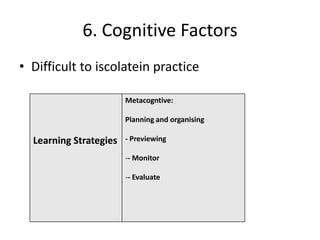
S- R                         Old + New = Meaning     Social interaction

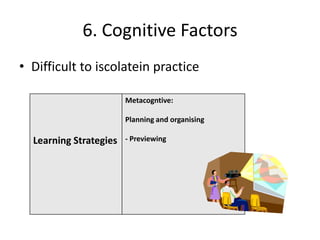
Governed by consequence      Systematic forgetting   Adaption

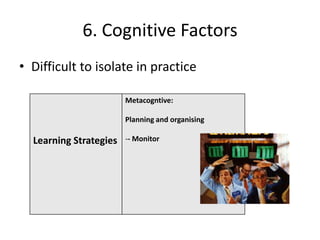
                                                     Personal growth
Language learning requires   Language Learning
stimulus response exposure   requires meaningful     Community of learners –
                             contexts                Facilitate, Interact,
                                                     empower
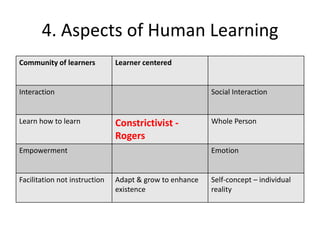
4. Aspects of Human Learning
Community of learners          Learner centered


Interaction                                              Social Interaction


Learn how to learn             Constrictivist -          Whole Person
                               Rogers
Empowerment                                              Emotion


Facilitation not instruction   Adapt & grow to enhance   Self-concept – individual
                               existence                 reality
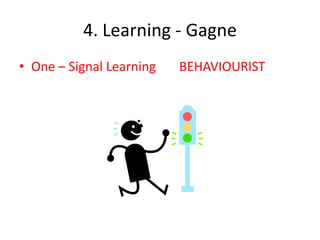
4. Learning - Gagne
• One – Signal Learning   BEHAVIOURIST
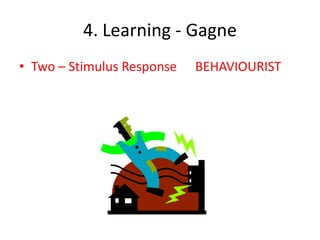
4. Learning - Gagne
• Two – Stimulus Response   BEHAVIOURIST
4. Learning - Gagne
• Three – Chaining   BEHAVIOURIST
4. Learning - Gagne
• Four – Multiple discriminations BEHAVIOURIST
4. Learning - Gagne
• Five – Concept Learning   COGNITIVE
4. Learning - Gagne
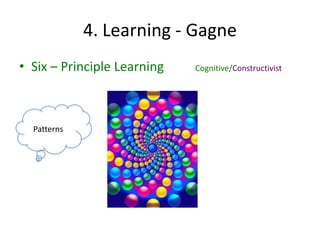
• Six – Principle Learning   Cognitive/Constructivist


  Patterns
4. Learning - Gagne
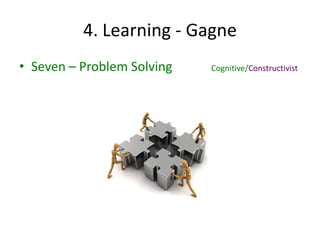
• Seven – Problem Solving   Cognitive/Constructivist
4. Learning – Multiple Intelligence : Gardiner

• Linguistic
4. Learning – Multiple Intelligence : Gardiner

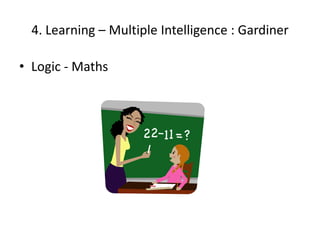
• Logic - Maths
4. Learning – Multiple Intelligence : Gardiner

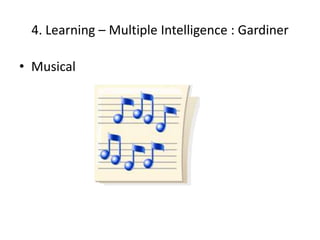
• Musical
4. Learning – Multiple Intelligence : Gardiner

• Spatial – forming mental pictures of reality
4. Learning – Multiple Intelligence : Gardiner

• Body - Kinesthetic
4. Learning – Multiple Intelligence : Gardiner

• Naturalist
4. Learning – Multiple Intelligence : Gardiner

• Interpersonal
4. Learning – Multiple Intelligence : Gardiner

• Intrapersonal – ID , me , self-awareness
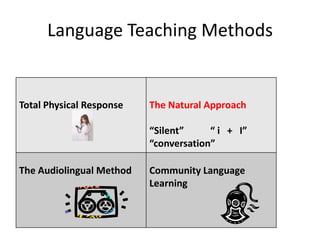
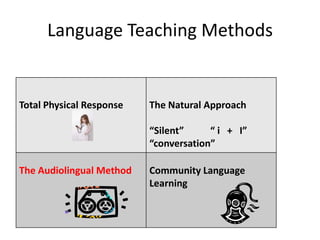
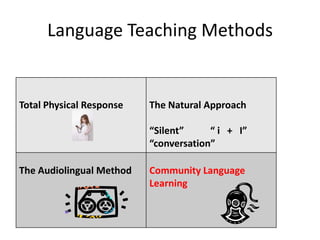
Language Teaching Methods


Total Physical Response   The Natural Approach

                          “Silent”     “ i + I”
                          “conversation”

The Audiolingual Method   Community Language
                          Learning
Language Teaching Methods


Total Physical Response   The Natural Approach

                          “Silent”     “ i + I”
                          “conversation”

The Audiolingual Method   Community Language
                          Learning
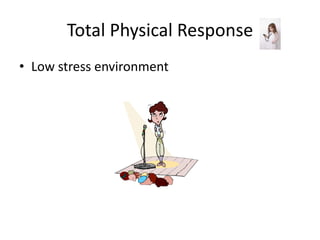
Total Physical Response
• Low stress environment
Total Physical Response
• Listening
Total Physical Response
• Acting
Total Physical Response
• Today useful for classroom activities

• Based on Behaviorist ideas of
  stimulus – response (S-R)
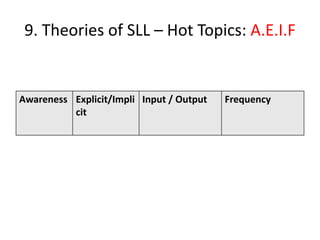
Language Teaching Methods


Total Physical Response   The Natural Approach

                          “Silent”     “ i + I”
                          “conversation”

The Audiolingual Method   Community Language
                          Learning
Krashen’s Natural Approach
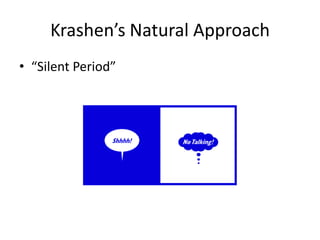
• “Silent Period”
Krashen’s Natural Approach
• “ i + I”


• Basic conversation. New input just beyond the
  learners level.
Krashen’s Natural Approach
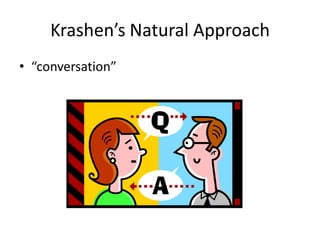
• “conversation”
Krashen’s Natural Approach
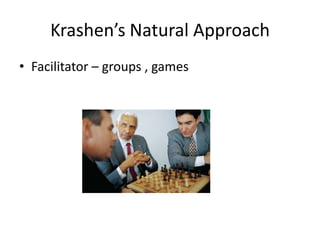
• Facilitator – groups , games
Krashen’s Natural Approach
• Criticism – reliance on input not interaction
Language Teaching Methods


Total Physical Response   The Natural Approach

                          “Silent”     “ i + I”
                          “conversation”

The Audiolingual Method   Community Language
                          Learning
The Audiolingual Method
• Reinforcement, Set phrases, repetition
The Audiolingual Method
• Lost popularity – LA not through rote and
  error avoidance.
Language Teaching Methods


Total Physical Response   The Natural Approach

                          “Silent”     “ i + I”
                          “conversation”

The Audiolingual Method   Community Language
                          Learning
Community Language Learning
• Fundamental affective and interpersonal
  nature of learning.
Community Language Learning
• CLL – Rogers – student teacher joint facilitation.
Community Language Learning
• CLL – Rogers – student teacher joint facilitation.
Community Language Learning
• CLL – joint facilitation – develop trust in L1.
Community Language Learning
• CLL – joint facilitation – group work – using tapes
Community Language Learning
• CLL – joint facilitation – dependence to independence
Community Language Learning
• CLL – Criticisms – too non-directive
Community Language Learning
• CLL – Criticisms – heavily reliant on language translation
Community Language Learning
• CLL – Positives:

• Lower anxiety, supportive groups, own pace, develop
  autonomy
Vygotsky – Sociocultural Learning
• ZPD – zone of proximal development

• “what a learner could learn with appropriate stimuli”

• “social interaction the foundation of cognitive
  development”
6. Cognitive Factors
• Help to account for learner differences
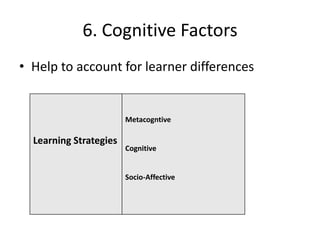
6. Cognitive Factors
• Help to account for learner differences


                        Metacogntive

  Learning Strategies
                        Cognitive


                        Socio-Affective
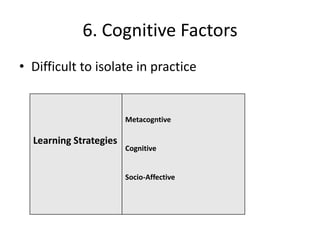
6. Cognitive Factors
• Difficult to isolate in practice


                        Metacogntive

  Learning Strategies
                        Cognitive


                        Socio-Affective
6. Cognitive Factors
• Difficult to iscolatein practice

                        Metacogntive:

                        Planning and organising

  Learning Strategies   - Previewing

                        -- Monitor

                        -- Evaluate
6. Cognitive Factors
• Difficult to iscolatein practice

                        Metacogntive:

                        Planning and organising

  Learning Strategies   - Previewing
6. Cognitive Factors
• Difficult to isolate in practice

                        Metacogntive:

                        Planning and organising

  Learning Strategies   -- Monitor
6. Cognitive Factors
• Difficult to iscolatein practice

                        Metacogntive:

                        Planning and organising

  Learning Strategies   -- Evaluate
6. Cognitive Factors
• Difficult to isolate in practice

                        Cognitive Strategies:

                        -Memorisation

  Learning Strategies
6. Cognitive Factors
• Difficult to isolate in practice

                        Cognitive Strategies:

                        -- repetition

  Learning Strategies
6. Cognitive Factors
• Difficult to isolate in practice

                        Cognitive Strategies:

                        -- note taking

  Learning Strategies
6. Cognitive Factors
• Difficult to isolate in practice

                        Socio-Affective:

                        - Lower anxiety
  Learning Strategies
                        -- Positive Self-talk

                        -- Ask Questions

                        -- Cooperate

                        --Empathise
6. Cognitive Factors
• Difficult to isolate in practice

                        Socio-Affective:

                        - Lower anxiety
  Learning Strategies
6. Cognitive Factors
• Difficult to isolate in practice

                        Socio-Affective:


  Learning Strategies   -- Positive Self-talk
6. Cognitive Factors
• Difficult to isolate in practice

                        Socio-Affective

                        -- Ask Questions
  Learning Strategies
6. Cognitive Factors
• Difficult to isolate in practice

                        Socio-Affective:

                        -- Cooperate
  Learning Strategies
6. Cognitive Factors
• Difficult to isolate in practice

                        Socio-Affective:

                        --Empathise
  Learning Strategies
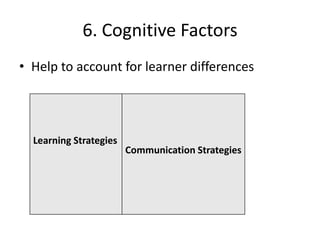
6. Cognitive Factors
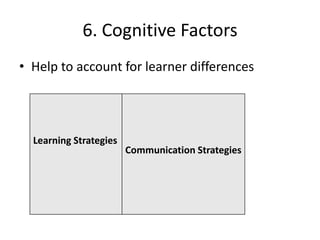
• Help to account for learner differences


  Learning Strategies
                        Communication Strategies
6. Cognitive Factors
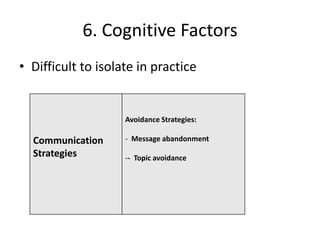
• Difficult to isolate in practice


                    Avoidance Strategies:

  Communication     - Message abandonment
  Strategies        -- Topic avoidance
6. Cognitive Factors
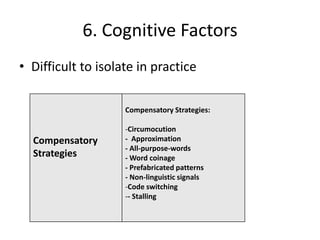
• Difficult to isolate in practice

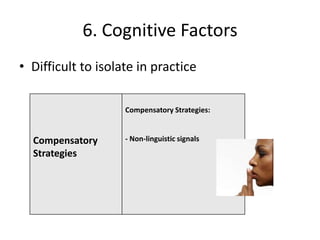
                    Compensatory Strategies:

                    -Circumocution
  Compensatory      - Approximation
                    - All-purpose-words
  Strategies        - Word coinage
                    - Prefabricated patterns
                    - Non-linguistic signals
                    -Code switching
                    -- Stalling
6. Cognitive Factors
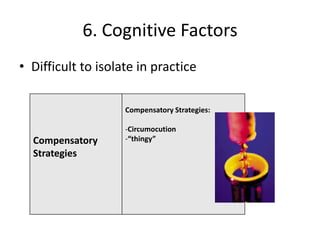
• Difficult to isolate in practice

                    Compensatory Strategies:

                    -Circumocution
  Compensatory      -“thingy”
  Strategies
6. Cognitive Factors
• Difficult to isolate in practice

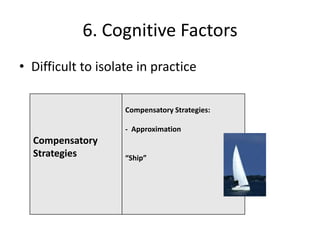
                    Compensatory Strategies:

                    - Approximation
  Compensatory
  Strategies        “Ship”
6. Cognitive Factors
• Difficult to isolate in practice

                    Compensatory Strategies:

                    - All-purpose-words
  Compensatory
  Strategies        “what you call” “thingy”
6. Cognitive Factors
• Difficult to isolate in practice

                    Compensatory Strategies:

                    - Word coinage
  Compensatory
                    Invent a word – “vegetarianist” for
  Strategies        “vegetarian”
6. Cognitive Factors
• Difficult to isolate in practice

                    Compensatory Strategies:

                    - Prefabricated patterns
  Compensatory
  Strategies        Stock expressions;

                    “Parle-vous Frances”
6. Cognitive Factors
• Difficult to isolate in practice

                    Compensatory Strategies:


  Compensatory      - Non-linguistic signals
  Strategies
6. Cognitive Factors
• Difficult to isolate in practice

                    Compensatory Strategies:

                    -Code switching
  Compensatory
  Strategies        English – French - English
6. Cognitive Factors
• Difficult to isolate in practice

                    Compensatory Strategies:

                    -Circumocution
  Compensatory      - Approximation
                    - All-purpose-words
  Strategies        - Word coinage
                    - Prefabricated patterns
                    - Non-linguistic signals
                    -Code switching
                    -- Stalling
6. Cognitive Factors
• Difficult to isolate in practice

                    Compensatory Strategies:

                    -- Stalling
  Compensatory
  Strategies
6. Cognitive Factors
• Help to account for learner differences


  Learning Strategies
                        Communication Strategies
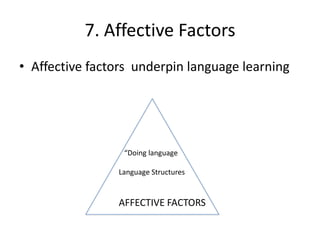
7. Affective Factors
• Affective factors underpin language learning


                 “Doing language

                Language Structures


                AFFECTIVE FACTORS
7. Affective Factors – cognitive +
             emotion
7. Affective Factors

• Methods a response to Affective Domain

• Eg Silent Way, Total Physical Response, Natural
  Approach, Community Language Learning
7. Affective Factors – W.E.E.I.R.A.S.S


Willingness to communicate:

“Collaborative language helps to develop
  interpersonal intelligence”
7. Affective Factors – W.E.E.I.R.A.S.S


Willingness to demonstrate empathy:


“Walk a mile in my shoes”
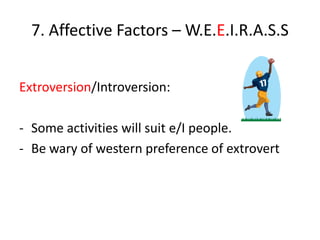
7. Affective Factors – W.E.E.I.R.A.S.S


Extroversion/Introversion:

- Some activities will suit e/I people.
- Be wary of western preference of extrovert
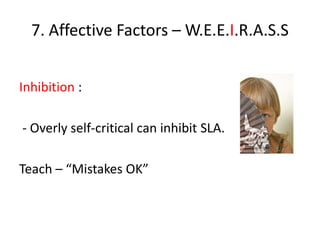
7. Affective Factors – W.E.E.I.R.A.S.S


Inhibition :

- Overly self-critical can inhibit SLA.

Teach – “Mistakes OK”
7. Affective Factors – W.E.E.I.R.A.S.S


Risk Taking :

- Some errors may be associated with risk
  aversion
- Be prepared to guess and attempt
7. Affective Factors – W.E.E.I.R.A.S.S

Anxiety:


“Anxiety a major SLA factor (Arnold & Brown)”.

- Some require to be alert & ready to enhance
   SLA
7. Affective Factors – W.E.E.I.R.A.S.S


Self-Esteem:


“Self-esteem can influence SLA (Arnold &
  Brown)”.
7. Affective Factors – W.E.E.I.R.A.S.S
Self-Efficacy: D.E.A.L

Reasons people attribute to their own success.
DEAL – Difficulty, Effort, Ability, Luck

“Self-esteem can influence SLA (Arnold &
  Brown)”.
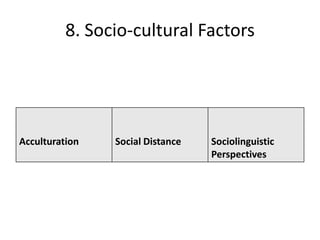
8. Socio-cultural Factors


Acculturation   Social Distance   Sociolinguistic
                                  Perspectives
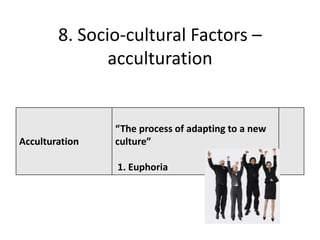
8. Socio-cultural Factors –
               acculturation


                “The process of adapting to a new
Acculturation   culture”

                1. Euphoria
8. Socio-cultural Factors –
               acculturation


                “The process of adapting to a new
Acculturation   culture”

                 “Social and psychological
                integration of the learner”
                Schumann
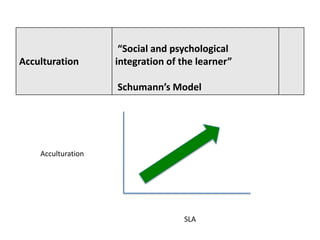
8. Socio-cultural Factors –
                 “Social and psychological
Acculturation  acculturation
                integration of the learner”

                   Schumann’s Model


   Acculturation


                               SLA
8. Socio-cultural Factors –
                 “Social and psychological
Acculturation  acculturation
                integration of the learner”

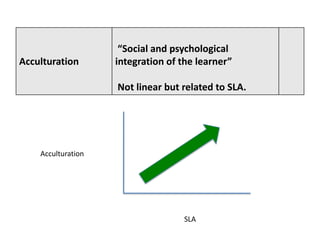
                   Not linear but related to SLA.


   Acculturation


                                  SLA
8. Socio-cultural Factors –
                 “Social and psychological
Acculturation  acculturation
                integration of the learner”

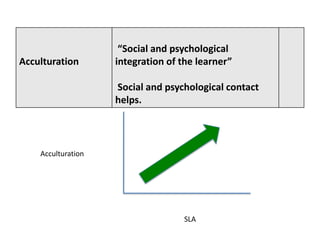
                   Social and psychological contact
                   helps.


   Acculturation


                                  SLA
8. Socio-cultural Factors –
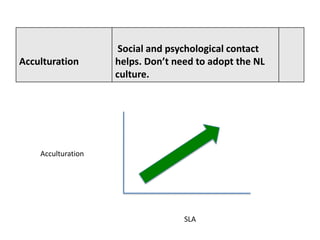
                Social and psychological contact
Acculturation  acculturation the NL
                helps. Don’t need to adopt
                    culture.


    Acculturation


                                SLA
8. Socio-cultural Factors –
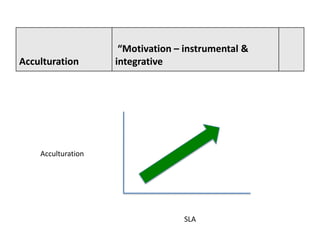
                 “Motivation – instrumental &
Acculturation  acculturation
                integrative


   Acculturation


                              SLA
8. Socio-cultural Factors –
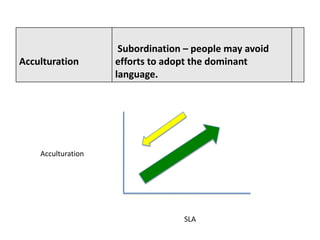
                Subordination – people may avoid
Acculturation  acculturation
                efforts to adopt the dominant
                    language.


    Acculturation


                                SLA
8. Socio-cultural Factors –
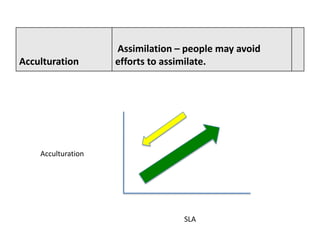
                Assimilation – people may avoid
Acculturation  acculturation
                efforts to assimilate.


    Acculturation


                               SLA
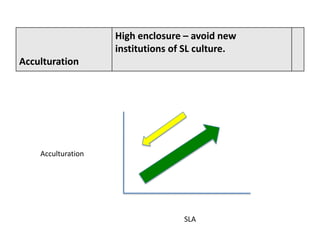
8. Socio-cultural– Factors –
                High enclosure avoid new
                institutions of SL culture.
Acculturation  acculturation


   Acculturation


                             SLA
8. Socio-cultural Factors - acculturation


                “The process of adapting to a new
Acculturation   culture”

                2. Culture Shock
8. Socio-cultural Factors - acculturation


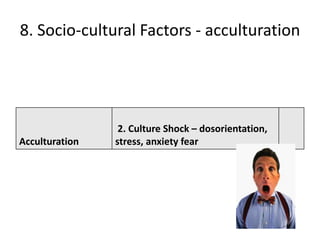
                 2. Culture Shock – dosorientation,
Acculturation   stress, anxiety fear
8. Socio-cultural Factors - acculturation


                “The process of adapting to a new
Acculturation   culture”

                3. Coping
8. Socio-cultural Factors - acculturation


                3. Coping
Acculturation
                L2 reluctance amongst adults as
                they do not want to make fools of
                themselves
8. Socio-cultural Factors - acculturation


                “The process of adapting to a new
Acculturation   culture”

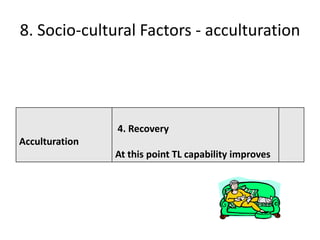
                4. Recovery
8. Socio-cultural Factors - acculturation


                4. Recovery
Acculturation
                At this point TL capability improves
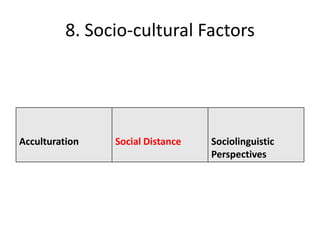
8. Socio-cultural Factors


Acculturation   Social Distance   Sociolinguistic
                                  Perspectives
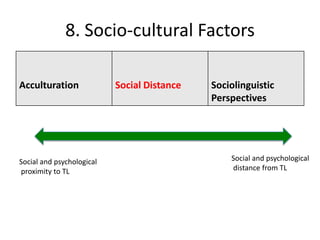
8. Socio-cultural Factors

Acculturation              Social Distance   Sociolinguistic
                                             Perspectives


Social and psychological                         Social and psychological
proximity to TL                                  distance from TL
8. Socio-cultural Factors


Acculturation   Social Distance   Sociolinguistic
                                  Perspectives
8. Socio-cultural Factors


Acculturation   Social Distance   Sociolinguistic
                                  Perspectives
8. Socio-cultural Factors


Acculturation            Social Distance             Sociolinguistic
                                                     Perspectives


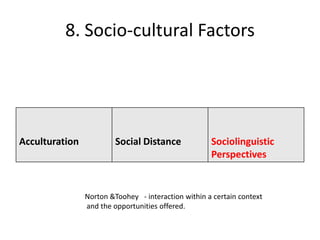
                Norton &Toohey - interaction within a certain context
                and the opportunities offered.
8. Socio-cultural Factors


Acculturation           Social Distance                Sociolinguistic
                                                       Perspectives


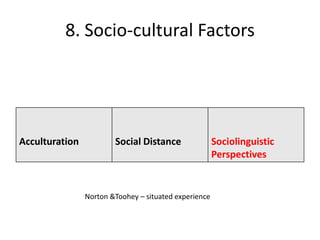
                Norton &Toohey – situated experience
8. Socio-cultural Factors


Acculturation           Social Distance              Sociolinguistic
                                                     Perspectives


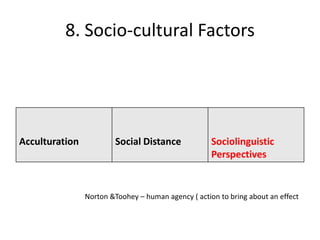
                Norton &Toohey – human agency ( action to bring about an effect
8. Socio-cultural Factors


Acculturation   Social Distance   Sociolinguistic
                                  Perspectives


           Teaching implications
8. Socio-cultural Factors – teaching
              implications
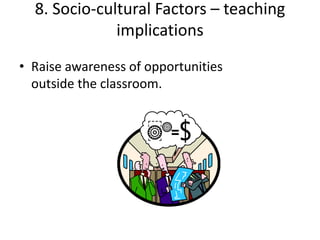
• Raise awareness of opportunities
  outside the classroom.
8. Socio-cultural Factors – teaching
              implications
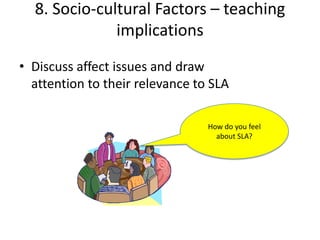
• Discuss affect issues and draw
  attention to their relevance to SLA

                                 How do you feel
                                   about SLA?
8. Socio-cultural Factors – teaching
               implications
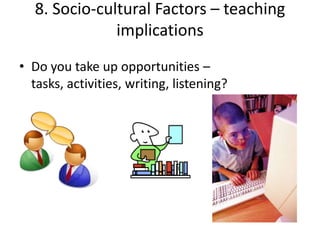
• Do you take up opportunities –
  tasks, activities, writing, listening?
8. Socio-cultural Factors – teaching
              implications
• Do you have set goals – have you
  identified based on your current
  strengths and weaknesses
  (SWOT?).
8. Socio-cultural Factors – teaching
              implications
• Do you have work collaboratively
  in groups, ask questions etc
8. Socio-cultural Factors – teaching
              implications
• Do you seek feedback and and
  evaluate progress formally
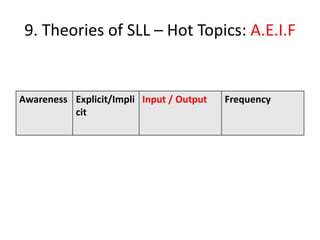
9. Theories of SLL – Hot Topics: A.E.I.F


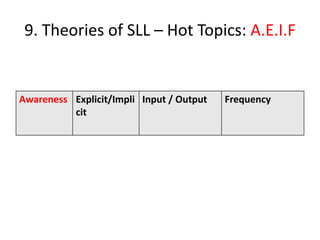
Awareness Explicit/Impli Input / Output   Frequency
          cit
9. Theories of SLL – Hot Topics: A.E.I.F


Awareness Explicit/Impli Input / Output   Frequency
          cit
9. Theories of SLL – Hot Topics: A.E.I.F


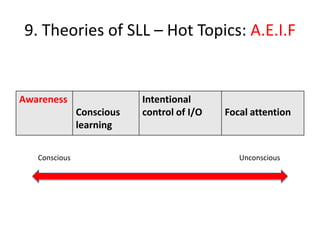
Awareness                  Intentional
               Conscious   control of I/O   Focal attention
               learning

   Conscious                                   Unconscious
9. Theories of SLL – Hot Topics: A.E.I.F


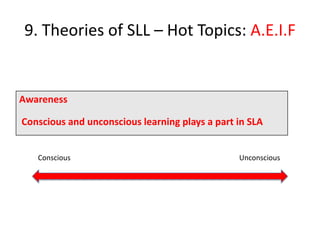
Awareness

Conscious and unconscious learning plays a part in SLA


   Conscious                                    Unconscious
9. Theories of SLL – Hot Topics: A.E.I.F


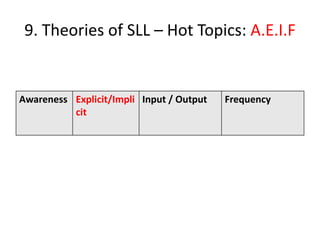
Awareness Explicit/Impli Input / Output   Frequency
          cit
9. Theories of SLL – Hot Topics: A.E.I.F


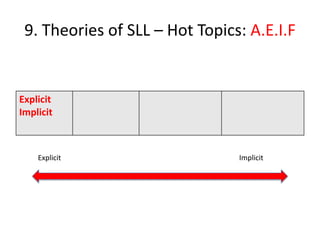
Explicit
Implicit


    Explicit                    Implicit
9. Theories of SLL – Hot Topics: A.E.I.F


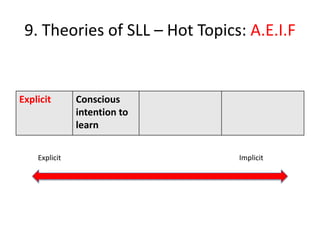
Explicit       Conscious
               intention to
               learn

    Explicit                    Implicit
9. Theories of SLL – Hot Topics: A.E.I.F


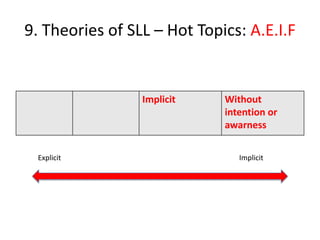
                 Implicit    Without
                             intention or
                             awarness

 Explicit                       Implicit
9. Theories of SLL – Hot Topics: A.E.I.F


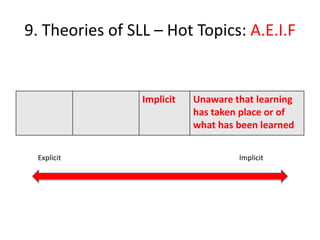
                 Implicit   Unaware that learning
                            has taken place or of
                            what has been learned

 Explicit                            Implicit
9. Theories of SLL – Hot Topics: A.E.I.F


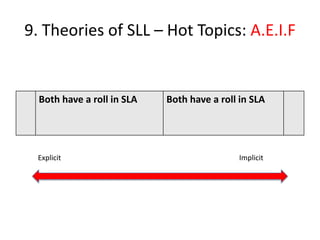
  Both have a roll in SLA   Both have a roll in SLA


 Explicit                                   Implicit
9. Theories of SLL – Hot Topics: A.E.I.F


Awareness Explicit/Impli Input / Output   Frequency
          cit
9. Theories of SLL – Hot Topics: A.E.I.F


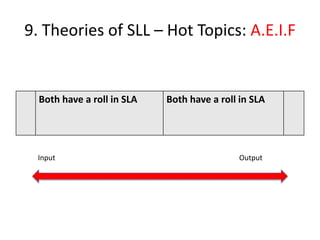
  Both have a roll in SLA   Both have a roll in SLA


 Input                                      Output
9. Theories of SLL – Hot Topics: A.E.I.F


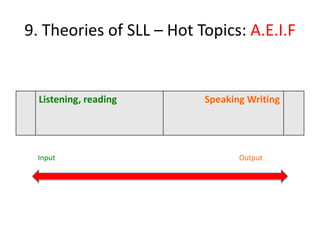
  Listening, reading      Speaking Writing


 Input                           Output
9. Theories of SLL – Hot Topics: A.E.I.F


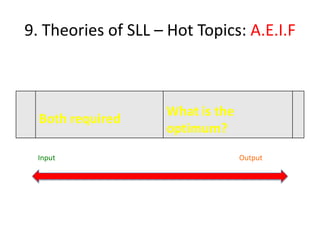
                    What is the
  Both required
                    optimum?
 Input                            Output
9. Theories of SLL – Hot Topics: A.E.I.F


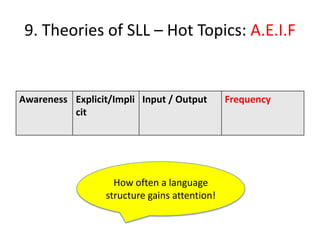
Awareness Explicit/Impli Input / Output       Frequency
          cit


                   How often a language
                 structure gains attention!
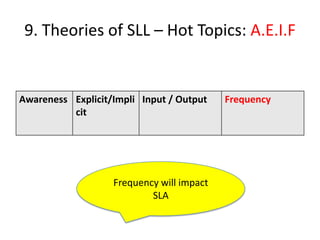
9. Theories of SLL – Hot Topics: A.E.I.F


Awareness Explicit/Impli Input / Output    Frequency
          cit


                   Frequency will impact
                           SLA
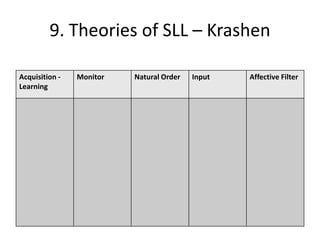
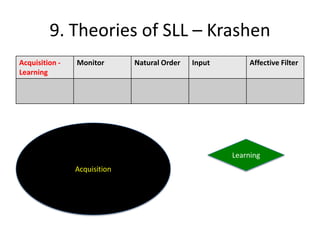
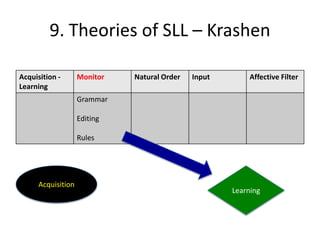
9. Theories of SLL – Krashen

Acquisition -   Monitor   Natural Order   Input   Affective Filter
Learning
9. Theories of SLL – Krashen
Acquisition -   Monitor       Natural Order   Input        Affective Filter
Learning


                                                      Learning
                Acquisition
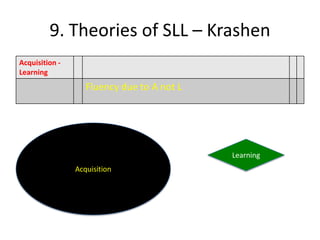
9. Theories of SLL – Krashen
Acquisition -
Learning
                   Fluency due to A not L


                                            Learning
                Acquisition
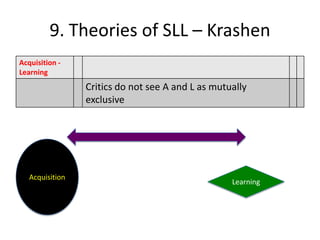
9. Theories of SLL – Krashen
Acquisition -
Learning
                 Critics do not see A and L as mutually
                 exclusive


   Acquisition
                                                   Learning
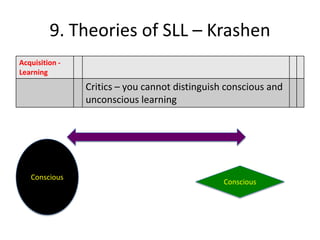
9. Theories of SLL – Krashen
Acquisition -
Learning
                Critics – you cannot distinguish conscious and
                unconscious learning


   Conscious
                                                Conscious
9. Theories of SLL – Krashen

Acquisition -       Monitor   Natural Order   Input        Affective Filter
Learning
                    Grammar

                    Editing

                    Rules


      Acquisition
                                                      Learning
9. Theories of SLL – Krashen

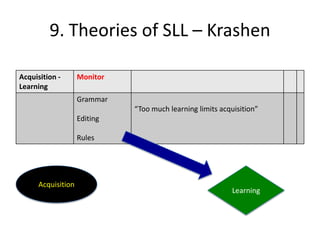
Acquisition -       Monitor
Learning
                    Grammar
                              “Too much learning limits acquisition”
                    Editing

                    Rules


      Acquisition
                                                            Learning
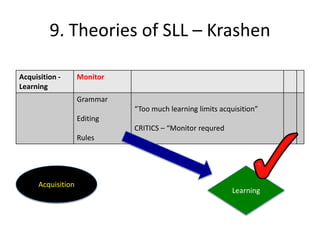
9. Theories of SLL – Krashen

Acquisition -       Monitor
Learning
                    Grammar
                              “Too much learning limits acquisition”
                    Editing
                              CRITICS – “Monitor requred
                    Rules


      Acquisition
                                                            Learning
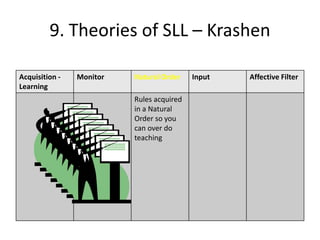
9. Theories of SLL – Krashen

Acquisition -   Monitor   Natural Order    Input   Affective Filter
Learning
                          Rules acquired
                          in a Natural
                          Order so you
                          can over do
                          teaching
9. Theories of SLL – Krashen

Acquisition -   Monitor   Natural Order   Input             Affective Filter
Learning

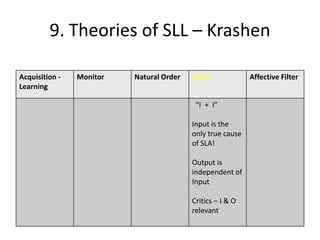
                                           “I + I”

                                          Input is the
                                          only true cause
                                          of SLA!

                                          Output is
                                          independent of
                                          Input

                                          Critics – I & O
                                          relevant
9. Theories of SLL – Krashen

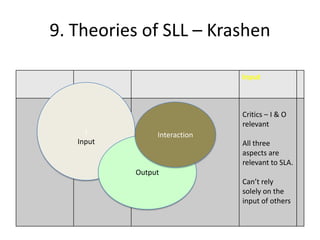
                              Input


                              Critics – I & O
                              relevant
     I          Interaction
   Input                      All three
                              aspects are
                              relevant to SLA.
           Output
                              Can’t rely
                              solely on the
                              input of others
9. Theories of SLL – Krashen

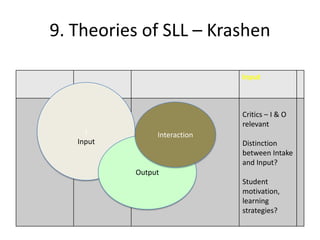
                              Input


                              Critics – I & O
                              relevant
     I          Interaction
   Input                      Distinction
                              between Intake
                              and Input?
           Output
                              Student
                              motivation,
                              learning
                              strategies?
9. Theories of SLL – Krashen

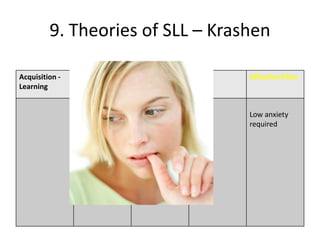
Acquisition -   Monitor   Natural Order   Input   Affective Filter
Learning


                                                  Low anxiety
                                                  required
9. Theories of SLL – Krashen
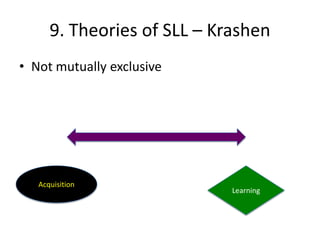
• Not mutually exclusive


   Acquisition
                             Learning
9. Theories of SLL – Krashen
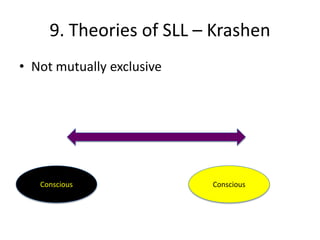
• Not mutually exclusive


   Conscious               Conscious
9. Theories of SLL – Krashen
• ?????????????????????????????????????


      Acquisition

                                 Learning
9. Theories of SLL – Krashen
• ?????????????????????????????????????


          Is Child One the ideal as
                   implied?
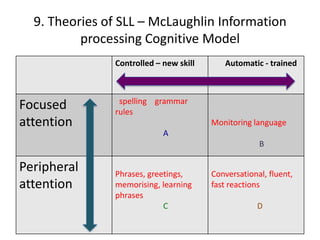
9. Theories of SLL – McLaughlin Information
          processing Cognitive Model
               Controlled – new skill      Automatic - trained


                spelling grammar
Focused        rules
attention                               Monitoring language
                            A
                                                     B

Peripheral     Phrases, greetings,      Conversational, fluent,
attention      memorising, learning     fast reactions
               phrases
                            C                       D
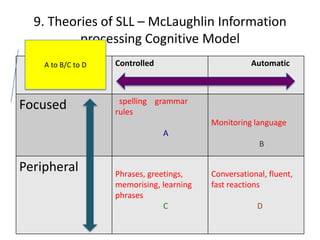
9. Theories of SLL – McLaughlin Information
          processing Cognitive Model
    A to B/C to D   Controlled                        Automatic


                     spelling grammar
Focused             rules
                                           Monitoring language
                                 A
                                                        B

Peripheral          Phrases, greetings,    Conversational, fluent,
                    memorising, learning   fast reactions
                    phrases
                                 C                     D
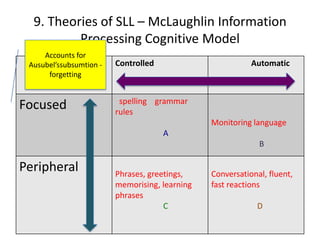
9. Theories of SLL – McLaughlin Information
          Processing Cognitive Model
     Accounts for
 Ausubel’ssubsumtion -   Controlled                        Automatic
      forgetting


                          spelling grammar
Focused                  rules
                                                Monitoring language
                                      A
                                                             B

Peripheral               Phrases, greetings,    Conversational, fluent,
                         memorising, learning   fast reactions
                         phrases
                                      C                     D
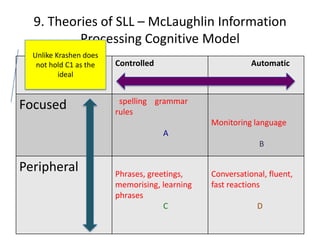
9. Theories of SLL – McLaughlin Information
          Processing Cognitive Model
  Unlike Krashen does
   not hold C1 as the   Controlled                        Automatic
          ideal


                         spelling grammar
Focused                 rules
                                               Monitoring language
                                     A
                                                            B

Peripheral              Phrases, greetings,    Conversational, fluent,
                        memorising, learning   fast reactions
                        phrases
                                     C                     D
9. Theories of SLL – McLaughlin Information
          Processing Cognitive Model
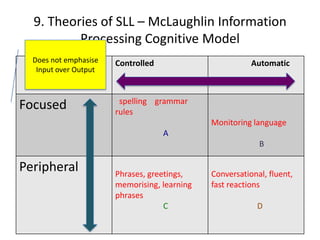
  Does not emphasise   Controlled                        Automatic
   Input over Output


                        spelling grammar
Focused                rules
                                              Monitoring language
                                    A
                                                           B

Peripheral             Phrases, greetings,    Conversational, fluent,
                       memorising, learning   fast reactions
                       phrases
                                    C                     D
9. Theories of SLL – McLaughlin Information
          Processing Cognitive Model
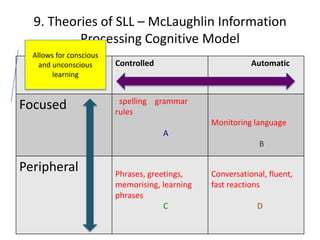
  Allows for conscious
    and unconscious      Controlled                        Automatic
        learning


                          spelling grammar
Focused                  rules
                                                Monitoring language
                                      A
                                                             B

Peripheral               Phrases, greetings,    Conversational, fluent,
                         memorising, learning   fast reactions
                         phrases
                                      C                     D
9. Theories of SLL – McLaughlin Information
          Processing Cognitive Model
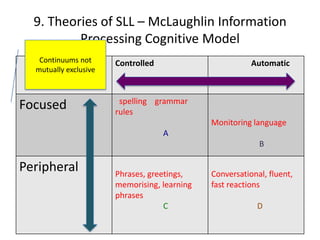
   Continuums not      Controlled                        Automatic
  mutually exclusive


                        spelling grammar
Focused                rules
                                              Monitoring language
                                    A
                                                           B

Peripheral             Phrases, greetings,    Conversational, fluent,
                       memorising, learning   fast reactions
                       phrases
                                    C                     D
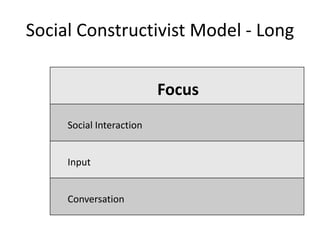
Social Constructivist Model - Long

                          Focus
     Social Interaction


     Input


     Conversation
Social Constructivist Model - Long

                             Focus
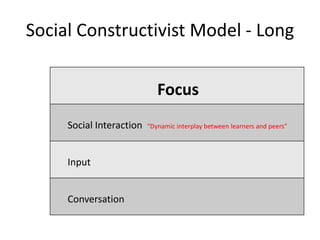
     Social Interaction   “Dynamic interplay between learners and peers”


     Input


     Conversation
Social Constructivist Model - Long

                             Focus
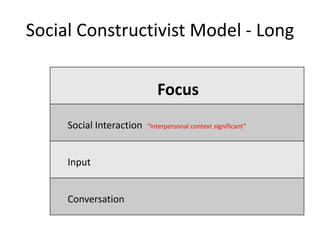
     Social Interaction   “Interpersonal context significant”


     Input


     Conversation
Social Constructivist Model - Long

                           Focus
      Social Interaction


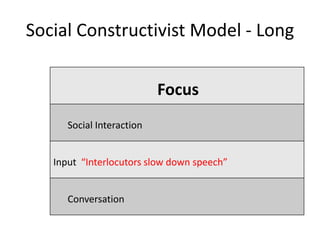
   Input “Interlocutors slow down speech”


      Conversation
Social Constructivist Model - Long

                           Focus
      Social Interaction


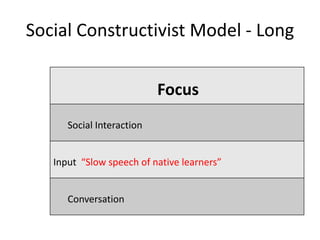
   Input “Slow speech of native learners”


      Conversation
Social Constructivist Model - Long

                                  Focus
       Social Interaction


   Input


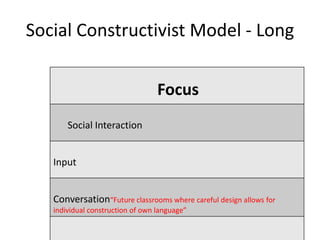
   Conversation“Future classrooms where careful design allows for
   individual construction of own language”
Social Constructivist Model - Long

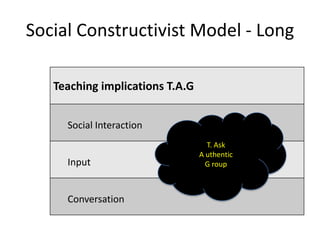
   Teaching implications T.A.G


     Social Interaction
                                   T. Ask
                                 A uthentic
     Input                         G roup


     Conversation
Social Constructivist Model - Long

   Teaching implications T.A.G


     Social Interaction

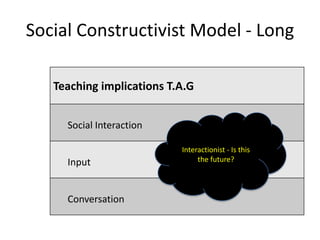
                           Interactionist - Is this
     Input                      the future?


     Conversation
Social Constructivist Model - Long

   Teaching implications T.A.G


     Social Interaction

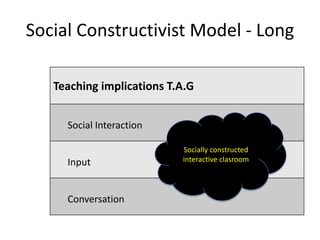
                           Socially constructed
     Input                 interactive clasroom


     Conversation
9. Theories of SLL – Krashen

Acquisition -   Monitor   Natural Order   Input   Affective Filter
Learning

Revision

  • 1.
  • 2.
    First language Acquisition Behaviorists Nativists Functionalists
  • 3.
  • 4.
  • 5.
  • 6.
  • 7.
  • 8.
  • 9.
  • 10.
  • 11.
    Nativists - Innate •Language Acquisition Device (LAD)
  • 12.
    Natavists - Innate •Universal Grammar (UG)
  • 13.
    Natavists - Innate •Construct Rules of language
  • 14.
    Natavists - Innate •Construct Rules of language – predetermined steps
  • 15.
    Natavists - Innate •Construct Grammar
  • 16.
    Natavists - Innate •Abstract Thinking – Creative Process Predisposition to language
  • 17.
    Natavists - Innate •Pre-wired Wired for language
  • 18.
  • 19.
  • 20.
  • 21.
  • 22.
    L1 Acquisition andL2 Learning • Similarities – Construct language from prior conceptual knowledge.
  • 23.
    L1 Acquisition andL2 Learning • Similarities – Active learner who tests and revises hypotheses.
  • 24.
    L1 Acquisition andL2 Learning • Similarities – Requires an interactional process
  • 25.
    L1 Acquisition andL2 Learning • Similarities – Use cognitive strategies eg oversimplification
  • 26.
    L1 Acquisition andL2 Learning • Similarities – is aided by modified input. Both will attempt to simplify language p. 42
  • 27.
    L1 Acquisition andL2 Learning • Similarities – Develop language in predicatable steps – prewired Predictable
  • 28.
    L1 Acquisition andL2 Learning • Similarities – Developmental errors
  • 29.
    L1 Acquisition • L1– Silent Period a must
  • 30.
    L2 Learning • L2– Silent Period desireable
  • 31.
    L2 Learning • L2– Cognitively more developed
  • 32.
    L2 Learning • L2– Greater Knowledge of the world
  • 33.
    L2 Learning • L2– Can learn and apply grammar rules more readily
  • 34.
    L2 Learning • L2– Has more control over input
  • 35.
    L2 Learning • L2– Has L1 as a resource
  • 36.
    L2 Learning • L2– Is familiar with one or more cultures
  • 37.
    L2 Learning • L2– Negative attitude & motivation
  • 38.
    L2 Learning • L2– Inhibition & anxious & afraid of errors.
  • 39.
    4. Aspects ofHuman Learning Cognitive Constructivist Behavioristic Skinner Pavlov Ausubel Rogers
  • 40.
    4. Aspects ofHuman Learning Cognitive Constructivist Behavioristic S- R Old + New = Meaning Social interaction Governed by consequence Systematic forgetting Adaption Personal growth Language learning requires Language Learning stimulus response exposure requires meaningful Community of learners – contexts Facilitate, Interact, empower
  • 41.
    4. Aspects ofHuman Learning Community of learners Learner centered Interaction Social Interaction Learn how to learn Constrictivist - Whole Person Rogers Empowerment Emotion Facilitation not instruction Adapt & grow to enhance Self-concept – individual existence reality
  • 42.
    4. Learning -Gagne • One – Signal Learning BEHAVIOURIST
  • 43.
    4. Learning -Gagne • Two – Stimulus Response BEHAVIOURIST
  • 44.
    4. Learning -Gagne • Three – Chaining BEHAVIOURIST
  • 45.
    4. Learning -Gagne • Four – Multiple discriminations BEHAVIOURIST
  • 46.
    4. Learning -Gagne • Five – Concept Learning COGNITIVE
  • 47.
    4. Learning -Gagne • Six – Principle Learning Cognitive/Constructivist Patterns
  • 48.
    4. Learning -Gagne • Seven – Problem Solving Cognitive/Constructivist
  • 49.
    4. Learning –Multiple Intelligence : Gardiner • Linguistic
  • 50.
    4. Learning –Multiple Intelligence : Gardiner • Logic - Maths
  • 51.
    4. Learning –Multiple Intelligence : Gardiner • Musical
  • 52.
    4. Learning –Multiple Intelligence : Gardiner • Spatial – forming mental pictures of reality
  • 53.
    4. Learning –Multiple Intelligence : Gardiner • Body - Kinesthetic
  • 54.
    4. Learning –Multiple Intelligence : Gardiner • Naturalist
  • 55.
    4. Learning –Multiple Intelligence : Gardiner • Interpersonal
  • 56.
    4. Learning –Multiple Intelligence : Gardiner • Intrapersonal – ID , me , self-awareness
  • 57.
    Language Teaching Methods TotalPhysical Response The Natural Approach “Silent” “ i + I” “conversation” The Audiolingual Method Community Language Learning
  • 58.
    Language Teaching Methods TotalPhysical Response The Natural Approach “Silent” “ i + I” “conversation” The Audiolingual Method Community Language Learning
  • 59.
    Total Physical Response •Low stress environment
  • 60.
  • 61.
  • 62.
    Total Physical Response •Today useful for classroom activities • Based on Behaviorist ideas of stimulus – response (S-R)
  • 63.
    Language Teaching Methods TotalPhysical Response The Natural Approach “Silent” “ i + I” “conversation” The Audiolingual Method Community Language Learning
  • 64.
  • 65.
    Krashen’s Natural Approach •“ i + I” • Basic conversation. New input just beyond the learners level.
  • 66.
  • 67.
    Krashen’s Natural Approach •Facilitator – groups , games
  • 68.
    Krashen’s Natural Approach •Criticism – reliance on input not interaction
  • 69.
    Language Teaching Methods TotalPhysical Response The Natural Approach “Silent” “ i + I” “conversation” The Audiolingual Method Community Language Learning
  • 70.
    The Audiolingual Method •Reinforcement, Set phrases, repetition
  • 71.
    The Audiolingual Method •Lost popularity – LA not through rote and error avoidance.
  • 72.
    Language Teaching Methods TotalPhysical Response The Natural Approach “Silent” “ i + I” “conversation” The Audiolingual Method Community Language Learning
  • 73.
    Community Language Learning •Fundamental affective and interpersonal nature of learning.
  • 74.
    Community Language Learning •CLL – Rogers – student teacher joint facilitation.
  • 75.
    Community Language Learning •CLL – Rogers – student teacher joint facilitation.
  • 76.
    Community Language Learning •CLL – joint facilitation – develop trust in L1.
  • 77.
    Community Language Learning •CLL – joint facilitation – group work – using tapes
  • 78.
    Community Language Learning •CLL – joint facilitation – dependence to independence
  • 79.
    Community Language Learning •CLL – Criticisms – too non-directive
  • 80.
    Community Language Learning •CLL – Criticisms – heavily reliant on language translation
  • 81.
    Community Language Learning •CLL – Positives: • Lower anxiety, supportive groups, own pace, develop autonomy
  • 82.
    Vygotsky – SocioculturalLearning • ZPD – zone of proximal development • “what a learner could learn with appropriate stimuli” • “social interaction the foundation of cognitive development”
  • 83.
    6. Cognitive Factors •Help to account for learner differences
  • 84.
    6. Cognitive Factors •Help to account for learner differences Metacogntive Learning Strategies Cognitive Socio-Affective
  • 85.
    6. Cognitive Factors •Difficult to isolate in practice Metacogntive Learning Strategies Cognitive Socio-Affective
  • 86.
    6. Cognitive Factors •Difficult to iscolatein practice Metacogntive: Planning and organising Learning Strategies - Previewing -- Monitor -- Evaluate
  • 87.
    6. Cognitive Factors •Difficult to iscolatein practice Metacogntive: Planning and organising Learning Strategies - Previewing
  • 88.
    6. Cognitive Factors •Difficult to isolate in practice Metacogntive: Planning and organising Learning Strategies -- Monitor
  • 89.
    6. Cognitive Factors •Difficult to iscolatein practice Metacogntive: Planning and organising Learning Strategies -- Evaluate
  • 90.
    6. Cognitive Factors •Difficult to isolate in practice Cognitive Strategies: -Memorisation Learning Strategies
  • 91.
    6. Cognitive Factors •Difficult to isolate in practice Cognitive Strategies: -- repetition Learning Strategies
  • 92.
    6. Cognitive Factors •Difficult to isolate in practice Cognitive Strategies: -- note taking Learning Strategies
  • 93.
    6. Cognitive Factors •Difficult to isolate in practice Socio-Affective: - Lower anxiety Learning Strategies -- Positive Self-talk -- Ask Questions -- Cooperate --Empathise
  • 94.
    6. Cognitive Factors •Difficult to isolate in practice Socio-Affective: - Lower anxiety Learning Strategies
  • 95.
    6. Cognitive Factors •Difficult to isolate in practice Socio-Affective: Learning Strategies -- Positive Self-talk
  • 96.
    6. Cognitive Factors •Difficult to isolate in practice Socio-Affective -- Ask Questions Learning Strategies
  • 97.
    6. Cognitive Factors •Difficult to isolate in practice Socio-Affective: -- Cooperate Learning Strategies
  • 98.
    6. Cognitive Factors •Difficult to isolate in practice Socio-Affective: --Empathise Learning Strategies
  • 99.
    6. Cognitive Factors •Help to account for learner differences Learning Strategies Communication Strategies
  • 100.
    6. Cognitive Factors •Difficult to isolate in practice Avoidance Strategies: Communication - Message abandonment Strategies -- Topic avoidance
  • 101.
    6. Cognitive Factors •Difficult to isolate in practice Compensatory Strategies: -Circumocution Compensatory - Approximation - All-purpose-words Strategies - Word coinage - Prefabricated patterns - Non-linguistic signals -Code switching -- Stalling
  • 102.
    6. Cognitive Factors •Difficult to isolate in practice Compensatory Strategies: -Circumocution Compensatory -“thingy” Strategies
  • 103.
    6. Cognitive Factors •Difficult to isolate in practice Compensatory Strategies: - Approximation Compensatory Strategies “Ship”
  • 104.
    6. Cognitive Factors •Difficult to isolate in practice Compensatory Strategies: - All-purpose-words Compensatory Strategies “what you call” “thingy”
  • 105.
    6. Cognitive Factors •Difficult to isolate in practice Compensatory Strategies: - Word coinage Compensatory Invent a word – “vegetarianist” for Strategies “vegetarian”
  • 106.
    6. Cognitive Factors •Difficult to isolate in practice Compensatory Strategies: - Prefabricated patterns Compensatory Strategies Stock expressions; “Parle-vous Frances”
  • 107.
    6. Cognitive Factors •Difficult to isolate in practice Compensatory Strategies: Compensatory - Non-linguistic signals Strategies
  • 108.
    6. Cognitive Factors •Difficult to isolate in practice Compensatory Strategies: -Code switching Compensatory Strategies English – French - English
  • 109.
    6. Cognitive Factors •Difficult to isolate in practice Compensatory Strategies: -Circumocution Compensatory - Approximation - All-purpose-words Strategies - Word coinage - Prefabricated patterns - Non-linguistic signals -Code switching -- Stalling
  • 110.
    6. Cognitive Factors •Difficult to isolate in practice Compensatory Strategies: -- Stalling Compensatory Strategies
  • 111.
    6. Cognitive Factors •Help to account for learner differences Learning Strategies Communication Strategies
  • 112.
    7. Affective Factors •Affective factors underpin language learning “Doing language Language Structures AFFECTIVE FACTORS
  • 113.
    7. Affective Factors– cognitive + emotion
  • 114.
    7. Affective Factors •Methods a response to Affective Domain • Eg Silent Way, Total Physical Response, Natural Approach, Community Language Learning
  • 115.
    7. Affective Factors– W.E.E.I.R.A.S.S Willingness to communicate: “Collaborative language helps to develop interpersonal intelligence”
  • 116.
    7. Affective Factors– W.E.E.I.R.A.S.S Willingness to demonstrate empathy: “Walk a mile in my shoes”
  • 117.
    7. Affective Factors– W.E.E.I.R.A.S.S Extroversion/Introversion: - Some activities will suit e/I people. - Be wary of western preference of extrovert
  • 118.
    7. Affective Factors– W.E.E.I.R.A.S.S Inhibition : - Overly self-critical can inhibit SLA. Teach – “Mistakes OK”
  • 119.
    7. Affective Factors– W.E.E.I.R.A.S.S Risk Taking : - Some errors may be associated with risk aversion - Be prepared to guess and attempt
  • 120.
    7. Affective Factors– W.E.E.I.R.A.S.S Anxiety: “Anxiety a major SLA factor (Arnold & Brown)”. - Some require to be alert & ready to enhance SLA
  • 121.
    7. Affective Factors– W.E.E.I.R.A.S.S Self-Esteem: “Self-esteem can influence SLA (Arnold & Brown)”.
  • 122.
    7. Affective Factors– W.E.E.I.R.A.S.S Self-Efficacy: D.E.A.L Reasons people attribute to their own success. DEAL – Difficulty, Effort, Ability, Luck “Self-esteem can influence SLA (Arnold & Brown)”.
  • 123.
    8. Socio-cultural Factors Acculturation Social Distance Sociolinguistic Perspectives
  • 124.
    8. Socio-cultural Factors– acculturation “The process of adapting to a new Acculturation culture” 1. Euphoria
  • 125.
    8. Socio-cultural Factors– acculturation “The process of adapting to a new Acculturation culture” “Social and psychological integration of the learner” Schumann
  • 126.
    8. Socio-cultural Factors– “Social and psychological Acculturation acculturation integration of the learner” Schumann’s Model Acculturation SLA
  • 127.
    8. Socio-cultural Factors– “Social and psychological Acculturation acculturation integration of the learner” Not linear but related to SLA. Acculturation SLA
  • 128.
    8. Socio-cultural Factors– “Social and psychological Acculturation acculturation integration of the learner” Social and psychological contact helps. Acculturation SLA
  • 129.
    8. Socio-cultural Factors– Social and psychological contact Acculturation acculturation the NL helps. Don’t need to adopt culture. Acculturation SLA
  • 130.
    8. Socio-cultural Factors– “Motivation – instrumental & Acculturation acculturation integrative Acculturation SLA
  • 131.
    8. Socio-cultural Factors– Subordination – people may avoid Acculturation acculturation efforts to adopt the dominant language. Acculturation SLA
  • 132.
    8. Socio-cultural Factors– Assimilation – people may avoid Acculturation acculturation efforts to assimilate. Acculturation SLA
  • 133.
    8. Socio-cultural– Factors– High enclosure avoid new institutions of SL culture. Acculturation acculturation Acculturation SLA
  • 134.
    8. Socio-cultural Factors- acculturation “The process of adapting to a new Acculturation culture” 2. Culture Shock
  • 135.
    8. Socio-cultural Factors- acculturation 2. Culture Shock – dosorientation, Acculturation stress, anxiety fear
  • 136.
    8. Socio-cultural Factors- acculturation “The process of adapting to a new Acculturation culture” 3. Coping
  • 137.
    8. Socio-cultural Factors- acculturation 3. Coping Acculturation L2 reluctance amongst adults as they do not want to make fools of themselves
  • 138.
    8. Socio-cultural Factors- acculturation “The process of adapting to a new Acculturation culture” 4. Recovery
  • 139.
    8. Socio-cultural Factors- acculturation 4. Recovery Acculturation At this point TL capability improves
  • 140.
    8. Socio-cultural Factors Acculturation Social Distance Sociolinguistic Perspectives
  • 141.
    8. Socio-cultural Factors Acculturation Social Distance Sociolinguistic Perspectives Social and psychological Social and psychological proximity to TL distance from TL
  • 142.
    8. Socio-cultural Factors Acculturation Social Distance Sociolinguistic Perspectives
  • 143.
    8. Socio-cultural Factors Acculturation Social Distance Sociolinguistic Perspectives
  • 144.
    8. Socio-cultural Factors Acculturation Social Distance Sociolinguistic Perspectives Norton &Toohey - interaction within a certain context and the opportunities offered.
  • 145.
    8. Socio-cultural Factors Acculturation Social Distance Sociolinguistic Perspectives Norton &Toohey – situated experience
  • 146.
    8. Socio-cultural Factors Acculturation Social Distance Sociolinguistic Perspectives Norton &Toohey – human agency ( action to bring about an effect
  • 147.
    8. Socio-cultural Factors Acculturation Social Distance Sociolinguistic Perspectives Teaching implications
  • 148.
    8. Socio-cultural Factors– teaching implications • Raise awareness of opportunities outside the classroom.
  • 149.
    8. Socio-cultural Factors– teaching implications • Discuss affect issues and draw attention to their relevance to SLA How do you feel about SLA?
  • 150.
    8. Socio-cultural Factors– teaching implications • Do you take up opportunities – tasks, activities, writing, listening?
  • 151.
    8. Socio-cultural Factors– teaching implications • Do you have set goals – have you identified based on your current strengths and weaknesses (SWOT?).
  • 152.
    8. Socio-cultural Factors– teaching implications • Do you have work collaboratively in groups, ask questions etc
  • 153.
    8. Socio-cultural Factors– teaching implications • Do you seek feedback and and evaluate progress formally
  • 154.
    9. Theories ofSLL – Hot Topics: A.E.I.F Awareness Explicit/Impli Input / Output Frequency cit
  • 155.
    9. Theories ofSLL – Hot Topics: A.E.I.F Awareness Explicit/Impli Input / Output Frequency cit
  • 156.
    9. Theories ofSLL – Hot Topics: A.E.I.F Awareness Intentional Conscious control of I/O Focal attention learning Conscious Unconscious
  • 157.
    9. Theories ofSLL – Hot Topics: A.E.I.F Awareness Conscious and unconscious learning plays a part in SLA Conscious Unconscious
  • 158.
    9. Theories ofSLL – Hot Topics: A.E.I.F Awareness Explicit/Impli Input / Output Frequency cit
  • 159.
    9. Theories ofSLL – Hot Topics: A.E.I.F Explicit Implicit Explicit Implicit
  • 160.
    9. Theories ofSLL – Hot Topics: A.E.I.F Explicit Conscious intention to learn Explicit Implicit
  • 161.
    9. Theories ofSLL – Hot Topics: A.E.I.F Implicit Without intention or awarness Explicit Implicit
  • 162.
    9. Theories ofSLL – Hot Topics: A.E.I.F Implicit Unaware that learning has taken place or of what has been learned Explicit Implicit
  • 163.
    9. Theories ofSLL – Hot Topics: A.E.I.F Both have a roll in SLA Both have a roll in SLA Explicit Implicit
  • 164.
    9. Theories ofSLL – Hot Topics: A.E.I.F Awareness Explicit/Impli Input / Output Frequency cit
  • 165.
    9. Theories ofSLL – Hot Topics: A.E.I.F Both have a roll in SLA Both have a roll in SLA Input Output
  • 166.
    9. Theories ofSLL – Hot Topics: A.E.I.F Listening, reading Speaking Writing Input Output
  • 167.
    9. Theories ofSLL – Hot Topics: A.E.I.F What is the Both required optimum? Input Output
  • 168.
    9. Theories ofSLL – Hot Topics: A.E.I.F Awareness Explicit/Impli Input / Output Frequency cit How often a language structure gains attention!
  • 169.
    9. Theories ofSLL – Hot Topics: A.E.I.F Awareness Explicit/Impli Input / Output Frequency cit Frequency will impact SLA
  • 170.
    9. Theories ofSLL – Krashen Acquisition - Monitor Natural Order Input Affective Filter Learning
  • 171.
    9. Theories ofSLL – Krashen Acquisition - Monitor Natural Order Input Affective Filter Learning Learning Acquisition
  • 172.
    9. Theories ofSLL – Krashen Acquisition - Learning Fluency due to A not L Learning Acquisition
  • 173.
    9. Theories ofSLL – Krashen Acquisition - Learning Critics do not see A and L as mutually exclusive Acquisition Learning
  • 174.
    9. Theories ofSLL – Krashen Acquisition - Learning Critics – you cannot distinguish conscious and unconscious learning Conscious Conscious
  • 175.
    9. Theories ofSLL – Krashen Acquisition - Monitor Natural Order Input Affective Filter Learning Grammar Editing Rules Acquisition Learning
  • 176.
    9. Theories ofSLL – Krashen Acquisition - Monitor Learning Grammar “Too much learning limits acquisition” Editing Rules Acquisition Learning
  • 177.
    9. Theories ofSLL – Krashen Acquisition - Monitor Learning Grammar “Too much learning limits acquisition” Editing CRITICS – “Monitor requred Rules Acquisition Learning
  • 178.
    9. Theories ofSLL – Krashen Acquisition - Monitor Natural Order Input Affective Filter Learning Rules acquired in a Natural Order so you can over do teaching
  • 179.
    9. Theories ofSLL – Krashen Acquisition - Monitor Natural Order Input Affective Filter Learning “I + I” Input is the only true cause of SLA! Output is independent of Input Critics – I & O relevant
  • 180.
    9. Theories ofSLL – Krashen Input Critics – I & O relevant I Interaction Input All three aspects are relevant to SLA. Output Can’t rely solely on the input of others
  • 181.
    9. Theories ofSLL – Krashen Input Critics – I & O relevant I Interaction Input Distinction between Intake and Input? Output Student motivation, learning strategies?
  • 182.
    9. Theories ofSLL – Krashen Acquisition - Monitor Natural Order Input Affective Filter Learning Low anxiety required
  • 183.
    9. Theories ofSLL – Krashen • Not mutually exclusive Acquisition Learning
  • 184.
    9. Theories ofSLL – Krashen • Not mutually exclusive Conscious Conscious
  • 185.
    9. Theories ofSLL – Krashen • ????????????????????????????????????? Acquisition Learning
  • 186.
    9. Theories ofSLL – Krashen • ????????????????????????????????????? Is Child One the ideal as implied?
  • 187.
    9. Theories ofSLL – McLaughlin Information processing Cognitive Model Controlled – new skill Automatic - trained spelling grammar Focused rules attention Monitoring language A B Peripheral Phrases, greetings, Conversational, fluent, attention memorising, learning fast reactions phrases C D
  • 188.
    9. Theories ofSLL – McLaughlin Information processing Cognitive Model A to B/C to D Controlled Automatic spelling grammar Focused rules Monitoring language A B Peripheral Phrases, greetings, Conversational, fluent, memorising, learning fast reactions phrases C D
  • 189.
    9. Theories ofSLL – McLaughlin Information Processing Cognitive Model Accounts for Ausubel’ssubsumtion - Controlled Automatic forgetting spelling grammar Focused rules Monitoring language A B Peripheral Phrases, greetings, Conversational, fluent, memorising, learning fast reactions phrases C D
  • 190.
    9. Theories ofSLL – McLaughlin Information Processing Cognitive Model Unlike Krashen does not hold C1 as the Controlled Automatic ideal spelling grammar Focused rules Monitoring language A B Peripheral Phrases, greetings, Conversational, fluent, memorising, learning fast reactions phrases C D
  • 191.
    9. Theories ofSLL – McLaughlin Information Processing Cognitive Model Does not emphasise Controlled Automatic Input over Output spelling grammar Focused rules Monitoring language A B Peripheral Phrases, greetings, Conversational, fluent, memorising, learning fast reactions phrases C D
  • 192.
    9. Theories ofSLL – McLaughlin Information Processing Cognitive Model Allows for conscious and unconscious Controlled Automatic learning spelling grammar Focused rules Monitoring language A B Peripheral Phrases, greetings, Conversational, fluent, memorising, learning fast reactions phrases C D
  • 193.
    9. Theories ofSLL – McLaughlin Information Processing Cognitive Model Continuums not Controlled Automatic mutually exclusive spelling grammar Focused rules Monitoring language A B Peripheral Phrases, greetings, Conversational, fluent, memorising, learning fast reactions phrases C D
  • 194.
    Social Constructivist Model- Long Focus Social Interaction Input Conversation
  • 195.
    Social Constructivist Model- Long Focus Social Interaction “Dynamic interplay between learners and peers” Input Conversation
  • 196.
    Social Constructivist Model- Long Focus Social Interaction “Interpersonal context significant” Input Conversation
  • 197.
    Social Constructivist Model- Long Focus Social Interaction Input “Interlocutors slow down speech” Conversation
  • 198.
    Social Constructivist Model- Long Focus Social Interaction Input “Slow speech of native learners” Conversation
  • 199.
    Social Constructivist Model- Long Focus Social Interaction Input Conversation“Future classrooms where careful design allows for individual construction of own language”
  • 200.
    Social Constructivist Model- Long Teaching implications T.A.G Social Interaction T. Ask A uthentic Input G roup Conversation
  • 201.
    Social Constructivist Model- Long Teaching implications T.A.G Social Interaction Interactionist - Is this Input the future? Conversation
  • 202.
    Social Constructivist Model- Long Teaching implications T.A.G Social Interaction Socially constructed Input interactive clasroom Conversation
  • 203.
    9. Theories ofSLL – Krashen Acquisition - Monitor Natural Order Input Affective Filter Learning