‘Are we truthfully

the
“GOOD DOCTORS”??’
Medical Deontology
THE FADING SCIENCE
&
NEED OF THE HOUR!!
PROF. MRIDUL M. PANDITRAO

Consultant
Department of Anesthesiology
PHA’s Rand Memorial Hospital
Freeport, The Bahamas
Introduction
Whenever We deal with a Patient-“Simple & Pertinent question!”
• “Was I ‘Good’ to my patient?
• (“Did I do everything ‘Good’ and nothing
‘Bad’ ??)”
• (Was there any ‘vested interest’ involved or
was I purely ‘altruistic’ ???)
Introduction
• Unprecedented advances the Medical Science
• The fundamental Value System
• The Principles and the Foundations of The “Noble
Profession”
• The need and greed of Lucre

• The ‘Principal Principle’
• Ruling this ‘Materialistic’ world.
Introduction

• Original guidelines of the Fathers of Medicine
• The necessity in these testing times
• To introspect deeply
• Reinvent the vanishing science of

‘Medical Deontology’.
The term is constituted by two words,
Deon(Greek) – ‘duty’ or ‘obligation’
Logos(Greek) – meaning opinion, word ….

and

 Defined as
“ A discipline for the study of norms of conduct for
the health care professionals, including moral and
legal norms as well as those pertaining more
strictly to professional performance!”
Fineschi V, Turillazzi E, Caten C.The new Italian code of medical ethics. Journal ofMedical Ethics 1997; 23: 239-244. jme.bmj.com
Definition
“Set of
Ethical Standards and Principles of behavior
of Medical Practitioners while executing
their professional duties
Professional Ethics of Medical Workers
Principles of Behavior of Medical Personnel
directed toward gaining maximum
benefit of treatment for the patients!”
Core Issues
Intricately inter-related 3 sub divisions:
Medical Jurisprudence
Medical Ethics
Medical Hodegetics
Sub divisions
Medical Jurisprudence or Law
• Jur (Latin) meaning Law …….. prudentia
(Latin) meaning knowledge
• Also known as Forensic Medicine,
• Can be defined as the “science which applies
the principles and practice of the different
branches of medicine to the elucidation of
doubtful questions in courts of justice”
Sub divisions
Medical Ethics
• ethica (Latin) from (Greek) ethice –
• teaching of morals,
• defined as a “system of moral principles:
that applies values and judgments to the practice
of medicine”
• As a scholarly discipline it encompasses
– its practical application in clinical settings
– as well as work on its
•
•
•
•

History,
Philosophy
Theology
Sociology
Sub divisions
Medical Hodegetics from (Arabic - ُ ُِ‫)أخالقيَّ ُ الط‬
‫ْ ِ ات ب‬
• literally means, guidelines for the study of
medicine.
• The guidelines which cover the ideal principles
which must be learnt while studying medicine
as were once envisioned by the ancient

“Fathers of the Medicine!
Duties of Medical Practitioners
Two main types of duties
Scientific - the section of medical science,
studying ethical and moral aspects of medical
workers’ activity

Practical – the area of medical practice
the tasks of which are the formation and
application of ethical standards and rules of the
professional medical activities
Medical Deontology includes :Problems of
Observing medical confidentiality
The extent of the medical worker’s responsibility
for the life and health of the patient
Relationships of medical workers to each other.
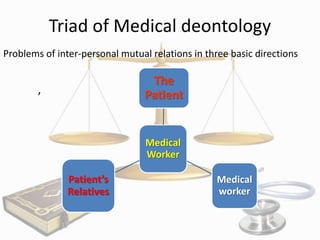
Triad of Medical deontology
Problems of inter-personal mutual relations in three basic directions

The
Patient

,

Medical
Worker

Patient’s
Relatives

Medical
worker
Historical Aspects
Plethora of literature from circumspective and
varied backgrounds
Indian “The Book of Life” (“Ayurveda” 30th
century B. C.)
“The Laws of Hammurabi” (Laws of
Ancient Babylon, 18th century B. C.),
“About the physician”, "The Oath" and "The Law“
by Hippocrates (5th -4th centuries B. C.)
The term "ethics", meaning “a concept of human
morals” introduced by Aristotle (384-322 B. C.).
Historical
• towards the middle Ages:
– “The Canon of Medical Science” and “Ethics” by
Ibn Sina (Avicenna, 10-11 centuries),
– Jeremy Bentham (English philosopher, lawyer,
priest; 1748-1832),
• who introduced the notion of Deontology as meaning
“… the teaching on the due behaviour of a person while
achieving his end” (18 century).
Historical
Some references in Russian medicine,
Matvey Yakovlevich Mudrov (1776-1831)
• “The Word Concerning Piety and Moral Qualities of a
Hippocratic Physician”
• “The Word Concerning the Ways of Teaching and
Learning the Practical Medicine”

 Nikolay Ivanovich Pirogov (1810-1881) are
noteworthy
• “Letters from Heidelberg” and
• “The Diary of an Old Doctor”.
Historical
The controversial Nuremberg process(1947),
• depicting the Verdict to the Nazi physicians,
(“The Nuremberg Code”,)
• postulates not only legal
• also moral regulations of medical /human
experiments.
Historical
Post 1947
• World Medical Association was created
• Its main actions were:
–
–
–
–
–
–

the adoption of “The Geneva Declaration”
the oath of a physician – the doctor (1948),
the International Code of Medical Ethics (1949),
“The Helsinki Declaration of Human Rights” (1964)
“The Helsinki-Tokyo Declaration” (1975), and
“The International Declaration on Human Rights”
(1983).
Quotes!
In the ancient Indian Medicine Teacher used to
tell to his disciples:
• “You now leave your passions, anger, greed,
madness, vanity, pride, envy, roughness,
buffoonery, falsity, laziness and any vicious
behavior. From now on, you will have your hair
and your nails shortly cut, wear red clothes,
conduct a pure life”.
A passage from the ancient Indian Book of Medicine : “AYURVEDA”
Quotes!
Ibn Sina (Avicenna) had already demanded a
special approach to the patient:
• “You should know that every separate person
possesses the special nature inherent in him
personally. It seldom happens, or it is absolutely
impossible, that somebody would have the nature
identical with his”
Primary Principle
PRIMUM NON NOCERE !
(Latin) - FIRST, DO NO HARM
• This maxim is & must always be the
Main Ethical Principle in Medicine!
Values in Medical Deontology
Six of the fundamental values/principles are:
•
•
•
•
•
•

Autonomy
Beneficence
Non-Maleficence
Justice
dignity
Truthfulness and Honesty
Values/principles
Autonomy
• the patient has the right to refuse or choose
their treatment. (Voluntas aegroti suprema
lex.)
• The principle of autonomy recognizes the rights
of individuals to self determination.
• This is rooted in society’s respect for
individuals’ ability to make informed decisions
about personal matters.
Values/principles
Beneficence
• a practitioner should act in the best interest of
the patient. (Salus aegroti suprema lex.)
• The term beneficence refers to actions that
promote the wellbeing of others.
• In the medical context, this means taking
actions that serve the best interests of
patients.
Values/principles
Non-Maleficence
• embodied by the primary principle
• "first, do no harm," or the Latin, primum non
nocere
• Many consider that should be the main or
primary consideration (hence primum):
• & it is more important not to harm your
patient, than to do them good!
Values/principles
Justice!
• concerns the distribution of scarce health
resources
and
• the decision of who gets what treatment
(fairness and equality).
Values/principles
Dignity
• the patient
• (and the person treating the patient)
• have the right to dignity.
Values/principles
Truthfulness & Honesty
the concept of Informed Consent has increased
in importance since the historical events of the
• “Nuremberg Trials of Nazi Doctors
&
• Infamous Tuskegee syphilis study (1932-72)
Additional Principles
We can add some more principles such as
• Medical privacy - allows a person to keep their
medical records from being revealed to others.
• Confidentiality - is commonly applied to
conversations between doctors and patients
– This concept is commonly known as patient-physician
privilege
– Legal protections prevent physicians from revealing
their discussions with patients, even under oath in
court of Law
Additional Principles
• Fidelity - is the quality of being faithful or loyal to
one’s patients as if it is the service rendered in
relation with the cause of ‘LORD ALMIGHTY’
• Veracity- Truth telling or Obligation to full and
honest disclosure,
– of the information, concerns or any such matter,
– in context with a patient’s health/ disease state to
himself/herself and their near and dear ones.
Epilogue
• Providing service with adequate skill, precision
and expertise is not enough
• but what matters the most is to judge, if it was
appropriate, necessary and not tinged with
‘vested interest’
• If and when we are questioned by our own
morality, about these issues
• then we must stop there for a moment,
introspect and be our own ‘Devil’s Advocates’, if
necessary.
Epilogue
• The ‘stark and naked materialism’
• monstrous proportions
• society on the whole has started looking at the
physician community
• with very suspicious and negative attitude
Epilogue
As the medicine is technologically evolving,
• There is a paradigm shift towards the protocol based
practice,
• So that there is very little margin for error!!
• Sadly, in the pursuit of ‘perfection’, ‘standardization’ and
‘quality’,
• The clinicians tend to forget, that we are not dealing with
the ‘mechanical objects’, but living beings!
• Requiring to be treated with the attitude of respect,
understanding and kindness!
• Which according to them, may have much more
significance than only ‘quality assurance’.
Epilogue
• On the other hand, even the physicians/clinicians
• should not be considered as, the
perfect mechanical devices or robots
• The picture is painted in only either black or
white, viz;
– ‘there can only be and must be the perfection in the
service
– if there is error that needs to be punished’,

• as is usually projected by the popular media and
legal fraternity
Epilogue
• These advocates of model of perfectionism,
maintain,
– that, the better efforts will lead to perfection in the
service, especially in medicine,
– As we are dealing with living human beings
– So if there is error, that needs to be punished severely
and swiftly
– because then there will be no further room for error.

• This ideology fundamentally is flawed,
• Because, nobody, even its advocates are not
‘perfect’ themselves.
Epilogue
We
• Medical professionals are also to certain
extent adding fuel to the ‘fire’
• By getting embroiled in the ‘blame game’ and
‘mud-slinging’ in the event of ‘an error’
• All these usually tend to culminate
• Into nasty, ugly and avoidable legal wrangles.
Epilogue
• The attitude on the part of doctors, while
dealing with their patients/ their relatives is of
• divulge only what is ‘ needed to know’
• Because the process becoming more and
more complex
• This ‘lack of communication’ can be
considered as one of the main causes of

‘litigation’.
Conclusion
• As this vicious process of self- perpetuating and selfdestructive hostilities,
• Is relentlessly unfolding,
• WE the Senior members of Medical Profession/ Teachers/
Trainers need to seriously ponder over the prevailing
situation and start re-inventing,
• The now almost certainly forgotten/ near extinct science of

“ Medical Deontology”
• In the interest of ‘Future Generation’ of the physicians!
Conclusion
• A physician should behave according to these
principles while he(she) treats his(her)
patient.
• These principles were also moral virtues of
the physicians in the past!!!!
Conclusion
• It is my conviction, passionate belief and moral
principle
• “To try and adhere to these principles as solemnly
and sincerely as possible”
• It is recommended to all the practicing,
experienced and conscientious doctors
• Try to inculcate these values, goals, moral
attitude and aptitude in the
“Younger generation of medical professionals!”
Thank you !

Medical Deontology: 'Are We Truthfully The "GOOD DOCTORS??'

  • 1.
  • 2.
    Medical Deontology THE FADINGSCIENCE & NEED OF THE HOUR!!
  • 3.
    PROF. MRIDUL M.PANDITRAO Consultant Department of Anesthesiology PHA’s Rand Memorial Hospital Freeport, The Bahamas
  • 4.
    Introduction Whenever We dealwith a Patient-“Simple & Pertinent question!” • “Was I ‘Good’ to my patient? • (“Did I do everything ‘Good’ and nothing ‘Bad’ ??)” • (Was there any ‘vested interest’ involved or was I purely ‘altruistic’ ???)
  • 5.
    Introduction • Unprecedented advancesthe Medical Science • The fundamental Value System • The Principles and the Foundations of The “Noble Profession” • The need and greed of Lucre • The ‘Principal Principle’ • Ruling this ‘Materialistic’ world.
  • 6.
    Introduction • Original guidelinesof the Fathers of Medicine • The necessity in these testing times • To introspect deeply • Reinvent the vanishing science of ‘Medical Deontology’.
  • 7.
    ‘Medical Deontology’. The termis constituted by two words, Deon(Greek) – ‘duty’ or ‘obligation’ Logos(Greek) – meaning opinion, word …. and  Defined as “ A discipline for the study of norms of conduct for the health care professionals, including moral and legal norms as well as those pertaining more strictly to professional performance!” Fineschi V, Turillazzi E, Caten C.The new Italian code of medical ethics. Journal ofMedical Ethics 1997; 23: 239-244. jme.bmj.com
  • 8.
    Definition “Set of Ethical Standardsand Principles of behavior of Medical Practitioners while executing their professional duties Professional Ethics of Medical Workers Principles of Behavior of Medical Personnel directed toward gaining maximum benefit of treatment for the patients!”
  • 9.
    Core Issues Intricately inter-related3 sub divisions: Medical Jurisprudence Medical Ethics Medical Hodegetics
  • 10.
    Sub divisions Medical Jurisprudenceor Law • Jur (Latin) meaning Law …….. prudentia (Latin) meaning knowledge • Also known as Forensic Medicine, • Can be defined as the “science which applies the principles and practice of the different branches of medicine to the elucidation of doubtful questions in courts of justice”
  • 11.
    Sub divisions Medical Ethics •ethica (Latin) from (Greek) ethice – • teaching of morals, • defined as a “system of moral principles: that applies values and judgments to the practice of medicine” • As a scholarly discipline it encompasses – its practical application in clinical settings – as well as work on its • • • • History, Philosophy Theology Sociology
  • 12.
    Sub divisions Medical Hodegeticsfrom (Arabic - ُ ُِ‫)أخالقيَّ ُ الط‬ ‫ْ ِ ات ب‬ • literally means, guidelines for the study of medicine. • The guidelines which cover the ideal principles which must be learnt while studying medicine as were once envisioned by the ancient “Fathers of the Medicine!
  • 13.
    Duties of MedicalPractitioners Two main types of duties Scientific - the section of medical science, studying ethical and moral aspects of medical workers’ activity Practical – the area of medical practice the tasks of which are the formation and application of ethical standards and rules of the professional medical activities
  • 14.
    Medical Deontology includes:Problems of Observing medical confidentiality The extent of the medical worker’s responsibility for the life and health of the patient Relationships of medical workers to each other.
  • 15.
    Triad of Medicaldeontology Problems of inter-personal mutual relations in three basic directions The Patient , Medical Worker Patient’s Relatives Medical worker
  • 16.
    Historical Aspects Plethora ofliterature from circumspective and varied backgrounds Indian “The Book of Life” (“Ayurveda” 30th century B. C.) “The Laws of Hammurabi” (Laws of Ancient Babylon, 18th century B. C.), “About the physician”, "The Oath" and "The Law“ by Hippocrates (5th -4th centuries B. C.) The term "ethics", meaning “a concept of human morals” introduced by Aristotle (384-322 B. C.).
  • 17.
    Historical • towards themiddle Ages: – “The Canon of Medical Science” and “Ethics” by Ibn Sina (Avicenna, 10-11 centuries), – Jeremy Bentham (English philosopher, lawyer, priest; 1748-1832), • who introduced the notion of Deontology as meaning “… the teaching on the due behaviour of a person while achieving his end” (18 century).
  • 18.
    Historical Some references inRussian medicine, Matvey Yakovlevich Mudrov (1776-1831) • “The Word Concerning Piety and Moral Qualities of a Hippocratic Physician” • “The Word Concerning the Ways of Teaching and Learning the Practical Medicine”  Nikolay Ivanovich Pirogov (1810-1881) are noteworthy • “Letters from Heidelberg” and • “The Diary of an Old Doctor”.
  • 19.
    Historical The controversial Nurembergprocess(1947), • depicting the Verdict to the Nazi physicians, (“The Nuremberg Code”,) • postulates not only legal • also moral regulations of medical /human experiments.
  • 20.
    Historical Post 1947 • WorldMedical Association was created • Its main actions were: – – – – – – the adoption of “The Geneva Declaration” the oath of a physician – the doctor (1948), the International Code of Medical Ethics (1949), “The Helsinki Declaration of Human Rights” (1964) “The Helsinki-Tokyo Declaration” (1975), and “The International Declaration on Human Rights” (1983).
  • 21.
    Quotes! In the ancientIndian Medicine Teacher used to tell to his disciples: • “You now leave your passions, anger, greed, madness, vanity, pride, envy, roughness, buffoonery, falsity, laziness and any vicious behavior. From now on, you will have your hair and your nails shortly cut, wear red clothes, conduct a pure life”. A passage from the ancient Indian Book of Medicine : “AYURVEDA”
  • 22.
    Quotes! Ibn Sina (Avicenna)had already demanded a special approach to the patient: • “You should know that every separate person possesses the special nature inherent in him personally. It seldom happens, or it is absolutely impossible, that somebody would have the nature identical with his”
  • 23.
    Primary Principle PRIMUM NONNOCERE ! (Latin) - FIRST, DO NO HARM • This maxim is & must always be the Main Ethical Principle in Medicine!
  • 24.
    Values in MedicalDeontology Six of the fundamental values/principles are: • • • • • • Autonomy Beneficence Non-Maleficence Justice dignity Truthfulness and Honesty
  • 25.
    Values/principles Autonomy • the patienthas the right to refuse or choose their treatment. (Voluntas aegroti suprema lex.) • The principle of autonomy recognizes the rights of individuals to self determination. • This is rooted in society’s respect for individuals’ ability to make informed decisions about personal matters.
  • 26.
    Values/principles Beneficence • a practitionershould act in the best interest of the patient. (Salus aegroti suprema lex.) • The term beneficence refers to actions that promote the wellbeing of others. • In the medical context, this means taking actions that serve the best interests of patients.
  • 27.
    Values/principles Non-Maleficence • embodied bythe primary principle • "first, do no harm," or the Latin, primum non nocere • Many consider that should be the main or primary consideration (hence primum): • & it is more important not to harm your patient, than to do them good!
  • 28.
    Values/principles Justice! • concerns thedistribution of scarce health resources and • the decision of who gets what treatment (fairness and equality).
  • 29.
    Values/principles Dignity • the patient •(and the person treating the patient) • have the right to dignity.
  • 30.
    Values/principles Truthfulness & Honesty theconcept of Informed Consent has increased in importance since the historical events of the • “Nuremberg Trials of Nazi Doctors & • Infamous Tuskegee syphilis study (1932-72)
  • 31.
    Additional Principles We canadd some more principles such as • Medical privacy - allows a person to keep their medical records from being revealed to others. • Confidentiality - is commonly applied to conversations between doctors and patients – This concept is commonly known as patient-physician privilege – Legal protections prevent physicians from revealing their discussions with patients, even under oath in court of Law
  • 32.
    Additional Principles • Fidelity- is the quality of being faithful or loyal to one’s patients as if it is the service rendered in relation with the cause of ‘LORD ALMIGHTY’ • Veracity- Truth telling or Obligation to full and honest disclosure, – of the information, concerns or any such matter, – in context with a patient’s health/ disease state to himself/herself and their near and dear ones.
  • 33.
    Epilogue • Providing servicewith adequate skill, precision and expertise is not enough • but what matters the most is to judge, if it was appropriate, necessary and not tinged with ‘vested interest’ • If and when we are questioned by our own morality, about these issues • then we must stop there for a moment, introspect and be our own ‘Devil’s Advocates’, if necessary.
  • 34.
    Epilogue • The ‘starkand naked materialism’ • monstrous proportions • society on the whole has started looking at the physician community • with very suspicious and negative attitude
  • 35.
    Epilogue As the medicineis technologically evolving, • There is a paradigm shift towards the protocol based practice, • So that there is very little margin for error!! • Sadly, in the pursuit of ‘perfection’, ‘standardization’ and ‘quality’, • The clinicians tend to forget, that we are not dealing with the ‘mechanical objects’, but living beings! • Requiring to be treated with the attitude of respect, understanding and kindness! • Which according to them, may have much more significance than only ‘quality assurance’.
  • 36.
    Epilogue • On theother hand, even the physicians/clinicians • should not be considered as, the perfect mechanical devices or robots • The picture is painted in only either black or white, viz; – ‘there can only be and must be the perfection in the service – if there is error that needs to be punished’, • as is usually projected by the popular media and legal fraternity
  • 37.
    Epilogue • These advocatesof model of perfectionism, maintain, – that, the better efforts will lead to perfection in the service, especially in medicine, – As we are dealing with living human beings – So if there is error, that needs to be punished severely and swiftly – because then there will be no further room for error. • This ideology fundamentally is flawed, • Because, nobody, even its advocates are not ‘perfect’ themselves.
  • 38.
    Epilogue We • Medical professionalsare also to certain extent adding fuel to the ‘fire’ • By getting embroiled in the ‘blame game’ and ‘mud-slinging’ in the event of ‘an error’ • All these usually tend to culminate • Into nasty, ugly and avoidable legal wrangles.
  • 39.
    Epilogue • The attitudeon the part of doctors, while dealing with their patients/ their relatives is of • divulge only what is ‘ needed to know’ • Because the process becoming more and more complex • This ‘lack of communication’ can be considered as one of the main causes of ‘litigation’.
  • 40.
    Conclusion • As thisvicious process of self- perpetuating and selfdestructive hostilities, • Is relentlessly unfolding, • WE the Senior members of Medical Profession/ Teachers/ Trainers need to seriously ponder over the prevailing situation and start re-inventing, • The now almost certainly forgotten/ near extinct science of “ Medical Deontology” • In the interest of ‘Future Generation’ of the physicians!
  • 41.
    Conclusion • A physicianshould behave according to these principles while he(she) treats his(her) patient. • These principles were also moral virtues of the physicians in the past!!!!
  • 42.
    Conclusion • It ismy conviction, passionate belief and moral principle • “To try and adhere to these principles as solemnly and sincerely as possible” • It is recommended to all the practicing, experienced and conscientious doctors • Try to inculcate these values, goals, moral attitude and aptitude in the “Younger generation of medical professionals!”
  • 43.