
A
PRESENTATION ON
ENVIRONMENTAL
PROTECTION MEASURES
Group members:
Prabhat, 097
Pradeep, 098
Rajan, 110
Sakcham, 132
Tutor:
Asst. Prof. Shukra Raj Paudel
Department of Civil Engineering
IOE, Tribhuvan University
2019-Jun-29
EIA
Objectives of the Presentation
To understand what Environmental Protection Measure is.
To understand the objectives of mitigation measures.
To know the different types of mitigation measures.
To know how these mitigation measures can be
implemented.
2
Presentation Outline
Introduction
Objectives of Mitigation Measures
Types of Mitigation Measures
Implementation of Mitigation Measures
3
Introduction
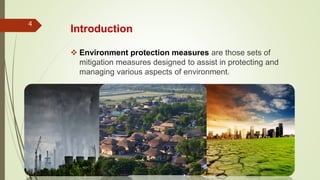
 Environment protection measures are those sets of
mitigation measures designed to assist in protecting and
managing various aspects of environment.
4
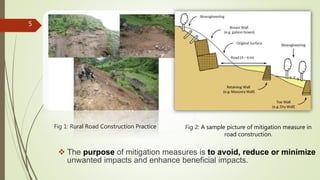
Fig 2: A sample picture of mitigation measure in
road construction.
5
 The purpose of mitigation measures is to avoid, reduce or minimize
unwanted impacts and enhance beneficial impacts.
Fig 1: Rural Road Construction Practice
Objectives of Mitigation Measures
To protect the physical, biological and human environments.
To manage mineral wastes.
To manage hazardous compounds and wastes.
To provide the basis for the development of monitoring plans.
To find better alternatives and ways of doing things.
To enhance the environmental and social benefits of a
proposal.
To avoid, minimize or remedy adverse impacts.
To ensure that residual adverse impacts are kept within
acceptable levels.
6
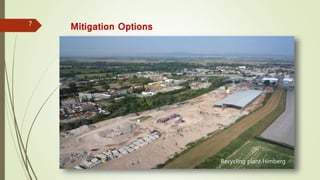
Mitigation Options
Develop alternatives that are better environmentally
Make changes in planning and design
Carry out impacts monitoring and management
Compensate for residual impacts
a. Monetary payment
7
Fig.3: Monetary compensation Fig.4: Compensatory Plantation
b. Site remediation bonds
Recycling plant Himberg
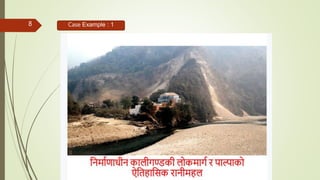
8 Case Example : 1
9 Case Example : 2
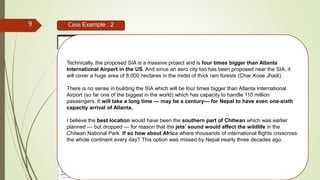
“What are the options then?
No doubt the only international airport in the country — Tribhuvan International Airport (TIA) — is
congested. But to ease air traffic at the TIA, can we afford to build another airport which has huge
economic and environmental cost?
The first thing the government should do is expanding the TIA to the extent possible. TIA still
has three more hours to accommodate flights, as it is currently operating for 21 hours a day. Then,
there is Simara Airport which can be upgraded. Since two international airports — in Pokhara
and Bhairahawa — are being built, these could suffice the need of Nepal. By spending the
money that we would be putting to build the SIA in Nijgadh, we can have at least three world class
international airports with aero cities.
The real investment must be augmented in the agriculture sector which still provides one
third of the GDP. Nepal still has a lot of potential in the tourism sector. But it is yet to contribute
more than 3 per cent to the GDP. The one sector that can bail the country out of economic
problems is but agriculture.
Our import export ratio of 15 to 1 can be improved only with needed investment in agriculture
which is still the most neglected sector.
The tourism sector needs heavy investment, but this must be made carefully to match with only
the practical arrival demands of future till 2050. So, for now investment in upgradation of the
TIA and Simara Airport and adding capacity in Lumbini and Pokhara international airports
is the most viable solution, which will have minimum environmental and social impacts.
Technically, the proposed SIA is a massive project and is four times bigger than Atlanta
International Airport in the US. And since an aero city too has been proposed near the SIA, it
will cover a huge area of 8,000 hectares in the midst of thick rain forests (Char Kose Jhadi).
There is no sense in building the SIA which will be four times bigger than Atlanta International
Airport (so far one of the biggest in the world) which has capacity to handle 110 million
passengers. It will take a long time — may be a century— for Nepal to have even one-sixth
capacity arrival of Atlanta.
I believe the best location would have been the southern part of Chitwan which was earlier
planned — but dropped — for reason that the jets’ sound would affect the wildlife in the
Chitwan National Park. If so how about Africa where thousands of international flights crisscross
the whole continent every day? This option was missed by Nepal nearly three decades ago.
10
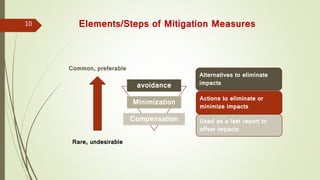
Common, preferable
Rare, undesirable
avoidance
Minimization
Compensation
Alternatives to eliminate
impacts
Actions to eliminate or
minimize impacts
Used as a last report to
offset impacts
Elements/Steps of Mitigation Measures
11 Case Example : 3
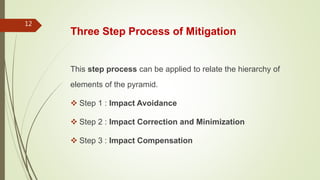
Three Step Process of Mitigation
This step process can be applied to relate the hierarchy of
elements of the pyramid.
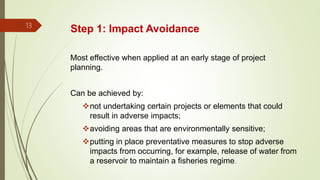
 Step 1 : Impact Avoidance
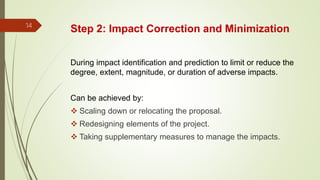
 Step 2 : Impact Correction and Minimization
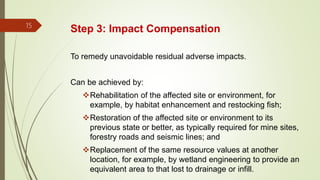
 Step 3 : Impact Compensation
12
Step 1: Impact Avoidance13
Most effective when applied at an early stage of project
planning.
Can be achieved by:
not undertaking certain projects or elements that could
result in adverse impacts;
avoiding areas that are environmentally sensitive;
putting in place preventative measures to stop adverse
impacts from occurring, for example, release of water from
a reservoir to maintain a fisheries regime.
Step 2: Impact Correction and Minimization
During impact identification and prediction to limit or reduce the
degree, extent, magnitude, or duration of adverse impacts.
Can be achieved by:
 Scaling down or relocating the proposal.
 Redesigning elements of the project.
 Taking supplementary measures to manage the impacts.
14
Step 3: Impact Compensation
To remedy unavoidable residual adverse impacts.
Can be achieved by:
Rehabilitation of the affected site or environment, for
example, by habitat enhancement and restocking fish;
Restoration of the affected site or environment to its
previous state or better, as typically required for mine sites,
forestry roads and seismic lines; and
Replacement of the same resource values at another
location, for example, by wetland engineering to provide an
equivalent area to that lost to drainage or infill.
15
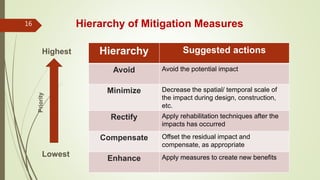
16 Hierarchy of Mitigation Measures
Hierarchy Suggested actions
Avoid Avoid the potential impact
Minimize Decrease the spatial/ temporal scale of
the impact during design, construction,
etc.
Rectify Apply rehabilitation techniques after the
impacts has occurred
Compensate Offset the residual impact and
compensate, as appropriate
Enhance Apply measures to create new benefits
Highest
Lowest
Priority
Types of Mitigation Measures
 Consideration of Alternatives
17
 Preventive Measures
 Corrective Measures
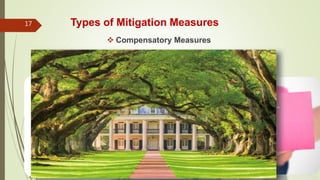
 Compensatory Measures
Consideration of Alternatives
 Selection of alternatives is a form of mitigation in terms of
impacts, cost and technology.
 Selection of alternatives is also known as “Heart of EIA”.
 Important aspects of developmental proposals, for which
alternatives are need to be considered includes: Scale,
technology, location, fuel, raw materials, design, time
schedule, economic factors.
 EIA examines the best alternatives to meet the objectives.
18
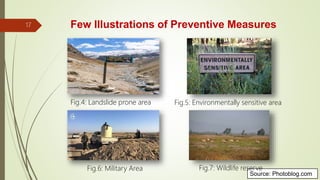
Preventive Measures
 Change location/site to avoid impacts, such as re-route from
forests to degraded areas
 Avoid environmentally sensitive areas
 Integrate education, health and sanitation programs and/or
include additional social service facilities
 Organize public awareness programs, etc.
19
Few Illustrations of Preventive Measures
Source: Photoblog.com
Fig.6: Military Area Fig.7: Wildlife reserve
Fig.5: Environmentally sensitive areaFig.4: Landslide prone area
17
Corrective Measures
 If impacts can’t be avoided, reduce impacts to an acceptable
level through.
 Use of technologies, practices, inclusion of facilitative
measures.
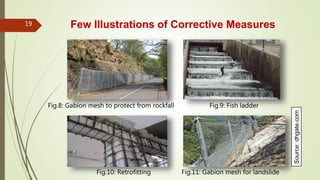
 Construct fish ladder to ensure movement of migratory fish
species.
 Use bio-engineering measures to stabilize slopes, etc.
21
Few Illustrations of Corrective Measures
Fig.8: Gabion mesh to protect from rockfall Fig.9: Fish ladder
Fig.10: Retrofitting Fig.11: Gabion mesh for landslide
Source:dhgate.com
19
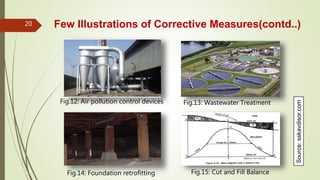
Few Illustrations of Corrective Measures(contd..)
Fig.13: Wastewater Treatment
Fig.15: Cut and Fill BalanceFig.14: Foundation retrofitting
Fig.12: Air pollution control devices
Source:sskavdisor.com
20
Compensatory Measures
 Compensatory measures are the actions that address
adverse impacts which are unavoidable.
 Compensatory plantation
 Compensation for land and property etc.
24
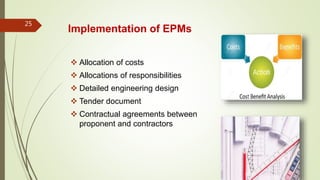
Implementation of EPMs
 Allocation of costs
 Allocations of responsibilities
 Detailed engineering design
 Tender document
 Contractual agreements between
proponent and contractors
25
Challenges Encountered
High financial cost involved.
Political interference.
Lack of adequate resources to implement the enforcement
mechanism for the implementation of mitigation measures.
26
Implementation of Mitigation Measures
Regular internal audits should be carried out by
management of industries.
Costs of implementation should be reduced.
Environment officers should be employed.
All workers should be involved in the implementation of
mitigation measures and not leaving the task only the
management.
Community members should be consulted.
Workers should be sensitized to increase awareness.
27
28
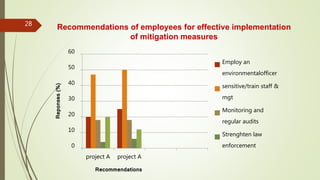
Recommendations of employees for effective implementation
of mitigation measures
0
10
20
30
40
50
60
project A project A
Employ an
environmentalofficer
sensitive/train staff &
mgt
Monitoring and
regular audits
Strenghten law
enforcement
Reponses(%)
Recommendations
THANK YOU…
29
Any Queries ???

EIA : Environmental Protection Measures

  • 1.
    A PRESENTATION ON ENVIRONMENTAL PROTECTION MEASURES Groupmembers: Prabhat, 097 Pradeep, 098 Rajan, 110 Sakcham, 132 Tutor: Asst. Prof. Shukra Raj Paudel Department of Civil Engineering IOE, Tribhuvan University 2019-Jun-29 EIA
  • 2.
    Objectives of thePresentation To understand what Environmental Protection Measure is. To understand the objectives of mitigation measures. To know the different types of mitigation measures. To know how these mitigation measures can be implemented. 2
  • 3.
    Presentation Outline Introduction Objectives ofMitigation Measures Types of Mitigation Measures Implementation of Mitigation Measures 3
  • 4.
    Introduction  Environment protectionmeasures are those sets of mitigation measures designed to assist in protecting and managing various aspects of environment. 4
  • 5.
    Fig 2: Asample picture of mitigation measure in road construction. 5  The purpose of mitigation measures is to avoid, reduce or minimize unwanted impacts and enhance beneficial impacts. Fig 1: Rural Road Construction Practice
  • 6.
    Objectives of MitigationMeasures To protect the physical, biological and human environments. To manage mineral wastes. To manage hazardous compounds and wastes. To provide the basis for the development of monitoring plans. To find better alternatives and ways of doing things. To enhance the environmental and social benefits of a proposal. To avoid, minimize or remedy adverse impacts. To ensure that residual adverse impacts are kept within acceptable levels. 6
  • 7.
    Mitigation Options Develop alternativesthat are better environmentally Make changes in planning and design Carry out impacts monitoring and management Compensate for residual impacts a. Monetary payment 7 Fig.3: Monetary compensation Fig.4: Compensatory Plantation b. Site remediation bonds Recycling plant Himberg
  • 8.
  • 9.
    9 Case Example: 2 “What are the options then? No doubt the only international airport in the country — Tribhuvan International Airport (TIA) — is congested. But to ease air traffic at the TIA, can we afford to build another airport which has huge economic and environmental cost? The first thing the government should do is expanding the TIA to the extent possible. TIA still has three more hours to accommodate flights, as it is currently operating for 21 hours a day. Then, there is Simara Airport which can be upgraded. Since two international airports — in Pokhara and Bhairahawa — are being built, these could suffice the need of Nepal. By spending the money that we would be putting to build the SIA in Nijgadh, we can have at least three world class international airports with aero cities. The real investment must be augmented in the agriculture sector which still provides one third of the GDP. Nepal still has a lot of potential in the tourism sector. But it is yet to contribute more than 3 per cent to the GDP. The one sector that can bail the country out of economic problems is but agriculture. Our import export ratio of 15 to 1 can be improved only with needed investment in agriculture which is still the most neglected sector. The tourism sector needs heavy investment, but this must be made carefully to match with only the practical arrival demands of future till 2050. So, for now investment in upgradation of the TIA and Simara Airport and adding capacity in Lumbini and Pokhara international airports is the most viable solution, which will have minimum environmental and social impacts. Technically, the proposed SIA is a massive project and is four times bigger than Atlanta International Airport in the US. And since an aero city too has been proposed near the SIA, it will cover a huge area of 8,000 hectares in the midst of thick rain forests (Char Kose Jhadi). There is no sense in building the SIA which will be four times bigger than Atlanta International Airport (so far one of the biggest in the world) which has capacity to handle 110 million passengers. It will take a long time — may be a century— for Nepal to have even one-sixth capacity arrival of Atlanta. I believe the best location would have been the southern part of Chitwan which was earlier planned — but dropped — for reason that the jets’ sound would affect the wildlife in the Chitwan National Park. If so how about Africa where thousands of international flights crisscross the whole continent every day? This option was missed by Nepal nearly three decades ago.
  • 10.
    10 Common, preferable Rare, undesirable avoidance Minimization Compensation Alternativesto eliminate impacts Actions to eliminate or minimize impacts Used as a last report to offset impacts Elements/Steps of Mitigation Measures
  • 11.
  • 12.
    Three Step Processof Mitigation This step process can be applied to relate the hierarchy of elements of the pyramid.  Step 1 : Impact Avoidance  Step 2 : Impact Correction and Minimization  Step 3 : Impact Compensation 12
  • 13.
    Step 1: ImpactAvoidance13 Most effective when applied at an early stage of project planning. Can be achieved by: not undertaking certain projects or elements that could result in adverse impacts; avoiding areas that are environmentally sensitive; putting in place preventative measures to stop adverse impacts from occurring, for example, release of water from a reservoir to maintain a fisheries regime.
  • 14.
    Step 2: ImpactCorrection and Minimization During impact identification and prediction to limit or reduce the degree, extent, magnitude, or duration of adverse impacts. Can be achieved by:  Scaling down or relocating the proposal.  Redesigning elements of the project.  Taking supplementary measures to manage the impacts. 14
  • 15.
    Step 3: ImpactCompensation To remedy unavoidable residual adverse impacts. Can be achieved by: Rehabilitation of the affected site or environment, for example, by habitat enhancement and restocking fish; Restoration of the affected site or environment to its previous state or better, as typically required for mine sites, forestry roads and seismic lines; and Replacement of the same resource values at another location, for example, by wetland engineering to provide an equivalent area to that lost to drainage or infill. 15
  • 16.
    16 Hierarchy ofMitigation Measures Hierarchy Suggested actions Avoid Avoid the potential impact Minimize Decrease the spatial/ temporal scale of the impact during design, construction, etc. Rectify Apply rehabilitation techniques after the impacts has occurred Compensate Offset the residual impact and compensate, as appropriate Enhance Apply measures to create new benefits Highest Lowest Priority
  • 17.
    Types of MitigationMeasures  Consideration of Alternatives 17  Preventive Measures  Corrective Measures  Compensatory Measures
  • 18.
    Consideration of Alternatives Selection of alternatives is a form of mitigation in terms of impacts, cost and technology.  Selection of alternatives is also known as “Heart of EIA”.  Important aspects of developmental proposals, for which alternatives are need to be considered includes: Scale, technology, location, fuel, raw materials, design, time schedule, economic factors.  EIA examines the best alternatives to meet the objectives. 18
  • 19.
    Preventive Measures  Changelocation/site to avoid impacts, such as re-route from forests to degraded areas  Avoid environmentally sensitive areas  Integrate education, health and sanitation programs and/or include additional social service facilities  Organize public awareness programs, etc. 19
  • 20.
    Few Illustrations ofPreventive Measures Source: Photoblog.com Fig.6: Military Area Fig.7: Wildlife reserve Fig.5: Environmentally sensitive areaFig.4: Landslide prone area 17
  • 21.
    Corrective Measures  Ifimpacts can’t be avoided, reduce impacts to an acceptable level through.  Use of technologies, practices, inclusion of facilitative measures.  Construct fish ladder to ensure movement of migratory fish species.  Use bio-engineering measures to stabilize slopes, etc. 21
  • 22.
    Few Illustrations ofCorrective Measures Fig.8: Gabion mesh to protect from rockfall Fig.9: Fish ladder Fig.10: Retrofitting Fig.11: Gabion mesh for landslide Source:dhgate.com 19
  • 23.
    Few Illustrations ofCorrective Measures(contd..) Fig.13: Wastewater Treatment Fig.15: Cut and Fill BalanceFig.14: Foundation retrofitting Fig.12: Air pollution control devices Source:sskavdisor.com 20
  • 24.
    Compensatory Measures  Compensatorymeasures are the actions that address adverse impacts which are unavoidable.  Compensatory plantation  Compensation for land and property etc. 24
  • 25.
    Implementation of EPMs Allocation of costs  Allocations of responsibilities  Detailed engineering design  Tender document  Contractual agreements between proponent and contractors 25
  • 26.
    Challenges Encountered High financialcost involved. Political interference. Lack of adequate resources to implement the enforcement mechanism for the implementation of mitigation measures. 26
  • 27.
    Implementation of MitigationMeasures Regular internal audits should be carried out by management of industries. Costs of implementation should be reduced. Environment officers should be employed. All workers should be involved in the implementation of mitigation measures and not leaving the task only the management. Community members should be consulted. Workers should be sensitized to increase awareness. 27
  • 28.
    28 Recommendations of employeesfor effective implementation of mitigation measures 0 10 20 30 40 50 60 project A project A Employ an environmentalofficer sensitive/train staff & mgt Monitoring and regular audits Strenghten law enforcement Reponses(%) Recommendations
  • 29.