
government in the 2.0 era Hillary Hartley NIC Inc. Government Technology Events Fall 2008
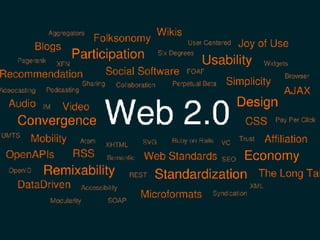
What is Web 2.0?
 
Web 2.0 is not… all about technology.
It is an era.
But how did we get here? Talking – Conversation  Reading – Newspapers  Listening – Radio Watching – Television Browsing – Web 1.0 Searching – Web 1.5 Sharing == Web 2.0
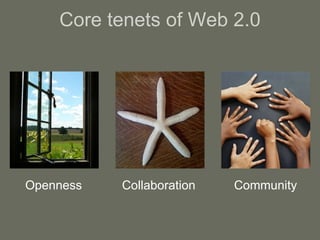
Core tenets of Web 2.0 Openness Collaboration Community
What does this mean for government?
The productivity gains from Web 1.0 have been used up. The efficiency gains and the real value of Web 2.0 will come from  collaboration .
Web 1.0    eGov Web 2.0    ????
eGov, iGov, we all Gov efficiency & invisibility
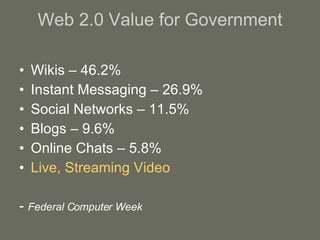
Web 2.0 Value for Government Wikis – 46.2% Instant Messaging – 26.9% Social Networks – 11.5% Blogs – 9.6% Online Chats – 5.8% Live, Streaming Video -  Federal Computer Week
let’s dig deeper
The 5 Ws Who? What? When? Where? Why?
Who?
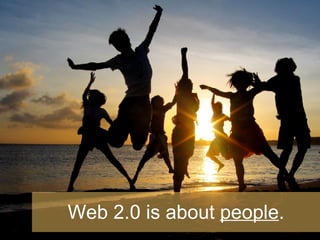
Web 2.0 is about  people .
Read-write Web  +  People Using It   Web 2.0
Collective User Value Benefiting from massive traffic and use The more users, the better the system performs Who? Web 2.0 is about  people .
Harnessing Collective Intelligence Wikinomics & Crowdsourcing Architecture of Participation Who? Web 2.0 is about  people .
What?
Web 2.0 is about  data .
Data is the “Intel Inside” Unique, hard-to-replicate data source = competitive advantage Large amounts of data create their own algorithms & patterns What? Web 2.0 is about  data .
Mashed Up “ High-tech versions of Tinkertoys” Individual pieces of data become more valuable together than apart What? Web 2.0 is about  data .
There are creative people all around the world…and they are going to think of things to do with our [data] that we didn’t think of. - Vint Cerf, Google Web 2.0 is about  data .
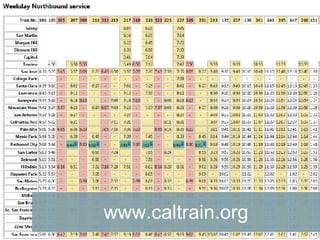
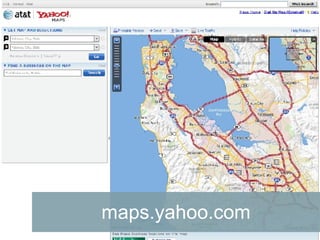
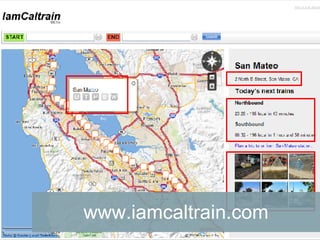
Quick Case Study iamcaltrain.com
www.caltrain.org
maps.yahoo.com
www.iamcaltrain.com
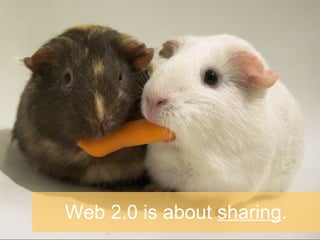
Web 2.0 is about  sharing .
What? Collaboration & Sharing A  culture  of sharing Old = knowledge management New = knowledge sharing Web 2.0 is about  sharing .
When?
Web 2.0 is  NOW .
When? Real-time, Always On, Immediate Real-time interactions among users Real-time services based on your data Dialog Viral, engaging Barriers to entry have disappeared Web 2.0 is  NOW .
Where?
Web 2.0 is about the  network .
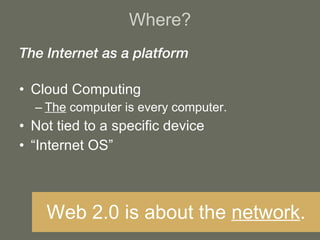
Where? The Internet as a platform Cloud Computing The  computer is every computer. Not tied to a specific device “ Internet OS” Web 2.0 is about the  network .
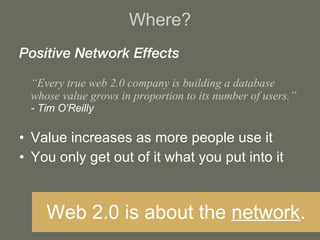
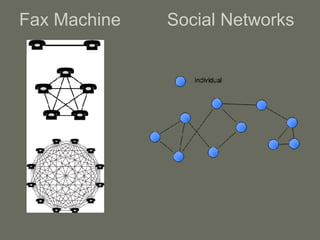
Where? Positive Network Effects “ Every true web 2.0 company is building a database whose value grows in proportion to its number of users.” - Tim O’Reilly Value increases as more people use it You only get out of it what you put into it Web 2.0 is about the  network .
Fax Machine   Social Networks
Why?
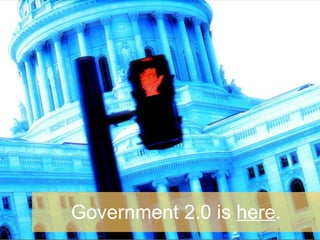
Government 2.0 is  here .
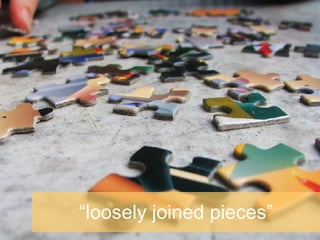
Future of eGovernment moving away from “one stop shop” portal turning more towards mashups reusability  of content and web services “ The ability to  integrate  information and services more easily with Web 2.0 technologies will cause a  fundamental rethinking  of how government services are delivered online and of what constitutes government data and processes.” Gartner,  The Real Future of E-Government: From Joined-Up to Mashed Up
“ loosely joined pieces”
 
Trust    Empowerment Cooperate with your citizens. Reward collaboration. Loosen the grips of control.
Examples Some of my favorite sites. What they do, and how you might use them.
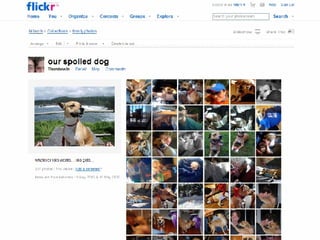
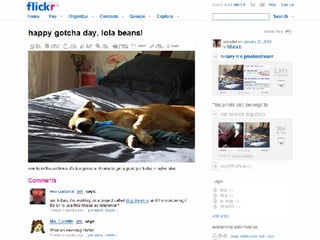
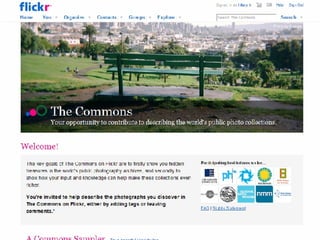
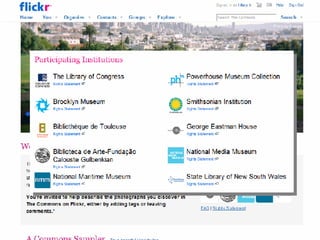
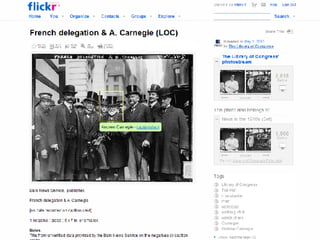
flickr folksonomy-based photo-sharing


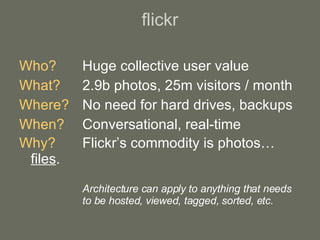
flickr Who? Huge collective user value What?   2.9b photos, 25m visitors / month Where? No need for hard drives, backups When? Conversational, real-time Why? Flickr’s commodity is photos… files . Architecture can apply to anything that needs to be hosted, viewed, tagged, sorted, etc.
twitter What are you doing?
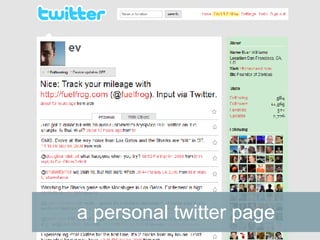
a personal twitter page
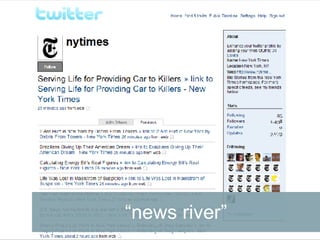
“ news river”
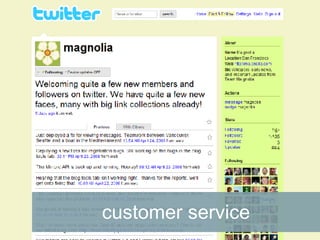
customer service
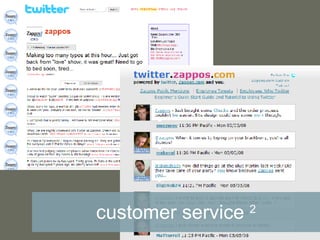
customer service  2
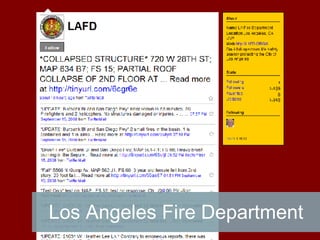
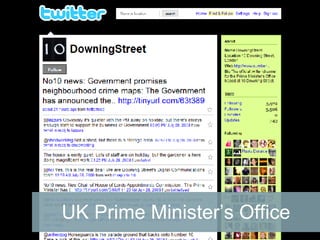
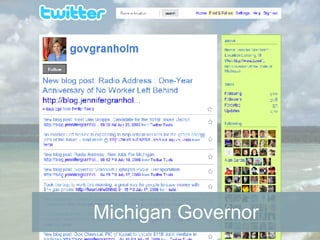
some gov-related twitters
Los Angeles Fire Department
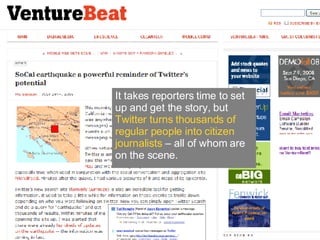
It takes reporters time to set up and get the story, but  Twitter turns thousands of regular people into citizen journalists  – all of whom are on the scene.
UK Prime Minister’s Office
Michigan Governor
twitter Who? Network effects are massive What?   1m+ users, 3m+ messages / day Where? Literally all over the globe When? Instantaneous, mobile, viral  Why? Future of hybrid communication Numerous ways to send & receive “tweets” – syndicated, IM, SMS, email, widgets, software
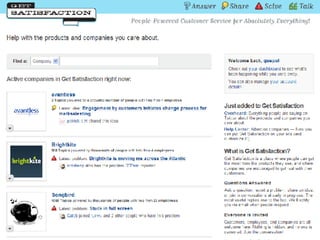
get satisfaction people-powered customer service
 
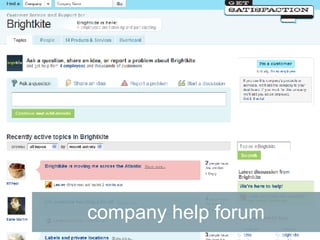
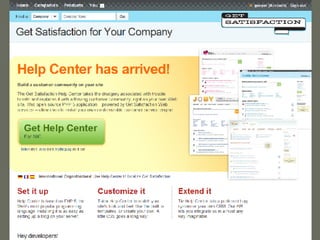
company help forum
 
 
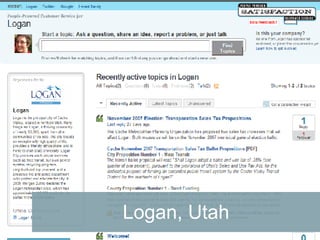
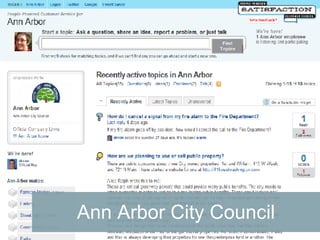
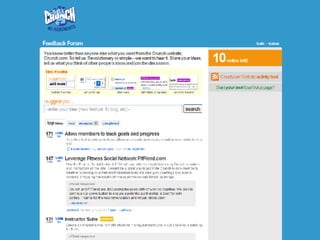
some gov-related forums
Logan, Utah
Ann Arbor City Council
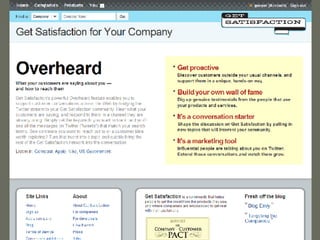
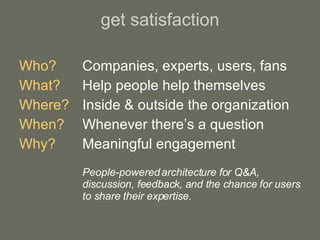
get satisfaction Who? Companies, experts, users, fans What?   Help people help themselves Where? Inside & outside the organization When? Whenever there’s a question Why? Meaningful engagement People-powered architecture for Q&A,  discussion, feedback, and the chance for users  to share their expertise.
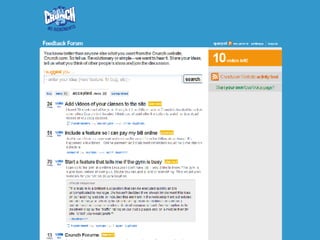
uservoice user-driven feedback loops


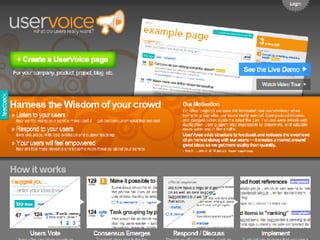
uservoice Who? Companies, organizations What?   Feedback, support tracking Where? From the bottom up When? Whenever someone has an idea Why? Empowered users, better products User-driven feedback loops, support tracking,  listen to users, build consensus, report
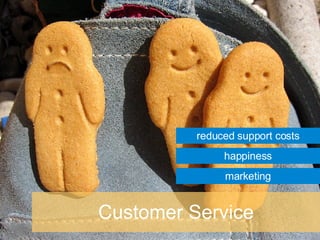
Customer Service marketing happiness reduced support costs
policy
Wikify the Process Draft –> Publish –> Review Changes tracked, history saved Near final form in much shorter time Address policy concerns.
Make the Business Case Perhaps instead of traditional “Acceptable Use Policies,” make the business case and let that drive creation and interaction. Address policy concerns.
Your To-Do List No need to reinvent the wheel. Use available tools. Get your feet wet.
Increasing Efficiency & Productivity Shared project and team spaces Live capture of streamed online meetings & conferences for ongoing participation and feedback Real-time collaboration channels Collaborative document creation Development & support of cross-agency Web sites and services
Start Small... Baby Steps Encourage use internally Productivity gains Learn to appreciate the technology Wikis, wikis, wikis! Organize and record notes from meetings Central repository for login information/web tools Storing contact information – staff, vendors, etc. Various “one-stop” projects
The Importance of Web Standards (X)HTML, XML, CSS, XSLT, DOM, etc. Microformats Plain ol’ semantic HTML (POSH)‏ More than just “table-free” HTML. When your site adheres to web standards, that semantic code becomes your API.
What can you do right now? Be open to technology and existing services think outside the box Think about your data in “layers” for google, twitter, iCal, web services Start to embrace a culture of sharing and openness Have conversations; build community
“ At the end of the day, it’s not even about collecting information on your portals.  The best way to make yourself web 2.0 is actually to  expose  your data  in ways that  let other people  re-use  it .” Tim O’Reilly,  Government Thinking about Web 2.0
Social Media Platform blogs & micro-blogs, wikis, podcasts, photo & video sharing, live video streaming, social networking, social bookmarking, mashups, feeds, microformats
Web 2.0 is not just about the technology… It is the emergence of a new era, a shift in ideals, enabled  by the technology.
embrace the shift
Photos & Concepts http://flickr.com/photos/dpwhitt/127977447/ http://flickr.com/photos/tookie/183503927/ http://flickr.com/photos/vonkinder/318622997/ http://flickr.com/photos/ryanr/142455033/ http://flickr.com/photos/adrian_s/8271860/ http://flickr.com/photos/thorinside/194806347/ http://flickr.com/photos/zeuxis/318242414/ http://flickr.com/photos/moonrising/211122147/ http://flickr.com/photos/tcp909/132665279/ http://flickr.com/photos/m_e_l_o_d_y/392265668/ http://flickr.com/photos/darwinbell/515431862/ http://flickr.com/photos/78364563@N00/34575328/ Many thanks to my friends Tara Hunt (http://horsepigcow.com) and Silona Bonewald (http://silona.com).
Thank you! Hillary Hartley [email_address] 415-573-2487 follow @quepol

Web 2.0 - cutting through the clutter

  • 1.
    government in the2.0 era Hillary Hartley NIC Inc. Government Technology Events Fall 2008
  • 2.
  • 3.
  • 4.
    Web 2.0 isnot… all about technology.
  • 5.
  • 6.
    But how didwe get here? Talking – Conversation Reading – Newspapers Listening – Radio Watching – Television Browsing – Web 1.0 Searching – Web 1.5 Sharing == Web 2.0
  • 7.
    Core tenets ofWeb 2.0 Openness Collaboration Community
  • 8.
    What does thismean for government?
  • 9.
    The productivity gainsfrom Web 1.0 have been used up. The efficiency gains and the real value of Web 2.0 will come from collaboration .
  • 10.
    Web 1.0  eGov Web 2.0  ????
  • 11.
    eGov, iGov, weall Gov efficiency & invisibility
  • 12.
    Web 2.0 Valuefor Government Wikis – 46.2% Instant Messaging – 26.9% Social Networks – 11.5% Blogs – 9.6% Online Chats – 5.8% Live, Streaming Video - Federal Computer Week
  • 13.
  • 14.
    The 5 WsWho? What? When? Where? Why?
  • 15.
  • 16.
    Web 2.0 isabout people .
  • 17.
    Read-write Web + People Using It Web 2.0
  • 18.
    Collective User ValueBenefiting from massive traffic and use The more users, the better the system performs Who? Web 2.0 is about people .
  • 19.
    Harnessing Collective IntelligenceWikinomics & Crowdsourcing Architecture of Participation Who? Web 2.0 is about people .
  • 20.
  • 21.
    Web 2.0 isabout data .
  • 22.
    Data is the“Intel Inside” Unique, hard-to-replicate data source = competitive advantage Large amounts of data create their own algorithms & patterns What? Web 2.0 is about data .
  • 23.
    Mashed Up “High-tech versions of Tinkertoys” Individual pieces of data become more valuable together than apart What? Web 2.0 is about data .
  • 24.
    There are creativepeople all around the world…and they are going to think of things to do with our [data] that we didn’t think of. - Vint Cerf, Google Web 2.0 is about data .
  • 25.
    Quick Case Studyiamcaltrain.com
  • 26.
  • 27.
  • 28.
  • 29.
    Web 2.0 isabout sharing .
  • 30.
    What? Collaboration &Sharing A culture of sharing Old = knowledge management New = knowledge sharing Web 2.0 is about sharing .
  • 31.
  • 32.
    Web 2.0 is NOW .
  • 33.
    When? Real-time, AlwaysOn, Immediate Real-time interactions among users Real-time services based on your data Dialog Viral, engaging Barriers to entry have disappeared Web 2.0 is NOW .
  • 34.
  • 35.
    Web 2.0 isabout the network .
  • 36.
    Where? The Internetas a platform Cloud Computing The computer is every computer. Not tied to a specific device “ Internet OS” Web 2.0 is about the network .
  • 37.
    Where? Positive NetworkEffects “ Every true web 2.0 company is building a database whose value grows in proportion to its number of users.” - Tim O’Reilly Value increases as more people use it You only get out of it what you put into it Web 2.0 is about the network .
  • 38.
    Fax Machine Social Networks
  • 39.
  • 40.
  • 41.
    Future of eGovernmentmoving away from “one stop shop” portal turning more towards mashups reusability of content and web services “ The ability to integrate information and services more easily with Web 2.0 technologies will cause a fundamental rethinking of how government services are delivered online and of what constitutes government data and processes.” Gartner, The Real Future of E-Government: From Joined-Up to Mashed Up
  • 42.
  • 43.
  • 44.
    Trust  Empowerment Cooperate with your citizens. Reward collaboration. Loosen the grips of control.
  • 45.
    Examples Some ofmy favorite sites. What they do, and how you might use them.
  • 46.
  • 47.
  • 48.
  • 49.
  • 50.
  • 51.
  • 52.
    flickr Who? Hugecollective user value What? 2.9b photos, 25m visitors / month Where? No need for hard drives, backups When? Conversational, real-time Why? Flickr’s commodity is photos… files . Architecture can apply to anything that needs to be hosted, viewed, tagged, sorted, etc.
  • 53.
    twitter What areyou doing?
  • 54.
  • 55.
  • 56.
  • 57.
  • 58.
  • 59.
    Los Angeles FireDepartment
  • 60.
    It takes reporterstime to set up and get the story, but Twitter turns thousands of regular people into citizen journalists – all of whom are on the scene.
  • 61.
  • 62.
  • 63.
    twitter Who? Networkeffects are massive What? 1m+ users, 3m+ messages / day Where? Literally all over the globe When? Instantaneous, mobile, viral Why? Future of hybrid communication Numerous ways to send & receive “tweets” – syndicated, IM, SMS, email, widgets, software
  • 64.
  • 65.
  • 66.
  • 67.
  • 68.
  • 69.
  • 70.
  • 71.
  • 72.
    get satisfaction Who?Companies, experts, users, fans What? Help people help themselves Where? Inside & outside the organization When? Whenever there’s a question Why? Meaningful engagement People-powered architecture for Q&A, discussion, feedback, and the chance for users to share their expertise.
  • 73.
  • 74.
  • 75.
  • 76.
  • 77.
    uservoice Who? Companies,organizations What? Feedback, support tracking Where? From the bottom up When? Whenever someone has an idea Why? Empowered users, better products User-driven feedback loops, support tracking, listen to users, build consensus, report
  • 78.
    Customer Service marketinghappiness reduced support costs
  • 79.
  • 80.
    Wikify the ProcessDraft –> Publish –> Review Changes tracked, history saved Near final form in much shorter time Address policy concerns.
  • 81.
    Make the BusinessCase Perhaps instead of traditional “Acceptable Use Policies,” make the business case and let that drive creation and interaction. Address policy concerns.
  • 82.
    Your To-Do ListNo need to reinvent the wheel. Use available tools. Get your feet wet.
  • 83.
    Increasing Efficiency &Productivity Shared project and team spaces Live capture of streamed online meetings & conferences for ongoing participation and feedback Real-time collaboration channels Collaborative document creation Development & support of cross-agency Web sites and services
  • 84.
    Start Small... BabySteps Encourage use internally Productivity gains Learn to appreciate the technology Wikis, wikis, wikis! Organize and record notes from meetings Central repository for login information/web tools Storing contact information – staff, vendors, etc. Various “one-stop” projects
  • 85.
    The Importance ofWeb Standards (X)HTML, XML, CSS, XSLT, DOM, etc. Microformats Plain ol’ semantic HTML (POSH)‏ More than just “table-free” HTML. When your site adheres to web standards, that semantic code becomes your API.
  • 86.
    What can youdo right now? Be open to technology and existing services think outside the box Think about your data in “layers” for google, twitter, iCal, web services Start to embrace a culture of sharing and openness Have conversations; build community
  • 87.
    “ At theend of the day, it’s not even about collecting information on your portals. The best way to make yourself web 2.0 is actually to expose your data in ways that let other people re-use it .” Tim O’Reilly, Government Thinking about Web 2.0
  • 88.
    Social Media Platformblogs & micro-blogs, wikis, podcasts, photo & video sharing, live video streaming, social networking, social bookmarking, mashups, feeds, microformats
  • 89.
    Web 2.0 isnot just about the technology… It is the emergence of a new era, a shift in ideals, enabled by the technology.
  • 90.
  • 91.
    Photos & Conceptshttp://flickr.com/photos/dpwhitt/127977447/ http://flickr.com/photos/tookie/183503927/ http://flickr.com/photos/vonkinder/318622997/ http://flickr.com/photos/ryanr/142455033/ http://flickr.com/photos/adrian_s/8271860/ http://flickr.com/photos/thorinside/194806347/ http://flickr.com/photos/zeuxis/318242414/ http://flickr.com/photos/moonrising/211122147/ http://flickr.com/photos/tcp909/132665279/ http://flickr.com/photos/m_e_l_o_d_y/392265668/ http://flickr.com/photos/darwinbell/515431862/ http://flickr.com/photos/78364563@N00/34575328/ Many thanks to my friends Tara Hunt (http://horsepigcow.com) and Silona Bonewald (http://silona.com).
  • 92.
    Thank you! HillaryHartley [email_address] 415-573-2487 follow @quepol