Efficient, Scalable, and
Provenance-Aware
Management
of Linked Data
Marcin Wylot
University of Fribourg, June 19, 2015
Doctoral advisor
Prof. Dr Philippe Cudré-Mauroux
Quiz
3
➢ Linked Data
➢ Big Data (3Vs)
➢ Semantic Web
➢ RDF
➢ Data Provenance
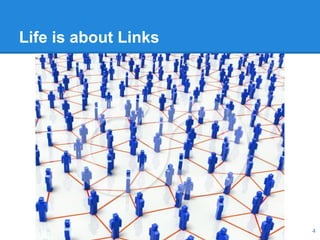
Life is about Links
4
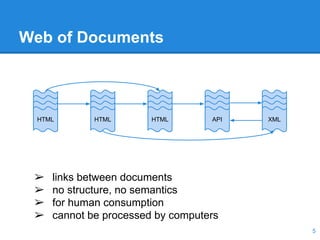
Web of Documents
5
HTML
HTML
HTML
HTML
HTML
HTML
HTML
HTML
HTML
HTML
HTML
HTML
HTML
HTML
HTML
API
HTML
HTML
HTML
XML
➢ links between documents
➢ no structure, no semantics
➢ for human consumption
➢ cannot be processed by computers
6
silos gonna silo
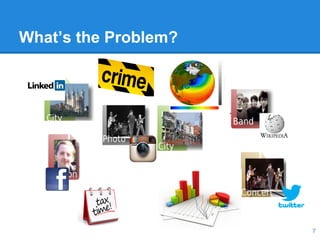
What’s the Problem?
7
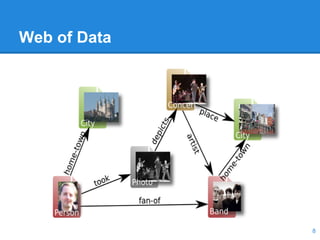
Web of Data
8
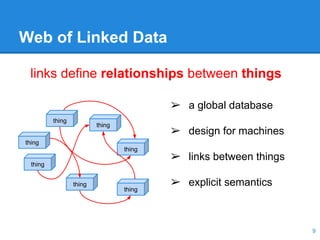
Web of Linked Data
9
thing
thing
thing
thing
thing
thing
thing
links define relationships between things
➢ a global database
➢ design for machines
➢ links between things
➢ explicit semantics
How Does it Change our Life?
10
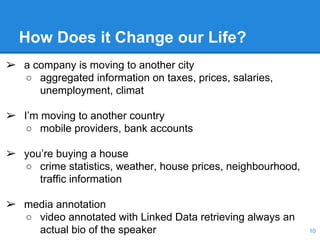
➢ a company is moving to another city
○ aggregated information on taxes, prices, salaries,
unemployment, climat
➢ I’m moving to another country
○ mobile providers, bank accounts
➢ you’re buying a house
○ crime statistics, weather, house prices, neighbourhood,
traffic information
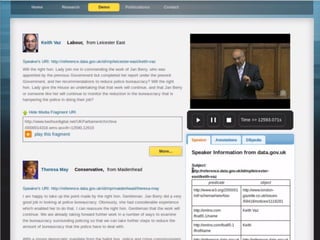
➢ media annotation
○ video annotated with Linked Data retrieving always an
actual bio of the speaker
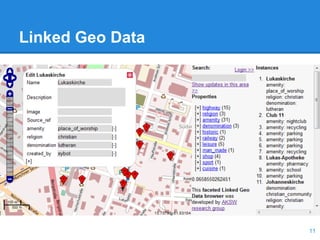
Linked Geo Data
11
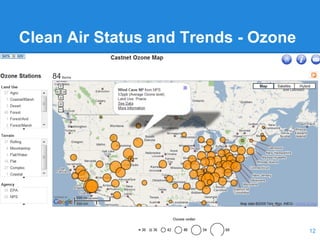
Clean Air Status and Trends - Ozone
12
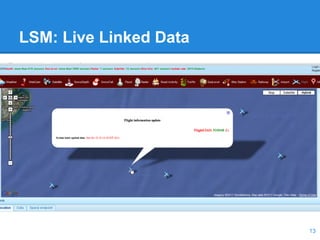
LSM: Live Linked Data
13
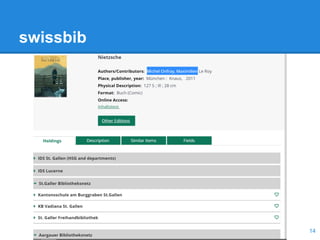
swissbib
14
15
16
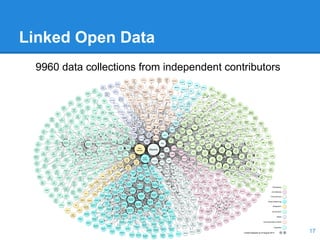
Linked Open Data
17
9960 data collections from independent contributors
Linked Data
12-05-30 18
➢ describes a method of publishing semi-structured data in
the Web
➢ data can be interlinked
➢ builds upon standard Web technologies
➢ extends the standards to share information in a way that
it can be read automatically by computers
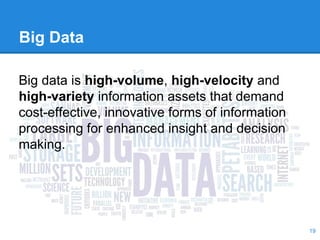
Big data is high-volume, high-velocity and
high-variety information assets that demand
cost-effective, innovative forms of information
processing for enhanced insight and decision
making.
Big Data
19
Linked Data is Big Data
12-05-30 20
➢ Volume: data size growing exponentially
➢ Velocity: streams of data from the Internet
of Things Cloud
➢ Variety
○ semi-structured data
○ heterogenous linked collections of data
Data Integration
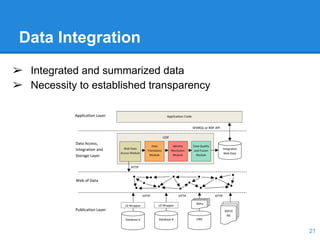
➢ Integrated and summarized data
➢ Necessity to established transparency
21
Data Provenance
“Provenance is information about
entities, activities, and people involved
in producing a piece of data or thing, which can be used to form
assessments about its quality, reliability or trustworthiness.”
Which pieces of data and how they were
combined to produce the results?
22
New Challenges
unstructuredness
AND
heterogeneity
23
How to efficiently store and query vast amounts
of Linked Data in the cloud?
24
➢ a new physiological data partitioning algorithm to
efficiently and effectively partition the graph and co-
locate related instances in partitions
➢ a new system architecture for handling fine-grained
partitions at scale
➢ novel data placement techniques to co-locate
semantically related pieces of data
➢ new data loading and query execution strategies
taking advantage of our system’s data partitions and
indices
How to store and track provenance in Linked
Data processing?
25
➢ a new way to express the provenance of query
results at two different granularity levels by leveraging
the concept of provenance polynomials
➢ two new storage models to represent provenance
data in a data store compactly
➢ query execution strategies to derive the
provenance polynomials while executing the queries
How can we efficiently support queries tailored
with provenance information?
26
➢ a characterization of provenance-enabled queries,
that is, queries tailored with provenance data
➢ five provenance-oriented query execution strategies
➢ storage model and indexing techniques to handle
provenance-aware query execution strategies
Contributions
➢ new advance data co-location and partitioning
techniques for efficient and scalable query
processing in the Cloud
➢ first efficient provenance-aware database for
Linked Data
27
Linked Data Technology Stack
➢ URI
➢ RDF
➢ SPARQL
28
URI: A Uniform Resource Identifier
29
“A Uniform Resource Identifier (URI) provides a
simple and extensible means for identifying a
resource.” -- RFC 3986
Some URIs for “real world” things:
https://www.linkedin.com/in/mwylot
http://dbpedia.org/page/Fribourg
http://www.geonames.org/2657895
RDF Data Model
30
➢ Standard model for data interchange on the
Web
➢ Statements about resources/things (triples)
○ Subject(URI) Predicate(URI) Object(URI) .
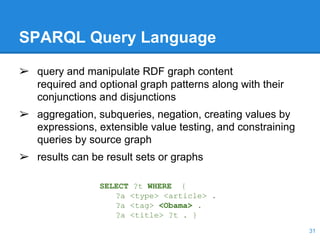
SPARQL Query Language
31
➢ query and manipulate RDF graph content
required and optional graph patterns along with their
conjunctions and disjunctions
➢ aggregation, subqueries, negation, creating values by
expressions, extensible value testing, and constraining
queries by source graph
➢ results can be result sets or graphs
SELECT ?t WHERE {
?a <type> <article> .
?a <tag> <Obama> .
?a <title> ?t . }
Outline
➢ Linked Data Management System
➢ Storing and Tracing Provenance
➢ Querying Provenance Information
32
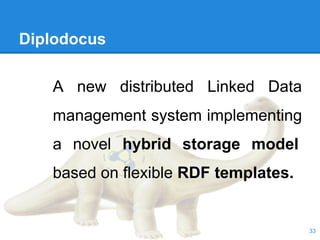
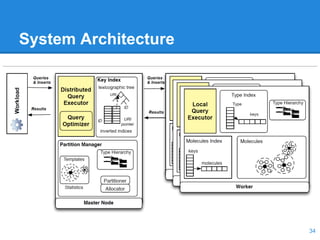
Diplodocus
33
A new distributed Linked Data
management system implementing
a novel hybrid storage model
based on flexible RDF templates.
System Architecture
34
Student787
Course18
Student
is_a
takes
John Doe
Last
Name
First
Name
4826 StudentID
Student67
Course5
Course6
Student
is_a
takes
takes
John Doe
Last
Name
First
Name
37347
StudentID
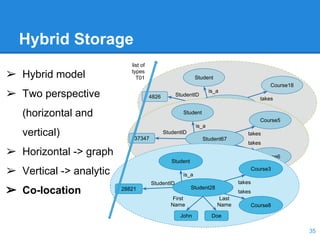
Hybrid Storage
Student28
Course3
Course8
Student
is_a
takes
takes
John Doe
Last
Name
First
Name
28821
StudentID
list of
types
T01➢ Hybrid model
➢ Two perspective
(horizontal and
vertical)
➢ Horizontal -> graph
➢ Vertical -> analytic
➢ Co-location
35
Outline
➢ Linked Data Management System
➢ Storing and Tracing Provenance
➢ Querying Provenance Information
36
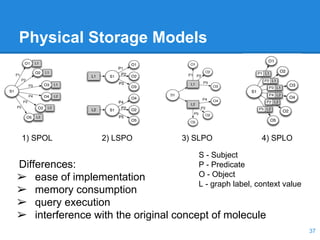
Physical Storage Models
Differences:
➢ ease of implementation
➢ memory consumption
➢ query execution
➢ interference with the original concept of molecule
1) SPOL 2) LSPO 3) SLPO 4) SPLO
37
S - Subject
P - Predicate
O - Object
L - graph label, context value
Provenance Polynomials
➢ Ability to characterize ways each source contributed
➢ Pinpoint the exact source to each result
➢ Trace back the list of sources the way they were combined
to deliver a result
"Algebraic structures for capturing the provenance
of sparql queries."
Geerts, Floris, et al.
Proceedings of the 16th International Conference
on Database Theory. ACM, 2013.
38
Example Polynomial
select ?lat ?long where {
?a [] ``Eiffel Tower''.
?a inCountry FR .
?a lat ?lat .
?a long ?long .
}
(l1 ⊕ l2 ⊕ l3) ⊗ (l4 ⊕ l5) ⊗ ( l6 ⊕ l7) ⊗ (l8 ⊕ l9) 39
Findings
➢ tracing provenance overhead is considerable
but acceptable, on average about 60-70%
➢ most suitable storage model depends upon
data and workloads characteristics
40
Outline
➢ Linked Data Management System
➢ Storing and Tracing Provenance
➢ Querying Provenance Information
41
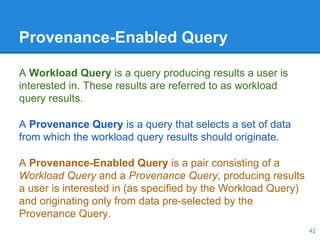
Provenance-Enabled Query
A Workload Query is a query producing results a user is
interested in. These results are referred to as workload
query results.
A Provenance Query is a query that selects a set of data
from which the workload query results should originate.
A Provenance-Enabled Query is a pair consisting of a
Workload Query and a Provenance Query, producing results
a user is interested in (as specified by the Workload Query)
and originating only from data pre-selected by the
Provenance Query.
42
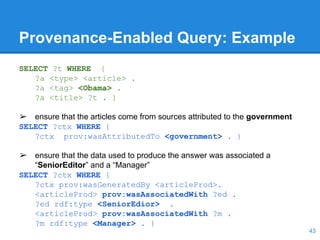
Provenance-Enabled Query: Example
SELECT ?t WHERE {
?a <type> <article> .
?a <tag> <Obama> .
?a <title> ?t . }
➢ ensure that the articles come from sources attributed to the government
SELECT ?ctx WHERE {
?ctx prov:wasAttributedTo <government> . }
➢ ensure that the data used to produce the answer was associated a
“SeniorEditor” and a “Manager”
SELECT ?ctx WHERE {
?ctx prov:wasGeneratedBy <articleProd>.
<articleProd> prov:wasAssociatedWith ?ed .
?ed rdf:type <SeniorEdior> .
<articleProd> prov:wasAssociatedWith ?m .
?m rdf:type <Manager> . }
43
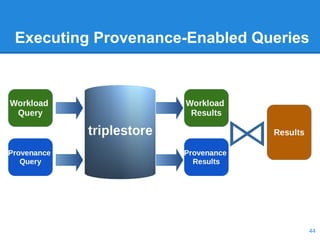
Executing Provenance-Enabled Queries
44
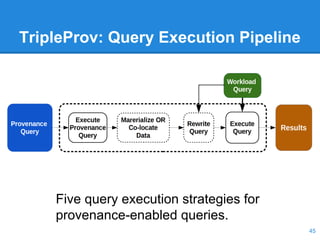
TripleProv: Query Execution Pipeline
45
Five query execution strategies for
provenance-enabled queries.
Results
46
Queries tailored with provenance
information can be executed faster due
to the selectivity of provenance
information.
Lessons Learnt
➢ there is room for further improvement in Linked Data
management
➢ co-location of related entities is the right way
➢ provenance overhead does not have to be high
➢ we can leverage provenance information to improve
performance
47
The Future
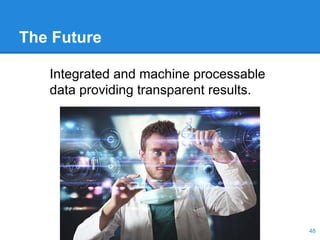
Integrated and machine processable
data providing transparent results.
48
Summary
➢ new advance data co-location and partitioning
techniques for efficient query processing
➢ cloud support for scalable query processing
➢ first efficient provenance-aware Linked Data
management system
➢ source code available online
49

Efficient, Scalable, and Provenance-Aware Management of Linked Data

  • 1.
    Efficient, Scalable, and Provenance-Aware Management ofLinked Data Marcin Wylot University of Fribourg, June 19, 2015 Doctoral advisor Prof. Dr Philippe Cudré-Mauroux
  • 2.
    Quiz 3 ➢ Linked Data ➢Big Data (3Vs) ➢ Semantic Web ➢ RDF ➢ Data Provenance
  • 3.
  • 4.
    Web of Documents 5 HTML HTML HTML HTML HTML HTML HTML HTML HTML HTML HTML HTML HTML HTML HTML API HTML HTML HTML XML ➢links between documents ➢ no structure, no semantics ➢ for human consumption ➢ cannot be processed by computers
  • 5.
  • 6.
  • 7.
  • 8.
    Web of LinkedData 9 thing thing thing thing thing thing thing links define relationships between things ➢ a global database ➢ design for machines ➢ links between things ➢ explicit semantics
  • 9.
    How Does itChange our Life? 10 ➢ a company is moving to another city ○ aggregated information on taxes, prices, salaries, unemployment, climat ➢ I’m moving to another country ○ mobile providers, bank accounts ➢ you’re buying a house ○ crime statistics, weather, house prices, neighbourhood, traffic information ➢ media annotation ○ video annotated with Linked Data retrieving always an actual bio of the speaker
  • 10.
  • 11.
    Clean Air Statusand Trends - Ozone 12
  • 12.
  • 13.
  • 14.
  • 15.
  • 16.
    Linked Open Data 17 9960data collections from independent contributors
  • 17.
    Linked Data 12-05-30 18 ➢describes a method of publishing semi-structured data in the Web ➢ data can be interlinked ➢ builds upon standard Web technologies ➢ extends the standards to share information in a way that it can be read automatically by computers
  • 18.
    Big data ishigh-volume, high-velocity and high-variety information assets that demand cost-effective, innovative forms of information processing for enhanced insight and decision making. Big Data 19
  • 19.
    Linked Data isBig Data 12-05-30 20 ➢ Volume: data size growing exponentially ➢ Velocity: streams of data from the Internet of Things Cloud ➢ Variety ○ semi-structured data ○ heterogenous linked collections of data
  • 20.
    Data Integration ➢ Integratedand summarized data ➢ Necessity to established transparency 21
  • 21.
    Data Provenance “Provenance isinformation about entities, activities, and people involved in producing a piece of data or thing, which can be used to form assessments about its quality, reliability or trustworthiness.” Which pieces of data and how they were combined to produce the results? 22
  • 22.
  • 23.
    How to efficientlystore and query vast amounts of Linked Data in the cloud? 24 ➢ a new physiological data partitioning algorithm to efficiently and effectively partition the graph and co- locate related instances in partitions ➢ a new system architecture for handling fine-grained partitions at scale ➢ novel data placement techniques to co-locate semantically related pieces of data ➢ new data loading and query execution strategies taking advantage of our system’s data partitions and indices
  • 24.
    How to storeand track provenance in Linked Data processing? 25 ➢ a new way to express the provenance of query results at two different granularity levels by leveraging the concept of provenance polynomials ➢ two new storage models to represent provenance data in a data store compactly ➢ query execution strategies to derive the provenance polynomials while executing the queries
  • 25.
    How can weefficiently support queries tailored with provenance information? 26 ➢ a characterization of provenance-enabled queries, that is, queries tailored with provenance data ➢ five provenance-oriented query execution strategies ➢ storage model and indexing techniques to handle provenance-aware query execution strategies
  • 26.
    Contributions ➢ new advancedata co-location and partitioning techniques for efficient and scalable query processing in the Cloud ➢ first efficient provenance-aware database for Linked Data 27
  • 27.
    Linked Data TechnologyStack ➢ URI ➢ RDF ➢ SPARQL 28
  • 28.
    URI: A UniformResource Identifier 29 “A Uniform Resource Identifier (URI) provides a simple and extensible means for identifying a resource.” -- RFC 3986 Some URIs for “real world” things: https://www.linkedin.com/in/mwylot http://dbpedia.org/page/Fribourg http://www.geonames.org/2657895
  • 29.
    RDF Data Model 30 ➢Standard model for data interchange on the Web ➢ Statements about resources/things (triples) ○ Subject(URI) Predicate(URI) Object(URI) .
  • 30.
    SPARQL Query Language 31 ➢query and manipulate RDF graph content required and optional graph patterns along with their conjunctions and disjunctions ➢ aggregation, subqueries, negation, creating values by expressions, extensible value testing, and constraining queries by source graph ➢ results can be result sets or graphs SELECT ?t WHERE { ?a <type> <article> . ?a <tag> <Obama> . ?a <title> ?t . }
  • 31.
    Outline ➢ Linked DataManagement System ➢ Storing and Tracing Provenance ➢ Querying Provenance Information 32
  • 32.
    Diplodocus 33 A new distributedLinked Data management system implementing a novel hybrid storage model based on flexible RDF templates.
  • 33.
  • 34.
    Student787 Course18 Student is_a takes John Doe Last Name First Name 4826 StudentID Student67 Course5 Course6 Student is_a takes takes JohnDoe Last Name First Name 37347 StudentID Hybrid Storage Student28 Course3 Course8 Student is_a takes takes John Doe Last Name First Name 28821 StudentID list of types T01➢ Hybrid model ➢ Two perspective (horizontal and vertical) ➢ Horizontal -> graph ➢ Vertical -> analytic ➢ Co-location 35
  • 35.
    Outline ➢ Linked DataManagement System ➢ Storing and Tracing Provenance ➢ Querying Provenance Information 36
  • 36.
    Physical Storage Models Differences: ➢ease of implementation ➢ memory consumption ➢ query execution ➢ interference with the original concept of molecule 1) SPOL 2) LSPO 3) SLPO 4) SPLO 37 S - Subject P - Predicate O - Object L - graph label, context value
  • 37.
    Provenance Polynomials ➢ Abilityto characterize ways each source contributed ➢ Pinpoint the exact source to each result ➢ Trace back the list of sources the way they were combined to deliver a result "Algebraic structures for capturing the provenance of sparql queries." Geerts, Floris, et al. Proceedings of the 16th International Conference on Database Theory. ACM, 2013. 38
  • 38.
    Example Polynomial select ?lat?long where { ?a [] ``Eiffel Tower''. ?a inCountry FR . ?a lat ?lat . ?a long ?long . } (l1 ⊕ l2 ⊕ l3) ⊗ (l4 ⊕ l5) ⊗ ( l6 ⊕ l7) ⊗ (l8 ⊕ l9) 39
  • 39.
    Findings ➢ tracing provenanceoverhead is considerable but acceptable, on average about 60-70% ➢ most suitable storage model depends upon data and workloads characteristics 40
  • 40.
    Outline ➢ Linked DataManagement System ➢ Storing and Tracing Provenance ➢ Querying Provenance Information 41
  • 41.
    Provenance-Enabled Query A WorkloadQuery is a query producing results a user is interested in. These results are referred to as workload query results. A Provenance Query is a query that selects a set of data from which the workload query results should originate. A Provenance-Enabled Query is a pair consisting of a Workload Query and a Provenance Query, producing results a user is interested in (as specified by the Workload Query) and originating only from data pre-selected by the Provenance Query. 42
  • 42.
    Provenance-Enabled Query: Example SELECT?t WHERE { ?a <type> <article> . ?a <tag> <Obama> . ?a <title> ?t . } ➢ ensure that the articles come from sources attributed to the government SELECT ?ctx WHERE { ?ctx prov:wasAttributedTo <government> . } ➢ ensure that the data used to produce the answer was associated a “SeniorEditor” and a “Manager” SELECT ?ctx WHERE { ?ctx prov:wasGeneratedBy <articleProd>. <articleProd> prov:wasAssociatedWith ?ed . ?ed rdf:type <SeniorEdior> . <articleProd> prov:wasAssociatedWith ?m . ?m rdf:type <Manager> . } 43
  • 43.
  • 44.
    TripleProv: Query ExecutionPipeline 45 Five query execution strategies for provenance-enabled queries.
  • 45.
    Results 46 Queries tailored withprovenance information can be executed faster due to the selectivity of provenance information.
  • 46.
    Lessons Learnt ➢ thereis room for further improvement in Linked Data management ➢ co-location of related entities is the right way ➢ provenance overhead does not have to be high ➢ we can leverage provenance information to improve performance 47
  • 47.
    The Future Integrated andmachine processable data providing transparent results. 48
  • 48.
    Summary ➢ new advancedata co-location and partitioning techniques for efficient query processing ➢ cloud support for scalable query processing ➢ first efficient provenance-aware Linked Data management system ➢ source code available online 49