LINKED DATA
DEMYSTIFIED

PRACTICAL EFFORTS TO TRANSFORM
CONTENTDM METADATA INTO LINKED
DATA
PRESENTERS


Silvia Southwick
Digital Collections Metadata Librarian
UNLV Libraries


Cory Lampert
Head of the Digital Collections Department
UNLV Libraries
OUTLINE
• Why should I care?
• What is it?
   • Defining Linked Data / Introduction to Linked Data
     Concepts / Linked Data Principles
   • Technologies & Standards for Linked Data
   • The Linked Data Cloud
• How?
   • Applying these concepts to digital collection records
   • Anticipated challenges working with CONTENTdm
• The UNLV Libraries Linked Data Project
• How could you start working with Linked Data?
LINKED DATA MYTHS

My collections are already visible through Google; so who
cares
This is a topic for catalogers
It’s too technical / complicated / boring


Actually ...
Linked data is the future of the Web
Data will no longer be in silos (catalog, CONTENTdm)
Relationships are powerful and worth the effort
HOW DO WE CURRENTLY CREATE
OUR DIGITAL COLLECTIONS?

Data (or metadata) are encapsulated in records
Records are contained in collections
Very few links are created within and/or across collections
Links have to be manually created
Existing links do not specify the nature of the relationships
among records


This structure hides potential links within and across
collections – DATA IS TRAPPED!
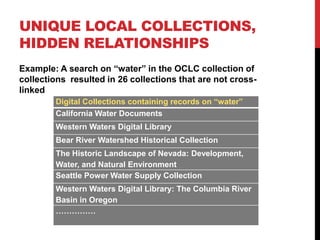
UNIQUE LOCAL COLLECTIONS,
HIDDEN RELATIONSHIPS
Example: A search on “water” in the OCLC collection of
collections resulted in 26 collections that are not cross-
linked
        Digital Collections containing records on “water”
        California Water Documents
        Western Waters Digital Library
        Bear River Watershed Historical Collection
        The Historic Landscape of Nevada: Development,
        Water, and Natural Environment
        Seattle Power Water Supply Collection
        Western Waters Digital Library: The Columbia River
        Basin in Oregon
        ……………
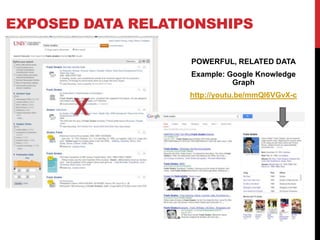
EXPOSED DATA RELATIONSHIPS

                   POWERFUL, RELATED DATA
                   Example: Google Knowledge
                             Graph
                   http://youtu.be/mmQl6VGvX-c
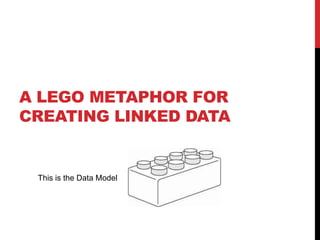
A LEGO METAPHOR FOR
CREATING LINKED DATA


 This is the Data Model
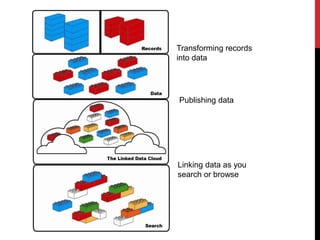
Transforming records
into data


Publishing data


Linking data as you
search or browse
DEFINING LINKED DATA
Linked Data
refers to a set of best practices for publishing and
interlinking data on the Web


   • Data needs to be machine-readable

   • Linked data (Web of Data) is an expansion of the Web we
     know (Web of documents)
WEB IN TRANSITION

1.   Two types of data:
     1.   Human-readable documents (email, brochure, report)
     2.   Machine-readable data (calendar, playlist, spreadsheet)

2.   Shopping example
     1.   A web page ad (document) says “dress”, “color”, “price”,
          “designer”
     2.   But machines cannot extract data to re-use in another
          application (e.g., spreadsheet to compare prices)

3.   RDF – new way to specify relationships and transfer context
     with data across applications: reusable data


4.   The time is now to start to evolve our documents into data
TECHNOLOGIES FOR
LINKED DATA
Linked data is built in the Web architecture (HTTP, URIs)


RDF is a data model (not a format)
 Most common serializations:
   • RDF/XML
   • RDFa
RDF is based on triples/statements


SPARQL - SPARQL Protocol and RDF Query Language -- is a
query language able to retrieve and manipulate data stored in
RDF.
WHAT ARE TRIPLES?
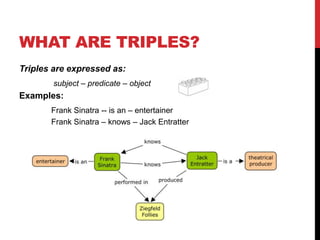
Triples are expressed as:
        subject – predicate – object
Examples:
       Frank Sinatra -- is an – entertainer
       Frank Sinatra – knows – Jack Entratter
EXAMPLE
TRIPLE  RDF


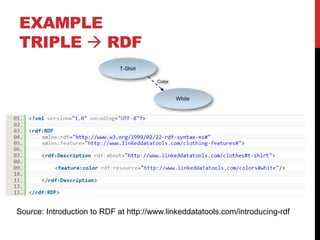
Source: Introduction to RDF at http://www.linkeddatatools.com/introducing-rdf
PRINCIPLES OF LINKED DATA

1. Use URIs as names for things (people, organizations,
   artifacts, abstract concepts, etc.)


2. Use HTTP URIs so that people can look up those names


3. When someone looks up a URI, provide useful
   information, using the standards (RDF, SPARQL)


4. Include links to other URI so that people can discover
   other related items (note: RDF Links have types)
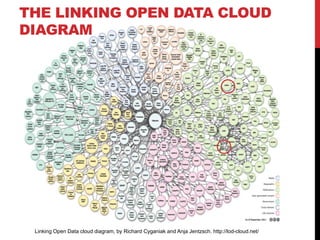
THE LINKING OPEN DATA CLOUD
DIAGRAM


 Linking Open Data cloud diagram, by Richard Cyganiak and Anja Jentzsch. http://lod-cloud.net/
COMPARING LINKED DATA
    CREATED FROM

  ORIGINAL RECORD
        VS.
 HARVESTED RECORD
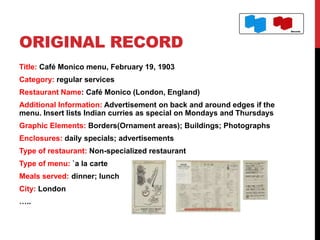
ORIGINAL RECORD
Title: Café Monico menu, February 19, 1903
Category: regular services
Restaurant Name: Café Monico (London, England)
Additional Information: Advertisement on back and around edges if the
menu. Insert lists Indian curries as special on Mondays and Thursdays
Graphic Elements: Borders(Ornament areas); Buildings; Photographs
Enclosures: daily specials; advertisements
Type of restaurant: Non-specialized restaurant
Type of menu: `a la carte
Meals served: dinner; lunch
City: London
…..
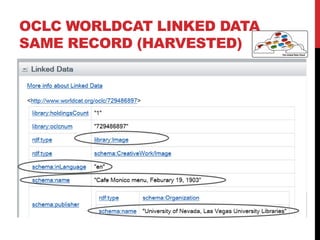
OCLC WORLDCAT LINKED DATA
SAME RECORD (HARVESTED)
HOW CAN WE CREATE RICH
LINKED DATA?
Create a complementary data structure that would allow
dynamic interlinking among data


How?
• Export records from the collections
• Deconstruct these records by extracting data from them
• Apply vocabularies
• Adopt a common model to express data
• Publish data in a data space (Linked Data Cloud) where
  links among data are created automatically
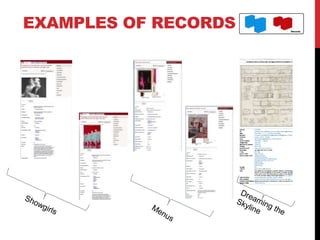
EXAMPLES OF RECORDS
TRANSFORMING RECORDS
INTO DATA
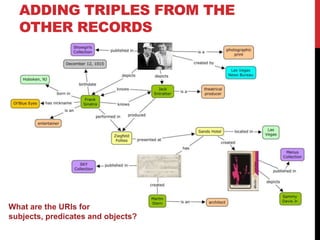
What are possible triples for this “thing”?
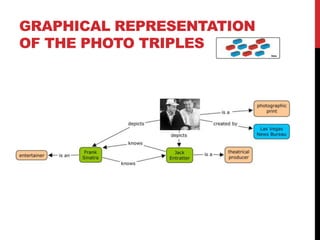
<this thing> <created by> <Las Vegas News Bureau>
< this thing > <is a> <photographic print>
< this thing> <depicts> <Frank Sinatra>
< this thing> <depicts> <Jack Entratter>
--------------
<Frank Sinatra> <knows> <Jack Entratter>
<Jack Entratter> <knows> <Frank Sinatra>
--------------
<Frank Sinatra> <is an> <entertainer>
<Jack Entratter> <is a> <theatrical producer>
----------
GRAPHICAL REPRESENTATION
OF THE PHOTO TRIPLES
ADDING TRIPLES FROM THE
  OTHER RECORDS


What are the URIs for
subjects, predicates and objects?
VOCABULARIES
ALERT:
Finally a place in the presentation we feel at home!
--------------
Vocabularies are specific terms used in RDF statements to describe specific resources.
----------
Vocabulary examples in linked data (Linked Open Vocabulary):
•    DCMI Type Vocabulary
•    Friend of a Friend Vocabulary
•    Geonames
•    MARC Code List for Relators
•    Creative Commons Rights Expression vocabulary
•    Schema.org
•    Many more at: http://lov.okfn.org/dataset/lov/
UNLV LINKED DATA PROJECT
Goals:
Study the feasibility of developing a common process that
would allow the conversion of our collection records into
linked data preserving their original expressivity and
richness


Publish data from our collections in the Linked Data Cloud to
improve discoverability and connections with other related
data sets on the Web
PHASES OF THE PROJECT
Literature Review
Evaluating Technologies
   • Research existing technologies and best practices
    • Develop small experiments with technologies
    • Make decisions of which technologies to adopt, adapt or
      develop
Data preparation
    • Select and prepare records from digital collections to
      participate in the project
Run process to generate data from the original records
Publish on the Linked Data Cloud
Assess results
DATA PREPARATION
• Defining vocabularies that will be adopted for predicates
  and objects
• Defining types of triples to be created (literal, outgoing
  links, incoming links, triples that describe related
  resources, triples that link to descriptions, triples that
  indicate provenance of the data, etc.)
• Specifying URIs for new “things”
• Identifying potential URIs for external links (e.g., things
  that already have URIs)
• Describing data sets that will be published in the linked
  data cloud
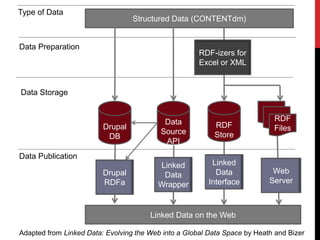
TECHNOLOGY OPTIONS
FOR DATA
TRANSFORMATION
Type of Data
                                  Structured Data (CONTENTdm)


Data Preparation
                                                      RDF-izers for
                                                      Excel or XML


Data Storage


                                           Data                             RDF
                         Drupal                           RDF               Files
                                          Source          Store
                          DB
                                           API
Data Publication
                                         Linked           Linked
                         Drupal           Data             Data             Web
                         RDFa            Wrapper         Interface         Server


                                       Linked Data on the Web

Adapted from Linked Data: Evolving the Web into a Global Data Space by Heath and Bizer
ANTICIPATED CHALLENGES

• Developing of a common process for transforming records
  into data because digital collections adopt different metadata
  schema

• Creating URIs for all our unique materials

• Finding ways to associate URIs to “things” in CONTENTdm

• Adopting linked data while it is in early stage of development
TIPS TO CONSIDER WHEN CREATING
DIGITAL COLLECTIONS METADATA
 • Avoid mixing different types of data in metadata
   fields

 • Avoid creating aggregated data fields

 • Record URIs whenever available

 • Reinforce use of controlled vocabularies

 • Monitor how content management systems are
   adopting linked data technologies
HOW WE STARTED

• Created a study group in the Library (members from
  various areas of the library)
• Watched webinars on the topic and have discussions after
  the webinars
• Created an internal wiki with linked data resources
• Participated in linked data interest groups
• Follow the literature on this topic
QUESTIONS?
Contact Information:


  Silvia Southwick
  Silvia.Southwick@unlv.edu


  Cory Lampert
  Cory.Lampert@unlv.edu


               Department of Digital Collections
                          UNLV Libraries

Linked data demystified:Practical efforts to transform CONTENTDM metadata into linked data

  • 1.
    LINKED DATA DEMYSTIFIED PRACTICAL EFFORTSTO TRANSFORM CONTENTDM METADATA INTO LINKED DATA
  • 2.
    PRESENTERS Silvia Southwick Digital CollectionsMetadata Librarian UNLV Libraries Cory Lampert Head of the Digital Collections Department UNLV Libraries
  • 3.
    OUTLINE • Why shouldI care? • What is it? • Defining Linked Data / Introduction to Linked Data Concepts / Linked Data Principles • Technologies & Standards for Linked Data • The Linked Data Cloud • How? • Applying these concepts to digital collection records • Anticipated challenges working with CONTENTdm • The UNLV Libraries Linked Data Project • How could you start working with Linked Data?
  • 4.
    LINKED DATA MYTHS Mycollections are already visible through Google; so who cares This is a topic for catalogers It’s too technical / complicated / boring Actually ... Linked data is the future of the Web Data will no longer be in silos (catalog, CONTENTdm) Relationships are powerful and worth the effort
  • 5.
    HOW DO WECURRENTLY CREATE OUR DIGITAL COLLECTIONS? Data (or metadata) are encapsulated in records Records are contained in collections Very few links are created within and/or across collections Links have to be manually created Existing links do not specify the nature of the relationships among records This structure hides potential links within and across collections – DATA IS TRAPPED!
  • 6.
    UNIQUE LOCAL COLLECTIONS, HIDDENRELATIONSHIPS Example: A search on “water” in the OCLC collection of collections resulted in 26 collections that are not cross- linked Digital Collections containing records on “water” California Water Documents Western Waters Digital Library Bear River Watershed Historical Collection The Historic Landscape of Nevada: Development, Water, and Natural Environment Seattle Power Water Supply Collection Western Waters Digital Library: The Columbia River Basin in Oregon ……………
  • 7.
    EXPOSED DATA RELATIONSHIPS POWERFUL, RELATED DATA Example: Google Knowledge Graph http://youtu.be/mmQl6VGvX-c
  • 8.
    A LEGO METAPHORFOR CREATING LINKED DATA This is the Data Model
  • 9.
    Transforming records into data Publishingdata Linking data as you search or browse
  • 10.
    DEFINING LINKED DATA LinkedData refers to a set of best practices for publishing and interlinking data on the Web • Data needs to be machine-readable • Linked data (Web of Data) is an expansion of the Web we know (Web of documents)
  • 11.
    WEB IN TRANSITION 1. Two types of data: 1. Human-readable documents (email, brochure, report) 2. Machine-readable data (calendar, playlist, spreadsheet) 2. Shopping example 1. A web page ad (document) says “dress”, “color”, “price”, “designer” 2. But machines cannot extract data to re-use in another application (e.g., spreadsheet to compare prices) 3. RDF – new way to specify relationships and transfer context with data across applications: reusable data 4. The time is now to start to evolve our documents into data
  • 12.
    TECHNOLOGIES FOR LINKED DATA Linkeddata is built in the Web architecture (HTTP, URIs) RDF is a data model (not a format) Most common serializations: • RDF/XML • RDFa RDF is based on triples/statements SPARQL - SPARQL Protocol and RDF Query Language -- is a query language able to retrieve and manipulate data stored in RDF.
  • 13.
    WHAT ARE TRIPLES? Triplesare expressed as: subject – predicate – object Examples: Frank Sinatra -- is an – entertainer Frank Sinatra – knows – Jack Entratter
  • 14.
    EXAMPLE TRIPLE  RDF Source:Introduction to RDF at http://www.linkeddatatools.com/introducing-rdf
  • 15.
    PRINCIPLES OF LINKEDDATA 1. Use URIs as names for things (people, organizations, artifacts, abstract concepts, etc.) 2. Use HTTP URIs so that people can look up those names 3. When someone looks up a URI, provide useful information, using the standards (RDF, SPARQL) 4. Include links to other URI so that people can discover other related items (note: RDF Links have types)
  • 16.
    THE LINKING OPENDATA CLOUD DIAGRAM Linking Open Data cloud diagram, by Richard Cyganiak and Anja Jentzsch. http://lod-cloud.net/
  • 17.
    COMPARING LINKED DATA CREATED FROM ORIGINAL RECORD VS. HARVESTED RECORD
  • 18.
    ORIGINAL RECORD Title: CaféMonico menu, February 19, 1903 Category: regular services Restaurant Name: Café Monico (London, England) Additional Information: Advertisement on back and around edges if the menu. Insert lists Indian curries as special on Mondays and Thursdays Graphic Elements: Borders(Ornament areas); Buildings; Photographs Enclosures: daily specials; advertisements Type of restaurant: Non-specialized restaurant Type of menu: `a la carte Meals served: dinner; lunch City: London …..
  • 19.
    OCLC WORLDCAT LINKEDDATA SAME RECORD (HARVESTED)
  • 20.
    HOW CAN WECREATE RICH LINKED DATA? Create a complementary data structure that would allow dynamic interlinking among data How? • Export records from the collections • Deconstruct these records by extracting data from them • Apply vocabularies • Adopt a common model to express data • Publish data in a data space (Linked Data Cloud) where links among data are created automatically
  • 21.
  • 22.
    TRANSFORMING RECORDS INTO DATA Whatare possible triples for this “thing”? <this thing> <created by> <Las Vegas News Bureau> < this thing > <is a> <photographic print> < this thing> <depicts> <Frank Sinatra> < this thing> <depicts> <Jack Entratter> -------------- <Frank Sinatra> <knows> <Jack Entratter> <Jack Entratter> <knows> <Frank Sinatra> -------------- <Frank Sinatra> <is an> <entertainer> <Jack Entratter> <is a> <theatrical producer> ----------
  • 23.
  • 24.
    ADDING TRIPLES FROMTHE OTHER RECORDS What are the URIs for subjects, predicates and objects?
  • 25.
    VOCABULARIES ALERT: Finally a placein the presentation we feel at home! -------------- Vocabularies are specific terms used in RDF statements to describe specific resources. ---------- Vocabulary examples in linked data (Linked Open Vocabulary): • DCMI Type Vocabulary • Friend of a Friend Vocabulary • Geonames • MARC Code List for Relators • Creative Commons Rights Expression vocabulary • Schema.org • Many more at: http://lov.okfn.org/dataset/lov/
  • 26.
    UNLV LINKED DATAPROJECT Goals: Study the feasibility of developing a common process that would allow the conversion of our collection records into linked data preserving their original expressivity and richness Publish data from our collections in the Linked Data Cloud to improve discoverability and connections with other related data sets on the Web
  • 27.
    PHASES OF THEPROJECT Literature Review Evaluating Technologies • Research existing technologies and best practices • Develop small experiments with technologies • Make decisions of which technologies to adopt, adapt or develop Data preparation • Select and prepare records from digital collections to participate in the project Run process to generate data from the original records Publish on the Linked Data Cloud Assess results
  • 28.
    DATA PREPARATION • Definingvocabularies that will be adopted for predicates and objects • Defining types of triples to be created (literal, outgoing links, incoming links, triples that describe related resources, triples that link to descriptions, triples that indicate provenance of the data, etc.) • Specifying URIs for new “things” • Identifying potential URIs for external links (e.g., things that already have URIs) • Describing data sets that will be published in the linked data cloud
  • 29.
  • 30.
    Type of Data Structured Data (CONTENTdm) Data Preparation RDF-izers for Excel or XML Data Storage Data RDF Drupal RDF Files Source Store DB API Data Publication Linked Linked Drupal Data Data Web RDFa Wrapper Interface Server Linked Data on the Web Adapted from Linked Data: Evolving the Web into a Global Data Space by Heath and Bizer
  • 31.
    ANTICIPATED CHALLENGES • Developingof a common process for transforming records into data because digital collections adopt different metadata schema • Creating URIs for all our unique materials • Finding ways to associate URIs to “things” in CONTENTdm • Adopting linked data while it is in early stage of development
  • 32.
    TIPS TO CONSIDERWHEN CREATING DIGITAL COLLECTIONS METADATA • Avoid mixing different types of data in metadata fields • Avoid creating aggregated data fields • Record URIs whenever available • Reinforce use of controlled vocabularies • Monitor how content management systems are adopting linked data technologies
  • 33.
    HOW WE STARTED •Created a study group in the Library (members from various areas of the library) • Watched webinars on the topic and have discussions after the webinars • Created an internal wiki with linked data resources • Participated in linked data interest groups • Follow the literature on this topic
  • 34.
    QUESTIONS? Contact Information: Silvia Southwick Silvia.Southwick@unlv.edu Cory Lampert Cory.Lampert@unlv.edu Department of Digital Collections UNLV Libraries

Editor's Notes

  • #12 Linked data principle advocates using URI references to identify not just Web documents and digital contents, but also real world objects and abstract concepts. These may include tangible things such as people, places, and cars, or those that are more abstracts such as relationships between people “knowing somebody”.Self-explanatoryUse of a single data model for publishing structured data on the WebUse of hyperlinks to connect not only web documents but any type of thing. Links in the context of linked data context ar called RDF links – they are distinct from hyperlinks for the web of documents because they have type.
  • #16 Linked data principle advocates using URI references to identify not just Web documents and digital contents, but also real world objects and abstract concepts. These may include tangible things such as people, places, and cars, or those that are more abstracts such as relationships between people “knowing somebody”.Self-explanatoryUse of a single data model for publishing structured data on the WebUse of hyperlinks to connect not only web documents but any type of thing. Links in the context of linked data context ar called RDF links – they are distinct from hyperlinks for the web of documents because they have type.