Representation Learning on Graphs with
Complex Structures
Prof. Dr. Philippe Cudré-Mauroux
eXascale Infolab, U. of Fribourg–Switzerland
DL4G-SDE @ WWW2019
San Francisco, May 13, 2019
Representation Learning on Graphs
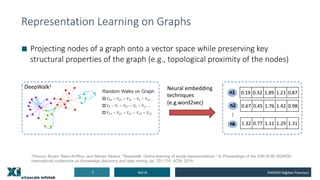
■ Projecting nodes of a graph onto a vector space while preserving key
structural properties of the graph (e.g., topological proximity of the nodes)
8/5/192 WWW2019@San Francisco
Neural embedding
techniques
(e.g.word2vec)
…
0.19 0.32 1.89 1.21 0.87
0.67 0.45 1.76 1.42 0.98
1.32 0.77 1.11 1.29 1.31
1
Perozzi, Bryan, Rami Al-Rfou, and Steven Skiena. "Deepwalk: Online learning of social representations." In Proceedings of the 20th ACM SIGKDD
international conference on Knowledge discovery and data mining, pp. 701-710. ACM, 2014.
DeepWalk1
8/5/193 WWW2019@San Francisco
What if the graph at hand exhibits
a much more complex structure?
Outlines
■ JUST: Embedding heterogeneous graphs without meta-paths
[CIKM’18]
■ LBSN2Vec: Embedding heterogeneous hypergraphs from LBSNs
[WWW’19]
■ NodeSketch: Highly-efficient graph embeddings via recursive
sketching [KDD’19]
8/5/194 WWW2019@San Francisco
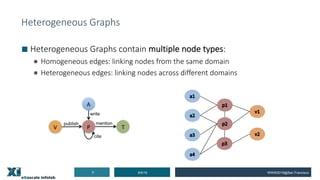
Heterogeneous Graphs
■ Heterogeneous Graphs contain multiple node types:
● Homogeneous edges: linking nodes from the same domain
● Heterogeneous edges: linking nodes across different domains
8/5/195 WWW2019@San Francisco
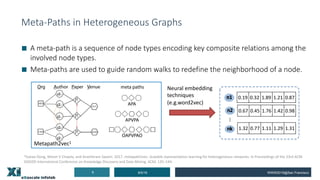
Meta-Paths in Heterogeneous Graphs
■ A meta-path is a sequence of node types encoding key composite relations among the
involved node types.
■ Meta-paths are used to guide random walks to redefine the neighborhood of a node.
8/5/196 WWW2019@San Francisco
1
Yuxiao Dong, Nitesh V Chawla, and Ananthram Swami. 2017. metapath2vec: Scalable representation learning for heterogeneous networks. In Proceedings of the 23rd ACM
SIGKDD International Conference on Knowledge Discovery and Data Mining. ACM, 135–144.
Metapath2vec1
Neural embedding
techniques
(e.g.word2vec)
…
0.19 0.32 1.89 1.21 0.87
0.67 0.45 1.76 1.42 0.98
1.32 0.77 1.11 1.29 1.31
Challenges with Meta-Paths
■ The choice of meta-paths highly affects the quality of the learnt node
embeddings for a specific task.
■ How to select meta-paths ?
● Graph specific and highly depends on prior knowledge from domain experts.
● Strategies to combine a set of meta-paths can be complex and computationally
expensive.
8/5/197 WWW2019@San Francisco
Are meta-paths necessary?
8/5/198 WWW2019@San Francisco
JUST: Embedding Heterogeneous Graphs without Meta-Paths
■ Random Walk with JUmp and STay strategies to probabilistically control the
random walk.
■ 2 ways to balance the random walk:
● Step I: Jump or stay?
−Objective: Balance the number of heterogeneous and homogeneous edges traversed during
random walks (stay with probability 𝝰, exponential decay).
● Step II: If Jump, where to Jump?
−Objective: Control the randomness in choosing a target domain
(memory window to favor diversity).
■ Learn node embeddings with SkipGram model.
8/5/199 WWW2019@San Francisco
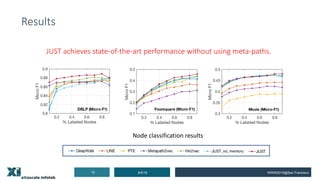
Results
8/5/1910 WWW2019@San Francisco
JUST achieves state-of-the-art performance without using meta-paths.
Node classification results
Runtime Performance
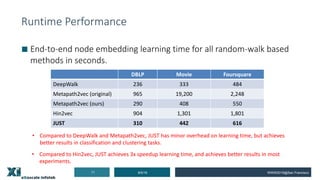
■ End-to-end node embedding learning time for all random-walk based
methods in seconds.
8/5/1911 WWW2019@San Francisco
DBLP Movie Foursquare
DeepWalk 236 333 484
Metapath2vec (original) 965 19,200 2,248
Metapath2vec (ours) 290 408 550
Hin2vec 904 1,301 1,801
JUST 310 442 616
• Compared to DeepWalk and Metapath2vec, JUST has minor overhead on learning time, but achieves
better results in classification and clustering tasks.
• Compared to Hin2vec, JUST achieves 3x speedup learning time, and achieves better results in most
experiments.
Outlines
■ JUST: Embedding heterogeneous graphs without meta-paths
[CIKM’18]
■ LBSN2Vec: Embedding heterogeneous hypergraphs from LBSNs
[WWW’19]
■ NodeSketch: Highly-efficient graph embeddings via recursive
sketching [KDD’19]
8/5/1912 WWW2019@San Francisco
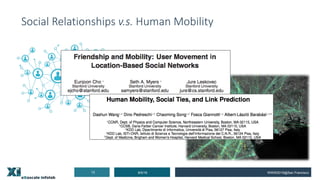
Social Relationships v.s. Human Mobility
8/5/1913 WWW2019@San Francisco
8/5/1914 WWW2019@San Francisco
How to quantify the impact of social relationships and
mobility on each other?
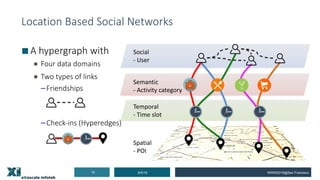
● Two types of links
−Friendships
−Check-ins (Hyperedges)
Location Based Social Networks
■A hypergraph with
● Four data domains
8/5/1915 WWW2019@San Francisco
Spatial
- POI
Temporal
- Time slot
Semantic
- Activity category
Social
- User
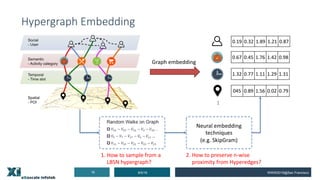
Hypergraph Embedding
8/5/1916 WWW2019@San Francisco
0.19 0.32 1.89 1.21 0.87
0.67 0.45 1.76 1.42 0.98
1.32 0.77 1.11 1.29 1.31
045 0.89 1.56 0.02 0.79
…
Graph embedding
Neural embedding
techniques
(e.g. SkipGram)
1. How to sample from a
LBSN hypergraph?
2. How to preserve n-wise
proximity from Hyperedges?
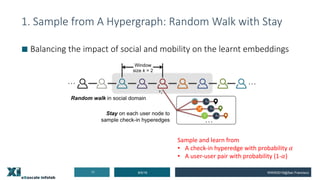
1. Sample from A Hypergraph: Random Walk with Stay
■ Balancing the impact of social and mobility on the learnt embeddings
8/5/1917 WWW2019@San Francisco
Sample and learn from
• A check-in hyperedge with probability 𝛼
• A user-user pair with probability (1-𝛼)
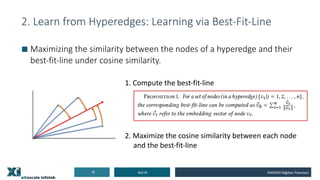
2. Learn from Hyperedges: Learning via Best-Fit-Line
■ Maximizing the similarity between the nodes of a hyperedge and their
best-fit-line under cosine similarity.
8/5/1918 WWW2019@San Francisco
1. Compute the best-fit-line
2. Maximize the cosine similarity between each node
and the best-fit-line
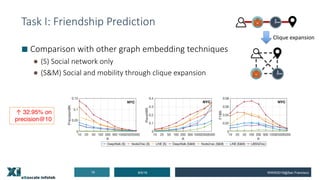
Task I: Friendship Prediction
■ Comparison with other graph embedding techniques
● (S) Social network only
● (S&M) Social and mobility through clique expansion
8/5/1919 WWW2019@San Francisco
↑ 32.95% on
precision@10
Clique expansion
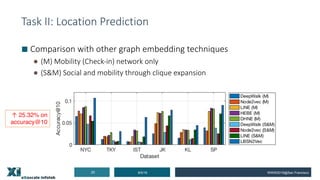
Task II: Location Prediction
■ Comparison with other graph embedding techniques
● (M) Mobility (Check-in) network only
● (S&M) Social and mobility through clique expansion
8/5/1920 WWW2019@San Francisco
↑ 25.32% on
accuracy@10
8/5/19 WWW2019@San Francisco21
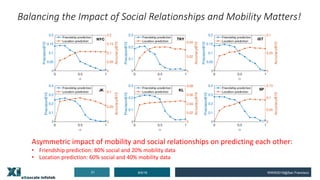
Balancing the Impact of Social Relationships and Mobility Matters!
Asymmetric impact of mobility and social relationships on predicting each other:
• Friendship prediction: 80% social and 20% mobility data
• Location prediction: 60% social and 40% mobility data
Outlines
■ JUST: Embedding heterogeneous graphs without meta-paths
[CIKM’18]
■ LBSN2Vec: Embedding heterogeneous hypergraphs from LBSNs
[WWW’19]
■ NodeSketch: Highly-efficient graph embeddings via recursive
sketching [KDD’19]
8/5/1922 WWW2019@San Francisco
Graph Embeddings
■ Graph-sampling based techniques
● Sample node pairs from a graph, and preserve node proximity from the node pairs
● Examples: DeepWalk, Node2Vec, LINE, SDNE and VERSE, etc.
● Efficiency bottleneck: A large number of node pairs -> significant computation resources (CPU time)
■ Factorization based techniques
● Factorize a (transformed, e.g., high-order) proximity/adjacency matrix of a graph
● Examples: GraRep, HOPE and NetMF, etc.
● Efficiency bottleneck: Large matrix factorization -> significant computation resources (both CPU time and
RAM)
■ Node proximity preserved using cosine similarity
● Efficiency bottleneck: cosine similarity is less efficient than hamming similarity, for example.
8/5/1923 WWW2019@San Francisco
Similarity-Preserving Hashing/Sketching
■ Efficient similarity approximation of high dimensional data
● Data-dependent hashing (learning-to-hash)
−Learning dataset-specific hashing functions
−Examples: spectral hashing, iterative quantization, etc.
−Efficient in similarity computation, but requires learning hashing functions
● Data-independent hashing/sketching (locality sensitive hashing)
−Hashing without involving any learning process from data
−Examples: minhash, consistent weighted sampling, etc.
−Efficient in both similarity approximation and hashing
8/5/1924 WWW2019@San Francisco
Can we sketch nodes in a graph as embeddings?
8/5/1925 WWW2019@San Francisco
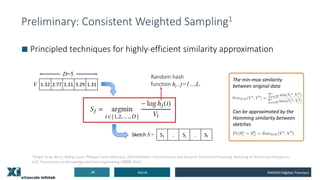
Preliminary: Consistent Weighted Sampling1
■ Principled techniques for highly-efficient similarity approximation
8/5/1926 WWW2019@San Francisco
The min-max similarity
between original data
Can be approximated by the
Hamming similarity between
sketches
1.32 2.77 1.11 3.29 1.31V
Sketch S = S1 … Sj … SL
D=5 Random hash
function hj , j=1…,L.
1
Dingqi Yang, Bin Li, Rettig Laura, Philippe Cudré-Mauroux, D2HistoSketch: Discriminative and Dynamic Similarity-Preserving Sketching of Streaming Histograms,
IEEE Transactions on Knowledge and Data Engineering (TKDE) 2018
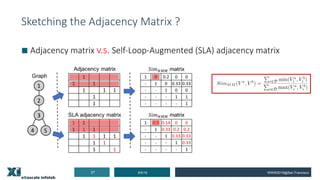
Sketching the Adjacency Matrix ?
■ Adjacency matrix v.s. Self-Loop-Augmented (SLA) adjacency matrix
8/5/1927 WWW2019@San Francisco
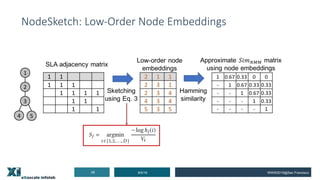
NodeSketch: Low-Order Node Embeddings
8/5/1928 WWW2019@San Francisco
1
2
3
4 5
NodeSketch: High-Order Node Embeddings
8/5/1929 WWW2019@San Francisco
1 1
0.33 0.33 0.33
Neighbors
𝒏 ∈ 𝜞 𝒓
Node 2 2 3 1
SLA adjacency vector '𝑽 𝒓
Sketch element distribution
𝟏
𝑳
∑𝒋-𝟏
𝑳
𝕝[𝑺 𝒋
𝒏
𝒌2𝟏 -𝒊], 𝑖=1,..,D
1.066 1.066 0.066
Approximate 𝑘-order
SLA adjacency vector '𝑽 𝒓
(𝒌)
node 1
Sketching using Eq. 3
*Weight
α=0.2
Merge
1 1
1 1 1
1 1 1 1
1 1
1 1
SLA adjacency
matrix '𝑨
2 1 1
2 3 1
2 3 4
4 3 4
5 3 5
(𝑘-1)-order node
embeddings 𝑺(𝒌 − 𝟏)
𝑘-order
embeddings 𝑺(𝒌)
2 1 3
2 3 4
2 3 4
2 3 4
4 3 5
(𝑘-1)-order Sketches
𝑺 𝒏
(𝒌 − 𝟏)
… … …
Uniformity of the generated samples:
The foundation of our recursive sketching process
1
2
3
4 5
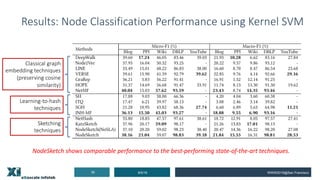
Results: Node Classification Performance using Kernel SVM
8/5/1930 WWW2019@San Francisco
Classical graph
embedding techniques
(preserving cosine
similarity)
Learning-to-hash
techniques
Sketching
techniques
NodeSketch shows comparable performance to the best-performing state-of-the-art techniques.
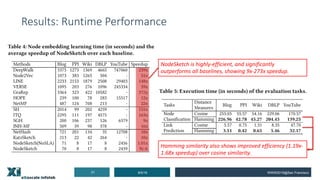
Results: Runtime Performance
8/5/1931 WWW2019@San Francisco
NodeSketch is highly-efficient, and significantly
outperforms all baselines, showing 9x-273x speedup.
Hamming similarity also shows improved efficiency (1.19x-
1.68x speedup) over cosine similarity.
Take-Away Messages
■ JUST: Meta-path free heterogeneous graph embedding can achieve state-
of-the-art performance efficiently. [CIKM’18]
■ LBSN2Vec: Asymmetric impact of social and mobility on each other
[WWW’19]
■ NodeSketch: High-quality node embeddings can be generated via highly-
efficient sketching techniques [KDD’19]
8/5/1932 WWW2019@San Francisco
[CIKM’18] Hussein, Rana, Dingqi Yang, and Philippe Cudré-Mauroux. "Are Meta-Paths Necessary?: Revisiting Heterogeneous Graph Embeddings." CIKM’18.
[WWW’19] Dingqi Yang, Bingqing Qu, Jie Yang, Philippe Cudre-Mauroux, ”Revisiting User Mobility and Social Relationships in LBSNs: A Hypergraph Embedding Approach.” WWW’19.
[KDD’19] Dingqi Yang, Paolo Rosso, Bin Li and Philippe Cudre-Mauroux, “NodeSketch: Highly-Efficient Graph Embeddings via Recursive Sketching.” KDD’19.
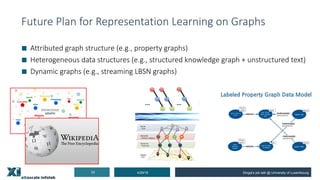
Future Plan for Representation Learning on Graphs
■ Attributed graph structure (e.g., property graphs)
■ Heterogeneous data structures (e.g., structured knowledge graph + unstructured text)
■ Dynamic graphs (e.g., streaming LBSN graphs)
4/29/19 Dingqi's job talk @ University of Luxembourg33

Representation Learning on Complex Graphs

  • 1.
    Representation Learning onGraphs with Complex Structures Prof. Dr. Philippe Cudré-Mauroux eXascale Infolab, U. of Fribourg–Switzerland DL4G-SDE @ WWW2019 San Francisco, May 13, 2019
  • 2.
    Representation Learning onGraphs ■ Projecting nodes of a graph onto a vector space while preserving key structural properties of the graph (e.g., topological proximity of the nodes) 8/5/192 WWW2019@San Francisco Neural embedding techniques (e.g.word2vec) … 0.19 0.32 1.89 1.21 0.87 0.67 0.45 1.76 1.42 0.98 1.32 0.77 1.11 1.29 1.31 1 Perozzi, Bryan, Rami Al-Rfou, and Steven Skiena. "Deepwalk: Online learning of social representations." In Proceedings of the 20th ACM SIGKDD international conference on Knowledge discovery and data mining, pp. 701-710. ACM, 2014. DeepWalk1
  • 3.
    8/5/193 WWW2019@San Francisco Whatif the graph at hand exhibits a much more complex structure?
  • 4.
    Outlines ■ JUST: Embeddingheterogeneous graphs without meta-paths [CIKM’18] ■ LBSN2Vec: Embedding heterogeneous hypergraphs from LBSNs [WWW’19] ■ NodeSketch: Highly-efficient graph embeddings via recursive sketching [KDD’19] 8/5/194 WWW2019@San Francisco
  • 5.
    Heterogeneous Graphs ■ HeterogeneousGraphs contain multiple node types: ● Homogeneous edges: linking nodes from the same domain ● Heterogeneous edges: linking nodes across different domains 8/5/195 WWW2019@San Francisco
  • 6.
    Meta-Paths in HeterogeneousGraphs ■ A meta-path is a sequence of node types encoding key composite relations among the involved node types. ■ Meta-paths are used to guide random walks to redefine the neighborhood of a node. 8/5/196 WWW2019@San Francisco 1 Yuxiao Dong, Nitesh V Chawla, and Ananthram Swami. 2017. metapath2vec: Scalable representation learning for heterogeneous networks. In Proceedings of the 23rd ACM SIGKDD International Conference on Knowledge Discovery and Data Mining. ACM, 135–144. Metapath2vec1 Neural embedding techniques (e.g.word2vec) … 0.19 0.32 1.89 1.21 0.87 0.67 0.45 1.76 1.42 0.98 1.32 0.77 1.11 1.29 1.31
  • 7.
    Challenges with Meta-Paths ■The choice of meta-paths highly affects the quality of the learnt node embeddings for a specific task. ■ How to select meta-paths ? ● Graph specific and highly depends on prior knowledge from domain experts. ● Strategies to combine a set of meta-paths can be complex and computationally expensive. 8/5/197 WWW2019@San Francisco
  • 8.
    Are meta-paths necessary? 8/5/198WWW2019@San Francisco
  • 9.
    JUST: Embedding HeterogeneousGraphs without Meta-Paths ■ Random Walk with JUmp and STay strategies to probabilistically control the random walk. ■ 2 ways to balance the random walk: ● Step I: Jump or stay? −Objective: Balance the number of heterogeneous and homogeneous edges traversed during random walks (stay with probability 𝝰, exponential decay). ● Step II: If Jump, where to Jump? −Objective: Control the randomness in choosing a target domain (memory window to favor diversity). ■ Learn node embeddings with SkipGram model. 8/5/199 WWW2019@San Francisco
  • 10.
    Results 8/5/1910 WWW2019@San Francisco JUSTachieves state-of-the-art performance without using meta-paths. Node classification results
  • 11.
    Runtime Performance ■ End-to-endnode embedding learning time for all random-walk based methods in seconds. 8/5/1911 WWW2019@San Francisco DBLP Movie Foursquare DeepWalk 236 333 484 Metapath2vec (original) 965 19,200 2,248 Metapath2vec (ours) 290 408 550 Hin2vec 904 1,301 1,801 JUST 310 442 616 • Compared to DeepWalk and Metapath2vec, JUST has minor overhead on learning time, but achieves better results in classification and clustering tasks. • Compared to Hin2vec, JUST achieves 3x speedup learning time, and achieves better results in most experiments.
  • 12.
    Outlines ■ JUST: Embeddingheterogeneous graphs without meta-paths [CIKM’18] ■ LBSN2Vec: Embedding heterogeneous hypergraphs from LBSNs [WWW’19] ■ NodeSketch: Highly-efficient graph embeddings via recursive sketching [KDD’19] 8/5/1912 WWW2019@San Francisco
  • 13.
    Social Relationships v.s.Human Mobility 8/5/1913 WWW2019@San Francisco
  • 14.
    8/5/1914 WWW2019@San Francisco Howto quantify the impact of social relationships and mobility on each other?
  • 15.
    ● Two typesof links −Friendships −Check-ins (Hyperedges) Location Based Social Networks ■A hypergraph with ● Four data domains 8/5/1915 WWW2019@San Francisco Spatial - POI Temporal - Time slot Semantic - Activity category Social - User
  • 16.
    Hypergraph Embedding 8/5/1916 WWW2019@SanFrancisco 0.19 0.32 1.89 1.21 0.87 0.67 0.45 1.76 1.42 0.98 1.32 0.77 1.11 1.29 1.31 045 0.89 1.56 0.02 0.79 … Graph embedding Neural embedding techniques (e.g. SkipGram) 1. How to sample from a LBSN hypergraph? 2. How to preserve n-wise proximity from Hyperedges?
  • 17.
    1. Sample fromA Hypergraph: Random Walk with Stay ■ Balancing the impact of social and mobility on the learnt embeddings 8/5/1917 WWW2019@San Francisco Sample and learn from • A check-in hyperedge with probability 𝛼 • A user-user pair with probability (1-𝛼)
  • 18.
    2. Learn fromHyperedges: Learning via Best-Fit-Line ■ Maximizing the similarity between the nodes of a hyperedge and their best-fit-line under cosine similarity. 8/5/1918 WWW2019@San Francisco 1. Compute the best-fit-line 2. Maximize the cosine similarity between each node and the best-fit-line
  • 19.
    Task I: FriendshipPrediction ■ Comparison with other graph embedding techniques ● (S) Social network only ● (S&M) Social and mobility through clique expansion 8/5/1919 WWW2019@San Francisco ↑ 32.95% on precision@10 Clique expansion
  • 20.
    Task II: LocationPrediction ■ Comparison with other graph embedding techniques ● (M) Mobility (Check-in) network only ● (S&M) Social and mobility through clique expansion 8/5/1920 WWW2019@San Francisco ↑ 25.32% on accuracy@10
  • 21.
    8/5/19 WWW2019@San Francisco21 Balancingthe Impact of Social Relationships and Mobility Matters! Asymmetric impact of mobility and social relationships on predicting each other: • Friendship prediction: 80% social and 20% mobility data • Location prediction: 60% social and 40% mobility data
  • 22.
    Outlines ■ JUST: Embeddingheterogeneous graphs without meta-paths [CIKM’18] ■ LBSN2Vec: Embedding heterogeneous hypergraphs from LBSNs [WWW’19] ■ NodeSketch: Highly-efficient graph embeddings via recursive sketching [KDD’19] 8/5/1922 WWW2019@San Francisco
  • 23.
    Graph Embeddings ■ Graph-samplingbased techniques ● Sample node pairs from a graph, and preserve node proximity from the node pairs ● Examples: DeepWalk, Node2Vec, LINE, SDNE and VERSE, etc. ● Efficiency bottleneck: A large number of node pairs -> significant computation resources (CPU time) ■ Factorization based techniques ● Factorize a (transformed, e.g., high-order) proximity/adjacency matrix of a graph ● Examples: GraRep, HOPE and NetMF, etc. ● Efficiency bottleneck: Large matrix factorization -> significant computation resources (both CPU time and RAM) ■ Node proximity preserved using cosine similarity ● Efficiency bottleneck: cosine similarity is less efficient than hamming similarity, for example. 8/5/1923 WWW2019@San Francisco
  • 24.
    Similarity-Preserving Hashing/Sketching ■ Efficientsimilarity approximation of high dimensional data ● Data-dependent hashing (learning-to-hash) −Learning dataset-specific hashing functions −Examples: spectral hashing, iterative quantization, etc. −Efficient in similarity computation, but requires learning hashing functions ● Data-independent hashing/sketching (locality sensitive hashing) −Hashing without involving any learning process from data −Examples: minhash, consistent weighted sampling, etc. −Efficient in both similarity approximation and hashing 8/5/1924 WWW2019@San Francisco
  • 25.
    Can we sketchnodes in a graph as embeddings? 8/5/1925 WWW2019@San Francisco
  • 26.
    Preliminary: Consistent WeightedSampling1 ■ Principled techniques for highly-efficient similarity approximation 8/5/1926 WWW2019@San Francisco The min-max similarity between original data Can be approximated by the Hamming similarity between sketches 1.32 2.77 1.11 3.29 1.31V Sketch S = S1 … Sj … SL D=5 Random hash function hj , j=1…,L. 1 Dingqi Yang, Bin Li, Rettig Laura, Philippe Cudré-Mauroux, D2HistoSketch: Discriminative and Dynamic Similarity-Preserving Sketching of Streaming Histograms, IEEE Transactions on Knowledge and Data Engineering (TKDE) 2018
  • 27.
    Sketching the AdjacencyMatrix ? ■ Adjacency matrix v.s. Self-Loop-Augmented (SLA) adjacency matrix 8/5/1927 WWW2019@San Francisco
  • 28.
    NodeSketch: Low-Order NodeEmbeddings 8/5/1928 WWW2019@San Francisco 1 2 3 4 5
  • 29.
    NodeSketch: High-Order NodeEmbeddings 8/5/1929 WWW2019@San Francisco 1 1 0.33 0.33 0.33 Neighbors 𝒏 ∈ 𝜞 𝒓 Node 2 2 3 1 SLA adjacency vector '𝑽 𝒓 Sketch element distribution 𝟏 𝑳 ∑𝒋-𝟏 𝑳 𝕝[𝑺 𝒋 𝒏 𝒌2𝟏 -𝒊], 𝑖=1,..,D 1.066 1.066 0.066 Approximate 𝑘-order SLA adjacency vector '𝑽 𝒓 (𝒌) node 1 Sketching using Eq. 3 *Weight α=0.2 Merge 1 1 1 1 1 1 1 1 1 1 1 1 1 SLA adjacency matrix '𝑨 2 1 1 2 3 1 2 3 4 4 3 4 5 3 5 (𝑘-1)-order node embeddings 𝑺(𝒌 − 𝟏) 𝑘-order embeddings 𝑺(𝒌) 2 1 3 2 3 4 2 3 4 2 3 4 4 3 5 (𝑘-1)-order Sketches 𝑺 𝒏 (𝒌 − 𝟏) … … … Uniformity of the generated samples: The foundation of our recursive sketching process 1 2 3 4 5
  • 30.
    Results: Node ClassificationPerformance using Kernel SVM 8/5/1930 WWW2019@San Francisco Classical graph embedding techniques (preserving cosine similarity) Learning-to-hash techniques Sketching techniques NodeSketch shows comparable performance to the best-performing state-of-the-art techniques.
  • 31.
    Results: Runtime Performance 8/5/1931WWW2019@San Francisco NodeSketch is highly-efficient, and significantly outperforms all baselines, showing 9x-273x speedup. Hamming similarity also shows improved efficiency (1.19x- 1.68x speedup) over cosine similarity.
  • 32.
    Take-Away Messages ■ JUST:Meta-path free heterogeneous graph embedding can achieve state- of-the-art performance efficiently. [CIKM’18] ■ LBSN2Vec: Asymmetric impact of social and mobility on each other [WWW’19] ■ NodeSketch: High-quality node embeddings can be generated via highly- efficient sketching techniques [KDD’19] 8/5/1932 WWW2019@San Francisco [CIKM’18] Hussein, Rana, Dingqi Yang, and Philippe Cudré-Mauroux. "Are Meta-Paths Necessary?: Revisiting Heterogeneous Graph Embeddings." CIKM’18. [WWW’19] Dingqi Yang, Bingqing Qu, Jie Yang, Philippe Cudre-Mauroux, ”Revisiting User Mobility and Social Relationships in LBSNs: A Hypergraph Embedding Approach.” WWW’19. [KDD’19] Dingqi Yang, Paolo Rosso, Bin Li and Philippe Cudre-Mauroux, “NodeSketch: Highly-Efficient Graph Embeddings via Recursive Sketching.” KDD’19.
  • 33.
    Future Plan forRepresentation Learning on Graphs ■ Attributed graph structure (e.g., property graphs) ■ Heterogeneous data structures (e.g., structured knowledge graph + unstructured text) ■ Dynamic graphs (e.g., streaming LBSN graphs) 4/29/19 Dingqi's job talk @ University of Luxembourg33