Collaborative Activities
                    and tools


Ana Maria Menezes


                                Center for Teaching & Learning Excellence
Building a Classroom community


You will find that each of your classes
 carries its own dynamic and its own
              personality.


                         Your responsibility as an instructor is to do what
                          you can to create an environment in which the
                                   students can learn together.


                                           Research has shown that students learn
                                          best in a classroom where they feel free to
                                          express their ideas, they feel needed, and
                                            they feel comfortable with their peers.
A classroom community
   Learn students' names and help them to learn each others' names.

Use an icebreaker on the first day in order to help students get to know each other.

Welcome questions and continually thank students for asking them. If students seem
hesitant to ask questions, try using the "Think-Pair-Share" activity or leave a little
more wait time after asking if there are any questions.

Welcome diversity and model tolerance in the classroom.

Arrive early to class in order to chat with students and stay a couple of minutes after
class to answer any individual questions they might have.

Use group activities to help students feel more comfortable with each other.

Create lessons that allow students to be active learners with their own contributions,
not just empty receptacles that need to be filled.

Ask for feedback on your teaching and do it often with various methods .
Collaborative
               Activities
Collaborative learning is the act of giving the responsibility of the learning to the
students. Don't panic if you haven't heard of collaborative learning before,
you've probably done a collaborative learning activity in a class without
knowing it. It's basically the instructional art of using groups and pairs of
students to fulfill a task/assignment. If done well, these activities can create a
valuable source of motivation, critical thinking skills, and active learning while
the students learn to manipulate classroom information into their own working
knowledge.
Think-pair Share
This activity helps to relieve the anxiety and mental
block of being called on to answer a question in
class. The rules are as follows:

1. Ask an open-ended question or pose a problem
to the students.

2. Give the students a time limit in which they can
ponder the answer.

3. Have them discuss their answer with someone
sitting next to them.

4. Call on different pairs to share their answers.
Group Projects

These are field-specific, but the following are a few pointers in order to carry
group projects out successfully:

1. Choose a project that will be challenging, yet not too difficult, for the students.
It will succeed if it is interesting to the students-especially if it has direct relation
to their own lives.

2. Either assign each member a key role in the project or let them assume a
role (e.g., one scribe, one data collector, one mathematician, one
theoretician…). This will help with grading issues and responsibility and it will
also help your groups to work as a team.

3. Specify exactly what you expect of the students and the end product you
anticipate.
Classroom Problems
After presenting information to the class , problems
are given to the students.

The students are paired or grouped, depending on
the activity.

The basics of this type of activity are the same as
the group projects, but you might find that your
students are a little hesitant to break out of their
comfort zones and meet new people in the class.
Case-based Learning
This style of learning works with several different fields and types of
coursework. It is often very successful at getting students engaged-especially
when they have received a great deal of abstract information that they need to
translate into real-life situations.

1. Group the students .

2. Give each group a situation that will require them to use the day's subject in
a creative or thoughtful way.
For example, if you've been teaching about marketing strategies, give the
students a specific product and have them use the information they've learned
by setting up a "plan-of-attack" to market it
(If you feel uncomfortable making up cases for your specific field, chances are
there is a book available with already-made cases. Check with your
department).

3. Time the students and have them share their results in the end.
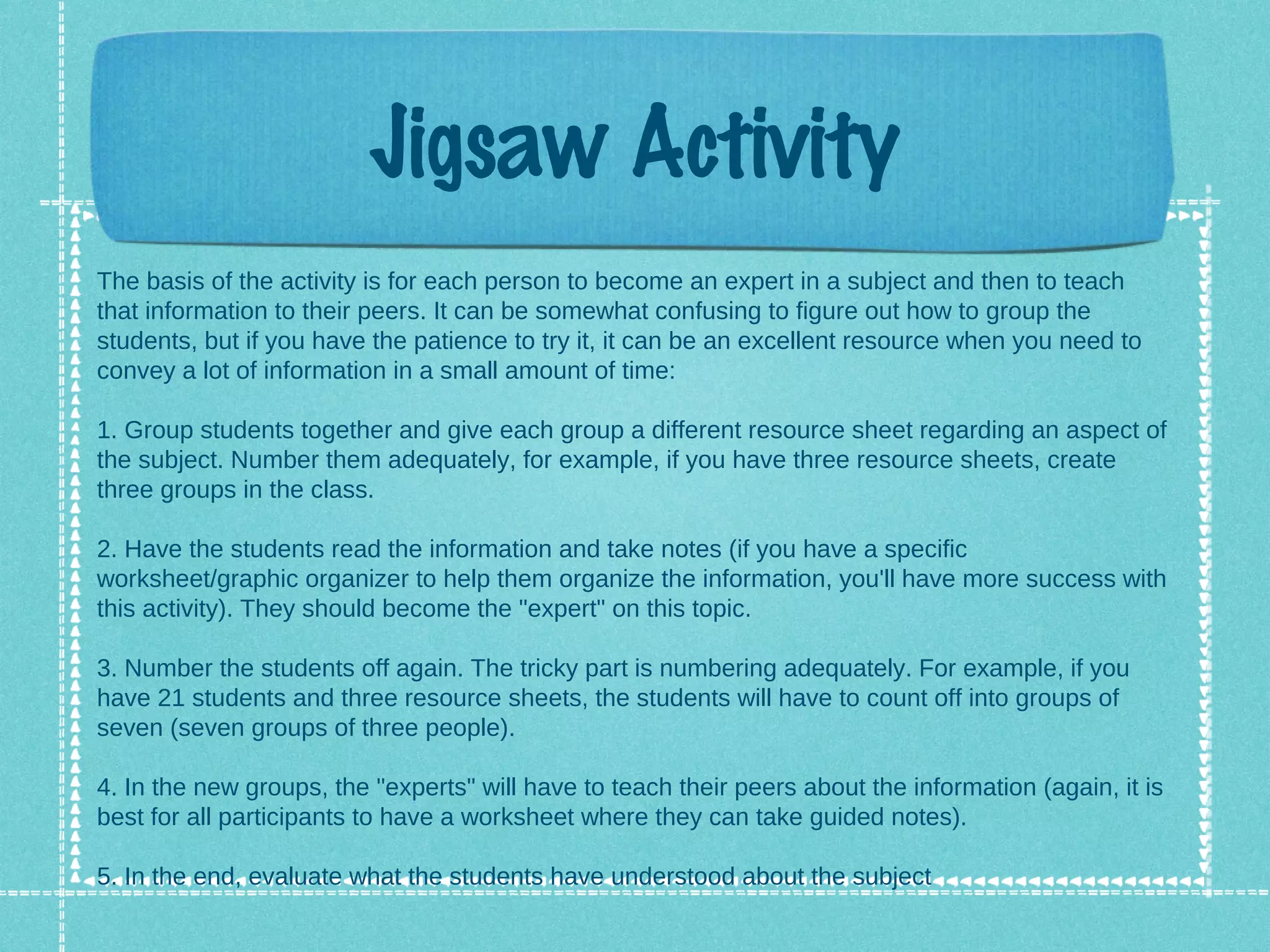
Jigsaw Activity
The basis of the activity is for each person to become an expert in a subject and then to teach
that information to their peers. It can be somewhat confusing to figure out how to group the
students, but if you have the patience to try it, it can be an excellent resource when you need to
convey a lot of information in a small amount of time:

1. Group students together and give each group a different resource sheet regarding an aspect of
the subject. Number them adequately, for example, if you have three resource sheets, create
three groups in the class.

2. Have the students read the information and take notes (if you have a specific
worksheet/graphic organizer to help them organize the information, you'll have more success with
this activity). They should become the "expert" on this topic.

3. Number the students off again. The tricky part is numbering adequately. For example, if you
have 21 students and three resource sheets, the students will have to count off into groups of
seven (seven groups of three people).

4. In the new groups, the "experts" will have to teach their peers about the information (again, it is
best for all participants to have a worksheet where they can take guided notes).

5. In the end, evaluate what the students have understood about the subject
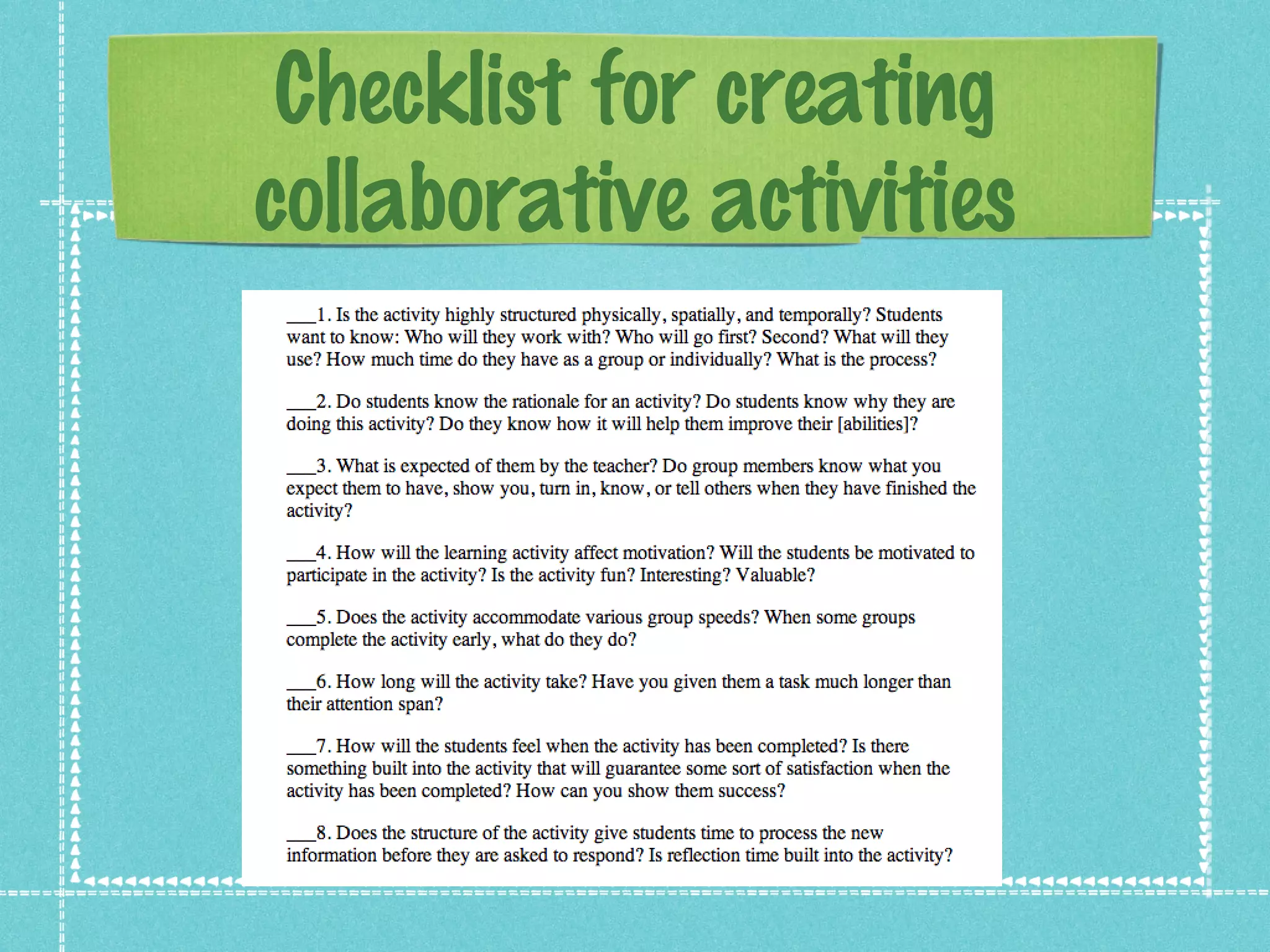
Checklist for creating
collaborative activities
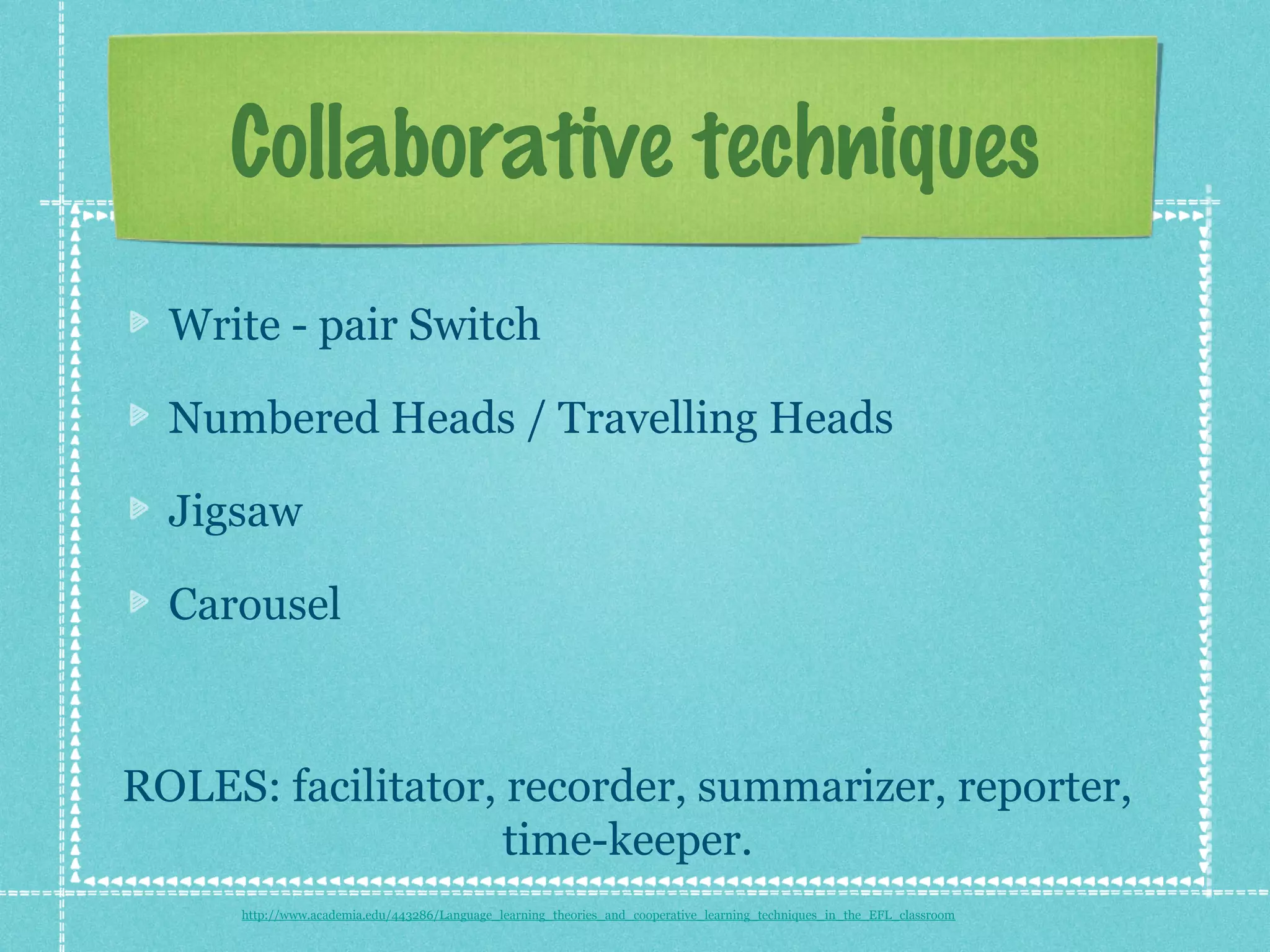
Collaborative techniques
  Write - pair Switch

  Numbered Heads / Travelling Heads

  Jigsaw

  Carousel


ROLES: facilitator, recorder, summarizer, reporter,
                    time-keeper.
      http://www.academia.edu/443286/Language_learning_theories_and_cooperative_learning_techniques_in_the_EFL_classroom
Tasks using CL techniques


Collaborative shadowing (listening + speaking)

Tourist skit.
Web-based collaboration
Google Docs

Stixy

Popplet


for Webtool lovers:
http://cooltoolsforschools.wikispaces.com/Colla
borative+Tools

Collaborative activities

  • 1.
    Collaborative Activities and tools Ana Maria Menezes Center for Teaching & Learning Excellence
  • 2.
    Building a Classroomcommunity You will find that each of your classes carries its own dynamic and its own personality. Your responsibility as an instructor is to do what you can to create an environment in which the students can learn together. Research has shown that students learn best in a classroom where they feel free to express their ideas, they feel needed, and they feel comfortable with their peers.
  • 3.
    A classroom community Learn students' names and help them to learn each others' names. Use an icebreaker on the first day in order to help students get to know each other. Welcome questions and continually thank students for asking them. If students seem hesitant to ask questions, try using the "Think-Pair-Share" activity or leave a little more wait time after asking if there are any questions. Welcome diversity and model tolerance in the classroom. Arrive early to class in order to chat with students and stay a couple of minutes after class to answer any individual questions they might have. Use group activities to help students feel more comfortable with each other. Create lessons that allow students to be active learners with their own contributions, not just empty receptacles that need to be filled. Ask for feedback on your teaching and do it often with various methods .
  • 4.
    Collaborative Activities Collaborative learning is the act of giving the responsibility of the learning to the students. Don't panic if you haven't heard of collaborative learning before, you've probably done a collaborative learning activity in a class without knowing it. It's basically the instructional art of using groups and pairs of students to fulfill a task/assignment. If done well, these activities can create a valuable source of motivation, critical thinking skills, and active learning while the students learn to manipulate classroom information into their own working knowledge.
  • 5.
    Think-pair Share This activityhelps to relieve the anxiety and mental block of being called on to answer a question in class. The rules are as follows: 1. Ask an open-ended question or pose a problem to the students. 2. Give the students a time limit in which they can ponder the answer. 3. Have them discuss their answer with someone sitting next to them. 4. Call on different pairs to share their answers.
  • 6.
    Group Projects These arefield-specific, but the following are a few pointers in order to carry group projects out successfully: 1. Choose a project that will be challenging, yet not too difficult, for the students. It will succeed if it is interesting to the students-especially if it has direct relation to their own lives. 2. Either assign each member a key role in the project or let them assume a role (e.g., one scribe, one data collector, one mathematician, one theoretician…). This will help with grading issues and responsibility and it will also help your groups to work as a team. 3. Specify exactly what you expect of the students and the end product you anticipate.
  • 7.
    Classroom Problems After presentinginformation to the class , problems are given to the students. The students are paired or grouped, depending on the activity. The basics of this type of activity are the same as the group projects, but you might find that your students are a little hesitant to break out of their comfort zones and meet new people in the class.
  • 8.
    Case-based Learning This styleof learning works with several different fields and types of coursework. It is often very successful at getting students engaged-especially when they have received a great deal of abstract information that they need to translate into real-life situations. 1. Group the students . 2. Give each group a situation that will require them to use the day's subject in a creative or thoughtful way. For example, if you've been teaching about marketing strategies, give the students a specific product and have them use the information they've learned by setting up a "plan-of-attack" to market it (If you feel uncomfortable making up cases for your specific field, chances are there is a book available with already-made cases. Check with your department). 3. Time the students and have them share their results in the end.
  • 9.
    Jigsaw Activity The basisof the activity is for each person to become an expert in a subject and then to teach that information to their peers. It can be somewhat confusing to figure out how to group the students, but if you have the patience to try it, it can be an excellent resource when you need to convey a lot of information in a small amount of time: 1. Group students together and give each group a different resource sheet regarding an aspect of the subject. Number them adequately, for example, if you have three resource sheets, create three groups in the class. 2. Have the students read the information and take notes (if you have a specific worksheet/graphic organizer to help them organize the information, you'll have more success with this activity). They should become the "expert" on this topic. 3. Number the students off again. The tricky part is numbering adequately. For example, if you have 21 students and three resource sheets, the students will have to count off into groups of seven (seven groups of three people). 4. In the new groups, the "experts" will have to teach their peers about the information (again, it is best for all participants to have a worksheet where they can take guided notes). 5. In the end, evaluate what the students have understood about the subject
  • 10.
  • 11.
    Collaborative techniques Write - pair Switch Numbered Heads / Travelling Heads Jigsaw Carousel ROLES: facilitator, recorder, summarizer, reporter, time-keeper. http://www.academia.edu/443286/Language_learning_theories_and_cooperative_learning_techniques_in_the_EFL_classroom
  • 12.
    Tasks using CLtechniques Collaborative shadowing (listening + speaking) Tourist skit.
  • 13.
    Web-based collaboration Google Docs Stixy Popplet forWebtool lovers: http://cooltoolsforschools.wikispaces.com/Colla borative+Tools