EFFECTIVE
PRESENTATION
STRATEGIES
By Vraj Shah
150010107T57
150010107062
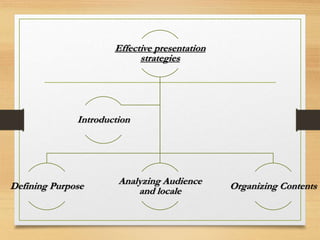
Effective presentation
strategies
Defining Purpose Analyzing Audience
and locale Organizing Contents
Introduction
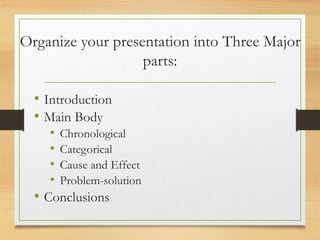
Organize your presentation into Three Major
parts:
• Introduction
• Main Body
• Chronological
• Categorical
• Cause and Effect
• Problem-solution
• Conclusions
There are four modes of delivery
which can be used for making
Presentations:
• Extemporaneous
• Manuscript
• Impromptu
• Memorization
KINESICS
• Kinesics is the name given to the study of the body’s
physical movements. In other words, it is the way the
body communicates without words, i.e., through
various movements of its parts.
E.g. Nodding your head, blinking your eyes, waving
the hands
Kinesics includes
• Personal Appearance
• Posture
• Gesture
• Facial Expression
• Eye Contact
PROXEMICS
• Proxemics is the study of physical space in
interpersonal relations. Space is related to behavioral
norms. The way people use space tells you a lot
about them. Speaker should use the psychological
power of this space to your advantage
PARALINGUISTICS
• Paralinguistic features are non-verbal vocal cues that
help you to give urgency to your voice. Your voice is
your trademark; it is that part of yourself that adds
human touch to your words.
• Quality: Quality is a characteristic that
distinguishes one voice from
another.
• Volume: Volume is the loudness or the
softness of the voice.
• Pace/Rate: Rate is the number of words which
you speak per minute. The normal
rate is from 120 to 150 words per
minute.
• Pitch: Pitch refers to the number of
vibrations per second of your voice.
• Articulation: Speakers should be careful not to
slop, chop, truncate, or omit
sounds between words or
sentences.
• Pronunciation: If articulation means speaking out
all the sounds distinctly, then
pronunciation requires us to speak
out sounds in way that is generally
accepted. The best way is to follow
British Received Pronunciation
• Voice Modulation: While intonation refers to the
tonal variations, modulation pertains to
the way we regulate, vary, or adjust
the tone, pitch, and volume of the
sound or speaking voice.
• Pauses: A pause is a short silence flanked
by words. A pause in speaking lets
the listener reflect on the message
and digest it accordingly
CHRONEMICS
• Chronemics is the study of how human beings
communicate through their use of time.

Effective presentation strategies

  • 1.
  • 2.
    Effective presentation strategies Defining PurposeAnalyzing Audience and locale Organizing Contents Introduction
  • 3.
    Organize your presentationinto Three Major parts: • Introduction • Main Body • Chronological • Categorical • Cause and Effect • Problem-solution • Conclusions
  • 4.
    There are fourmodes of delivery which can be used for making Presentations: • Extemporaneous • Manuscript • Impromptu • Memorization
  • 5.
    KINESICS • Kinesics isthe name given to the study of the body’s physical movements. In other words, it is the way the body communicates without words, i.e., through various movements of its parts. E.g. Nodding your head, blinking your eyes, waving the hands
  • 6.
    Kinesics includes • PersonalAppearance • Posture • Gesture • Facial Expression • Eye Contact
  • 7.
    PROXEMICS • Proxemics isthe study of physical space in interpersonal relations. Space is related to behavioral norms. The way people use space tells you a lot about them. Speaker should use the psychological power of this space to your advantage
  • 8.
    PARALINGUISTICS • Paralinguistic featuresare non-verbal vocal cues that help you to give urgency to your voice. Your voice is your trademark; it is that part of yourself that adds human touch to your words.
  • 9.
    • Quality: Qualityis a characteristic that distinguishes one voice from another. • Volume: Volume is the loudness or the softness of the voice. • Pace/Rate: Rate is the number of words which you speak per minute. The normal rate is from 120 to 150 words per minute. • Pitch: Pitch refers to the number of vibrations per second of your voice.
  • 10.
    • Articulation: Speakersshould be careful not to slop, chop, truncate, or omit sounds between words or sentences. • Pronunciation: If articulation means speaking out all the sounds distinctly, then pronunciation requires us to speak out sounds in way that is generally accepted. The best way is to follow British Received Pronunciation
  • 11.
    • Voice Modulation:While intonation refers to the tonal variations, modulation pertains to the way we regulate, vary, or adjust the tone, pitch, and volume of the sound or speaking voice. • Pauses: A pause is a short silence flanked by words. A pause in speaking lets the listener reflect on the message and digest it accordingly
  • 12.
    CHRONEMICS • Chronemics isthe study of how human beings communicate through their use of time.