Writing Methods
--Dr. Debaleena Dutta
PSIT, Kanpur
Recap
Last lesson, we learnt about Reading Skills.
They are:
• Skimming
• Scanning
• Churning
• Assimilation
Focus of this lesson: Writing
Reading = Receptive Skill
Writing= Productive Skill
So, we are going to discuss Writing.
Specifically,
How we develop ideas through Writing
Can you guess the next lines to these
sentences?
• College life is the best time of our lives.
--------------------------------------------
--------------------------------------------
• Chat over Whatsapp is easier than talking in front
----------------------------------------------------------
----------------------------------------------------------
Can you guess the starting lines?
_______________________________
_______________________________
_______________________________
That’s why, you should watch Mirzapur.
Can you guess the starting and ending lines?
________________________________
________________________________
However, movies can have negative effects
as well, side by side its positives.
_________________________________
_________________________________
Can you trace the most important line?
Different people spend their holidays in
different ways. Some like to travel to nice
places. Some prefer staying home and
watching movies. Still, there are some who
make a get-together with their relatives.
Can you trace the most important line?
Different people spend their holidays in
different ways. Some like to travel to nice
places. Some prefer staying home and
watching movies. Still, there are some who
make a get-together with their relatives.
Can you trace the most important line?
Distance education lets you to have a degree
while you are doing a job. It is also good for
poor students who do not have good colleges
nearby, and cannot afford to go to another
city to study. Clearly, distance learning is a
strong alternative to college education.
Can you trace the most important line?
Distance education lets you to have a degree
while you are doing a job. It is also good for
poor students who do not have good colleges
nearby, and cannot afford to go to another
city to study. Clearly, distance learning is a
strong alternative to college education.
So, what you have learnt so far
• A paragraph is a collection of sentences.
• The sentences are connected to each other.
• There is a complete idea, a ‘topic’ developed
in a paragraph.
• One line in the paragraph is the most
important line in it.
• This line could be at the beginning, end, or
middle.
Definition: What is a Paragraph?
• A paragraph is a collection of sentences, that
logically present one single idea.
• One sentence among them is the most
important one. It is called the Topic sentence.
• The other sentences give support to the Topic
sentence. These sentences are called
supporting sentences.
Methods of Paragraph Writing
• Depending upon our purpose, we can order
the Topic sentence and the Supporting
sentences in 7 specific ways. They are:
Deductive, Inductive, Exposition, Chronological,
Spatial, Linear, & Interrupted.
These are called ‘Methods of Paragraph Writing’.
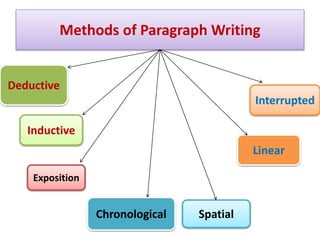
Methods of Paragraph Writing
Deductive
Inductive
Chronological Spatial
Linear
Interrupted
Exposition
Purpose: Defending an idea
• When our purpose is to defend an idea by
providing evidence, we write the paragraph in
Deductive method.
• The topic sentence comes at the beginning. It
states a fact.
• The supporting sentences come after it, and
give evidence that the fact is true.
Deductive paragraph: Example
Mental depression is a dangerous symptom.
First, it can affect any one, be he an adult or a
child. This is because of cut-throat
competition in every area of life. Second,
depression has no physical indications. This
makes it hard to detect. Third, people have
the false idea that depression means
madness. Clearly, depression is a deadly
disease, and is hard to treat.
Purpose: To make an inference
When we put together clues to reach a conclusion,
we make an inference. [recall inference from Reading Skills].
While we make an inference, we use Inductive
method of Paragraph writing.
The Topic sentence comes at the last, as a
conclusion.
The supporting sentences come at the beginning, as
clues that lead to the conclusion.
Inductive Paragraph: Example
Aryan reached late in office today. He
comes to office by public transport.
He always starts early from his home
to avoid traffic. Therefore, the bus he
took today must have had a
breakdown.
Purpose: Explaining a concept
When we have to explain a concept to a person,
we make a lot of effort to do so through
examples, through comparing and contrasting
with other concepts, and through clear-cut
description of how it looks/feels.
Such explaining is called the Expository
method.
Any Wikipedia article is Expository in nature.
Expository Method: Example
Mirzapur is a crime-based TV series released
in 2018, on Amazon Prime. It revolves around
drugs, guns and lawlessness. It depicts the
rule of mafia dons and gang-rivalry in
the Purvanchal region of Uttar Pradesh. Its
season 1 consists of 9 episodes in total. In
comparison with Sacred Games, it has scored
more popularity among the viewers.
Purpose: Giving background information
Sometimes, we have to give a background
information of a person or event. For example,
medical history; tracing the development of a
country, a thing, an action down the ages.
Then we use Chronological method.
The topic sentence is written in the beginning.
The supporting sentences give a history,
with the oldest dates first.
Chronological Method: Example
Going to halls for watching movies has
become redundant nowadays. In the 90’s,
people went to movie halls to watch movies
only. Those were the times of television and
VCRs. By the 2000s, people started having
their personal computers. So movies were
watched in DVDs. Now, with the advent of
android phone and 4G connectivity, people
can watch movies right in their mobiles.
Purpose: Describing objects in a place
When we have to give exact description of a
place, so that people have clear idea of where
things are kept, we use Spatial method of
paragraph writing.
The Topic sentence comes at the beginning,
telling the name of the place.
The supporting sentences give details of things
positioned in that place.
Spatial Method: Example
PSIT is located on the Delhi Agra express
highway. On entering the gate, you will find a
road that leads to two opposite sides. Follow
the left-hand side, and you will come across
PSIT-block, Pharmacy-block, and the finally,
the Boys’ hostel. Follow the right-hand side
road, you will come across the PSIT-COE block,
and the Girls’ hostel.
Purpose: Step-by-Step description of a
Process
Often, we have to write description of a process
in manuals.
We have to write every step, from starting point
to the finish.
Then, we use Linear method.
In linear method, one line logically leads to the
other.
Linear method: Example
Uninstalling a program needs a few, simple
steps. First, go to the Start Menu. Then, Go to
Control Panel. Next, click Uninstall a
Program. Then, select the program you want
to remove. Finally, click Uninstall at the top of
the page.
Purpose: Narrating an experience in a
dramatic way
In chronological method, we found events
narrated like a diary-entry.
But often, in order to sound more dramatic and
interesting, we break the strict chronology.
We talk about present, and then go back to
past, and then start talking about future.
This is called Interrupted method. They show
the interrupted way of our thoughts.
Interrupted Method: Example
I am a fan of movies of superheroes. From
Baahubali to Spiderman, I love them all. When
I was a child, I had a huge obsession for
Shaktiman. I even tried jumping off a terrace,
but was luckily saved. Now, I just use jackets
and T Shirts to show my obsession. Someday, I
dream of creating a superhero series on TV
myself.
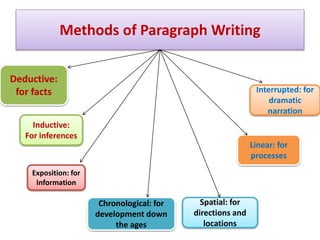
Methods of Paragraph Writing
Deductive:
for facts
Inductive:
For inferences
Chronological: for
development down
the ages
Spatial: for
directions and
locations
Linear: for
processes
Interrupted: for
dramatic
narration
Exposition: for
Information

Writing methods

  • 1.
  • 2.
    Recap Last lesson, welearnt about Reading Skills. They are: • Skimming • Scanning • Churning • Assimilation
  • 3.
    Focus of thislesson: Writing Reading = Receptive Skill Writing= Productive Skill So, we are going to discuss Writing. Specifically, How we develop ideas through Writing
  • 4.
    Can you guessthe next lines to these sentences? • College life is the best time of our lives. -------------------------------------------- -------------------------------------------- • Chat over Whatsapp is easier than talking in front ---------------------------------------------------------- ----------------------------------------------------------
  • 5.
    Can you guessthe starting lines? _______________________________ _______________________________ _______________________________ That’s why, you should watch Mirzapur.
  • 6.
    Can you guessthe starting and ending lines? ________________________________ ________________________________ However, movies can have negative effects as well, side by side its positives. _________________________________ _________________________________
  • 7.
    Can you tracethe most important line? Different people spend their holidays in different ways. Some like to travel to nice places. Some prefer staying home and watching movies. Still, there are some who make a get-together with their relatives.
  • 8.
    Can you tracethe most important line? Different people spend their holidays in different ways. Some like to travel to nice places. Some prefer staying home and watching movies. Still, there are some who make a get-together with their relatives.
  • 9.
    Can you tracethe most important line? Distance education lets you to have a degree while you are doing a job. It is also good for poor students who do not have good colleges nearby, and cannot afford to go to another city to study. Clearly, distance learning is a strong alternative to college education.
  • 10.
    Can you tracethe most important line? Distance education lets you to have a degree while you are doing a job. It is also good for poor students who do not have good colleges nearby, and cannot afford to go to another city to study. Clearly, distance learning is a strong alternative to college education.
  • 11.
    So, what youhave learnt so far • A paragraph is a collection of sentences. • The sentences are connected to each other. • There is a complete idea, a ‘topic’ developed in a paragraph. • One line in the paragraph is the most important line in it. • This line could be at the beginning, end, or middle.
  • 12.
    Definition: What isa Paragraph? • A paragraph is a collection of sentences, that logically present one single idea. • One sentence among them is the most important one. It is called the Topic sentence. • The other sentences give support to the Topic sentence. These sentences are called supporting sentences.
  • 13.
    Methods of ParagraphWriting • Depending upon our purpose, we can order the Topic sentence and the Supporting sentences in 7 specific ways. They are: Deductive, Inductive, Exposition, Chronological, Spatial, Linear, & Interrupted. These are called ‘Methods of Paragraph Writing’.
  • 14.
    Methods of ParagraphWriting Deductive Inductive Chronological Spatial Linear Interrupted Exposition
  • 15.
    Purpose: Defending anidea • When our purpose is to defend an idea by providing evidence, we write the paragraph in Deductive method. • The topic sentence comes at the beginning. It states a fact. • The supporting sentences come after it, and give evidence that the fact is true.
  • 16.
    Deductive paragraph: Example Mentaldepression is a dangerous symptom. First, it can affect any one, be he an adult or a child. This is because of cut-throat competition in every area of life. Second, depression has no physical indications. This makes it hard to detect. Third, people have the false idea that depression means madness. Clearly, depression is a deadly disease, and is hard to treat.
  • 17.
    Purpose: To makean inference When we put together clues to reach a conclusion, we make an inference. [recall inference from Reading Skills]. While we make an inference, we use Inductive method of Paragraph writing. The Topic sentence comes at the last, as a conclusion. The supporting sentences come at the beginning, as clues that lead to the conclusion.
  • 18.
    Inductive Paragraph: Example Aryanreached late in office today. He comes to office by public transport. He always starts early from his home to avoid traffic. Therefore, the bus he took today must have had a breakdown.
  • 19.
    Purpose: Explaining aconcept When we have to explain a concept to a person, we make a lot of effort to do so through examples, through comparing and contrasting with other concepts, and through clear-cut description of how it looks/feels. Such explaining is called the Expository method. Any Wikipedia article is Expository in nature.
  • 20.
    Expository Method: Example Mirzapuris a crime-based TV series released in 2018, on Amazon Prime. It revolves around drugs, guns and lawlessness. It depicts the rule of mafia dons and gang-rivalry in the Purvanchal region of Uttar Pradesh. Its season 1 consists of 9 episodes in total. In comparison with Sacred Games, it has scored more popularity among the viewers.
  • 21.
    Purpose: Giving backgroundinformation Sometimes, we have to give a background information of a person or event. For example, medical history; tracing the development of a country, a thing, an action down the ages. Then we use Chronological method. The topic sentence is written in the beginning. The supporting sentences give a history, with the oldest dates first.
  • 22.
    Chronological Method: Example Goingto halls for watching movies has become redundant nowadays. In the 90’s, people went to movie halls to watch movies only. Those were the times of television and VCRs. By the 2000s, people started having their personal computers. So movies were watched in DVDs. Now, with the advent of android phone and 4G connectivity, people can watch movies right in their mobiles.
  • 23.
    Purpose: Describing objectsin a place When we have to give exact description of a place, so that people have clear idea of where things are kept, we use Spatial method of paragraph writing. The Topic sentence comes at the beginning, telling the name of the place. The supporting sentences give details of things positioned in that place.
  • 24.
    Spatial Method: Example PSITis located on the Delhi Agra express highway. On entering the gate, you will find a road that leads to two opposite sides. Follow the left-hand side, and you will come across PSIT-block, Pharmacy-block, and the finally, the Boys’ hostel. Follow the right-hand side road, you will come across the PSIT-COE block, and the Girls’ hostel.
  • 25.
    Purpose: Step-by-Step descriptionof a Process Often, we have to write description of a process in manuals. We have to write every step, from starting point to the finish. Then, we use Linear method. In linear method, one line logically leads to the other.
  • 26.
    Linear method: Example Uninstallinga program needs a few, simple steps. First, go to the Start Menu. Then, Go to Control Panel. Next, click Uninstall a Program. Then, select the program you want to remove. Finally, click Uninstall at the top of the page.
  • 27.
    Purpose: Narrating anexperience in a dramatic way In chronological method, we found events narrated like a diary-entry. But often, in order to sound more dramatic and interesting, we break the strict chronology. We talk about present, and then go back to past, and then start talking about future. This is called Interrupted method. They show the interrupted way of our thoughts.
  • 28.
    Interrupted Method: Example Iam a fan of movies of superheroes. From Baahubali to Spiderman, I love them all. When I was a child, I had a huge obsession for Shaktiman. I even tried jumping off a terrace, but was luckily saved. Now, I just use jackets and T Shirts to show my obsession. Someday, I dream of creating a superhero series on TV myself.
  • 29.
    Methods of ParagraphWriting Deductive: for facts Inductive: For inferences Chronological: for development down the ages Spatial: for directions and locations Linear: for processes Interrupted: for dramatic narration Exposition: for Information