The document discusses establishing appropriate credit limits for customers. It recommends considering qualitative factors like a customer's character, capacity to pay, and capital, as well as quantitative factors from financial statements. A sample credit limit policy is provided that establishes criteria like granting 10% of a customer's tangible net worth as the base limit and adjusting up or down based on additional factors like security, payment history, and financial ratios. The policy outlines obtaining annual financial statements and reviewing accounts regularly.
Overview of credit as a puzzle that forms a clearer picture with more pieces. Understanding credit pieces is essential for a comprehensive view.
Credit lines as investments and privileges linked to a firm's sales terms, market penetration, risk appetite, and customer's growth capacity.
Parameters and factors influencing credit decisions including net worth, cash flow, industry risks, and market conditions.
Quantitative metrics such as cash flow, liquidity, leverage, and additional resources that influence credit decisions.
Importance of collateral, equity, revenue expectations, and customer base diversity in credit evaluation.
Objective and subjective factors that may prevent or complicate credit approvals including negative histories and management issues. Signs of caution for lenders including growth patterns, financial ratio declines, and managerial structures that can indicate risk.
Detailed examples of credit limit policies, including criteria, procedures, and financial evaluation standards used by ABC, Inc.
Recap of the webinar, future opportunities, and invitation for questions and feedback on credit management practices.
Credit is likea puzzle … … the more pieces you have, the clearer the picture
3.
The Credit PuzzleThe pieces fit together to form a picture The more pieces you have, the clearer the picture It is possible to understand the essence of the picture without having all of the pieces in place Although no one piece is enough to make you comfortable, you can become uncomfortable based on a single item.
Credit Line Acredit line must coincide with your firm’s Terms of sale Desired level of market penetration Appetite for risk
6.
Extension of CreditYour credit extensions will be linked to your customer’s: Capacity for growth Ability to withstand adversity in the economy and the market place Credit worthiness Need for your product matched to the ability to repay the debt
7.
Granting a lineof Credit Percentage of Net Worth Percentage of Cash Flow from Operations Percentage of Working Capital Based upon Dun & Bradstreet rating Supplier references Bank references Personal / Corporate guaranty Security
8.
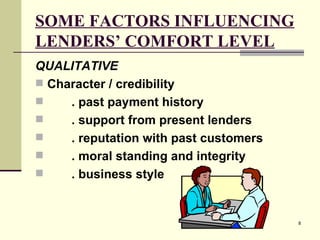
SOME FACTORS INFLUENCINGLENDERS’ COMFORT LEVEL QUALITATIVE Character / credibility . past payment history . support from present lenders . reputation with past customers . moral standing and integrity . business style
9.
SOME FACTORS INFLUENCINGLENDERS’ COMFORT LEVEL -2 Proven ability to grow / adapt . successful problem identification / resolution . strategies to keep abreast of the times . ability to manage complexity . balance of key managerial functions
10.
SOME FACTORS INFLUENCINGLENDERS’ COMFORT LEVEL -3 Depth of experience / talent . degree of competence in critical areas what must they do well ? what is company’s real business ? . competent to manage in adversity as well as prosperity
11.
Industry Inherent riskcompared to other industries State of maturity . growing . flat . declining Present Stage of Industry Cycle Position within industry . market share . trend Competition within industry . domestic / international . entry / exit barriers . cost structure . energy sensitivity
12.
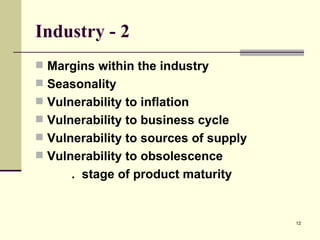
Industry - 2Margins within the industry Seasonality Vulnerability to inflation Vulnerability to business cycle Vulnerability to sources of supply Vulnerability to obsolescence . stage of product maturity
13.
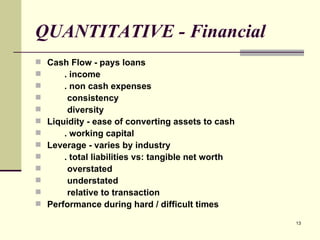
QUANTITATIVE - FinancialCash Flow - pays loans . income . non cash expenses consistency diversity Liquidity - ease of converting assets to cash . working capital Leverage - varies by industry . total liabilities vs: tangible net worth overstated understated relative to transaction Performance during hard / difficult times
14.
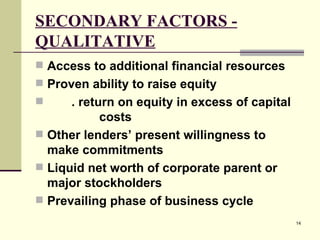
SECONDARY FACTORS -QUALITATIVE Access to additional financial resources Proven ability to raise equity . return on equity in excess of capital costs Other lenders’ present willingness to make commitments Liquid net worth of corporate parent or major stockholders Prevailing phase of business cycle
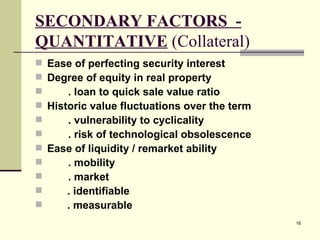
SECONDARY FACTORS - QUANTITATIVE (Collateral) Ease of perfecting security interest Degree of equity in real property . loan to quick sale value ratio Historic value fluctuations over the term . vulnerability to cyclicality . risk of technological obsolescence Ease of liquidity / remarket ability . mobility . market . identifiable . measurable
17.
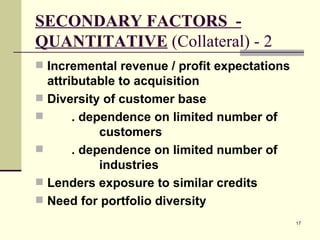
SECONDARY FACTORS - QUANTITATIVE (Collateral) - 2 Incremental revenue / profit expectations attributable to acquisition Diversity of customer base . dependence on limited number of customers . dependence on limited number of industries Lenders exposure to similar credits Need for portfolio diversity
18.
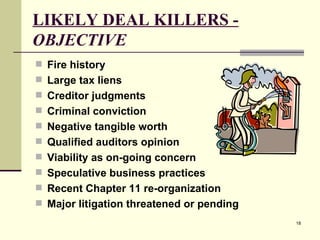
LIKELY DEAL KILLERS- OBJECTIVE Fire history Large tax liens Creditor judgments Criminal conviction Negative tangible worth Qualified auditors opinion Viability as on-going concern Speculative business practices Recent Chapter 11 re-organization Major litigation threatened or pending
19.
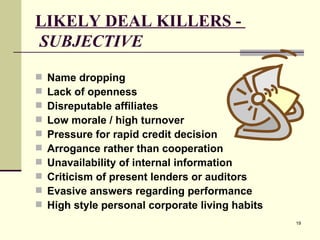
LIKELY DEAL KILLERS- SUBJECTIVE Name dropping Lack of openness Disreputable affiliates Low morale / high turnover Pressure for rapid credit decision Arrogance rather than cooperation Unavailability of internal information Criticism of present lenders or auditors Evasive answers regarding performance High style personal corporate living habits
20.
REASONS FOR CAUTION Rapid growth Changing banks Heavy cash usage Debt rescheduling Changes in auditors Slow trade payment
21.
REASONS FOR CAUTION 2 No dominant lead bank Deteriorating financial ratios No regional bank involvement Acquisitions (friendly / unfriendly) Change in ownership / management Previous turndowns
22.
REASONS FOR CAUTION 3 Continuous restating of previous year’s statements. Previously troubled credits that appear to have turned around Reported payment history inconsistent with trade reference comments Criminal indictment
23.
SUBJECTIVE Poorly managedAbsentee management Family dominated company Anything out of the ordinary Company with one person rule Significant changes in operations Heavy fixed costs or other operating rigidities Alterations in corporate emphasis and objectives Large, complex corporate and financial structures Marginal borrowers with down market positions in their industries
24.
Example of aPolicy Exhibit “A” Company Policy on establishing a Credit limit for your customers…
25.
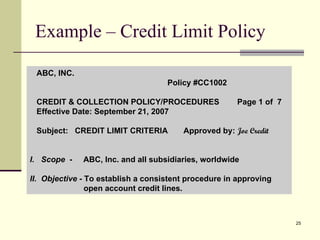
Example – CreditLimit Policy ABC, INC. Policy #CC1002 CREDIT & COLLECTION POLICY/PROCEDURES Page 1 of 7 Effective Date: September 21, 2007 Subject: CREDIT LIMIT CRITERIA Approved by: Joe Credit I. Scope - ABC, Inc. and all subsidiaries, worldwide II. Objective - To establish a consistent procedure in approving open account credit lines.
26.
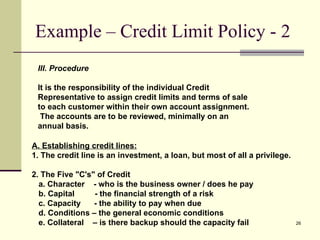
Example – CreditLimit Policy - 2 III. Procedure It is the responsibility of the individual Credit Representative to assign credit limits and terms of sale to each customer within their own account assignment. The accounts are to be reviewed, minimally on an annual basis. A. Establishing credit lines: 1. The credit line is an investment, a loan, but most of all a privilege. 2. The Five "C's" of Credit a. Character - who is the business owner / does he pay b. Capital - the financial strength of a risk c. Capacity - the ability to pay when due d. Conditions – the general economic conditions e. Collateral – is there backup should the capacity fail
27.
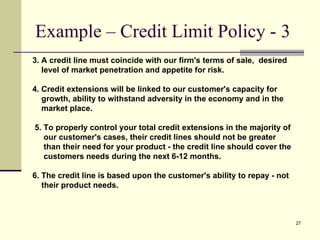
Example – CreditLimit Policy - 3 3. A credit line must coincide with our firm's terms of sale, desired level of market penetration and appetite for risk. 4. Credit extensions will be linked to our customer's capacity for growth, ability to withstand adversity in the economy and in the market place. 5. To properly control your total credit extensions in the majority of our customer's cases, their credit lines should not be greater than their need for your product - the credit line should cover the customers needs during the next 6-12 months. 6. The credit line is based upon the customer's ability to repay - not their product needs.
28.
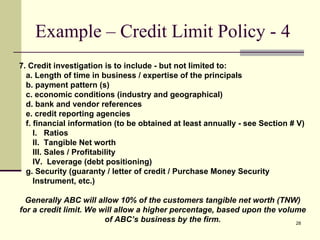
Example – CreditLimit Policy - 4 7. Credit investigation is to include - but not limited to: a. Length of time in business / expertise of the principals b. payment pattern (s) c. economic conditions (industry and geographical) d. bank and vendor references e. credit reporting agencies f. financial information (to be obtained at least annually - see Section # V) I. Ratios II. Tangible Net worth III. Sales / Profitability IV. Leverage (debt positioning) g. Security (guaranty / letter of credit / Purchase Money Security Instrument, etc.) Generally ABC will allow 10% of the customers tangible net worth (TNW) for a credit limit. We will allow a higher percentage, based upon the volume of ABC’s business by the firm.
29.
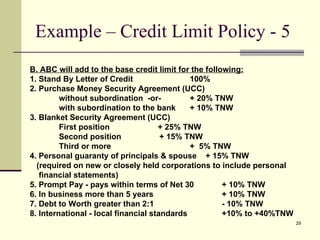
Example – CreditLimit Policy - 5 B. ABC will add to the base credit limit for the following: 1. Stand By Letter of Credit 100% 2. Purchase Money Security Agreement (UCC) without subordination -or- + 20% TNW with subordination to the bank + 10% TNW 3. Blanket Security Agreement (UCC) First position + 25% TNW Second position + 15% TNW Third or more + 5% TNW 4. Personal guaranty of principals & spouse + 15% TNW (required on new or closely held corporations to include personal financial statements) 5. Prompt Pay - pays within terms of Net 30 + 10% TNW 6. In business more than 5 years + 10% TNW 7. Debt to Worth greater than 2:1 - 10% TNW 8. International - local financial standards +10% to +40%TNW
30.
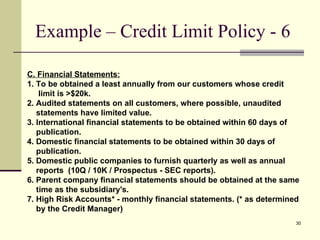
Example – CreditLimit Policy - 6 C. Financial Statements: 1. To be obtained a least annually from our customers whose credit limit is >$20k. 2. Audited statements on all customers, where possible, unaudited statements have limited value. 3. International financial statements to be obtained within 60 days of publication. 4. Domestic financial statements to be obtained within 30 days of publication. 5. Domestic public companies to furnish quarterly as well as annual reports (10Q / 10K / Prospectus - SEC reports). 6. Parent company financial statements should be obtained at the same time as the subsidiary's. 7. High Risk Accounts* - monthly financial statements. (* as determined by the Credit Manager)
31.
For Further ConsiderationFuture webinars On Line Classes Western Regional Credit Conference in Las Vegas (10/14-16) We are always open to your comments and suggestions for future programs … please contact your rep at CMA
32.
Question time……….. Timeto ask your questions… I can email you a copy of this policy if you would like… Thank you for joining us today…Jim Menard, CCE You can contact me at [email_address]