CREDIT
MANAGEMENT
Prepared By:
          Ketan Vagh
          Saurabh Raval
          Nidhi Shah
          Kushal Shah
          Chirag Parekh
TABLE OF CONTENTS

   Terms of payment

   Credit policy variables

   Credit evaluation

   Credit granting decision

   Control of accounts receivable

   Credit management in India
TERMS OF PAYMENTS

 Cash   Terms

 Open    Account

     Credit Period

     Cash Discount

     Billing
TERMS OF PAYMENTS

 Consignment


 Bill   of Exchange


 Letter   of Credit
CREDIT POLICY
VARIABLES
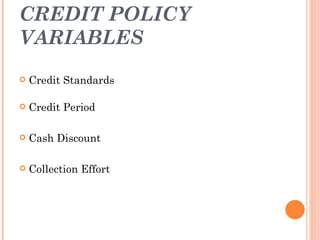
   Credit Standards

   Credit Period

   Cash Discount

   Collection Effort
CREDIT STANDARDS

   ∆RI = [∆S (1 – V) - ∆S bn] (1 – t) -k ∆I

    Where
     ∆RI = Change in residual income
     ∆S = increase in sales
     V   = ratio of variables costs to sales
     bn = bad debt loss ratio on new sales
     t   = corporate tax rate
     k   = post tax cost of capital
     ∆t = increase in receivables investment.
CREDIT PERIOD

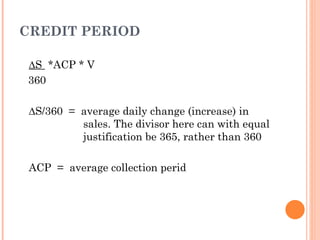
∆S *ACP * V
360

 ∆S/360 = average daily change (increase) in
          sales. The divisor here can with equal
          justification be 365, rather than 360

 ACP = average collection perid
CASH DISCOUNT

   ∆RI = [∆S (1 – V) - ∆DIS] (1 – t) + k∆I

    Where
        ∆S     =     Increase in sales
        V      =     ratio of variable cost to sales
        k      =      cost of capital
        ∆I     =     savings in receivables investment
      ∆DIS     =     increase in discount cost
COLLECTION EFFORT
   ∆RI = [∆S (1 – V) - ∆BD] (1 – t) + k∆I

    Where
         ∆RI   =     Change in residual income
         ∆S    =     Increase in sales
         V     =     ratio of variable cost to sales
       ∆BD     =     increase in bad debt cost
       t       =     tax rate
          k    =      cost of capital
      ∆I       =     savings in investment in receivables
Credit Evaluation

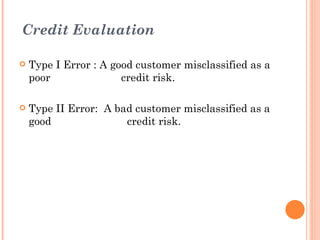
   Type I Error : A good customer misclassified as a
    poor               credit risk.

   Type II Error: A bad customer misclassified as a
    good               credit risk.
TRADITIONAL CREDIT
ANALYSIS
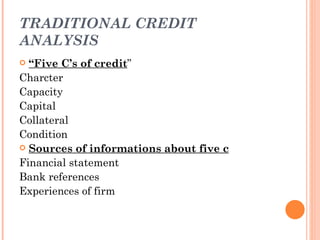
 “Five C’s of credit”
Charcter
Capacity
Capital
Collateral
Condition
 Sources of informations about five c

Financial statement
Bank references
Experiences of firm
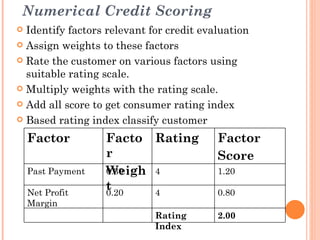
Numerical Credit Scoring
 Identify factors relevant for credit evaluation
 Assign weights to these factors

 Rate the customer on various factors using
  suitable rating scale.
 Multiply weights with the rating scale.

 Add all score to get consumer rating index

 Based rating index classify customer

    Factor         Facto Rating           Factor
                   r                      Score
    Past Payment   Weigh 4
                   0.30                   1.20

    Net Profit
                   t
                   0.20  4                0.80
    Margin
                             Rating       2.00
                             Index
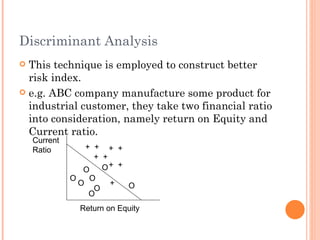
Discriminant Analysis
 This technique is employed to construct better
  risk index.
 e.g. ABC company manufacture some product for
  industrial customer, they take two financial ratio
  into consideration, namely return on Equity and
  Current ratio.
    Current
    Ratio         + + + +
                    + +
                 O    O+ +
              O    O
                O       +  O
                    O
                   O
                Return on Equity
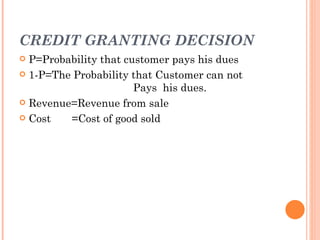
CREDIT GRANTING DECISION
 P=Probability that customer pays his dues
 1-P=The Probability that Customer can not
                       Pays his dues.
 Revenue=Revenue from sale

 Cost   =Cost of good sold
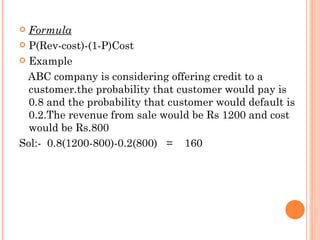
 Formula
 P(Rev-cost)-(1-P)Cost

 Example

  ABC company is considering offering credit to a
  customer.the probability that customer would pay is
  0.8 and the probability that customer would default is
  0.2.The revenue from sale would be Rs 1200 and cost
  would be Rs.800
Sol:- 0.8(1200-800)-0.2(800) = 160
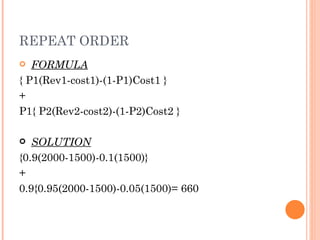
REPEAT ORDER
  FORMULA
{ P1(Rev1-cost1)-(1-P1)Cost1 }
+
P1{ P2(Rev2-cost2)-(1-P2)Cost2 }

  SOLUTION
{0.9(2000-1500)-0.1(1500)}
+
0.9{0.95(2000-1500)-0.05(1500)= 660
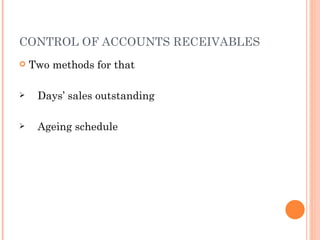
CONTROL OF ACCOUNTS RECEIVABLES
   Two methods for that

    Days’ sales outstanding

    Ageing schedule
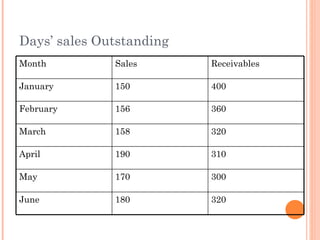
Days’ sales Outstanding
Month         Sales       Receivables

January       150         400

February      156         360

March         158         320

April         190         310

May           170         300

June          180         320
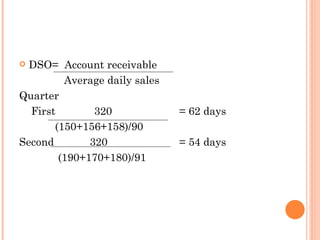
 DSO= Account receivable
         Average daily sales
Quarter
  First        320             = 62 days
       (150+156+158)/90
Second        320              = 54 days
        (190+170+180)/91
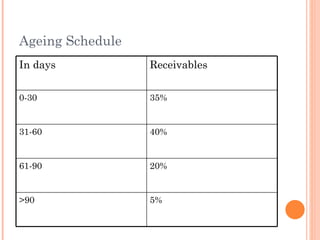
Ageing Schedule
In days           Receivables


0-30              35%


31-60             40%


61-90             20%


>90               5%
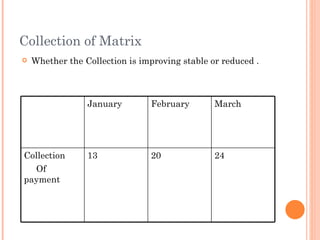
Collection of Matrix
   Whether the Collection is improving stable or reduced .


                 January        February        March


Collection       13             20              24
  Of
payment
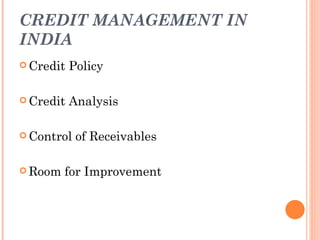
CREDIT MANAGEMENT IN
INDIA
 Credit   Policy

 Credit   Analysis

 Control   of Receivables

 Room   for Improvement
Credit management

Credit management

  • 1.
    CREDIT MANAGEMENT Prepared By: Ketan Vagh Saurabh Raval Nidhi Shah Kushal Shah Chirag Parekh
  • 2.
    TABLE OF CONTENTS  Terms of payment  Credit policy variables  Credit evaluation  Credit granting decision  Control of accounts receivable  Credit management in India
  • 3.
    TERMS OF PAYMENTS Cash Terms  Open Account  Credit Period  Cash Discount  Billing
  • 4.
    TERMS OF PAYMENTS Consignment  Bill of Exchange  Letter of Credit
  • 5.
    CREDIT POLICY VARIABLES  Credit Standards  Credit Period  Cash Discount  Collection Effort
  • 6.
    CREDIT STANDARDS  ∆RI = [∆S (1 – V) - ∆S bn] (1 – t) -k ∆I Where  ∆RI = Change in residual income  ∆S = increase in sales  V = ratio of variables costs to sales  bn = bad debt loss ratio on new sales  t = corporate tax rate  k = post tax cost of capital  ∆t = increase in receivables investment.
  • 7.
    CREDIT PERIOD ∆S *ACP* V 360 ∆S/360 = average daily change (increase) in sales. The divisor here can with equal justification be 365, rather than 360 ACP = average collection perid
  • 8.
    CASH DISCOUNT  ∆RI = [∆S (1 – V) - ∆DIS] (1 – t) + k∆I Where ∆S = Increase in sales V = ratio of variable cost to sales k = cost of capital ∆I = savings in receivables investment ∆DIS = increase in discount cost
  • 9.
    COLLECTION EFFORT  ∆RI = [∆S (1 – V) - ∆BD] (1 – t) + k∆I Where ∆RI = Change in residual income ∆S = Increase in sales V = ratio of variable cost to sales ∆BD = increase in bad debt cost t = tax rate k = cost of capital ∆I = savings in investment in receivables
  • 10.
    Credit Evaluation  Type I Error : A good customer misclassified as a poor credit risk.  Type II Error: A bad customer misclassified as a good credit risk.
  • 11.
    TRADITIONAL CREDIT ANALYSIS  “FiveC’s of credit” Charcter Capacity Capital Collateral Condition  Sources of informations about five c Financial statement Bank references Experiences of firm
  • 12.
    Numerical Credit Scoring Identify factors relevant for credit evaluation  Assign weights to these factors  Rate the customer on various factors using suitable rating scale.  Multiply weights with the rating scale.  Add all score to get consumer rating index  Based rating index classify customer Factor Facto Rating Factor r Score Past Payment Weigh 4 0.30 1.20 Net Profit t 0.20 4 0.80 Margin Rating 2.00 Index
  • 13.
    Discriminant Analysis  Thistechnique is employed to construct better risk index.  e.g. ABC company manufacture some product for industrial customer, they take two financial ratio into consideration, namely return on Equity and Current ratio. Current Ratio + + + + + + O O+ + O O O + O O O Return on Equity
  • 14.
    CREDIT GRANTING DECISION P=Probability that customer pays his dues  1-P=The Probability that Customer can not Pays his dues.  Revenue=Revenue from sale  Cost =Cost of good sold
  • 15.
     Formula  P(Rev-cost)-(1-P)Cost Example ABC company is considering offering credit to a customer.the probability that customer would pay is 0.8 and the probability that customer would default is 0.2.The revenue from sale would be Rs 1200 and cost would be Rs.800 Sol:- 0.8(1200-800)-0.2(800) = 160
  • 16.
    REPEAT ORDER  FORMULA { P1(Rev1-cost1)-(1-P1)Cost1 } + P1{ P2(Rev2-cost2)-(1-P2)Cost2 }  SOLUTION {0.9(2000-1500)-0.1(1500)} + 0.9{0.95(2000-1500)-0.05(1500)= 660
  • 17.
    CONTROL OF ACCOUNTSRECEIVABLES  Two methods for that  Days’ sales outstanding  Ageing schedule
  • 18.
    Days’ sales Outstanding Month Sales Receivables January 150 400 February 156 360 March 158 320 April 190 310 May 170 300 June 180 320
  • 19.
     DSO= Accountreceivable Average daily sales Quarter First 320 = 62 days (150+156+158)/90 Second 320 = 54 days (190+170+180)/91
  • 20.
    Ageing Schedule In days Receivables 0-30 35% 31-60 40% 61-90 20% >90 5%
  • 21.
    Collection of Matrix  Whether the Collection is improving stable or reduced . January February March Collection 13 20 24 Of payment
  • 22.
    CREDIT MANAGEMENT IN INDIA Credit Policy  Credit Analysis  Control of Receivables  Room for Improvement