Credit Appraisal & Portfolio
Management of Corporate
Banking
Moazzem Hossain Shumon
Head of Underwriting,
Wholesale Banking Unit 2
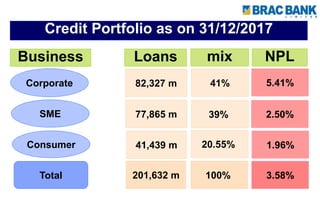
Credit Portfolio as on 31/12/2017
Business Loans
Corporate
SME
Consumer
Total
82,327 m
77,865 m
41,439 m
201,632 m
mix
41%
39%
20.55%
100%
NPL
5.41%
2.50%
1.96%
3.58%
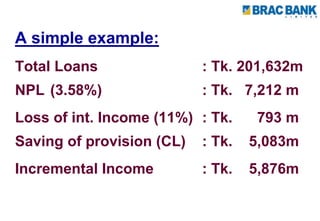
A simple example:
Total Loans : Tk. 201,632m
NPL (3.58%) : Tk. 7,212 m
Loss of int. Income (11%) : Tk. 793 m
Saving of provision (CL) : Tk. 5,083m
Incremental Income : Tk. 5,876m
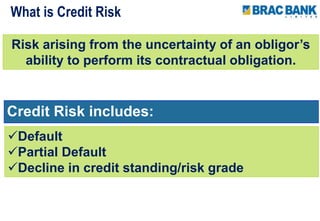
What is Credit Risk
Risk arising from the uncertainty of an obligor’s
ability to perform its contractual obligation.
Credit Risk includes:
Default
Partial Default
Decline in credit standing/risk grade
Globally more than 50% of total risk elements in
banks and FIs are Credit Risk alone
Credit Losses have, historically, been the single
largest cause of bank failures.
– The Economist
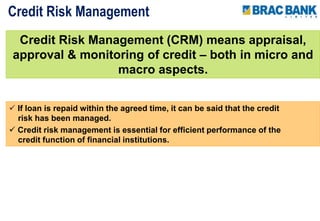
Credit Risk Management
Credit Risk Management (CRM) means appraisal,
approval & monitoring of credit – both in micro and
macro aspects.
 If loan is repaid within the agreed time, it can be said that the credit
risk has been managed.
 Credit risk management is essential for efficient performance of the
credit function of financial institutions.
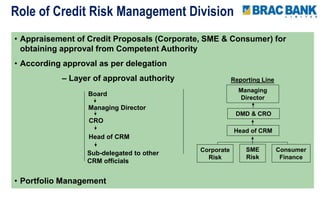
Role of Credit Risk Management Division
• Appraisement of Credit Proposals (Corporate, SME & Consumer) for
obtaining approval from Competent Authority
• According approval as per delegation
– Layer of approval authority
• Portfolio Management
Board
Managing Director
Head of CRM
Sub-delegated to other
CRM officials
Reporting Line
Managing
Director
Head of CRM
Consumer
Finance
Corporate
Risk
SME
Risk
CRO
DMD & CRO
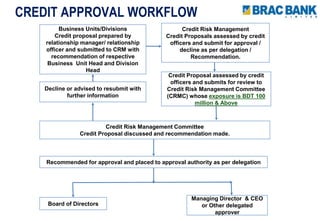
CREDIT APPROVAL WORKFLOW
Business Units/Divisions
Credit proposal prepared by
relationship manager/ relationship
officer and submitted to CRM with
recommendation of respective
Business Unit Head and Division
Head
Credit Risk Management
Credit Proposals assessed by credit
officers and submit for approval /
decline as per delegation /
Recommendation.
Credit Proposal assessed by credit
officers and submits for review to
Credit Risk Management Committee
(CRMC) whose exposure is BDT 100
million & Above
Credit Risk Management Committee
Credit Proposal discussed and recommendation made.
Decline or advised to resubmit with
further information
Recommended for approval and placed to approval authority as per delegation
Board of Directors
Managing Director & CEO
or Other delegated
approver
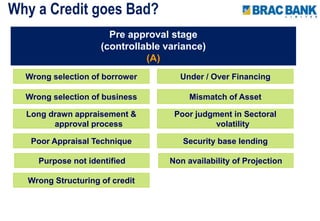
Why a Credit goes Bad?
Pre approval stage
(controllable variance)
(A)
Wrong selection of borrower
Wrong selection of business
Long drawn appraisement &
approval process
Poor Appraisal Technique
Purpose not identified
Wrong Structuring of credit
Under / Over Financing
Mismatch of Asset
Poor judgment in Sectoral
volatility
Security base lending
Non availability of Projection
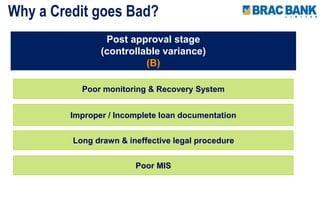
Why a Credit goes Bad?
Post approval stage
(controllable variance)
(B)
Poor monitoring & Recovery System
Improper / Incomplete loan documentation
Long drawn & ineffective legal procedure
Poor MIS
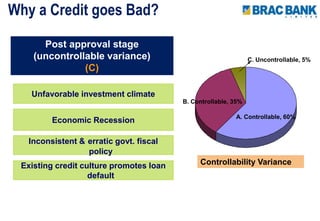
Why a Credit goes Bad?
Post approval stage
(uncontrollable variance)
(C)
Unfavorable investment climate
Economic Recession
Inconsistent & erratic govt. fiscal
policy
Existing credit culture promotes loan
default
A. Controllable, 60%
B. Controllable, 35%
C. Uncontrollable, 5%
Controllability Variance
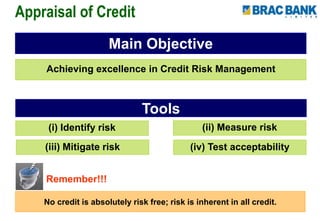
Appraisal of Credit
Main Objective
Achieving excellence in Credit Risk Management
Remember!!!
No credit is absolutely risk free; risk is inherent in all credit.
Tools
(i) Identify risk (ii) Measure risk
(iii) Mitigate risk (iv) Test acceptability
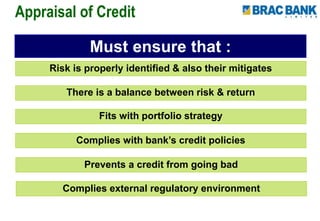
Risk is properly identified & also their mitigates
Must ensure that :
There is a balance between risk & return
Fits with portfolio strategy
Complies with bank’s credit policies
Prevents a credit from going bad
Complies external regulatory environment
Appraisal of Credit

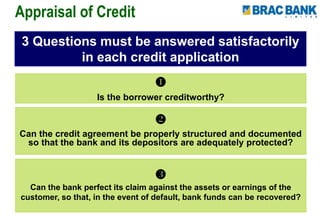
Is the borrower creditworthy?
3 Questions must be answered satisfactorily
in each credit application

Can the credit agreement be properly structured and documented
so that the bank and its depositors are adequately protected?

Can the bank perfect its claim against the assets or earnings of the
customer, so that, in the event of default, bank funds can be recovered?
Appraisal of Credit
Appraisal of Credit
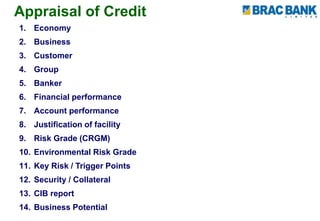
1. Economy
2. Business
3. Customer
4. Group
5. Banker
6. Financial performance
7. Account performance
8. Justification of facility
9. Risk Grade (CRGM)
10. Environmental Risk Grade
11. Key Risk / Trigger Points
12. Security / Collateral
13. CIB report
14. Business Potential
Components of Credit Risk Management
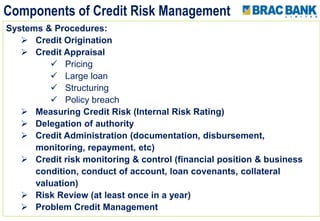
Systems & Procedures:
 Credit Origination
 Credit Appraisal
 Pricing
 Large loan
 Structuring
 Policy breach
 Measuring Credit Risk (Internal Risk Rating)
 Delegation of authority
 Credit Administration (documentation, disbursement,
monitoring, repayment, etc)
 Credit risk monitoring & control (financial position & business
condition, conduct of account, loan covenants, collateral
valuation)
 Risk Review (at least once in a year)
 Problem Credit Management
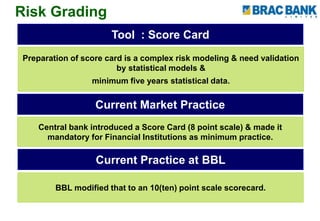
Risk Grading
Tool : Score Card
Preparation of score card is a complex risk modeling & need validation
by statistical models &
minimum five years statistical data.
Current Market Practice
Central bank introduced a Score Card (8 point scale) & made it
mandatory for Financial Institutions as minimum practice.
Current Practice at BBL
BBL modified that to an 10(ten) point scale scorecard.
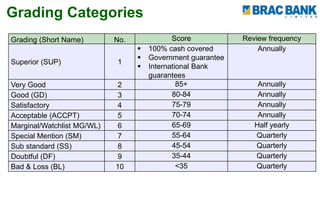
Grading Categories
Grading (Short Name) No. Score Review frequency
Superior (SUP) 1
 100% cash covered
 Government guarantee
 International Bank
guarantees
Annually
Very Good 2 85+ Annually
Good (GD) 3 80-84 Annually
Satisfactory 4 75-79 Annually
Acceptable (ACCPT) 5 70-74 Annually
Marginal/Watchlist MG/WL) 6 65-69 Half yearly
Special Mention (SM) 7 55-64 Quarterly
Sub standard (SS) 8 45-54 Quarterly
Doubtful (DF) 9 35-44 Quarterly
Bad & Loss (BL) 10 <35 Quarterly
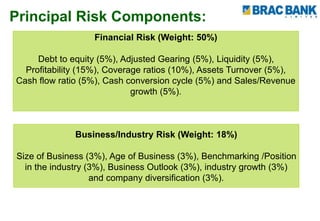
Principal Risk Components:
Financial Risk (Weight: 50%)
Debt to equity (5%), Adjusted Gearing (5%), Liquidity (5%),
Profitability (15%), Coverage ratios (10%), Assets Turnover (5%),
Cash flow ratio (5%), Cash conversion cycle (5%) and Sales/Revenue
growth (5%).
Business/Industry Risk (Weight: 18%)
Size of Business (3%), Age of Business (3%), Benchmarking /Position
in the industry (3%), Business Outlook (3%), industry growth (3%)
and company diversification (3%).
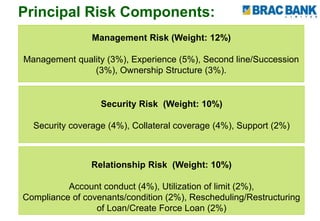
Management Risk (Weight: 12%)
Management quality (3%), Experience (5%), Second line/Succession
(3%), Ownership Structure (3%).
Security Risk (Weight: 10%)
Security coverage (4%), Collateral coverage (4%), Support (2%)
Relationship Risk (Weight: 10%)
Account conduct (4%), Utilization of limit (2%),
Compliance of covenants/condition (2%), Rescheduling/Restructuring
of Loan/Create Force Loan (2%)
Principal Risk Components:
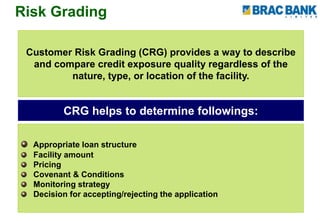
Risk Grading
Customer Risk Grading (CRG) provides a way to describe
and compare credit exposure quality regardless of the
nature, type, or location of the facility.
CRG helps to determine followings:
Appropriate loan structure
Facility amount
Pricing
Covenant & Conditions
Monitoring strategy
Decision for accepting/rejecting the application
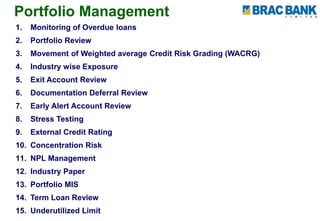
Portfolio Management
1. Monitoring of Overdue loans
2. Portfolio Review
3. Movement of Weighted average Credit Risk Grading (WACRG)
4. Industry wise Exposure
5. Exit Account Review
6. Documentation Deferral Review
7. Early Alert Account Review
8. Stress Testing
9. External Credit Rating
10. Concentration Risk
11. NPL Management
12. Industry Paper
13. Portfolio MIS
14. Term Loan Review
15. Underutilized Limit
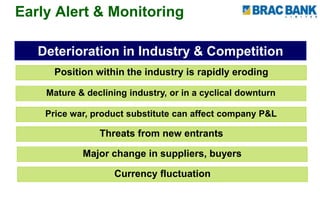
Early Alert & Monitoring
Deterioration in Industry & Competition
Position within the industry is rapidly eroding
Price war, product substitute can affect company P&L
Mature & declining industry, or in a cyclical downturn
Threats from new entrants
Major change in suppliers, buyers
Currency fluctuation
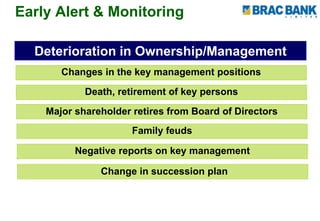
Early Alert & Monitoring
Deterioration in Ownership/Management
Changes in the key management positions
Death, retirement of key persons
Major shareholder retires from Board of Directors
Family feuds
Negative reports on key management
Change in succession plan
Early Alert & Monitoring
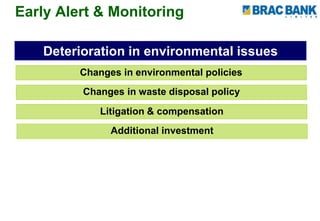
Deterioration in environmental issues
Changes in environmental policies
Changes in waste disposal policy
Litigation & compensation
Additional investment
Early Alert & Monitoring
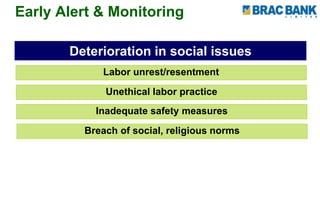
Deterioration in social issues
Labor unrest/resentment
Unethical labor practice
Inadequate safety measures
Breach of social, religious norms
Early Alert & Monitoring
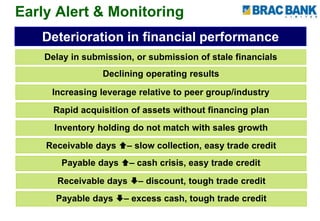
Deterioration in financial performance
Delay in submission, or submission of stale financials
Declining operating results
Increasing leverage relative to peer group/industry
Rapid acquisition of assets without financing plan
Inventory holding do not match with sales growth
Receivable days – slow collection, easy trade credit
Payable days – cash crisis, easy trade credit
Receivable days – discount, tough trade credit
Payable days – excess cash, tough trade credit
Early Alert & Monitoring
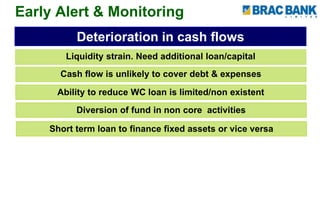
Deterioration in cash flows
Liquidity strain. Need additional loan/capital
Cash flow is unlikely to cover debt & expenses
Ability to reduce WC loan is limited/non existent
Diversion of fund in non core activities
Short term loan to finance fixed assets or vice versa
Early Alert & Monitoring
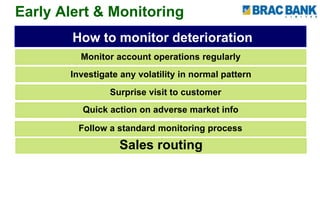
How to monitor deterioration
Monitor account operations regularly
Investigate any volatility in normal pattern
Surprise visit to customer
Quick action on adverse market info
Follow a standard monitoring process
Sales routing
Early Alert & Monitoring
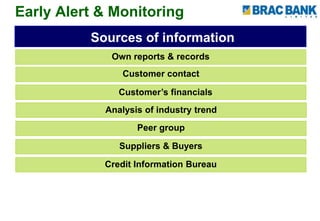
Sources of information
Own reports & records
Customer contact
Customer’s financials
Analysis of industry trend
Peer group
Suppliers & Buyers
Credit Information Bureau
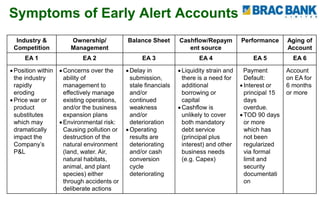
Symptoms of Early Alert Accounts
Industry &
Competition
Ownership/
Management
Balance Sheet Cashflow/Repaym
ent source
Performance Aging of
Account
EA 1 EA 2 EA 3 EA 4 EA 5 EA 6
Position within
the industry
rapidly
eroding
Price war or
product
substitutes
which may
dramatically
impact the
Company’s
P&L
Concerns over the
ability of
management to
effectively manage
existing operations,
and/or the business
expansion plans
Environmental risk:
Causing pollution or
destruction of the
natural environment
(land, water. Air,
natural habitats,
animal, and plant
species) either
through accidents or
deliberate actions
Delay in
submission,
stale financials
and/or
continued
weakness
and/or
deterioration
Operating
results are
deteriorating
and/or cash
conversion
cycle
deteriorating
Liquidity strain and
there is a need for
additional
borrowing or
capital
Cashflow is
unlikely to cover
both mandatory
debt service
(principal plus
interest) and other
business needs
(e.g. Capex)
Payment
Default:
Interest or
principal 15
days
overdue.
TOD 90 days
or more
which has
not been
regularized
via formal
limit and
security
documentati
on
Account
on EA for
6 months
or more
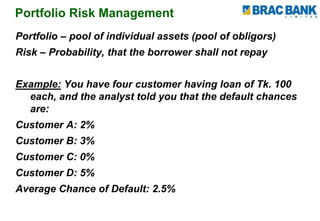
Portfolio Risk Management
Portfolio – pool of individual assets (pool of obligors)
Risk – Probability, that the borrower shall not repay
Example: You have four customer having loan of Tk. 100
each, and the analyst told you that the default chances
are:
Customer A: 2%
Customer B: 3%
Customer C: 0%
Customer D: 5%
Average Chance of Default: 2.5%
Portfolio Risk Management
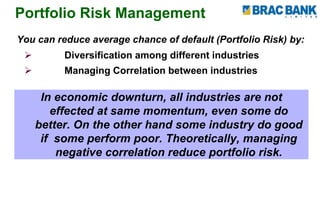
You can reduce average chance of default (Portfolio Risk) by:
 Diversification among different industries
 Managing Correlation between industries
In economic downturn, all industries are not
effected at same momentum, even some do
better. On the other hand some industry do good
if some perform poor. Theoretically, managing
negative correlation reduce portfolio risk.
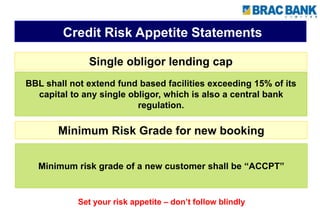
Credit Risk Appetite Statements
BBL shall not extend fund based facilities exceeding 15% of its
capital to any single obligor, which is also a central bank
regulation.
Single obligor lending cap
Minimum risk grade of a new customer shall be “ACCPT”
Minimum Risk Grade for new booking
Set your risk appetite – don’t follow blindly
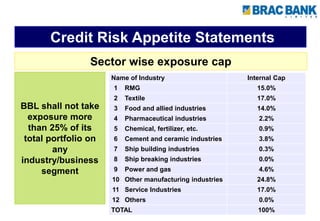
Credit Risk Appetite Statements
BBL shall not take
exposure more
than 25% of its
total portfolio on
any
industry/business
segment
Sector wise exposure cap
Name of Industry Internal Cap
1 RMG 15.0%
2 Textile 17.0%
3 Food and allied industries 14.0%
4 Pharmaceutical industries 2.2%
5 Chemical, fertilizer, etc. 0.9%
6 Cement and ceramic industries 3.8%
7 Ship building industries 0.3%
8 Ship breaking industries 0.0%
9 Power and gas 4.6%
10 Other manufacturing industries 24.8%
11 Service Industries 17.0%
12 Others 0.0%
TOTAL 100%
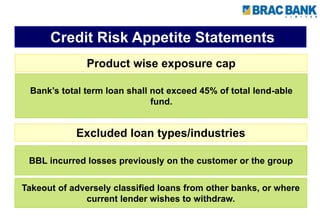
Credit Risk Appetite Statements
Bank’s total term loan shall not exceed 45% of total lend-able
fund.
Product wise exposure cap
BBL incurred losses previously on the customer or the group
Excluded loan types/industries
Takeout of adversely classified loans from other banks, or where
current lender wishes to withdraw.
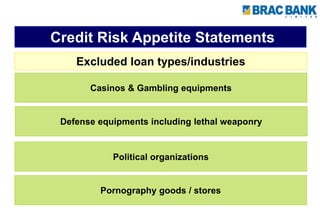
Credit Risk Appetite Statements
Excluded loan types/industries
Casinos & Gambling equipments
Defense equipments including lethal weaponry
Political organizations
Pornography goods / stores
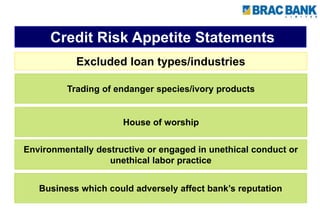
Credit Risk Appetite Statements
Excluded loan types/industries
Trading of endanger species/ivory products
House of worship
Environmentally destructive or engaged in unethical conduct or
unethical labor practice
Business which could adversely affect bank’s reputation
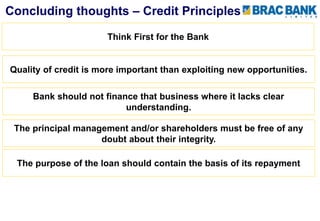
Quality of credit is more important than exploiting new opportunities.
The principal management and/or shareholders must be free of any
doubt about their integrity.
The purpose of the loan should contain the basis of its repayment
Concluding thoughts – Credit Principles
Think First for the Bank
Bank should not finance that business where it lacks clear
understanding.
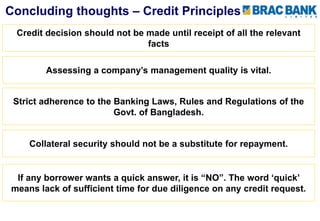
Strict adherence to the Banking Laws, Rules and Regulations of the
Govt. of Bangladesh.
Collateral security should not be a substitute for repayment.
If any borrower wants a quick answer, it is “NO”. The word ‘quick’
means lack of sufficient time for due diligence on any credit request.
Concluding thoughts – Credit Principles
Credit decision should not be made until receipt of all the relevant
facts
Assessing a company’s management quality is vital.
THANK YOU

CRM Training.pptx

  • 1.
    Credit Appraisal &Portfolio Management of Corporate Banking Moazzem Hossain Shumon Head of Underwriting, Wholesale Banking Unit 2
  • 2.
    Credit Portfolio ason 31/12/2017 Business Loans Corporate SME Consumer Total 82,327 m 77,865 m 41,439 m 201,632 m mix 41% 39% 20.55% 100% NPL 5.41% 2.50% 1.96% 3.58%
  • 3.
    A simple example: TotalLoans : Tk. 201,632m NPL (3.58%) : Tk. 7,212 m Loss of int. Income (11%) : Tk. 793 m Saving of provision (CL) : Tk. 5,083m Incremental Income : Tk. 5,876m
  • 4.
    What is CreditRisk Risk arising from the uncertainty of an obligor’s ability to perform its contractual obligation. Credit Risk includes: Default Partial Default Decline in credit standing/risk grade
  • 5.
    Globally more than50% of total risk elements in banks and FIs are Credit Risk alone Credit Losses have, historically, been the single largest cause of bank failures. – The Economist
  • 6.
    Credit Risk Management CreditRisk Management (CRM) means appraisal, approval & monitoring of credit – both in micro and macro aspects.  If loan is repaid within the agreed time, it can be said that the credit risk has been managed.  Credit risk management is essential for efficient performance of the credit function of financial institutions.
  • 7.
    Role of CreditRisk Management Division • Appraisement of Credit Proposals (Corporate, SME & Consumer) for obtaining approval from Competent Authority • According approval as per delegation – Layer of approval authority • Portfolio Management Board Managing Director Head of CRM Sub-delegated to other CRM officials Reporting Line Managing Director Head of CRM Consumer Finance Corporate Risk SME Risk CRO DMD & CRO
  • 8.
    CREDIT APPROVAL WORKFLOW BusinessUnits/Divisions Credit proposal prepared by relationship manager/ relationship officer and submitted to CRM with recommendation of respective Business Unit Head and Division Head Credit Risk Management Credit Proposals assessed by credit officers and submit for approval / decline as per delegation / Recommendation. Credit Proposal assessed by credit officers and submits for review to Credit Risk Management Committee (CRMC) whose exposure is BDT 100 million & Above Credit Risk Management Committee Credit Proposal discussed and recommendation made. Decline or advised to resubmit with further information Recommended for approval and placed to approval authority as per delegation Board of Directors Managing Director & CEO or Other delegated approver
  • 9.
    Why a Creditgoes Bad? Pre approval stage (controllable variance) (A) Wrong selection of borrower Wrong selection of business Long drawn appraisement & approval process Poor Appraisal Technique Purpose not identified Wrong Structuring of credit Under / Over Financing Mismatch of Asset Poor judgment in Sectoral volatility Security base lending Non availability of Projection
  • 10.
    Why a Creditgoes Bad? Post approval stage (controllable variance) (B) Poor monitoring & Recovery System Improper / Incomplete loan documentation Long drawn & ineffective legal procedure Poor MIS
  • 11.
    Why a Creditgoes Bad? Post approval stage (uncontrollable variance) (C) Unfavorable investment climate Economic Recession Inconsistent & erratic govt. fiscal policy Existing credit culture promotes loan default A. Controllable, 60% B. Controllable, 35% C. Uncontrollable, 5% Controllability Variance
  • 12.
    Appraisal of Credit MainObjective Achieving excellence in Credit Risk Management Remember!!! No credit is absolutely risk free; risk is inherent in all credit. Tools (i) Identify risk (ii) Measure risk (iii) Mitigate risk (iv) Test acceptability
  • 13.
    Risk is properlyidentified & also their mitigates Must ensure that : There is a balance between risk & return Fits with portfolio strategy Complies with bank’s credit policies Prevents a credit from going bad Complies external regulatory environment Appraisal of Credit
  • 14.
     Is the borrowercreditworthy? 3 Questions must be answered satisfactorily in each credit application  Can the credit agreement be properly structured and documented so that the bank and its depositors are adequately protected?  Can the bank perfect its claim against the assets or earnings of the customer, so that, in the event of default, bank funds can be recovered? Appraisal of Credit
  • 15.
    Appraisal of Credit 1.Economy 2. Business 3. Customer 4. Group 5. Banker 6. Financial performance 7. Account performance 8. Justification of facility 9. Risk Grade (CRGM) 10. Environmental Risk Grade 11. Key Risk / Trigger Points 12. Security / Collateral 13. CIB report 14. Business Potential
  • 16.
    Components of CreditRisk Management Systems & Procedures:  Credit Origination  Credit Appraisal  Pricing  Large loan  Structuring  Policy breach  Measuring Credit Risk (Internal Risk Rating)  Delegation of authority  Credit Administration (documentation, disbursement, monitoring, repayment, etc)  Credit risk monitoring & control (financial position & business condition, conduct of account, loan covenants, collateral valuation)  Risk Review (at least once in a year)  Problem Credit Management
  • 17.
    Risk Grading Tool :Score Card Preparation of score card is a complex risk modeling & need validation by statistical models & minimum five years statistical data. Current Market Practice Central bank introduced a Score Card (8 point scale) & made it mandatory for Financial Institutions as minimum practice. Current Practice at BBL BBL modified that to an 10(ten) point scale scorecard.
  • 18.
    Grading Categories Grading (ShortName) No. Score Review frequency Superior (SUP) 1  100% cash covered  Government guarantee  International Bank guarantees Annually Very Good 2 85+ Annually Good (GD) 3 80-84 Annually Satisfactory 4 75-79 Annually Acceptable (ACCPT) 5 70-74 Annually Marginal/Watchlist MG/WL) 6 65-69 Half yearly Special Mention (SM) 7 55-64 Quarterly Sub standard (SS) 8 45-54 Quarterly Doubtful (DF) 9 35-44 Quarterly Bad & Loss (BL) 10 <35 Quarterly
  • 19.
    Principal Risk Components: FinancialRisk (Weight: 50%) Debt to equity (5%), Adjusted Gearing (5%), Liquidity (5%), Profitability (15%), Coverage ratios (10%), Assets Turnover (5%), Cash flow ratio (5%), Cash conversion cycle (5%) and Sales/Revenue growth (5%). Business/Industry Risk (Weight: 18%) Size of Business (3%), Age of Business (3%), Benchmarking /Position in the industry (3%), Business Outlook (3%), industry growth (3%) and company diversification (3%).
  • 20.
    Management Risk (Weight:12%) Management quality (3%), Experience (5%), Second line/Succession (3%), Ownership Structure (3%). Security Risk (Weight: 10%) Security coverage (4%), Collateral coverage (4%), Support (2%) Relationship Risk (Weight: 10%) Account conduct (4%), Utilization of limit (2%), Compliance of covenants/condition (2%), Rescheduling/Restructuring of Loan/Create Force Loan (2%) Principal Risk Components:
  • 21.
    Risk Grading Customer RiskGrading (CRG) provides a way to describe and compare credit exposure quality regardless of the nature, type, or location of the facility. CRG helps to determine followings: Appropriate loan structure Facility amount Pricing Covenant & Conditions Monitoring strategy Decision for accepting/rejecting the application
  • 22.
    Portfolio Management 1. Monitoringof Overdue loans 2. Portfolio Review 3. Movement of Weighted average Credit Risk Grading (WACRG) 4. Industry wise Exposure 5. Exit Account Review 6. Documentation Deferral Review 7. Early Alert Account Review 8. Stress Testing 9. External Credit Rating 10. Concentration Risk 11. NPL Management 12. Industry Paper 13. Portfolio MIS 14. Term Loan Review 15. Underutilized Limit
  • 23.
    Early Alert &Monitoring Deterioration in Industry & Competition Position within the industry is rapidly eroding Price war, product substitute can affect company P&L Mature & declining industry, or in a cyclical downturn Threats from new entrants Major change in suppliers, buyers Currency fluctuation
  • 24.
    Early Alert &Monitoring Deterioration in Ownership/Management Changes in the key management positions Death, retirement of key persons Major shareholder retires from Board of Directors Family feuds Negative reports on key management Change in succession plan
  • 25.
    Early Alert &Monitoring Deterioration in environmental issues Changes in environmental policies Changes in waste disposal policy Litigation & compensation Additional investment
  • 26.
    Early Alert &Monitoring Deterioration in social issues Labor unrest/resentment Unethical labor practice Inadequate safety measures Breach of social, religious norms
  • 27.
    Early Alert &Monitoring Deterioration in financial performance Delay in submission, or submission of stale financials Declining operating results Increasing leverage relative to peer group/industry Rapid acquisition of assets without financing plan Inventory holding do not match with sales growth Receivable days – slow collection, easy trade credit Payable days – cash crisis, easy trade credit Receivable days – discount, tough trade credit Payable days – excess cash, tough trade credit
  • 28.
    Early Alert &Monitoring Deterioration in cash flows Liquidity strain. Need additional loan/capital Cash flow is unlikely to cover debt & expenses Ability to reduce WC loan is limited/non existent Diversion of fund in non core activities Short term loan to finance fixed assets or vice versa
  • 29.
    Early Alert &Monitoring How to monitor deterioration Monitor account operations regularly Investigate any volatility in normal pattern Surprise visit to customer Quick action on adverse market info Follow a standard monitoring process Sales routing
  • 30.
    Early Alert &Monitoring Sources of information Own reports & records Customer contact Customer’s financials Analysis of industry trend Peer group Suppliers & Buyers Credit Information Bureau
  • 31.
    Symptoms of EarlyAlert Accounts Industry & Competition Ownership/ Management Balance Sheet Cashflow/Repaym ent source Performance Aging of Account EA 1 EA 2 EA 3 EA 4 EA 5 EA 6 Position within the industry rapidly eroding Price war or product substitutes which may dramatically impact the Company’s P&L Concerns over the ability of management to effectively manage existing operations, and/or the business expansion plans Environmental risk: Causing pollution or destruction of the natural environment (land, water. Air, natural habitats, animal, and plant species) either through accidents or deliberate actions Delay in submission, stale financials and/or continued weakness and/or deterioration Operating results are deteriorating and/or cash conversion cycle deteriorating Liquidity strain and there is a need for additional borrowing or capital Cashflow is unlikely to cover both mandatory debt service (principal plus interest) and other business needs (e.g. Capex) Payment Default: Interest or principal 15 days overdue. TOD 90 days or more which has not been regularized via formal limit and security documentati on Account on EA for 6 months or more
  • 32.
    Portfolio Risk Management Portfolio– pool of individual assets (pool of obligors) Risk – Probability, that the borrower shall not repay Example: You have four customer having loan of Tk. 100 each, and the analyst told you that the default chances are: Customer A: 2% Customer B: 3% Customer C: 0% Customer D: 5% Average Chance of Default: 2.5%
  • 33.
    Portfolio Risk Management Youcan reduce average chance of default (Portfolio Risk) by:  Diversification among different industries  Managing Correlation between industries In economic downturn, all industries are not effected at same momentum, even some do better. On the other hand some industry do good if some perform poor. Theoretically, managing negative correlation reduce portfolio risk.
  • 34.
    Credit Risk AppetiteStatements BBL shall not extend fund based facilities exceeding 15% of its capital to any single obligor, which is also a central bank regulation. Single obligor lending cap Minimum risk grade of a new customer shall be “ACCPT” Minimum Risk Grade for new booking Set your risk appetite – don’t follow blindly
  • 35.
    Credit Risk AppetiteStatements BBL shall not take exposure more than 25% of its total portfolio on any industry/business segment Sector wise exposure cap Name of Industry Internal Cap 1 RMG 15.0% 2 Textile 17.0% 3 Food and allied industries 14.0% 4 Pharmaceutical industries 2.2% 5 Chemical, fertilizer, etc. 0.9% 6 Cement and ceramic industries 3.8% 7 Ship building industries 0.3% 8 Ship breaking industries 0.0% 9 Power and gas 4.6% 10 Other manufacturing industries 24.8% 11 Service Industries 17.0% 12 Others 0.0% TOTAL 100%
  • 36.
    Credit Risk AppetiteStatements Bank’s total term loan shall not exceed 45% of total lend-able fund. Product wise exposure cap BBL incurred losses previously on the customer or the group Excluded loan types/industries Takeout of adversely classified loans from other banks, or where current lender wishes to withdraw.
  • 37.
    Credit Risk AppetiteStatements Excluded loan types/industries Casinos & Gambling equipments Defense equipments including lethal weaponry Political organizations Pornography goods / stores
  • 38.
    Credit Risk AppetiteStatements Excluded loan types/industries Trading of endanger species/ivory products House of worship Environmentally destructive or engaged in unethical conduct or unethical labor practice Business which could adversely affect bank’s reputation
  • 39.
    Quality of creditis more important than exploiting new opportunities. The principal management and/or shareholders must be free of any doubt about their integrity. The purpose of the loan should contain the basis of its repayment Concluding thoughts – Credit Principles Think First for the Bank Bank should not finance that business where it lacks clear understanding.
  • 40.
    Strict adherence tothe Banking Laws, Rules and Regulations of the Govt. of Bangladesh. Collateral security should not be a substitute for repayment. If any borrower wants a quick answer, it is “NO”. The word ‘quick’ means lack of sufficient time for due diligence on any credit request. Concluding thoughts – Credit Principles Credit decision should not be made until receipt of all the relevant facts Assessing a company’s management quality is vital.
  • 41.