Microfinance Policyin the PhilippinesA DOF-NCC Presentation to the Microfinance Development ForumSponsored by PACAP-AusAID January 29, 2009Crowne Plaza Galleria ManilaOrtigas, Pasig City
2PRESENTATION OUTLINESituation before	--  Old policy regimeWhat we have done(Government’s Response)Microfinance Industry TodayWhat we have learnedThe challenges ahead
3OLD REGIMEAttempts to address the problem:1970s-mid 1990s -- Creation of government directed credit programs (DCPs) Features:Funding from budgetary allocation, special funds, foreign borrowingsFunds given at highly concessional ratesFunds provided through specialized banksGovernment line agencies also implementing DCPs
4OLD REGIMEWHAT HAPPENED THENVery low outreach implemented by GNFAs  compared to those implemented by GFIsLow repayment rates in DCPs	(Undisciplined borrowers with “dole-out mentality”)Large scale borrowers captured the subsidiesHuge fiscal costs Private financial institutions dependent on cheap government funds, leaving out savings mobilization
5WHAT WE HAVE DONEInitiatives to rationalize and optimize the use of government credit programs through Social Pact on CreditThe Pact became part of the Social Reform Agenda  Institutional champion—the National Credit Council – created to lead the reform process.
6WHAT WE HAVE DONE  THE NATIONAL CREDIT COUNCILcreated in 1993 through Administrative Order No. 86 to meet the need to rationalize credit policyChaired by the Department of Finance (DOF), with Landbank of the Philippines as Vice-ChairMember agencies:	Bangko Sentral ng Pilipinas	Cooperative Development Authority	Agricultural Credit Policy Council	Philippine Deposit Insurance Corporation	People’s Credit and Finance Corporation	Bureau of Rural Workers-DOLE	Social Security System	Small Business and Guarantee Finance Corporation	Development Bank of the Philippines
7WHAT WE HAVE DONETHE NATIONAL STRATEGY FOR MICROFINANCE (1997)A new paradigm to develop the country’s microfinance marketVISION is to (1) achieve  a viable, sustainable, strong private microfinance market and (2) provide poor households and microentrepreneurs greater access to microfinance services
8WHAT WE HAVE DONETHE NATIONAL STRATEGY FOR MICROFINANCEFour policy principles:Provision of an enabling policy environment to facilitate increased participation of the private sectorAdoption of market-oriented financial and credit policies Non-participation of government line agencies in the implementation of credit and guarantee programsGreater role of the private sector in the delivery of financial services to the poor
9WHAT WE HAVE DONETHE NATIONAL STRATEGY FOR MICROFINANCENational Strategy for Microfinance embodies new paradigmFrom government-led to private sector-driven.  Government to only provide the enabling policy and regulatory environmentFrom directed, subsidized credit to market-based approach (market-oriented interest rates)Donors primarily as providers of technical assistance e.g. capacity building
10WHAT WE HAVE DONEENABLING LAWSSocial Reform and Poverty Alleviation Act (December 11,1997)Adopt a market based interest rate policy for microfinanceGovernment funds used only for capacity building purposesEmphasis on savings mobilizationEstablished the People’s Credit and Finance Corporation, the forerunner of microfinance services through wholesale lendingAgriculture and Fisheries Modernization Act (AFMA) –December 22, 1997Phase out of  DCPs in the agriculture sector Adoption of market-based interest ratesNon-provision of credit subsidiesGovernment financial institutions (GFIs) acting as wholesalers of funds
11WHAT WE HAVE DONEENABLING LAWSIssuance of Executive Order No. 138 on August 10, 1999	- directs government agencies implementing  credit programs to adopt the NCC Credit Policy Guidelines.  What are these guidelines?non-participation of government non-financial agencies in    the implementation of credit programs
government financial institutions to be the main vehicle in the implementation of government credit programs
adoption of market-based financial and credit policies12WHAT WE HAVE DONEENABLING LAWSGeneral Banking Law (GBL)  and BSP CircularsRecognition of peculiarities of microfinance e.g. allows cash-flow based lending and collateral-free loansMakes banking rules and regulations more “microfinance-friendly” i.e., lifting of moratorium on branching by microfinance banksBarangay Microbusiness Enterprise Act (BMBE) Requires market-based interest rates for loans to barangay or village-based microenterprisesGFIs acting as wholesalers of fundsSetting up of a special credit window, within a GFI, that will provide credit to barangay microenterprise business at market-based interest rates
13WHAT WE HAVE DONEREGULATORY FRAMEWORK FOR MICROFINANCEA regulatory framework to develop a viable and sustainable microfinance marketDeposit-taking institutions are subject to prudential regulation and supervisionBanks engaged in microfinance are regulated and supervised by the Bangko Sentral ng Pilipinas (BSP)Cooperative Development Authority (CDA) as designated regulatory authority for credit cooperativesDeposit-taking microfinance NGOs encouraged to transform into banks or cooperatives and be regulatedMicroinsurance is under jurisdiction of the Insurance Commission (IC)
14WHAT WE HAVE DONEREGULATORY FRAMEWORK FOR MICROFINANCEDevelopment of a core set of performance standards for all types of institutions involved in microfinance
Indicators to assess MFI financial performance15WHAT WE HAVE DONELEGAL AND REGULATORY FRAMEWORK FOR CREDIT/FINANCIAL COOPERATIVESStandardized the Chart of Accounts for Savings and Credit Coops (SCCs)Formulated the Performance Standards for SCCs (COOP-PESOS)Developed the Manual of Rules and Regulations for SCCsBuilding the capacity of CDA to regulate and supervise SCCsEstablishing the Coop Information Infrastructure SystemDrafting the Manual of Supervision and Examination for SCCs
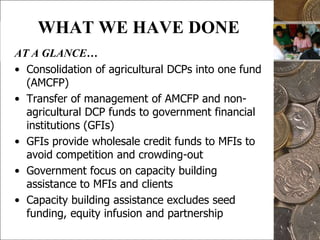
16WHAT WE HAVE DONEAT A GLANCE…Consolidation of agricultural DCPs into one fund (AMCFP)Transfer of management of AMCFP and non-agricultural DCP funds to government financial institutions (GFIs)GFIs provide wholesale credit funds to MFIs to avoid competition and crowding-outGovernment focus on capacity building assistance to MFIs and clientsCapacity building assistance excludes seed funding, equity infusion and partnership
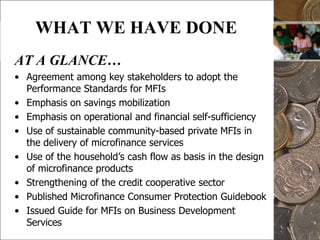
17WHAT WE HAVE DONEAT A GLANCE…Agreement among key stakeholders to adopt the Performance Standards for MFIsEmphasis on savings mobilizationEmphasis on operational and financial self-sufficiencyUse of sustainable community-based private MFIs in the delivery of microfinance services Use of the household’s cash flow as basis in the design of microfinance productsStrengthening of the credit cooperative sectorPublished Microfinance Consumer Protection GuidebookIssued Guide for MFIs on Business Development Services
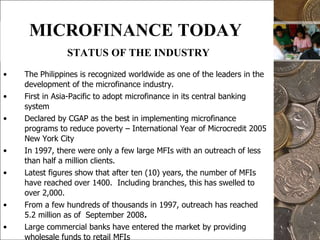
18MICROFINANCE TODAY                        STATUS OF THE INDUSTRYThe Philippines is recognized worldwide as one of the leaders in the development of the microfinance industry.First in Asia-Pacific to adopt microfinance in its central banking systemDeclared by CGAP as the best in implementing microfinance programs to reduce poverty – International Year of Microcredit 2005 New York City  In 1997, there were only a few large MFIs with an outreach of less than half a million clients.Latest figures show that after ten (10) years, the number of MFIs have reached over 1400.  Including branches, this has swelled to over 2,000.From a few hundreds of thousands in 1997, outreach has reached 5.2 million as of  September 2008.Large commercial banks have entered the market by providing wholesale funds to retail MFIs
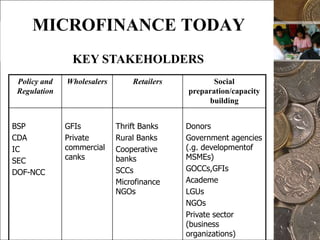
19MICROFINANCE TODAYKEY STAKEHOLDERS
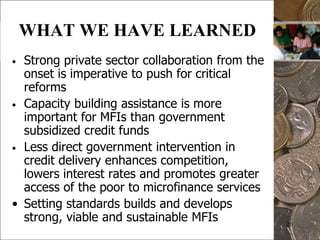
20WHAT WE HAVE LEARNEDStrong private sector collaboration from the onset is imperative to push for critical reformsCapacity building assistance is more important for MFIs than government subsidized credit funds Less direct government intervention in credit delivery enhances competition, lowers interest rates and promotes greater access of the poor to microfinance servicesSetting standards builds and develops strong, viable and sustainable MFIs
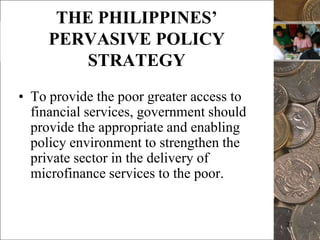
21THE PHILIPPINES’ PERVASIVE POLICY STRATEGYTo provide the poor greater access to financial services, government should provide the appropriate and enabling policy environment to strengthen the private sector in the delivery of microfinance services to the poor.
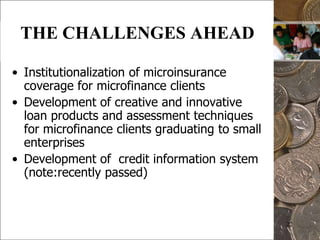
22THE CHALLENGES AHEADInstitutionalization of microinsurance coverage for microfinance clientsDevelopment of creative and innovative loan products and assessment techniques for microfinance clients graduating to small enterprises Development of  credit information system (note:recently passed)
23Contact InformationMr. Joselito S. Almario, Deputy Executive Director, NCCMr. Napoleon P. Micu, Sr. Project Specialist, NCC 4th Floor, Fiscal Policy and Planning OfficeDepartment of FinanceDOF Building, BSP ComplexRoxas Boulevard, Manila, PhilippinesEmails: itoy@dof.gov.ph ; NMicu@dof.gov.phTelefax: 632-523-3825http://www.dof.gov.ph http://ncc.dof.gov.ph

Microfinance Policy in the Philippines

  • 1.
    Microfinance Policyin thePhilippinesA DOF-NCC Presentation to the Microfinance Development ForumSponsored by PACAP-AusAID January 29, 2009Crowne Plaza Galleria ManilaOrtigas, Pasig City
  • 2.
    2PRESENTATION OUTLINESituation before -- Old policy regimeWhat we have done(Government’s Response)Microfinance Industry TodayWhat we have learnedThe challenges ahead
  • 3.
    3OLD REGIMEAttempts toaddress the problem:1970s-mid 1990s -- Creation of government directed credit programs (DCPs) Features:Funding from budgetary allocation, special funds, foreign borrowingsFunds given at highly concessional ratesFunds provided through specialized banksGovernment line agencies also implementing DCPs
  • 4.
    4OLD REGIMEWHAT HAPPENEDTHENVery low outreach implemented by GNFAs compared to those implemented by GFIsLow repayment rates in DCPs (Undisciplined borrowers with “dole-out mentality”)Large scale borrowers captured the subsidiesHuge fiscal costs Private financial institutions dependent on cheap government funds, leaving out savings mobilization
  • 5.
    5WHAT WE HAVEDONEInitiatives to rationalize and optimize the use of government credit programs through Social Pact on CreditThe Pact became part of the Social Reform Agenda Institutional champion—the National Credit Council – created to lead the reform process.
  • 6.
    6WHAT WE HAVEDONE THE NATIONAL CREDIT COUNCILcreated in 1993 through Administrative Order No. 86 to meet the need to rationalize credit policyChaired by the Department of Finance (DOF), with Landbank of the Philippines as Vice-ChairMember agencies: Bangko Sentral ng Pilipinas Cooperative Development Authority Agricultural Credit Policy Council Philippine Deposit Insurance Corporation People’s Credit and Finance Corporation Bureau of Rural Workers-DOLE Social Security System Small Business and Guarantee Finance Corporation Development Bank of the Philippines
  • 7.
    7WHAT WE HAVEDONETHE NATIONAL STRATEGY FOR MICROFINANCE (1997)A new paradigm to develop the country’s microfinance marketVISION is to (1) achieve a viable, sustainable, strong private microfinance market and (2) provide poor households and microentrepreneurs greater access to microfinance services
  • 8.
    8WHAT WE HAVEDONETHE NATIONAL STRATEGY FOR MICROFINANCEFour policy principles:Provision of an enabling policy environment to facilitate increased participation of the private sectorAdoption of market-oriented financial and credit policies Non-participation of government line agencies in the implementation of credit and guarantee programsGreater role of the private sector in the delivery of financial services to the poor
  • 9.
    9WHAT WE HAVEDONETHE NATIONAL STRATEGY FOR MICROFINANCENational Strategy for Microfinance embodies new paradigmFrom government-led to private sector-driven. Government to only provide the enabling policy and regulatory environmentFrom directed, subsidized credit to market-based approach (market-oriented interest rates)Donors primarily as providers of technical assistance e.g. capacity building
  • 10.
    10WHAT WE HAVEDONEENABLING LAWSSocial Reform and Poverty Alleviation Act (December 11,1997)Adopt a market based interest rate policy for microfinanceGovernment funds used only for capacity building purposesEmphasis on savings mobilizationEstablished the People’s Credit and Finance Corporation, the forerunner of microfinance services through wholesale lendingAgriculture and Fisheries Modernization Act (AFMA) –December 22, 1997Phase out of DCPs in the agriculture sector Adoption of market-based interest ratesNon-provision of credit subsidiesGovernment financial institutions (GFIs) acting as wholesalers of funds
  • 11.
    11WHAT WE HAVEDONEENABLING LAWSIssuance of Executive Order No. 138 on August 10, 1999 - directs government agencies implementing credit programs to adopt the NCC Credit Policy Guidelines. What are these guidelines?non-participation of government non-financial agencies in the implementation of credit programs
  • 12.
    government financial institutionsto be the main vehicle in the implementation of government credit programs
  • 13.
    adoption of market-basedfinancial and credit policies12WHAT WE HAVE DONEENABLING LAWSGeneral Banking Law (GBL) and BSP CircularsRecognition of peculiarities of microfinance e.g. allows cash-flow based lending and collateral-free loansMakes banking rules and regulations more “microfinance-friendly” i.e., lifting of moratorium on branching by microfinance banksBarangay Microbusiness Enterprise Act (BMBE) Requires market-based interest rates for loans to barangay or village-based microenterprisesGFIs acting as wholesalers of fundsSetting up of a special credit window, within a GFI, that will provide credit to barangay microenterprise business at market-based interest rates
  • 14.
    13WHAT WE HAVEDONEREGULATORY FRAMEWORK FOR MICROFINANCEA regulatory framework to develop a viable and sustainable microfinance marketDeposit-taking institutions are subject to prudential regulation and supervisionBanks engaged in microfinance are regulated and supervised by the Bangko Sentral ng Pilipinas (BSP)Cooperative Development Authority (CDA) as designated regulatory authority for credit cooperativesDeposit-taking microfinance NGOs encouraged to transform into banks or cooperatives and be regulatedMicroinsurance is under jurisdiction of the Insurance Commission (IC)
  • 15.
    14WHAT WE HAVEDONEREGULATORY FRAMEWORK FOR MICROFINANCEDevelopment of a core set of performance standards for all types of institutions involved in microfinance
  • 16.
    Indicators to assessMFI financial performance15WHAT WE HAVE DONELEGAL AND REGULATORY FRAMEWORK FOR CREDIT/FINANCIAL COOPERATIVESStandardized the Chart of Accounts for Savings and Credit Coops (SCCs)Formulated the Performance Standards for SCCs (COOP-PESOS)Developed the Manual of Rules and Regulations for SCCsBuilding the capacity of CDA to regulate and supervise SCCsEstablishing the Coop Information Infrastructure SystemDrafting the Manual of Supervision and Examination for SCCs
  • 17.
    16WHAT WE HAVEDONEAT A GLANCE…Consolidation of agricultural DCPs into one fund (AMCFP)Transfer of management of AMCFP and non-agricultural DCP funds to government financial institutions (GFIs)GFIs provide wholesale credit funds to MFIs to avoid competition and crowding-outGovernment focus on capacity building assistance to MFIs and clientsCapacity building assistance excludes seed funding, equity infusion and partnership
  • 18.
    17WHAT WE HAVEDONEAT A GLANCE…Agreement among key stakeholders to adopt the Performance Standards for MFIsEmphasis on savings mobilizationEmphasis on operational and financial self-sufficiencyUse of sustainable community-based private MFIs in the delivery of microfinance services Use of the household’s cash flow as basis in the design of microfinance productsStrengthening of the credit cooperative sectorPublished Microfinance Consumer Protection GuidebookIssued Guide for MFIs on Business Development Services
  • 19.
    18MICROFINANCE TODAY STATUS OF THE INDUSTRYThe Philippines is recognized worldwide as one of the leaders in the development of the microfinance industry.First in Asia-Pacific to adopt microfinance in its central banking systemDeclared by CGAP as the best in implementing microfinance programs to reduce poverty – International Year of Microcredit 2005 New York City In 1997, there were only a few large MFIs with an outreach of less than half a million clients.Latest figures show that after ten (10) years, the number of MFIs have reached over 1400. Including branches, this has swelled to over 2,000.From a few hundreds of thousands in 1997, outreach has reached 5.2 million as of September 2008.Large commercial banks have entered the market by providing wholesale funds to retail MFIs
  • 20.
  • 21.
    20WHAT WE HAVELEARNEDStrong private sector collaboration from the onset is imperative to push for critical reformsCapacity building assistance is more important for MFIs than government subsidized credit funds Less direct government intervention in credit delivery enhances competition, lowers interest rates and promotes greater access of the poor to microfinance servicesSetting standards builds and develops strong, viable and sustainable MFIs
  • 22.
    21THE PHILIPPINES’ PERVASIVEPOLICY STRATEGYTo provide the poor greater access to financial services, government should provide the appropriate and enabling policy environment to strengthen the private sector in the delivery of microfinance services to the poor.
  • 23.
    22THE CHALLENGES AHEADInstitutionalizationof microinsurance coverage for microfinance clientsDevelopment of creative and innovative loan products and assessment techniques for microfinance clients graduating to small enterprises Development of credit information system (note:recently passed)
  • 24.
    23Contact InformationMr. JoselitoS. Almario, Deputy Executive Director, NCCMr. Napoleon P. Micu, Sr. Project Specialist, NCC 4th Floor, Fiscal Policy and Planning OfficeDepartment of FinanceDOF Building, BSP ComplexRoxas Boulevard, Manila, PhilippinesEmails: itoy@dof.gov.ph ; NMicu@dof.gov.phTelefax: 632-523-3825http://www.dof.gov.ph http://ncc.dof.gov.ph