LOGISTICS MANAGEMENT

Doç. Dr. Bülent SEZEN
What is Logistics?
Logistics is the . . . “process of planning,
implementing, and controlling the
efficient, effective flow and storage of
goods, services, and related information
from point of origin to point of
consumption for the purpose of
conforming to customer requirements.“
Council of Logistics Management
Is it different from SCM?
Not really!
“Supply Chain Management deals with the
management of materials, information, and
financial flows in a network consisting of
suppliers, manufacturers, distributors, and
customers.” (Stanford Supply Chain Forum)

So, Logistics and Supply Chain are
equivalent terms.
Logistics Functions
Purchasing /
Procurement

Facility Location /
Network Design

Inventory Control

Transportation

Warehousing

Customer Service

Materials Handling

Order Processing
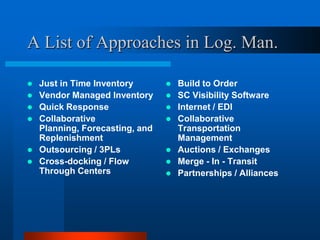
A List of Approaches in Log. Man.








Just in Time Inventory
Vendor Managed Inventory
Quick Response
Collaborative
Planning, Forecasting, and
Replenishment
Outsourcing / 3PLs
Cross-docking / Flow
Through Centers










Build to Order
SC Visibility Software
Internet / EDI
Collaborative
Transportation
Management
Auctions / Exchanges
Merge - In - Transit
Partnerships / Alliances
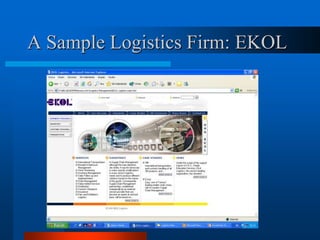
A Sample Logistics Firm: EKOL
Value Added Services
Value added services, such as
quality
control, labeling, sorting, repacking,
etc. can be included in the logistics
processes.
Bonded Warehouse
(In Turkish: “Antrepo”)
Bonded warehouse is a warehouse in which
goods are stored without customs duties
being paid until they are removed from the
warehouse.
Such warehouses are used for the storage
of import merchandise, subject to duty, until
the duties are paid or the goods reshipped
without entry.
Bonded Warehouse…
In accordance with the limitations and
authorities defined by laws of
customs, bonded warehouse stores
merchandise, not subject to free
circulation, under internationally
acclaimed standards prior to
nationalization.
Operations in the warehouse may include
assembly, manipulation or storage but
usually not manufacturing.
Cross Docking
A logistics activity that attempts to reduce
costs and total lead time.
Breaks down received items on the
loading dock and immediately matches
them with outgoing shipment
requirements, instead of stocking the
items in warehouse locations and
returning to pick for orders at a later time.
Cross Docking…
Eliminates the need to place
inventory in storage.
This can mean moving pallets across
the docking areas (hence the name)
for loading onto delivery vehicles.
Cross Docking…
Crossdocking essentially eliminates the
inventory-holding function of a warehouse
while still allowing it to serve its
consolidation and shipping functions.
The idea is to transfer incoming
shipments directly to outgoing trailers
without storing them in between.
Logistics Experience will be
different from one sector to another
Textiles
– speed and variety due to seasonality concerns

Retailing (FMCG)
– prevents stores from having empty shelves or shelves with
overstocks
– Frozen storage and transportation

Health
– hygienic, have limited shelf life, require special storage
conditions and entertain high inventory risks

Automotive
– just in time (JIT), delivering parts from thousands of
kilometers, special packaging

Fuel and Petroleum Transportation
– very special tanker security systems
Fuel and Petroleum
Transportation


Fuel tankers have bodies, including the
chassis, made of aluminum alloy and are
the lightest tankers in weight and highest
in volume (20.000 to 38.000 liters).



The tanks have a bottom loading and
unloading system and all the necessary
security equipments for overloading.
Fuel and Petroleum
Transportation…


The tanks have capacities between 20.000 and
38.000 liters, 4 to 7 compartments and 3.200 to
7.000 liters of compartment capacities.



Along with these tankers there are three-level
security systems, bottom loading equipments,
anti-rolling system, a security system locking the
brakes when the API drum is opened and the
valves when it is closed, emergency buttons at
three sides and an EBS brake system.
Fuel and Petroleum
Transportation…
There are also:
Emergency power switch,
Emergency valve locking switch,

6 rear-view mirrors
Fuel and Petroleum
Transportation…
The drivers clothes have long sleeves and long
trousers.
The fabric is 100% cotton to avoid static
electricity.
In addition, all drivers wear anti-static shoes.
The drivers’ equipments also include gloves
resistant to the material they carry, a helmet
compliant to EN norms and glasses against the
material vapor.
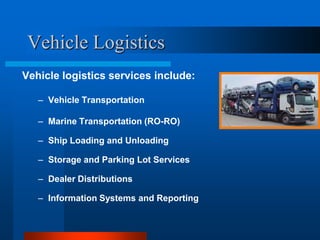
Vehicle Logistics
Vehicle logistics services include:
– Vehicle Transportation
– Marine Transportation (RO-RO)
– Ship Loading and Unloading
– Storage and Parking Lot Services
– Dealer Distributions
– Information Systems and Reporting
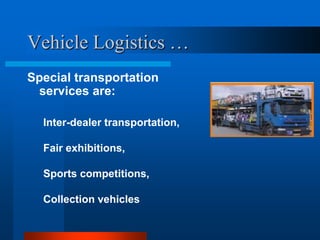
Vehicle Logistics …
Special transportation
services are:
Inter-dealer transportation,
Fair exhibitions,
Sports competitions,
Collection vehicles
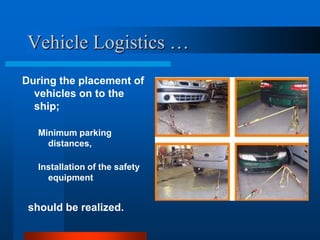
Vehicle Logistics …
During the placement of
vehicles on to the
ship;
Minimum parking
distances,

Installation of the safety
equipment

should be realized.
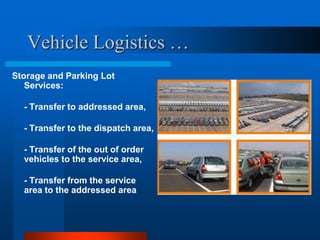
Vehicle Logistics …
Storage and Parking Lot
Services:
- Transfer to addressed area,
- Transfer to the dispatch area,
- Transfer of the out of order
vehicles to the service area,
- Transfer from the service
area to the addressed area
What is Ro-Ro?
Roll-on/roll-off (RORO) ships are
designed to carry wheeled cargo
such as automobiles, trailers or
railway carriages.
This is in contrast to lo-lo (lift on-lift
off) vessels which use a crane to
load and unload cargo.
What is Ro-Ro?
RORO vessels have built-in ramps which
allow the cargo to be efficiently "rolled on"
and "rolled off" the vessel when in port.
While smaller ferries that operate across
rivers and other short distances still often
have built-in ramps, the term RORO is
generally reserved for larger ocean-going
vessels.
What is Intermodal (Combined)
Transport?
It is a transport method that more than
one transport mode is used for the same
transport container.
The process can also be defined as a
transportation method where transport
mode changes for the same transport
container or land vehicle, but the goods
themselves are not handled during these
changes.
What is Intermodal (Combined)
Transport?
In other words, it is a transport method
that integrates advantages of different
transport modes.
In intermodal transport, the aim is to
achieve an effective combination of
cost, delivery time and service quality.
Features of Intermodal Transport
Using standard transport units (like standard
containers, trailers or pallet).
The suitability of the transport units for loading,
carriage and unloading.
The compatibility of the technological, legal and
organizational parts of the process chain within
the transport system.

The goods inside the transportation container are
not handled
Advantages of Land-Railway
Intermodal Transport
Guarentee of long-term fixed price
Secure shipping

Minimum interference by weather conditions and
traffic constraints
Easier border crossing

Cost and equipment supply advantage in high
volume and planned shippings
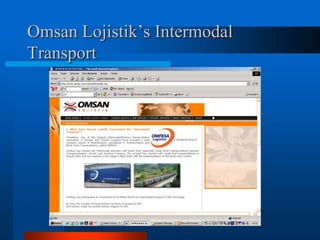
Omsan Lojistik’s Intermodal
Transport
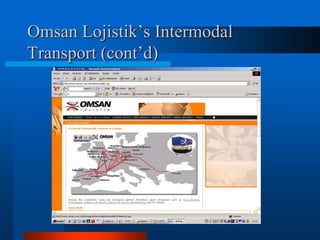
Omsan Lojistik’s Intermodal
Transport (cont’d)
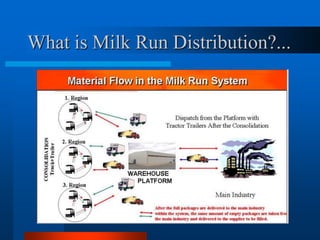
What is Milk Run Distribution?
It is the combination of shipments
from multiple vendors in close
geographic proximity into one
shipment received by the customer,
normally done for a defined route on a
recurring basis.
What is Milk Run Distribution?...
What is a Freight Forwarder?
An independent business that handles
export/import shipments for a fee.
A freight forwarder is among the best sources of
information and assistance on export regulations
and documentation, shipping methods, and
foreign import regulations.
Forwarder assembles, collects and consolidates
less-than-truckload (LTL) freight .
What is a Freight Forwarder?...
Forwarder consolidates freight for many
shippers, arranges for shipment and delivery via
LTL carriers and gets lower (freight) rates based
on volume than the individual shippers could
obtain.
At the request of the shipper, the forwarder
makes the actual arrangements and provides the
necessary services for expediting the shipment
to its overseas destination.
It also clears the freight through customs.
What is a Freight Forwarder?...
The freight forwarder does not actually carry the
cargo or conduct business for the ship.
It is an intermediary between carrier and owner of
goods being transported.
The forwarding agent assists the exporter in
finding the most economic and efficient methods
of transporting and storing cargo.
E-marketplace, Online Auctions and
Exchanges
An E-marketplace is a virtual online
market where organizations register as
buyers or sellers to conduct B2B ecommerce over Internet.
They can be operated by an independent
party, or be run by some form of industry
consortium that has been set-up to serve
a particular sector.

Logistics management

  • 1.
  • 2.
    What is Logistics? Logisticsis the . . . “process of planning, implementing, and controlling the efficient, effective flow and storage of goods, services, and related information from point of origin to point of consumption for the purpose of conforming to customer requirements.“ Council of Logistics Management
  • 3.
    Is it differentfrom SCM? Not really! “Supply Chain Management deals with the management of materials, information, and financial flows in a network consisting of suppliers, manufacturers, distributors, and customers.” (Stanford Supply Chain Forum) So, Logistics and Supply Chain are equivalent terms.
  • 4.
    Logistics Functions Purchasing / Procurement FacilityLocation / Network Design Inventory Control Transportation Warehousing Customer Service Materials Handling Order Processing
  • 5.
    A List ofApproaches in Log. Man.       Just in Time Inventory Vendor Managed Inventory Quick Response Collaborative Planning, Forecasting, and Replenishment Outsourcing / 3PLs Cross-docking / Flow Through Centers        Build to Order SC Visibility Software Internet / EDI Collaborative Transportation Management Auctions / Exchanges Merge - In - Transit Partnerships / Alliances
  • 6.
  • 7.
    Value Added Services Valueadded services, such as quality control, labeling, sorting, repacking, etc. can be included in the logistics processes.
  • 8.
    Bonded Warehouse (In Turkish:“Antrepo”) Bonded warehouse is a warehouse in which goods are stored without customs duties being paid until they are removed from the warehouse. Such warehouses are used for the storage of import merchandise, subject to duty, until the duties are paid or the goods reshipped without entry.
  • 9.
    Bonded Warehouse… In accordancewith the limitations and authorities defined by laws of customs, bonded warehouse stores merchandise, not subject to free circulation, under internationally acclaimed standards prior to nationalization. Operations in the warehouse may include assembly, manipulation or storage but usually not manufacturing.
  • 10.
    Cross Docking A logisticsactivity that attempts to reduce costs and total lead time. Breaks down received items on the loading dock and immediately matches them with outgoing shipment requirements, instead of stocking the items in warehouse locations and returning to pick for orders at a later time.
  • 11.
    Cross Docking… Eliminates theneed to place inventory in storage. This can mean moving pallets across the docking areas (hence the name) for loading onto delivery vehicles.
  • 12.
    Cross Docking… Crossdocking essentiallyeliminates the inventory-holding function of a warehouse while still allowing it to serve its consolidation and shipping functions. The idea is to transfer incoming shipments directly to outgoing trailers without storing them in between.
  • 13.
    Logistics Experience willbe different from one sector to another Textiles – speed and variety due to seasonality concerns Retailing (FMCG) – prevents stores from having empty shelves or shelves with overstocks – Frozen storage and transportation Health – hygienic, have limited shelf life, require special storage conditions and entertain high inventory risks Automotive – just in time (JIT), delivering parts from thousands of kilometers, special packaging Fuel and Petroleum Transportation – very special tanker security systems
  • 14.
    Fuel and Petroleum Transportation  Fueltankers have bodies, including the chassis, made of aluminum alloy and are the lightest tankers in weight and highest in volume (20.000 to 38.000 liters).  The tanks have a bottom loading and unloading system and all the necessary security equipments for overloading.
  • 15.
    Fuel and Petroleum Transportation…  Thetanks have capacities between 20.000 and 38.000 liters, 4 to 7 compartments and 3.200 to 7.000 liters of compartment capacities.  Along with these tankers there are three-level security systems, bottom loading equipments, anti-rolling system, a security system locking the brakes when the API drum is opened and the valves when it is closed, emergency buttons at three sides and an EBS brake system.
  • 16.
    Fuel and Petroleum Transportation… Thereare also: Emergency power switch, Emergency valve locking switch, 6 rear-view mirrors
  • 17.
    Fuel and Petroleum Transportation… Thedrivers clothes have long sleeves and long trousers. The fabric is 100% cotton to avoid static electricity. In addition, all drivers wear anti-static shoes. The drivers’ equipments also include gloves resistant to the material they carry, a helmet compliant to EN norms and glasses against the material vapor.
  • 18.
    Vehicle Logistics Vehicle logisticsservices include: – Vehicle Transportation – Marine Transportation (RO-RO) – Ship Loading and Unloading – Storage and Parking Lot Services – Dealer Distributions – Information Systems and Reporting
  • 19.
    Vehicle Logistics … Specialtransportation services are: Inter-dealer transportation, Fair exhibitions, Sports competitions, Collection vehicles
  • 20.
    Vehicle Logistics … Duringthe placement of vehicles on to the ship; Minimum parking distances, Installation of the safety equipment should be realized.
  • 21.
    Vehicle Logistics … Storageand Parking Lot Services: - Transfer to addressed area, - Transfer to the dispatch area, - Transfer of the out of order vehicles to the service area, - Transfer from the service area to the addressed area
  • 22.
    What is Ro-Ro? Roll-on/roll-off(RORO) ships are designed to carry wheeled cargo such as automobiles, trailers or railway carriages. This is in contrast to lo-lo (lift on-lift off) vessels which use a crane to load and unload cargo.
  • 23.
    What is Ro-Ro? ROROvessels have built-in ramps which allow the cargo to be efficiently "rolled on" and "rolled off" the vessel when in port. While smaller ferries that operate across rivers and other short distances still often have built-in ramps, the term RORO is generally reserved for larger ocean-going vessels.
  • 24.
    What is Intermodal(Combined) Transport? It is a transport method that more than one transport mode is used for the same transport container. The process can also be defined as a transportation method where transport mode changes for the same transport container or land vehicle, but the goods themselves are not handled during these changes.
  • 25.
    What is Intermodal(Combined) Transport? In other words, it is a transport method that integrates advantages of different transport modes. In intermodal transport, the aim is to achieve an effective combination of cost, delivery time and service quality.
  • 26.
    Features of IntermodalTransport Using standard transport units (like standard containers, trailers or pallet). The suitability of the transport units for loading, carriage and unloading. The compatibility of the technological, legal and organizational parts of the process chain within the transport system. The goods inside the transportation container are not handled
  • 27.
    Advantages of Land-Railway IntermodalTransport Guarentee of long-term fixed price Secure shipping Minimum interference by weather conditions and traffic constraints Easier border crossing Cost and equipment supply advantage in high volume and planned shippings
  • 28.
  • 29.
  • 30.
    What is MilkRun Distribution? It is the combination of shipments from multiple vendors in close geographic proximity into one shipment received by the customer, normally done for a defined route on a recurring basis.
  • 31.
    What is MilkRun Distribution?...
  • 32.
    What is aFreight Forwarder? An independent business that handles export/import shipments for a fee. A freight forwarder is among the best sources of information and assistance on export regulations and documentation, shipping methods, and foreign import regulations. Forwarder assembles, collects and consolidates less-than-truckload (LTL) freight .
  • 33.
    What is aFreight Forwarder?... Forwarder consolidates freight for many shippers, arranges for shipment and delivery via LTL carriers and gets lower (freight) rates based on volume than the individual shippers could obtain. At the request of the shipper, the forwarder makes the actual arrangements and provides the necessary services for expediting the shipment to its overseas destination. It also clears the freight through customs.
  • 34.
    What is aFreight Forwarder?... The freight forwarder does not actually carry the cargo or conduct business for the ship. It is an intermediary between carrier and owner of goods being transported. The forwarding agent assists the exporter in finding the most economic and efficient methods of transporting and storing cargo.
  • 35.
    E-marketplace, Online Auctionsand Exchanges An E-marketplace is a virtual online market where organizations register as buyers or sellers to conduct B2B ecommerce over Internet. They can be operated by an independent party, or be run by some form of industry consortium that has been set-up to serve a particular sector.