Motion Media
Motion Media is
defined as a class of
graphics that make use
of video and/or
animation technology in
a way that an illusion of
motion or a
transforming
appearance is created.
Earliest
Motion
Media
devices
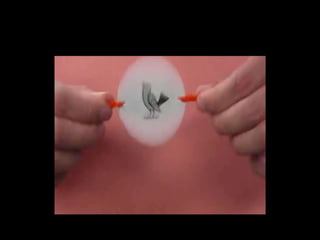
Thaumatrope
is a toy that was popular
in Victorian times. A disk or card
with a picture on each side is
attached to two pieces of string.
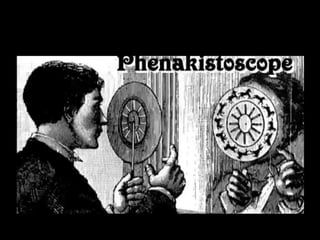
Phenakistoscope
also spelled phenakistiscope
or phenakitiscope was an early
animation device that used the
persistence of vision principle to create
an illusion of motion.
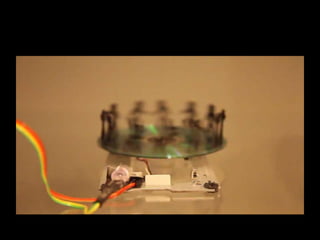
Stroboscope
also known as a strobe, is an
instrument used to make a
cyclically moving object appear to
be slow-moving, or stationary.
Zoetrope
is a device that produces the
illusion of motion from a rapid
succession of static pictures.
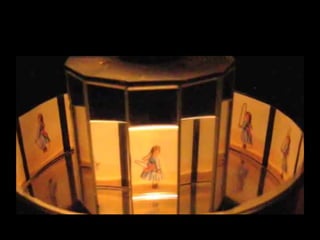
Praxinoscope
was an animation device, the
successor to the zoetrope.. Like the
zoetrope, it used a strip of pictures
placed around the inner surface of
a spinning cylinder
Flip book
or flick book is a book with a series of
pictures that vary gradually from one
page to the next.
History
1800

There have been presentations that
could be classified as motion graphics
as early as this year.
1920

Michael Betancourt wrote the first in depth
historical survey of the field
1960

One of the first uses of the term "motion
graphics" was by animator John Whitney,
1955 to 1962

Saul Bass is a major pioneer in the development of
feature film title sequences.
His designs were simple, but effectively
communicated the mood of the film.
1962 to 2014

Motion Media is universal
- Kaprion.com
Types of Motion Media
Motion Media
Motion Media is defined as a class of
graphics that make use of 1. video and/or
2.animation technology in a way that an
illusion of motion or a transforming
appearance is created.
These motion graphics are usually
combined with audio for use in multimedia
projects.
1. Video
• Video is an electronic medium for the
recording, copying, and broadcasting of
moving visual images.
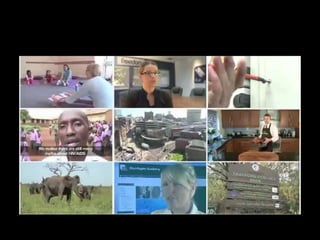
Video Footage
• In filmmaking and video production,
footage is the raw, unedited material as it
had been originally filmed by movie
camera or recorded by a video camera
which usually must be edited to create a
motion picture, video clip, television show
or similar completed work.
MOTION PICTURE, MOVIE, FILM,
CINEMA, THEATER, AND
PICTURE?
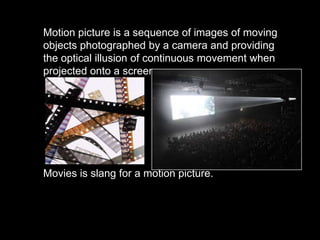
Motion picture is a sequence of images of moving
objects photographed by a camera and providing
the optical illusion of continuous movement when
projected onto a screen.

Movies is slang for a motion picture.
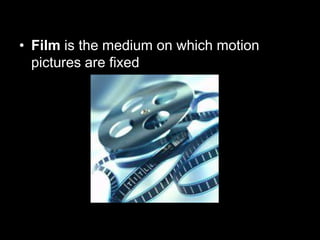
• Film is the medium on which motion
pictures are fixed
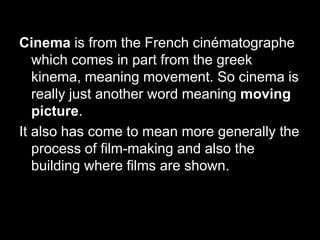
Cinema is from the French cinématographe
which comes in part from the greek
kinema, meaning movement. So cinema is
really just another word meaning moving
picture.
It also has come to mean more generally the
process of film-making and also the
building where films are shown.
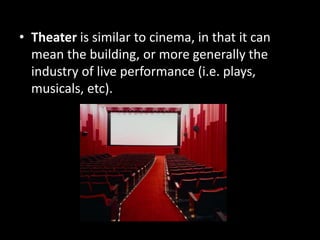
• Theater is similar to cinema, in that it can
mean the building, or more generally the
industry of live performance (i.e. plays,
musicals, etc).
In context, the theater is the building where
movies are shown, but usually people would
specify the movie theater to avoid confusion
with the live theater.

Film, movies, and pictures are used
interchangeably: I saw a film. I saw a movie. I
saw a picture.
Movies and pictures can be used
interchangeably: I'm going to the
movies/pictures.
2. Animation
Animation is the process of creating a
continuous motion and shape change
illusion by means of the rapid display of a
sequence of static images that minimally
differ from each other. The illusion—as in
motion pictures in general—is thought to
rely on the phi phenomenon.
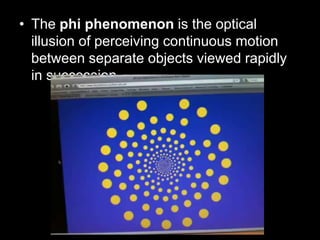
• The phi phenomenon is the optical
illusion of perceiving continuous motion
between separate objects viewed rapidly
in succession.
Animation
Animations can be stored or recorded on
either analogue media, such as Flip book,
motion picture film, video tape, on digital
media.

Including formats such as animated GIF
(Graphics Interchange Format), Flash
animation or digital video.
To display it, a digital camera, a computer, or a
projector are used.
Animation creation methods include
the traditional animation creation method
and those involving stop motion animation
of two and three-dimensional objects, such
as paper cutouts , puppets and clay
figures.
Animation Techniques
Creativity has no limits.
There are various types of animation
techniques practiced by film makers all
over the world. Classical and digital 2D
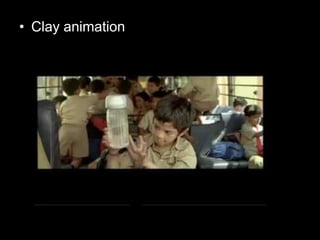
animation, digital 3D Animation, stopmotion, clay animation, cut-out animation,
paint-on-glass animation, drawn-on-film
animation, and experimental animation are
just a few among the many existing forms
of animation.
• Classical 2D animation is also known
as hand-drawn 2D animation or traditional
animation.
• Digital 2D animation
• Digital 3D animation
• Stop-motion animation.
• Clay animation
• Cut-out animation
• Drawn-on-film animation
• Paint-on-glass animation
• Experimental animation
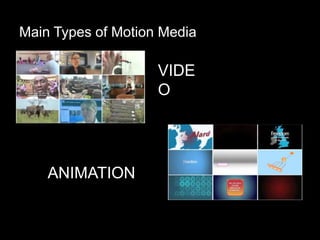
Main Types of Motion Media

VIDE
O

ANIMATION
ADVANTAGES AND
DISADVANTAGES OF MOTION
MEDA
Advantages
• Great way of demonstrating and guiding step
by step processes
• Flexible: pace (rewind, fast forward and
pause)
• Accessible (DVDs, online and live streams)
• Attractive
• Larger audience (large number of students can
be taught simultaneously by one instructor)
• Larger number of hosts (outside speakers
can be involved who would not otherwise
be available)
• Connection (students can be linked with
others from different communities,
backgrounds and cultures)
• Attention Grabbing
• Skill Learning
• To be able to establish commonality
Disadvantages
• No student-teacher relationship (questions
can’t be asked)
• Expensive (supporting materials: projector,
laptops, computers)
• Time consuming
• Unpredicted problems (audio and visual
difficulties)
• Not flexible: style (teaching style and
strategies)
• Fixed Pace (cannot be interrupted)
• Misinterpretation
• Time consuming (preparation of the video
takes time: production material)
• Not interactive
APPLICATIONS TO EDUCATION
• Video mediated lessons could provide better
understanding of the content and could also
improve the cognitive capacities of a student
since learning is mostly due to visual and
hearing.
• These materials promote student centered
instructional approach. After viewing and
utilizing a material in the classroom, online, or
in a distant learning setting, students create
their own interpretation. Thus they dig deeper
into the content and understands the topic
more. Concepts are transferred to new
problem questions and the construction of
knowledge occurs. Thus students are
becoming more engaged in the learning
process.
• Distant learning is a form of schooling that is
continuously emerging. Online seminars can
now be held through video conferences.
These are effective since they are like
seminars/talks only smaller which provides
more room for interaction.
• Video conferences eliminate/reduce the
possibility of misunderstanding since these
provide opportunities for the input of the
facilitator or teachers opposed to that of video
only based learning (fixed). Video
conferences provide the opportunity for
interaction.
• Examples: Video-based learning materials,
how to videos (problem based topics), public
broadcast archives (current events, important
events like SONA, public speeches),
educational films, documentaries, multimedia
essays, video call/ video conferences,
interactive videos
• Other Examples: Webinars (Seminars/talks
held online), alternative to some hands-on
lessons (like videos of dissections to provide
a clearer and more accurate lecture)

Edtech101report

  • 1.
  • 2.
    Motion Media is definedas a class of graphics that make use of video and/or animation technology in a way that an illusion of motion or a transforming appearance is created.
  • 3.
  • 4.
    Thaumatrope is a toythat was popular in Victorian times. A disk or card with a picture on each side is attached to two pieces of string.
  • 6.
    Phenakistoscope also spelled phenakistiscope orphenakitiscope was an early animation device that used the persistence of vision principle to create an illusion of motion.
  • 8.
    Stroboscope also known asa strobe, is an instrument used to make a cyclically moving object appear to be slow-moving, or stationary.
  • 10.
    Zoetrope is a devicethat produces the illusion of motion from a rapid succession of static pictures.
  • 12.
    Praxinoscope was an animationdevice, the successor to the zoetrope.. Like the zoetrope, it used a strip of pictures placed around the inner surface of a spinning cylinder
  • 14.
    Flip book or flickbook is a book with a series of pictures that vary gradually from one page to the next.
  • 18.
  • 19.
    1800 There have beenpresentations that could be classified as motion graphics as early as this year.
  • 20.
    1920 Michael Betancourt wrotethe first in depth historical survey of the field
  • 21.
    1960 One of thefirst uses of the term "motion graphics" was by animator John Whitney,
  • 22.
    1955 to 1962 SaulBass is a major pioneer in the development of feature film title sequences. His designs were simple, but effectively communicated the mood of the film.
  • 23.
    1962 to 2014 MotionMedia is universal - Kaprion.com
  • 24.
  • 25.
    Motion Media Motion Mediais defined as a class of graphics that make use of 1. video and/or 2.animation technology in a way that an illusion of motion or a transforming appearance is created. These motion graphics are usually combined with audio for use in multimedia projects.
  • 26.
    1. Video • Videois an electronic medium for the recording, copying, and broadcasting of moving visual images.
  • 27.
    Video Footage • Infilmmaking and video production, footage is the raw, unedited material as it had been originally filmed by movie camera or recorded by a video camera which usually must be edited to create a motion picture, video clip, television show or similar completed work.
  • 29.
    MOTION PICTURE, MOVIE,FILM, CINEMA, THEATER, AND PICTURE?
  • 30.
    Motion picture isa sequence of images of moving objects photographed by a camera and providing the optical illusion of continuous movement when projected onto a screen. Movies is slang for a motion picture.
  • 31.
    • Film isthe medium on which motion pictures are fixed
  • 32.
    Cinema is fromthe French cinématographe which comes in part from the greek kinema, meaning movement. So cinema is really just another word meaning moving picture. It also has come to mean more generally the process of film-making and also the building where films are shown.
  • 33.
    • Theater issimilar to cinema, in that it can mean the building, or more generally the industry of live performance (i.e. plays, musicals, etc).
  • 34.
    In context, thetheater is the building where movies are shown, but usually people would specify the movie theater to avoid confusion with the live theater. Film, movies, and pictures are used interchangeably: I saw a film. I saw a movie. I saw a picture. Movies and pictures can be used interchangeably: I'm going to the movies/pictures.
  • 36.
    2. Animation Animation isthe process of creating a continuous motion and shape change illusion by means of the rapid display of a sequence of static images that minimally differ from each other. The illusion—as in motion pictures in general—is thought to rely on the phi phenomenon.
  • 37.
    • The phiphenomenon is the optical illusion of perceiving continuous motion between separate objects viewed rapidly in succession.
  • 38.
    Animation Animations can bestored or recorded on either analogue media, such as Flip book, motion picture film, video tape, on digital media. Including formats such as animated GIF (Graphics Interchange Format), Flash animation or digital video. To display it, a digital camera, a computer, or a projector are used.
  • 39.
    Animation creation methodsinclude the traditional animation creation method and those involving stop motion animation of two and three-dimensional objects, such as paper cutouts , puppets and clay figures.
  • 40.
    Animation Techniques Creativity hasno limits. There are various types of animation techniques practiced by film makers all over the world. Classical and digital 2D animation, digital 3D Animation, stopmotion, clay animation, cut-out animation, paint-on-glass animation, drawn-on-film animation, and experimental animation are just a few among the many existing forms of animation.
  • 41.
    • Classical 2Danimation is also known as hand-drawn 2D animation or traditional animation.
  • 42.
    • Digital 2Danimation
  • 43.
    • Digital 3Danimation
  • 44.
  • 45.
  • 46.
  • 47.
  • 48.
  • 49.
  • 50.
    Main Types ofMotion Media VIDE O ANIMATION
  • 51.
  • 52.
    Advantages • Great wayof demonstrating and guiding step by step processes • Flexible: pace (rewind, fast forward and pause) • Accessible (DVDs, online and live streams) • Attractive • Larger audience (large number of students can be taught simultaneously by one instructor)
  • 53.
    • Larger numberof hosts (outside speakers can be involved who would not otherwise be available) • Connection (students can be linked with others from different communities, backgrounds and cultures) • Attention Grabbing • Skill Learning • To be able to establish commonality
  • 54.
    Disadvantages • No student-teacherrelationship (questions can’t be asked) • Expensive (supporting materials: projector, laptops, computers) • Time consuming • Unpredicted problems (audio and visual difficulties)
  • 55.
    • Not flexible:style (teaching style and strategies) • Fixed Pace (cannot be interrupted) • Misinterpretation • Time consuming (preparation of the video takes time: production material) • Not interactive
  • 56.
  • 57.
    • Video mediatedlessons could provide better understanding of the content and could also improve the cognitive capacities of a student since learning is mostly due to visual and hearing. • These materials promote student centered instructional approach. After viewing and utilizing a material in the classroom, online, or in a distant learning setting, students create their own interpretation. Thus they dig deeper into the content and understands the topic more. Concepts are transferred to new problem questions and the construction of knowledge occurs. Thus students are becoming more engaged in the learning process.
  • 58.
    • Distant learningis a form of schooling that is continuously emerging. Online seminars can now be held through video conferences. These are effective since they are like seminars/talks only smaller which provides more room for interaction. • Video conferences eliminate/reduce the possibility of misunderstanding since these provide opportunities for the input of the facilitator or teachers opposed to that of video only based learning (fixed). Video conferences provide the opportunity for interaction.
  • 59.
    • Examples: Video-basedlearning materials, how to videos (problem based topics), public broadcast archives (current events, important events like SONA, public speeches), educational films, documentaries, multimedia essays, video call/ video conferences, interactive videos • Other Examples: Webinars (Seminars/talks held online), alternative to some hands-on lessons (like videos of dissections to provide a clearer and more accurate lecture)

Editor's Notes

  • #56 (In documentaries and dramatizations especially, intended messages are quite deep and complex. Because of the young viewers who lack maturity tend to misterpret the message. Misinterpretation