Educational system in
Croatia
Our heritage is our treasure
LTTA, Anarita, Cyprus
November, 2018
Educational system
• Early childhood education
• Elementary education
• Secondary education
• Higher education
Elementary and secondary education in state schools is free. (?!)
Early childhood education
• organized in kindergartens, which are not compulsory
• Three stages: - from when the child is 6 months old to when they’re one
- from the ages of one to three
- from the age of three until the child starts attending primary school
Every child must attend kindergarten for a year prior to primary school.
Elementary education
• compulsory by law for all children
• eight years
• children begin school at at the age of 6 and a half or 7
• There is an adult education system for those over the age of 15 who fail
to complete elementary education
Elementary education
1st - 4th grade
• taught by one teacher per class that teaches every subject with the exception of foreign languages and religion
• subjects: Croatian, mathematics, art, nature and society, PE, music and one foreign language (usually English)
Religious education is optional; in 4th grade optional second foreign language (usually German)
• students stay in one classroom for the four years
Elementary education
5th - 8th grades
• students are taught by different teachers for each subject including history, geography, biology, chemistry, physics,
informatics
• students no longer have one classroom, but rather move around the school to get to their classes
Secondary education
• currently optional, although most political parties advocate that it should be mandatory
• according to curricula divided into: gymnasiums (high school)
vocational schools (technical, industrial and craft based)
art schools (music, dance, art)
Process of getting into a secondary school:
- a student chooses six schools which they want to go to, in order of choice
- the first school on the list is the school that the student wants to go to the most
- the maximum number of points while signing up is 80 (gathered from primary school grades and any extra criteria)
Schools have quotas of how many students can enroll in that particular year.
Secondary education
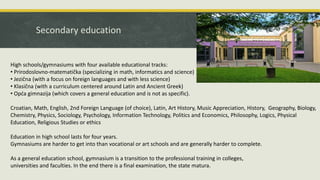
High schools/gymnasiums with four available educational tracks:
• Prirodoslovno-matematička (specializing in math, informatics and science)
• Jezična (with a focus on foreign languages and with less science)
• Klasična (with a curriculum centered around Latin and Ancient Greek)
• Opća gimnazija (which covers a general education and is not as specific).
Croatian, Math, English, 2nd Foreign Language (of choice), Latin, Art History, Music Appreciation, History, Geography, Biology,
Chemistry, Physics, Sociology, Psychology, Information Technology, Politics and Economics, Philosophy, Logics, Physical
Education, Religious Studies or ethics
Education in high school lasts for four years.
Gymnasiums are harder to get into than vocational or art schools and are generally harder to complete.
As a general education school, gymnasium is a transition to the professional training in colleges,
universities and faculties. In the end there is a final examination, the state matura.
Secondary education
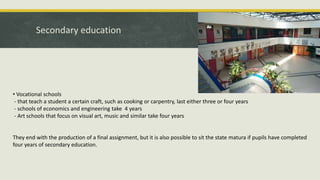
• Vocational schools
- that teach a student a certain craft, such as cooking or carpentry, last either three or four years
- schools of economics and engineering take 4 years
- Art schools that focus on visual art, music and similar take four years
They end with the production of a final assignment, but it is also possible to sit the state matura if pupils have completed
four years of secondary education.
Higher education
Students can enroll into two basic kinds of higher education:
• Polytechnic schools (veleučilište), higher level education
• Universities (sveučilište), highest level education
With implementation of the Bologna process, the levels of expertise are:
• Bachelor of Science and Bachelor of Arts
• Master of Science and Master of Arts
• Master of Education
• Doctor of Science and Doctor of Arts
All larger universities in Croatia are composed of independent “faculties”. Each independent college or
department maintains its own administration, professional staff and campus. The colleges focus on specific
areas of learning: Natural Sciences, Philosophy, Law, Engineering, Economy, Architecture, Medicine, and so
on.
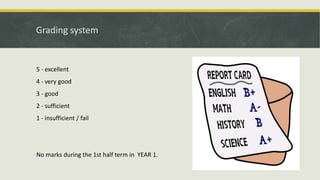
Grading system
5 - excellent
4 - very good
3 - good
2 - sufficient
1 - insufficient / fail
No marks during the 1st half term in YEAR 1.
School time
• the school year lasts 175 days
• 5 days a week, 35 weeks
• 2 terms: 1st term – 3 September – 21 December
2nd term – 14 January – 14 June
• holidays - 3 weeks winter holidays
- 1 week spring break (around Easter)
• lessons last 45 minutes; breaks last 5 minutes; longer break for brunch last 15 minutes
Timetable
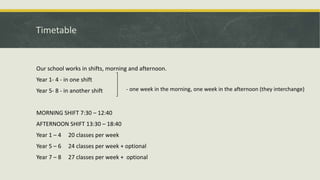
Our school works in shifts, morning and afternoon.
Year 1- 4 - in one shift
Year 5- 8 - in another shift
MORNING SHIFT 7:30 – 12:40
AFTERNOON SHIFT 13:30 – 18:40
Year 1 – 4 20 classes per week
Year 5 – 6 24 classes per week + optional
Year 7 – 8 27 classes per week + optional
- one week in the morning, one week in the afternoon (they interchange)
Professional development - teachers
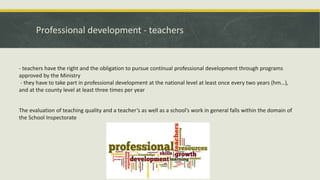
- teachers have the right and the obligation to pursue continual professional development through programs
approved by the Ministry
- they have to take part in professional development at the national level at least once every two years (hm…),
and at the county level at least three times per year
The evaluation of teaching quality and a teacher’s as well as a school’s work in general falls within the domain of
the School Inspectorate
Professional development - teachers
After becoming a certified teacher, there are two more advancement levels:
• teacher-mentor
• teacher-counsellor
Requirements for the promotion of teachers are defined at the national level by the Regulatory Act on the Promotion
of Teachers in Primary and Secondary Schools and the elements taken into consideration for advancement are an
evaluation of teaching quality and the enhancement of learning displayed by candidates, involvement in
extracurricular activities and continuous professional development
After completing studies all novice teachers are obliged to undergo a one-year induction period supervised by a
teacher-mentor and regulated by the Ministry.
The beginner teacher then takes the State Certification Exam before Ministry’s commission in order to become a fully
qualified and certified teacher.
Salary
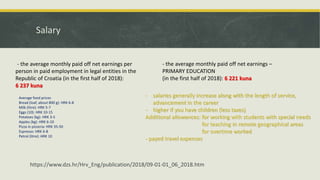
- the average monthly paid off net earnings per
person in paid employment in legal entities in the
Republic of Croatia (in the first half of 2018):
6 237 kuna
- the average monthly paid off net earnings –
PRIMARY EDUCATION
(in the first half of 2018): 6 221 kuna
https://www.dzs.hr/Hrv_Eng/publication/2018/09-01-01_06_2018.htm
Average food prices
Bread (loaf, about 800 g): HRK 6-8
Milk (litre): HRK 5-7
Eggs (10): HRK 10-15
Potatoes (kg): HRK 3-5
Apples (kg): HRK 6-10
Pizza in pizzeria: HRK 35-50
Espresso: HRK 6-8
Petrol (litre): HRK 10
- salaries generally increase along with the length of service,
advancement in the career
- higher if you have children (less taxes)
Additional allowances: for working with students with special needs
for teaching in remote geographical areas
for overtime worked
- payed travel expenses
Curricular reform
At the moment…
- the curricular reform of the public primary and secondary education system, then reform of the
vocational education system, followed by reform in higher education and encouraging excellence in
science and linking academia with the business sector in an effort to advance both
LTTA, Anarita, Cyprus
November, 2018

Educational system - Croatia

  • 1.
    Educational system in Croatia Ourheritage is our treasure LTTA, Anarita, Cyprus November, 2018
  • 2.
    Educational system • Earlychildhood education • Elementary education • Secondary education • Higher education Elementary and secondary education in state schools is free. (?!)
  • 3.
    Early childhood education •organized in kindergartens, which are not compulsory • Three stages: - from when the child is 6 months old to when they’re one - from the ages of one to three - from the age of three until the child starts attending primary school Every child must attend kindergarten for a year prior to primary school.
  • 4.
    Elementary education • compulsoryby law for all children • eight years • children begin school at at the age of 6 and a half or 7 • There is an adult education system for those over the age of 15 who fail to complete elementary education
  • 5.
    Elementary education 1st -4th grade • taught by one teacher per class that teaches every subject with the exception of foreign languages and religion • subjects: Croatian, mathematics, art, nature and society, PE, music and one foreign language (usually English) Religious education is optional; in 4th grade optional second foreign language (usually German) • students stay in one classroom for the four years
  • 6.
    Elementary education 5th -8th grades • students are taught by different teachers for each subject including history, geography, biology, chemistry, physics, informatics • students no longer have one classroom, but rather move around the school to get to their classes
  • 7.
    Secondary education • currentlyoptional, although most political parties advocate that it should be mandatory • according to curricula divided into: gymnasiums (high school) vocational schools (technical, industrial and craft based) art schools (music, dance, art) Process of getting into a secondary school: - a student chooses six schools which they want to go to, in order of choice - the first school on the list is the school that the student wants to go to the most - the maximum number of points while signing up is 80 (gathered from primary school grades and any extra criteria) Schools have quotas of how many students can enroll in that particular year.
  • 8.
    Secondary education High schools/gymnasiumswith four available educational tracks: • Prirodoslovno-matematička (specializing in math, informatics and science) • Jezična (with a focus on foreign languages and with less science) • Klasična (with a curriculum centered around Latin and Ancient Greek) • Opća gimnazija (which covers a general education and is not as specific). Croatian, Math, English, 2nd Foreign Language (of choice), Latin, Art History, Music Appreciation, History, Geography, Biology, Chemistry, Physics, Sociology, Psychology, Information Technology, Politics and Economics, Philosophy, Logics, Physical Education, Religious Studies or ethics Education in high school lasts for four years. Gymnasiums are harder to get into than vocational or art schools and are generally harder to complete. As a general education school, gymnasium is a transition to the professional training in colleges, universities and faculties. In the end there is a final examination, the state matura.
  • 9.
    Secondary education • Vocationalschools - that teach a student a certain craft, such as cooking or carpentry, last either three or four years - schools of economics and engineering take 4 years - Art schools that focus on visual art, music and similar take four years They end with the production of a final assignment, but it is also possible to sit the state matura if pupils have completed four years of secondary education.
  • 10.
    Higher education Students canenroll into two basic kinds of higher education: • Polytechnic schools (veleučilište), higher level education • Universities (sveučilište), highest level education With implementation of the Bologna process, the levels of expertise are: • Bachelor of Science and Bachelor of Arts • Master of Science and Master of Arts • Master of Education • Doctor of Science and Doctor of Arts All larger universities in Croatia are composed of independent “faculties”. Each independent college or department maintains its own administration, professional staff and campus. The colleges focus on specific areas of learning: Natural Sciences, Philosophy, Law, Engineering, Economy, Architecture, Medicine, and so on.
  • 11.
    Grading system 5 -excellent 4 - very good 3 - good 2 - sufficient 1 - insufficient / fail No marks during the 1st half term in YEAR 1.
  • 12.
    School time • theschool year lasts 175 days • 5 days a week, 35 weeks • 2 terms: 1st term – 3 September – 21 December 2nd term – 14 January – 14 June • holidays - 3 weeks winter holidays - 1 week spring break (around Easter) • lessons last 45 minutes; breaks last 5 minutes; longer break for brunch last 15 minutes
  • 13.
    Timetable Our school worksin shifts, morning and afternoon. Year 1- 4 - in one shift Year 5- 8 - in another shift MORNING SHIFT 7:30 – 12:40 AFTERNOON SHIFT 13:30 – 18:40 Year 1 – 4 20 classes per week Year 5 – 6 24 classes per week + optional Year 7 – 8 27 classes per week + optional - one week in the morning, one week in the afternoon (they interchange)
  • 14.
    Professional development -teachers - teachers have the right and the obligation to pursue continual professional development through programs approved by the Ministry - they have to take part in professional development at the national level at least once every two years (hm…), and at the county level at least three times per year The evaluation of teaching quality and a teacher’s as well as a school’s work in general falls within the domain of the School Inspectorate
  • 15.
    Professional development -teachers After becoming a certified teacher, there are two more advancement levels: • teacher-mentor • teacher-counsellor Requirements for the promotion of teachers are defined at the national level by the Regulatory Act on the Promotion of Teachers in Primary and Secondary Schools and the elements taken into consideration for advancement are an evaluation of teaching quality and the enhancement of learning displayed by candidates, involvement in extracurricular activities and continuous professional development After completing studies all novice teachers are obliged to undergo a one-year induction period supervised by a teacher-mentor and regulated by the Ministry. The beginner teacher then takes the State Certification Exam before Ministry’s commission in order to become a fully qualified and certified teacher.
  • 16.
    Salary - the averagemonthly paid off net earnings per person in paid employment in legal entities in the Republic of Croatia (in the first half of 2018): 6 237 kuna - the average monthly paid off net earnings – PRIMARY EDUCATION (in the first half of 2018): 6 221 kuna https://www.dzs.hr/Hrv_Eng/publication/2018/09-01-01_06_2018.htm Average food prices Bread (loaf, about 800 g): HRK 6-8 Milk (litre): HRK 5-7 Eggs (10): HRK 10-15 Potatoes (kg): HRK 3-5 Apples (kg): HRK 6-10 Pizza in pizzeria: HRK 35-50 Espresso: HRK 6-8 Petrol (litre): HRK 10 - salaries generally increase along with the length of service, advancement in the career - higher if you have children (less taxes) Additional allowances: for working with students with special needs for teaching in remote geographical areas for overtime worked - payed travel expenses
  • 17.
    Curricular reform At themoment… - the curricular reform of the public primary and secondary education system, then reform of the vocational education system, followed by reform in higher education and encouraging excellence in science and linking academia with the business sector in an effort to advance both
  • 18.