THE EDUCATION SYSTEM IN  LITHUANIA Liutauras Ivoška Induction meeting for incoming Comenius assistants Vilnius 2010- 10 - 28
LEGAL BACKGROUND
1991, Law on Education of the Republic of Lithuania Education is a priority area of activities supported by the state.  On 25 June 1991, the Seimas (Parliament) passed the Law on Education of the Republic of Lithuania, which established the  structure  of the Lithuanian educational system and the  basis for the governance and activities of educational institutions  (with the exception of higher schools).
2003, new wersion of the law on Education The new version of the Law on Education passed in 2003 establishes the  goals  of education in Lithuania, the  principles  of its educational system, the  basic foundations  for the framework of educational institutions, their  activities and relationships  and also  obligations  of the State in the area of education.
2003, National Education Strategy 2003-2012 In 2003, the Provisions of the National Education Strategy 2003-2012 were adopted. The Provisions complement the Long-term Development Strategy of the State and define the goals for further development of the Lithuanian educational system and the means for attaining them.
LEGAL BACKGROUND
At present, education is regulated by the Laws on Education, Science and Studies (adopted in 2009), Vocational Training, Special Education, Adult Non-formal Education and subsequent legislation.  The activity of local educational establishments is governed by the Laws on Local Self-Government.
REGULATIVE BODIES
Education is the responsibility of the  Ministry of Education and Science  (responsible for the development and implementation of education policies, and defines the criteria for the allocation of financial resources) . Responsibilities with regard to the administration and organisation of the education system are assumed by central government, the local education authorities and the administrative bodies of the establishments involved.
GENERAL INFORMATION
Educational principles Equal opportunities; Contextual interdependence; Effectiveness; Continuity.
Educational principles Educational institutions: state, municipality, private; Education is free of charge (except for private educational establishments and universities); Education is compulsory from 7 to 16; The official language of instruction – Lithuanian.
Today 1415  general education schools in Lithuania; School year 2010 –  418 500  students;  School year 2010 –  39 842  teachers;  97  vocational education schools 22  universities; 23  colleges.
General Principles 1st September – the beginning of a school year; May – the end of a school year for 1st – 5th forms; June/July – the end of a school year for 11th – 12th forms; 2 or 3 semester s  a year; 45 minutes = 1 lesson; 30/35 minutes = 1 lesson (pr e -prim a ry – 1st form); 22 – 31 lessons per week (Monday – Friday); 24 – 30 students in a class.
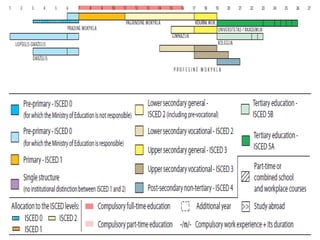
Structure of the education system in Lithuania Formal education ; Non-formal education .
Structure of the Education system in Lithuania Formal education : pre-school (6-7) primary (7-11); basic (11-16); secondary (16-18/19); vocational education and training (14-21); training and higher education (18/19-26). Non-formal education: pre-primary education (1-6); non-formal education of children; non-formal education of adults.
 
Pre-primary education PRE-PRIMARY EDUCATION
Pre-primary education Pre-primary education is considered part of non-formal education. It caters for children from 1 year to 7 years of age.  Attendance is optional.  In 2008/09, the attendance rate in pre-primary groups was 97.5 % of children of 6 years of age.
COMPULSORY EDUCATION
P rimary  education Provided to children between 7 and 11 years of age; The duration of curriculum – 4 years (forms 1 st  – 4 th ); Primary education is implemented by kindergarten-schools, primary schools, and other schools; Early foreign language teaching is offered in the 2nd form; All subjects are compulsory; Primary education is gained.
Basic education Provided to children between 11 and 16 years of age; Basic education curriculum is implemented by gymnasiums and  secondary, basic, youth, vocational and other types of schools; The duration of curriculum – 6 years (forms 5 th  – 10 th ); Around 17 subjects are taught at 1 general level; All subjects are compulsory; Basic education is gained.
NON-COMPULSORY EDUCATION
Secondary  education Provided to children between 16 and 19 years of age; Curriculum consists of compulsory and optional modules of general education; Secondary education curriculum is implemented by gymnasiums, secondary and vocational schools, and other types of schools; The duration of curriculum – 2 years (forms 11 th  – 12 th ); Examinations   ( A  or  B  level)  for the school-leaving  ( maturity )  certificate; Secondary education is completed.
…
Vocational education and training Provided to students who have basic education (starting from the age of 14 (8 th  form) or 16 (10 th  form); Curriculum is implemented by vocational schools; Upon completion of studies a student gets primary professional qualification and/or completes secondary education;
Higher education studies Available to people who are at least 18-years-old and have completed secondary education; The higher education curricula are implemented by the higher education schools, i.e. universities and colleges; A college  – study programmes are focused on practice; A university  – university study programmes prevail: - Bachelor of Arts (BA) – 3-5 years; - Master of Arts (MA) – 1,5-2 years; - Philosophy Doctor (PhD) – up to 4 years.
Education Exhanges Support Foundation Gelezinis Vilkas str.  12, 01112 Vilnius Tel.: (8 ~ 5) 261 0592, 212 3364, 249 7134, 249 8189 Fa x : (8 ~ 5) 249 7137 E -mail:  liutauras.ivoska @smpf.lt   www.smpf.lt

The Education System in Lithuania 1

  • 1.
    THE EDUCATION SYSTEMIN LITHUANIA Liutauras Ivoška Induction meeting for incoming Comenius assistants Vilnius 2010- 10 - 28
  • 2.
  • 3.
    1991, Law onEducation of the Republic of Lithuania Education is a priority area of activities supported by the state. On 25 June 1991, the Seimas (Parliament) passed the Law on Education of the Republic of Lithuania, which established the structure of the Lithuanian educational system and the basis for the governance and activities of educational institutions (with the exception of higher schools).
  • 4.
    2003, new wersionof the law on Education The new version of the Law on Education passed in 2003 establishes the goals of education in Lithuania, the principles of its educational system, the basic foundations for the framework of educational institutions, their activities and relationships and also obligations of the State in the area of education.
  • 5.
    2003, National EducationStrategy 2003-2012 In 2003, the Provisions of the National Education Strategy 2003-2012 were adopted. The Provisions complement the Long-term Development Strategy of the State and define the goals for further development of the Lithuanian educational system and the means for attaining them.
  • 6.
  • 7.
    At present, educationis regulated by the Laws on Education, Science and Studies (adopted in 2009), Vocational Training, Special Education, Adult Non-formal Education and subsequent legislation. The activity of local educational establishments is governed by the Laws on Local Self-Government.
  • 8.
  • 9.
    Education is theresponsibility of the Ministry of Education and Science (responsible for the development and implementation of education policies, and defines the criteria for the allocation of financial resources) . Responsibilities with regard to the administration and organisation of the education system are assumed by central government, the local education authorities and the administrative bodies of the establishments involved.
  • 10.
  • 11.
    Educational principles Equalopportunities; Contextual interdependence; Effectiveness; Continuity.
  • 12.
    Educational principles Educationalinstitutions: state, municipality, private; Education is free of charge (except for private educational establishments and universities); Education is compulsory from 7 to 16; The official language of instruction – Lithuanian.
  • 13.
    Today 1415 general education schools in Lithuania; School year 2010 – 418 500 students; School year 2010 – 39 842 teachers; 97 vocational education schools 22 universities; 23 colleges.
  • 14.
    General Principles 1stSeptember – the beginning of a school year; May – the end of a school year for 1st – 5th forms; June/July – the end of a school year for 11th – 12th forms; 2 or 3 semester s a year; 45 minutes = 1 lesson; 30/35 minutes = 1 lesson (pr e -prim a ry – 1st form); 22 – 31 lessons per week (Monday – Friday); 24 – 30 students in a class.
  • 15.
    Structure of theeducation system in Lithuania Formal education ; Non-formal education .
  • 16.
    Structure of theEducation system in Lithuania Formal education : pre-school (6-7) primary (7-11); basic (11-16); secondary (16-18/19); vocational education and training (14-21); training and higher education (18/19-26). Non-formal education: pre-primary education (1-6); non-formal education of children; non-formal education of adults.
  • 17.
  • 18.
  • 19.
    Pre-primary education Pre-primaryeducation is considered part of non-formal education. It caters for children from 1 year to 7 years of age. Attendance is optional. In 2008/09, the attendance rate in pre-primary groups was 97.5 % of children of 6 years of age.
  • 20.
  • 21.
    P rimary education Provided to children between 7 and 11 years of age; The duration of curriculum – 4 years (forms 1 st – 4 th ); Primary education is implemented by kindergarten-schools, primary schools, and other schools; Early foreign language teaching is offered in the 2nd form; All subjects are compulsory; Primary education is gained.
  • 22.
    Basic education Providedto children between 11 and 16 years of age; Basic education curriculum is implemented by gymnasiums and secondary, basic, youth, vocational and other types of schools; The duration of curriculum – 6 years (forms 5 th – 10 th ); Around 17 subjects are taught at 1 general level; All subjects are compulsory; Basic education is gained.
  • 23.
  • 24.
    Secondary educationProvided to children between 16 and 19 years of age; Curriculum consists of compulsory and optional modules of general education; Secondary education curriculum is implemented by gymnasiums, secondary and vocational schools, and other types of schools; The duration of curriculum – 2 years (forms 11 th – 12 th ); Examinations ( A or B level) for the school-leaving ( maturity ) certificate; Secondary education is completed.
  • 25.
  • 26.
    Vocational education andtraining Provided to students who have basic education (starting from the age of 14 (8 th form) or 16 (10 th form); Curriculum is implemented by vocational schools; Upon completion of studies a student gets primary professional qualification and/or completes secondary education;
  • 27.
    Higher education studiesAvailable to people who are at least 18-years-old and have completed secondary education; The higher education curricula are implemented by the higher education schools, i.e. universities and colleges; A college – study programmes are focused on practice; A university – university study programmes prevail: - Bachelor of Arts (BA) – 3-5 years; - Master of Arts (MA) – 1,5-2 years; - Philosophy Doctor (PhD) – up to 4 years.
  • 28.
    Education Exhanges SupportFoundation Gelezinis Vilkas str. 12, 01112 Vilnius Tel.: (8 ~ 5) 261 0592, 212 3364, 249 7134, 249 8189 Fa x : (8 ~ 5) 249 7137 E -mail: liutauras.ivoska @smpf.lt www.smpf.lt