Croatian educational systemCroatian educational system
Basic features
Koprivnički Bregi, January 2013
Elementary school Koprivnički Bregi
Land of knowledgeLand of knowledge
The Education Sector Development Plan 2005 - 2010 and
Science & Technology Policy of the Republic of Croatia 2006 
– 2010 are strategic plans of Croatian government related to
education and science.
There have been many changes which are based on Croatian
educational tradition and science as well as the best
experience of other European countries in this field.
(The Lisbon Strategy).
Achievements, projects, reformsAchievements, projects, reforms
Investments in educational system and science
Increasing investments in educational system and science in
the period from 2003 to 2007 by 34.21% (2.6 billion kn).
1) Increasing the salaries in educational system and
science
2) Increasing the number of jobs
Croatian National Educational Standard (HNOS)
The aim is to improve the quality of education in elementary
schools by reducing the amount of contents in syllabus
Introducing the State Graduation
The aim is to improve the quality of education and to use the
State Graduation as a replacement for the entrance exams for
the university
High school for everyone
The aim is to decrease the number of people without high
school education and provide opportunity for more pupils to
continue their higher education. This way the percentage of
people without higher education in Croatia would be
decreased.
The Bologna Process
It is a long term process with the aim of improving
structure and organization of educational process by
pointing out creative, research and practical components;
afirming the connection between scientific and educational
activities and developing their better efficiency.
The strategy of developing scienceThe strategy of developing science
and technology in Croatiaand technology in Croatia
Using the World Bank loan of 31 million Euros as well as the
additional 5.7 million Euros provided by Croatia to
implement the strategy of developing science and technology
Informatization of educational system
All elementary and high schools are connected on the CARnet
web.
Cross-linking of students residence halls – stuDOM
Connecting schools on the islands.
Smart cards – SmaertX and e-INDEX
Information system in institutions of higher education - ISVU
Sports law
SSystem of education and science inystem of education and science in
CroatiaCroatia
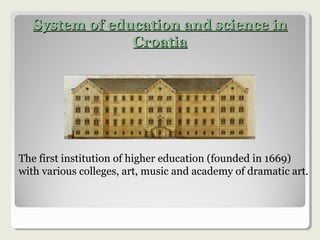
The first institution of higher education (founded in 1669)
with various colleges, art, music and academy of dramatic art.
Organization of educational systemOrganization of educational system
Educational system in Croatia includes:
• pre-school education
• 8 years long elementary education which is compulsory and
free of charge for all children aged 7-15
• high school education - includes general educational
(grammar schools), vocational training (technical, industrial
schools and crafts) and art schools.
• higher education – includes universities, polytechnics and
academies
Ministry of science, education and sports is responsible for
education in Croatia at all levels.
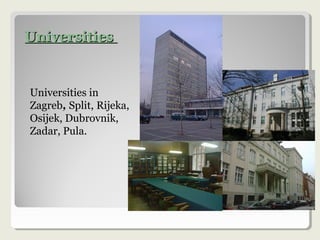
UniversitiesUniversities
Universities in
Zagreb, Split, Rijeka,
Osijek, Dubrovnik,
Zadar, Pula.
PrePre-school-school
educationeducation
Pre-school education
lasts from age 1 to 6/7 in
day nurseries and
kidergartens
Pre-school education
has a long tradition in
Croatia. Starting from the
school year 2013/2014
one year pre-school
education will be
compulsory.
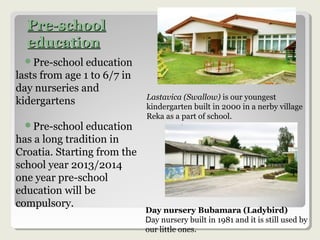
Lastavica (Swallow) is our youngest
kindergarten built in 2000 in a nerby village
Reka as a part of school.
Day nursery Bubamara (Ladybird)
Day nursery built in 1981 and it is still used by
our little ones.
Pre-school education is carried out in
regular programmes which last from
5 to 10 hours a day.
An average number of children in a
group is 20. One pre-school teacher
looks after 12 children.
Around the year 2000 we realized
that more and more children take
part in pre-school education.
One year of compulsory pre-school
education (150 hours) is free of
charge and it includes 95% of
children who are about to start their
elementary education.
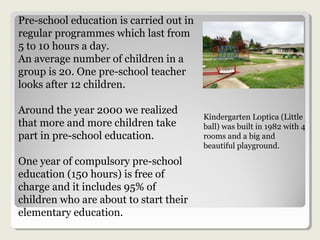
Kindergarten Loptica (Little
ball) was built in 1982 with 4
rooms and a big and
beautiful playground.
Elementary schoolElementary school
Elementary education is compulsory.
It provides wide general
education. Nowadays it lasts 8 years
(in the past it developed
gradually from 4, 5, 6 and 7 years long elementary school).
It is divided in 2 parts:
1) Children are taught by one teacher.
2) Children are taught each subject by another teacher.
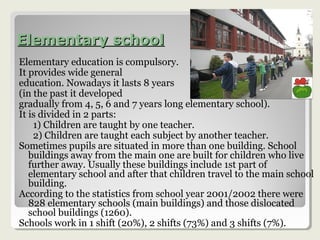
Sometimes pupils are situated in more than one building. School
buildings away from the main one are built for children who live
further away. Usually these buildings include 1st part of
elementary school and after that children travel to the main school
building.
According to the statistics from school year 2001/2002 there were
828 elementary schools (main buildings) and those dislocated
school buildings (1260).
Schools work in 1 shift (20%), 2 shifts (73%) and 3 shifts (7%).
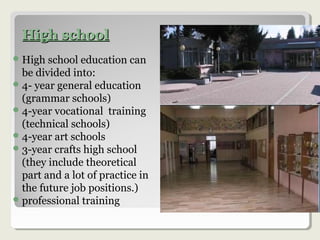
High schoolHigh school
High school education can
be divided into:
4- year general education
(grammar schools)
4-year vocational training
(technical schools)
4-year art schools
3-year crafts high school
(they include theoretical
part and a lot of practice in
the future job positions.)
professional training
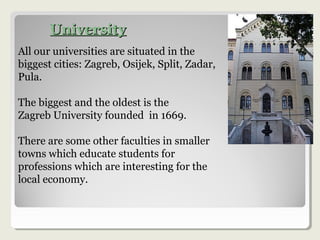
UniversityUniversity
All our universities are situated in the
biggest cities: Zagreb, Osijek, Split, Zadar,
Pula.
The biggest and the oldest is the
Zagreb University founded in 1669.
There are some other faculties in smaller
towns which educate students for
professions which are interesting for the
local economy.
Author: Karolina VidovićAuthor: Karolina Vidović
Editor: Sunčica VuljakEditor: Sunčica Vuljak
Graphik design: Sunčica VuljakGraphik design: Sunčica Vuljak
Translation: Ivana BilušTranslation: Ivana Biluš

Croatian educational system

  • 1.
    Croatian educational systemCroatianeducational system Basic features Koprivnički Bregi, January 2013 Elementary school Koprivnički Bregi
  • 2.
    Land of knowledgeLandof knowledge The Education Sector Development Plan 2005 - 2010 and Science & Technology Policy of the Republic of Croatia 2006  – 2010 are strategic plans of Croatian government related to education and science. There have been many changes which are based on Croatian educational tradition and science as well as the best experience of other European countries in this field. (The Lisbon Strategy).
  • 3.
    Achievements, projects, reformsAchievements,projects, reforms Investments in educational system and science Increasing investments in educational system and science in the period from 2003 to 2007 by 34.21% (2.6 billion kn). 1) Increasing the salaries in educational system and science 2) Increasing the number of jobs Croatian National Educational Standard (HNOS) The aim is to improve the quality of education in elementary schools by reducing the amount of contents in syllabus Introducing the State Graduation The aim is to improve the quality of education and to use the State Graduation as a replacement for the entrance exams for the university
  • 4.
    High school foreveryone The aim is to decrease the number of people without high school education and provide opportunity for more pupils to continue their higher education. This way the percentage of people without higher education in Croatia would be decreased. The Bologna Process It is a long term process with the aim of improving structure and organization of educational process by pointing out creative, research and practical components; afirming the connection between scientific and educational activities and developing their better efficiency.
  • 5.
    The strategy ofdeveloping scienceThe strategy of developing science and technology in Croatiaand technology in Croatia Using the World Bank loan of 31 million Euros as well as the additional 5.7 million Euros provided by Croatia to implement the strategy of developing science and technology Informatization of educational system All elementary and high schools are connected on the CARnet web. Cross-linking of students residence halls – stuDOM Connecting schools on the islands. Smart cards – SmaertX and e-INDEX Information system in institutions of higher education - ISVU Sports law
  • 6.
    SSystem of educationand science inystem of education and science in CroatiaCroatia The first institution of higher education (founded in 1669) with various colleges, art, music and academy of dramatic art.
  • 7.
    Organization of educationalsystemOrganization of educational system Educational system in Croatia includes: • pre-school education • 8 years long elementary education which is compulsory and free of charge for all children aged 7-15 • high school education - includes general educational (grammar schools), vocational training (technical, industrial schools and crafts) and art schools. • higher education – includes universities, polytechnics and academies Ministry of science, education and sports is responsible for education in Croatia at all levels.
  • 8.
    UniversitiesUniversities Universities in Zagreb, Split,Rijeka, Osijek, Dubrovnik, Zadar, Pula.
  • 9.
    PrePre-school-school educationeducation Pre-school education lasts fromage 1 to 6/7 in day nurseries and kidergartens Pre-school education has a long tradition in Croatia. Starting from the school year 2013/2014 one year pre-school education will be compulsory. Lastavica (Swallow) is our youngest kindergarten built in 2000 in a nerby village Reka as a part of school. Day nursery Bubamara (Ladybird) Day nursery built in 1981 and it is still used by our little ones.
  • 10.
    Pre-school education iscarried out in regular programmes which last from 5 to 10 hours a day. An average number of children in a group is 20. One pre-school teacher looks after 12 children. Around the year 2000 we realized that more and more children take part in pre-school education. One year of compulsory pre-school education (150 hours) is free of charge and it includes 95% of children who are about to start their elementary education. Kindergarten Loptica (Little ball) was built in 1982 with 4 rooms and a big and beautiful playground.
  • 11.
    Elementary schoolElementary school Elementaryeducation is compulsory. It provides wide general education. Nowadays it lasts 8 years (in the past it developed gradually from 4, 5, 6 and 7 years long elementary school). It is divided in 2 parts: 1) Children are taught by one teacher. 2) Children are taught each subject by another teacher. Sometimes pupils are situated in more than one building. School buildings away from the main one are built for children who live further away. Usually these buildings include 1st part of elementary school and after that children travel to the main school building. According to the statistics from school year 2001/2002 there were 828 elementary schools (main buildings) and those dislocated school buildings (1260). Schools work in 1 shift (20%), 2 shifts (73%) and 3 shifts (7%).
  • 12.
    High schoolHigh school Highschool education can be divided into: 4- year general education (grammar schools) 4-year vocational training (technical schools) 4-year art schools 3-year crafts high school (they include theoretical part and a lot of practice in the future job positions.) professional training
  • 13.
    UniversityUniversity All our universitiesare situated in the biggest cities: Zagreb, Osijek, Split, Zadar, Pula. The biggest and the oldest is the Zagreb University founded in 1669. There are some other faculties in smaller towns which educate students for professions which are interesting for the local economy.
  • 14.
    Author: Karolina VidovićAuthor:Karolina Vidović Editor: Sunčica VuljakEditor: Sunčica Vuljak Graphik design: Sunčica VuljakGraphik design: Sunčica Vuljak Translation: Ivana BilušTranslation: Ivana Biluš