Education system
in Poland
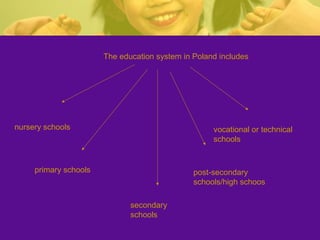
The education system in Poland includes
nursery schools
primary schools
secondary
schools
post-secondary
schools/high schoos
vocational or technical
schools
• In Poland a higher education system
(colleges and universities) belongs to a
separate department of the government
administration. It isn't ranked among the
educational system because it is being
granted constitutional autonomy
• In accordance with records of the
Constitution of the Republic of Poland
everyone has right to learn. Education is
compulsory from the age 7 to 18 years
old, but the status of compulsory
institutions is given only to a primary
school and the secondary school.
Learning in public schools is free of
charge .
• Activities and the
organization of the
system are specified in
the act from 7
September 1991 about
the educational system .
A new structure of
education was
introduced in 1999 .
Nursery schools
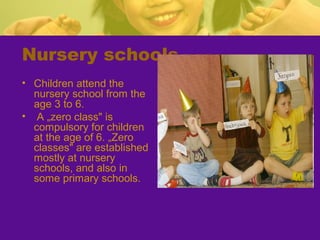
• Children attend the
nursery school from the
age 3 to 6.
• A „zero class" is
compulsory for children
at the age of 6. „Zero
classes" are established
mostly at nursery
schools, and also in
some primary schools.
Primary schools
• The six-year school is divided
into two three-year stages .
The first stage includes
classes from I to III; the main
part is the block called
„integrated education ” –
these classes are being
conducted by one teacher
who is also acting as the
class tutor. Each class lasts
for 45 minutes and then there
is a 10 minutes break. Lunch
break is usually at 11.30 or
12.30 and lasts for 20
minutes.
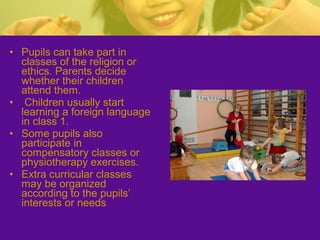
• Pupils can take part in
classes of the religion or
ethics. Parents decide
whether their children
attend them.
• Children usually start
learning a foreign language
in class 1.
• Some pupils also
participate in
compensatory classes or
physiotherapy exercises.
• Extra curricular classes
may be organized
according to the pupils’
interests or needs
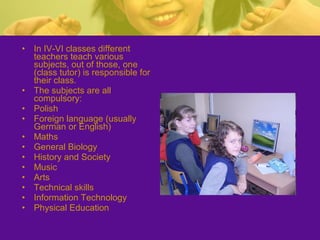
• In IV-VI classes different
teachers teach various
subjects, out of those, one
(class tutor) is responsible for
their class.
• The subjects are all
compulsory:
• Polish
• Foreign language (usually
German or English)
• Maths
• General Biology
• History and Society
• Music
• Arts
• Technical skills
• Information Technology
• Physical Education
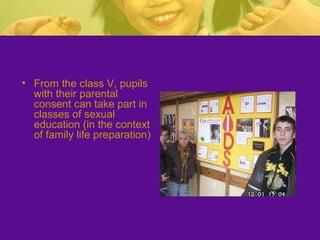
• From the class V, pupils
with their parental
consent can take part in
classes of sexual
education (in the context
of family life preparation)
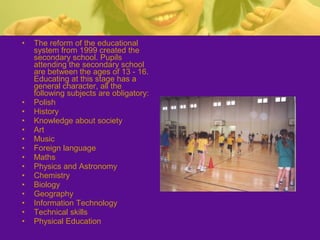
• The reform of the educational
system from 1999 created the
secondary school. Pupils
attending the secondary school
are between the ages of 13 - 16.
Educating at this stage has a
general character, all the
following subjects are obligatory:
• Polish
• History
• Knowledge about society
• Art
• Music
• Foreign language
• Maths
• Physics and Astronomy
• Chemistry
• Biology
• Geography
• Information Technology
• Technical skills
• Physical Education
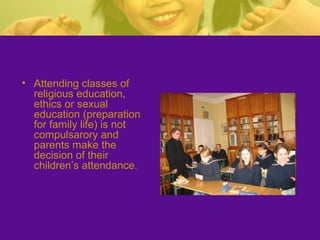
• Attending classes of
religious education,
ethics or sexual
education (preparation
for family life) is not
compulsarory and
parents make the
decision of their
children’s attendance.
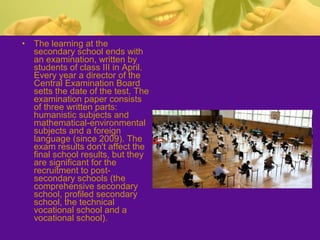
• The learning at the
secondary school ends with
an examination, written by
students of class III in April.
Every year a director of the
Central Examination Board
setts the date of the test. The
examination paper consists
of three written parts:
humanistic subjects and
mathematical-environmental
subjects and a foreign
language (since 2009). The
exam results don't affect the
final school results, but they
are significant for the
recruitment to post-
secondary schools (the
comprehensive secondary
school, profiled secondary
school, the technical
vocational school and a
vocational school).
Post-secondary education
a) two-year fundamental vocational schools,
b) three-year comprehensive secondary schools,
c) three-year profiled secondary schools,
d) four-year technical vocational schools,
e) two-year supplementing comprehensive secondary schools,
f) three-year supplementing technical vocational schools,
Grading
• The annual (semester)
classification grades
from educational
classes, start being
given in class of the IV
primary education.They
are set according to the
following scale:
• perfect – 6
• very good – 5
• good – 4
• satisfactory- 3
• ‚barely there’– 2
• Insufficient (fail) – 1
• Annual classification grades
for the behaviour:
• perfect
• very good
• good
• correct
• inappropriate
• reprehensible
• In classes I-III of the primary
school a descriptive
evaluation is applied.
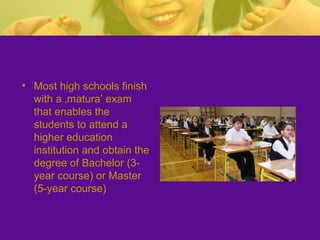
• Most high schools finish
with a ‚matura’ exam
that enables the
students to attend a
higher education
institution and obtain the
degree of Bachelor (3-
year course) or Master
(5-year course)

School education system in poland

  • 1.
  • 2.
    The education systemin Poland includes nursery schools primary schools secondary schools post-secondary schools/high schoos vocational or technical schools
  • 3.
    • In Polanda higher education system (colleges and universities) belongs to a separate department of the government administration. It isn't ranked among the educational system because it is being granted constitutional autonomy
  • 4.
    • In accordancewith records of the Constitution of the Republic of Poland everyone has right to learn. Education is compulsory from the age 7 to 18 years old, but the status of compulsory institutions is given only to a primary school and the secondary school. Learning in public schools is free of charge .
  • 5.
    • Activities andthe organization of the system are specified in the act from 7 September 1991 about the educational system . A new structure of education was introduced in 1999 .
  • 6.
    Nursery schools • Childrenattend the nursery school from the age 3 to 6. • A „zero class" is compulsory for children at the age of 6. „Zero classes" are established mostly at nursery schools, and also in some primary schools.
  • 7.
    Primary schools • Thesix-year school is divided into two three-year stages . The first stage includes classes from I to III; the main part is the block called „integrated education ” – these classes are being conducted by one teacher who is also acting as the class tutor. Each class lasts for 45 minutes and then there is a 10 minutes break. Lunch break is usually at 11.30 or 12.30 and lasts for 20 minutes.
  • 8.
    • Pupils cantake part in classes of the religion or ethics. Parents decide whether their children attend them. • Children usually start learning a foreign language in class 1. • Some pupils also participate in compensatory classes or physiotherapy exercises. • Extra curricular classes may be organized according to the pupils’ interests or needs
  • 9.
    • In IV-VIclasses different teachers teach various subjects, out of those, one (class tutor) is responsible for their class. • The subjects are all compulsory: • Polish • Foreign language (usually German or English) • Maths • General Biology • History and Society • Music • Arts • Technical skills • Information Technology • Physical Education
  • 10.
    • From theclass V, pupils with their parental consent can take part in classes of sexual education (in the context of family life preparation)
  • 11.
    • The reformof the educational system from 1999 created the secondary school. Pupils attending the secondary school are between the ages of 13 - 16. Educating at this stage has a general character, all the following subjects are obligatory: • Polish • History • Knowledge about society • Art • Music • Foreign language • Maths • Physics and Astronomy • Chemistry • Biology • Geography • Information Technology • Technical skills • Physical Education
  • 12.
    • Attending classesof religious education, ethics or sexual education (preparation for family life) is not compulsarory and parents make the decision of their children’s attendance.
  • 13.
    • The learningat the secondary school ends with an examination, written by students of class III in April. Every year a director of the Central Examination Board setts the date of the test. The examination paper consists of three written parts: humanistic subjects and mathematical-environmental subjects and a foreign language (since 2009). The exam results don't affect the final school results, but they are significant for the recruitment to post- secondary schools (the comprehensive secondary school, profiled secondary school, the technical vocational school and a vocational school).
  • 14.
    Post-secondary education a) two-yearfundamental vocational schools, b) three-year comprehensive secondary schools, c) three-year profiled secondary schools, d) four-year technical vocational schools, e) two-year supplementing comprehensive secondary schools, f) three-year supplementing technical vocational schools,
  • 15.
    Grading • The annual(semester) classification grades from educational classes, start being given in class of the IV primary education.They are set according to the following scale: • perfect – 6 • very good – 5 • good – 4 • satisfactory- 3 • ‚barely there’– 2 • Insufficient (fail) – 1
  • 16.
    • Annual classificationgrades for the behaviour: • perfect • very good • good • correct • inappropriate • reprehensible • In classes I-III of the primary school a descriptive evaluation is applied.
  • 17.
    • Most highschools finish with a ‚matura’ exam that enables the students to attend a higher education institution and obtain the degree of Bachelor (3- year course) or Master (5-year course)