Education System
  in Lithuania
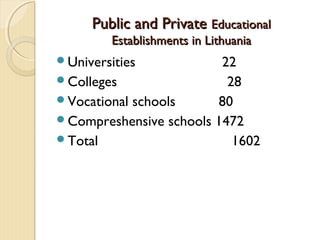
Public and Private Educational
         Establishments in Lithuania
Universities            22
Colleges                 28
Vocational schools     80
Compreshensive schools 1472
Total                     1602
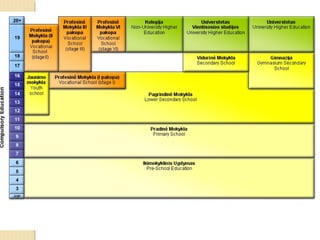
Explanation of the Educational system
             Pre-school
1. Pre-school
The pre-school programme is on offer
 for children aged from 5 to 6 at nursery
 schools, school nursery schools and
 primary school, is conducted by qualified
 teaching staff and is voluntary.
Primary and Lower Secondary
                  School
 2. Primary and lower secondary school School
 begins at the age of 6 - 7, ten class system for primary
  and lower secondary education. The 4-year primary
  school is followed by 6 years of basic education. If a
  pupil is successful in the final examination, this
  concludes with a basic education certificate (the
  equivalent of the intermediate school leaving certificate
  in Germany).
Upper Secondary Education
 3.  Upper secondary education
 After completion of basic education, a two-year course
  of upper secondary education may be embarked upon.
  It is also possible to transfer to an upper secondary
  school upon completion of class 8, this school then
  continuing until class 12. In classes 11 and 12, pupils are
  permitted to select subjects in a targeted way in
  accordance with their personal interests and strengths.
Gymnasium
It is academically stronger school.Gymnasium
 usually has 9,10,11,12 forms that are called
 1,2,3,4 gymnasium years.
Students who intend to enter Universities study
 in gymnasiums and usually take National
 exams. Better qualified teachers work in
 gymnasiums.
Vocational Education and Training
   Vocational education and training can be completed in vocational
    schools by young people from the age of 14. The training
    comprises the imparting of both theoretical and practical
    knowledge. Four types of training programme are differentiated.
                            Type 1.
    For young people from the age of 14 who have not gained a basic
    education leaving certificate which forms the basis of vocational
    education and training. This framework also affords the
    opportunity of gaining the lower secondary school leaving
    certificate
Vocational Education and Training
                Type 2
3-year  vocational education and training for
 those who have gained the basic education
 leaving certificate. They acquire a VET
 qualification (skilled worker status).
                Type 3
For those who have passed the upper
 secondary school leaving certificate, 1 to 2
 years of vocational training
Vocational Education and Training
             Type 4
For those who have passed the upper
 secondary school leaving certificate, 3 to 4 year
 course of training comprising higher education
 and occupational qualification. Some modules
 correspond to Bachelor level, and credit for
 these may be transferred to a later course of
 higher education study
Higher Education
 Lithuania has academic
                      1.           (universities)
  2.      non-academic institutes of higher education (colleges).
 Students gain entry via selection procedures which mostly involve
  consideration being accorded to marks obtained in the upper
  secondary school leaving certificate. Higher education is based on
  the European credit system. The duration of the course of study
  leading to the acquisition of a Bachelor degree (basic higher
  education study) is 4 years. This can be followed by a one or two
  year vocational qualification diploma, such as a teaching
  qualification or a Masters degree which in turn can be followed by
  a doctorate

Education system in lithuania

  • 1.
    Education System in Lithuania
  • 3.
    Public and PrivateEducational Establishments in Lithuania Universities 22 Colleges 28 Vocational schools 80 Compreshensive schools 1472 Total 1602
  • 4.
    Explanation of theEducational system Pre-school 1. Pre-school The pre-school programme is on offer for children aged from 5 to 6 at nursery schools, school nursery schools and primary school, is conducted by qualified teaching staff and is voluntary.
  • 5.
    Primary and LowerSecondary School  2. Primary and lower secondary school School  begins at the age of 6 - 7, ten class system for primary and lower secondary education. The 4-year primary school is followed by 6 years of basic education. If a pupil is successful in the final examination, this concludes with a basic education certificate (the equivalent of the intermediate school leaving certificate in Germany).
  • 6.
    Upper Secondary Education 3. Upper secondary education  After completion of basic education, a two-year course of upper secondary education may be embarked upon. It is also possible to transfer to an upper secondary school upon completion of class 8, this school then continuing until class 12. In classes 11 and 12, pupils are permitted to select subjects in a targeted way in accordance with their personal interests and strengths.
  • 7.
    Gymnasium It is academicallystronger school.Gymnasium usually has 9,10,11,12 forms that are called 1,2,3,4 gymnasium years. Students who intend to enter Universities study in gymnasiums and usually take National exams. Better qualified teachers work in gymnasiums.
  • 8.
    Vocational Education andTraining  Vocational education and training can be completed in vocational schools by young people from the age of 14. The training comprises the imparting of both theoretical and practical knowledge. Four types of training programme are differentiated.  Type 1.  For young people from the age of 14 who have not gained a basic education leaving certificate which forms the basis of vocational education and training. This framework also affords the opportunity of gaining the lower secondary school leaving certificate
  • 9.
    Vocational Education andTraining  Type 2 3-year vocational education and training for those who have gained the basic education leaving certificate. They acquire a VET qualification (skilled worker status).  Type 3 For those who have passed the upper secondary school leaving certificate, 1 to 2 years of vocational training
  • 10.
    Vocational Education andTraining  Type 4 For those who have passed the upper secondary school leaving certificate, 3 to 4 year course of training comprising higher education and occupational qualification. Some modules correspond to Bachelor level, and credit for these may be transferred to a later course of higher education study
  • 11.
    Higher Education  Lithuaniahas academic  1. (universities)  2. non-academic institutes of higher education (colleges).  Students gain entry via selection procedures which mostly involve consideration being accorded to marks obtained in the upper secondary school leaving certificate. Higher education is based on the European credit system. The duration of the course of study leading to the acquisition of a Bachelor degree (basic higher education study) is 4 years. This can be followed by a one or two year vocational qualification diploma, such as a teaching qualification or a Masters degree which in turn can be followed by a doctorate