Created by primary school
Kosmonautu 15, Ostrava
This project is funded by European Union
• School attendance in the Czech Republic is
compulsory from the age of 6 to 15.
• Most children attend state school, but there
are private and church schools.
• Education at state schools (primary,
secondary, and tertiary) is free of charge but
students at secondary and tertiary schools
must pay their for textbooks.
• Private and church schools charge schools
fees.
• All schools are coeducational.
• Children in our state schools wear no uniforms.
• Handicapped children are educated in:
– schools which provide special support for them
– or they can be integrated in a special class which is
part of a regular school
– or they are integrated individually into a classroom
with healthy pupils.
Education in our country includes three stages :
• Pre-school 3 - 6 (kindergarten, optional)
• Primary 6 - 15 (in one building is elementary level
and junior high school, compulsory)
• Secondary 15 – 19 (optional, almost all pupils,
80% takes „Maturita leaving exam“, majority studies
general education in „Gymnázium“ or profession
orientated engineering schools, minority goes to
vocational schools)
• Tertiary 19 – 26 (optional, 60% of students enters
colleges, universities, or higher education
specialized schools)
TYPES OF SCHOOL EDUCATION
State kindergarten 3 – 6
Free of charge, optional
Private kindergarten 3 – 6
Quite expensive, optional
GYMNÁZIUM
15 - 19, 4 grades
Maturita leaving exam
general education
Secondary
ENGINEERING SCHOOLS
Economical, building,
electric, technical, chemical,
pedagogical
15 - 19, usually 4 grades
Maturita leaving exam
Secondary
GYMNÁZIUM
11 - 19, 8 grades
Entrance exam,
11% of
population
Maturita exam
general education
VOCATIONAL
SCHOOL
15 – 18 or 19
3 or 4 grades
Rarely Maturita
Profession exam
Secondary
Public primary schools
6 – 15, usually 9 grades
Free of charge,
Compulsory education
Private primary
schools
Charge fee,
Offer extra classes
Church primary
schools
Charge little fee,
Excepts all pupils
VOŠ – higher education
3 years
Diploma of expert specialit
COLLEGE
3 years Bachelor degree
+ 2 years for Master degree
UNIVERSITY
3 years Bachelor degree
+ 2 years for Master degree
TERTIARY EDUCATION
• The school year starts on 1st September.
• School year ends on 30th June of the following year.
• The school year is divided into two terms: September –
January and February – June.
• At the end of the term pupils get report for parents
about their results.
• They get marks for their behaviour and all school
subjects. The best mark is 1, the worst is 5
• Most pupils 11 – 15 years old study 14 subjects
• The names of the subjects can be different but the
curriculum is given by the government. Pupils can
choose some subjects and the offer depends on school.
• A lesson lasts 45 minutes, a break is 10 minutes
• A school day is different at different types of
schools.
• The average number of lessons is thirty a week.
• Primary schools have fewer lessons in a row,
followed by a lunch break, usually 45 minutes
long, which is one period, and then pupils have
afternoon classes.
• Afternoon classes end between 4 and 5 p.m. at
the latest. Breaks last from 5 to 15 minutes.
• Pre-school education is provided by kindergartens
for children aged 3 to 6, sometimes younger
children can be admitted.
• A lot of children attend kindergartens, even
though parents must pay for it.
• The last year of kindergarten is free of charge.
• Many kindergartens are part of a primary school,
they still have their separate building and
curriculum. Only the headmaster is common for
both types of schools.
• At 6 children start to go to primary schools and they
stay there until 15.
• Compulsory school attendance lasts 9 years and pupils
usually go to the same school building.
• But there are two levels within the school.
• Elementary education lasts five years, pupils have
fewer subjects which are mostly taught by the same
teacher.
• Some pupils transfer to grammar schools earlier, after
finishing grade 5 they can take the entrance exam to
grammar school. And about 20 percent of the
population is admitted.
SCHOOL SUBJECTS
Czech
language
MATHS SCIENCE
P. E.ART MUSIC CRAFTS
1 - 9
English
language
4 - 9 Biology
Geo-
graphy
Civics6 - 9 Physics HISTORY
7 - 9
Russian
language
ICT
8 - 9 Chemistry
• At the age of 15 when pupils are in grade 9 they
have to decide about their future.
• Pupils can apply for 2 secondary schools:
- some schools organize entrance exams
- most schools look at the grades in school reports.
• Pupils can choose among a variety of secondary
schools which differ in the curriculum, the length of
school attendance and level of education.
After clubs and school canteen
School playground
Typical old primary school Gym
• Most of the best pupils continue in grammar schools.
- They last 4 years and teach all general subjects.
- Pupils are well prepared to entry a university,
especially medical, law or math.
• Some best pupils and most of the average ones
choose specialized middle schools, for example on
constructions, electricity, business, chemistry,
agricultural etc.
- They also last 4 years
- Prepare students to start work after graduating
- Students are also well prepared for studying at
technical colleges and universities.
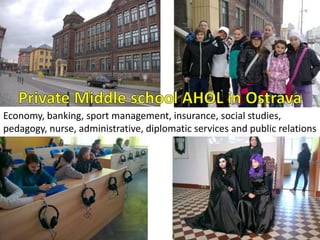
Economy, banking, sport management, insurance, social studies,
pedagogy, nurse, administrative, diplomatic services and public relations
This middle school prepares competition „Harry Potter´s Day“ to attract
young people to come, see the school and decide to study here later.
• Pupils who are not interested in studying or
do not have good academic results enter
vocational school which prepare them for the
world of work.
• They learn general subject very little and most
of the time is devoted to gaining practical
skills and learning specific technical subjects
needed for the chosen profession.
• Some of these schools last 4 year and
students can try to study at college, some
take 3 or even 2 years.
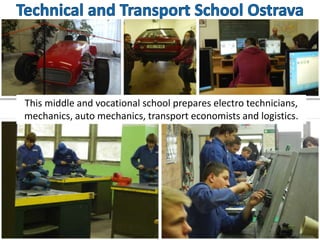
This middle and vocational school prepares electro technicians,
mechanics, auto mechanics, transport economists and logistics.
• Secondary education is usually finished with a school-leaving
exam called “Maturita” which is required by all universities
and colleges.
• This exam has two parts.
• One is written test from Czech language and English or
Math prepared by the ministry of education, it is the same
for all students.
• The second part is oral and it is prepared by each school.
- This exam is held mostly in May.
- It usually consists of 4 different subjects.
- Students have some time to prepare and then they try to
show what they have learnt during the past four years.
• Universities and colleges provide tertiary education which
lasts from 4 to 6 years.
• Each student can apply to as many schools as he or she likes
but there is a fee for the entrance exams. Usually there is
also entrance test.
• Public universities and colleges do not charge any fees for
regular students.
• Those who study longer because they failed to pass exams
or write diplomas in time have to pay for the extra year.
• Foreign students who study in English programs must pay
for the education.
• Students pay for their accommodation in dormitories or
hire flats. They can eat in school canteens, meals are very
cheap but the choice is limited. They also buy books.
• We have many universities and colleges, almost in
every bigger city is at least one.
• Charles University in Prague is the oldest university in
the Middle Europe.
• Students can usually study for 3 years for a Bachelor´s
degree and then continue for 2 years for a Master´s
degree. Medicine takes 6 years.
• Students are awarded after another few years of study
with the Doctoral degree.
• There are also various training courses for managers,
social workers, and businessman. They are more
practical and specialized. Students must pay them.
Czech educational system

Czech educational system

  • 1.
    Created by primaryschool Kosmonautu 15, Ostrava This project is funded by European Union
  • 2.
    • School attendancein the Czech Republic is compulsory from the age of 6 to 15. • Most children attend state school, but there are private and church schools. • Education at state schools (primary, secondary, and tertiary) is free of charge but students at secondary and tertiary schools must pay their for textbooks. • Private and church schools charge schools fees.
  • 3.
    • All schoolsare coeducational. • Children in our state schools wear no uniforms. • Handicapped children are educated in: – schools which provide special support for them – or they can be integrated in a special class which is part of a regular school – or they are integrated individually into a classroom with healthy pupils.
  • 4.
    Education in ourcountry includes three stages : • Pre-school 3 - 6 (kindergarten, optional) • Primary 6 - 15 (in one building is elementary level and junior high school, compulsory) • Secondary 15 – 19 (optional, almost all pupils, 80% takes „Maturita leaving exam“, majority studies general education in „Gymnázium“ or profession orientated engineering schools, minority goes to vocational schools) • Tertiary 19 – 26 (optional, 60% of students enters colleges, universities, or higher education specialized schools)
  • 5.
    TYPES OF SCHOOLEDUCATION State kindergarten 3 – 6 Free of charge, optional Private kindergarten 3 – 6 Quite expensive, optional GYMNÁZIUM 15 - 19, 4 grades Maturita leaving exam general education Secondary ENGINEERING SCHOOLS Economical, building, electric, technical, chemical, pedagogical 15 - 19, usually 4 grades Maturita leaving exam Secondary GYMNÁZIUM 11 - 19, 8 grades Entrance exam, 11% of population Maturita exam general education VOCATIONAL SCHOOL 15 – 18 or 19 3 or 4 grades Rarely Maturita Profession exam Secondary Public primary schools 6 – 15, usually 9 grades Free of charge, Compulsory education Private primary schools Charge fee, Offer extra classes Church primary schools Charge little fee, Excepts all pupils VOŠ – higher education 3 years Diploma of expert specialit COLLEGE 3 years Bachelor degree + 2 years for Master degree UNIVERSITY 3 years Bachelor degree + 2 years for Master degree TERTIARY EDUCATION
  • 6.
    • The schoolyear starts on 1st September. • School year ends on 30th June of the following year. • The school year is divided into two terms: September – January and February – June. • At the end of the term pupils get report for parents about their results. • They get marks for their behaviour and all school subjects. The best mark is 1, the worst is 5 • Most pupils 11 – 15 years old study 14 subjects • The names of the subjects can be different but the curriculum is given by the government. Pupils can choose some subjects and the offer depends on school. • A lesson lasts 45 minutes, a break is 10 minutes
  • 7.
    • A schoolday is different at different types of schools. • The average number of lessons is thirty a week. • Primary schools have fewer lessons in a row, followed by a lunch break, usually 45 minutes long, which is one period, and then pupils have afternoon classes. • Afternoon classes end between 4 and 5 p.m. at the latest. Breaks last from 5 to 15 minutes.
  • 8.
    • Pre-school educationis provided by kindergartens for children aged 3 to 6, sometimes younger children can be admitted. • A lot of children attend kindergartens, even though parents must pay for it. • The last year of kindergarten is free of charge. • Many kindergartens are part of a primary school, they still have their separate building and curriculum. Only the headmaster is common for both types of schools.
  • 9.
    • At 6children start to go to primary schools and they stay there until 15. • Compulsory school attendance lasts 9 years and pupils usually go to the same school building. • But there are two levels within the school. • Elementary education lasts five years, pupils have fewer subjects which are mostly taught by the same teacher. • Some pupils transfer to grammar schools earlier, after finishing grade 5 they can take the entrance exam to grammar school. And about 20 percent of the population is admitted.
  • 10.
    SCHOOL SUBJECTS Czech language MATHS SCIENCE P.E.ART MUSIC CRAFTS 1 - 9 English language 4 - 9 Biology Geo- graphy Civics6 - 9 Physics HISTORY 7 - 9 Russian language ICT 8 - 9 Chemistry
  • 11.
    • At theage of 15 when pupils are in grade 9 they have to decide about their future. • Pupils can apply for 2 secondary schools: - some schools organize entrance exams - most schools look at the grades in school reports. • Pupils can choose among a variety of secondary schools which differ in the curriculum, the length of school attendance and level of education.
  • 12.
    After clubs andschool canteen School playground Typical old primary school Gym
  • 13.
    • Most ofthe best pupils continue in grammar schools. - They last 4 years and teach all general subjects. - Pupils are well prepared to entry a university, especially medical, law or math. • Some best pupils and most of the average ones choose specialized middle schools, for example on constructions, electricity, business, chemistry, agricultural etc. - They also last 4 years - Prepare students to start work after graduating - Students are also well prepared for studying at technical colleges and universities.
  • 14.
    Economy, banking, sportmanagement, insurance, social studies, pedagogy, nurse, administrative, diplomatic services and public relations
  • 15.
    This middle schoolprepares competition „Harry Potter´s Day“ to attract young people to come, see the school and decide to study here later.
  • 17.
    • Pupils whoare not interested in studying or do not have good academic results enter vocational school which prepare them for the world of work. • They learn general subject very little and most of the time is devoted to gaining practical skills and learning specific technical subjects needed for the chosen profession. • Some of these schools last 4 year and students can try to study at college, some take 3 or even 2 years.
  • 18.
    This middle andvocational school prepares electro technicians, mechanics, auto mechanics, transport economists and logistics.
  • 21.
    • Secondary educationis usually finished with a school-leaving exam called “Maturita” which is required by all universities and colleges. • This exam has two parts. • One is written test from Czech language and English or Math prepared by the ministry of education, it is the same for all students. • The second part is oral and it is prepared by each school. - This exam is held mostly in May. - It usually consists of 4 different subjects. - Students have some time to prepare and then they try to show what they have learnt during the past four years.
  • 22.
    • Universities andcolleges provide tertiary education which lasts from 4 to 6 years. • Each student can apply to as many schools as he or she likes but there is a fee for the entrance exams. Usually there is also entrance test. • Public universities and colleges do not charge any fees for regular students. • Those who study longer because they failed to pass exams or write diplomas in time have to pay for the extra year. • Foreign students who study in English programs must pay for the education. • Students pay for their accommodation in dormitories or hire flats. They can eat in school canteens, meals are very cheap but the choice is limited. They also buy books.
  • 23.
    • We havemany universities and colleges, almost in every bigger city is at least one. • Charles University in Prague is the oldest university in the Middle Europe. • Students can usually study for 3 years for a Bachelor´s degree and then continue for 2 years for a Master´s degree. Medicine takes 6 years. • Students are awarded after another few years of study with the Doctoral degree. • There are also various training courses for managers, social workers, and businessman. They are more practical and specialized. Students must pay them.