DR EMMA WOODWARD
EDUCATIONAL PSYCHOLOGIST
BRIGHTON AND HOVE CITY COUNCIL
Educational Psychology
What is an Educational Psychologist?
Our main role is to remove the barriers to learning.
To do this we apply psychology to help the emotional
development and educational progress of children
and young people between the ages of 0-19.
Barriers to learning
 Academic barriers – specific learning difficulties, learning
difficulties/disabilities, access to appropriate educational provision.
 Emotional barriers – attachment, anxiety, motivation.
 Physical/Medical barriers – physical disability, epilepsy, autism.
 Social barriers – aspirations, culture.
 These are not mutually exclusive.
Applying psychology
There are varying psychological frameworks that we work to:-
 Psychodynamic – Bion, Freud – looking at relationships and a persons’ sense of
self – projection and transference.
 Systemic – exploring a person’s concern in the context of their ‘system’- family,
school etc..
 Solution focused – supporting a person view their concern in terms of ways
forward.
 CBT – looking at the link between thoughts, feelings and behaviour.
 Most EPs work using most of these frameworks interchangeably to form an holistic
and responsive approach.
We work at three levels:-
 Organisational level
Supporting the strategic development of school education policies to support
inclusion
Championing the voice of the child in the wider organisation
 Group level
Running groups for children
Training for parents/teaching staff
 Individual level
Children, parents, teachers
How we work:-
 We each are allocated a ‘patch’ of schools (based on area and including early
years, primary, secondary and special).
 We also make links with local community groups and children’s centres.
 We work closely with other professionals, including – education, health, and
social care.
 We work in an integrated manner meaning that we apply psychology in every
encounter to ensure the adults around the child work as effectively as possible.
 Some local authorities have now adopted a traded services model.
What do Educational Psychologists do?
 Tackle the problems encountered by young people in education, (learning
difficulties and social or emotional problems).
 Enable teachers to become more aware of the factors affecting teaching and
learning.
 Support parents/carers understand child development to enable them to
support their child.
 Write reports about children for allocation of special educational places, or
as part of court proceedings or children's panels.
 Some Educational Psychologists have areas of special interest (Children in
Care, ASC etc..)
We do this using:-
 Research
 Consultation
 Training
 Observations
 Individual assessment
 Supervision
 Our main role is to develop and test hypothesis about the concern using our
psychological knowledge.
 We don’t always need to see the child, it is most helpful to help those working with
the child to solve their own problems as they have the lasting relationship with the
child.
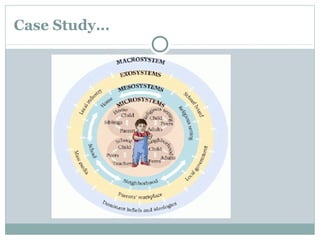
Case Study…
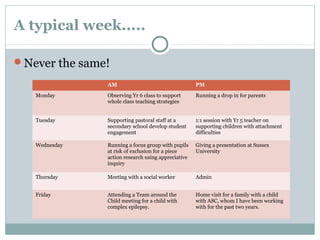
A typical week.....
Never the same!
AM PM
Monday Observing Yr 6 class to support
whole class teaching strategies
Running a drop in for parents
Tuesday Supporting pastoral staff at a
secondary school develop student
engagement
1:1 session with Yr 5 teacher on
supporting children with attachment
difficulties
Wednesday Running a focus group with pupils
at risk of exclusion for a piece
action research using appreciative
inquiry
Giving a presentation at Sussex
University
Thursday Meeting with a social worker Admin
Friday Attending a Team around the
Child meeting for a child with
complex epilepsy.
Home visit for a family with a child
with ASC, whom I have been working
with for the past two years.
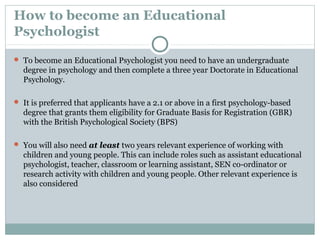
How to become an Educational
Psychologist
 To become an Educational Psychologist you need to have an undergraduate
degree in psychology and then complete a three year Doctorate in Educational
Psychology.
 It is preferred that applicants have a 2.1 or above in a first psychology-based
degree that grants them eligibility for Graduate Basis for Registration (GBR)
with the British Psychological Society (BPS)
 You will also need at least two years relevant experience of working with
children and young people. This can include roles such as assistant educational
psychologist, teacher, classroom or learning assistant, SEN co-ordinator or
research activity with children and young people. Other relevant experience is
also considered
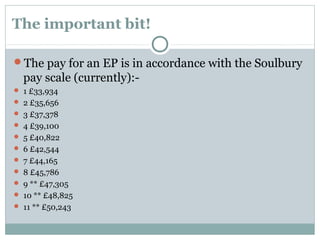
The important bit!
The pay for an EP is in accordance with the Soulbury
pay scale (currently):-
 1 £33,934
 2 £35,656
 3 £37,378
 4 £39,100
 5 £40,822
 6 £42,544
 7 £44,165
 8 £45,786
 9 ** £47,305
 10 ** £48,825
 11 ** £50,243
Over to you!
Any questions or thoughts?
For further information please see:-
http://www.cwdcouncil.org.uk/educational-
psychology
http://www.bps.org.uk/

Educational Psychology

  • 1.
    DR EMMA WOODWARD EDUCATIONALPSYCHOLOGIST BRIGHTON AND HOVE CITY COUNCIL Educational Psychology
  • 2.
    What is anEducational Psychologist? Our main role is to remove the barriers to learning. To do this we apply psychology to help the emotional development and educational progress of children and young people between the ages of 0-19.
  • 3.
    Barriers to learning Academic barriers – specific learning difficulties, learning difficulties/disabilities, access to appropriate educational provision.  Emotional barriers – attachment, anxiety, motivation.  Physical/Medical barriers – physical disability, epilepsy, autism.  Social barriers – aspirations, culture.  These are not mutually exclusive.
  • 4.
    Applying psychology There arevarying psychological frameworks that we work to:-  Psychodynamic – Bion, Freud – looking at relationships and a persons’ sense of self – projection and transference.  Systemic – exploring a person’s concern in the context of their ‘system’- family, school etc..  Solution focused – supporting a person view their concern in terms of ways forward.  CBT – looking at the link between thoughts, feelings and behaviour.  Most EPs work using most of these frameworks interchangeably to form an holistic and responsive approach.
  • 5.
    We work atthree levels:-  Organisational level Supporting the strategic development of school education policies to support inclusion Championing the voice of the child in the wider organisation  Group level Running groups for children Training for parents/teaching staff  Individual level Children, parents, teachers
  • 6.
    How we work:- We each are allocated a ‘patch’ of schools (based on area and including early years, primary, secondary and special).  We also make links with local community groups and children’s centres.  We work closely with other professionals, including – education, health, and social care.  We work in an integrated manner meaning that we apply psychology in every encounter to ensure the adults around the child work as effectively as possible.  Some local authorities have now adopted a traded services model.
  • 7.
    What do EducationalPsychologists do?  Tackle the problems encountered by young people in education, (learning difficulties and social or emotional problems).  Enable teachers to become more aware of the factors affecting teaching and learning.  Support parents/carers understand child development to enable them to support their child.  Write reports about children for allocation of special educational places, or as part of court proceedings or children's panels.  Some Educational Psychologists have areas of special interest (Children in Care, ASC etc..)
  • 8.
    We do thisusing:-  Research  Consultation  Training  Observations  Individual assessment  Supervision  Our main role is to develop and test hypothesis about the concern using our psychological knowledge.  We don’t always need to see the child, it is most helpful to help those working with the child to solve their own problems as they have the lasting relationship with the child.
  • 9.
  • 10.
    A typical week..... Neverthe same! AM PM Monday Observing Yr 6 class to support whole class teaching strategies Running a drop in for parents Tuesday Supporting pastoral staff at a secondary school develop student engagement 1:1 session with Yr 5 teacher on supporting children with attachment difficulties Wednesday Running a focus group with pupils at risk of exclusion for a piece action research using appreciative inquiry Giving a presentation at Sussex University Thursday Meeting with a social worker Admin Friday Attending a Team around the Child meeting for a child with complex epilepsy. Home visit for a family with a child with ASC, whom I have been working with for the past two years.
  • 11.
    How to becomean Educational Psychologist  To become an Educational Psychologist you need to have an undergraduate degree in psychology and then complete a three year Doctorate in Educational Psychology.  It is preferred that applicants have a 2.1 or above in a first psychology-based degree that grants them eligibility for Graduate Basis for Registration (GBR) with the British Psychological Society (BPS)  You will also need at least two years relevant experience of working with children and young people. This can include roles such as assistant educational psychologist, teacher, classroom or learning assistant, SEN co-ordinator or research activity with children and young people. Other relevant experience is also considered
  • 12.
    The important bit! Thepay for an EP is in accordance with the Soulbury pay scale (currently):-  1 £33,934  2 £35,656  3 £37,378  4 £39,100  5 £40,822  6 £42,544  7 £44,165  8 £45,786  9 ** £47,305  10 ** £48,825  11 ** £50,243
  • 13.
    Over to you! Anyquestions or thoughts? For further information please see:- http://www.cwdcouncil.org.uk/educational- psychology http://www.bps.org.uk/