
Careers and Employability Centre
Surviving
Assessment Centres
Information about……
• Assessment centres – what to expect
• How to deal with selection tests and tasks
• How to prepare beforehand
• Resources and getting support
Assessment centres – what to expect
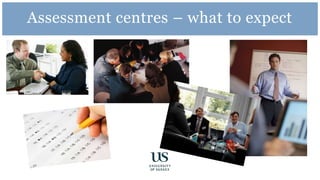
Assessment centres vary widely, but typically include:
• Selection Tests and exercises including ‘in’ or ‘e tray’ -
individually or in groups you will answer questions, solve
problems, make decisions
• Giving a presentation – address the audience, clearly
and confidently
• Group tasks, role play and case studies - get everyone
involved.
• An Interview - which may be in depth so prepare well.
• Social/informal events – also part of the selection
process
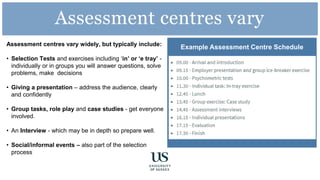
Example Assessment Centre Schedule
Assessment centres vary
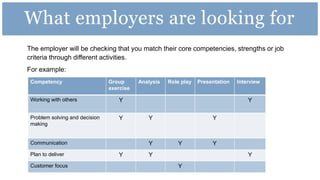
The employer will be checking that you match their core competencies, strengths or job
criteria through different activities.
For example:
What employers are looking for
Competency Group
exercise
Analysis Role play Presentation Interview
Working with others Y Y
Problem solving and decision
making
Y Y Y
Communication Y Y Y
Plan to deliver Y Y Y
Customer focus Y
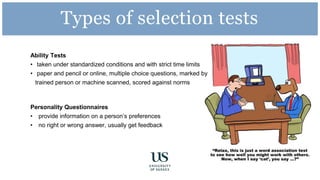
Ability Tests
• taken under standardized conditions and with strict time limits
• paper and pencil or online, multiple choice questions, marked by
trained person or machine scanned, scored against norms
Personality Questionnaires
• provide information on a person’s preferences
• no right or wrong answer, usually get feedback
Types of selection tests
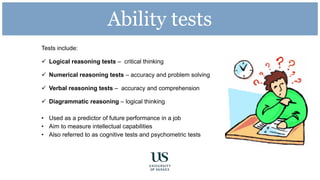
Ability tests
Tests include:
 Logical reasoning tests – critical thinking
 Numerical reasoning tests – accuracy and problem solving
 Verbal reasoning tests – accuracy and comprehension
 Diagrammatic reasoning – logical thinking
• Used as a predictor of future performance in a job
• Aim to measure intellectual capabilities
• Also referred to as cognitive tests and psychometric tests
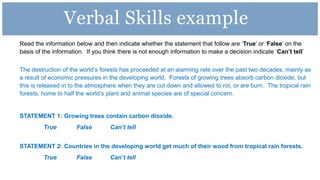
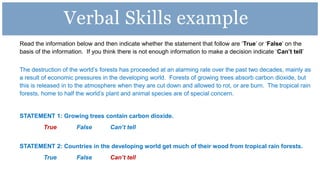
Read the information below and then indicate whether the statement that follow are ‘True’ or ‘False’ on the
basis of the information. If you think there is not enough information to make a decision indicate ‘Can’t tell’
The destruction of the world’s forests has proceeded at an alarming rate over the past two decades, mainly as
a result of economic pressures in the developing world. Forests of growing trees absorb carbon dioxide, but
this is released in to the atmosphere when they are cut down and allowed to rot, or are burn. The tropical rain
forests, home to half the world’s plant and animal species are of special concern.
STATEMENT 1: Growing trees contain carbon dioxide.
True False Can’t tell
STATEMENT 2: Countries in the developing world get much of their wood from tropical rain forests.
True False Can’t tell
Verbal Skills example
Read the information below and then indicate whether the statement that follow are ‘True’ or ‘False’ on the
basis of the information. If you think there is not enough information to make a decision indicate ‘Can’t tell’
The destruction of the world’s forests has proceeded at an alarming rate over the past two decades, mainly as
a result of economic pressures in the developing world. Forests of growing trees absorb carbon dioxide, but
this is released in to the atmosphere when they are cut down and allowed to rot, or are burn. The tropical rain
forests, home to half the world’s plant and animal species are of special concern.
STATEMENT 1: Growing trees contain carbon dioxide.
True False Can’t tell
STATEMENT 2: Countries in the developing world get much of their wood from tropical rain forests.
True False Can’t tell
Verbal Skills example
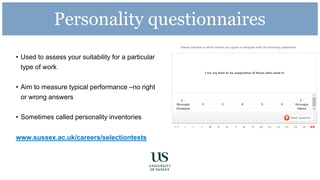
Personality questionnaires
• Used to assess your suitability for a particular
type of work
• Aim to measure typical performance –no right
or wrong answers
• Sometimes called personality inventories
www.sussex.ac.uk/careers/selectiontests
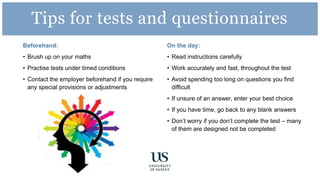
Beforehand:
• Brush up on your maths
• Practise tests under timed conditions
• Contact the employer beforehand if you require
any special provisions or adjustments
On the day:
• Read instructions carefully
• Work accurately and fast, throughout the test
• Avoid spending too long on questions you find
difficult
• If unsure of an answer, enter your best choice
• If you have time, go back to any blank answers
• Don’t worry if you don’t complete the test – many
of them are designed not be completed
Tips for tests and questionnaires
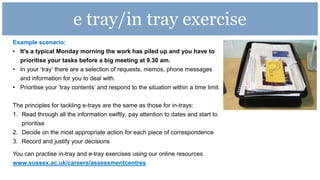
e tray/in tray exercise
Example scenario:
• It's a typical Monday morning the work has piled up and you have to
prioritise your tasks before a big meeting at 9.30 am.
• In your ‘tray’ there are a selection of requests, memos, phone messages
and information for you to deal with.
• Prioritise your ‘tray contents’ and respond to the situation within a time limit.
The principles for tackling e-trays are the same as those for in-trays:
1. Read through all the information swiftly, pay attention to dates and start to
prioritise
2. Decide on the most appropriate action for each piece of correspondence
3. Record and justify your decisions
You can practise in-tray and e-tray exercises using our online resources
www.sussex.ac.uk/careers/assessmentcentres
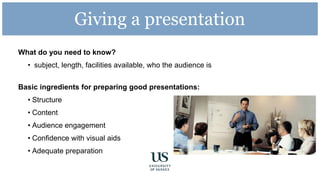
Giving a presentation
What do you need to know?
• subject, length, facilities available, who the audience is
Basic ingredients for preparing good presentations:
• Structure
• Content
• Audience engagement
• Confidence with visual aids
• Adequate preparation
Dealing with case studies
The scenario:
A publisher of scientific journals and books is looking to make a significant
acquisition. It has identified a target company and approached a number of
investment banks for their views on the merits of a potential deal and a target price.
Based on these presentations, the publisher will decide whether to proceed with a
bid and, if so, select one bank to act as their adviser.
The task:
Your team is one of the investment banks bidding to win the mandate. You need to
analyse the figures provided; to review the marketplace, your potential client (the
publisher) and the target company; and to prepare a five-minute presentation giving
your recommendations, eg whether to go ahead, go ahead under specific
conditions, etc.
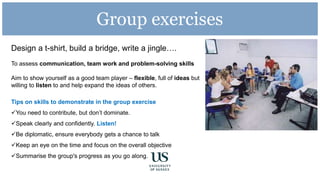
Group exercises
Design a t-shirt, build a bridge, write a jingle….
To assess communication, team work and problem-solving skills
Aim to show yourself as a good team player – flexible, full of ideas but
willing to listen to and help expand the ideas of others.
Tips on skills to demonstrate in the group exercise
You need to contribute, but don’t dominate.
Speak clearly and confidently. Listen!
Be diplomatic, ensure everybody gets a chance to talk
Keep an eye on the time and focus on the overall objective
Summarise the group's progress as you go along.
You’re going on a 1-week camping trip in the UK with shelter provided.
The campsite has no direct car access and is:
• 25 minutes walk from the road
• 40 minutes walk from a small village shop
On the next screen are some objects you can take with you.
You have 10 minutes to discuss this in groups, choose and agree on
which 5 objects you think are the most important to take with you.
A speaker from each group must then report back and explain concisely,
which 5 objects they chose and why.
Have a go!
What will you take?
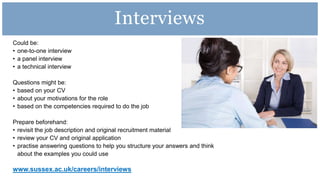
Could be:
• one-to-one interview
• a panel interview
• a technical interview
Questions might be:
• based on your CV
• about your motivations for the role
• based on the competencies required to do the job
Prepare beforehand:
• revisit the job description and original recruitment material
• review your CV and original application
• practise answering questions to help you structure your answers and think
about the examples you could use
www.sussex.ac.uk/careers/interviews
Interviews
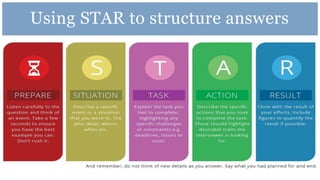
Using STAR to structure answers
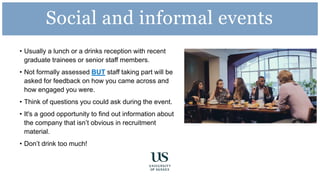
• Usually a lunch or a drinks reception with recent
graduate trainees or senior staff members.
• Not formally assessed BUT staff taking part will be
asked for feedback on how you came across and
how engaged you were.
• Think of questions you could ask during the event.
• It's a good opportunity to find out information about
the company that isn’t obvious in recruitment
material.
• Don’t drink too much!
Social and informal events
1. Call the recruitment team if anything is unclear or to
make any special arrangements.
2. Research the organisation and role
3. Research competitors, news and trends in the
business area
4. Reflect on your first interview – were there any areas
that caused you difficulty?
5. Practise tests and exercises
6. Practise answers to typical interview questions – check
the organisation’s competencies and job description for
clues
7. Plan your journey and read their instructions carefully
Preparation
1. Remember you are being observed from the moment you attend
the centre until you leave; be professional and engaged
throughout.
2. Show enthusiasm and interest for the role and organisation.
3. Try to ignore observers and keep in mind that they're assessing
you against criteria and not against other candidates.
4. Speak clearly in interviews, presentations and group activities and
maintain eye contact.
5. Try not to dominate discussions and think before you speak.
6. Dress as if you're attending a formal interview. Smart is key!
Top Tips – on the day
Getting help - online resources
• www.sussex.ac.uk/careers/assessmentcentres
• TARGETjobs - assessment centres
• Wikijob - assessment centre
• Graduate Prospects - assessment centres
• University of Kent - in-tray exercises
• In Tray Exercise - Free example with solutions
• https://targetjobs.co.uk/career-sectors/engineering/284839-what-types-
of-exercises-are-used-at-assessment-centres-for-engineering-
graduate-jobs - engineering assessment tests
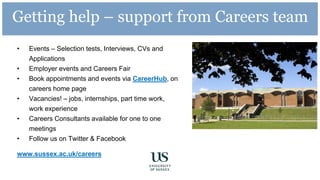
• Events – Selection tests, Interviews, CVs and
Applications
• Employer events and Careers Fair
• Book appointments and events via CareerHub, on
careers home page
• Vacancies! – jobs, internships, part time work,
work experience
• Careers Consultants available for one to one
meetings
• Follow us on Twitter & Facebook
www.sussex.ac.uk/careers
Getting help – support from Careers team

Surviving Assessment Centres

  • 1.
    Careers and EmployabilityCentre Surviving Assessment Centres
  • 2.
    Information about…… • Assessmentcentres – what to expect • How to deal with selection tests and tasks • How to prepare beforehand • Resources and getting support
  • 3.
    Assessment centres –what to expect
  • 4.
    Assessment centres varywidely, but typically include: • Selection Tests and exercises including ‘in’ or ‘e tray’ - individually or in groups you will answer questions, solve problems, make decisions • Giving a presentation – address the audience, clearly and confidently • Group tasks, role play and case studies - get everyone involved. • An Interview - which may be in depth so prepare well. • Social/informal events – also part of the selection process Example Assessment Centre Schedule Assessment centres vary
  • 5.
    The employer willbe checking that you match their core competencies, strengths or job criteria through different activities. For example: What employers are looking for Competency Group exercise Analysis Role play Presentation Interview Working with others Y Y Problem solving and decision making Y Y Y Communication Y Y Y Plan to deliver Y Y Y Customer focus Y
  • 6.
    Ability Tests • takenunder standardized conditions and with strict time limits • paper and pencil or online, multiple choice questions, marked by trained person or machine scanned, scored against norms Personality Questionnaires • provide information on a person’s preferences • no right or wrong answer, usually get feedback Types of selection tests
  • 7.
    Ability tests Tests include: Logical reasoning tests – critical thinking  Numerical reasoning tests – accuracy and problem solving  Verbal reasoning tests – accuracy and comprehension  Diagrammatic reasoning – logical thinking • Used as a predictor of future performance in a job • Aim to measure intellectual capabilities • Also referred to as cognitive tests and psychometric tests
  • 8.
    Read the informationbelow and then indicate whether the statement that follow are ‘True’ or ‘False’ on the basis of the information. If you think there is not enough information to make a decision indicate ‘Can’t tell’ The destruction of the world’s forests has proceeded at an alarming rate over the past two decades, mainly as a result of economic pressures in the developing world. Forests of growing trees absorb carbon dioxide, but this is released in to the atmosphere when they are cut down and allowed to rot, or are burn. The tropical rain forests, home to half the world’s plant and animal species are of special concern. STATEMENT 1: Growing trees contain carbon dioxide. True False Can’t tell STATEMENT 2: Countries in the developing world get much of their wood from tropical rain forests. True False Can’t tell Verbal Skills example
  • 9.
    Read the informationbelow and then indicate whether the statement that follow are ‘True’ or ‘False’ on the basis of the information. If you think there is not enough information to make a decision indicate ‘Can’t tell’ The destruction of the world’s forests has proceeded at an alarming rate over the past two decades, mainly as a result of economic pressures in the developing world. Forests of growing trees absorb carbon dioxide, but this is released in to the atmosphere when they are cut down and allowed to rot, or are burn. The tropical rain forests, home to half the world’s plant and animal species are of special concern. STATEMENT 1: Growing trees contain carbon dioxide. True False Can’t tell STATEMENT 2: Countries in the developing world get much of their wood from tropical rain forests. True False Can’t tell Verbal Skills example
  • 10.
    Personality questionnaires • Usedto assess your suitability for a particular type of work • Aim to measure typical performance –no right or wrong answers • Sometimes called personality inventories www.sussex.ac.uk/careers/selectiontests
  • 11.
    Beforehand: • Brush upon your maths • Practise tests under timed conditions • Contact the employer beforehand if you require any special provisions or adjustments On the day: • Read instructions carefully • Work accurately and fast, throughout the test • Avoid spending too long on questions you find difficult • If unsure of an answer, enter your best choice • If you have time, go back to any blank answers • Don’t worry if you don’t complete the test – many of them are designed not be completed Tips for tests and questionnaires
  • 12.
    e tray/in trayexercise Example scenario: • It's a typical Monday morning the work has piled up and you have to prioritise your tasks before a big meeting at 9.30 am. • In your ‘tray’ there are a selection of requests, memos, phone messages and information for you to deal with. • Prioritise your ‘tray contents’ and respond to the situation within a time limit. The principles for tackling e-trays are the same as those for in-trays: 1. Read through all the information swiftly, pay attention to dates and start to prioritise 2. Decide on the most appropriate action for each piece of correspondence 3. Record and justify your decisions You can practise in-tray and e-tray exercises using our online resources www.sussex.ac.uk/careers/assessmentcentres
  • 13.
    Giving a presentation Whatdo you need to know? • subject, length, facilities available, who the audience is Basic ingredients for preparing good presentations: • Structure • Content • Audience engagement • Confidence with visual aids • Adequate preparation
  • 14.
    Dealing with casestudies The scenario: A publisher of scientific journals and books is looking to make a significant acquisition. It has identified a target company and approached a number of investment banks for their views on the merits of a potential deal and a target price. Based on these presentations, the publisher will decide whether to proceed with a bid and, if so, select one bank to act as their adviser. The task: Your team is one of the investment banks bidding to win the mandate. You need to analyse the figures provided; to review the marketplace, your potential client (the publisher) and the target company; and to prepare a five-minute presentation giving your recommendations, eg whether to go ahead, go ahead under specific conditions, etc.
  • 15.
    Group exercises Design at-shirt, build a bridge, write a jingle…. To assess communication, team work and problem-solving skills Aim to show yourself as a good team player – flexible, full of ideas but willing to listen to and help expand the ideas of others. Tips on skills to demonstrate in the group exercise You need to contribute, but don’t dominate. Speak clearly and confidently. Listen! Be diplomatic, ensure everybody gets a chance to talk Keep an eye on the time and focus on the overall objective Summarise the group's progress as you go along.
  • 16.
    You’re going ona 1-week camping trip in the UK with shelter provided. The campsite has no direct car access and is: • 25 minutes walk from the road • 40 minutes walk from a small village shop On the next screen are some objects you can take with you. You have 10 minutes to discuss this in groups, choose and agree on which 5 objects you think are the most important to take with you. A speaker from each group must then report back and explain concisely, which 5 objects they chose and why. Have a go!
  • 17.
  • 18.
    Could be: • one-to-oneinterview • a panel interview • a technical interview Questions might be: • based on your CV • about your motivations for the role • based on the competencies required to do the job Prepare beforehand: • revisit the job description and original recruitment material • review your CV and original application • practise answering questions to help you structure your answers and think about the examples you could use www.sussex.ac.uk/careers/interviews Interviews
  • 19.
    Using STAR tostructure answers
  • 20.
    • Usually alunch or a drinks reception with recent graduate trainees or senior staff members. • Not formally assessed BUT staff taking part will be asked for feedback on how you came across and how engaged you were. • Think of questions you could ask during the event. • It's a good opportunity to find out information about the company that isn’t obvious in recruitment material. • Don’t drink too much! Social and informal events
  • 21.
    1. Call therecruitment team if anything is unclear or to make any special arrangements. 2. Research the organisation and role 3. Research competitors, news and trends in the business area 4. Reflect on your first interview – were there any areas that caused you difficulty? 5. Practise tests and exercises 6. Practise answers to typical interview questions – check the organisation’s competencies and job description for clues 7. Plan your journey and read their instructions carefully Preparation
  • 22.
    1. Remember youare being observed from the moment you attend the centre until you leave; be professional and engaged throughout. 2. Show enthusiasm and interest for the role and organisation. 3. Try to ignore observers and keep in mind that they're assessing you against criteria and not against other candidates. 4. Speak clearly in interviews, presentations and group activities and maintain eye contact. 5. Try not to dominate discussions and think before you speak. 6. Dress as if you're attending a formal interview. Smart is key! Top Tips – on the day
  • 23.
    Getting help -online resources • www.sussex.ac.uk/careers/assessmentcentres • TARGETjobs - assessment centres • Wikijob - assessment centre • Graduate Prospects - assessment centres • University of Kent - in-tray exercises • In Tray Exercise - Free example with solutions • https://targetjobs.co.uk/career-sectors/engineering/284839-what-types- of-exercises-are-used-at-assessment-centres-for-engineering- graduate-jobs - engineering assessment tests
  • 24.
    • Events –Selection tests, Interviews, CVs and Applications • Employer events and Careers Fair • Book appointments and events via CareerHub, on careers home page • Vacancies! – jobs, internships, part time work, work experience • Careers Consultants available for one to one meetings • Follow us on Twitter & Facebook www.sussex.ac.uk/careers Getting help – support from Careers team

Editor's Notes

  • #2 welcome and introductions
  • #4  ASK – what do you think you can expect? What might you be asked to do?
  • #5 . Social/informal events - A good chance for you to find out more about the employer, you should behave in a way that reflects well on you. Selection Tests and exercises including ‘in’ or ‘e tray’ - Working individually or in groups you will have to answer questions, solve problems, make  decisions and find information from different sources. Giving a presentation – Try to speak to your audience, don’t just read your notes, keep to the time limit, speak clearly and confidently. Group tasks, role play and case studies - Usually with six to eight people. Lead or chair a group, make sure you get everyone involved. An Interview - Which may be in depth so prepare well.
  • #8 time is the issue and lack of familiarity
  • #11 .be yourself - your best self
  • #13 Identify diary clashes
  • #14 Ask for this information if not given – could be part of the assessment Could be asked to prepare for this in advance or on the day. May have tech access (eg. powerpoint), flip chart or no visual back up etc….
  • #15 So, here’s an example case study How to approach the case study exercise on the day You need to be clear about what you’re being asked to do. Understand what the problem is, what your role is and what your objectives are. Start by reading through the information pack and assessing which parts of the information are relevant. Manage your time. Allow time to prepare for the final presentation at the end of the session, and be realistic about how much you can fit in to it. If you’re working in a small group you could divide up the tasks between you. You could nominate someone to assess any new information passed to the group during the course of the exercise. You could also nominate a note-keeper. Don’t dominate, but do contribute to discussions. Articulate what you’re thinking. Ask for more information.. Don’t lose sight of your objectives. The final presentation should be relevant, clear and concise, and should include a summary of your conclusions and recommendations
  • #22 The schedules and lengths of assessment days will vary widely