Applied Areas of
Psychology:
Educational
Psychology
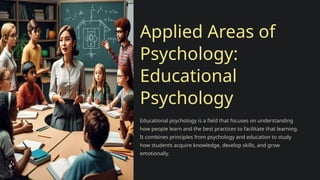
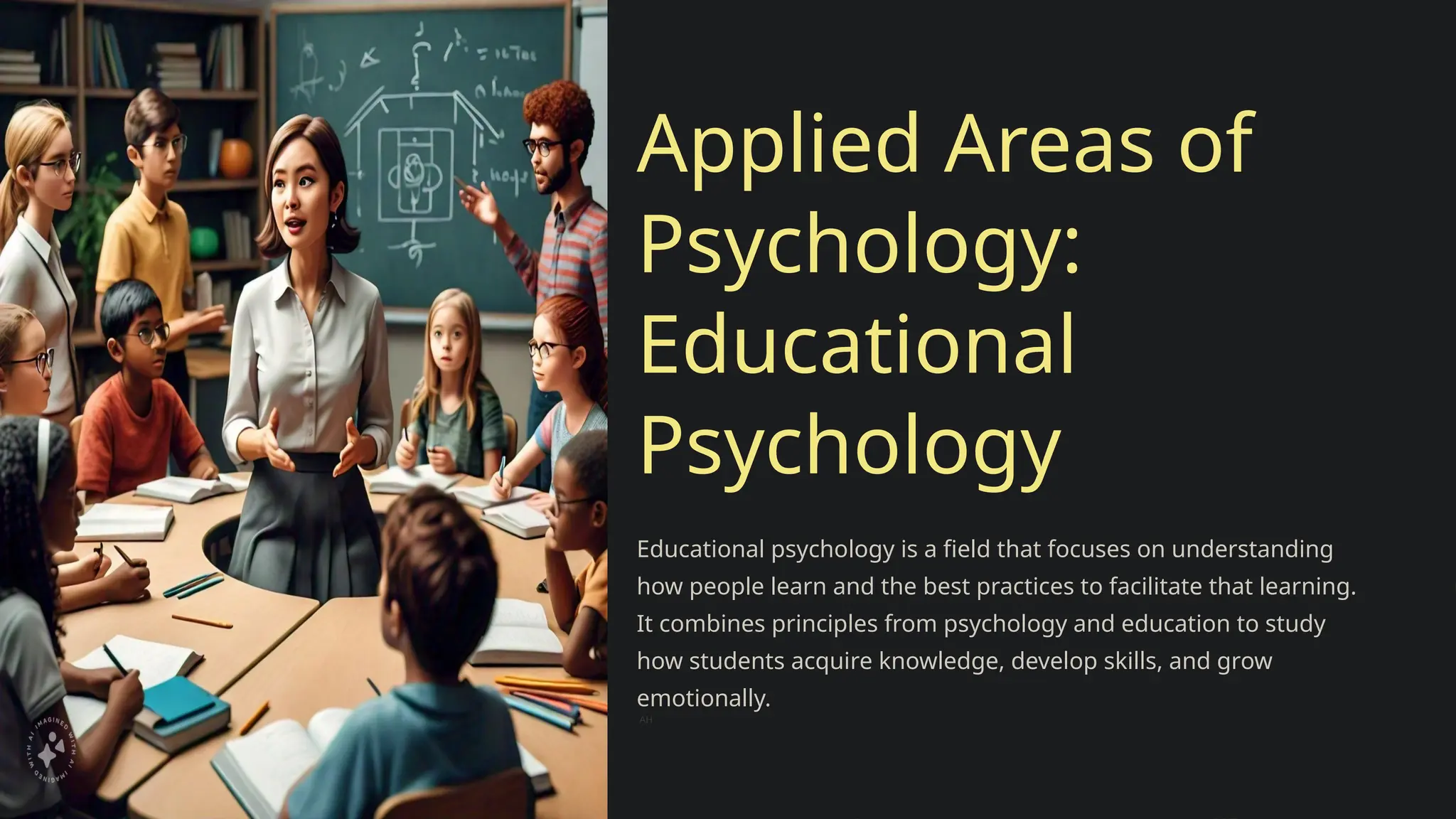
Educational psychology is a field that focuses on understanding
how people learn and the best practices to facilitate that learning.
It combines principles from psychology and education to study
how students acquire knowledge, develop skills, and grow
emotionally.
AH
Reason for Choosing Educational Psychology
1 Better Learning
Educational psychology helps find the best ways
to teach and help students do well.
2 Supports All Learners
It provides tools to meet different learning
needs and styles.
3 Increases Motivation
It helps make learning more interesting and
engaging for students.
4 Cares for Well-being
It focuses on students’ emotional and social needs.
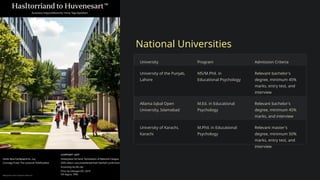
National Universities
University Program Admission Criteria
University of the Punjab,
Lahore
MS/M.Phil. in
Educational Psychology
Relevant bachelor's
degree, minimum 45%
marks, entry test, and
interview
Allama Iqbal Open
University, Islamabad
M.Ed. in Educational
Psychology
Relevant bachelor's
degree, minimum 45%
marks, and interview
University of Karachi,
Karachi
M.Phil. in Educational
Psychology
Relevant master's
degree, minimum 50%
marks, entry test, and
interview
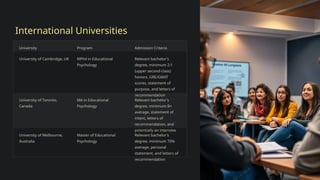
International Universities
University Program Admission Criteria
University of Cambridge, UK MPhil in Educational
Psychology
Relevant bachelor's
degree, minimum 2:1
(upper second-class)
honors, GRE/GMAT
scores, statement of
purpose, and letters of
recommendation
University of Toronto,
Canada
MA in Educational
Psychology
Relevant bachelor's
degree, minimum B+
average, statement of
intent, letters of
recommendation, and
potentially an interview
University of Melbourne,
Australia
Master of Educational
Psychology
Relevant bachelor's
degree, minimum 70%
average, personal
statement, and letters of
recommendation
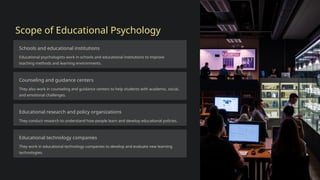
Scope of Educational Psychology
Schools and educational institutions
Educational psychologists work in schools and educational institutions to improve
teaching methods and learning environments.
Counseling and guidance centers
They also work in counseling and guidance centers to help students with academic, social,
and emotional challenges.
Educational research and policy organizations
They conduct research to understand how people learn and develop educational policies.
Educational technology companies
They work in educational technology companies to develop and evaluate new learning
technologies.
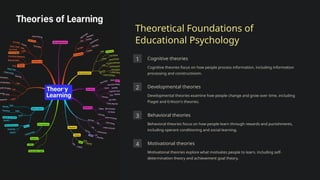
Theoretical Foundations of
Educational Psychology
1 Cognitive theories
Cognitive theories focus on how people process information, including information
processing and constructivism.
2 Developmental theories
Developmental theories examine how people change and grow over time, including
Piaget and Erikson's theories.
3 Behavioral theories
Behavioral theories focus on how people learn through rewards and punishments,
including operant conditioning and social learning.
4 Motivational theories
Motivational theories explore what motivates people to learn, including self-
determination theory and achievement goal theory.
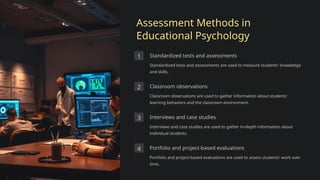
Assessment Methods in
Educational Psychology
1 Standardized tests and assessments
Standardized tests and assessments are used to measure students' knowledge
and skills.
2 Classroom observations
Classroom observations are used to gather information about students'
learning behaviors and the classroom environment.
3 Interviews and case studies
Interviews and case studies are used to gather in-depth information about
individual students.
4 Portfolio and project-based evaluations
Portfolio and project-based evaluations are used to assess students' work over
time.
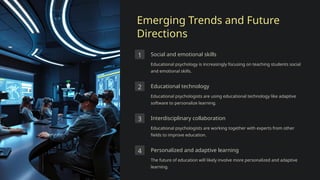
Emerging Trends and Future
Directions
1 Social and emotional skills
Educational psychology is increasingly focusing on teaching students social
and emotional skills.
2 Educational technology
Educational psychologists are using educational technology like adaptive
software to personalize learning.
3 Interdisciplinary collaboration
Educational psychologists are working together with experts from other
fields to improve education.
4 Personalized and adaptive learning
The future of education will likely involve more personalized and adaptive
learning.
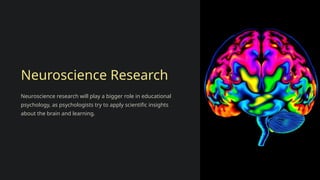
Neuroscience Research
Neuroscience research will play a bigger role in educational
psychology, as psychologists try to apply scientific insights
about the brain and learning.
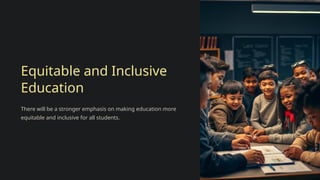
Equitable and Inclusive
Education
There will be a stronger emphasis on making education more
equitable and inclusive for all students.

Educational psychology and its overview.pptx

  • 1.
    Applied Areas of Psychology: Educational Psychology Educationalpsychology is a field that focuses on understanding how people learn and the best practices to facilitate that learning. It combines principles from psychology and education to study how students acquire knowledge, develop skills, and grow emotionally. AH
  • 2.
    Reason for ChoosingEducational Psychology 1 Better Learning Educational psychology helps find the best ways to teach and help students do well. 2 Supports All Learners It provides tools to meet different learning needs and styles. 3 Increases Motivation It helps make learning more interesting and engaging for students. 4 Cares for Well-being It focuses on students’ emotional and social needs.
  • 3.
    National Universities University ProgramAdmission Criteria University of the Punjab, Lahore MS/M.Phil. in Educational Psychology Relevant bachelor's degree, minimum 45% marks, entry test, and interview Allama Iqbal Open University, Islamabad M.Ed. in Educational Psychology Relevant bachelor's degree, minimum 45% marks, and interview University of Karachi, Karachi M.Phil. in Educational Psychology Relevant master's degree, minimum 50% marks, entry test, and interview
  • 4.
    International Universities University ProgramAdmission Criteria University of Cambridge, UK MPhil in Educational Psychology Relevant bachelor's degree, minimum 2:1 (upper second-class) honors, GRE/GMAT scores, statement of purpose, and letters of recommendation University of Toronto, Canada MA in Educational Psychology Relevant bachelor's degree, minimum B+ average, statement of intent, letters of recommendation, and potentially an interview University of Melbourne, Australia Master of Educational Psychology Relevant bachelor's degree, minimum 70% average, personal statement, and letters of recommendation
  • 5.
    Scope of EducationalPsychology Schools and educational institutions Educational psychologists work in schools and educational institutions to improve teaching methods and learning environments. Counseling and guidance centers They also work in counseling and guidance centers to help students with academic, social, and emotional challenges. Educational research and policy organizations They conduct research to understand how people learn and develop educational policies. Educational technology companies They work in educational technology companies to develop and evaluate new learning technologies.
  • 6.
    Theoretical Foundations of EducationalPsychology 1 Cognitive theories Cognitive theories focus on how people process information, including information processing and constructivism. 2 Developmental theories Developmental theories examine how people change and grow over time, including Piaget and Erikson's theories. 3 Behavioral theories Behavioral theories focus on how people learn through rewards and punishments, including operant conditioning and social learning. 4 Motivational theories Motivational theories explore what motivates people to learn, including self- determination theory and achievement goal theory.
  • 7.
    Assessment Methods in EducationalPsychology 1 Standardized tests and assessments Standardized tests and assessments are used to measure students' knowledge and skills. 2 Classroom observations Classroom observations are used to gather information about students' learning behaviors and the classroom environment. 3 Interviews and case studies Interviews and case studies are used to gather in-depth information about individual students. 4 Portfolio and project-based evaluations Portfolio and project-based evaluations are used to assess students' work over time.
  • 8.
    Emerging Trends andFuture Directions 1 Social and emotional skills Educational psychology is increasingly focusing on teaching students social and emotional skills. 2 Educational technology Educational psychologists are using educational technology like adaptive software to personalize learning. 3 Interdisciplinary collaboration Educational psychologists are working together with experts from other fields to improve education. 4 Personalized and adaptive learning The future of education will likely involve more personalized and adaptive learning.
  • 9.
    Neuroscience Research Neuroscience researchwill play a bigger role in educational psychology, as psychologists try to apply scientific insights about the brain and learning.
  • 10.
    Equitable and Inclusive Education Therewill be a stronger emphasis on making education more equitable and inclusive for all students.