PRESENTED BY:-
Rupinder Kaur Bajwa
Pathankot College of Education,
Pathankot
EDUCATIONAL PSYCHOLOGY FOR
TEACHING AND LEARNING
2
EDUCATIONAL PSYCHOLOGY FOR
TEACHING AND LEARNING
3
Psychology
 The word Psychology was used for first time used
in 1590 by Rudolf Geockle.
 First Stage: Psychology was defined as the “study
of the soul”
 Second Stage: It was again defined as the “study
of the mind”
 Third Stage: Again it was defined by William
James (1890) as the “Study of Consciousness”
 Fourth Stage: “Study of total Behaviour”
(consciousness and unconsciousness)
 Action , Reaction and Interaction is called
behaviour
4
 It is scientific because it is systematic study of
observable events/behavior and behavior is
unlearned process where in include reflexes,
physiological process and instincts and it is learned
behavior also because all behavior acquire through
practice.
 It is a study of human behaviour and human
relationships.
 Today Psychology is scientific method of collecting
data about individual and groups to analyze and
predict their behavior.
Psychology
5
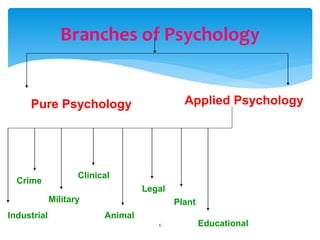
Branches of Psychology
Pure Psychology Applied Psychology
Industrial
Crime
Military
Clinical
Animal
Legal
Plant
Educational6
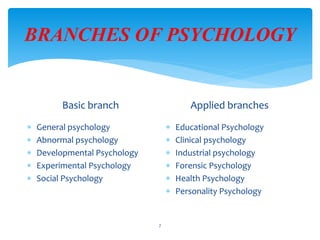
BRANCHES OF PSYCHOLOGY
Basic branch
 General psychology
 Abnormal psychology
 Developmental Psychology
 Experimental Psychology
 Social Psychology
Applied branches
 Educational Psychology
 Clinical psychology
 Industrial psychology
 Forensic Psychology
 Health Psychology
 Personality Psychology
7
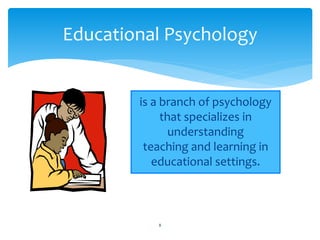
Educational Psychology
is a branch of psychology
that specializes in
understanding
teaching and learning in
educational settings.
8
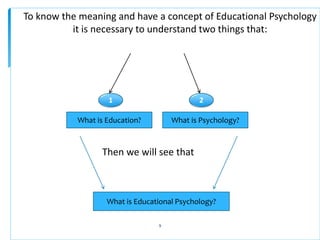
To know the meaning and have a concept of Educational Psychology
it is necessary to understand two things that:
Then we will see that
What is Education? What is Psychology?
What is Educational Psychology?
1 2
9
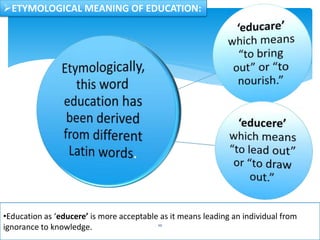
ETYMOLOGICAL MEANING OF EDUCATION:
•Education as ‘educere’ is more acceptable as it means leading an individual from
ignorance to knowledge. 10
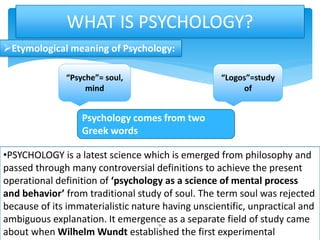
Etymological meaning of Psychology:
WHAT IS PSYCHOLOGY?
“Psyche”= soul,
mind
“Logos”=study
of
Psychology comes from two
Greek words
•PSYCHOLOGY is a latest science which is emerged from philosophy and
passed through many controversial definitions to achieve the present
operational definition of ‘psychology as a science of mental process
and behavior’ from traditional study of soul. The term soul was rejected
because of its immaterialistic nature having unscientific, unpractical and
ambiguous explanation. It emergence as a separate field of study came
about when Wilhelm Wundt established the first experimental
11
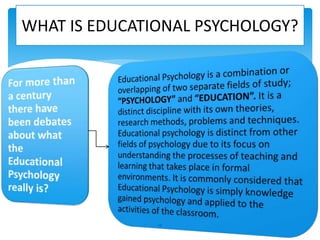
WHAT IS EDUCATIONAL PSYCHOLOGY?
12
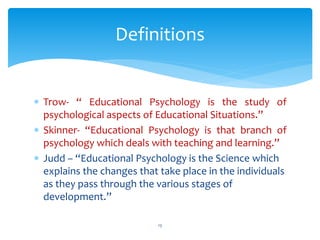
 Trow- “ Educational Psychology is the study of
psychological aspects of Educational Situations.”
 Skinner- “Educational Psychology is that branch of
psychology which deals with teaching and learning.”
 Judd – “Educational Psychology is the Science which
explains the changes that take place in the individuals
as they pass through the various stages of
development.”
13
Definitions
 Educational psychology is one of the branches of
applies psychology concerned with the application of
the principles, techniques and other resources of
psychology to the solution of the problems
confronting the teacher attempting to direct the
growth of children toward defined objectives.
14
15
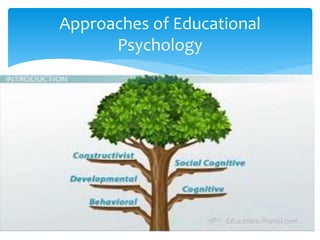
Approaches of Educational
Psychology
16
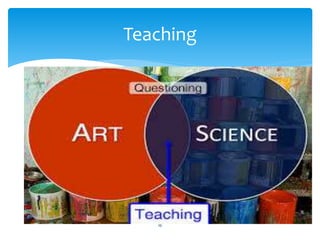
Teaching
Teaching as Art & Science
 Teaching is both art and science.
 Good teaching is partly an art and partly a science
 Teaching as an art
 Way of relating, creative Persuasive
 Teaching as a science
 Observing, Diagnosing, Designing, Tracking, Evaluating
17
Reflection & Observation ?
Reflection:
 What were the
characteristics of the
most effective teachers in
your educational
experience?
application of educational psychology in the
teaching and learning
19
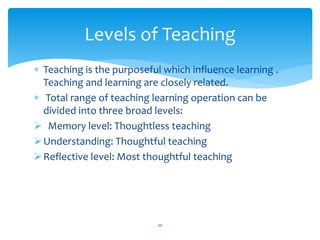
 Teaching is the purposeful which influence learning .
Teaching and learning are closely related.
 Total range of teaching learning operation can be
divided into three broad levels:
 Memory level: Thoughtless teaching
Understanding: Thoughtful teaching
Reflective level: Most thoughtful teaching
20
Levels of Teaching
21
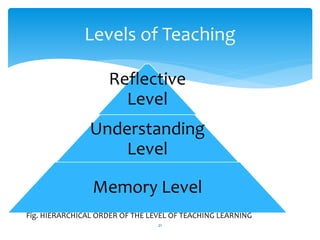
Levels of Teaching
Reflective
Level
Understanding
Level
Memory Level
Fig. HIERARCHICAL ORDER OF THE LEVEL OF TEACHING LEARNING
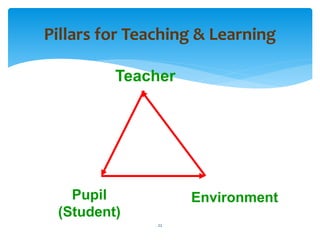
Pillars for Teaching & Learning
Teacher
Pupil
(Student)
Environment
22
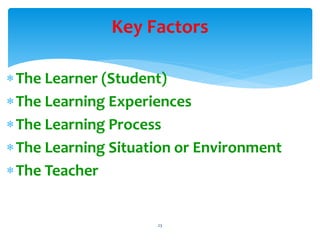
Key Factors
The Learner (Student)
The Learning Experiences
The Learning Process
The Learning Situation or Environment
The Teacher
23
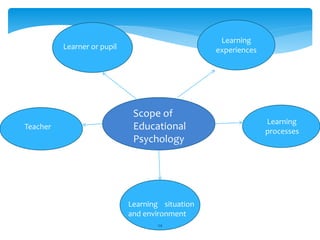
Scope of
Educational
Psychology
Learning
experiencesLearner or pupil
Teacher
Learning situation
and environment
Learning
processes
24
The subject matter of education psychology, if it is at all necessary to draw its boundaries,
revolves round these pivots mentioned above.
Learner: The total subject matter of educational psychology primarily revolves
around this factor-learner. This subject of the subject acquaints us with the need of
knowing the learner and deals with the learner and deals with the techniques of
knowing him well.
Learning experiences: This is the second area of educational psychology and though
the subject does not directly connect itself with the problem of what to teach or
what learning experiences to provide the learner, it has the responsibility of
suggesting the techniques on acquiring learning experiences. Educational
psychology helps in deciding the kinds of learning experiences desirable at different
stages of growth and development of the learner so that these experiences can be
acquired with a greater ease and satisfaction. In this area, education psychology
has the subject matter which facilitates the selection of the desirable experiences
for the learner.
25
Learning processes: After knowing the learner and deciding on the types of
learning experiences that are to be provided , the next problem arises when
helping learner properly acquires these experiences with ease and convenience.
Therefore around this pivot, educational psychology deals with the nature of
learning and how it takes place and comprises topics such as laws, principles and
theories of learning, remembering and forgetting perceiving , Concept formation,
thinking and reasoning process, problem solving, transfer of training, ways and
means of effective learning and so on.
Learning situation or environment: Under this topic , educational psychology
focuses on the environmental factors and learning situations which come between
the learner and the teacher.
Teacher: Last but not the least is the teacher. It emphasize the need of knowing the
self for a teacher to play his role properly in the process of education. It discusses
he conflicts motivation, anxiety, adjustment level of aspiration etc. Moreover it
throws light on the essential personality traits, interest, aptitudes, characteristics of
effective teaching etc. so as to inspire him to become a successful teacher.
26
27
How will learning about educational
psychology help you be a better teacher?
Teaching is a complex enterprise
Educational psychology provides information about a wide
range of knowledge and skills
Research that informs teachers
Educational psychology offers useful and tested ideas for
improving instruction
Coursework and competence
Educational psychology helps prepare teachers
to be effective
28
 Knowledge of theories and research findings on the psychology of teachers‘
learning may be meaningful and important for students in teacher
education
 Psychology of teachers‘ learning may improve the good quality of their
teaching practice.
 Knowledge of the psychology of teachers' learning may improve the good
quality of the ability of faculty to teach educational psychology more
effectively in teacher preparation programs
 To suggest art and techniques of learning as well as teaching
 Solving classroom problems
 To know the learner
Importance in Teacher Education
29
Educational Psychology with regard to
Teaching & Learning
 To Know the learner
 Growth and development of the child and his requirements at different
levels
 To select and organize the subject-matter or learning experiences
 When to teach, how to teach and what to teach the child
 Educational psychology is concerned with how students feel, interact,
learn, develop and behave often focusing on subgroups such as those
subject to specific disabilities.
 It involves the application to education of psychological theories,
research and techniques, with the aim of establishing a body of
knowledge about the psychological and educational development of
children within the context of home, school and society
 To suggest art and techniques of learning as well as teaching
 To arrange learning situation or environment
 To study mental health of students30
 To acquaint him with the mechanism of heredity and
environment
 Helping in maintaining discipline
 Rendering guidance services
 Helping in evaluation and assessment
 Solving classroom problems
 Knowing about himself
 Motivation for Teaching and Learning
 Knowledge about group study and group behaviour
 All round development personality
 Educational psychology helps the teacher to study the ability,
interests, intelligence, needs and adopt different techniques
of teaching for effective communication.
31
 Whom to teach? (childs abilities, aptitude,interest)
 Who is to teach? (teacher understand himself)
 What to teach? (subject matter, experiences
according to stages of development)
 How to teach? (methods, techniques)
 When to teach? (motivational aspect)
Summarisation Educational
Psychology
32
Limitation of Education Psychology
 New and complex Science
 Problem of individual differences
 Complexity of Psychological
phenomena
 Difficulty in applying Laboratory
finding
33
 Use the Suggestions for Teaching from each chapter
to gather ideas
 Try the Suggestions out in your teaching
 Use the Journal Entries from each chapter to help
guide observation notes of yourself and your
students
 Analyze the observation notes for strengths and
weaknesses
 After each teaching episode, think about and/or write
down an assessment of how you did
Ways to become a Reflective
Teacher
34
 Psychology
 Branches of Psychology
 Educational Psychology
 Teaching as Art & Science
 Levels of Teaching
 Key Factors
 Importance in Teacher Education
 Educational Psychology with regard to Teaching &
Learning
 Limitation of Education Psychology
35
OVERVIEW
We never end what we wants to end
… … …
It begins with inclusion of
something New
36
 Aggarwal J. C. (2005) Essentials of Educational
Psychology. Vikas Publishing House Pvt. Ltd.,New
Delhi.
 Chauhan. S. S. (2008) “Advanced Educational
Psychology” Vikas publicity House Pvt.Ltd.
 Mangal S. K. (2009) “An Introduction to Psychology.
Prakash Brothers, Ludhiana
 Mathur, S. S. (1996) Educational Psychology. Vinod
Pustak Mandir, Agra.
 Oladele, J. O. (1998). Fundamentals of Educational
Psychology.Yaba: Johns-Lad Publishers Ltd.
References
37
THANK YOU
38

Educational psychology concept

  • 2.
    PRESENTED BY:- Rupinder KaurBajwa Pathankot College of Education, Pathankot EDUCATIONAL PSYCHOLOGY FOR TEACHING AND LEARNING 2
  • 3.
  • 4.
    Psychology  The wordPsychology was used for first time used in 1590 by Rudolf Geockle.  First Stage: Psychology was defined as the “study of the soul”  Second Stage: It was again defined as the “study of the mind”  Third Stage: Again it was defined by William James (1890) as the “Study of Consciousness”  Fourth Stage: “Study of total Behaviour” (consciousness and unconsciousness)  Action , Reaction and Interaction is called behaviour 4
  • 5.
     It isscientific because it is systematic study of observable events/behavior and behavior is unlearned process where in include reflexes, physiological process and instincts and it is learned behavior also because all behavior acquire through practice.  It is a study of human behaviour and human relationships.  Today Psychology is scientific method of collecting data about individual and groups to analyze and predict their behavior. Psychology 5
  • 6.
    Branches of Psychology PurePsychology Applied Psychology Industrial Crime Military Clinical Animal Legal Plant Educational6
  • 7.
    BRANCHES OF PSYCHOLOGY Basicbranch  General psychology  Abnormal psychology  Developmental Psychology  Experimental Psychology  Social Psychology Applied branches  Educational Psychology  Clinical psychology  Industrial psychology  Forensic Psychology  Health Psychology  Personality Psychology 7
  • 8.
    Educational Psychology is abranch of psychology that specializes in understanding teaching and learning in educational settings. 8
  • 9.
    To know themeaning and have a concept of Educational Psychology it is necessary to understand two things that: Then we will see that What is Education? What is Psychology? What is Educational Psychology? 1 2 9
  • 10.
    ETYMOLOGICAL MEANING OFEDUCATION: •Education as ‘educere’ is more acceptable as it means leading an individual from ignorance to knowledge. 10
  • 11.
    Etymological meaning ofPsychology: WHAT IS PSYCHOLOGY? “Psyche”= soul, mind “Logos”=study of Psychology comes from two Greek words •PSYCHOLOGY is a latest science which is emerged from philosophy and passed through many controversial definitions to achieve the present operational definition of ‘psychology as a science of mental process and behavior’ from traditional study of soul. The term soul was rejected because of its immaterialistic nature having unscientific, unpractical and ambiguous explanation. It emergence as a separate field of study came about when Wilhelm Wundt established the first experimental 11
  • 12.
    WHAT IS EDUCATIONALPSYCHOLOGY? 12
  • 13.
     Trow- “Educational Psychology is the study of psychological aspects of Educational Situations.”  Skinner- “Educational Psychology is that branch of psychology which deals with teaching and learning.”  Judd – “Educational Psychology is the Science which explains the changes that take place in the individuals as they pass through the various stages of development.” 13 Definitions
  • 14.
     Educational psychologyis one of the branches of applies psychology concerned with the application of the principles, techniques and other resources of psychology to the solution of the problems confronting the teacher attempting to direct the growth of children toward defined objectives. 14
  • 15.
  • 16.
  • 17.
    Teaching as Art& Science  Teaching is both art and science.  Good teaching is partly an art and partly a science  Teaching as an art  Way of relating, creative Persuasive  Teaching as a science  Observing, Diagnosing, Designing, Tracking, Evaluating 17
  • 18.
    Reflection & Observation? Reflection:  What were the characteristics of the most effective teachers in your educational experience?
  • 19.
    application of educationalpsychology in the teaching and learning 19
  • 20.
     Teaching isthe purposeful which influence learning . Teaching and learning are closely related.  Total range of teaching learning operation can be divided into three broad levels:  Memory level: Thoughtless teaching Understanding: Thoughtful teaching Reflective level: Most thoughtful teaching 20 Levels of Teaching
  • 21.
    21 Levels of Teaching Reflective Level Understanding Level MemoryLevel Fig. HIERARCHICAL ORDER OF THE LEVEL OF TEACHING LEARNING
  • 22.
    Pillars for Teaching& Learning Teacher Pupil (Student) Environment 22
  • 23.
    Key Factors The Learner(Student) The Learning Experiences The Learning Process The Learning Situation or Environment The Teacher 23
  • 24.
    Scope of Educational Psychology Learning experiencesLearner orpupil Teacher Learning situation and environment Learning processes 24
  • 25.
    The subject matterof education psychology, if it is at all necessary to draw its boundaries, revolves round these pivots mentioned above. Learner: The total subject matter of educational psychology primarily revolves around this factor-learner. This subject of the subject acquaints us with the need of knowing the learner and deals with the learner and deals with the techniques of knowing him well. Learning experiences: This is the second area of educational psychology and though the subject does not directly connect itself with the problem of what to teach or what learning experiences to provide the learner, it has the responsibility of suggesting the techniques on acquiring learning experiences. Educational psychology helps in deciding the kinds of learning experiences desirable at different stages of growth and development of the learner so that these experiences can be acquired with a greater ease and satisfaction. In this area, education psychology has the subject matter which facilitates the selection of the desirable experiences for the learner. 25
  • 26.
    Learning processes: Afterknowing the learner and deciding on the types of learning experiences that are to be provided , the next problem arises when helping learner properly acquires these experiences with ease and convenience. Therefore around this pivot, educational psychology deals with the nature of learning and how it takes place and comprises topics such as laws, principles and theories of learning, remembering and forgetting perceiving , Concept formation, thinking and reasoning process, problem solving, transfer of training, ways and means of effective learning and so on. Learning situation or environment: Under this topic , educational psychology focuses on the environmental factors and learning situations which come between the learner and the teacher. Teacher: Last but not the least is the teacher. It emphasize the need of knowing the self for a teacher to play his role properly in the process of education. It discusses he conflicts motivation, anxiety, adjustment level of aspiration etc. Moreover it throws light on the essential personality traits, interest, aptitudes, characteristics of effective teaching etc. so as to inspire him to become a successful teacher. 26
  • 27.
  • 28.
    How will learningabout educational psychology help you be a better teacher? Teaching is a complex enterprise Educational psychology provides information about a wide range of knowledge and skills Research that informs teachers Educational psychology offers useful and tested ideas for improving instruction Coursework and competence Educational psychology helps prepare teachers to be effective 28
  • 29.
     Knowledge oftheories and research findings on the psychology of teachers‘ learning may be meaningful and important for students in teacher education  Psychology of teachers‘ learning may improve the good quality of their teaching practice.  Knowledge of the psychology of teachers' learning may improve the good quality of the ability of faculty to teach educational psychology more effectively in teacher preparation programs  To suggest art and techniques of learning as well as teaching  Solving classroom problems  To know the learner Importance in Teacher Education 29
  • 30.
    Educational Psychology withregard to Teaching & Learning  To Know the learner  Growth and development of the child and his requirements at different levels  To select and organize the subject-matter or learning experiences  When to teach, how to teach and what to teach the child  Educational psychology is concerned with how students feel, interact, learn, develop and behave often focusing on subgroups such as those subject to specific disabilities.  It involves the application to education of psychological theories, research and techniques, with the aim of establishing a body of knowledge about the psychological and educational development of children within the context of home, school and society  To suggest art and techniques of learning as well as teaching  To arrange learning situation or environment  To study mental health of students30

  • 31.
     To acquainthim with the mechanism of heredity and environment  Helping in maintaining discipline  Rendering guidance services  Helping in evaluation and assessment  Solving classroom problems  Knowing about himself  Motivation for Teaching and Learning  Knowledge about group study and group behaviour  All round development personality  Educational psychology helps the teacher to study the ability, interests, intelligence, needs and adopt different techniques of teaching for effective communication. 31
  • 32.
     Whom toteach? (childs abilities, aptitude,interest)  Who is to teach? (teacher understand himself)  What to teach? (subject matter, experiences according to stages of development)  How to teach? (methods, techniques)  When to teach? (motivational aspect) Summarisation Educational Psychology 32
  • 33.
    Limitation of EducationPsychology  New and complex Science  Problem of individual differences  Complexity of Psychological phenomena  Difficulty in applying Laboratory finding 33
  • 34.
     Use theSuggestions for Teaching from each chapter to gather ideas  Try the Suggestions out in your teaching  Use the Journal Entries from each chapter to help guide observation notes of yourself and your students  Analyze the observation notes for strengths and weaknesses  After each teaching episode, think about and/or write down an assessment of how you did Ways to become a Reflective Teacher 34
  • 35.
     Psychology  Branchesof Psychology  Educational Psychology  Teaching as Art & Science  Levels of Teaching  Key Factors  Importance in Teacher Education  Educational Psychology with regard to Teaching & Learning  Limitation of Education Psychology 35 OVERVIEW
  • 36.
    We never endwhat we wants to end … … … It begins with inclusion of something New 36
  • 37.
     Aggarwal J.C. (2005) Essentials of Educational Psychology. Vikas Publishing House Pvt. Ltd.,New Delhi.  Chauhan. S. S. (2008) “Advanced Educational Psychology” Vikas publicity House Pvt.Ltd.  Mangal S. K. (2009) “An Introduction to Psychology. Prakash Brothers, Ludhiana  Mathur, S. S. (1996) Educational Psychology. Vinod Pustak Mandir, Agra.  Oladele, J. O. (1998). Fundamentals of Educational Psychology.Yaba: Johns-Lad Publishers Ltd. References 37
  • 38.