
Careers and Employability Centre
How to write about
yourself
We’re experts about ourselves. So, why do we
find it so difficult to write about ourselves?
• It’s very different from any other writing that you do
• It can seem selfish, boasting and self promotional
• You’re not sure who you’re really writing for
• It’s difficult for everyone
BUT it gets easier with practise
Reflection and writing about yourself:
• is big part of job applications and professional work
roles, so it’s good to start practising now
• helps you develop your skills, identifying what you
might want to develop further etc
Why is it so difficult?
• What employers / academic admissions
officers are looking for
• The process of reflection
• Identifying experiences to highlight your
skills
• Using positive language to create a good
impression
• Writing about your own experiences – have
a go!
Today we’ll cover…
Research the job advertisement, company website,
course description, university website etc for specific
information.
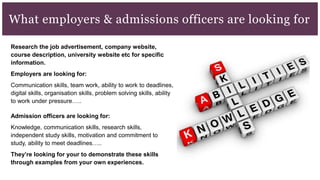
Employers are looking for:
Communication skills, team work, ability to work to deadlines,
digital skills, organisation skills, problem solving skills, ability
to work under pressure…..
Admission officers are looking for:
Knowledge, communication skills, research skills,
independent study skills, motivation and commitment to
study, ability to meet deadlines…..
They’re looking for your to demonstrate these skills
through examples from your own experiences.
What employers & admissions officers are looking for
• Through reflection on your experiences in
education, work, volunteering, societies,
hobbies etc.
• Through online skills assessment tools.
• Through talking with people you know you
well.
Identifying your skills
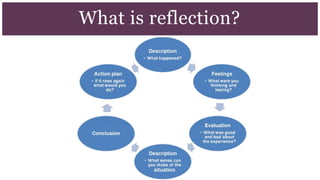
What is reflection?
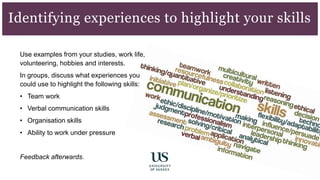
Use examples from your studies, work life,
volunteering, hobbies and interests.
In groups, discuss what experiences you
could use to highlight the following skills:
• Team work
• Verbal communication skills
• Organisation skills
• Ability to work under pressure
Feedback afterwards.
Identifying experiences to highlight your skills
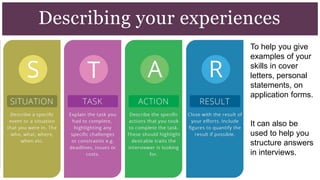
Describing your experiences
To help you give
examples of your
skills in cover
letters, personal
statements, on
application forms.
It can also be
used to help you
structure answers
in interviews.
1. Remember that you’re not alone. Everyone with a job or
in post-secondary education has had to self-promote in
some way. It’s not fun or easy, but it’s necessary. The
reward is delayed, but receiving that acceptance letter will
make the brief torture worthwhile.
2. Treat it like something you’re familiar with; an
assignment, an essay, etc.
3. Forget the pressure you’re under and just start
writing. Try a free writing exercise to get you going.
4. Let someone take a red pen to it. Get a different
perspective and feedback on what you’ve written.
Tips for moving forward…
1. Plan and allocate time in your schedule.
2. Research the job role / course requirements.
3. What are they looking for? (skills, qualities, experience etc)
4. What examples could you use to highlight how you match their requirements?
5. What positive words could you incorporate?
6. How could you structure your cover letter / personal
statement / application form answer?
• See examples to help with this.
• Do you like to use mind maps?
• Do you like to break it down in to questions?
7. Write a first draft.
8. Ask for feedback.
9. Write your second draft…….
Getting started - treat it like an assignment
Resources to help you
Cover letter structure, advice & examples:
• www.sussex.ac.uk/careers/applyingforjobs/coveringletters
• www.prospects.ac.uk/careers-advice/cvs-and-cover-letters/cover-letters
Postgrad personal statement structure & advice:
• www.sussex.ac.uk/careers/aboutus/taughtpostgrads
• www.prospects.ac.uk/postgraduate-study/masters-degrees/personal-statements-for-postgraduate-
applications
Application form advice:
• www.sussex.ac.uk/careers/applyingforjobs/applications
• www.prospects.ac.uk/careers-advice/applying-for-jobs/write-a-successful-job-application
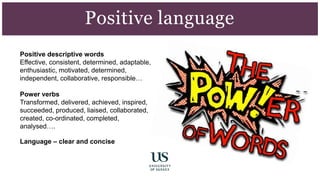
Positive descriptive words
Effective, consistent, determined, adaptable,
enthusiastic, motivated, determined,
independent, collaborative, responsible…
Power verbs
Transformed, delivered, achieved, inspired,
succeeded, produced, liaised, collaborated,
created, co-ordinated, completed,
analysed….
Language – clear and concise
Positive language
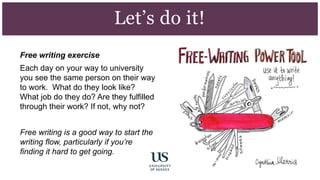
Free writing exercise
Each day on your way to university
you see the same person on their way
to work. What do they look like?
What job do they do? Are they fulfilled
through their work? If not, why not?
Free writing is a good way to start the
writing flow, particularly if you’re
finding it hard to get going.
Let’s do it!
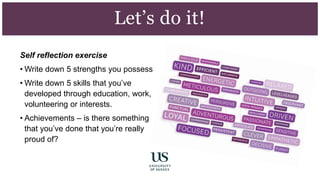
Self reflection exercise
• Write down 5 strengths you possess
• Write down 5 skills that you’ve
developed through education, work,
volunteering or interests.
• Achievements – is there something
that you’ve done that you’re really
proud of?
Let’s do it!
Let’s do it!
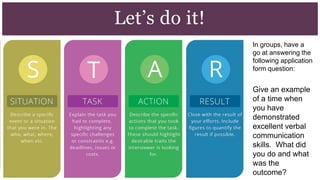
In groups, have a
go at answering the
following application
form question:
Give an example
of a time when
you have
demonstrated
excellent verbal
communication
skills. What did
you do and what
was the
outcome?
Any questions

How to Write About Yourself

  • 1.
    Careers and EmployabilityCentre How to write about yourself
  • 2.
    We’re experts aboutourselves. So, why do we find it so difficult to write about ourselves? • It’s very different from any other writing that you do • It can seem selfish, boasting and self promotional • You’re not sure who you’re really writing for • It’s difficult for everyone BUT it gets easier with practise Reflection and writing about yourself: • is big part of job applications and professional work roles, so it’s good to start practising now • helps you develop your skills, identifying what you might want to develop further etc Why is it so difficult?
  • 3.
    • What employers/ academic admissions officers are looking for • The process of reflection • Identifying experiences to highlight your skills • Using positive language to create a good impression • Writing about your own experiences – have a go! Today we’ll cover…
  • 4.
    Research the jobadvertisement, company website, course description, university website etc for specific information. Employers are looking for: Communication skills, team work, ability to work to deadlines, digital skills, organisation skills, problem solving skills, ability to work under pressure….. Admission officers are looking for: Knowledge, communication skills, research skills, independent study skills, motivation and commitment to study, ability to meet deadlines….. They’re looking for your to demonstrate these skills through examples from your own experiences. What employers & admissions officers are looking for
  • 5.
    • Through reflectionon your experiences in education, work, volunteering, societies, hobbies etc. • Through online skills assessment tools. • Through talking with people you know you well. Identifying your skills
  • 6.
  • 7.
    Use examples fromyour studies, work life, volunteering, hobbies and interests. In groups, discuss what experiences you could use to highlight the following skills: • Team work • Verbal communication skills • Organisation skills • Ability to work under pressure Feedback afterwards. Identifying experiences to highlight your skills
  • 8.
    Describing your experiences Tohelp you give examples of your skills in cover letters, personal statements, on application forms. It can also be used to help you structure answers in interviews.
  • 9.
    1. Remember thatyou’re not alone. Everyone with a job or in post-secondary education has had to self-promote in some way. It’s not fun or easy, but it’s necessary. The reward is delayed, but receiving that acceptance letter will make the brief torture worthwhile. 2. Treat it like something you’re familiar with; an assignment, an essay, etc. 3. Forget the pressure you’re under and just start writing. Try a free writing exercise to get you going. 4. Let someone take a red pen to it. Get a different perspective and feedback on what you’ve written. Tips for moving forward…
  • 10.
    1. Plan andallocate time in your schedule. 2. Research the job role / course requirements. 3. What are they looking for? (skills, qualities, experience etc) 4. What examples could you use to highlight how you match their requirements? 5. What positive words could you incorporate? 6. How could you structure your cover letter / personal statement / application form answer? • See examples to help with this. • Do you like to use mind maps? • Do you like to break it down in to questions? 7. Write a first draft. 8. Ask for feedback. 9. Write your second draft……. Getting started - treat it like an assignment
  • 11.
    Resources to helpyou Cover letter structure, advice & examples: • www.sussex.ac.uk/careers/applyingforjobs/coveringletters • www.prospects.ac.uk/careers-advice/cvs-and-cover-letters/cover-letters Postgrad personal statement structure & advice: • www.sussex.ac.uk/careers/aboutus/taughtpostgrads • www.prospects.ac.uk/postgraduate-study/masters-degrees/personal-statements-for-postgraduate- applications Application form advice: • www.sussex.ac.uk/careers/applyingforjobs/applications • www.prospects.ac.uk/careers-advice/applying-for-jobs/write-a-successful-job-application
  • 12.
    Positive descriptive words Effective,consistent, determined, adaptable, enthusiastic, motivated, determined, independent, collaborative, responsible… Power verbs Transformed, delivered, achieved, inspired, succeeded, produced, liaised, collaborated, created, co-ordinated, completed, analysed…. Language – clear and concise Positive language
  • 13.
    Free writing exercise Eachday on your way to university you see the same person on their way to work. What do they look like? What job do they do? Are they fulfilled through their work? If not, why not? Free writing is a good way to start the writing flow, particularly if you’re finding it hard to get going. Let’s do it!
  • 14.
    Self reflection exercise •Write down 5 strengths you possess • Write down 5 skills that you’ve developed through education, work, volunteering or interests. • Achievements – is there something that you’ve done that you’re really proud of? Let’s do it!
  • 15.
    Let’s do it! Ingroups, have a go at answering the following application form question: Give an example of a time when you have demonstrated excellent verbal communication skills. What did you do and what was the outcome?
  • 16.