
Career Success for
Masters Students
• Where do masters graduates go?
• Career options after your masters
• Pathway 1 – Further study
• Pathway 2 – Employment in the UK
• Pathway 3 – International options
• Making applications
• Marketing your masters
• Enhancing your skills and experience now
• Support & advice
Agenda
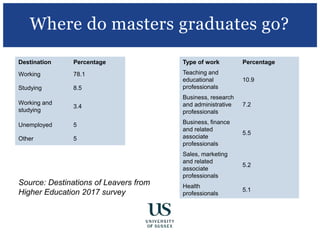
Where do masters graduates go?
Destination Percentage
Working 78.1
Studying 8.5
Working and
studying
3.4
Unemployed 5
Other 5
Type of work Percentage
Teaching and
educational
professionals
10.9
Business, research
and administrative
professionals
7.2
Business, finance
and related
associate
professionals
5.5
Sales, marketing
and related
associate
professionals
5.2
Health
professionals
5.1
Source: Destinations of Leavers from
Higher Education 2017 survey
Career Options
After Your Masters
• Think about your interests and motivations
• Complete some career planning
questionnaires
• How could you use your qualifications
• Investigate LinkedIn
I have no idea where to start…
• Ensure you have solid reasons for undertaking further study such as you
need to gain essential qualifications required for your career, you want to
specialise in your subject area and/or you want to progress in your
existing field.
• Various different courses can be undertaken after your masters degree,
usually through different modes of study. Courses may be available on a
full-time, part-time or distance learning basis.
• View the different options for further study.
• Most common route is PhD where you need to consider carefully the area
of research, supervisor and funding options available.
Pathway 1 – Further Study
• Masters graduates are often applying for
the same positions as new graduates
• Masters degrees can be a prerequisite
for certain jobs so do check
• Use our sector guides
• Consider graduate schemes and
graduate jobs
• International students – consider visa
options, list of registered sponsors and
have a back-up plan.
Pathway 2 – Employment in the UK
• International vacancies
• GoinGlobal
• GradLink
• Country specific information
Pathway 3 – International Options
Making
Applications
You need to be able to articulate the benefits of your masters course.
Evidencing the skills gained:
• Communication skills (written): produced a high quality dissertation or project, effectively summarised
relevant research and arguments.
• Communication skills (oral): delivered presentations or explained complex terminology/ideas to peers.
• Research methods: searched journal databases, designed appropriate experimental or survey methods,
selected appropriate methods for analysis.
• Critical and analytical thinking: interpreted and drew conclusions from various data.
• Planning and organisation: completed a dissertation/project which required a realistic plan of action.
• Team work: worked in a group and took responsibility contributing to team success.
• Advanced IT skills: developed familiarity with specific research software packages over the course of the
masters.
Marketing your masters
Gained deeper understanding and knowledge of a subject. You will
have:
• Up to date knowledge
• Knowledge of sources of information
• Knowledge of key people working in the field
• Knowledge of current thinking about techniques relevant to the field
• You may have gained experience of:
• Group projects
• Writing reports or extended essays
• A dissertation or extensive piece of independent research
• Work related or professional experience
Marketing your masters
Enhancing your skills and experience now
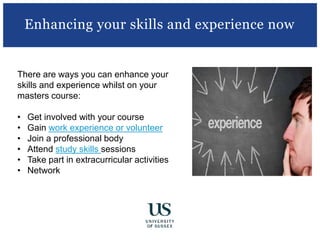
There are ways you can enhance your
skills and experience whilst on your
masters course:
• Get involved with your course
• Gain work experience or volunteer
• Join a professional body
• Attend study skills sessions
• Take part in extracurricular activities
• Network
• Masters careers web page
• Applying for jobs resources
• Look at vacancies on CareerHub
• Attend events and workshops
• Book 1 to 1 appointments via CareerHub
Support & Advice
Questions?

Career Success for Masters Students

  • 1.
  • 2.
    • Where domasters graduates go? • Career options after your masters • Pathway 1 – Further study • Pathway 2 – Employment in the UK • Pathway 3 – International options • Making applications • Marketing your masters • Enhancing your skills and experience now • Support & advice Agenda
  • 3.
    Where do mastersgraduates go? Destination Percentage Working 78.1 Studying 8.5 Working and studying 3.4 Unemployed 5 Other 5 Type of work Percentage Teaching and educational professionals 10.9 Business, research and administrative professionals 7.2 Business, finance and related associate professionals 5.5 Sales, marketing and related associate professionals 5.2 Health professionals 5.1 Source: Destinations of Leavers from Higher Education 2017 survey
  • 4.
  • 5.
    • Think aboutyour interests and motivations • Complete some career planning questionnaires • How could you use your qualifications • Investigate LinkedIn I have no idea where to start…
  • 6.
    • Ensure youhave solid reasons for undertaking further study such as you need to gain essential qualifications required for your career, you want to specialise in your subject area and/or you want to progress in your existing field. • Various different courses can be undertaken after your masters degree, usually through different modes of study. Courses may be available on a full-time, part-time or distance learning basis. • View the different options for further study. • Most common route is PhD where you need to consider carefully the area of research, supervisor and funding options available. Pathway 1 – Further Study
  • 7.
    • Masters graduatesare often applying for the same positions as new graduates • Masters degrees can be a prerequisite for certain jobs so do check • Use our sector guides • Consider graduate schemes and graduate jobs • International students – consider visa options, list of registered sponsors and have a back-up plan. Pathway 2 – Employment in the UK
  • 8.
    • International vacancies •GoinGlobal • GradLink • Country specific information Pathway 3 – International Options
  • 9.
  • 10.
    You need tobe able to articulate the benefits of your masters course. Evidencing the skills gained: • Communication skills (written): produced a high quality dissertation or project, effectively summarised relevant research and arguments. • Communication skills (oral): delivered presentations or explained complex terminology/ideas to peers. • Research methods: searched journal databases, designed appropriate experimental or survey methods, selected appropriate methods for analysis. • Critical and analytical thinking: interpreted and drew conclusions from various data. • Planning and organisation: completed a dissertation/project which required a realistic plan of action. • Team work: worked in a group and took responsibility contributing to team success. • Advanced IT skills: developed familiarity with specific research software packages over the course of the masters. Marketing your masters
  • 11.
    Gained deeper understandingand knowledge of a subject. You will have: • Up to date knowledge • Knowledge of sources of information • Knowledge of key people working in the field • Knowledge of current thinking about techniques relevant to the field • You may have gained experience of: • Group projects • Writing reports or extended essays • A dissertation or extensive piece of independent research • Work related or professional experience Marketing your masters
  • 12.
    Enhancing your skillsand experience now There are ways you can enhance your skills and experience whilst on your masters course: • Get involved with your course • Gain work experience or volunteer • Join a professional body • Attend study skills sessions • Take part in extracurricular activities • Network
  • 13.
    • Masters careersweb page • Applying for jobs resources • Look at vacancies on CareerHub • Attend events and workshops • Book 1 to 1 appointments via CareerHub Support & Advice
  • 14.

Editor's Notes

  • #4 Destinations of Leavers from Higher Education 2017 survey, 90% of the 42,275 Masters leavers in 2015/16 were in work or further study six months after graduation. Of those who were in a job in the UK, 87% were doing a professional or managerial job. In 2017, some common jobs held by recent Masters graduates were: education professionals, such as secondary and higher education teachers business, human resources (HR) and finance professionals, particularly management consultants and financial analysts health professionals, such as nurses and social workers
  • #6 If you do not know where to start a good place would be to think about your interests and motivations. It can help you to formulate ideas about different job roles that could suit you and the sectors or organisations that you might like to work in. You could complete some career planning questionnaires such as prospects career planner and/or profiling for success on our website. They match your skills and personality to more than 400 job profiles and provide you with recommendations on jobs and sectors that could interest you. It is worth exploring both your masters and undergraduate degree qualifications and where they can take you. Our page allows you to see the skills you have gained from your qualifications, common career paths and where previous students have gone before. LinkedIn is a business and employment oriented social networking service. It is used for professional networking, linking to alumni and finding employment. You can make use of the search function to get an idea about the career paths of people with similar qualifications to you and to identify potential employers in your field. Use hyperlinks to link to our website and Linked In
  • #7 It is important to have a solid reason for undertaking further study as this will be asked at interview. You might decide to undertake further study because: you need to gain an essential qualification required for your chosen career; you want to enhance your skills and knowledge and specialise in your subject area; you want to progress in your existing role/field. Emphasise further study options can have different modes of study. Different options for further study links to Target Postgrad site. Scroll down to find the following: PgCert/PgDip: a vocational postgraduate certificate or diploma such as the PGCE (Postgraduate Certificate in Education) or GDL (Graduate Diploma in Law) can be an entry point into relevant professions. MBA: an MBA (Masters of Business Administration) provides grounding in all aspects of business management. An MBA may be useful for management roles and/or consulting. MRes/MPhil: a Masters of/by Research (MRes) or a Masters of Philosophy (MPhil) can include taught elements but focuses on research methods. It could help to improve your research skills and pursue a research topic in which you are interested in preparation for a research-based role or a PhD. PhD/DPhil: a doctorate (PhD/DPhil) involves intense research for at least three years full time or six years part time. A PhD is necessary for many academic careers and scientific research careers. Professional doctorates: professional doctoral programmes with a taught core element are available in some vocational areas, such as engineering (EngD), education (EdD) and business (DBA). These tend to be designed for experienced practitioners seeking to enhance their professional skills and profile. New route PhD: these PhD programmes include formal training which can include research skills and transferable skills such as leadership and enterprise. Most take at least four years to complete. Most common route is PhD. We have lots of information on our website (show link) around researching positions, funding and how to apply.
  • #8 It is important to note that in the UK employers welcome applications from masters graduates and new graduates for the same roles. There are only a few employers who have specific postgraduate roles so do check before applying. Use our sector guides to find out more about the industries you are interested in. Find case studies, sector profiles, training routes, information about finding jobs, what skills you need to develop and news and resources. Consider both graduate schemes and graduate jobs. Graduate schemes are generally run by large organisations. They offer the opportunity to experience various aspects of an organisation, often through rotational placements in different departments. They are highly competitive and account for under 10% of graduate jobs. Graduate schemes are well-promoted via the major graduate jobsites such as Milkround, Prospects, TARGETjobs etc. Graduate jobs tend to be for smaller organisations and generally you will need to submit an application form or cv/cover letter to apply. We list multiple graduate job site resources on our website. If you are an international student it is important to understand the visa and sponsorship options available after your course has ended. The most common route is a Tier 2 visa. To obtain a Tier 2 (general) visa you must have been offered a graduate level job with an employer who is a registered sponsor and who is therefore able to offer you a Certificate of Sponsorship. Once you find a position you are interested in applying for, check they are on the list of registered sponsors. Do read our dedicated pages for all of the visa options available. It is also always wise to pursue a back-up plan at the same time in your home country or internationally.
  • #9 International vacancies – we have various job vacancies and graduate schemes on our website GoinGlobal – provides constantly updated careers advice for more than 90 locations along with job search and employer directories. It provides information such as: employment outlook/industry trends local job search resources work permit and visa regulations interview and cultural advice cv guidelines and examples GradLink – for international students who have or are studying in the UK. Includes sections for China, South-East Asia, the Gulf, Canada, Africa, India and Bangladesh. The site allows you to: Search and apply for jobs Build a CV Research the graduate job market in your chosen country Country specific information – have useful links on our website to various countries
  • #11 Whether you choose employment or further study it is important that you are able to articulate the benefits of your masters course including the skills, knowledge and experience you have gained. It will often be up to you to articulate the difference that your masters course has made to prospective employers. First benefit is the skills gained, for example: - Communication skills (written): produced a high quality dissertation or project, effectively summarised relevant research and arguments. - Communication skills (oral): delivered presentations or explained complex terminology/ideas to peers. - Research methods: searched journal databases, designed appropriate experimental or survey methods, selected appropriate methods for analysis. - Critical and analytical thinking: interpreted and drew conclusions from various data. - Planning and organisation: completed a dissertation/project which required a realistic plan of action. - Team work: worked in a group and took responsibility contributing to team success. - Advanced IT skills: developed familiarity with specific research software packages over the course of the masters.
  • #12 Knowledge – masters graduates are likely to be able to conceptualise and think about the range of a topic, pose questions and formulate answers. You will be experienced in finding relevant subject specific information quickly using a range of sources. Experience – masters courses vary in style as well as subject so another benefit may be that you have gained experience in group projects etc.
  • #13 You can continue to enhance your skills and experience whilst on your masters course. You could: Get involved with your course – particularly if you want to go onto further study. You could help to organise a conference, run tutorials or help conduct lab demonstrations. You might be a rep for your course or help out at open days. Gain work experience – you may consider a part-time job, volunteering or other work experience opportunities. They are a great way to find out about different sectors, which working environments suit you and the kind of role you’d prefer. Postgraduate taught students with a Tier 4 visa are permitted to work full-time hours during the official Christmas vacation (16 December 2017 - 7 January 2018) and Easter vacation (24 March - 8 April 2018) and when their course officially ends (normally the end date on your CAS - 30 September in most cases). Your visa will usually state that you can work up to 20 hours part-time during term time but do check your individual circumstances. Join a professional body - Professional bodies are a great sources of news, sector trends and specialist careers advice. They often also have their qualifications that you can undertake, showing commitment to your personal and professional development. Professional bodies also often run events locally, nationally and internationally, providing networking opportunities. Study Skills - There are dedicated study skills pages for both taught postgraduate students and international students. These resources provide advice and links to resources to help you with your studies at Sussex. Extracurricular activities – can you play an active role on a student society? how are you pursuing your hobbies or interests whilst here? Network – with everyone from supervisors to tutors to peers. You may also make industry connections through conferences or events.