
Educational objectives and
levels of taxonomy
General objective
At the end of this session each participant will be able to identify,
analyze, determine and differentiate between types of educational
objective.
Specific objectives
By the end of this lecture the student will be able to :-
•Define the educational objectives.
•Define the educational goals
•Identify how to write a learning objective
•Identify the benefits of educational objectives.
•List the characteristics of educational objective
•Recognize the categories of educational objectives “domains”.
•Discuss blooms taxonomy
•List some verbs
•Illustrate blooms taxonomy action verbs graph
Differentiate between goals and
objectives. Objectives and goals
are terms that are sometimes used
interchangeably, but there is a
distinct difference between
educational objectives and
educational goals
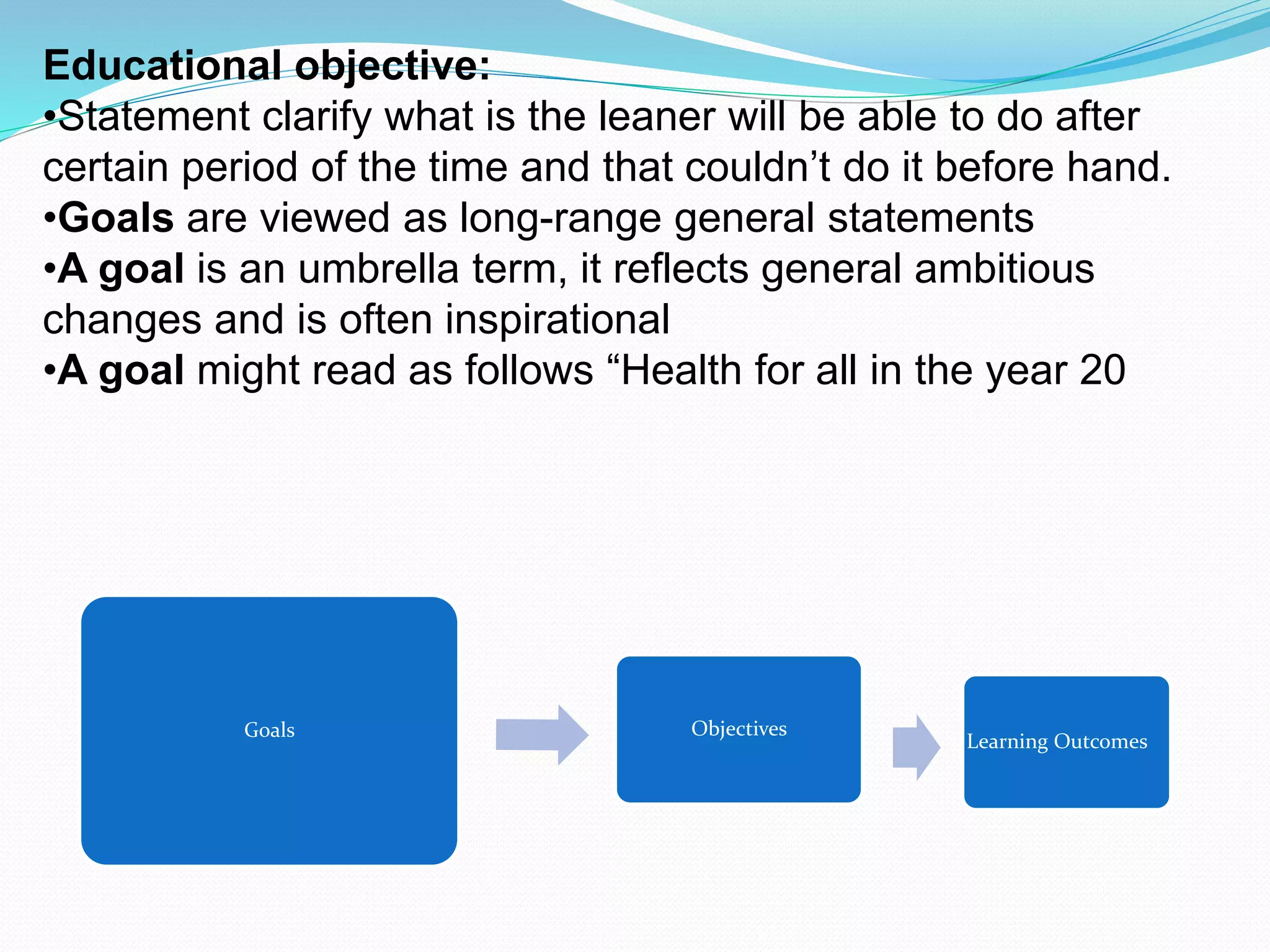
Educational objective:
•Statement clarify what is the leaner will be able to do after
certain period of the time and that couldn’t do it before hand.
•Goals are viewed as long-range general statements
•A goal is an umbrella term, it reflects general ambitious
changes and is often inspirational
•A goal might read as follows “Health for all in the year 20
Goals Objectives
Learning Outcomes
How to write learning objectives:
Learning Objectives emphasize:
1. students’ performance
2. The end product
3.What students learned?
Learning Objectives do not emphasize:
•teacher performance
•the subject matter
•how knowledge was acquired
In order to ensure clear and measurable Learning Objectives, one
must focus on:
•Performance: Describe what is to be learned in with outcome of
performance in mind.
•Norm: Describe clearly what outcome is expected and what level of
accuracy is expected in order for the learning to be judged adequate.
•Settings: Describe the specific circumstances under which the learner is
supposed to perform and what tools are to be used
The benefits of educational objectives
1. For Teacher:
i. Help in selecting of instructional material, content and
methods.
ii. Help in evaluating or assessment success of
instruction.
iii. Enable teacher to described intended result of her
instruction.
iv. Provide basis for improving worse of existing
instruction.
2- For Learner:
•Know exactly what they are going to learn and study.
•Help them in planning and evaluation their progress.
 Each domain is classified into “3” levels, learner
goes from simple to complex action.
(1)Cognitive Domain:
Known as cognitive area that focus on information and
deal with knowledge.
E.g. define educational objective
(2) Psychomotor Domain
Refer to physical doing, psychomotor behaviors are easy to
observe, describe and measure.
E.g. performpelvicexamination
(3) Affective Domains:
Refer to emotional feeling an objectives are concerned with
attitude and all other emotion.
E.g. obtain comprehensive history in a sensitive and
friendly manner
•Elements of Educational Objectives
(1) Act
Is expressed by an active verb describing the intent of the
task aimed at.
(2) Content
Specifies the subject in relation to which the act is to be
performed (answer of act).
(3) Condition
Is the description of resources available for carrying out
the act (date, equipment)
(4) Criteria
The definition of acceptable level of performance expected
from students describing.
Characteristics of Educational objective
Objectives must be :-SMARTER
 Specific not general but related to task at hand
 Measurable can be evaluated
 Appropriate for the course and cognitive level of
the learner
 Realistic can be achieved
 Time bound
 Ethically
 Recorded
How can you tell if your educational
objectives are being reached?
About half of your students are passing
tests and quizzes.
Students tell you they enjoy your class.
None of your students are struggling
on tests and quizzes
Student surveys on your course come
back positive.
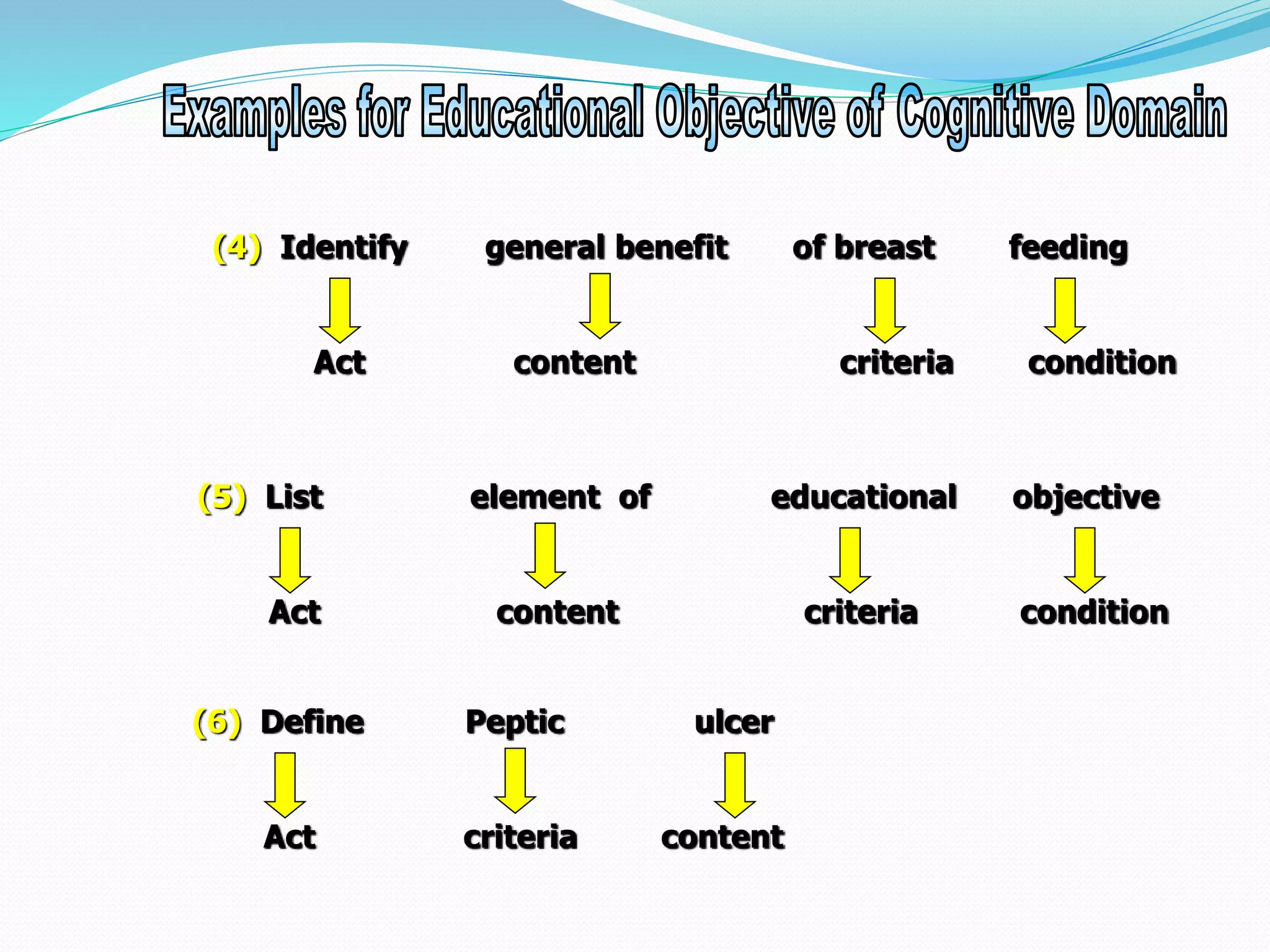
(4) Identify general benefit of breast feeding
Act content criteria condition
(5) List element of educational objective
Act content criteria condition
(6) Define Peptic ulcer
Act criteria content
(1) Define educational objective
Act Criteria content
(2) Identify two types of diabetes mellitus
Act Criteria content condition
(3) Mention the main sign and symptoms of DM
Act Criteria content condition
(1) Obtain comprehensive history in a sensitive and friendly manner.
Obtain Act
History content
Comprehensive
Criteria
A sensitive and friendly manner Condition
(2) Counsel pts about sexual risk reduction (using non judgmental language)
both verbal and non verbal
Act Counsel
Content Reduction
Criteria
Condition
Sexual
risk
Patient
(1) Perform pelvic examination
Act Criteria Content
(2) Administer oral medication to an infant
Act Criteria Content Condition
(3) Demonstrate insulin injection sub cut anensly
Act Criteria Content Condition
(4) Demonstrate breast self examination
Act Criteria Condition Content
(5) Move the shoulder joint through R.O.M
Act Criteria Content Condition
References
Billings, D.M.; Halstead, J.A. (2009): Teaching in
nursing a guide for faculty. 3rded., Saunders
Goleman, D. (1995). Emotional intelligence. New
York: Bantam Books.
Greene, J. (2002). High school graduation rates in
the United States (Rev.). Washington, DC: Black
Alliance for Educational Options. Retrieved
December 2002, from http://www.manhattan-
institute.org/html/cr_baeo.htm#03
Hummel, J., &Huitt, W. (1994, February). What you
measure is what you get. GaASCD Newsletter: The
Reporter, 10-11. Retrieved May 2003, from
Educational objectives

Educational objectives

  • 1.
  • 2.
    General objective At theend of this session each participant will be able to identify, analyze, determine and differentiate between types of educational objective. Specific objectives By the end of this lecture the student will be able to :- •Define the educational objectives. •Define the educational goals •Identify how to write a learning objective •Identify the benefits of educational objectives. •List the characteristics of educational objective •Recognize the categories of educational objectives “domains”. •Discuss blooms taxonomy •List some verbs •Illustrate blooms taxonomy action verbs graph
  • 4.
    Differentiate between goalsand objectives. Objectives and goals are terms that are sometimes used interchangeably, but there is a distinct difference between educational objectives and educational goals
  • 5.
    Educational objective: •Statement clarifywhat is the leaner will be able to do after certain period of the time and that couldn’t do it before hand. •Goals are viewed as long-range general statements •A goal is an umbrella term, it reflects general ambitious changes and is often inspirational •A goal might read as follows “Health for all in the year 20 Goals Objectives Learning Outcomes
  • 7.
    How to writelearning objectives: Learning Objectives emphasize: 1. students’ performance 2. The end product 3.What students learned? Learning Objectives do not emphasize: •teacher performance •the subject matter •how knowledge was acquired In order to ensure clear and measurable Learning Objectives, one must focus on: •Performance: Describe what is to be learned in with outcome of performance in mind. •Norm: Describe clearly what outcome is expected and what level of accuracy is expected in order for the learning to be judged adequate. •Settings: Describe the specific circumstances under which the learner is supposed to perform and what tools are to be used
  • 8.
    The benefits ofeducational objectives 1. For Teacher: i. Help in selecting of instructional material, content and methods. ii. Help in evaluating or assessment success of instruction. iii. Enable teacher to described intended result of her instruction. iv. Provide basis for improving worse of existing instruction. 2- For Learner: •Know exactly what they are going to learn and study. •Help them in planning and evaluation their progress.
  • 9.
     Each domainis classified into “3” levels, learner goes from simple to complex action. (1)Cognitive Domain: Known as cognitive area that focus on information and deal with knowledge. E.g. define educational objective (2) Psychomotor Domain Refer to physical doing, psychomotor behaviors are easy to observe, describe and measure. E.g. performpelvicexamination (3) Affective Domains: Refer to emotional feeling an objectives are concerned with attitude and all other emotion. E.g. obtain comprehensive history in a sensitive and friendly manner
  • 10.
    •Elements of EducationalObjectives (1) Act Is expressed by an active verb describing the intent of the task aimed at. (2) Content Specifies the subject in relation to which the act is to be performed (answer of act). (3) Condition Is the description of resources available for carrying out the act (date, equipment) (4) Criteria The definition of acceptable level of performance expected from students describing.
  • 11.
    Characteristics of Educationalobjective Objectives must be :-SMARTER  Specific not general but related to task at hand  Measurable can be evaluated  Appropriate for the course and cognitive level of the learner  Realistic can be achieved  Time bound  Ethically  Recorded
  • 12.
    How can youtell if your educational objectives are being reached? About half of your students are passing tests and quizzes. Students tell you they enjoy your class. None of your students are struggling on tests and quizzes Student surveys on your course come back positive.
  • 18.
    (4) Identify generalbenefit of breast feeding Act content criteria condition (5) List element of educational objective Act content criteria condition (6) Define Peptic ulcer Act criteria content
  • 19.
    (1) Define educationalobjective Act Criteria content (2) Identify two types of diabetes mellitus Act Criteria content condition (3) Mention the main sign and symptoms of DM Act Criteria content condition
  • 20.
    (1) Obtain comprehensivehistory in a sensitive and friendly manner. Obtain Act History content Comprehensive Criteria A sensitive and friendly manner Condition (2) Counsel pts about sexual risk reduction (using non judgmental language) both verbal and non verbal Act Counsel Content Reduction Criteria Condition Sexual risk Patient
  • 21.
    (1) Perform pelvicexamination Act Criteria Content (2) Administer oral medication to an infant Act Criteria Content Condition (3) Demonstrate insulin injection sub cut anensly Act Criteria Content Condition (4) Demonstrate breast self examination Act Criteria Condition Content (5) Move the shoulder joint through R.O.M Act Criteria Content Condition
  • 22.
    References Billings, D.M.; Halstead,J.A. (2009): Teaching in nursing a guide for faculty. 3rded., Saunders Goleman, D. (1995). Emotional intelligence. New York: Bantam Books. Greene, J. (2002). High school graduation rates in the United States (Rev.). Washington, DC: Black Alliance for Educational Options. Retrieved December 2002, from http://www.manhattan- institute.org/html/cr_baeo.htm#03 Hummel, J., &Huitt, W. (1994, February). What you measure is what you get. GaASCD Newsletter: The Reporter, 10-11. Retrieved May 2003, from